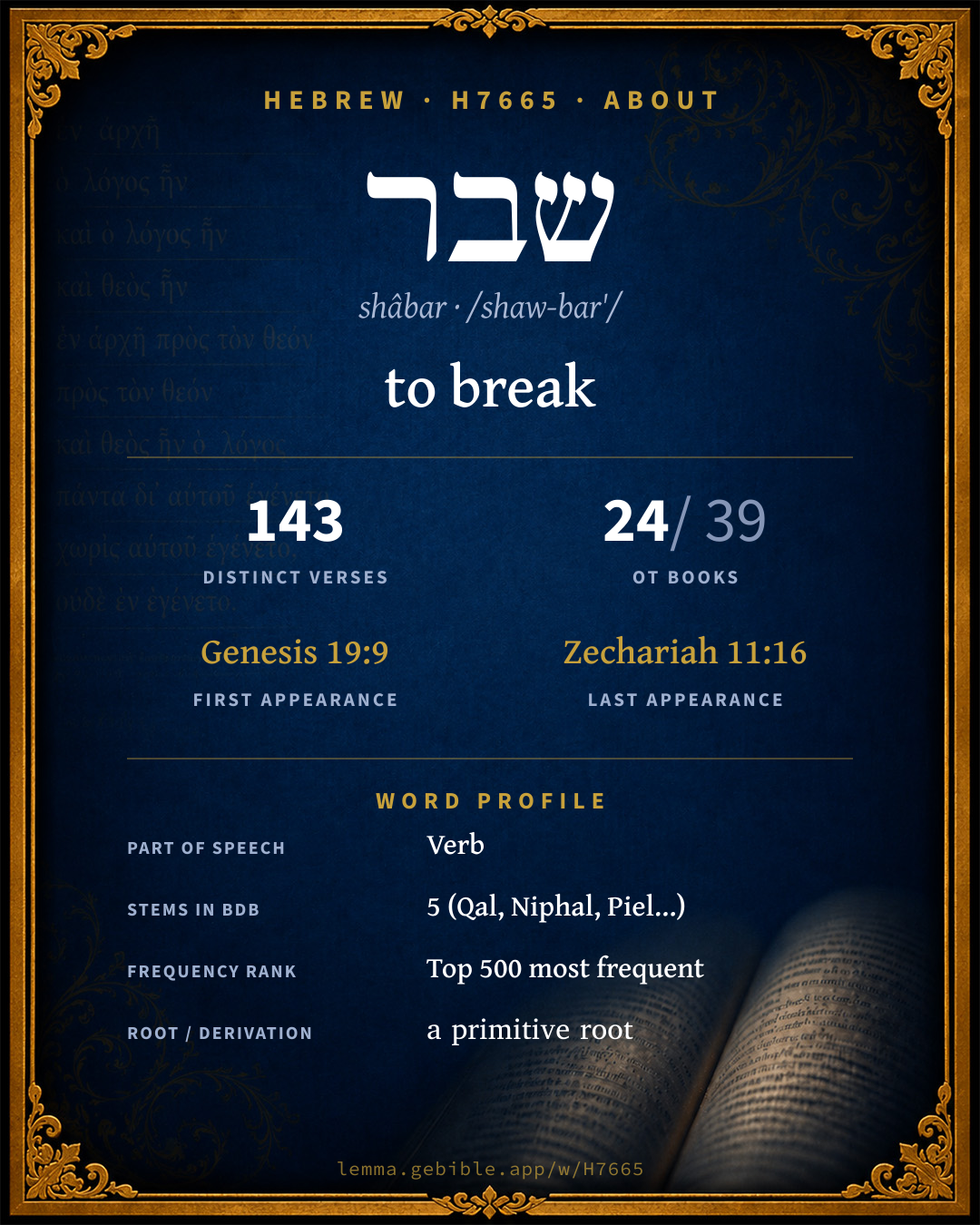
שָׁבַר
to break
‘to break’ is one of 4 main senses fuller range ↓
Full lexicon entry — Brown-Driver-Briggs (BDB)
From Brown-Driver-Briggs (BDB)
Where this word appears
Grammar key — what these labels mean
Part of speech
- Verb
- An action or state-of-being word.
- Noun
- A naming word — a person, place, thing, or idea.
Noun type
- Common
- A common noun — a general class of person, place, or thing (“king,” “city,” “water”), not a specific name.
Stem
- Niphal
- Usually the simple passive or reflexive of the Qal (“he was written”).
- Qal
- The basic, simple active stem — the plain form of the verb (“he wrote”).
- Piel
- An intensive or resultative active stem.
- Hophal
- The passive counterpart of the Hiphil (“he was caused to…”). Here: ‘be broken’
- Hiphil
- The causative active stem (“he caused / brought about”). Here: ‘cause to break out’
Form
- Perfect
- A completed action or state — Hebrew marks aspect (completeness) more than strict tense (“he wrote”).
- Sequential Perfect
- A perfect with prefixed waw continuing a preceding imperfect or command (waw-consecutive perfect).
- Imperfect
- An incomplete, ongoing, or future action (“he will / would write”).
- Sequential Imperfect
- An imperfect with prefixed waw — the standard past-narrative form (waw-consecutive imperfect).
- Infinitive Construct
- A bound verbal noun, frequently with prepositions (“to write / in writing”).
- Participle Active
- A verbal adjective expressing ongoing or characteristic action (“writing / one who writes”).
- Participle Passive
- A verbal adjective expressing action received (“written”).
- Infinitive Absolute
- An unbound verbal noun, often intensifying or standing in for a finite verb.
- Imperative
- A direct command (“write!”).
State
- Absolute
- The independent form of a noun, not bound to a following word.
- Construct
- A noun bound to a following noun in a possessive / “of” relationship (the construct chain).
Person
- 3rd Person
- The one spoken about (“he / she / it / they”).
- 1st Person
- The speaker (“I / we”).
- 2nd Person
- The one addressed (“you”).
Gender
- Feminine
- Grammatically feminine.
- Common
- Either gender — not distinguished for this form.
- Masculine
- Grammatically masculine.
Number
- Singular
- One.
- Plural
- More than one (in Hebrew, generally three or more).
Every verse where H7665 appears in the Book of Deuteronomy — 4 distinct verses. Click any verse to open its interlinear word-by-word view. Verse text shown in the World English Bible for context — . Each verse’s Hebrew form is shown with its reference; the English is not keyword-highlighted, since the data carries no word-level English alignment. Use “Compare translations” on any verse to read it across multiple English versions. This concordance covers the Hebrew Bible; Septuagint (Greek Old Testament) occurrences are not indexed here.
Deuteronomy
- Deuteronomy 7:5 תְּשַׁבֵּ֑רוּ Piel impf 2mp But thus shall you deal with them: you shall break down their altars, and dash in pieces their pillars, and hew down their Asherim, and burn their engraved images with fire.
- Deuteronomy 9:17 וָ/אֲשַׁבְּרֵ֖/ם conj + Piel wimpf 1cs + sfx pers 3mp I took hold of the two tables, and cast them out of my two hands, and broke them before your eyes.
- Deuteronomy 10:2 שִׁבַּ֑רְתָּ Piel pf 2ms I will write on the tables the words that were on the first tables which you broke, and you shall put them in the ark.
- Deuteronomy 12:3 וְ/שִׁבַּרְתֶּם֙ conj + Piel wpf 2mp and you shall break down their altars, and dash in pieces their pillars, and burn their Asherim with fire; and you shall cut down the engraved images of their gods; and you shall destroy their name out of that place.
About this entry
At a glance — auto-summarized from this page’s data, not written by a person. Every figure links to its source below. This summary describes the numbers; it doesn’t interpret them.
“to break” is the headline sense of the Hebrew verb שבר (shâbar). Where the King James Version says “brake,” newer translations reach for “shattered” (Berean Standard Bible) and “break” (unfoldingWord Literal Text); the renderings breakdown has the detail. It appears 143 verses across 24 books of the Hebrew Bible, among its common vocabulary. First canonically at Genesis 19:9, it enters the text early. Across 5 stems, its meaning turns on the binyan (Qal, Niphal). See the sense tree, 143-verse concordance, and the renderings breakdown below.
Gloss history
Strong's 1890 vs modern scholarship
About this word
Strong's H7665 catalogs a Hebrew word from the Hebrew Old Testament.
These counts are not copied from any lexicon or concordance. They are computed here, from the morphology-tagged Hebrew Old Testament. What Lemma adds →
- 143
- distinct verses
- The word appears in 143 distinct verses.
- 24 / 39
- OT books
- The word appears in 24 of 39 Old Testament books.
- #301
- by frequency
- Top 500 most frequent Hebrew words (rank 301 of 8,640 Hebrew words by occurrence).
View all 143 occurrences in the concordance →
By section of the Old Testament
By traditional corpus
Conventional, traditional groupings — biblical authorship is debated, so this is a traditional corpus grouping, not an authorship claim. Each share is this word’s portion of its verses in that division of the Hebrew canon. Each figure is a share of the word’s 143 distinct verses.
- Prophets (Nevi'im) 77 verses · 54%
- Writings (Ketuvim) 45 verses · 31%
- Torah (Pentateuch) 21 verses · 15%
How translations render this word
Counts come from each version’s own published word-to-Strong’s tagging or interlinear alignment — an approximate guide to how each version renders this word, not a word-level alignment the data otherwise carries. Because each total is that version’s own tagged count, the per-version totals vary from one another and need not match the appearance or distinct-verse counts above. These counts may also differ from a printed concordance because Lemma counts each distinctly tagged rendering and does not collapse phrase taggings into a single head-word total. This is a fixed set of word-tagged versions (KJV, ASV, BSB, ULT) and does not change with the reading translation you choose elsewhere. Each version’s license is shown beside its name below (and on Sources).
BDB lists this Strong’s number as 3 distinct words (homographs). Each count above pools all of them and is not split by sense — see the Senses section below. A low-frequency rendering may belong to a different one of those words, not the primary meaning.
- King James Version†: Brake 13×, Shall be broken 9×, I will break 8×
- American Standard Version†: Brake 10×, I will break 8×, Broken 7×
- Berean Standard Bible†: Shattered 8×, I will break 7×, Broken 6×
- unfoldingWord Literal Text†: Break 8×, I will break 8×, He shattered 6×
King James Version Public Domain
Renders H7665 across 150† tagged occurrences — most commonly:
Plus other, less common renderings. Plus 55 renderings that appear only once — usually multi-word phrases or single function words the recovered tagging swept in, not distinct renderings. Not rendered by a distinct English word in 2 further occurrences.
American Standard Version Public Domain
Renders H7665 across 153† tagged occurrences — most commonly:
Plus other, less common renderings. Plus 59 renderings that appear only once — usually multi-word phrases or single function words the recovered tagging swept in, not distinct renderings.
Berean Standard Bible Public Domain
Renders H7665 across 146† tagged occurrences — most commonly:
Plus other, less common renderings. Plus 66 renderings that appear only once — usually multi-word phrases or single function words the recovered tagging swept in, not distinct renderings. Not rendered by a distinct English word in 1 further occurrence.
unfoldingWord Literal Text CC BY-SA 4.0
Renders H7665 across 148† tagged occurrences — most commonly:
Plus other, less common renderings. Plus 60 renderings that appear only once — usually multi-word phrases or single function words the recovered tagging swept in, not distinct renderings.
7 senses and sub-senses in the full BDB
Hebrew verbs can shift meaning by stem (binyan): Qal is the basic action, Niphal is often passive or reflexive, Piel often intensifies or makes it factitive, and Hiphil is typically causative. The senses below are grouped under the stem BDB assigns to each. This entry also uses Hophal (the passive of Hiphil).
What do BDB’s symbols mean?
BDB uses these scholarly abbreviations:
| Symbol | Meaning |
|---|---|
| 𝔊 | the Septuagint (the ancient Greek translation, LXX) |
| 𝔙 | the Vulgate (the Latin translation) |
| 𝔖 | the Syriac version (the Peshitta) |
| 𝔗 | the Targum (the Aramaic translation) |
| ψ | the Psalms |
| √ | root (the underlying root or stem) |
| ‖ | parallel passage (a synonymous or contrasted parallel) |
| † | the dagger: every passage where the word occurs is cited |
The 7 senses and sub-senses the full Brown-Driver-Briggs lexicon distinguishes for this word, in lexicon order (not ranked by frequency), with BDB’s own verbatim wording and sub-sense lettering. Shown in Hebrew script with BDB’s own scholarly abbreviations. The condensed entry is in the Lexicon Entry tab. See also the Forms in the corpus table below.
שבר I break, break in pieces (NH id.
Qal
- Pf. 3 ms. שׁ׳ 1 K 13:28; Is 14:5, etc.; Impf. 3 ms. יִשְׁבֹּר Je 19:11, -בּוֹר Is 42:3; 3 fs. תִּשְׁבָּר־ Pr 25:15, etc.; Imv. ms. שְׁבֹר ψ 10:15, sf. שָׁבְרֵם Je 17:18; Inf. cstr. לִשְׁבֹּר Gn 19:9 + 2 times, שְׁבוֹר Je 28:12; Pt. act. שֹׁבֵר Ez 4:16 + 2 times; pass. שָׁבוּר Lv 22:22, pl. cstr. שְׁבוּרֵי ψ 147:3;—break, lit., obj. earthen vessel Ju 7:20 Lv 11:33 (P), Je 19:11 (in sim.), cf. v 11 48:38; Is 30:14, flask Je 19:10, gate-bar Am 1:5 (in metaph.), bow Ho 1:5; Je 49:35, and sword Ho 2:20 (מִן־הָאָרֶץ), bone of lamb Ex 12:46; Nu 9:12 (P), and (in metaph.) Pr 25:15, cf. שָׁבוּר i.e. fractured of limb Lv 22:22 (H), yoke Je 28:10, 12, 13, and, in metaph., of deliverance (י׳ subj.) v 2, 4, 11; 38:8 (c. מֵעַל), + 4 times, of rebellion Je 2:20; 5:5, so staff Is 14:5 + 5 times, reed Is 42:3, arm of Pharoah Ez 30:21, 22, 24 cf. ψ 10:15; trees (subj. thunder) ψ 29:5; break in, down, door Gn 19:9 (J); rend violently (of lion), man 1 K 13:26, ass v 28; wreck Tyre (as ship) Ez 27:26; fig. break pride Lv 26:19 (H); crush (fig.) Is 14:25 (cf. Je 48:28 supr.), La 1:15; Dn 11:26; מִשְׁנֶה שִׁבָּרוֹן שׁ׳ Je 17:18; break, rupture, heart (fig.) ψ 69:21 + Ez 6:9 (v. Niph. ad fin.), שְׁבוּרֵי לֵב ψ 147:3; וָאֶשְׁבֹּר עָלָיו חֻקִּי Jb 38:10 broke for it my boundary, of sea, ref. to abrupt ending of mainland; = quench thirst (frangere sitim) ψ 104:11. e.g. 1 Kings 13:28
Niphal
- Pf. 3 ms. נִשְׁבַּר Ex 22:9 +, etc.; Impf. 3 ms. יִשָּׁבֵר Lv 6:21 +, 3 fs. וְתִשָּׁ֫בֶר Ec 12:6, 2 ms. תִּשָּׁבֵר Ez 29:7, -בַר֥ 32:28, etc.; Inf. cstr. הִשָּׁבֵר Jon 1:4; Pt. נִשְׁבָּר ψ 51:19, fs. נִשְׁבָּרָה v 19, נִשְׁבֶּ֫רֶת Ez 27:34 +, etc.;—be broken, of neck 1 S 4:18, bones ψ 34:21, gate-bars Je 51:30, rod (in fig.) Is 14:21; Je 48:17, idols Ez 6:4, 6, horn Dn 8:8, cf. v 22, arm Jb 31:22 (מִקָּנָה), and (in metaph.) Je 48:25; Jb 38:15 ψ 37:17, cf. Ez 30:22, bough Ez 31:12; Is 27:11, cf. (fig.) of wickedness, like a tree Jb 24:20, other things ψ 37:15 Je 50:23; Ez 29:17 ψ 124:7; cisterns Je 2:13 (id.), pottery Lv 6:21; 15:12 (P), Ec 12:6 (in fig.); = be maimed, crippled (have limb broken), of animal Ex 22:9, 13 (E), and (fig.) Ez 34:4, 16; Zc 11:16, so (fig. of men stumbling) Is 8:15; 28:13; be wrecked, of ships 1 K 22:49 (read Qr נִשְׁבְּרוּ), ‖ 2 Ch 20:37, Jon 1:4, metaph. of Tyre Ez 27:34; fig. be crushed, destroyed (pers., warriors, kingdoms, etc.), Je 14:17; 22:20; 48:4; 51:8 + 10 times; fig. be broken, of heart †Je 23:9; Is 61:1 ψ 34:19; 51:19, cf. רוּחַ נִשׁ׳ v 19.—Ez 6:9 read prob. וְשָֽׁבְרְתִּ֫י (We Sm Berthol Toy Krae); Co בְּשָׁבְרִי. e.g. Exodus 22:9
Piel
- Pf. 3 ms. שִׁבַּר Is 21:9 +, שִׁבֵּ֑ר Ex 9:25, etc.; Impf. 3 ms. יְשַׁבֵּר ψ; 46:10 +, 2 mpl. תְּשַׁבֵּר֑וּן Ex 34:13, etc.; Inf. abs. שַׁבֵּר Ex 23:24; Pt. מְשַׁבֵּר 1 K 19:11;—shatter, break, tablets Ex 32:19 (E), 34:1 (J), Dt 9:17; 10:2; מַצֵּבוֹת Ex 23:24 (E; + Inf. abs.), 34:13 (J) + 7 times; images 2 K 11:18 + 3 times; bronze sea, etc., 2 K 25:13 = Je 52:17; horns Dn 8:7; jaws Jb 29:17 (in fig.); of hail shattering trees Ex 9:25 (J), cf. 1 K 19:11; elsewhere subj. י׳, shattering gate-bars, etc., weapons Is 45:2; 38:13; La 2:9; 3:4 ψ 46:10; 76:4; 107:16, trees 29:5; 105:33, heads of תַּנִּינִים 74:13; wrecking ships 48:8. e.g. Isaiah 21:9
Hiphil
- cause to break out, i.e. bring to the birth, Impf. 1 s. הַאֲנִי אַשְׁבִּיר וְלֹא אוֹלִיד Is 66:9 (י׳ subj.; cf. מַשְׁבֵּר infr.). e.g. Isaiah 66:9
Hophal
- be broken, shattered (in heart), Pf. 1 s. עַל־שֶׁבֶר בַּת־עַמִּי הָשְׁבַּ֑רְתִּי Je 8:21. e.g. Jeremiah 8:21
שבר II denom. buy grain
Qal
- Impf. 2 mpl. תִּשְׁבְּרוּ Dt 2:6, 1 pl. נִשְׁבְּרָה Gn 43:4; Imv. mpl. שִׁבְרוּ 42:2 +; Inf. cstr. לִשְׁבֹּר v 3 +, לִשְׁבָּר־ v 7 +; Pt. mpl. שֹׁבְרִים 47:14;—buy grain for food Gn 41:57 (v 56 v. Hiph.), 42:2 (שֶׁבֶר in v a), v 5; c. acc. אֹכֶל v 7, 10; 43:2, 4, 20, 22; 44:25; Dt 2:6 (מִן pers.); c. acc. בָּר Gn 42:3, שֶׁבֶר 47:14; fig. Is 55:1, c. acc. יַיִן וְחָלָב v 1. e.g. Deuteronomy 2:6
Hiphil
- Impf. 1 pl. נַשְׁבִּיר Am 8:6 etc.; Pt. מַשְׁבִּיר Gn 42:6 Pr 11:26;—sell grain (proposes cause to buy grain), c. ל pers. Gn 42:6 + 41:56 (read וַיַּשְׁבֵּר for MT וַיִּשְׁבֹּר Ol Di Gunk), c. acc. שֶׁבֶר Am 8:5, מַפַּל בָּר v 6, cf. Pr 11:26; c. sf. pers. + acc. אֹכֶל + ב pret. Dt 2:28. e.g. Amos 8:6
Senses from the full Brown-Driver-Briggs lexicon (Brown, Driver, Briggs; Oxford 1906 — public domain), digitized via Sefaria, supplemented by the OpenScriptures HebrewLexicon (CC BY 4.0). Full attribution on Sources.
Word origin
I. vb. break, break in pieces (NH id.; Sab. תֿבר break, destroy DHMHof.Mus., no. 1(×2). 26 MordtmHI 74; Arabic ثَبَرَ restrain, destroy; Aramaic תְּבַר, ܬܒܰܪ: Assyrian šabâru, break, break in pieces; Ethiopic ሰበረ: break);—
I. Lv 22:22 v. √ Qal.
II. vb.denom. buy grain;—
— Brown-Driver-Briggs (Oxford 1906, public domain), digitized via Sefaria, supplemented by the OpenScriptures HebrewLexicon (CC BY 4.0). See Sources.
Origin: a primitive root
Jastrow Dictionary
A second Hebrew/Aramaic lexicon for comparison, covering Aramaic and post-biblical (Talmudic, Targumic, Midrashic) usage that the biblical-Hebrew BDB does not. Matched by lemma rather than by Strong’s number, so a lemma may carry more than one Jastrow headword (shown separately below), and the entries cover usage well beyond the Bible.
שֵׂבֶר
- , v. סֵבֶר
שְׂבַר
- , Poël שׂוֹבַר, v. סְבַר II.
שָׁבַר I
- (b. h.)
- 1. to break. Y. Ab. Zar. II, 41ᵈ (play on אכל תשברו, Deut. II, 6) באכל תִּשְׁבְּרוֹ האכלתו שְׁבַרְתּוֹ with food break him (his ill-will); when thou hast given him to eat, thou hast broken him; אם היה קשה עליך באכל תשברו וכ׳ if he is hard on thee, break him with food, and if not (if thou succeedest not with food), heap silver upon him; Y. Sabb. I, 3ᶜ bot. Tanḥ. Sh’laḥ. 9 נתכוונו … לִשְׁבּוֹר לבן וכ׳ the spies intended to break the heart (courage) of the Israelites (ref. to ויניאו, Num. XXXII, 9). Tosef. B. Mets. II, 26 אוהבו … כדי לשבור את לבו if a friend requires help for loading, and an enemy for unloading (to relieve the broken down beast of burden), it is commended to help the enemy in order to break his heart (hatred); (B. Mets. 32ᵇ כדי לכוף את יצרו). Pesik. Eth Korb., p. 59ᵇ נטל את הטבלא … ושְׁבָרָהּ he took the plate … and shattered it. Ex. R. s. 18 (ref. to Ps. LXXVII, 7) נזכרת אני את השברים שהיית שׁוֹבֵר וכ׳ I remember the breaks with which thou brokest (the calamities with which thou didst visit) the empires for me by night; בא … שָׁבַרְתָּ וכ׳ Sennacherib came upon me, thou brokest him at night (v. infra Hof.); a. v. fr.—Y. Shebi. VIII, beg. 37ᵈ כל מדרש שאתה דורש ושׁוֹבֵר וכ׳ a textual interpretation which you introduce, and by which you break (upset partially) a previous interpretation of the same verse, is no legitimate interpretation. Tanḥ. Vayera 13 סופו … שובר את ראשו the end of the verse breaks (contradicts) its beginning. Cant. R. to VII, 9 (expl. דתבריא, Dan. III, 2) the scholars (scholastici) are called d’thabraya (v. תְּבַר), שהם שׁוֹבְרִים הדברים because they break (twist out of joint) the words (of the law).—Part. pass. שָׁבוּר, f. שְׁבוּרָה having a broken limb, injured. B. Mets. I, 4 רצין … אחר צבי ש׳ running … after a wounded deer. Ib. 94ᵇ ש׳ ומתה a borrowed animal that was injured or that died. Ib. נשבעין על הש׳ must make oath concerning an injured animal in their charge; a. fr.—2) (denom. of שׁוֹבֵר) to give a receipt; to acknowledge payment; to acquit. Tosef. Keth. IV, 11 שָׁבְרָה לו (על) מקצת כתובתה שברה לו אל כולה if she gave him a receipt for a portion of her jointure, she has released him of all obligations of the marriage contract. Ib. IX, 1 כונסה … והיא שׁוֹבֶרֶת לו וכ׳ he marries her and divorces her (and remarries her), and she gives him a receipt for her jointure (by which act the mortgage on the entire estate is cancelled); Y. ib. VIII, 32ᵇ bot.; Y. Yeb. IV, 5ᵈ; a. fr. e.g. Deuteronomy 2:6
- to break. Sabb. 105ᵇ המקרע … והמְשַׁבֵּר כליו וכ׳ he who in his anger tears his garment or breaks his vessels, … let him be in thy sight like an idolater; a. fr.—Part. pass. מְשׁוּבָּר. Pesik. R. s. 17 (ref. to Job I, 15) מש׳ ומלוקה היה he (that escaped) was broken of limbs and smitten; Ruth R. to I, 5; Lev. R. s. 17 מוּשְׁבָּר; Yalk. Job 892 מושבר. e.g. Job 1:15
- to be broken. Pesik. Vattom., p. 129ᵇ (ref. to Ps. LXXVII, 7) נזכרת אני שֶׁבֶר שהוּשְׁבַּרְתִּי וכ׳ (not שכר שהושכ׳) I remember how I was broken (crushed) among the empires (v. supra); Lam. R. to I, 2 שהָשְׁבַּרְתִּי … בלילן וכ׳ how I was broken before thee in the night of persecution by the empires; Yalk. Ps. 816; a. fr.—Part. מוּשְׁבָּר, v. supra. e.g. Psalms 77:7
- , Nithpa. נִשְׁתַּבֵּר same. B. Mets. VI, 4. Kel. III, 3 ונִשְׁבְּרָה and was again broken. Ib. XI, 1 נִשְׁבְּרוּ טהרו when they are broken, they are no longer susceptible of uncleanness. Gen. R. s. 91 נִשְׁתַּבְּרוּ שיניהם their teeth were broken (fell out). Y. Kidd. I, beg. 58ᵇ נשבר קל וחומר the conclusion a minori is impaired. Ab. Zar. 50ᵇ, sq. זריקה מִשְׁתַּבֶּרֶת an interrupted throwing, i.e. sprinkling a liquid, but not throwing a solid object; a. fr.—Treat. Der. Er. ch. X מִשְׁתַּבֵּר על השיש ‘has his limbs broken’ (a sort of massage) on the marble floor (in the bath-house, in the presence of other people).
שָׁבַר II
- to buy provisions. Gen. R. s. 91 אף … לִשְׁבָּר אוכל Joseph, too, knew that his brothers were coming down to Egypt to buy food; ib. כל מי שנכנס לִשְׁבּוֹר וכ׳ let whomsoever enters (Egypt) to buy food register his name &c; Tanḥ. Mikk. 8.
- to sell provisions, to supply. Ib. (ref. to מַשְׁבִּיר, Prov. XI, 26) זה יוסף שזן וכ׳ that means Joseph who sustained the world &c.; Gen. R. l. c.; a. e.—[Tanḥ. ed. Bub. Vayesheb 13 משביר אותו, read: מַשְׂכִּיר.] e.g. Proverbs 11:26
שֶׁבֶר I
- 1. break, fracture. Sabb. XXII, 6 אין מחזירין את הש׳ you must not set a fracture (on the Sabbath). T’bul Yom IV, 7 שלום מן הש׳ וכ׳ (he meant) that it will be brought up in safety without being broken and without being spilt; Y. Ter. II, 41ᶜ top; a. e.—Trnsf. destruction, calamity. Gen. R. s. 91 (play on שֶׁבֶר, Gen. XLII, 1, a. סֵבֶר) כי יש ש׳ זה הרעב כי יש סבר זה השבע וכ׳ ‘that there is a calamity’, that means the famine; ‘that there is brightness’, that means plenty &c. Ib. והלא כבר נאמר ותרעב … יש ש׳ has it not been said before, ‘and all the land of Egypt was hungry’? what is meant by ‘there is a calamity in Egypt’? &c. Pesik. Vattom., p. 129ᵇ (not שכר); Yalk. Ps. 816, v. שָׁבַר I; a. e.—Pl. שְׁבָרִים, constr. שִׁבְרֵי. Gen. R. s. 30 (ref. to Job XII, 5) שהיו מוכנים לשני ש׳ לשבר מלמעלן וכ׳ they were predestined for two calamities, for destruction from above (rain), and for destruction from below (rise of the deeps). Ex. R. s. 18, v. שָׁבַר I. Kel. XI, 3, a. fr. שברי כלים fragments of vessels, broken vessels. B. Bath. 14ᵇ שברי לוחות the tablets broken by Moses. Ber. 8ᵇ הזהרו בזקן … לוחות ושברי וכ׳ be careful not to despise an old man that has forgotten his learning through no fault of his, for we are told, the (whole) tablets and the broken ones were deposited in the Ark; Men. 99ᵃ; a. fr. e.g. Genesis 42:1
- 2. a broken ejaculation, sigh, esp. the broken disconnected sounds produced on the Shofar. Y. Taan. II, 65ᵇ top (play on אֵד, Gen. II, 6) עלה ש׳ מלמטן וכ׳ when the broken tune (at the prayer meeting) rises from below, at once the rain comes down.—Pl. as ab. R. Hash. 34ᵃ שיעור תרועה כשלשה ש׳ the value of a t’ruʿah (a succession of tremulous sounds) is equal to three sh’barim. Ib. אתקין … שלשה ש׳ תרועה וכ׳ R. Abbahu introduced in Cæsaræa (for the New Year’s Day) the blowing of a t’ḳiʿah (a succession of connected notes), three sh’barim, a tr’uʿah, and a t’ḳi‘ah; a. e. e.g. Genesis 2:6
שֶׁבֶר II
- ; ש׳ רעבון, v. Gen. XLII, 19 a. 33, cmp. Ps. CIV, 11; v. Ehrlich Miḳra ki-Pheschuṭô, p. 114 sq.) (sale of) provisions (in time of famine). Gen. R. s. 91 מפני … יש אוכל במצרים שאמר הכתוב יש ש׳ וכ׳ why does not the Scripture say (Gen. XLII, 1) ‘there was okhel (food) in Egypt? (why is it) that the text says, ‘there was sheber’? e.g. Genesis 42:19
שִׁבַר
- (denom. of בַּר II, בְּרָא) [boy, Syr.,] simple, foolish (corresp. to h. פֶּתִי). Targ. Prov. IX, 4 (some ed. שכר, corr. acc.). Ib. XIV, 15. Targ. Job V, 2 (ed. Wil. שְׁבִירָא). Targ. Ps. XIX, 8 (ed. Lag. שִׁיבְרָא; ed. Wil. שִׂבְ׳, corr. acc.); a. e.—Pl. שַׁבְרֵי. Targ. Prov. I, 4; 22; 32; a. fr.—Fem. שְׁבַרְתָּא. Ib. IX, 13 (ed. Wil. שִׁבְרָתָה; some ed. שכ׳, corr. acc.).
A Dictionary of the Targumim, the Talmud Babli and Yerushalmi, and the Midrashic Literature (Marcus Jastrow; London, Luzac, 1903) — Public Domain. Digitized via Sefaria. Digitized via Sefaria. Full attribution on Sources.
Forms in the corpus
The 130 distinct written forms H7665 takes in the Hebrew Bible, most frequent first — each parse links to that stem’s occurrences in the concordance. Hebrew forms include their vowel points and cantillation, so a single lemma takes many written forms.
The 60 most common forms are shown; 70 rarer forms follow in the full concordance.
Same root — word family
Other BDB entries built from the same root as H7665, grouped by Strong’s listed origin. These share a root / origin per the lexicon — not necessarily a shared meaning. Each links to that word’s own entry.
Derived from this word
- משבר mishbêr H4866 breach
- משבר mishbâr H4867 breaker
- שבר sheber H7667 breaking
- שברון shibrôwn H7670 destruction
- תבר tᵉbar H8406 to break
Compare all same-root words → Showing 4 of 6 — not the complete family. They share a root, not necessarily a meaning.
Septuagint verse parallels
This word appears in 131 verses that also exist in the Greek Old Testament (Septuagint), out of the 143 Hebrew verses it occurs in. You can read those verses in Greek by switching the Old Testament edition to the Septuagint.
Read these verses in the Septuagint
- Genesis 19:9
- Exodus 9:25
- Leviticus 11:33
- Numbers 9:12
- Deuteronomy 7:5
- Judges 7:20
- 1 Samuel 4:18
- 1 Kings 13:26
- 2 Kings 11:18
- 2 Chronicles 14:3
- Job 24:20
- Psalms 3:7
This is a verse-level parallel only — the same verses exist in both the Hebrew and Greek Old Testaments. No word-level Hebrew↔Greek correspondence is claimed: the data carries no such alignment, so no Greek word is shown as this Hebrew word’s translation. Coverage is not total — the Septuagint omits the deuterocanon and renumbers the Psalms, so some Hebrew verses have no direct Greek parallel.