
Ezekiel 30:24

Hebrew (Westminster Leningrad Codex) Ezekiel 30:24 appears in the Hebrew Old Testament. The text above is from the Westminster Leningrad Codex. Each word links to its Strong’s number, a concise gloss, and parsing drawn from the Open Scriptures Hebrew Bible morphology. Click any word for its full Brown-Driver-Briggs (BDB) entry.
Download image
Cite this verse

Ezekiel 30:24 (World English Bible). Public Domain. Lemma interlinear Bible study tool, https://lemma.gebible.app/v/ezekiel/30/24.

Show BibTeX & RIS
BibTeX
RIS
English Translation
I will strengthen the arms of the king of Babylon, and put my sword in his hand: but I will break the arms of Pharaoh, and he shall groan before him with the groanings of a deadly wounded man.
World English Bible · Public Domain
Download a study sheet

One document with this verse’s original text, its word-by-word gloss line, the meaning frame, cross-references with their text, attributed commentary, and full source and license credits — printable, and it pastes into notes with its structure intact.

This verse Autodidact and up

Study sheet (.html) Plain text (.txt)

A passage Seminary Student

Up to 50 verses in one chapter. A passage sheet keeps up to 6 commentary sources and 12 cross-references per verse, in the order this page ranks them, and says so on the sheet whenever that leaves anything out. Ask for a single verse and you get the Autodidact verse sheet above.

Everything on this page stays free to read, with no account — the sheet is a download of what is already on screen, not access to it.

Want to remove ads? Support Godless Engineer
Compare translations 3

The same verse in 3 English versions, stacked beneath the original-language interlinear above. Click any original word for its lexicon entry.

Each is an independent rendering of the whole verse — the interlinear is not word-aligned to these translations.

Highlighted words mark where these versions differ — a whole-verse word diff, not a word-by-word alignment.

  • World English Bible Public Domain
    I will strengthen the arms of the king of Babylon, and put my sword in his hand: but I will break the arms of Pharaoh, and he shall groan before him with the groanings of a deadly wounded man.
  • King James Version Public Domain
    And I will strengthen the arms of the king of Babylon, and put my sword in his hand: but I will break Pharaoh's arms, and he shall groan before him with the groanings of a deadly wounded man.
  • unfoldingWord Literal Text CC BY-SA 4.0
    I will strengthen the arms of the king of Babylon and place my sword in his hand so that I might destroy Pharaoh’s arms. He will groan before the king of Babylon with the groans of a dying man.

unfoldingWord Literal Text — © unfoldingWord, licensed CC BY-SA 4.0. Word-aligned USFM3 via Door43 (git.door43.org/unfoldingWord/en_ult).

Versions to compare (up to 4)

3 of 4 selected

Show all 18 translations

Every available English version of this verse, each an independent rendering of the whole verse.

  • World English Bible Public Domain
    I will strengthen the arms of the king of Babylon, and put my sword in his hand: but I will break the arms of Pharaoh, and he shall groan before him with the groanings of a deadly wounded man.
  • Berean Standard Bible Public Domain
    I will strengthen the arms of Babylon’s king and place My sword in his hand, but I will break the arms of Pharaoh, who will groan before him like a mortally wounded man.
  • Majority Standard Bible Public Domain
    I will strengthen the arms of Babylon’s king and place My sword in his hand, but I will break the arms of Pharaoh, who will groan before him like a mortally wounded man.
  • King James Version Public Domain
    And I will strengthen the arms of the king of Babylon, and put my sword in his hand: but I will break Pharaoh's arms, and he shall groan before him with the groanings of a deadly wounded man.
  • American Standard Version (1901) Public Domain
    And I will strengthen the arms of the king of Babylon, and put my sword in his hand: but I will break the arms of Pharaoh, and he shall groan before him with the groanings of a deadly wounded man.
  • Revised Version (1885) Public Domain
    And I will strengthen the arms of the king of Babylon, and put my sword in his hand: but I will break the arms of Pharaoh, and he shall groan before him with the groanings of a deadly wounded man.
  • Geneva Bible (1599) Public Domain
    And I will strengthen the arme of the King of Babel, and put my sworde in his hand, but I will breake Pharaohs armes, and he shall cast out sighings, as the sighings of him, that is wounded before him.
  • Douay-Rheims (1899) Public Domain
    And I will strengthen the arms of the king of Babylon, and will put my sword in his hand: and I will break the arms of Pharao, and they shall groan bitterly being slain before his face.
  • Young's Literal Translation Public Domain
    And strengthened the arms of the king of Babylon, And I have given My sword into his hand, And I have broken the arms of Pharaoh, And he hath groaned the groans of a pierced one -- before him.
  • Literal Standard Version CC BY-SA 4.0
    And I have strengthened the arms of the king of Babylon, || And have given My sword into his hand, || And I have broken the arms of Pharaoh, || And he has groaned the groans of a pierced one—before him.
  • Unlocked Literal Bible CC BY-SA 4.0
    I will strengthen the arms of the king of Babylon and place my sword in his hand so that I might destroy Pharaoh's arms. He will groan before the king of Babylon with the groans of a dying man.
  • unfoldingWord Literal Text CC BY-SA 4.0
    I will strengthen the arms of the king of Babylon and place my sword in his hand so that I might destroy Pharaoh’s arms. He will groan before the king of Babylon with the groans of a dying man.
  • Darby Bible Public Domain
    And I will strengthen the arms of the king of Babylon, and put my sword in his hand; and I will break Pharaoh's arms, so that he shall groan before him with the groanings of a deadly-wounded [man].
  • World Messianic Bible Public Domain
    I will strengthen the arms of the king of Babylon, and put my sword in his hand; but I will break the arms of Pharaoh, and he will groan before the king of Babylon with the groaning of a mortally wounded man.
  • Webster's Bible Public Domain
    And I will strengthen the arms of the king of Babylon, and put my sword in his hand: but I will break Pharaoh's arms, and he shall groan before him with the groanings of a deadly wounded man.
  • Free Bible Version CC BY-SA 4.0
    I will make the arms of the king of Babylon strong, and put my sword in his hand, but I will break Pharaoh's arms, and he will moan in pain like someone who's about to die.
  • Bible in Basic English Public Domain
    And I will make the arms of the king of Babylon strong, and will put my sword in his hand: but Pharaoh's arms will be broken, and he will give cries of pain before him like the cries of a man wounded to death.
  • JPS Tanakh (1917) Public Domain
    And I will strengthen the arms of the king of Babylon, and put My sword in his hand; but I will break the arms of Pharaoh, and he shall groan before him with the groanings of a deadly wounded man.

Literal Standard Version (2020), Covenant Press — licensed CC BY-SA 4.0. Text via the HelloAO Bible API (eBible.org). Unlocked Literal Bible (unfoldingWord) — licensed CC BY-SA 4.0. Text via the HelloAO Bible API (eBible.org). unfoldingWord Literal Text — © unfoldingWord, licensed CC BY-SA 4.0. Word-aligned USFM3 via Door43 (git.door43.org/unfoldingWord/en_ult). Free Bible Version, Dr. Jonathan Gallagher — licensed CC BY-SA 4.0. Text via the HelloAO Bible API (eBible.org).

Word by word

More ways to search: Search by grammar → Find every occurrence → Compare this word →

Practice this passage: Drill this verse → Learn its vocabulary →

וְנָאַ֛ק
nâʼaq
H5008
“and · to groan”
Conjunction + Verb, Qal, Perfect, 3rd Person, Masculine, Singular
Part of Speech
Conjunction + Verb
Stem
Qal
Form
Perfect
Person
3rd Person
Gender
Masculine
Number
Singular
Full BDB Definition

Origin: a primitive root

TWOT: 1275

(Qal) to groan
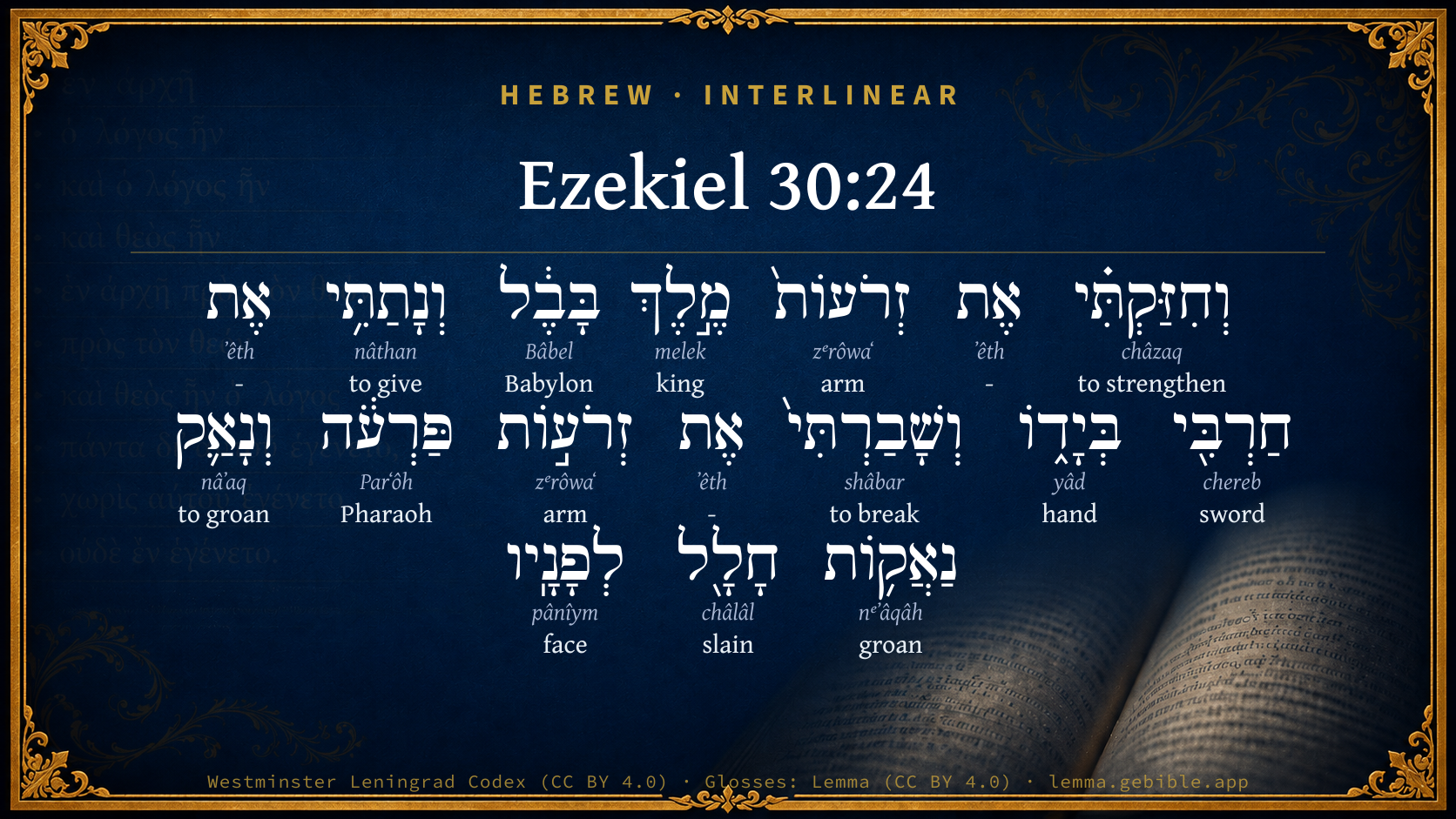
  1. וְחִזַּקְתִּ֗י châzaq H2388 “and · to strengthen” Conjunction + Verb, Piel, Sequential Perfect, 1st Person, Common, Singular
  2. אֶת ʼêth H853 “-” Particle, Direct Object
  3. זְרֹעוֹת֙ zᵉrôwaʻ H2220 “arms of” Noun, Common, Both, Plural, Construct
  4. מֶ֣לֶךְ melek H4428 “king of” Noun, Common, Masculine, Singular, Construct
  5. בָּבֶ֔ל Bâbel H894 “Babylon” Noun, Proper
  6. וְנָתַתִּ֥י nâthan H5414 “and · to give” Conjunction + Verb, Qal, Sequential Perfect, 1st Person, Common, Singular
  7. אֶת ʼêth H853 “-” Particle, Direct Object
  8. חַרְבִּ֖י chereb H2719 “sword · my” Noun, Common, Feminine, Singular, Construct + Suffix, Personal, 1st Person, Common, Singular
  9. בְּיָד֑וֹ yâd H3027 “in/at · hand · his” Preposition + Noun, Common, Both, Singular, Construct + Suffix, Personal, 3rd Person, Masculine, Singular
  10. וְשָׁבַרְתִּי֙ shâbar H7665 “and · to break” Conjunction + Verb, Qal, Sequential Perfect, 1st Person, Common, Singular
  11. אֶת ʼêth H853 “-” Particle, Direct Object
  12. זְרֹע֣וֹת zᵉrôwaʻ H2220 “arms of” Noun, Common, Both, Plural, Construct
  13. פַּרְעֹ֔ה Parʻôh H6547 “Pharaoh” Noun, Proper
  14. נַאֲק֥וֹת nᵉʼâqâh H5009 “groans of” Noun, Common, Feminine, Plural, Construct
  15. חָלָ֖ל châlâl H2491 “slain” Adjective, Adjective, Masculine, Singular, Absolute
  16. לְפָנָֽיו pânîym H6440 “to/for · face(s) · his” Preposition + Noun, Common, Both, Plural, Construct + Suffix, Personal, 3rd Person, Masculine, Singular

About this verse

These counts appear in no published source. They are computed here, from the morphology-tagged text and Lemma’s own curated glosses. What Lemma adds →

17
words
14
distinct lemmas
Prophets
section

Notable vocabulary

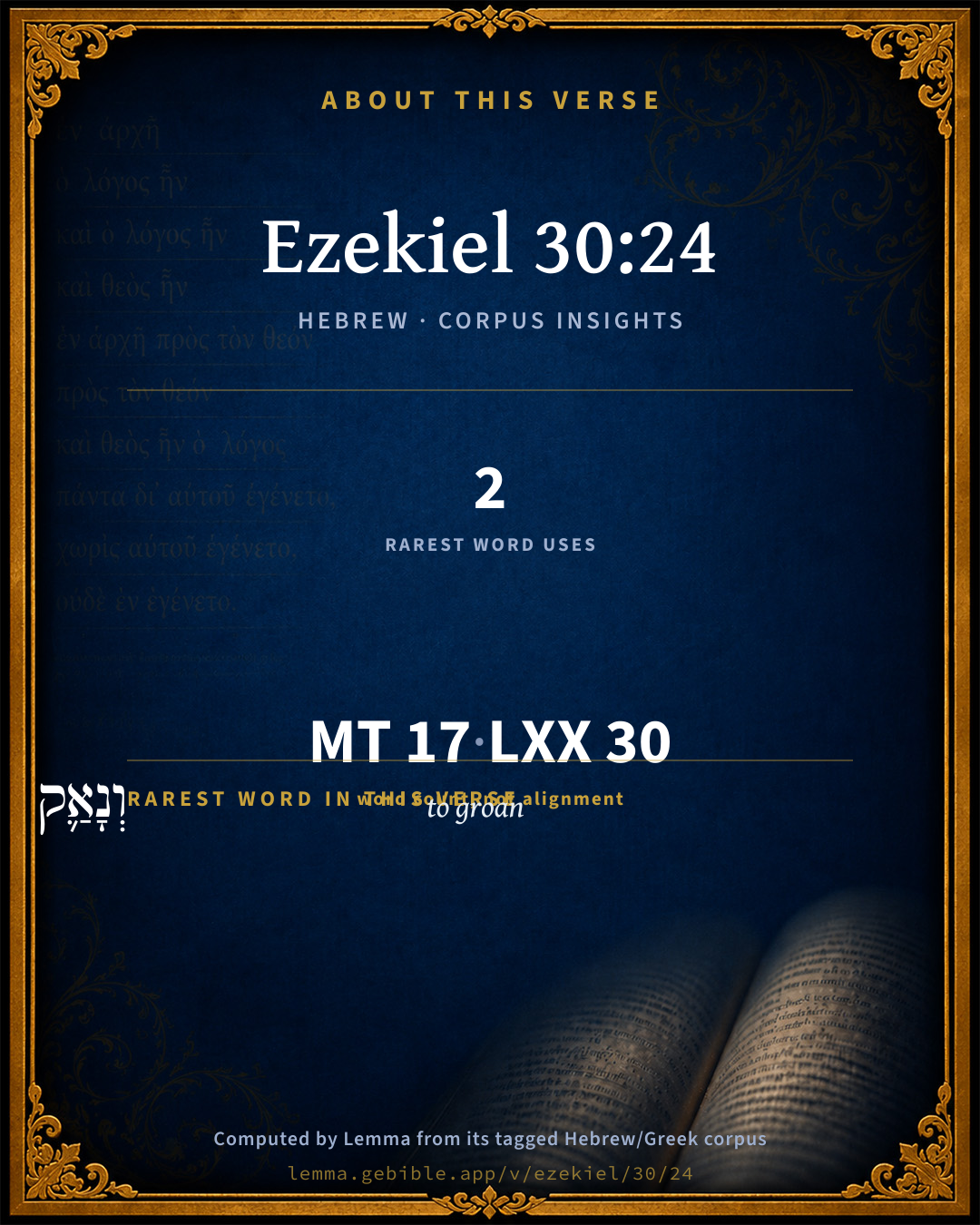
The rarest word here is וְנָאַ֛ק to groan H5008 — appearing just 2 times in the whole Hebrew Bible.

Shared distinctive vocabulary

וְנָאַ֛ק to groan H5008 occurs in 2 verses of the Hebrew Bible. Also found in:

Grammatical profile

  • 4 verbs
  • 9 nouns
  • 1 adjective
  • 3 particles

Verb forms

  • וְחִזַּקְתִּ֗י Piel · Sequential Perfect
  • וְנָתַתִּ֥י Qal · Sequential Perfect
  • וְשָׁבַרְתִּי֙ Qal · Sequential Perfect
  • וְנָאַ֛ק Qal · Perfect

Repetition

A word recurs within this verse — often emphatic in Hebrew:

  • זְרֹעוֹת֙ arm H2220 ×2

Hebrew & Septuagint length

In English translation the verse runs 39 words from the Hebrew and 34 from the Septuagint (LXX English) — closely comparable.

A rough comparison of the two English renderings, which tokenize alike — not a word-level alignment.

Word counts can differ between the Hebrew and the Greek without any difference in meaning — e.g. the Hebrew direct-object marker אֵת has no separate Greek word, and Greek often adds the article ὁ.

In the original languages it is 17 Hebrew tokens and 30 Greek tokens — but the two are counted differently (Hebrew bundles its prefixes and suffixes into one token; the Greek is in lemma form), so that isn’t a like-for-like length.

Cross-references

18

Topical passages linked to Ezekiel 30:24 in the Treasury of Scripture Knowledge — connected by theme and wording, ordered by reader-vote popularity; previews shown in the World English Bible.

  • Ezekiel 30:25 I will hold up the arms of the king of Babylon; and the arms of Pharaoh shall fall down; and they shall know that I am Yahweh, when I shall put my sword into the hand of the king of Babylon, and he shall stretch it out on the land of Egypt.
  • Zephaniah 2:12 You Cushites also, you will be killed by my sword.
  • Nehemiah 6:9 For they all would have made us afraid, saying, Their hands shall be weakened from the work, that it not be done. But now, [God], strengthen you my hands.
  • Isaiah 45:1 Thus says Yahweh to his anointed, to Cyrus, whose right hand I have held, to subdue nations before him, and I will loose the loins of kings; to open the doors before him, and the gates shall not be shut:
  • Isaiah 45:5 I am Yahweh, and there is none else; besides me there is no God. I will gird you, though you have not known me;
  • Deuteronomy 32:41–42 If I whet my glittering sword, My hand take hold on judgment; I will render vengeance to my adversaries, Will recompense those who hate me.
  • Job 24:12 From out of the populous city, men groan. The soul of the wounded cries out, Yet God doesn't regard the folly.
  • Psalms 17:13 Arise, Yahweh, Confront him, cast him down. Deliver my soul from the wicked by your sword;
  • Psalms 18:32 The God who arms me with strength, and makes my way perfect?
  • Psalms 18:39 For you have girded me with strength to the battle. You have subdued under me those who rose up against me.
  • Psalms 144:1 Blessed be Yahweh, my rock, Who teaches my hands to war, And my fingers to battle:
  • Isaiah 10:5–6 Ho Assyrian, the rod of my anger, the staff in whose hand is my indignation!
  • Isaiah 10:15 Shall the axe boast itself against him who hews therewith? Shall the saw magnify itself against him who wields it? as if a rod should wield those who lift it up, [or] as if a staff should lift up [him who is] not wood.
  • Jeremiah 27:6–8 Now have I given all these lands into the hand of Nebuchadnezzar the king of Babylon, my servant; and the animals of the field also have I given him to serve him.
  • Jeremiah 51:52 Therefore, behold, the days come, says Yahweh, that I will execute judgment on her engraved images; and through all her land the wounded shall groan.
  • Ezekiel 26:15 Thus says the Lord Yahweh to Tyre: shall not the isles shake at the sound of your fall, when the wounded groan, when the slaughter is made in the midst of you?
  • Ezekiel 30:10 Thus says the Lord Yahweh: I will also make the multitude of Egypt to cease, by the hand of Nebuchadrezzar king of Babylon.
  • Zechariah 10:11–12 He will pass through the sea of affliction, And will strike the waves in the sea, And all the depths of the Nile will dry up; And the pride of Assyria will be brought down, And the scepter of Egypt will depart.

Cross-references courtesy of OpenBible.info (CC BY 4.0).

Hebrew and Greek witnesses Masoretic Hebrew ↔ Greek Septuagint

The same verse in the two great witnesses to the Old Testament, shown verse-for-verse.

These are two independent witnesses, not word-aligned to each other, and the Septuagint is shown in lemma (dictionary) form.

Hebrew Ezekiel 30:24 Masoretic · Westminster Leningrad Codex

וְחִזַּקְתִּ֗י אֶת זְרֹעוֹת֙ מֶ֣לֶךְ בָּבֶ֔ל וְנָתַתִּ֥י אֶת חַרְבִּ֖י בְּיָד֑וֹ וְשָׁבַרְתִּי֙ אֶת זְרֹע֣וֹת פַּרְעֹ֔ה וְנָאַ֛ק נַאֲק֥וֹת חָלָ֖ל לְפָנָֽיו

I will strengthen the arms of the king of Babylon, and put my sword in his hand: but I will break the arms of Pharaoh, and he shall groan before him with the groanings of a deadly wounded man.

World English Bible · Public Domain

Greek LXX Ezekiel 30:24 Septuagint · lemma form

καί καταἰσχύω ὁ βραχίων βασιλεύς βαβυλών καί δίδωμι ὁ ῥομφαία ἐγώ εἰς ὁ χείρ αὐτός καί ἐπιἄγω αὐτός ἐπί αἴγυπτος καί προνομεύω ὁ προνομή αὐτός καί σκυλεύω ὁ σκῦλον αὐτός

And I will strengthen the arms of the king of Babylon, and put my sword into his hand: and he shall bring it upon Egypt, and shall take her plunder and seize her spoils.

LXX2012 (modern English Septuagint) · Public Domain

Hebrew: Westminster Leningrad Codex (CC BY 4.0). Greek: Septuagint (public domain); English from LXX2012 (modern English Septuagint) (Public Domain). How the Septuagint differs from the Hebrew →

Targum (Aramaic paraphrase)

1

The Targum is the ancient Jewish Aramaic paraphrase of the Hebrew Scriptures — an interpretive translation, not the Hebrew text itself. Onkelos (literal) and Pseudo-Jonathan (expansive) render the Torah, and Jonathan the Prophets. Coverage is partial: where no permissively-licensed English translation exists for a verse, only the Aramaic is shown. This is verse-level text, not a word-by-word alignment to the Hebrew.

  1. Targum Jonathan Prophets (Joshua–Malachi)
    וְאַתְקֵיף יַת מַלְכוּת מַלְכָּא דְבָבֶל וְאֶתֵּן יַת תּוּקְפִי בִּידֵיהּ וְאֶתְּבַר יַת תְּקוֹף פַּרְעֹה וְיִנְהֵם נְהוֹם מְטַעֲנֵי חֶרֶב קֳדָמוֹהִי:

    (no public-domain English translation for this verse)

    Targum Jonathan — Aramaic: “Mikraot Gedolot” (public domain). English: “Sefaria Community Translation” (CC0 1.0 (public-domain dedication)); “London "Chaldee Paraphrase," 1871” (public domain). Text via Sefaria.

Commentary

Notes on Ezekiel 30:24 from classic Christian and Jewish commentators (each source and its license shown beneath its notes). The classic Christian expositions comment on the surrounding passage and are grouped to its opening verse, so a note may address several verses; the Jewish commentaries on the Tanakh (Rashi and others) are per-verse, so they appear only where the commentator wrote on this verse.

Lemma curates 59 commentaries, every one of them public domain or Creative Commons licensed, each selected and text-cleaned for this edition rather than reprinted as found. About our sources →

Trapp's Complete Commentary

John Trapp

Eze 30:24 And I will strengthen the arms of the king of Babylon, and put my sword in his hand: but I will break Pharaoh’s arms, and he shall groan before him with the groanings of a deadly wounded [man].

Ver. 24. And I will strengthen the arms of the king of Babylon.] {a} God, as he sends the sword, {Eze 14:17} musters the men, {Isa 13:4} orders the ammunition, {Jer 50:25} renders the weapons vain or prosperous, {Isa 54:17} so he strengtheneth and weakeneth the arm of either party.

{a} Herod.

John Trapp, A Commentary or Exposition upon All the Books of the Old and New Testament (1647–1656) — public domain. Text from a community e-Sword module.

Tyndale Open Study Notes

Tyndale Open Resources

30:24-26 While disabling Pharaoh (30:22), the Lord would strengthen the arms of Babylon’s king, increasing the already uneven nature of the contest. The fate of the forthcoming battle of the superpowers rested entirely in the Lord’s hands, and he had already determined its outcome. Nebuchadnezzar clashed with the Egyptians on a number of occasions, ending with victory in 567 BC.

Tyndale Open Study Notes — © Tyndale Open Resources, licensed CC BY-SA 4.0. Text via the HelloAO Bible API.

The Cambridge Bible for Schools and Colleges

gen. ed. J. J. S. Perowne

24. groan before him] Pharaoh shall groan before Nebuchadnezzar as a wounded man groans. The figure is well pursued. The “arm” sometimes means the “helper,” but here the two champions appear as if engaged in a personal combat. Jehovah strikes down the arms of Pharaoh, and the sword falls from his grasp; he strengthens the arms of Nebuchadnezzar, putting his own sword into his hand. And thus the king of Egypt, mortally wounded, groans before his adversary from his death-stroke. Cf. Eze_28:9.

The Cambridge Bible for Schools and Colleges (gen. ed. J. J. S. Perowne; Cambridge University Press, 1878–1918) — public domain. Text from a community e-Sword module.

John Gill's Exposition

And I will strengthen the arms of the king of Babylon,.... Give him a commission to make war; direct his councils; supply him with all necessaries; animate and encourage his soldiers; and give him success in all his enterprises:

and put my sword in his hand; which confirms the above sense, that he should have power and authority from the Lord to attack the king of Egypt, and should gain a victory over him; since it was not his own sword he drew, but the sword of the Lord of hosts; which coming from him, and having his commission, cannot fail of doing execution;

but will break Pharaoh's arms; as before in Eze 30:21,

and he shall groan before him with the groanings of a deadly wounded man; that is, before the king of Babylon; by whom, as an instrument, his arms shall be broken, and his power destroyed; and he be like a man in the agonies of death, just expiring, not able to speak, but groaning out his life under the inexpressible anguish of broken bones, and none to set them.

John Gill's Exposition of the Whole Bible (1746–1763) — public domain (CC PDM 1.0). Text via the HelloAO Bible API.

Whedon's Commentary on the Bible

Daniel D. Whedon

24. I will strengthen the arms of the king of Babylon — Nebuchadnezzar is unknowingly working out the will of Jehovah, and it is because of Jehovah’s help that he shall see the Pharaoh groaning and dying at his feet, while his people are carried away captive into far countries by the victor (Eze_30:23; Eze_30:26; notes Eze_29:11-12; Eze_28:22).

Daniel D. Whedon (gen. ed.), Commentary on the Old and New Testaments (1874–1909) — public domain. Text from a community e-Sword module.

Rashi

Rabbi Shlomo Yitzchaki (Rashi)

And I shall strengthen [Heb. וְחִזַּקְתִּי,] an expression of strength.

Rashi on the Tanakh — English translations: “The Judaica Press complete Tanach with Rashi, translated by A. J. Rosenberg” (CC BY 4.0); “Pentateuch with Rashi's commentary by M. Rosenbaum and A.M. Silbermann, 1929-1934” (public domain); “The Metsudah Tanach series, Lakewood, N.J” (CC BY 4.0); and “The Book of Joshua, Metsudah Publications, 1997” (CC BY 4.0). Text via Sefaria.

Lesson kit

Teaching starters — assembled from the data on this page, not authored interpretation. Every prompt links to the verse data it draws on. Edit before teaching.

Ezekiel, in the Prophets, opens this verse with 17 words (14 distinct Hebrew lemmas). Its most distinctive word is nâʼaq (“to groan”). A historical commentator’s framing appears above. Read the whole chapter for the surrounding context.

Discussion questions

  1. How does “to groan” (nâʼaq) shape what this verse is saying?
  2. Job 24:12 shares the word «to groan» with this verse. How do the two illuminate each other?
  3. “arm” occurs 2× in this one verse. What is the effect of the repetition?
  4. These translations render this verse differently; the difference is in the English rendering, not the original. What questions does that raise?
  5. The verb «וְחִזַּקְתִּ֗י» is Piel Sequential Perfect. How does its form color the action?
  6. Reading how Trapp's Complete Commentary and Tyndale Open Study Notes read this verse, where do the two commentators agree and where do they part?

Things to notice

Reading settings

Reading text

Shown beneath each verse's original-language words.

Old Testament
Old Testament edition

Read the OT as the Masoretic Hebrew (MT) or the Greek Septuagint (LXX).

English shown for the Greek Septuagint (in the Hebrew ↔ Greek comparison).

Comparing translations? Open the Compare panel on any verse page to stack up to four side by side.