

Proverbs 11:26

Hebrew (Westminster Leningrad Codex) Proverbs 11:26 appears in the Hebrew Old Testament. The text above is from the Westminster Leningrad Codex. Each word links to its Strong’s number, a concise gloss, and parsing drawn from the Open Scriptures Hebrew Bible morphology. Click any word for its full Brown-Driver-Briggs (BDB) entry.
Download image
Cite this verse

Proverbs 11:26 (World English Bible). Public Domain. Lemma interlinear Bible study tool, https://lemma.gebible.app/v/proverbs/11/26.

Show BibTeX & RIS
BibTeX
RIS
English Translation
People curse someone who withholds grain, But blessing will be on the head of him who sells it.
World English Bible · Public Domain
Download a study sheet

One document with this verse’s original text, its word-by-word gloss line, the meaning frame, cross-references with their text, attributed commentary, and full source and license credits — printable, and it pastes into notes with its structure intact.

This verse Autodidact and up

Study sheet (.html) Plain text (.txt)

A passage Seminary Student

Up to 50 verses in one chapter. A passage sheet keeps up to 6 commentary sources and 12 cross-references per verse, in the order this page ranks them, and says so on the sheet whenever that leaves anything out. Ask for a single verse and you get the Autodidact verse sheet above.

Everything on this page stays free to read, with no account — the sheet is a download of what is already on screen, not access to it.

Want to remove ads? Support Godless Engineer
Compare translations 3

The same verse in 3 English versions, stacked beneath the original-language interlinear above. Click any original word for its lexicon entry.

Each is an independent rendering of the whole verse — the interlinear is not word-aligned to these translations.

Highlighted words mark where these versions differ — a whole-verse word diff, not a word-by-word alignment.

  • World English Bible Public Domain
    People curse someone who withholds grain, But blessing will be on the head of him who sells it.
  • King James Version Public Domain
    He that withholdeth corn, the people shall curse him: but blessing shall be upon the head of him that selleth it.
  • unfoldingWord Literal Text CC BY-SA 4.0
    One withholding grain, people will curse him, but a blessing for the head of the seller.

unfoldingWord Literal Text — © unfoldingWord, licensed CC BY-SA 4.0. Word-aligned USFM3 via Door43 (git.door43.org/unfoldingWord/en_ult).

Versions to compare (up to 4)

3 of 4 selected

Show all 18 translations

Every available English version of this verse, each an independent rendering of the whole verse.

  • World English Bible Public Domain
    People curse someone who withholds grain, But blessing will be on the head of him who sells it.
  • Berean Standard Bible Public Domain
    The people will curse the hoarder of grain, but blessing will crown the one who sells it.
  • Majority Standard Bible Public Domain
    The people will curse the hoarder of grain, but blessing will crown the one who sells it.
  • King James Version Public Domain
    He that withholdeth corn, the people shall curse him: but blessing shall be upon the head of him that selleth it.
  • American Standard Version (1901) Public Domain
    He that withholdeth grain, the people shall curse him; But blessing shall be upon the head of him that selleth it.
  • Revised Version (1885) Public Domain
    He that withholdeth corn, the people shall curse him: but blessing shall be upon the head of him that selleth it.
  • Geneva Bible (1599) Public Domain
    He that withdraweth the corne, the people will curse him: but blessing shalbe vpon the head of him that selleth corne.
  • Douay-Rheims (1899) Public Domain
    He that hideth up corn, shall be cursed among the people: but a blessing upon the head of them that sell.
  • Young's Literal Translation Public Domain
    Whoso is withholding corn, the people execrate him, And a blessing `is' for the head of him who is selling.
  • Literal Standard Version CC BY-SA 4.0
    Whoever is withholding grain, the people execrate him, || And a blessing [is] for the head of him who is selling.
  • Unlocked Literal Bible CC BY-SA 4.0
    People curse the man who refuses to sell grain, but good gifts crown the head of him who sells it.
  • unfoldingWord Literal Text CC BY-SA 4.0
    One withholding grain, people will curse him, but a blessing for the head of the seller.
  • Darby Bible Public Domain
    He that withholdeth corn, the people curse him; but blessing shall be upon the head of him that selleth it.
  • World Messianic Bible Public Domain
    People curse someone who withholds grain, but blessing will be on the head of him who sells it.
  • Webster's Bible Public Domain
    He that withholdeth corn, the people shall curse him: but blessing shall be upon the head of him that selleth it.
  • Free Bible Version CC BY-SA 4.0
    People curse those who hoard grain; but they bless those who sell.
  • Bible in Basic English Public Domain
    He who keeps back grain will be cursed by the people; but a blessing will be on the head of him who lets them have it for a price.
  • JPS Tanakh (1917) Public Domain
    He that withholdeth corn, the people shall curse him; but blessing shall be upon the head of him that selleth it.

Literal Standard Version (2020), Covenant Press — licensed CC BY-SA 4.0. Text via the HelloAO Bible API (eBible.org). Unlocked Literal Bible (unfoldingWord) — licensed CC BY-SA 4.0. Text via the HelloAO Bible API (eBible.org). unfoldingWord Literal Text — © unfoldingWord, licensed CC BY-SA 4.0. Word-aligned USFM3 via Door43 (git.door43.org/unfoldingWord/en_ult). Free Bible Version, Dr. Jonathan Gallagher — licensed CC BY-SA 4.0. Text via the HelloAO Bible API (eBible.org).

Word by word

More ways to search: Search by grammar → Find every occurrence → Compare this word →

Practice this passage: Drill this verse → Learn its vocabulary →

About this verse

These counts appear in no published source. They are computed here, from the morphology-tagged text and Lemma’s own curated glosses. What Lemma adds →

7
words
7
distinct lemmas
Wisdom
section

Notable vocabulary

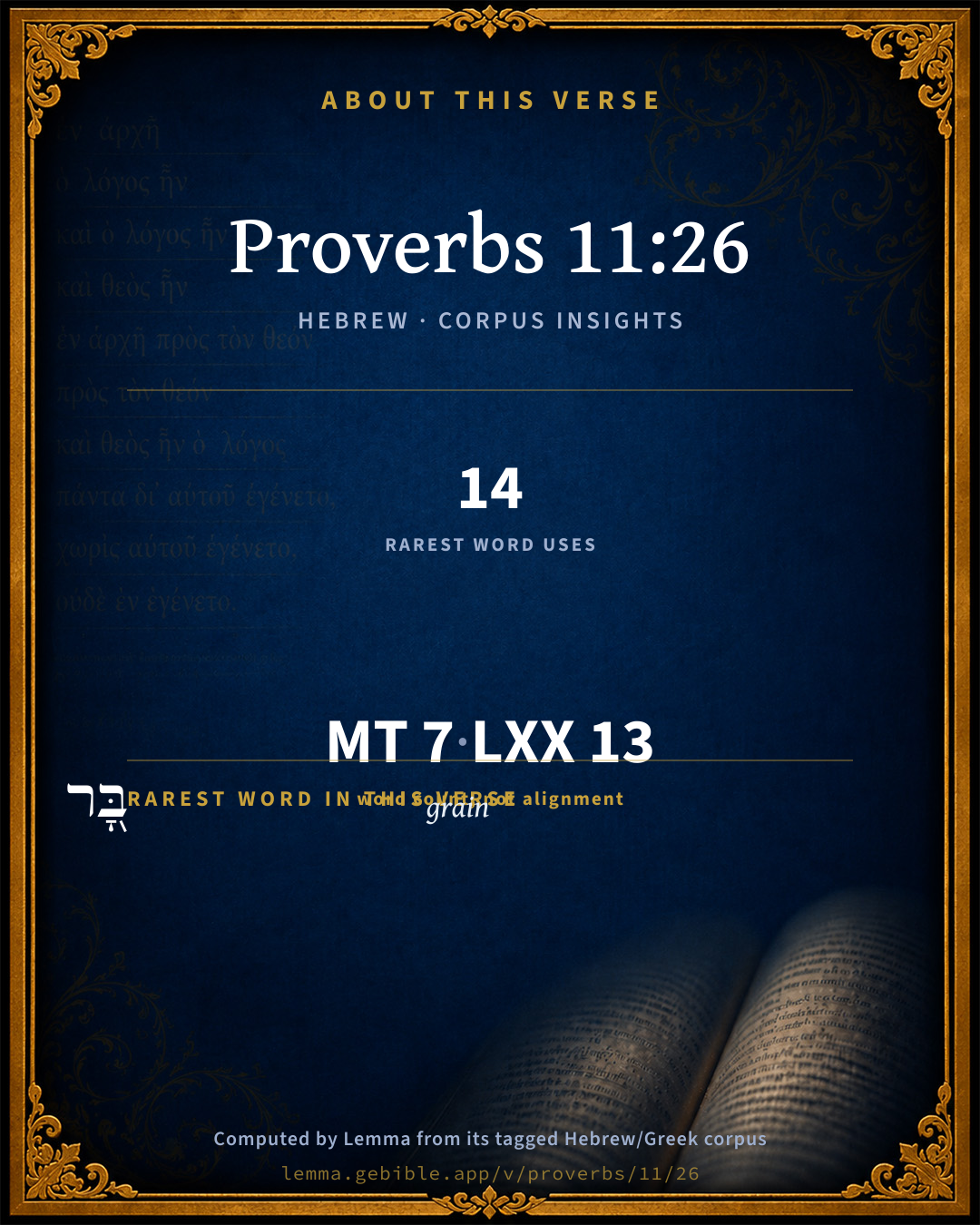
The rarest word here is בָּ֭ר grain H1250 — appearing just 14 times in the whole Hebrew Bible.

Shared distinctive vocabulary

בָּ֭ר grain H1250 occurs in 14 verses of the Hebrew Bible. Also found in:

Grammatical profile

  • 3 verbs
  • 4 nouns

Verb forms

  • מֹ֣נֵֽעַ Qal · Participle Active
  • יִקְּבֻ֣הוּ Qal · Imperfect
  • מַשְׁבִּֽיר Hiphil · Participle Active

Hebrew & Septuagint length

In English translation the verse runs 18 words from the Hebrew and 21 from the Septuagint (LXX English) — closely comparable.

A rough comparison of the two English renderings, which tokenize alike — not a word-level alignment.

Word counts can differ between the Hebrew and the Greek without any difference in meaning — e.g. the Hebrew direct-object marker אֵת has no separate Greek word, and Greek often adds the article ὁ.

In the original languages it is 7 Hebrew tokens and 13 Greek tokens — but the two are counted differently (Hebrew bundles its prefixes and suffixes into one token; the Greek is in lemma form), so that isn’t a like-for-like length.

Cross-references

4

Topical passages linked to Proverbs 11:26 in the Treasury of Scripture Knowledge — connected by theme and wording, ordered by reader-vote popularity; previews shown in the World English Bible.

  • Genesis 42:6 Joseph was the governor over the land. It was he who sold to all the people of the land. Joseph's brothers came, and bowed themselves down to him with their faces to the earth.
  • Job 29:13 The blessing of him who was ready to perish came on me, And I caused the widow's heart to sing for joy.
  • Amos 8:4–6 Hear this, you who desire to swallow up the needy, And cause the poor of the land to fail,
  • Proverbs 24:24 He who says to the wicked, "You are righteous;" Peoples shall curse him, and nations shall abhor him--

Cross-references courtesy of OpenBible.info (CC BY 4.0).

Hebrew and Greek witnesses Masoretic Hebrew ↔ Greek Septuagint

The same verse in the two great witnesses to the Old Testament, shown verse-for-verse.

These are two independent witnesses, not word-aligned to each other, and the Septuagint is shown in lemma (dictionary) form.

Hebrew Proverbs 11:26 Masoretic · Westminster Leningrad Codex

מֹ֣נֵֽעַ בָּ֭ר יִקְּבֻ֣הוּ לְא֑וֹם וּ֝בְרָכָ֗ה לְרֹ֣אשׁ מַשְׁבִּֽיר

People curse someone who withholds grain, But blessing will be on the head of him who sells it.

World English Bible · Public Domain

Greek LXX Proverbs 11:26 Septuagint · lemma form

ὁ συνεχής σῖτος ὑπολείπω αὐτός ὁ ἔθνος εὐλογία δέ εἰς κεφαλή ὁ μεταδίδωμι

May he that hoards corn leave it to the nation: but blessing be on the head of him that gives it.

LXX2012 (modern English Septuagint) · Public Domain

On this verse, John Gill's Exposition discusses the Septuagint’s reading. Read the note in Commentary ↓

Hebrew: Westminster Leningrad Codex (CC BY 4.0). Greek: Septuagint (public domain); English from LXX2012 (modern English Septuagint) (Public Domain). How the Septuagint differs from the Hebrew →

Commentary

Notes on Proverbs 11:26 from classic Christian and Jewish commentators (each source and its license shown beneath its notes). The classic Christian expositions comment on the surrounding passage and are grouped to its opening verse, so a note may address several verses; the Jewish commentaries on the Tanakh (Rashi and others) are per-verse, so they appear only where the commentator wrote on this verse.

Lemma curates 59 commentaries, every one of them public domain or Creative Commons licensed, each selected and text-cleaned for this edition rather than reprinted as found. About our sources →

Trapp's Complete Commentary

John Trapp

Pro 11:26 He that withholdeth corn, the people shall curse him: but blessing [shall be] upon the head of him that selleth [it].

Ver. 26. The people shall curse him,] i.e., Complain and cry out of him, as the people of Rome did of Pompey in another case. Nostra miseria tu es magnus. Our misery is you greatness. In another case, I say; for in this I must acquit him, remembering that speech of his, when, being by his office to bring in corn from a far country for the people’s necessity, and wished by his friends to stay for a better wind, he hoisted up sail, and said: Necesse est ut eam, non ut vivam - there is a necessity of my going, not so of my life; if I perish, I perish. Hence he was the people’s Corculum, or sweetheart, as it is said of Scipio Nasica.

John Trapp, A Commentary or Exposition upon All the Books of the Old and New Testament (1647–1656) — public domain. Text from a community e-Sword module.

The Biblical Illustrator

Joseph S. Exell

Pro_11:26

He that withholdeth corn, the people shall curse him.

Withholding corn

The text has to do with owners of corn and dealers in it. In Solomons day famines were frequent, and were serious because trade communications between different countries were so uncertain. Then persons would buy up all the corn they could, so as to unduly raise the market-price. In relation to this greed in trade, there is a wonderful reserve of Holy Scripture. Mr. Arnot says, In this brief maxim no arbitrary rule is laid down to the possessor of corn, that he must sell at a certain period and at a certain price: and yet the hungry are not left without a protecting law. The protection of the weak is entrusted not to small police regulations, but to great self-acting providential arrangements. The double fact is recorded in terms of peculiar distinctness, that he who in times of scarcity keeps up his corn in order to enrich himself is loathed by the people, and he who sells it freely is loved. This is all. There is no further legislation on the subject. Laws which interfere between buyer and seller, master and workman, are blunders and nuisances. The market goes best when it is left alone, and so in our text there is no law enacted and no penalty threatened, except that which the nature of things makes inevitable. A man may do as he pleases about selling or not, but he cannot escape from the curse of the people if he chooses to lock up his grain. But if it bring a curse upon a man to withhold the bread that perisheth, what a weight of curse will light upon the man who withholds the bread of eternal life.

I. How can this be done?

1. By locking up the Word of God in an unknown language, or by delivering and preaching it in such a style that the people shall not comprehend it. Illustrate by the practice of the Roman Church. But the terms of theology, the phrases of art, the definitions of philosophy, the jargon of science, are an unknown tongue to the young godly ploughmen, or praying shopkeepers. Simplicity is the authorised style of true gospel ministry.

2. By keeping back the most important and vital truths of revelation, and giving a prominence to other things, which are but secondary. Morality brings no food to hungry souls, although it is good enough in its place. Dissuasives from vice are not the bread of heaven, though well enough in their way. We need to have the great doctrines of grace brought forward, for the Word of God is the sword of the Spirit, and it is by preaching the truth as it is in Jesus that souls are won to Him.

3. By want of loving zeal in our labour. That which God blesses to the saving of sinners is truth attended by the earnestness of the speaker. Think of the preaching of Baxter. We are guilty of withholding corn unless we preach with a sympathising, loving, tender, affectionate, earnest, anxious soul.

4. By refusing to labour zealously for the spread of the kingdom of Christ and the conversion of sinners.

5. By refusing to help those who are working for Christ. I cannot understand how a man can love God when he only lives to heap up riches.

II. The blessedness which those possess who break the bread of life. To describe it is altogether beyond my power. You must know, and taste, and feel it. There are many blessednesses in doing good to others.

1. An easy conscience.

2. Comfort in doing something for Jesus.

3. Watching the first buddings of conviction in a young soul.

4. The joy of success.

5. The final and gracious reward.

III. Now I have to open the granary myself. Hungry sinners, wanting a Saviour, we cannot withhold the bread from you! We tell you the way of salvation.

1. It is a satisfying salvation.

2. It is an all-sufficient salvation.

3. It is a complete salvation.

4. It is a present salvation.

5. It is an available salvation. (C. H. Spurgeon.)

The right to withhold

The text may be regarded as suggestive of a still higher thought than the one to which it is limited. If men have no right to withhold corn, what right can they have to withhold knowledge? If it is an evil thing to injure the body or expose it to danger, what is it to injure the soul or to expose it to the peril of eternal loss? If it is wrong to keep back bread from the body, what must it be to keep back bread from the soul? An important doctrine is involved in the whole text; there are some things which a man may possess, as it were, for himself, and enjoy without sharing his delight with others; a man may have many precious stones, and may conceal them, and permit no eye but his own to look upon them, or hand to touch them but his own: so be it; the pleasure is a narrow and selfish one, and no great social consequences attend its enjoyment. On the other hand, it would seem as if no man could have private property in corn or in bread, in the sense of saying to the people, I have it, but you shall not possess it; though you offer double its price I will not allow you to take it from me unless you multiply the price fivefold. A man may talk thus about diamonds and rubies, but he is not at liberty to talk thus about bread. A man may have great property in pictures, but it is questionable whether he should have any property in land in any sense that makes the people dependent upon his caprice as to whether it shall be cultivated and turned to the highest uses. It would seem as if light and air and land were universal possessions, and that all men were equally welcome to them. In the case of the land, it may be necessary that there should be temporary proprietorship, or some regulated relation to it so as to prevent robbery; but with such regulated relation proprietorship might well terminate. All this issue, however, can only be realised as the result of the largest spiritual education. It is difficult to persuade any great landed proprietor that he ought to surrender his rights for the good of the commonwealth. This can only come after years, it may be even centuries, of education of the most spiritual kind; or if it come earlier by statesmanship, it must also come justly, for even good rights may be created by faulty processes, and by mere lapse of time ownerships may be set up which have no original force. We shall never have a commonwealth founded upon righteousness and inspired by the spirit of patriotism until we are just to every interest which stands in the way of its realisation. (J. Parker, D.D.)

The Biblical Illustrator, edited by Joseph S. Exell (c. 1880s–1900s) — public domain. Text from a community e-Sword module.

Joseph Benson's Commentary

Pro 11:26. He that withholdeth corn — In a time of scarcity, when others need and desire it; the people shall curse him — He shall fall into the popular hatred, and be loaded with many curses; but blessing — Namely, the blessing of God, which the people shall earnestly ask for him; shall be upon the head of him that selleth it — Upon reasonable terms. “The truth of this,” says Dr. Dodd, “is experienced in all times of scarcity. They who have the hardness of heart to withhold their corn at such seasons are accursed of God and men. The justice of God fails not to display itself upon those who are insensible to the miseries of the public, and who are not afraid to bring upon themselves the hatred and curses of the people:” see Amo 8:5-7, and Calmet.

Joseph Benson's Commentary on the Old and New Testaments (1811–1818) — public domain. Text from a community e-Sword module.

Geneva Bible (1599)

Geneva Bible translators

That provideth for the use of them that are in necessity.

Geneva Bible (1599) marginal notes — public domain. Text via Bolls.life.

Matthew Henry's Commentary

See here, 1. What use we are to make of the gifts of God's bounty; we must not hoard them up merely for our own advantage, that we may be enriched by them, but we must bring them forth for the benefit of others, that they may be supported and maintained by them. It is a sin, when corn is dear and scarce, to withhold it, in hopes that it will still grow dearer, so to keep up and advance the market, when it is already so high that the poor suffer by it; and at such a time it is the duty of those that have stocks of corn by them to consider the poor, and to be willing to sell at the market-price, to be content with moderate profit, and not aim to make a gain of God's judgments. It is a noble and extensive piece of charity for those that have stores wherewithal to do it to help to keep the markets low when the price of our commodities grows excessive. 2. What regard we are to have to the voice of the people. We are not to think it an indifferent thing, and not worth heeding, whether we have the ill will and word, or the good will and word, of our neighbours, their prayers or their curses; for here we are taught to dread their curses, and forego our own profit rather than incur them; and to court their blessings, and be at some expense to purchase them. Sometimes, vox populi est vox Dei - the voice of the people is the voice of God.

Matthew Henry's Commentary on the Whole Bible (1708–1710) — public domain (CC PDM 1.0). Text via the HelloAO Bible API.

Jamieson, Fausset & Brown

Robert Jamieson, A. R. Fausset & David Brown

Another example of the truth of Pro 11:23; the miser loses reputation, though he saves corn.

selleth it--that is, at a fair price.

Jamieson, Fausset & Brown — Commentary Critical and Explanatory on the Whole Bible (1871) — public domain (CC PDM 1.0). Text via the HelloAO Bible API.

Adam Clarke's Commentary

Verse 26. He that withholdeth corn] Who refuses to sell because he hopes for a dearth, and then he can make his own price.

The people shall curse him] Yes, and God shall curse him also; and if he do not return and repent, he will get God's curse, and the curse of the poor, which will be a canker in his money during time, and in his soul throughout eternity.

Adam Clarke's Commentary on the Bible (1810–1826) — public domain. Text from a community e-Sword/MySword module.

Ellicott's Commentary for English Readers

(26) He that withholdeth corn till it has reached an exorbitant price, “the people shall curse him: but blessing shall be upon the head of him that selleth it” at a fair price. The truth of this is not affected by the fact that the dealer’s selfishness is in the long run beneficial to the community by limiting consumption in consequence of the rise in the price of corn.

A Bible Commentary for English Readers, edited by Charles John Ellicott (1878–1897) — public domain. Text from a community e-Sword module.

The Cambridge Bible for Schools and Colleges

gen. ed. J. J. S. Perowne

26. withholdeth] e.g. by keeping back his store in time of necessity to run up the price. See Amo_8:4-6, and comp. the legend of Bishop Hatto.

The Cambridge Bible for Schools and Colleges (gen. ed. J. J. S. Perowne; Cambridge University Press, 1878–1918) — public domain. Text from a community e-Sword module.

John Gill's Exposition

He that withholdeth corn, the people shall curse him,.... That hoards it up for a better price, in hopes of a better market; and does not bring it out, and expose it to sale, when there is a scarcity of it; so the Targum adds, "in famine"; or, "in straits", as the Syriac version; in a time of distress through, famine: this will bring the curse of the poor upon him, who will imprecate the most dreadful things on him and his family. Jarchi interprets it of the law, and of withholding the teaching of it; but it may be better applied to the Gospel, and the withholding the ministration of that, and so causing a famine, not of bread and of water, but of hearing the word of the Lord; which is done by the Papists, by prohibiting Gospel ministers preaching the word; forbidding the people to read it in their own language; locking it up from them in a language they understand not; and so starve the souls of men, which brings upon them a curse;

but blessing shall be upon the head of him that selleth it; at a moderate price, so that the poor may be able to come at it; such will have their blessing; they will wish all happiness to them and their families, here and hereafter. Or, "that breaks" (d) it; separates it from the heap, breaks and grinds it into flour, and then sells it: or imparts it freely; so the Septuagint version, "that communicates": and the Arabic version, "that gives"; and may be fitly applied to a faithful minister of the Gospel, who breaks the bread of life, and freely and plentifully imparts it to the souls of men; and who has the hearty prayers and good wishes of the people to whom he ministers. The master of a family used to break the bread, as Christ often did.

(d) "frangentis", Montanus.

John Gill's Exposition of the Whole Bible (1746–1763) — public domain (CC PDM 1.0). Text via the HelloAO Bible API.

Albert Barnes' Notes on the Bible

In the early stages of commerce there seems no way of making money rapidly so sure as that of buying up grain in time of famine, waiting until the dearth presses heavily, and then selling at famine prices. Men hate this selfishness, and pour blessings upon him who sells at a moderate profit.

Albert Barnes' Notes on the Bible (1834–1885) — public domain. Text from a community e-Sword/MySword module.

Haydock's Catholic Bible Commentary

Corn. In times of scarcity. See Amos viii. 7.

George Leo Haydock (1774–1849), Haydock's Catholic Family Bible and Commentary, 1859 edition — public domain. Excludes Psalms (Douay-Rheims chapter numbering differs from Protestant) and Deuterocanonical books (Catholic canon only).

Matthew Poole's English Annotations

Withholdeth corn, in a time of scarcity, when others need and desire it.

Blessing; the blessing of God, which the people shall heartily beg for him.

That selleth it upon reasonable terms.

Matthew Poole's English Annotations on the Holy Bible (1683–1685) — public domain. Text from a community e-Sword/MySword module.

Whedon's Commentary on the Bible

Daniel D. Whedon

26. Withholdeth — Selfishly garners it up when the grain is needed to prevent famine.

People shall curse him — Shall utter sharp, piercing words concerning him. “He that hoardeth up corn in the time of scarcity, on purpose to raise the price, shall fall into the popular hatred, and be loaded with many a curse; but he who opens his granaries, and sells at a moderate rate, shall not only have the people’s goodwill, but the blessing of God.” — Patrick. The first clause applies to all speculating monopolizers of the necessaries of life. Job_29:13; Amo_8:5.

Daniel D. Whedon (gen. ed.), Commentary on the Old and New Testaments (1874–1909) — public domain. Text from a community e-Sword module.

The Pulpit Commentary

He that withholdeth corn. The practice reprehended is not confined to any one time or place. The avaricious have always been found ready to buy corn and other necessary articles of consumption when plentiful, and wait till there was dearth in the market or scarcity in the land, and then sell them at famine prices. Amos sternly reproves this iniquity. (Amo_8:4, etc.) It is a sin against justice and charity, and it is said of him who is guilty of it, the people shall curse him. (Pro_24:24) Such selfishness has often given rise to tumult and bloodshed, and has been punished in a signal manner. The legend of Bishop Hatto shows the popular feeling concerning these Dardanarians, as they were called by Ulpian ("Digest. Justin.," 47:11.6). Such a one St. Chrysostom ("Hom. in 1Co:," 39) calls "a common enemy of the blessings of the world, and a foe to the liberality of the Lord of the world, and a friend of mammon, or rather his slave." The Septuagint gives a curious rendering: "He who holdeth corn may he leave it for the peoples!" i.e. may neither he nor his heirs be benefited by his store, but may it be distributed among others far and near! That selleth it; literally, that breaketh it, as it is said of Joseph when he sold corn to the Egyptians. (Gen_41:56 Gen_42:6)

The Pulpit Commentary (1880–1919), ed. H.D.M. Spence-Jones & Joseph S. Exell — public domain. Text from a community e-Sword module.

John Wesley's Explanatory Notes

With-holdeth corn - In a time of scarcity. Selleth - Upon reasonable terms.

John Wesley, Explanatory Notes Upon the Whole Bible (1754–1765) — public domain. Text via the GEBible commentary corpus.

Keil & Delitzsch

C. F. Keil & F. Delitzsch

The following proverbs are especially directed, as connected with this כן, against the contradiction of the external appearance and of the masked internal nature.

20 An abomination to Jahve are the crookedly dishonest of heart,

And they who are of honest walk are his delight.

Keil & Delitzsch — Biblical Commentary on the Old Testament (1861–1891) — public domain (CC PDM 1.0). Text via the HelloAO Bible API. (Old Testament only.)

Bridges on Proverbs

Charles Bridges

This is a piece of sacred ’political economy.’ It reminds us, that we are the stewards of the gifts of God. (2Co 9:11 .) To use them therefore for our own interest, without a due regard to our neighbour, is unfaithfulness to our trust. (Mat 25:26-27 .) A flagrant sin, therefore, is it to withhold the very "staff of life" (Isa 3:1 ); holding back the hand of God stretched out in bounty over our land. This may indeed be a prudential restraint in the time of scarcity. (Gen 41:46-49 .) Private interest may also claim a measure of consideration. But a grinding spirit; a spirit of selfish monopoly; raising the price for gain, with manifest suffering to the poor — will bring a piercing curse.†1 And here the curse of the people may be the curse of God. For if the cry of oppressed individuals (Exo 22:22-24 . Jas 5:4 ) — much more that of an oppressed people — will "enter into the ears of the LORD of Sabaoth." (Amo 8:4-8 .) His withering blast upon withholden corn has often scourged this merciless covetousness.

The point of the antithesis apparently fails, only to give stronger security to the blessing. The curse comes directly from the people; the blessing from above. To him that subordinates his own interest to the public good — blessings shall be upon his head (Pro 10:6 ), descending immediately from the fountain of all grace.

Would that the cry for the "bread of life" were as earnest and universal as for the bread that perisheth! But if he be justly cursed that withholds the one; much more he, that unfaithfully and cruelly withholds the other. And if blessings be upon the head of him, that selleth the corn of this life; what is his privilege, who sells not indeed the bread of life, but freely dispenses it to his fellow-sinners! "The blessing of him that was ready to perish shall come upon him." (Job 29:13 .) The supply is abundant. Let the invitation be welcomed. (Isa 55:1 .)

Footnotes:

†1 The original implies the piercing of a sword, or dagger; as if the selfish spoiler was, as it were, pierced through and stabbed to death by the curses of the people. — Cartwright in loco. The system of speculating in corn, in cruel disregard of the poor, was rebuked by a popular preacher in the latter days of Elizabeth, in the true spirit of Latimer — ’The poor man must needs sell presently to maintain his family, to pay his rents. And that which he sells the rich cormorant buys that hath money enough lying by him, to hoard it up, that he may sell it dearer after. These buyers commonly dwell in market-towns, and wait to get into their hands all the corn (if it were possible) in the country. Nay — they will not only wait at home, but they will travel abroad into the country to those men, whom they know have great plenty of cord to sell, and will bargain aforehand with them for as much as they can spare, and so will prevent the market. And when they have it in their garners, they make the price at their pleasure. Surely this is a wolf of the soul. Some others will sell at home to their poor neighbours; but they will make them pay for their ease. They shall pay, above the market something; or else they will let them have none. They know the poor man must need have it. He cannot buy it in the market, because he cannot then convey it home; and knowing this his necessity, they will make him pay above all reason. And that also which makes their sin more heinous; if they send any corn to market, they will dress it very clean, and it shall be of their best corn. But if they sell at home, they which buy shall be constrained to take their worst or meanest, and not so well dressed.’ A godly and fruitful sermon, preached at Grantham A.D. 1592, by Francis Trigge.

Charles Bridges, An Exposition of the Book of Proverbs (1846) — public domain. Text from a community e-Sword module.

Kretzmann's Popular Commentary

Paul E. Kretzmann

v. 26. He that withholdeth corn, as is done to this day in the so-called dealing in "futures" and in "corners in wheat," the people shall curse him, for such speculative manipulations raise the price of the necessities of life; but blessing shall be upon the head of him that selleth it, not holding it for purposes of speculation, but disposing of it as there is need.

Paul E. Kretzmann, Popular Commentary of the Bible (1921–1924) — public domain. Text from a community e-Sword module.

Rashi

Rabbi Shlomo Yitzchaki (Rashi)

He who keeps back grain [who refrains] from teaching Torah.

Rashi on the Tanakh — English translations: “The Judaica Press complete Tanach with Rashi, translated by A. J. Rosenberg” (CC BY 4.0); “Pentateuch with Rashi's commentary by M. Rosenbaum and A.M. Silbermann, 1929-1934” (public domain); “The Metsudah Tanach series, Lakewood, N.J” (CC BY 4.0); and “The Book of Joshua, Metsudah Publications, 1997” (CC BY 4.0). Text via Sefaria.

Lesson kit

Teaching starters — assembled from the data on this page, not authored interpretation. Every prompt links to the verse data it draws on. Edit before teaching.

Proverbs, in the Wisdom, opens this verse with 7 words (7 distinct Hebrew lemmas). Its most distinctive word is bâr (“grain”). A historical commentator’s framing appears above. Read the whole chapter for the surrounding context.

Discussion questions

  1. The word bâr carries the sense “grain.” How does it shape the verse?
  2. How does Genesis 41:35, which shares the word «grain», read alongside this verse?
  3. These translations render this verse differently. What is at stake in choosing one wording over another?
  4. «מֹ֣נֵֽעַ» is a Qal Participle Active verb. How does that grammatical form shape the action described?
  5. Compare how Trapp's Complete Commentary and The Biblical Illustrator read this verse. Where do they agree or differ?

Things to notice

Reading settings

Reading text

Shown beneath each verse's original-language words.

Old Testament
Old Testament edition

Read the OT as the Masoretic Hebrew (MT) or the Greek Septuagint (LXX).

English shown for the Greek Septuagint (in the Hebrew ↔ Greek comparison).

Comparing translations? Open the Compare panel on any verse page to stack up to four side by side.