
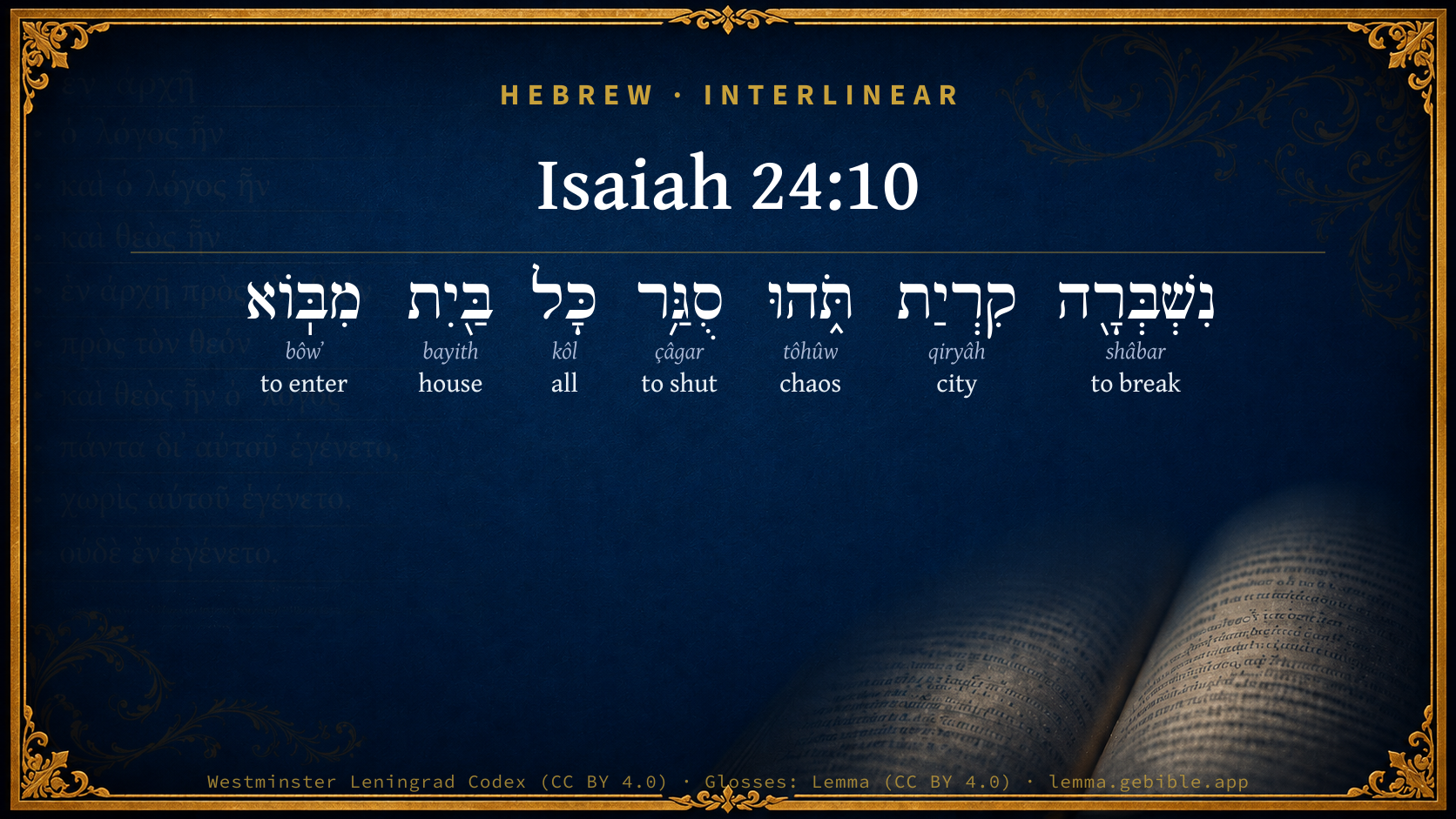
Isaiah 24:10

Hebrew (Westminster Leningrad Codex) Isaiah 24:10 appears in the Hebrew Old Testament. The text above is from the Westminster Leningrad Codex. Each word links to its Strong’s number, a concise gloss, and parsing drawn from the Open Scriptures Hebrew Bible morphology. Click any word for its full Brown-Driver-Briggs (BDB) entry.
Download image
Cite this verse

Isaiah 24:10 (World English Bible). Public Domain. Lemma interlinear Bible study tool, https://lemma.gebible.app/v/isaiah/24/10.

Show BibTeX & RIS
BibTeX
RIS
English Translation
The waste city is broken down; every house is shut up, that no man may come in.
World English Bible · Public Domain
Download a study sheet

One document with this verse’s original text, its word-by-word gloss line, the meaning frame, cross-references with their text, attributed commentary, and full source and license credits — printable, and it pastes into notes with its structure intact.

This verse Autodidact and up

Study sheet (.html) Plain text (.txt)

A passage Seminary Student

Up to 50 verses in one chapter. A passage sheet keeps up to 6 commentary sources and 12 cross-references per verse, in the order this page ranks them, and says so on the sheet whenever that leaves anything out. Ask for a single verse and you get the Autodidact verse sheet above.

Everything on this page stays free to read, with no account — the sheet is a download of what is already on screen, not access to it.

Want to remove ads? Support Godless Engineer
Compare translations 3

The same verse in 3 English versions, stacked beneath the original-language interlinear above. Click any original word for its lexicon entry.

Each is an independent rendering of the whole verse — the interlinear is not word-aligned to these translations.

Highlighted words mark where these versions differ — a whole-verse word diff, not a word-by-word alignment.

  • World English Bible Public Domain
    The waste city is broken down; every house is shut up, that no man may come in.
  • King James Version Public Domain
    The city of confusion is broken down: every house is shut up, that no man may come in.
  • unfoldingWord Literal Text CC BY-SA 4.0
    The city of emptiness is broken down; every house is shut from entering.

unfoldingWord Literal Text — © unfoldingWord, licensed CC BY-SA 4.0. Word-aligned USFM3 via Door43 (git.door43.org/unfoldingWord/en_ult).

Versions to compare (up to 4)

3 of 4 selected

Show all 18 translations

Every available English version of this verse, each an independent rendering of the whole verse.

  • World English Bible Public Domain
    The waste city is broken down; every house is shut up, that no man may come in.
  • Berean Standard Bible Public Domain
    The city of chaos is shattered; every house is closed to entry.
  • Majority Standard Bible Public Domain
    The city of chaos is shattered; every house is closed to entry.
  • King James Version Public Domain
    The city of confusion is broken down: every house is shut up, that no man may come in.
  • American Standard Version (1901) Public Domain
    The waste city is broken down; every house is shut up, that no man may come in.
  • Revised Version (1885) Public Domain
    The city of confusion is broken down: every house is shut up, that no man may come in.
  • Geneva Bible (1599) Public Domain
    The citie of vanitie is broken downe: euery house is shut vp, that no man may come in.
  • Douay-Rheims (1899) Public Domain
    The city of vanity is broken down, every house is shut up, no man cometh in.
  • Young's Literal Translation Public Domain
    It was broken down -- a city of emptiness, Shut hath been every house from entrance.
  • Literal Standard Version CC BY-SA 4.0
    It was broken down—a city of emptiness, || Every house has been shut from [its] entrance.
  • Unlocked Literal Bible CC BY-SA 4.0
    The city of chaos has been broken down; every house is closed up and empty.
  • unfoldingWord Literal Text CC BY-SA 4.0
    The city of emptiness is broken down; every house is shut from entering.
  • Darby Bible Public Domain
    The city of solitude is broken down; every house is shut up, so that none entereth in.
  • World Messianic Bible Public Domain
    The confused city is broken down. Every house is shut up, that no man may come in.
  • Webster's Bible Public Domain
    The city of confusion is broken down: every house is shut up, that no man may enter.
  • Free Bible Version CC BY-SA 4.0
    The chaotic city is falling apart; every house is barred shut to keep others out.
  • Bible in Basic English Public Domain
    The town is waste and broken down: every house is shut up, so that no man may come in.
  • JPS Tanakh (1917) Public Domain
    Broken down is the city of wasteness; every house is shut up, that none may come in.

Literal Standard Version (2020), Covenant Press — licensed CC BY-SA 4.0. Text via the HelloAO Bible API (eBible.org). Unlocked Literal Bible (unfoldingWord) — licensed CC BY-SA 4.0. Text via the HelloAO Bible API (eBible.org). unfoldingWord Literal Text — © unfoldingWord, licensed CC BY-SA 4.0. Word-aligned USFM3 via Door43 (git.door43.org/unfoldingWord/en_ult). Free Bible Version, Dr. Jonathan Gallagher — licensed CC BY-SA 4.0. Text via the HelloAO Bible API (eBible.org).

Word by word

More ways to search: Search by grammar → Find every occurrence → Compare this word →

Practice this passage: Drill this verse → Learn its vocabulary →

About this verse

These counts appear in no published source. They are computed here, from the morphology-tagged text and Lemma’s own curated glosses. What Lemma adds →

7
words
7
distinct lemmas
Prophets
section

Notable vocabulary

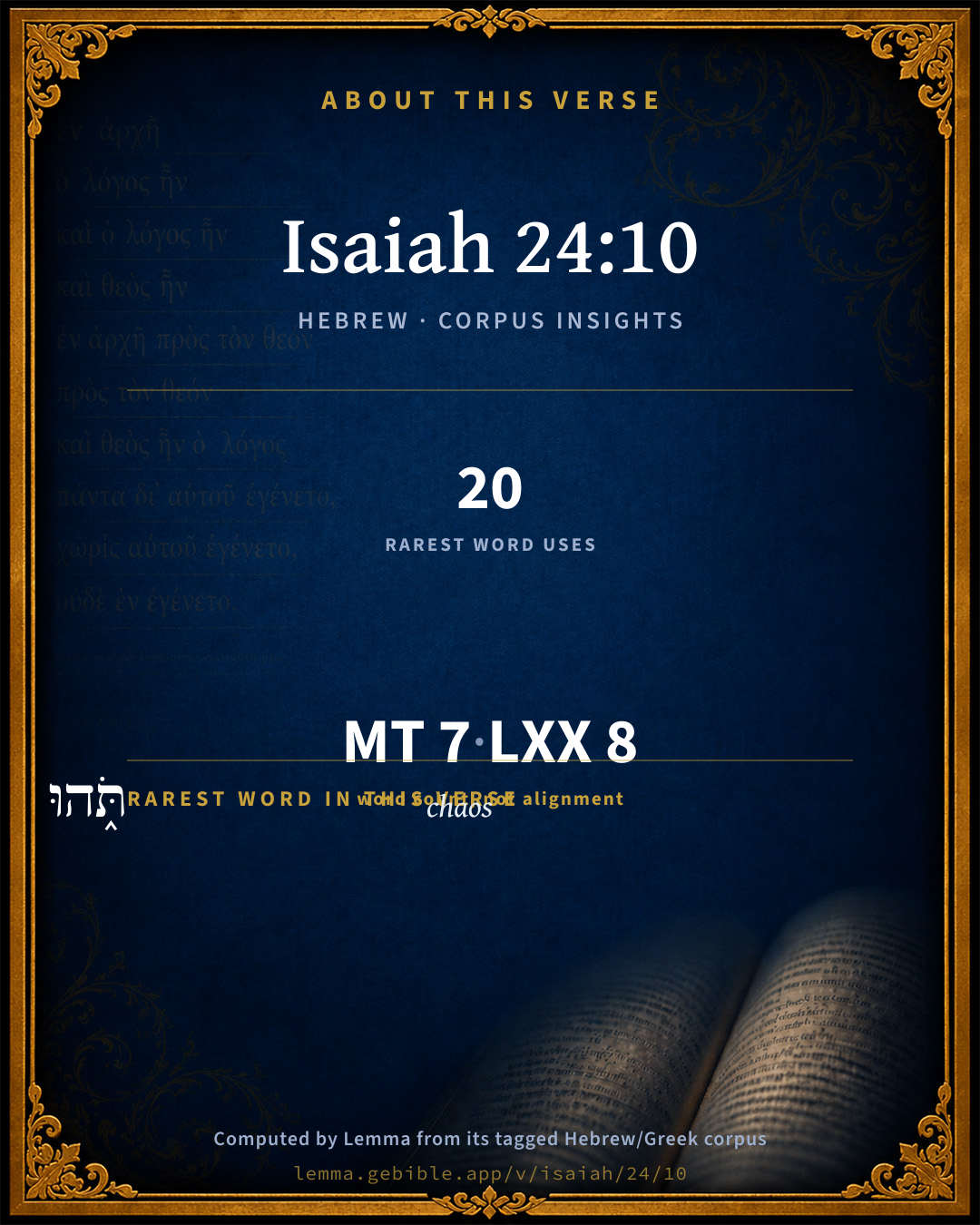
The rarest word here is תֹּ֑הוּ chaos H8414 — appearing just 20 times in the whole Hebrew Bible.

Shared distinctive vocabulary

תֹּ֑הוּ chaos H8414 occurs in 19 verses of the Hebrew Bible. Also found in:

Grammatical profile

  • 3 verbs
  • 4 nouns

Verb forms

  • נִשְׁבְּרָ֖ה Niphal · Perfect
  • סֻגַּ֥ר Pual · Perfect
  • מִבּֽוֹא Qal · Infinitive Construct

Hebrew & Septuagint length

In English translation the verse runs 17 words from the Hebrew and 16 from the Septuagint (LXX English) — closely comparable.

A rough comparison of the two English renderings, which tokenize alike — not a word-level alignment.

Word counts can differ between the Hebrew and the Greek without any difference in meaning — e.g. the Hebrew direct-object marker אֵת has no separate Greek word, and Greek often adds the article ὁ.

In the original languages it is 7 Hebrew tokens and 8 Greek tokens — but the two are counted differently (Hebrew bundles its prefixes and suffixes into one token; the Greek is in lemma form), so that isn’t a like-for-like length.

Cross-references

23

Topical passages linked to Isaiah 24:10 in the Treasury of Scripture Knowledge — connected by theme and wording, ordered by reader-vote popularity; previews shown in the World English Bible.

  • Revelation 18:2 He cried with a mighty voice, saying, "Fallen, fallen is Babylon the great, and she has become a habitation of demons, a prison of every unclean spirit, and a prison of every unclean and hateful bird!
  • Revelation 17:5–6 And on her forehead a name was written, "MYSTERY, BABYLON THE GREAT, THE MOTHER OF THE PROSTITUTES AND OF THE ABOMINATIONS OF THE EARTH."
  • Genesis 11:9 Therefore the name of it was called Babel, because Yahweh confused the language of all the earth, there. From there, Yahweh scattered them abroad on the surface of all the earth.
  • 2 Kings 25:4 Then a breach was made in the city, and all the men of war [fled] by night by the way of the gate between the two walls, which was by the king's garden (now the Chaldeans were against the city round about); and [the king] went by the way of the Arabah.
  • 2 Kings 25:9–10 He burnt the house of Yahweh, and the king's house; and all the houses of Jerusalem, even every great house, burnt he with fire.
  • Isaiah 23:1 The burden of Tyre. Howl, you ships of Tarshish; for it is laid waste, so that there is no house, no entering in: from the land of Kittim it is revealed to them.
  • Isaiah 24:12 In the city is left desolation, and the gate is struck with destruction.
  • Isaiah 25:2 For you have made of a city a heap, of a fortified city a ruin, a palace of strangers to be no city; it shall never be built.
  • Isaiah 27:10 For the fortified city is solitary, a habitation deserted and forsaken, like the wilderness: there shall the calf feed, and there shall he lie down, and consume the branches of it.
  • Isaiah 32:14 For the palace shall be forsaken; the populous city shall be deserted; the hill and the watch-tower shall be for dens forever, a joy of wild donkeys, a pasture of flocks;
  • Isaiah 34:11 But the pelican and the porcupine shall possess it; and the owl and the raven shall dwell therein: and he will stretch over it the line of confusion, and the plummet of emptiness.
  • Isaiah 34:13–15 Thorns shall come up in its palaces, nettles and thistles in the fortresses of it; and it shall be a habitation of jackals, a court for ostriches.
  • Jeremiah 9:25–26 Behold, the days come, says Yahweh, that I will punish all those who are circumcised in [their] uncircumcision:
  • Jeremiah 39:4 It happened that, when Zedekiah the king of Judah and all the men of war saw them, then they fled, and went forth out of the city by night, by the way of the king's garden, through the gate between the two walls; and he went out toward the Arabah.
  • Jeremiah 39:8 The Chaldeans burned the king's house, and the houses of the people, with fire, and broke down the walls of Jerusalem.
  • Jeremiah 52:7 Then a breach was made in the city, and all the men of war fled, and went forth out of the city by night by the way of the gate between the two walls, which was by the king's garden; (now the Chaldeans were against the city round about;) and they went toward the Arabah.
  • Jeremiah 52:13–14 and he burned the house of Yahweh, and the king's house; and all the houses of Jerusalem, even every great house, burned he with fire.
  • Micah 2:13 He who breaks open the way goes up before them. They break through the gate, and go out. And their king passes on before them, With Yahweh at their head."
  • Micah 3:12 Therefore Zion for your sake will be plowed like a field, And Jerusalem will become heaps of rubble, And the mountain of the temple like the high places of a forest.
  • Matthew 23:34–35 Therefore, behold, I send to you prophets, wise men, and scribes. Some of them you will kill and crucify; and some of them you will scourge in your synagogues, and persecute from city to city;
  • Luke 19:43 For the days will come on you, when your enemies will throw up a barricade against you, surround you, hem you in on every side,
  • Luke 21:24 They will fall by the edge of the sword, and will be led captive into all the nations. Jerusalem will be trampled down by the Gentiles, until the times of the Gentiles are fulfilled.
  • Revelation 11:7–8 When they have finished their testimony, the beast that comes up out of the abyss will make war with them, and overcome them, and kill them.

Cross-references courtesy of OpenBible.info (CC BY 4.0).

Hebrew and Greek witnesses Masoretic Hebrew ↔ Greek Septuagint

The same verse in the two great witnesses to the Old Testament, shown verse-for-verse.

These are two independent witnesses, not word-aligned to each other, and the Septuagint is shown in lemma (dictionary) form.

Hebrew Isaiah 24:10 Masoretic · Westminster Leningrad Codex

נִשְׁבְּרָ֖ה קִרְיַת תֹּ֑הוּ סֻגַּ֥ר כָּל בַּ֖יִת מִבּֽוֹא

The waste city is broken down; every house is shut up, that no man may come in.

World English Bible · Public Domain

Greek LXX Isaiah 24:10 Septuagint · lemma form

ἐρημόω πᾶς πόλις κλείω οἰκία ὁ μή εἰςἔρχομαι

All the city has become desolate: one shall shut his house so that none shall enter.

LXX2012 (modern English Septuagint) · Public Domain

Hebrew: Westminster Leningrad Codex (CC BY 4.0). Greek: Septuagint (public domain); English from LXX2012 (modern English Septuagint) (Public Domain). How the Septuagint differs from the Hebrew →

Targum (Aramaic paraphrase)

1

The Targum is the ancient Jewish Aramaic paraphrase of the Hebrew Scriptures — an interpretive translation, not the Hebrew text itself. Onkelos (literal) and Pseudo-Jonathan (expansive) render the Torah, and Jonathan the Prophets. Coverage is partial: where no permissively-licensed English translation exists for a verse, only the Aramaic is shown. This is verse-level text, not a word-by-word alignment to the Hebrew.

  1. Targum Jonathan Prophets (Joshua–Malachi)
    אִתְּבַרַת קַרְתְּהוֹן צְדִיאַת אֲחִידוּ כָל בָּתַּיָא מִלְמֵעַל:

    Their city is broken down, and laid desolate: all their houses are shut up, so that no one can enter.

    Targum Jonathan — Aramaic: “Mikraot Gedolot” (public domain). English: “Sefaria Community Translation” (CC0 1.0 (public-domain dedication)); “London "Chaldee Paraphrase," 1871” (public domain). Text via Sefaria.

Commentary

Notes on Isaiah 24:10 from classic Christian and Jewish commentators (each source and its license shown beneath its notes). The classic Christian expositions comment on the surrounding passage and are grouped to its opening verse, so a note may address several verses; the Jewish commentaries on the Tanakh (Rashi and others) are per-verse, so they appear only where the commentator wrote on this verse.

Lemma curates 59 commentaries, every one of them public domain or Creative Commons licensed, each selected and text-cleaned for this edition rather than reprinted as found. About our sources →

Trapp's Complete Commentary

John Trapp

Isa 24:10 The city of confusion is broken down: every house is shut up, that no man may come in.

Ver. 10. The city of confusion.] Urbs desolanda, destined to desolation: whether it be Babylon, Tyre, Jerusalem, or any other. Mundum intellige in quo nihil nisi vanum, saith Oecolampadius: that is, by this city of vanity - so the Vulgate translateth it - understand the world; according to that of the preacher, "Vanity of vanities, all is vanity." Augustine, in the beginning of that excellent work of his, De Civitate Dei, maketh two opposite cities - the one the city of God, the other the city of the devil; the one a city of verity, the other a city of vanity.

John Trapp, A Commentary or Exposition upon All the Books of the Old and New Testament (1647–1656) — public domain. Text from a community e-Sword module.

Albert Barnes' Notes on the Bible

The city of confusion - That Jerusalem is here intended there can be no doubt. The name ‘city of confusion.’ is probably given to it by anticipation of what it would be; that is, as it appeared in prophetic vision to Isaiah (see the note at Isa 1:1). He gave to it a name that would describe its state when these calamities should have come upon it. The word rendered ‘confusion’ (תהו tôhû) does not denote disorder or anarchy, but is a word expressive of emptiness, vanity, destitution of form, waste. It occurs Gen 1:2 : ‘And the earth was without form.’ In Job 26:7, it is rendered ‘the empty place;’ in 1Sa 12:21; Isa 45:18-19, ‘in vain;’ and usually ‘emptiness,’ ‘vanity’, ‘confusion’ (see Isa 24:10; Isa 40:17; Isa 41:29). In Job 12:24; Psa 107:40, it denotes a wilderness. Here it means that the city would be desolate, empty, and depopulated.

Is broken down - Its walls and dwellings are in ruins.

Every house is shut up - That is, either because every man, fearful of danger, would fasten his doors so that enemies could not enter; or more probably, the entrance to every house would be so obstructed by ruins as to render it impossible to enter it.

Albert Barnes' Notes on the Bible (1834–1885) — public domain. Text from a community e-Sword/MySword module.

Joseph Benson's Commentary

Isa 24:10-12. The city — Jerusalem, and other cities, for the word may be here taken collectively; of confusion — Hebrew, תהו, which signifies vanity, emptiness, desolation, or confusion. And the city may be thus called, either, 1st, In regard of the judgments of God coming upon it, as if he had termed it a city devoted to desolation and destruction: or, 2d, For its sin, a city of confusion and disorder; breaking all the laws and orders which God had established among them; or a city walking in and after vanity, worshipping vain idols, and pursuing vain things. And this may seem the most proper and suitable, that the sin of the city should be pointed out in this word, as the punishment is expressed in the next; is broken down — Its walls, palaces, and temple battered down and demolished; every house is shut up — Either for fear of the enemy, who have entered the city, or because the inhabitants are either fled or dead, or gone into captivity. This seems to be only applicable to the destruction of the city by the Chaldeans, or by the Romans. There is a crying for wine — For the want or loss of their wine; or for the spoiling of the vintage, whereby they were deprived of the means both of their profit and pleasure. In the city is desolation — In Jerusalem itself, that had been so much frequented, there shall be left nothing but desolation; grass shall grow in the streets. The gate is smitten with destruction — The gates of the city are totally ruined, so that the enemy may enter when and where they please. Or, all that used to pass and repass through the gates are smitten, and all the strength of the city is destroyed. How soon can God make a city of order, a city of confusion; and then it will soon be a city of desolation!

Joseph Benson's Commentary on the Old and New Testaments (1811–1818) — public domain. Text from a community e-Sword module.

Tyndale Open Study Notes

Tyndale Open Resources

24:10 city writhes in chaos: With normal levels of urban disarray being raised to chaotic and dangerous disorder, people will be forced to seek refuge in locked homes.

Tyndale Open Study Notes — © Tyndale Open Resources, licensed CC BY-SA 4.0. Text via the HelloAO Bible API.

Geneva Bible (1599)

Geneva Bible translators

Which as it was without order, so now should it be brought to desolation and confusion: and this was not only meant of Jerusalem, but of all the other wicked cities.

Geneva Bible (1599) marginal notes — public domain. Text via Bolls.life.

Jamieson, Fausset & Brown

Robert Jamieson, A. R. Fausset & David Brown

city of confusion--rather, "desolation." What Jerusalem would be; by anticipation it is called so. HORSLEY translates, "The city is broken down; it is a ruin."

shut up--through fear; or rather, "choked up by ruins."

Jamieson, Fausset & Brown — Commentary Critical and Explanatory on the Whole Bible (1871) — public domain (CC PDM 1.0). Text via the HelloAO Bible API.

Ellicott's Commentary for English Readers

(10) The city of confusion.—Better, the city of chaos, the tohu of Gen_1:2, “without form and void.” The world should be cast back out of its cosmos into its primeval chaos. The word is a favourite one with Isaiah (Isa_34:11; Isa_59:4, and nine other passages).

Every house is shut up—i.e., to complete the picture, not because its gates are barred, but because its own ruins block up the entrance.

A Bible Commentary for English Readers, edited by Charles John Ellicott (1878–1897) — public domain. Text from a community e-Sword module.

The Cambridge Bible for Schools and Colleges

gen. ed. J. J. S. Perowne

10. The city of confusion] (or of chaos, Gen_1:2) need not mean “the city destined to become a chaos,” still less “the city of idolatry,” which of course would be epithets inapplicable to Jerusalem. It may simply be equivalent to “the wasted city.”

every house … come in] (cf. ch. Isa_23:1) i.e. the surviving inhabitants have barred their doors, suspicious of the intrusion of unbidden guests.

10–12. Even the “city,” usually the scene of busy and joyous life, shares in the universal sadness. It is difficult to say whether a particular city is meant, or whether the word is used collectively for cities in general. The fulness of the picture gives the impression that the writer has a particular city before his mind, although it stands as a type of many others throughout the world. If this be so, it is most natural to refer the description to Jerusalem, where the prophecy seems to have been written.

The Cambridge Bible for Schools and Colleges (gen. ed. J. J. S. Perowne; Cambridge University Press, 1878–1918) — public domain. Text from a community e-Sword module.

John Gill's Exposition

The city of confusion is broken down,.... Or "of vanity", as the Vulgate Latin version; or of "emptiness" or "desolation"; the word is "tohu", used in Gen 1:2 this is to be understood not of Bethel, where one of Jeroboam's calves was, called Bethaven, or "the house of vanity"; nor Samaria, the chief city of the ten tribes; nor Jerusalem; but mystical Babylon, whose name signifies "confusion"; even the city of Rome, in which there is nothing but disorder and irregularity, no truth, justice, or religion; a city of vanity, full of superstition and idolatry, and devoted to ruin and desolation; and will be broke to pieces by the judgments of God, which will come upon it in one hour, Rev 18:8,

every house is shut up, that no man may come in: or, "from coming in"; not for fear of the enemy, and to keep him out; but because there are no inhabitants in them, being all destroyed by one means or another, by fire or sword, or famine or pestilence, so that there is none to go in or out.

John Gill's Exposition of the Whole Bible (1746–1763) — public domain (CC PDM 1.0). Text via the HelloAO Bible API.

Haydock's Catholic Bible Commentary

Vanity. Jerusalem, (Calmet) or any other city, will be all in confusion. (Haydock) --- In, as was the case in times of mourning, Jeremias ix. 21. (Calmet)

George Leo Haydock (1774–1849), Haydock's Catholic Family Bible and Commentary, 1859 edition — public domain. Excludes Psalms (Douay-Rheims chapter numbering differs from Protestant) and Deuterocanonical books (Catholic canon only).

Matthew Poole's English Annotations

The city; Jerusalem, and other cities; for the singular word may be here taken collectively.

Of confusion; or, of vanity, or emptiness, or desolation; for this Hebrew word signifies all these things. And the city may be thus called, either,

1. In regard of the judgments of God coming upon it, as if he had said, a city devoted to desolation or destruction, to be emptied of its goods and people; or,

2. For its sin, a city of confusion or disorder, breaking all the laws and orders which God had established among them; or a city that walketh with or after vanity, as the Scripture speaks, Job 31:5; Jer 2:5, that loveth and speaketh vanity, as they did, Psa 4:2; 12:2. And this may seem most convenient, that the sin of the city should be noted in this word, as the punishment is expressed in the next.

Every house is shut up; either for fear of the enemy who have entered the city; or rather, because the inhabitants are either fled, or dead, or gone into captivity, and so there are none to go into it, or come out of it.

Matthew Poole's English Annotations on the Holy Bible (1683–1685) — public domain. Text from a community e-Sword/MySword module.

Whedon's Commentary on the Bible

Daniel D. Whedon

10. City of confusion — “Confusion,” not in respect to social order, but external unplacement: thohu, like that in Gen_1:2, chaos; every thing in amorphous fragments and impalpable ruins. No house to enter, no shelter from sun or storm.

Daniel D. Whedon (gen. ed.), Commentary on the Old and New Testaments (1874–1909) — public domain. Text from a community e-Sword module.

The Pulpit Commentary

The city of confusion is broken down. No special city seems to be intended. "Est urbis nomen collective capiendum" (Rosenm Chaos (tohu) reigns in the cities, where there is no civic life, no government, no order, nothing but confusion. Every house is shut up; bolted and barred against intruders. There is no confidence, no friendly intercourse, no visiting.

The Pulpit Commentary (1880–1919), ed. H.D.M. Spence-Jones & Joseph S. Exell — public domain. Text from a community e-Sword module.

John Wesley's Explanatory Notes

The city - Jerusalem, and other cities; for the singular word may be here taken collectively. A city of confusion or disorder, breaking all the laws and orders which God had established among them. Shut up - Because the inhabitants are either dead, or gone into captivity.

John Wesley, Explanatory Notes Upon the Whole Bible (1754–1765) — public domain. Text via the GEBible commentary corpus.

Keil & Delitzsch

C. F. Keil & F. Delitzsch

The world with its pleasure is judged; the world's city is also judged, in which both the world's power and the world's pleasure were concentrated. "The city of tohu is broken to pieces; every house is shut up, so that no man can come in. There is lamentation for wine in the fields; all rejoicing has set; the delight of the earth is banished. What is left of the city is wilderness, and the gate was shattered to ruins. For so will it be within the earth, in the midst of the nations; as at the olive-beating, as at the gleaning, when the vintage is over." The city of tohu (kiryath tōhu): this cannot be taken collectively, as Rosenmller, Arndt, and Drechsler suppose, on account of the annexation of kiryath to tohu, which is turned into a kind of proper name; for can we understand it as referring to Jerusalem, as the majority of commentators have done, including even Schegg and Stier (according to Isa 32:13-14), after we have taken "the earth" (hâ'âretz) in the sense of kosmos (the world). It is rather the central city of the world as estranged from God; and it is here designated according to its end, which end will be tohu, as its nature was tohu. Its true nature was the breaking up of the harmony of all divine order; and so its end will be the breaking up of its own standing, and a hurling back, as it were, into the chaos of its primeval beginning. With a very similar significance Rome is called turbida Roma in Persius (i. 5). The whole is thoroughly Isaiah's, even to the finest points: tohu is the same as in Isa 29:21; and for the expression מבּוא (so that you cannot enter; namely, on account of the ruins which block up the doorway) compare Isa 23:1; Isa 7:8; Isa 17:1, also Isa 5:9; Isa 6:11; Isa 32:13. The cry or lamentation for the wine out in the fields (Isa 24:11; cf., Job 5:10) is the mourning on account of the destruction of the vineyards; the vine, which is one of Isaiah's most favourite symbols, represents in this instance also all the natural sources of joy. In the term ‛ârbâh (rejoicing) the relation between joy and light is presupposed; the sun of joy is set (compare Mic 3:6). What remains of the city בּעיר is partitive, just as בּו in Isa 10:22) is shammâh (desolation), to which the whole city has been brought (compare Isa 5:9; Isa 32:14). The strong gates, which once swarmed with men, are shattered to ruins (yuccath, like Mic 1:7, for yūcath, Ges. 67, Anm. 8; שׁאיּה, ἁπ λεγ, a predicating noun of sequence, as in Isa 37:26, "into desolated heaps;" compare Isa 6:11, etc., and other passages). In the whole circuit of the earth (Isa 6:12; Isa 7:22; hâ'âretz is "the earth" here as in Isa 10:23; Isa 19:24), and in the midst of what was once a crowd of nations (compare Mic 5:6-7), there is only a small remnant of men left. This is the leading thought, which runs through the book of Isaiah from beginning to end, and is figuratively depicted here in a miniature of Isa 17:4-6. The state of things produced by the catastrophe is compared to the olive-beating, which fetches down what fruit was left at the general picking, and to the gleaning of the grapes after the vintage has been fully gathered in (câlâh is used here as in Isa 10:25; Isa 16:4; Isa 21:16, etc., viz., "to be over," whereas in Isa 32:10 it means to be hopelessly lost, as in Isa 15:6). There are no more men in the whole of the wide world than there are of olives and grapes after the principal gathering has taken place. The persons saved belong chiefly, though not exclusively, to Israel (Joh 3:5). The place where they assemble is the land of promise.

Keil & Delitzsch — Biblical Commentary on the Old Testament (1861–1891) — public domain (CC PDM 1.0). Text via the HelloAO Bible API. (Old Testament only.)

J. A. Alexander on Isaiah

Joseph Addison Alexander

“Broken down is the city of confusion (emptiness or desolation), shut up is every house from entering (i.e., so that it is not or cannot be entered).” The city meant is Jerusalem. The last clause might be understood to refer to the closing of the houses by the inhabitants against the enemy, or to their being left unoccupied; but the first clause seems to show that it rather relates to the obstruction of the entrance by the ruins.

Joseph Addison Alexander, The Prophecies of Isaiah (1846–1847; New York: Scribner, 1870–1878) — public domain. Text from a community e-Sword module.

unfoldingWord translationNotes

Door43 World Missions Community

General Information:

Isaiah continues to describe a time in the future when God will judge the earth. Prophets sometimes describe a future event as something in the past or in the present. This emphasizes the event certainly will happen. (See: Predictive Past)

The city of chaos has been broken down

This can be stated in active form. AT: "Yahweh will break down the city of chaos" (See: Active or Passive)

The city of chaos

Possible meanings are 1) the city was in chaos before the Lord breaks it down; the people did not obey God, the government was corrupt, and the city was full of drinking and parties, or 2)the city will be in chaos after God breaks it down. The walls and buildings that were once built strong and tall are now in ruins on the ground. With either meaning it does not mean one city. It refers to cities in general.

every house is closed up and empty

This can be stated in active form. AT: "the people will close up their houses and leave them empty" (See: Active or Passive)

because of the wine

"because there is no wine"

all joy is darkened, the gladness of the land has disappeared

These two phrases mean basically the same thing. AT: "all joy will be gone from the earth" (See: Parallelism)

gladness of the land

Here "land" represents the people of the earth. (See: Metonymy)

translationWords

wine

joy

unfoldingWord translationNotes — © Distant Shores Media and the Door43 World Missions Community, licensed CC BY-SA 4.0. Source: git.door43.org/Door43/en_tn.

Rashi

Rabbi Shlomo Yitzchaki (Rashi)

The wasted city is broken When it is broken, it will be called the wasted city.

from entering for anyone to enter.

Rashi on the Tanakh — English translations: “The Judaica Press complete Tanach with Rashi, translated by A. J. Rosenberg” (CC BY 4.0); “Pentateuch with Rashi's commentary by M. Rosenbaum and A.M. Silbermann, 1929-1934” (public domain); “The Metsudah Tanach series, Lakewood, N.J” (CC BY 4.0); and “The Book of Joshua, Metsudah Publications, 1997” (CC BY 4.0). Text via Sefaria.

Ibn Ezra

Rabbi Abraham ibn Ezra

The city of vanity. The city whose inhabitants go after vain things.

Every house is shut up, that no man can come in. For every one will go out into the streets because of the great trouble.

Ibn Ezra on the Tanakh — English translations: “Sefaria Community Translation” (CC0 1.0 (public-domain dedication)); “Yalkut, Sifsei Chachomim Chumash, Metsudah Publications, 2009” (CC BY 4.0); and “Commentary of Ibn Ezra on Isaiah - trans. by M. Friedlander, 1873” (public domain). Text via Sefaria.

Lesson kit

Teaching starters — assembled from the data on this page, not authored interpretation. Every prompt links to the verse data it draws on. Edit before teaching.

Isaiah, in the Prophets, opens this verse with 7 words (7 distinct Hebrew lemmas). Its most distinctive word is tôhûw (“chaos”). A historical commentator’s framing appears above. Read the whole chapter for the surrounding context.

Discussion questions

  1. How does “chaos” (tôhûw) shape what this verse is saying?
  2. Genesis 1:2 shares the word «chaos» with this verse. How do the two illuminate each other?
  3. These translations render this verse differently. What is at stake in choosing one wording over another?
  4. The verb «נִשְׁבְּרָ֖ה» is Niphal Perfect. How does its form color the action?
  5. Reading how Trapp's Complete Commentary and Albert Barnes' Notes on the Bible read this verse, where do the two commentators agree and where do they part?

Things to notice

Reading settings

Reading text

Shown beneath each verse's original-language words.

Old Testament
Old Testament edition

Read the OT as the Masoretic Hebrew (MT) or the Greek Septuagint (LXX).

English shown for the Greek Septuagint (in the Hebrew ↔ Greek comparison).

Comparing translations? Open the Compare panel on any verse page to stack up to four side by side.