
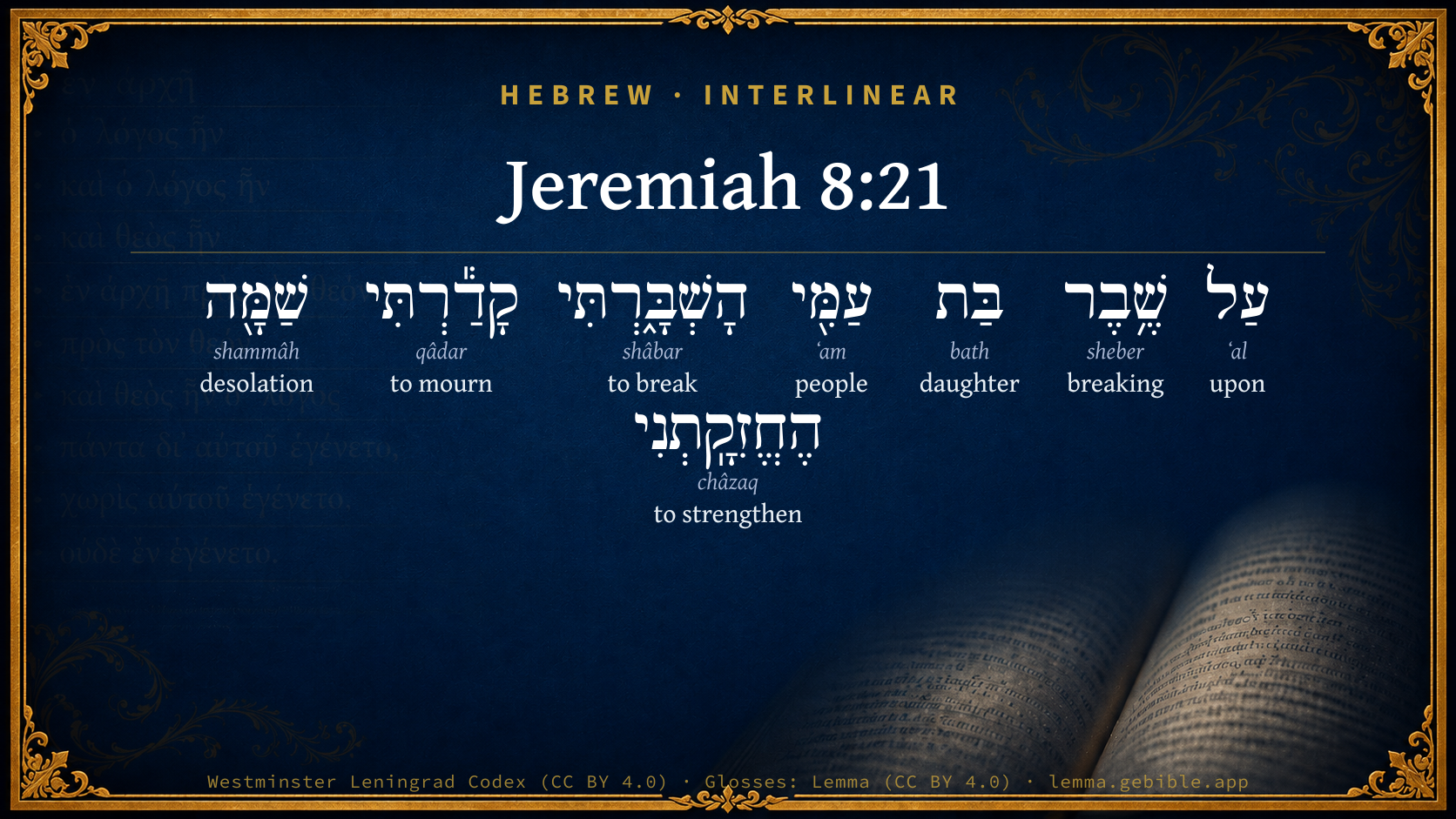
Jeremiah 8:21

Hebrew (Westminster Leningrad Codex) Jeremiah 8:21 appears in the Hebrew Old Testament. The text above is from the Westminster Leningrad Codex. Each word links to its Strong’s number, a concise gloss, and parsing drawn from the Open Scriptures Hebrew Bible morphology. Click any word for its full Brown-Driver-Briggs (BDB) entry.
Download image
Cite this verse

Jeremiah 8:21 (World English Bible). Public Domain. Lemma interlinear Bible study tool, https://lemma.gebible.app/v/jeremiah/8/21.

Show BibTeX & RIS
BibTeX
RIS
English Translation
For the hurt of the daughter of my people am I hurt: I mourn; dismay has taken hold on me.
World English Bible · Public Domain
Download a study sheet

One document with this verse’s original text, its word-by-word gloss line, the meaning frame, cross-references with their text, attributed commentary, and full source and license credits — printable, and it pastes into notes with its structure intact.

This verse Autodidact and up

Study sheet (.html) Plain text (.txt)

A passage Seminary Student

Up to 50 verses in one chapter. A passage sheet keeps up to 6 commentary sources and 12 cross-references per verse, in the order this page ranks them, and says so on the sheet whenever that leaves anything out. Ask for a single verse and you get the Autodidact verse sheet above.

Everything on this page stays free to read, with no account — the sheet is a download of what is already on screen, not access to it.

Want to remove ads? Support Godless Engineer
Compare translations 3

The same verse in 3 English versions, stacked beneath the original-language interlinear above. Click any original word for its lexicon entry.

Each is an independent rendering of the whole verse — the interlinear is not word-aligned to these translations.

Highlighted words mark where these versions differ — a whole-verse word diff, not a word-by-word alignment.

  • World English Bible Public Domain
    For the hurt of the daughter of my people am I hurt: I mourn; dismay has taken hold on me.
  • King James Version Public Domain
    For the hurt of the daughter of my people am I hurt; I am black; astonishment hath taken hold on me.
  • unfoldingWord Literal Text CC BY-SA 4.0
    For the brokenness of the daughter of my people I am broken; I mourn, horror has seized me.

unfoldingWord Literal Text — © unfoldingWord, licensed CC BY-SA 4.0. Word-aligned USFM3 via Door43 (git.door43.org/unfoldingWord/en_ult).

Versions to compare (up to 4)

3 of 4 selected

Show all 18 translations

Every available English version of this verse, each an independent rendering of the whole verse.

  • World English Bible Public Domain
    For the hurt of the daughter of my people am I hurt: I mourn; dismay has taken hold on me.
  • Berean Standard Bible Public Domain
    For the brokenness of the daughter of my people I am crushed. I mourn; horror has gripped me.
  • Majority Standard Bible Public Domain
    For the brokenness of the daughter of my people I am crushed. I mourn; horror has gripped me.
  • King James Version Public Domain
    For the hurt of the daughter of my people am I hurt; I am black; astonishment hath taken hold on me.
  • American Standard Version (1901) Public Domain
    For the hurt of the daughter of my people am I hurt: I mourn; dismay hath taken hold on me.
  • Revised Version (1885) Public Domain
    For the hurt of the daughter of my people am I hurt: I am black; astonishment hath taken hold on me.
  • Geneva Bible (1599) Public Domain
    I am sore vexed for the hurt of ye daughter of my people: I am heauie, and astonishment hath taken me.
  • Douay-Rheims (1899) Public Domain
    For the affliction of the daughter of my people I am afflicted, and made sorrowful, astonishment hath taken hold on me.
  • Young's Literal Translation Public Domain
    For a breach of the daughter of my people have I been broken, I have been black, astonishment hath seized me.
  • Literal Standard Version CC BY-SA 4.0
    For a breach of the daughter of my people I have been broken, || I have been dark, || Astonishment has seized me.
  • Unlocked Literal Bible CC BY-SA 4.0
    I am hurt because of the hurt of the daughter of my people. I mourn at the horrible things that have happened to her; I am dismayed.
  • unfoldingWord Literal Text CC BY-SA 4.0
    For the brokenness of the daughter of my people I am broken; I mourn, horror has seized me.
  • Darby Bible Public Domain
    -- For the breach of the daughter of my people am I crushed; I go mourning; astonishment hath taken hold of me.
  • World Messianic Bible Public Domain
    For the hurt of the daughter of my people, I am hurt. I mourn. Dismay has taken hold of me.
  • Webster's Bible Public Domain
    For the hurt of the daughter of my people am I hurt; I am black; astonishment hath taken hold on me.
  • Free Bible Version CC BY-SA 4.0
    I'm crushed by the injuries suffered by my people; I mourn for them. I'm horrified at what's happened!
  • Bible in Basic English Public Domain
    For the destruction of the daughter of my people I am broken: I am dressed in the clothing of grief; fear has taken me in its grip.
  • JPS Tanakh (1917) Public Domain
    For the hurt of the daughter of my people am I seized with anguish; I am black, appalment hath taken hold on me.

Literal Standard Version (2020), Covenant Press — licensed CC BY-SA 4.0. Text via the HelloAO Bible API (eBible.org). Unlocked Literal Bible (unfoldingWord) — licensed CC BY-SA 4.0. Text via the HelloAO Bible API (eBible.org). unfoldingWord Literal Text — © unfoldingWord, licensed CC BY-SA 4.0. Word-aligned USFM3 via Door43 (git.door43.org/unfoldingWord/en_ult). Free Bible Version, Dr. Jonathan Gallagher — licensed CC BY-SA 4.0. Text via the HelloAO Bible API (eBible.org).

Word by word

More ways to search: Search by grammar → Find every occurrence → Compare this word →

Practice this passage: Drill this verse → Learn its vocabulary →

About this verse

These counts appear in no published source. They are computed here, from the morphology-tagged text and Lemma’s own curated glosses. What Lemma adds →

8
words
8
distinct lemmas
Prophets
section

Notable vocabulary

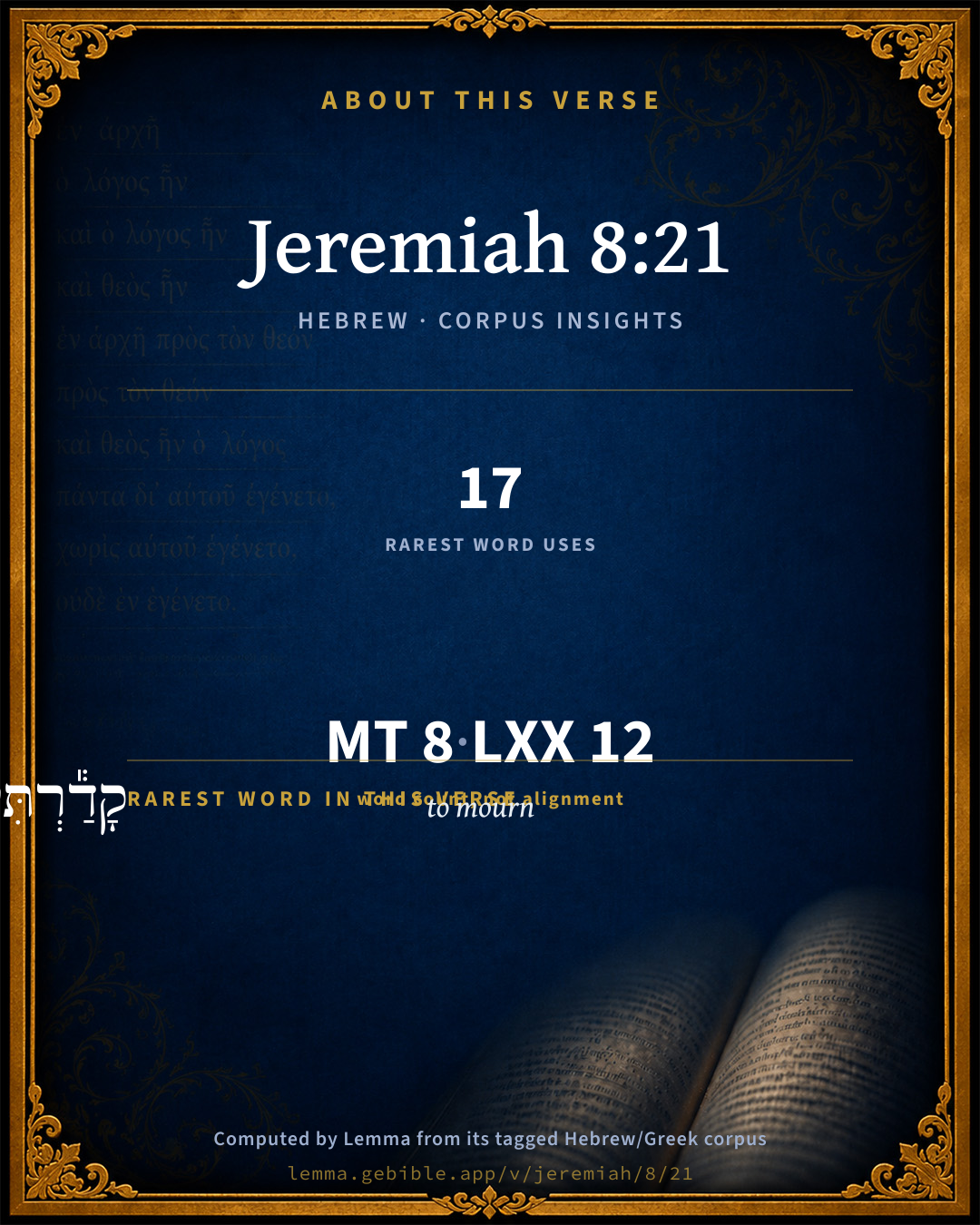
The rarest word here is קָדַ֕רְתִּי to mourn H6937 — appearing just 17 times in the whole Hebrew Bible.

Shared distinctive vocabulary

קָדַ֕רְתִּי to mourn H6937 occurs in 17 verses of the Hebrew Bible. Also found in:

Grammatical profile

  • 3 verbs
  • 4 nouns
  • 1 preposition

Verb forms

  • הָשְׁבָּ֑רְתִּי Hophal · Perfect
  • קָדַ֕רְתִּי Qal · Perfect
  • הֶחֱזִקָֽתְנִי Hiphil · Perfect

Hebrew & Septuagint length

In the original languages it is 8 Hebrew tokens and 12 Greek tokens — but the two are counted differently (Hebrew bundles its prefixes and suffixes into one token; the Greek is in lemma form), so that isn’t a like-for-like length.

Cross-references

11

Topical passages linked to Jeremiah 8:21 in the Treasury of Scripture Knowledge — connected by theme and wording, ordered by reader-vote popularity; previews shown in the World English Bible.

  • Jeremiah 14:17 You shall say this word to them, Let my eyes run down with tears night and day, and let them not cease; for the virgin daughter of my people is broken with a great breach, with a very grievous wound.
  • Joel 2:6 At their presence the peoples are in anguish. All faces have grown pale.
  • Nahum 2:10 She is empty, void, and waste. The heart melts, the knees knock together, their bodies and faces have grown pale.
  • Psalms 137:3–6 For there, those who led us captive asked us for songs. Those who tormented us demanded songs of joy: "Sing us one of the songs of Zion!"
  • Song of Solomon 1:5–6 I am dark, but lovely, You daughters of Jerusalem, Like Kedar's tents, Like Solomon's curtains.
  • Jeremiah 4:19 My anguish, my anguish! I am pained at my very heart; my heart is disquieted in me; I can't hold my peace; because you have heard, O my soul, the sound of the trumpet, the alarm of war.
  • Jeremiah 9:1 Oh that my head were waters, and my eyes a spring of tears, that I might weep day and night for the slain of the daughter of my people!
  • Luke 19:41 When he drew near, he saw the city and wept over it,
  • Romans 9:1–3 I tell the truth in Christ. I am not lying, my conscience testifying with me in the Holy Spirit,
  • Nehemiah 2:3 I said to the king, Let the king live forever: why should not my face be sad, when the city, the place of my fathers' tombs, lies waste, and the gates of it are consumed with fire?
  • Jeremiah 17:16 As for me, I have not hurried from being a shepherd after you; neither have I desired the woeful day; you know: that which came out of my lips was before your face.

Cross-references courtesy of OpenBible.info (CC BY 4.0).

Hebrew and Greek witnesses Masoretic Hebrew ↔ Greek Septuagint

The same verse in the two great witnesses to the Old Testament, shown verse-for-verse.

These are two independent witnesses, not word-aligned to each other, and the Septuagint is shown in lemma (dictionary) form.

Hebrew Jeremiah 8:21 Masoretic · Westminster Leningrad Codex

עַל שֶׁ֥בֶר בַּת עַמִּ֖י הָשְׁבָּ֑רְתִּי קָדַ֕רְתִּי שַׁמָּ֖ה הֶחֱזִקָֽתְנִי

For the hurt of the daughter of my people am I hurt: I mourn; dismay has taken hold on me.

World English Bible · Public Domain

Greek LXX Structure differs

In the Septuagint, Jeremiah is about an eighth shorter than the Hebrew and arranges its material differently — the Oracles Against the Nations (Hebrew chapters 46–51) appear in the middle of the Greek book, after 25:13. Because the chapter and verse boundaries do not line up, a verse-for-verse comparison with the Hebrew is not shown.

A verse-for-verse comparison isn’t shown here because the chapters and verses don’t line up. Switch to the LXX edition with the MT / LXX toggle above to read the Greek directly.

On this verse, Joseph Benson's Commentary discusses the Septuagint’s reading. Read the note in Commentary ↓

Hebrew: Westminster Leningrad Codex (CC BY 4.0). Greek: Septuagint (public domain); English from a public-domain English Septuagint. How the Septuagint differs from the Hebrew →

Targum (Aramaic paraphrase)

1

The Targum is the ancient Jewish Aramaic paraphrase of the Hebrew Scriptures — an interpretive translation, not the Hebrew text itself. Onkelos (literal) and Pseudo-Jonathan (expansive) render the Torah, and Jonathan the Prophets. Coverage is partial: where no permissively-licensed English translation exists for a verse, only the Aramaic is shown. This is verse-level text, not a word-by-word alignment to the Hebrew.

  1. Targum Jonathan Prophets (Joshua–Malachi)
    אֲמָרֵית יְרוּשְׁלֵם עַל תְּבַר כְּנִשְׁתָּא דְעַמִי אִזְדַעְזְעֵית אִתְחַפִּיאוּ אַפֵּי אִכְרוּם אוּכָמִין כְּקִדְרָא אִשְׁתַּמָמוּ אַחֲדָתְנִי:

    (no public-domain English translation for this verse)

    Targum Jonathan — Aramaic: “Mikraot Gedolot” (public domain). English: “Sefaria Community Translation” (CC0 1.0 (public-domain dedication)); “London "Chaldee Paraphrase," 1871” (public domain). Text via Sefaria.

Commentary

Notes on Jeremiah 8:21 from classic Christian and Jewish commentators (each source and its license shown beneath its notes). The classic Christian expositions comment on the surrounding passage and are grouped to its opening verse, so a note may address several verses; the Jewish commentaries on the Tanakh (Rashi and others) are per-verse, so they appear only where the commentator wrote on this verse.

Lemma curates 59 commentaries, every one of them public domain or Creative Commons licensed, each selected and text-cleaned for this edition rather than reprinted as found. About our sources →

Trapp's Complete Commentary

John Trapp

Jer 8:21 For the hurt of the daughter of my people am I hurt; I am black; astonishment hath taken hold on me.

Ver. 21. For the hurt of the daughter of my people am I hurt, I am black.] Or, I go in black, mourner like; for I am denigrated and contemned for bewailing my people’s misery, who neither feel nor fear hurt.

John Trapp, A Commentary or Exposition upon All the Books of the Old and New Testament (1647–1656) — public domain. Text from a community e-Sword module.

Joseph Benson's Commentary

Jer 8:21-22. For the hurt of the daughter of my people am I hurt, &c. — These are the words of the prophet, lamenting the miserable condition of his country. The Hebrew is more literally rendered, For the breach of the daughter of my people am I broken, that is, heart-broken: or, as Houbigant renders it, I am wounded with the wound of my people. I am black — I look ghastly, as those who are dying. Astonishment hath taken hold on me — I am so stupified that I know not what to do, or which way to turn. Is there no balm in Gilead — Balm, or balsam, is used with us as a common name for many of those oily, resinous substances, which flow spontaneously, or by incision, from certain trees or plants, and are of considerable use in medicine and surgery, being good, as physicians inform us, to soften, assuage, warm, dissolve, cleanse, dry up, and purge. The Hebrew word here used, צרי, is rendered by the LXX., ρητινη, and interpreted resin by the ancients in general. For this balm, resin, or turpentine, as the word might be rendered, Gilead was famous from very ancient times. See Gen 37:25, where we find Joseph was sold to Ishmaelite merchants, who came from Gilead, and carried it, with sweet spices, into Egypt. This made many physicians and surgeons to resort to Gilead. The prophet applies this metaphorically to the state of the Jews, which was all over corrupted, (compare Isa 1:6,) and represents God as asking whether there have been no methods used to heal these mortal wounds and distempers? or, if there have, how it comes to pass they should have so little success? As if he had said, Whence comes it that the wounds of my people have not been healed and closed? Have means of healing been wanting? Spiritual medicines or physicians? Have I not sent you prophets, who have admonished, warned, and instructed you? Have I not given you time, and furnished you with helps sufficient to enable you to return to your duty? Why then are not your spiritual disorders cured? Doubtless it is your own fault: it is because you would not make use of the remedies provided, nor follow the prescriptions of the physicians. Thus we may apply the words spoken concerning Babylon, Jer 51:9, to the present case: we would have healed Babylon, but she is not, or rather, she would not, be healed. The words may likewise be understood of a temporal deliverance. As if he had said, Is this people so forsaken both of God and men, that there is no remedy left to effect their deliverance? Are there no salutary means within reach, or no persons that know how to apply them, for the relief of my country from those miseries with which it is afflicted? Observe, reader, if sinners die of their wounds, their blood is upon their own heads. The blood of Christ is balm in Gilead, his Spirit is the physician there: both are sufficient, all-sufficient, to effect a perfect cure; so that they might have been healed, but would not.

Joseph Benson's Commentary on the Old and New Testaments (1811–1818) — public domain. Text from a community e-Sword module.

Tyndale Open Study Notes

Tyndale Open Resources

8:21-22 Jeremiah empathized with the suffering of his people. The closeness between the Lord and his prophet means that sometimes the first-person pronouns refer to the Lord as well—the Lord also hurts with the hurt of his people (cp. Matt 23:37).

Tyndale Open Study Notes — © Tyndale Open Resources, licensed CC BY-SA 4.0. Text via the HelloAO Bible API.

Geneva Bible (1599)

Geneva Bible translators

The Prophet speaketh this.

Geneva Bible (1599) marginal notes — public domain. Text via Bolls.life.

Jamieson, Fausset & Brown

Robert Jamieson, A. R. Fausset & David Brown

black--sad in visage with grief (Joe 2:6).

Jamieson, Fausset & Brown — Commentary Critical and Explanatory on the Whole Bible (1871) — public domain (CC PDM 1.0). Text via the HelloAO Bible API.

John Calvin's Commentaries

As the hardness of the people was so great, that the threatenings we have observed did not touch them, the Prophet now ascribes to himself what he had before attributed to them. We then see how the Prophet varies his mode of speaking; but it was necessary, for he was at a loss to find a way to address them sufficiently strong to penetrate into their stony and even iron hearts. We need not wonder, then, that there are so many figurative terms used by the Prophet; for it was needful to set before them God’s judgment in various ways, that the people might be awakened out of their torpid state.

He then says, that he was bruised for the bruising of his people. He was no doubt ridiculed by most of them: “Oh! thou grievest for thine own evils; it is well and prosperous with us: who has asked thee for this pity? Think not, then, that thou canst gain any favor with us, for we are contented with our lot. Weep rather for thine own calamities, if thou hast any at home; but suffer us at the same time to enjoy our pleasures, since God is propitious and indulgent to us.” Thus then was the Prophet derided; but yet he warns the obstinate people, that they might be less excusable: he says, that he was rendered black; for sorrow brings blackness with it, and makes dark the face of man: it is a metaphorical expression. He says at last, that he was astonished The astonishment with which he was seized he no doubt sets down as being the opposite of the people’s torpor and insensibility, for they had no fear for themselves. It follows —

John Calvin's Commentaries (1540-1563) — public domain. Text from the Calvin Translation Society English edition (1840s-50s) via the Christian Classics Ethereal Library (ccel.org). Calvin's coverage is partial (roughly two-thirds of the Bible); uncommented books and verses are honest gaps, never fabricated. The 19th-century editor's footnotes and remarks are omitted so the notes are faithfully Calvin's own voice.

Ellicott's Commentary for English Readers

(21) For the hurt . . .—Now the prophet again speaks in his own person. He is crushed in that crushing of his people. His face is darkened, as one that mourns. (Comp. Psa_38:6; Jos_5:11.)

A Bible Commentary for English Readers, edited by Charles John Ellicott (1878–1897) — public domain. Text from a community e-Sword module.

The Cambridge Bible for Schools and Colleges

gen. ed. J. J. S. Perowne

21. the hurt] lit. the breach, and so the verb that follows.

black] mg. mourning (as to garb). Cp. on Jer_4:28.

The Cambridge Bible for Schools and Colleges (gen. ed. J. J. S. Perowne; Cambridge University Press, 1878–1918) — public domain. Text from a community e-Sword module.

John Gill's Exposition

Is there no balm in Gilead?.... Which was famous for it; see Gen 37:25, or rather turpentine or rosin, a gum which drops from pine trees and the like; since balm or balsam grew on this side Jordan, near Jericho and Engedi, and not beyond Jordan, in the land of Gilead; and rosin is good for healing. Some render it "treacle", but very wrongly, since, as Calvin observes, that is a composition of many things,

Is there no physician there? or surgeon, anyone that heals wounds and bruises; very probably there were many such lived in Gilead, since it was a place where proper medicines were to be got and applied: this may be understood of prophets and teachers, who, in a moral and spiritual sense, are instruments of healing of men, by showing them their evil, calling them to repentance, and directing where to go for healing or pardon of sin; namely, to Christ, the alone physician, and to his precious blood, shed for the remission of sins. Some reference may be had to Elijah, who was of Gilead, and to the school of the prophets there, Kg1 17:1. The Targum is,

"Jeremiah the prophet said, perhaps there are no good works in me, that I should supplicate for the house of Israel; should I not desire the doctrine of Elijah the prophet, who was of Gilead, whose words were healing?''

Why then is not the health of the daughter of my people recovered? that is, seeing there is balm in Gilead, and a physician there, how comes it to pass that such medicine is not made use of, and such a physician not applied to, that health might be restored? This shows the stupidity, sluggishness, and indolence of the people, and how inexcusable they were, as well as the prophet's great concern for their welfare; the want of means of deliverance, or non-attendance to them, or the failure of them.

Next: Jeremiah Chapter 9

John Gill's Exposition of the Whole Bible (1746–1763) — public domain (CC PDM 1.0). Text via the HelloAO Bible API.

Albert Barnes' Notes on the Bible

For the hurt ... hurt - literally, “Because of the breaking ... broken.” These are the words of the prophet, whose heart is crushed by the cry of his countrymen.

I am black - Or, I go mourning.

Albert Barnes' Notes on the Bible (1834–1885) — public domain. Text from a community e-Sword/MySword module.

Haydock's Catholic Bible Commentary

I. Jeremias. (Menochius) --- The prophet continues to speak in the next chapter.

George Leo Haydock (1774–1849), Haydock's Catholic Family Bible and Commentary, 1859 edition — public domain. Excludes Psalms (Douay-Rheims chapter numbering differs from Protestant) and Deuterocanonical books (Catholic canon only).

Matthew Poole's English Annotations

The prophet here shows how deeply he is affected with the people’s misery, he deeply sympathized with them.

The hurt; it signifies breach, I am broken in my spirit; and so it answers to the breach that is made upon the people.

I am black; I am as those that are clad in deep mourning, Psa 38:6; Jer 14:2.

Astonishment hath taken hold on me; I am amazed to think that my people should sin themselves beyond help, no remedy for them, as the next verse, that no threatenings or counsels should prevail with them.

Matthew Poole's English Annotations on the Holy Bible (1683–1685) — public domain. Text from a community e-Sword/MySword module.

Whedon's Commentary on the Bible

Daniel D. Whedon

21. Am I hurt — Thus does the prophet identify himself with his people in their humiliation. The language here is highly emotional; the short, nervous sentences marking the warm feeling of the writer as more diffuse words could not.

Daniel D. Whedon (gen. ed.), Commentary on the Old and New Testaments (1874–1909) — public domain. Text from a community e-Sword module.

The Pulpit Commentary

For the hurt, etc.; literally, because of the breaking, etc., I am broken; comp. Jer_23:9, and the phrase "broken in heart" Isa_61:1, etc.). The prophet feels crushed by the sense of the utter ruin of his people. I am black; rather, I go in mourning. (so Psa_38:6 Psa_42:9) The root means rather "foulness" or "squalor" than "blackness". (Job_6:16, where "blackish," an epithet of streams, should rather be "turbid

Vers. 21, 22. Why the hurt of Israel is not healed.

I IT IS NOT FOR WANT OF EARNESTLY CALLING ATTENTION TO THE HURT. Jeremiah had wearied and vexed his fellow-countrymen by his persistent warnings. In Ver. 21 he insists on how the hurt of Israel had become his hurt. In one sense he was not hurt, for he had kept clear of all idolatrous and unjust ways; he was in a different service and different kind of occupation. But though separated thus, he was also united even as a member to the rest of the body, and had to suffer where he had not sinned. His fellow-countrymen, perhaps, said to him, in substance if not in so many words, "Leave us to go our way, and go you yours; if we sin, we sin, and if we suffer, we suffer, and it is no concern to any but ourselves." The sinner in his suffering and his heart-corruption must be a cause of great trouble to those who are trying to serve God. They cannot go by on the other side and leave him. No matter how self-occupied one may have been before he came under the control of the Divine will, afterwards he must occupy himself with such things as concern the spiritual health and blessedness of all mankind. Jeremiah sets us a great example in thus speaking of himself as being individually wounded. If sinners continue careless, impenitent, incredulous as to the wrath of God and their pitiable state of alienation from him, there is all the more need that God"s people should feel instead of them. These Israelites could not say they were left without warning and urgent remonstrance, for the man upon whom the business of warning had been laid cried and mourned over the troubles of others, because in a very deep sense they were his own. Vain, therefore, was it for the people, in after years, amid the gloom of exile and bereavement, to say they had not been properly warned.

II IT WAS NOT FOR WANT OF A MEDICAMENT. In wounds of the body, Israel knew where to go. They found balm in Gilead, and Gilead was not far off, even supposing they had always to go there to get the balm. Balm of Gilead might be made to grow nearer than Gilead. Thus we see the medicament was easily procured, a very important consideration. The incense for the altar they brought all the way from Sheba, but the balm for healing grew much nearer. Easiness of procurement, however, would have been little without efficiency. A certain remedy brought from the ends of the earth is better than a doubtful one near to home; only, of course, there must be foresight to lay in a stock, so that it will be at hand when wanted. Evidently this balm of Gilead which grew within Israelite territory was a famous and trusted balm. Only some popular and widely known agent of healing would have served the purpose of the prophet for quoting here. And is it not plain that the God who thus provided for bodily wounds a balm so easily obtained and so efficient in its action, might also be trusted to provide an available and thorough cure for the worst of spiritual ills? Assuredly the prophet means that an affirmative and encouraging answer is to be given to his question. There is balm in Gilead. There is peace for the guilty conscience, purity for the turbid and defiled imagination, strength for the weakened will. The springs of all our pollution and pain can be dried up, and their place know them no more forever.

III IT WAS NOT FOR WANT OF A PHYSICIAN. The medicament is good, but it may require to be applied by a skilful and experienced hand. The physician can do nothing without his medicaments, and the medicaments are oftentimes nothing without the physician. A physician is needed to prepare the way for saving truth, to apply it in its most efficacious order, and to press it home in close and vigorous contact with that which has to be healed. The balm of Gilead is not given that it may be trifled with, that it may film over deep evils with a deceptive appearance of removal. In applying that balm there may have to be pain, intense pain for a time, in order that a worse pain may be forever taken away. The pain coming from self-indulgence must be succeeded by the pain coming from self-denial. Men have to discover that the pains of sin are the smitings of God, and when they have made this discovery they will be in a fair way to learn that only he who smites can also heal. Do not let us unjustly complain of incurable ills; let us rather confess that we are much in the condition of the poor woman who, after spending much on many physicians, found, by a simple faith touching the true Source of healing, what she had long vainly sought.

IV THE REASON PLAINLY LAY WITH THE PEOPLE THEMSELVES. They would listen to no warning. Balm was offered, and the physician"s skill to apply it, but they would not come to be healed. They preferred the pleasures of sin along with its risks and pains. That their state was bad they knew, but they believed it was not near so bad as the prophet made it out to be. Only physicians can tell how many cases of bodily disease might be cured if the sick were willing to go to the root of the matter, and mend their habits as to eating and drinking, working and playing. Ignorance, indifference, prejudice, and unblushing lust of the flesh lie at the bottom of much bodily disease, explaining both how it originates and how it continues. And similar causes operate with regard to such ills as afflict the consciousness of the entire man. Sinners must have a will to go to Jesus if they expect healing and life, and then life more abundantly. Y.

The Pulpit Commentary (1880–1919), ed. H.D.M. Spence-Jones & Joseph S. Exell — public domain. Text from a community e-Sword module.

John Wesley's Explanatory Notes

Am I hurt - The prophet here shews how deeply he is affected with the peoples misery. Black - I am as those that are clad in deep mourning.

John Wesley, Explanatory Notes Upon the Whole Bible (1754–1765) — public domain. Text via the GEBible commentary corpus.

Rashi

Rabbi Shlomo Yitzchaki (Rashi)

I mourn lit. I am darkened, an expression of blackness and darkness.

dismay Heb. שמה, wonder.

has taken hold of me Has held me.

Rashi on the Tanakh — English translations: “The Judaica Press complete Tanach with Rashi, translated by A. J. Rosenberg” (CC BY 4.0); “Pentateuch with Rashi's commentary by M. Rosenbaum and A.M. Silbermann, 1929-1934” (public domain); “The Metsudah Tanach series, Lakewood, N.J” (CC BY 4.0); and “The Book of Joshua, Metsudah Publications, 1997” (CC BY 4.0). Text via Sefaria.

Lesson kit

Teaching starters — assembled from the data on this page, not authored interpretation. Every prompt links to the verse data it draws on. Edit before teaching.

Jeremiah, in the Prophets, opens this verse with 8 words (8 distinct Hebrew lemmas). Its most distinctive word is qâdar (“to mourn”). A historical commentator’s framing appears above. Read the whole chapter for the surrounding context.

Discussion questions

  1. The word qâdar carries the sense “to mourn.” How does it shape the verse?
  2. 1 Kings 18:45 shares the word «to mourn» with this verse. How do the two illuminate each other?
  3. The translations on this page render this verse differently — a whole-verse word diff, not a word-by-word alignment. What might account for the different wordings?
  4. The verb «הָשְׁבָּ֑רְתִּי» is Hophal Perfect. How does its form color the action?
  5. Reading how Trapp's Complete Commentary and Joseph Benson's Commentary read this verse, where do the two commentators agree and where do they part?

Things to notice

Reading settings

Reading text

Shown beneath each verse's original-language words.

Old Testament
Old Testament edition

Read the OT as the Masoretic Hebrew (MT) or the Greek Septuagint (LXX).

English shown for the Greek Septuagint (in the Hebrew ↔ Greek comparison).

Comparing translations? Open the Compare panel on any verse page to stack up to four side by side.