Jeremiah 50:23

Hebrew (Westminster Leningrad Codex) Jeremiah 50:23 appears in the Hebrew Old Testament. The text above is from the Westminster Leningrad Codex. Each word links to its Strong’s number, a concise gloss, and parsing drawn from the Open Scriptures Hebrew Bible morphology. Click any word for its full Brown-Driver-Briggs (BDB) entry.
Download image
Cite this verse

Jeremiah 50:23 (World English Bible). Public Domain. Lemma interlinear Bible study tool, https://lemma.gebible.app/v/jeremiah/50/23.

Show BibTeX & RIS
BibTeX
RIS
English Translation
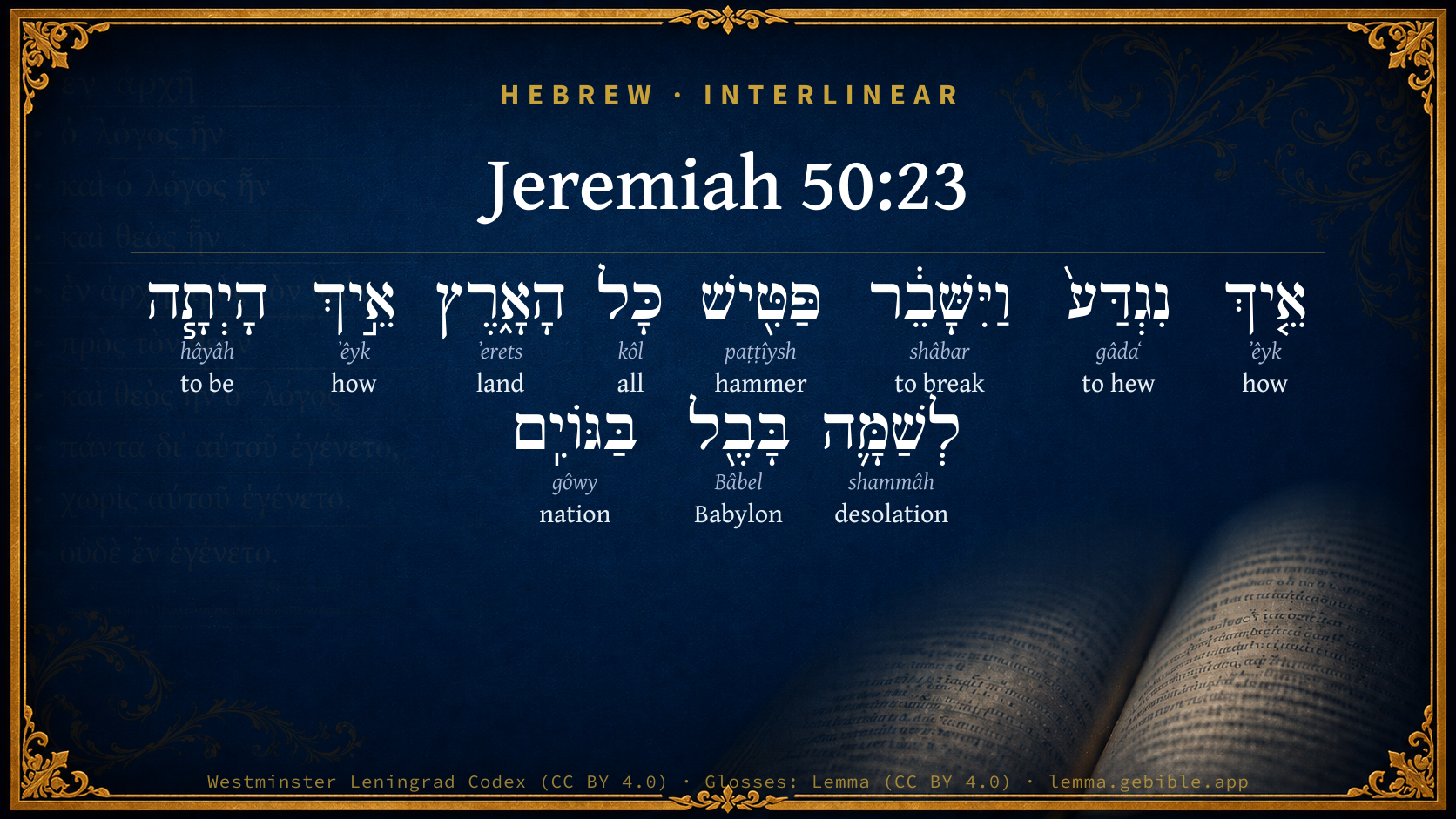
How is the hammer of the whole earth cut apart and broken! how is Babylon become a desolation among the nations!
World English Bible · Public Domain
Download a study sheet

One document with this verse’s original text, its word-by-word gloss line, the meaning frame, cross-references with their text, attributed commentary, and full source and license credits — printable, and it pastes into notes with its structure intact.

This verse Autodidact and up

Study sheet (.html) Plain text (.txt)

A passage Seminary Student

Up to 50 verses in one chapter. A passage sheet keeps up to 6 commentary sources and 12 cross-references per verse, in the order this page ranks them, and says so on the sheet whenever that leaves anything out. Ask for a single verse and you get the Autodidact verse sheet above.

Everything on this page stays free to read, with no account — the sheet is a download of what is already on screen, not access to it.

Want to remove ads? Support Godless Engineer
Compare translations 3

The same verse in 3 English versions, stacked beneath the original-language interlinear above. Click any original word for its lexicon entry.

Each is an independent rendering of the whole verse — the interlinear is not word-aligned to these translations.

Highlighted words mark where these versions differ — a whole-verse word diff, not a word-by-word alignment.

  • World English Bible Public Domain
    How is the hammer of the whole earth cut apart and broken! how is Babylon become a desolation among the nations!
  • King James Version Public Domain
    How is the hammer of the whole earth cut asunder and broken! how is Babylon become a desolation among the nations!
  • unfoldingWord Literal Text CC BY-SA 4.0
    How the hammer of all the lands has been cut apart and destroyed. How Babylon has become a destroyed place among the nations.

unfoldingWord Literal Text — © unfoldingWord, licensed CC BY-SA 4.0. Word-aligned USFM3 via Door43 (git.door43.org/unfoldingWord/en_ult).

Versions to compare (up to 4)

3 of 4 selected

Show all 18 translations

Every available English version of this verse, each an independent rendering of the whole verse.

  • World English Bible Public Domain
    How is the hammer of the whole earth cut apart and broken! how is Babylon become a desolation among the nations!
  • Berean Standard Bible Public Domain
    How the hammer of the whole earth lies broken and shattered! What a horror Babylon has become among the nations!
  • Majority Standard Bible Public Domain
    How the hammer of the whole earth lies broken and shattered! What a horror Babylon has become among the nations!
  • King James Version Public Domain
    How is the hammer of the whole earth cut asunder and broken! how is Babylon become a desolation among the nations!
  • American Standard Version (1901) Public Domain
    How is the hammer of the whole earth cut asunder and broken! how is Babylon become a desolation among the nations!
  • Revised Version (1885) Public Domain
    How is the hammer of the whole earth cut asunder and broken! how is Babylon become a desolation among the nations!
  • Geneva Bible (1599) Public Domain
    Howe is the hammer of the whole world destroied, and broken! howe is Babel become desolate among the nations!
  • Douay-Rheims (1899) Public Domain
    How is the hammer of the whole earth broken, and destroyed! how is Babylon turned into a desert among the nations!
  • Young's Literal Translation Public Domain
    How hath it been cut and broken, The hammer of the whole earth! How hath Babylon been for a desolation among nations!
  • Literal Standard Version CC BY-SA 4.0
    How it has been cut and broken, || The hammer of the whole earth! How Babylon has been for a desolation among nations!
  • Unlocked Literal Bible CC BY-SA 4.0
    How the hammer of all the lands has been cut apart and destroyed. How Babylon has become a destroyed place among the nations.
  • unfoldingWord Literal Text CC BY-SA 4.0
    How the hammer of all the lands has been cut apart and destroyed. How Babylon has become a destroyed place among the nations.
  • Darby Bible Public Domain
    How is the hammer of the whole earth cut asunder and broken! How is Babylon become an astonishment among the nations!
  • World Messianic Bible Public Domain
    How the hammer of the whole earth is cut apart and broken! How Babylon has become a desolation among the nations!
  • Webster's Bible Public Domain
    How is the hammer of the whole earth cut asunder and broken! how is Babylon become a desolation among the nations!
  • Free Bible Version CC BY-SA 4.0
    See how the hammer of the whole earth is lying broken in pieces in the ground! The nations look with horror on what Babylon has become!
  • Bible in Basic English Public Domain
    How is the hammer of all the earth cut in two and broken! how has Babylon become a waste among the nations!
  • JPS Tanakh (1917) Public Domain
    How is the hammer of the whole earth cut asunder and broken! How is Babylon become a desolation among the nations!

Literal Standard Version (2020), Covenant Press — licensed CC BY-SA 4.0. Text via the HelloAO Bible API (eBible.org). Unlocked Literal Bible (unfoldingWord) — licensed CC BY-SA 4.0. Text via the HelloAO Bible API (eBible.org). unfoldingWord Literal Text — © unfoldingWord, licensed CC BY-SA 4.0. Word-aligned USFM3 via Door43 (git.door43.org/unfoldingWord/en_ult). Free Bible Version, Dr. Jonathan Gallagher — licensed CC BY-SA 4.0. Text via the HelloAO Bible API (eBible.org).

Word by word

More ways to search: Search by grammar → Find every occurrence → Compare this word →

Practice this passage: Drill this verse → Learn its vocabulary →

פַּטִּ֖ישׁ
paṭṭîysh
H6360
“hammer of”
Noun, Common, Masculine, Singular, Construct
Part of Speech
Noun
Type
Common
Gender
Masculine
Number
Singular
State
Construct
Full BDB Definition

Origin: intensively from an unused root meaning to pound

TWOT: 1763

forge hammer, hammer
  1. אֵ֤יךְ ʼêyk H349 “how” Particle, Interrogative
  2. נִגְדַּע֙ gâdaʻ H1438 “to hew” Verb, Niphal, Perfect, 3rd Person, Masculine, Singular
  3. וַיִּשָּׁבֵ֔ר shâbar H7665 “and · to break” Conjunction + Verb, Niphal, Sequential Imperfect, 3rd Person, Masculine, Singular
  4. כָּל kôl H3605 “all of” Noun, Common, Masculine, Singular, Construct
  5. הָאָ֑רֶץ ʼerets H776 “the · land” Particle, Definite Article + Noun, Common, Both, Singular, Absolute
  6. אֵ֣יךְ ʼêyk H349 “how” Particle, Interrogative
  7. הָיְתָ֧ה hâyâh H1961 “to be” Verb, Qal, Perfect, 3rd Person, Feminine, Singular
  8. לְשַׁמָּ֛ה shammâh H8047 “to/for · desolation” Preposition + Noun, Common, Feminine, Singular, Absolute
  9. בָּבֶ֖ל Bâbel H894 “Babylon” Noun, Proper
  10. בַּגּוֹיִֽם gôwy H1471 “in/at the · nations” Preposition, Determined + Noun, Common, Masculine, Plural, Absolute

About this verse

These counts appear in no published source. They are computed here, from the morphology-tagged text and Lemma’s own curated glosses. What Lemma adds →

11
words
10
distinct lemmas
Prophets
section

Notable vocabulary

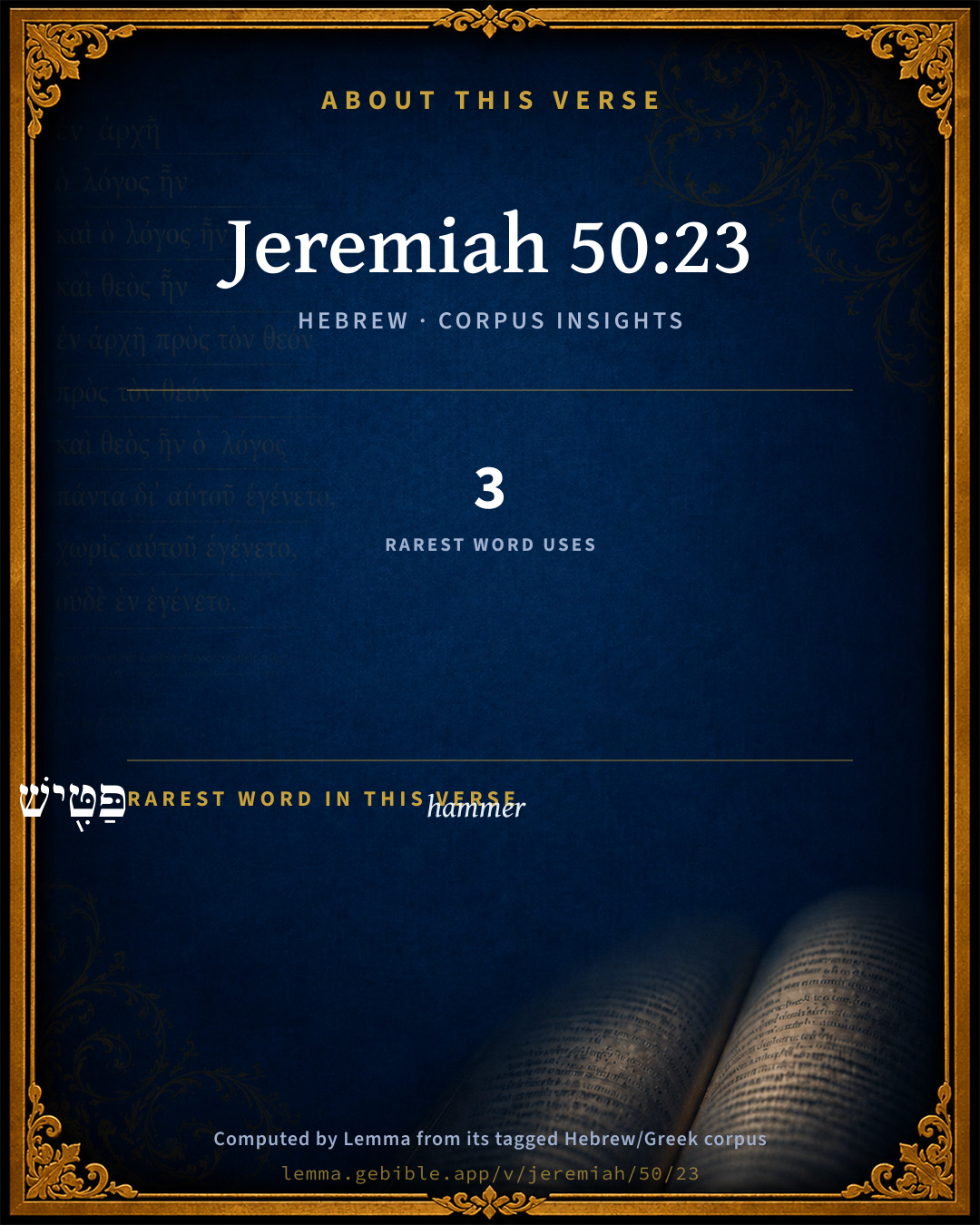
The rarest word here is פַּטִּ֖ישׁ hammer H6360 — appearing just 3 times in the whole Hebrew Bible.

Shared distinctive vocabulary

פַּטִּ֖ישׁ hammer H6360 occurs in 3 verses of the Hebrew Bible. Also found in:

Grammatical profile

  • 3 verbs
  • 6 nouns
  • 2 particles

Verb forms

  • נִגְדַּע֙ Niphal · Perfect
  • וַיִּשָּׁבֵ֔ר Niphal · Sequential Imperfect
  • הָיְתָ֧ה Qal · Perfect

Repetition

A word recurs within this verse — often emphatic in Hebrew:

  • אֵ֤יךְ how H349 ×2

Cross-references

4

Topical passages linked to Jeremiah 50:23 in the Treasury of Scripture Knowledge — connected by theme and wording, ordered by reader-vote popularity; previews shown in the World English Bible.

  • Jeremiah 51:20–24 You are my battle-axe and weapons of war: and with you will I break in pieces the nations; and with you will I destroy kingdoms;
  • Isaiah 14:4–6 that you shall take up this parable against the king of Babylon, and say, How has the oppressor ceased! the golden city ceased!
  • Isaiah 14:12–17 How you are fallen from heaven, day-star, son of the morning! How you are cut down to the ground, who laid the nations low!
  • Revelation 18:16 saying, 'Woe, woe, the great city, she who was dressed in fine linen, purple, and scarlet, and decked with gold and precious stones and pearls!

Cross-references courtesy of OpenBible.info (CC BY 4.0).

Hebrew and Greek witnesses Masoretic Hebrew ↔ Greek Septuagint

The same verse in the two great witnesses to the Old Testament, shown verse-for-verse.

These are two independent witnesses, not word-aligned to each other, and the Septuagint is shown in lemma (dictionary) form.

Hebrew Jeremiah 50:23 Masoretic · Westminster Leningrad Codex

אֵ֤יךְ נִגְדַּע֙ וַיִּשָּׁבֵ֔ר פַּטִּ֖ישׁ כָּל הָאָ֑רֶץ אֵ֣יךְ הָיְתָ֧ה לְשַׁמָּ֛ה בָּבֶ֖ל בַּגּוֹיִֽם

How is the hammer of the whole earth cut apart and broken! how is Babylon become a desolation among the nations!

World English Bible · Public Domain

Greek LXX Structure differs

In the Septuagint, Jeremiah is about an eighth shorter than the Hebrew and arranges its material differently — the Oracles Against the Nations (Hebrew chapters 46–51) appear in the middle of the Greek book, after 25:13. Because the chapter and verse boundaries do not line up, a verse-for-verse comparison with the Hebrew is not shown.

A verse-for-verse comparison isn’t shown here because the chapters and verses don’t line up. Switch to the LXX edition with the MT / LXX toggle above to read the Greek directly.

Hebrew: Westminster Leningrad Codex (CC BY 4.0). Greek: Septuagint (public domain); English from a public-domain English Septuagint. How the Septuagint differs from the Hebrew →

Targum (Aramaic paraphrase)

1

The Targum is the ancient Jewish Aramaic paraphrase of the Hebrew Scriptures — an interpretive translation, not the Hebrew text itself. Onkelos (literal) and Pseudo-Jonathan (expansive) render the Torah, and Jonathan the Prophets. Coverage is partial: where no permissively-licensed English translation exists for a verse, only the Aramaic is shown. This is verse-level text, not a word-by-word alignment to the Hebrew.

  1. Targum Jonathan Prophets (Joshua–Malachi)
    אֵיכְדֵין אִתְקְטֵיף וְאִתְּבַר מַלְכָּא דַהֲוָה מְזִיחַ לְכָל אַרְעָא אֵיכְדֵין הֲוַת לְצָדוּ בָּבֶל בְּעַמְמַיָא:

    (no public-domain English translation for this verse)

    Targum Jonathan — Aramaic: “Mikraot Gedolot” (public domain). English: “Sefaria Community Translation” (CC0 1.0 (public-domain dedication)); “London "Chaldee Paraphrase," 1871” (public domain). Text via Sefaria.

Commentary

Notes on Jeremiah 50:23 from classic Christian and Jewish commentators (each source and its license shown beneath its notes). The classic Christian expositions comment on the surrounding passage and are grouped to its opening verse, so a note may address several verses; the Jewish commentaries on the Tanakh (Rashi and others) are per-verse, so they appear only where the commentator wrote on this verse.

Lemma curates 59 commentaries, every one of them public domain or Creative Commons licensed, each selected and text-cleaned for this edition rather than reprinted as found. About our sources →

Trapp's Complete Commentary

John Trapp

Jer 50:23 How is the hammer of the whole earth cut asunder and broken! how is Babylon become a desolation among the nations!

Ver. 23. How is the hammer of the whole earth cut asunder!] Babylon was the maul or hammer of many nations, Nimrod began it, and his successors took after him. Charles Martel, King of France, was so called for like cause. Augustine also was worthily styled Haereticorum malleus, the hammer of heretics; and Mr Arthur Hildersam, Schismaticorum malleus, the maul of schismatics.

John Trapp, A Commentary or Exposition upon All the Books of the Old and New Testament (1647–1656) — public domain. Text from a community e-Sword module.

Geneva Bible (1599)

Geneva Bible translators

Nebuchadnezzar, who had smitten down all the princes and people of the world.

Geneva Bible (1599) marginal notes — public domain. Text via Bolls.life.

Jamieson, Fausset & Brown

Robert Jamieson, A. R. Fausset & David Brown

hammer--that is, Babylon, so called because of its ponderous destructive power; just as "Martel," that is, "a little hammer," was the surname of a king of the Franks (Isa 14:6).

Jamieson, Fausset & Brown — Commentary Critical and Explanatory on the Whole Bible (1871) — public domain (CC PDM 1.0). Text via the HelloAO Bible API.

Adam Clarke's Commentary

Verse 23. The hammer of the whole earth] Nebuchadnezzar dashed to pieces the nations against whom he warred. He was the scourge of the Lord.

Adam Clarke's Commentary on the Bible (1810–1826) — public domain. Text from a community e-Sword/MySword module.

John Calvin's Commentaries

Here, in the first place, Jeremiah asks in astonishment how it happened that the hammer of the whole earth was broken, when it had before broken all nations. God afterwards gives an answer, even because “I am he who have taken Babylon.” The question availed to rouse the people to a greater attention. We neglect God’s judgments or are blind to them, even because we do not carefully consider them; for little things often excite us, when that which God works in an unusual manner is deemed by us as nothing. As then our apathy as to the works of God is so great, it is necessary to stimulate us. And this is what is done now by Jeremiah, when he says in astonishment, How? for he intimates that to cut down Babylon would be incredible, for no one could have thought that that monarchy could have ever fallen; for it had arrived to the highest eminence, and was surrounded on all sides by so many fortresses, that no danger could be feared. In short, all thought that Babylon could not be endangered without a concussion of heaven and earth.

Then the Prophet here wonders at a thing unusual, and says, How is the hammer of all the earth broken and shattered to pieces? and then, How has Babylon become a waste among the nations? for it had subjugated to itself not only the neighboring nations, but the remotest parts of the earth. And in this manner he animated the faithful to entertain hope, lest they should despond, for the power of that monarchy was terrible.

John Calvin's Commentaries (1540-1563) — public domain. Text from the Calvin Translation Society English edition (1840s-50s) via the Christian Classics Ethereal Library (ccel.org). Calvin's coverage is partial (roughly two-thirds of the Bible); uncommented books and verses are honest gaps, never fabricated. The 19th-century editor's footnotes and remarks are omitted so the notes are faithfully Calvin's own voice.

Ellicott's Commentary for English Readers

(23) How is the hammer of the whole earth cut asunder . . . !—The image had been used before (Jer_23:29) of the might of right as seen in the words of Jehovah. Here it describes the right of might as seen in the despotism of Babylon. The name of Charles Martel and, according to one etymology, that of Judas Maccabæus, present interesting parallelisms. And now the hammer itself, which had been as an instrument in the hand of Jehovah (Jer_51:20), is to be, in its turn, crushed by a power mightier than its own.

A Bible Commentary for English Readers, edited by Charles John Ellicott (1878–1897) — public domain. Text from a community e-Sword module.

The Cambridge Bible for Schools and Colleges

gen. ed. J. J. S. Perowne

23. the hammer] For the figure cp. Jer_23:29, and for its application to Babylon Jer_51:20-23. Cp. for the title, as given in later days, Charles Martel (hammer), who was grandfather of Charles the Great, and conquered the Saracens in a decisive battle at Tours in 732 a.d., and Edward I of England, on whose tomb at Westminster Abbey are inscribed the words “Scotorum Malleus.”

The Cambridge Bible for Schools and Colleges (gen. ed. J. J. S. Perowne; Cambridge University Press, 1878–1918) — public domain. Text from a community e-Sword module.

John Gill's Exposition

How is the hammer of the whole earth cut asunder and broken!.... The Targum is,

"how is the king cut down and broken that moved the whole earth!''

The king of Babylon, or the kingdom of Babylon, which was like a hammer for its hardness and strength; and being an instrument, in the hand of God, of beating to pieces and destroying the kingdoms and nations around it; but is now destroyed itself. These are the words either of the prophet, or rather of the people of other nations, wondering how this destruction came about, and rejoicing at it;

how is Babylon become a desolation among the nations! this explains who and what is meant by the hammer of the earth, and by its being cut asunder and broken; even the utter destruction of the city and kingdom of Babylon.

John Gill's Exposition of the Whole Bible (1746–1763) — public domain (CC PDM 1.0). Text via the HelloAO Bible API.

Albert Barnes' Notes on the Bible

The hammer - Babylon, by whose instrumentality Yahweh had crushed the nations, is now cut asunder, i. e., the head of iron or bronze is cut away from the wooden handle, and broken.

Albert Barnes' Notes on the Bible (1834–1885) — public domain. Text from a community e-Sword/MySword module.

Haydock's Catholic Bible Commentary

Hammer. The violent injustice of the Chaldeans is thus entitled.

George Leo Haydock (1774–1849), Haydock's Catholic Family Bible and Commentary, 1859 edition — public domain. Excludes Psalms (Douay-Rheims chapter numbering differs from Protestant) and Deuterocanonical books (Catholic canon only).

Matthew Poole's English Annotations

The latter part of the verse expounds the former; God had made the Babylonians his hammer, to break other nations in pieces, now it was itself broken: the particle

how may be understood either as expressing triumph and rejoicing, or admiration, or as inquiring how such a thing could be in the last sense. The next verse is an answer to this.

Matthew Poole's English Annotations on the Holy Bible (1683–1685) — public domain. Text from a community e-Sword/MySword module.

Whedon's Commentary on the Bible

Daniel D. Whedon

23. The hammer of the whole earth — Babylon is here so called because it had been used to break in pieces other nations and kingdoms.

Daniel D. Whedon (gen. ed.), Commentary on the Old and New Testaments (1874–1909) — public domain. Text from a community e-Sword module.

The Pulpit Commentary

The hammer of the whole earth. So in Isaiah, (Isa_14:5) "Jehovah hath broken the staff of the wicked, the rod of the rulers; which smote peoples in passion with an unceasing stroke." In the next chapter a similar title is conferred upon Israel, with the right to retaliate upon Babylon all the evil which Babylon had done to Zion. (Jer_51:20-24) Compare the epithet Martel, "The Hammer," given to Charles, Duke of the Franks, on account of his great victory over the Saraoens at Tours; it is tempting to add "Makkabi," the epithet of Judas (Maccabaeus), but the k is not the same letter as that in maqqab, hammer.

Hammer versus hammer.

Babylon was "the hammer of the whole earth" in the days in which and of which Jeremiah wrote. Nineveh had striven to resist, as had Tyre, Syria, and Egypt, but one by one they had been crushed beneath Babylon"s ponderous blow. And now Judah and Jerusalem were crushed likewise. But God"s Word was that other hammer, against which even the force of the hammer of the whole earth should be put forth in vain. "Is not my Word... as a hammer, saith the Lord, which breaketh the rock in pieces?". (Jer_23:29) And it did thus break the power of Babylon, and made her "a desolation among the nations." Now, all this is a parable of what is and long has been in the spiritual world. Note

I THERE IS A HAMMER-LIKE FORCE WORKING AGAINST GOOD IN THE WORLD. See how it crushes joy, innocency, purposes of good, noble endeavours, life itself. It is the kingdom of Satan; such crushing of so much that is good is of those "works of the devil" to destroy which the Son of God was manifested.

II BUT THERE IS A GOD-LIKE FORCE WHICH SHALL PROVE A MIGHTIER HAMMER STILL. The strong one shall be driven out by the stronger. For proof of this, see:

1. The progress of humanity. Surely he must be blind who will deny the improvement in the general condition, conduct, and character of men since Christ lived and died on this earth. Most admit it, but ascribe it to merely secular, natural, and subordinate causes.

2. The laws of civilized nations. How much more just, humane, and righteous they are than they once were!

3. The philanthropic instinct amongst men. What abundance of objects there now are on which this instinct flings itself and toils for their good! Now, these things are, at least, "aids to faith," in a fuller and more complete deliverance of man from all evil, which it is the glory of the gospel both to promise and to promote. But see this Divine power at work in the individual soul. The fear which hath torment is taken away. The sin which tyrannizes is broken and subdued. The good which was weak is made strong, the evil which was strong is made weak. The sorrow which killed all joy is hushed. Death which destroyed is itself destroyed by the resurrection of Christ from the dead. These are some of the present trophies of the grace of God, and they are but an earnest of more and far better things to come. But in virtue of them we believe in the Son of God, who shall subdue all things unto himself. God"s Word, God"s providence, God"s Spirit, all unite to testify to the existence and by and by the exercise of that triumphant power by which all the might of evil shall be crushed, shattered, and broken forever. On which side, then, are we taking our place? C.

The Pulpit Commentary (1880–1919), ed. H.D.M. Spence-Jones & Joseph S. Exell — public domain. Text from a community e-Sword module.

unfoldingWord translationNotes

Door43 World Missions Community

General Information:

Yahweh speaks to the people of Babylon.

How the hammer of all the lands has been cut apart and destroyed

The army of Babylon is spoken of as if it were a hammer. The destruction of this army is spoken of as if the hammer was to be cut up and destroyed. This can be stated as a simile. AT: "The mighty army of Babylon that conquered all the nations is like a hammer that will be broken into pieces and destroyed" (See: Metaphor and Simile)

How Babylon has become a destroyed place among the nations

Babylon was a nation like the other nations, but it will become a complete ruin, totally destroyed.

I have set a trap for you and you were taken

The destruction of Babylon is spoken of as if Yahweh had caught them in a trap like an animal. AT: "I set a trap and caught you in it as a hunter catches an animal" or "You people of Babylon, I have set a trap for you" (See: Metaphor)

you were taken ... You were found and captured

This can be stated in active form. AT: "I have captured you ... I found you and captured you" (See: Active or Passive)

translationWords

Babylon

nation

Yahweh

unfoldingWord translationNotes — © Distant Shores Media and the Door43 World Missions Community, licensed CC BY-SA 4.0. Source: git.door43.org/Door43/en_tn.

Rashi

Rabbi Shlomo Yitzchaki (Rashi)

the hammer of the whole earth which would shatter and crush everyone.

Rashi on the Tanakh — English translations: “The Judaica Press complete Tanach with Rashi, translated by A. J. Rosenberg” (CC BY 4.0); “Pentateuch with Rashi's commentary by M. Rosenbaum and A.M. Silbermann, 1929-1934” (public domain); “The Metsudah Tanach series, Lakewood, N.J” (CC BY 4.0); and “The Book of Joshua, Metsudah Publications, 1997” (CC BY 4.0). Text via Sefaria.

Lesson kit

Teaching starters — assembled from the data on this page, not authored interpretation. Every prompt links to the verse data it draws on. Edit before teaching.

Jeremiah, in the Prophets, opens this verse with 11 words (10 distinct Hebrew lemmas). Its most distinctive word is paṭṭîysh (“hammer”). A historical commentator’s framing appears above. Read the whole chapter for the surrounding context.

Discussion questions

  1. The word paṭṭîysh carries the sense “hammer.” How does it shape the verse?
  2. How does Isaiah 41:7, which shares the word «hammer», read alongside this verse?
  3. What does the repetition of “how” (2× in this one verse) do in this verse?
  4. These translations render this verse differently; the difference is in the English rendering, not the original. What questions does that raise?
  5. «נִגְדַּע֙» is a Niphal Perfect verb. How does that grammatical form shape the action described?
  6. Compare how Trapp's Complete Commentary and Geneva Bible (1599) read this verse. Where do they agree or differ?

Things to notice

Reading settings

Reading text

Shown beneath each verse's original-language words.

Old Testament
Old Testament edition

Read the OT as the Masoretic Hebrew (MT) or the Greek Septuagint (LXX).

English shown for the Greek Septuagint (in the Hebrew ↔ Greek comparison).

Comparing translations? Open the Compare panel on any verse page to stack up to four side by side.