
2 Chronicles 20:37

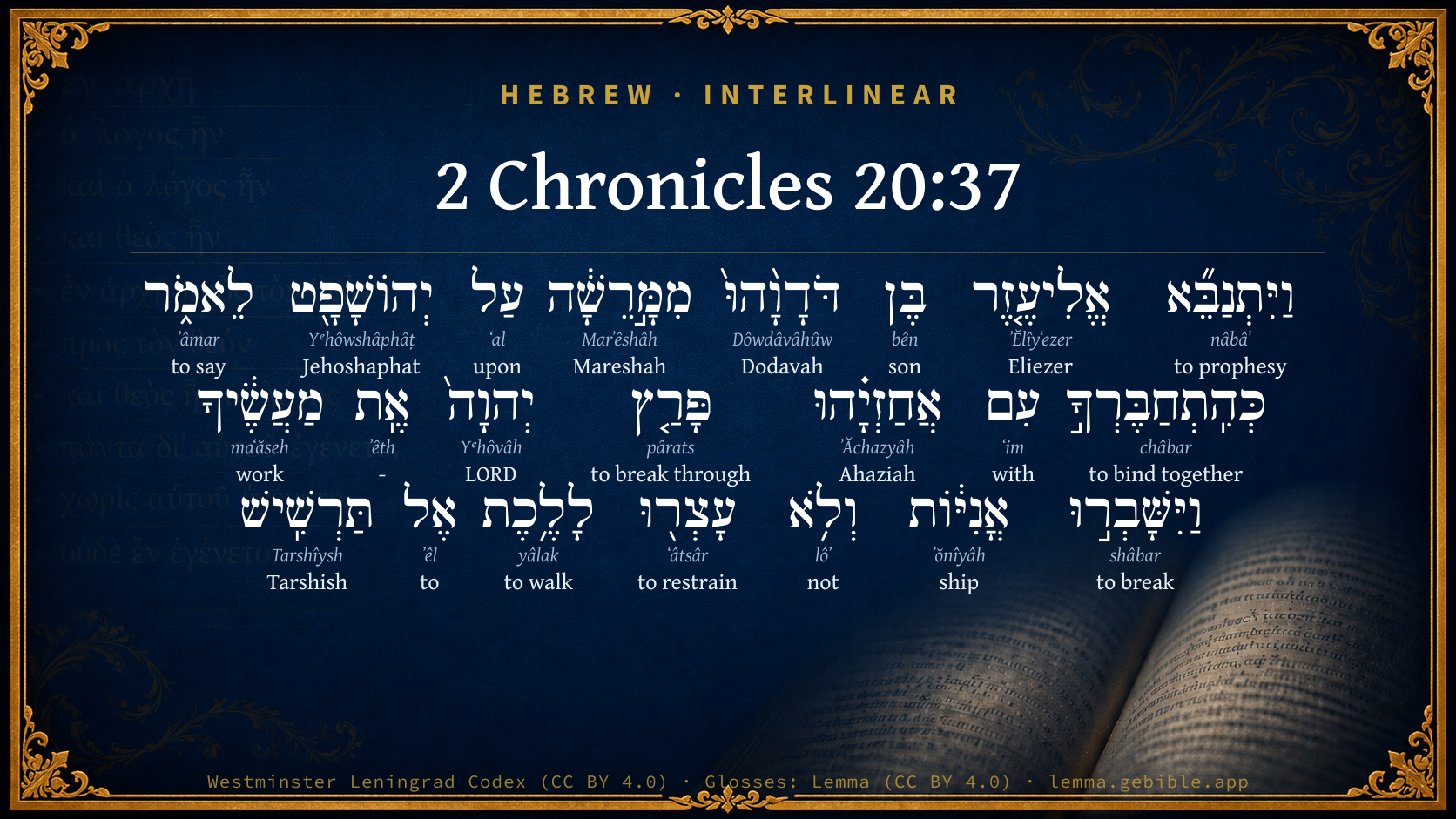
Hebrew (Westminster Leningrad Codex) 2 Chronicles 20:37 appears in the Hebrew Old Testament. The text above is from the Westminster Leningrad Codex. Each word links to its Strong’s number, a concise gloss, and parsing drawn from the Open Scriptures Hebrew Bible morphology. Click any word for its full Brown-Driver-Briggs (BDB) entry.
Download image
Cite this verse

2 Chronicles 20:37 (World English Bible). Public Domain. Lemma interlinear Bible study tool, https://lemma.gebible.app/v/2-chronicles/20/37.

Show BibTeX & RIS
BibTeX
RIS
English Translation
Then Eliezer the son of Dodavahu of Mareshah prophesied against Jehoshaphat, saying, Because you have joined yourself with Ahaziah, Yahweh has destroyed your works. The ships were broken, so that they were not able to go to Tarshish.
World English Bible · Public Domain
Highlights
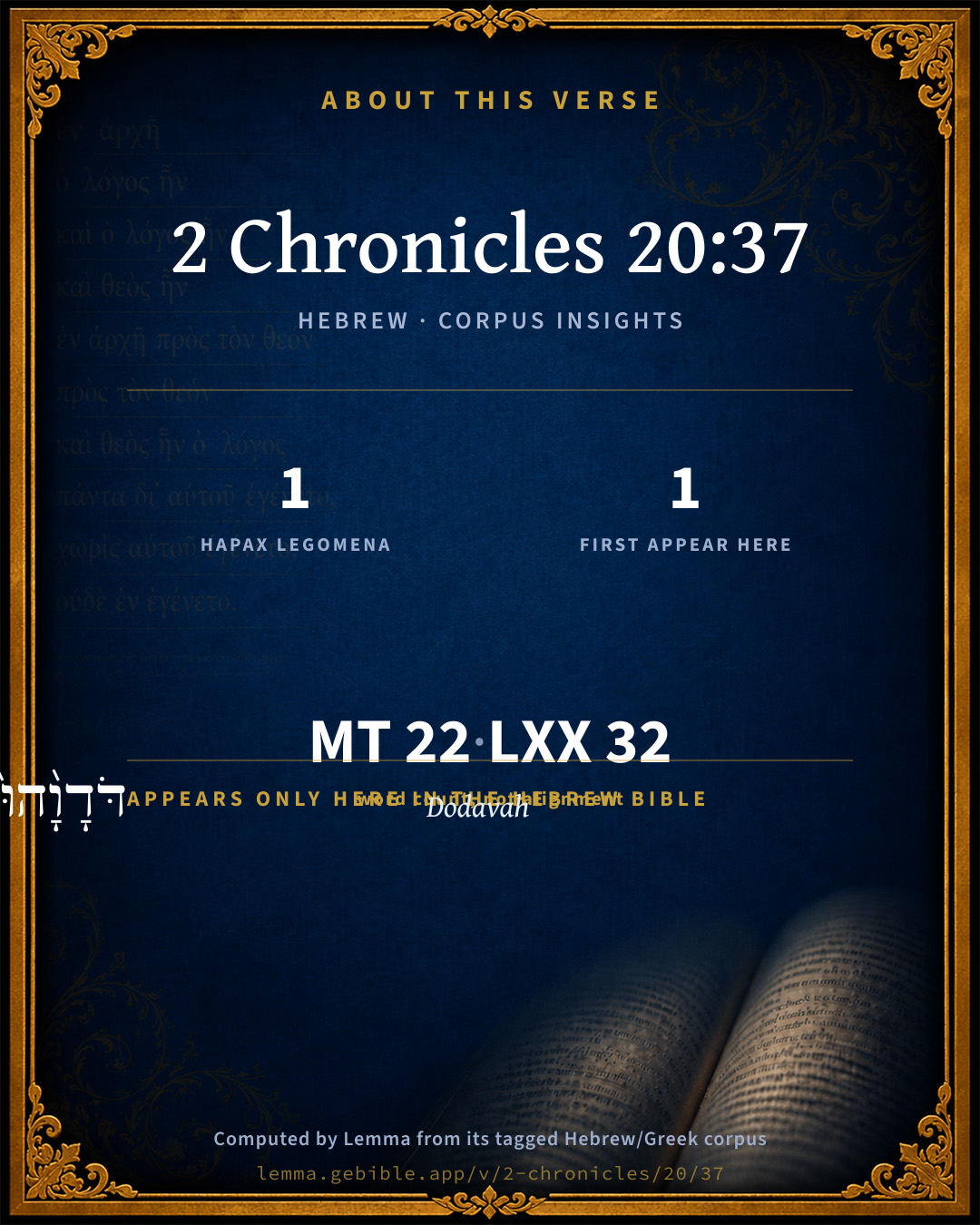
  • 1 hapax legomenon — only here in the Hebrew Bible
  • 1 first appearance in the Hebrew Bible
Full analysis ↓
Download a study sheet

One document with this verse’s original text, its word-by-word gloss line, the meaning frame, cross-references with their text, attributed commentary, and full source and license credits — printable, and it pastes into notes with its structure intact.

This verse Autodidact and up

Study sheet (.html) Plain text (.txt)

A passage Seminary Student

Up to 50 verses in one chapter. A passage sheet keeps up to 6 commentary sources and 12 cross-references per verse, in the order this page ranks them, and says so on the sheet whenever that leaves anything out. Ask for a single verse and you get the Autodidact verse sheet above.

Everything on this page stays free to read, with no account — the sheet is a download of what is already on screen, not access to it.

Want to remove ads? Support Godless Engineer
Compare translations 3

The same verse in 3 English versions, stacked beneath the original-language interlinear above. Click any original word for its lexicon entry.

Each is an independent rendering of the whole verse — the interlinear is not word-aligned to these translations.

Highlighted words mark where these versions differ — a whole-verse word diff, not a word-by-word alignment.

  • World English Bible Public Domain
    Then Eliezer the son of Dodavahu of Mareshah prophesied against Jehoshaphat, saying, Because you have joined yourself with Ahaziah, Yahweh has destroyed your works. The ships were broken, so that they were not able to go to Tarshish.
  • King James Version Public Domain
    Then Eliezer the son of Dodavah of Mareshah prophesied against Jehoshaphat, saying, Because thou hast joined thyself with Ahaziah, the LORD hath broken thy works. And the ships were broken, that they were not able to go to Tarshish.
  • unfoldingWord Literal Text CC BY-SA 4.0
    And Eliezer the son of Dodavahu from Mareshah prophesied against Jehoshaphat, saying, “When you allied yourself with Ahaziah, Yahweh broke through your works.” And the ships were broken, and they were not able to go to Tarshish.

unfoldingWord Literal Text — © unfoldingWord, licensed CC BY-SA 4.0. Word-aligned USFM3 via Door43 (git.door43.org/unfoldingWord/en_ult).

Versions to compare (up to 4)

3 of 4 selected

Show all 18 translations

Every available English version of this verse, each an independent rendering of the whole verse.

  • World English Bible Public Domain
    Then Eliezer the son of Dodavahu of Mareshah prophesied against Jehoshaphat, saying, Because you have joined yourself with Ahaziah, Yahweh has destroyed your works. The ships were broken, so that they were not able to go to Tarshish.
  • Berean Standard Bible Public Domain
    Then Eliezer son of Dodavahu of Mareshah prophesied against Jehoshaphat, saying, “Because you have allied yourself with Ahaziah, the LORD has destroyed your works.” So the ships were wrecked and were unable to sail to Tarshish.
  • Majority Standard Bible Public Domain
    Then Eliezer son of Dodavahu of Mareshah prophesied against Jehoshaphat, saying, “Because you have allied yourself with Ahaziah, the LORD has destroyed your works.” So the ships were wrecked and were unable to sail to Tarshish.
  • King James Version Public Domain
    Then Eliezer the son of Dodavah of Mareshah prophesied against Jehoshaphat, saying, Because thou hast joined thyself with Ahaziah, the LORD hath broken thy works. And the ships were broken, that they were not able to go to Tarshish.
  • American Standard Version (1901) Public Domain
    Then Eliezer the son of Dodavahu of Mareshah prophesied against Jehoshaphat, saying, Because thou hast joined thyself with Ahaziah, Jehovah hath destroyed thy works. And the ships were broken, so that they were not able to go to Tarshish.
  • Revised Version (1885) Public Domain
    Then Eliezer the son of Dodavahu of Mareshah prophesied against Jehoshaphat, saying, Because thou hast joined thyself with Ahaziah, the LORD hath destroyed thy works. And the ships were broken, that they were not able to go to Tarshish.
  • Geneva Bible (1599) Public Domain
    Then Eliezer ye sonne of Dodauah of Mareshah prophecied against Iehoshaphat, saying, Because thou hast ioyned thy selfe with Ahaziah, the Lord hath broken thy workes. and the shippes were broken, that they were not able to go to Tarshish.
  • Douay-Rheims (1899) Public Domain
    And Eliezer the son of Dodau of Maresa prophesied to Josaphat, saying: Because thou hast made a league with Ochozias, the Lord hath destroyed thy works, and the ships are broken, and they could not go to Tharsis.
  • Young's Literal Translation Public Domain
    and prophesy doth Eliezer son of Dodavah, of Mareshah, against Jehoshaphat, saying, `For thy joining thyself with Ahaziah, Jehovah hath broken up thy works;' and the ships are broken, and have not retained `power' to go unto Tarshish.
  • Literal Standard Version CC BY-SA 4.0
    and Eliezer son of Dodavah, of Mareshah, prophesies against Jehoshaphat, saying, “For your joining yourself with Ahaziah, YHWH has broken up your works”; and the ships are broken, and have not retained [power] to go to Tarshish.
  • Unlocked Literal Bible CC BY-SA 4.0
    Then Eliezer son of Dodavahu of Mareshah, prophesied against Jehoshaphat; he said, “Because you have allied yourself with Ahaziah, Yahweh has destroyed your projects.” The ships were wrecked so that they were not able to sail.
  • unfoldingWord Literal Text CC BY-SA 4.0
    And Eliezer the son of Dodavahu from Mareshah prophesied against Jehoshaphat, saying, “When you allied yourself with Ahaziah, Yahweh broke through your works.” And the ships were broken, and they were not able to go to Tarshish.
  • Darby Bible Public Domain
    And Eliezer the son of Dodavah, of Mareshah, prophesied against Jehoshaphat, saying, Because thou hast joined thyself with Ahaziah, Jehovah has broken thy works. And the ships were broken, and could not go to Tarshish.
  • World Messianic Bible Public Domain
    Then Eliezer the son of Dodavahu of Mareshah prophesied against Jehoshaphat, saying, “Because you have joined yourself with Ahaziah, the LORD has destroyed your works.” The ships were wrecked, so that they were not able to go to Tarshish.
  • Webster's Bible Public Domain
    Then Eliezer the son of Dodavah of Mareshah prophesied against Jehoshaphat, saying, Because thou hast joined thyself with Ahaziah, the LORD hath broken thy works. And the ships were broken, that they were not able to go to Tarshish.
  • Free Bible Version CC BY-SA 4.0
    But Eliezer, son of Dodavahu of Mareshah, prophesied against Jehoshaphat, saying, “Because you have made an alliance with Ahaziah, the Lord will destroy what you're doing.” The ships were wrecked and couldn't sail to Tarshish.
  • Bible in Basic English Public Domain
    Then the word of Eliezer the prophet, the son of Dodavahu of Mareshah, came against Jehoshaphat, saying, Because you have let yourself be joined with Ahaziah, the Lord has sent destruction on your works. And the ships were broken and were not able to go to Tarshish.
  • JPS Tanakh (1917) Public Domain
    Then Eliezer the son of Dodavahu of Mareshah prophesied against Jehoshaphat, saying: 'Because thou hast joined thyself with Ahaziah, the LORD hath made a breach in thy works.' And the ships were broken, that they were not able to go to Tarshish.

Literal Standard Version (2020), Covenant Press — licensed CC BY-SA 4.0. Text via the HelloAO Bible API (eBible.org). Unlocked Literal Bible (unfoldingWord) — licensed CC BY-SA 4.0. Text via the HelloAO Bible API (eBible.org). unfoldingWord Literal Text — © unfoldingWord, licensed CC BY-SA 4.0. Word-aligned USFM3 via Door43 (git.door43.org/unfoldingWord/en_ult). Free Bible Version, Dr. Jonathan Gallagher — licensed CC BY-SA 4.0. Text via the HelloAO Bible API (eBible.org).

Word by word

More ways to search: Search by grammar → Find every occurrence → Compare this word →

Practice this passage: Drill this verse → Learn its vocabulary →

דֹּדָוָ֨הוּ֙
Dôwdâvâhûw
H1735
“Dodavah”
Noun, Proper
Part of Speech
Noun
Type
Proper
Full BDB Definition

Origin: from H1730 and H3050

TWOT: None

Dodavah = "beloved of Jehovah" - a man of Mareshah in Judah, the father of Eliezer, who denounced Jehoshaphat's alliance with Ahaziah
  1. וַיִּתְנַבֵּ֞א nâbâʼ H5012 “and · to prophesy” Conjunction + Verb, Hithpael, Sequential Imperfect, 3rd Person, Masculine, Singular
  2. אֱלִיעֶ֤זֶר ʼĔlîyʻezer H461 “Eliezer” Noun, Proper
  3. בֶּן bên H1121 “son of” Noun, Common, Masculine, Singular, Construct
  4. מִמָּ֣רֵשָׁ֔ה Marʼêshâh H4762 “from · Mareshah” Preposition + Noun, Proper
  5. עַל ʻal H5921 “upon” Preposition
  6. יְהוֹשָׁפָ֖ט Yᵉhôwshâphâṭ H3092 “Jehoshaphat” Noun, Proper
  7. לֵאמֹ֑ר ʼâmar H559 “to say” Preposition + Verb, Qal, Infinitive Construct
  8. כְּהִֽתְחַבֶּרְךָ֣ châbar H2266 “like/as · to bind together · you” Preposition + Verb, Hithpael, Infinitive Construct + Suffix, Personal, 2nd Person, Masculine, Singular
  9. עִם ʻim H5973 “with” Preposition
  10. אֲחַזְיָ֗הוּ ʼĂchazyâh H274 “Ahaziah” Noun, Proper
  11. פָּרַ֤ץ pârats H6555 “to break through” Verb, Qal, Perfect, 3rd Person, Masculine, Singular
  12. יְהוָה֙ Yᵉhôvâh H3068 “LORD” Noun, Proper
  13. אֶֽת ʼêth H853 “-” Particle, Direct Object
  14. מַעֲשֶׂ֔יךָ maʻăseh H4639 “works · your” Noun, Common, Masculine, Plural, Construct + Suffix, Personal, 2nd Person, Masculine, Singular
  15. וַיִּשָּׁבְר֣וּ shâbar H7665 “and · to break” Conjunction + Verb, Niphal, Sequential Imperfect, 3rd Person, Masculine, Plural
  16. אֳנִיּ֔וֹת ʼŏnîyâh H591 “ships” Noun, Common, Feminine, Plural, Absolute
  17. וְלֹ֥א lôʼ H3808 “and · not” Conjunction + Particle, Negative
  18. עָצְר֖וּ ʻâtsâr H6113 “to restrain” Verb, Qal, Perfect, 3rd Person, Common, Plural
  19. לָלֶ֥כֶת yâlak H3212 “to walk” Preposition + Verb, Qal, Infinitive Construct
  20. אֶל ʼêl H413 “to” Preposition
  21. תַּרְשִֽׁישׁ Tarshîysh H8659 “Tarshish” Noun, Proper

About this verse

These counts appear in no published source. They are computed here, from the morphology-tagged text and Lemma’s own curated glosses. What Lemma adds →

22
words
22
distinct lemmas
Historical
section

Notable vocabulary

1 hapax legomenon — a word that appears only here in the entire Hebrew Bible:

  • דֹּדָוָ֨הוּ֙ Dodavah H1735

First appearance in Scripture

This word makes its first canonical appearance in the Hebrew Bible here:

  • דֹּדָוָ֨הוּ֙ Dodavah H1735

Shared distinctive vocabulary

מִמָּ֣רֵשָׁ֔ה Mareshah H4762 occurs in 8 verses of the Hebrew Bible. Also found in:

Grammatical profile

  • 7 verbs
  • 10 nouns
  • 3 prepositions
  • 2 particles

Verb forms

  • וַיִּתְנַבֵּ֞א Hithpael · Sequential Imperfect
  • לֵאמֹ֑ר Qal · Infinitive Construct
  • כְּהִֽתְחַבֶּרְךָ֣ Hithpael · Infinitive Construct
  • פָּרַ֤ץ Qal · Perfect
  • וַיִּשָּׁבְר֣וּ Niphal · Sequential Imperfect
  • עָצְר֖וּ Qal · Perfect
  • לָלֶ֥כֶת Qal · Infinitive Construct

Hebrew & Septuagint length

In English translation the verse runs 38 words from the Hebrew and 39 from the Septuagint (LXX English) — closely comparable.

A rough comparison of the two English renderings, which tokenize alike — not a word-level alignment.

Word counts can differ between the Hebrew and the Greek without any difference in meaning — e.g. the Hebrew direct-object marker אֵת has no separate Greek word, and Greek often adds the article ὁ.

In the original languages it is 22 Hebrew tokens and 32 Greek tokens — but the two are counted differently (Hebrew bundles its prefixes and suffixes into one token; the Greek is in lemma form), so that isn’t a like-for-like length.

Cross-references

9

Topical passages linked to 2 Chronicles 20:37 in the Treasury of Scripture Knowledge — connected by theme and wording, ordered by reader-vote popularity; previews shown in the World English Bible.

  • Proverbs 13:20 One who walks with wise men grows wise, But a companion of fools suffers harm.
  • 2 Chronicles 9:21 For the king had ships that went to Tarshish with the servants of Huram; once every three years came the ships of Tarshish, bringing gold, and silver, ivory, and apes, and peacocks.
  • 2 Chronicles 19:2 Jehu the son of Hanani the seer went out to meet him, and said to king Jehoshaphat, Should you help the wicked, and love those who hate Yahweh? for this thing wrath is on you from before Yahweh.
  • Joshua 7:11–12 Israel has sinned; yes, they have even transgressed my covenant which I commanded them: yes, they have even taken of the devoted thing, and have also stolen, and dissembled also; and they have even put it among their own stuff.
  • 1 Kings 22:48 Jehoshaphat made ships of Tarshish to go to Ophir for gold: but they didn't go; for the ships were broken at Ezion Geber.
  • 2 Chronicles 16:9 For the eyes of Yahweh run back and forth throughout the whole earth, to show himself strong in the behalf of them whose heart is perfect toward him. Herein you have done foolishly; for from henceforth you shall have wars.
  • Proverbs 9:6 Leave your simple ways, and live. Walk in the way of understanding."
  • Hebrews 12:6 For whom the Lord loves, he chastens, And scourges every son whom he receives."
  • Revelation 3:19 As many as I love, I reprove and chasten. Be zealous therefore, and repent.

Cross-references courtesy of OpenBible.info (CC BY 4.0).

Hebrew and Greek witnesses Masoretic Hebrew ↔ Greek Septuagint

The same verse in the two great witnesses to the Old Testament, shown verse-for-verse.

These are two independent witnesses, not word-aligned to each other, and the Septuagint is shown in lemma (dictionary) form.

Hebrew 2 Chronicles 20:37 Masoretic · Westminster Leningrad Codex

וַיִּתְנַבֵּ֞א אֱלִיעֶ֤זֶר בֶּן דֹּדָוָ֨הוּ֙ מִמָּ֣רֵשָׁ֔ה עַל יְהוֹשָׁפָ֖ט לֵאמֹ֑ר כְּהִֽתְחַבֶּרְךָ֣ עִם אֲחַזְיָ֗הוּ פָּרַ֤ץ יְהוָה֙ אֶֽת מַעֲשֶׂ֔יךָ וַיִּשָּׁבְר֣וּ אֳנִיּ֔וֹת וְלֹ֥א עָצְר֖וּ לָלֶ֥כֶת אֶל תַּרְשִֽׁישׁ

Then Eliezer the son of Dodavahu of Mareshah prophesied against Jehoshaphat, saying, Because you have joined yourself with Ahaziah, Yahweh has destroyed your works. The ships were broken, so that they were not able to go to Tarshish.

World English Bible · Public Domain

Greek LXX 2 Chronicles 20:37 Septuagint · lemma form

καί προφητεύω ελιεζερ ὁ ὁ δωδια ἀπό μαρισης ἐπί ιωσαφατ λέγω ὡς φιλιάζω ὁ οχοζια θραύω κύριος ὁ ἔργον σύ καί συντρίβω ὁ πλοῖον σύ καί οὐ δύναμαι ὁ πορεύομαι εἰς θαρσις

And Eliezer you son of Dodia of Marisa prophesied against Josaphat, saying, Forasmuch as you have allied yourself with Ochozias, the Lord has broken your work, and your vessels have been wrecked. And they could not go to Tharsis.

LXX2012 (modern English Septuagint) · Public Domain

On this verse, Ellicott's Commentary for English Readers discusses the Septuagint’s reading. Read the note in Commentary ↓

Hebrew: Westminster Leningrad Codex (CC BY 4.0). Greek: Septuagint (public domain); English from LXX2012 (modern English Septuagint) (Public Domain). How the Septuagint differs from the Hebrew →

Commentary

Notes on 2 Chronicles 20:37 from classic Christian and Jewish commentators (each source and its license shown beneath its notes). The classic Christian expositions comment on the surrounding passage and are grouped to its opening verse, so a note may address several verses; the Jewish commentaries on the Tanakh (Rashi and others) are per-verse, so they appear only where the commentator wrote on this verse.

Lemma curates 59 commentaries, every one of them public domain or Creative Commons licensed, each selected and text-cleaned for this edition rather than reprinted as found. About our sources →

Trapp's Complete Commentary

John Trapp

2Ch 20:37 Then Eliezer the son of Dodavah of Mareshah prophesied against Jehoshaphat, saying, Because thou hast joined thyself with Ahaziah, the LORD hath broken thy works. And the ships were broken, that they were not able to go to Tarshish.

Ver. 37. And the ships were broken.] By tempest likely; and perhaps lying at anchor in the harbour; as it befell Charles V’s navy before the walls of Algiers, besieged by him by sea and by land, and well-nigh taken.

John Trapp, A Commentary or Exposition upon All the Books of the Old and New Testament (1647–1656) — public domain. Text from a community e-Sword module.

The Biblical Illustrator

Joseph S. Exell

2Ch_20:37

Because thou hast joined thyself with Ahaziah, the Lord hath broken thy works.

Evil compacts

Some partnerships are inexplicable. A Church officer who has led the devotions of the Church has been known to enter into partnership with a grovelling man who never hesitated to use profane language in the warehouse; a generous supporter of good institutions has associated with a man who would have sold his own father if he could have made money by the transaction. And men have wondered who have not known how two could walk together except they were agreed, and who have gone upon the principle that light could have no communion with darkness. The principle of ill-associated partnerships works in two ways: the professing Christian finds it convenient to be able to remit all questionable work to the man who has made away with his conscience and honour, and the said man finds it very satisfactory to point to his professing partner as a proof and pledge that all is straightforward and upright. But is this as it ought to be? (J. Parker, D.D.)

An immoral fallacy

It will be said that business is business, and religion is religion, that there is a distinction between the merchant and the man. Let us admit that there remains this question: When the merchant is damned for his wicked deeds where will the man go? (J. Parker, D. D.)

Evil associations

The principle of the text--

I. Supplies a lesson for the young. What you have to settle first and foremost is, the moral basis on which you are proceeding; you must get the full consent of your judgment and heart and conscience before you give yourself up to any commercial course.

II. Is expansive enough to include the subject of marriage. We do not hesitate to lay down the broad principle that where there is incongruity of religious conviction between man and woman happiness of the deepest and purest kind is entirely out of the question.

III. Will permit an earnest word about evil companionship generally. (J. Parker, D. D.)

.

The Biblical Illustrator, edited by Joseph S. Exell (c. 1880s–1900s) — public domain. Text from a community e-Sword module.

Geneva Bible (1599)

Geneva Bible translators

Thus God would not have his to join in society with idolaters and wicked men.

Geneva Bible (1599) marginal notes — public domain. Text via Bolls.life.

Adam Clarke's Commentary

Verse 37. The Lord hath broken, c.] "The WORD of the Lord hath broken." - Targum. Concerning Tarshish, Ezion-geber, and Ophir, and the voyage thither, 1Kg 10:22, and at the end of that chapter, 1Kg 10:29, and on 2Ch 9:26-28. The Tarshish here is called by the Chaldee Torsos in the great sea, some place in the Mediterranean. On this subject the reader has, no doubt, already seen a great variety of opinions.

Adam Clarke's Commentary on the Bible (1810–1826) — public domain. Text from a community e-Sword/MySword module.

Ellicott's Commentary for English Readers

(37) Then.—And.

Eliezer the son of Dodavah.—A prophet who is otherwise unknown.

Dodavah.—Heb. Dôdâvâhû. (Comp. Hôdavyâhû. 1Ch_3:24; LXX., Δωδία, as if the Heb. were Dôdîyâh; Vulg., “Dodau.”

Mareshah.—See 2Ch_11:8.

Because thou hast joined thyself.—Comp. Jehu the son of Hanani’s similar rebuke of Jenoshaphat for his alliance with Ahab (2Ch_19:2).

The Lord hath broken.—Shattered (parac). (Comp. 2Ch_24:7.) The perfect is prophetic, i.e., will certainly shatter.

And the ships were broken.—Wrecked by a gale. (Comp. Psa_48:7 : “With the east wind Thou breakest ships of Tarshish.”)

That they were not able.—And kept not strength to go (2Ch_13:20; 2Ch_14:10).

After this misadventure, Ahaziah proposed another joint expedition; but the king of Judah declined. (See on 2Ch_20:36.)

A Bible Commentary for English Readers, edited by Charles John Ellicott (1878–1897) — public domain. Text from a community e-Sword module.

The Cambridge Bible for Schools and Colleges

gen. ed. J. J. S. Perowne

37. Mareshah] Cp. 2Ch_11:8 (note); 2Ch_14:10.

hath broken] R.V. hath destroyed. The same Heb. word is used 1Ch_13:11 (“had broken forth,” R.V.); 2Ch_14:11 (“hath broken forth,” R.V. mg.).

The Cambridge Bible for Schools and Colleges (gen. ed. J. J. S. Perowne; Cambridge University Press, 1878–1918) — public domain. Text from a community e-Sword module.

Whedon's Commentary on the Bible

Daniel D. Whedon

37. Eliezer… prophesied against Jehoshaphat — This fact is mentioned only by the chronicler, and shows that Jehoshaphat was twice censured by the prophets for his connexion with the kingdom of Israel. Compare the rebuke of Jehu in 2Ch_19:2-3. These rebukes, and the evils which resulted from his alliance with the northern kingdom, are a cloud upon the memory of Jehoshaphat, but, on the whole, the general character of his administration was, as Stanley observes, “such as to leave behind the recollection of a reign of proverbial splendour.”

Daniel D. Whedon (gen. ed.), Commentary on the Old and New Testaments (1874–1909) — public domain. Text from a community e-Sword module.

The Pulpit Commentary

Eliezer the son of Dodavah of Mareshah. Nothing beside is known of this prophet. For Mareshah, see 2Ch_11:8, and note there. The ships were broken; i.e. presumably by some storm. One general remark may be made upon these verses (34-37), together with vers. 45-50 of 1Ki 22., viz. that the dislocation of both manner and matter, observable in both, of them, probably betrays something out of order for whatever reason or accident, in the more original source, from which both drew, the apparently disjointed mixture of matter in the parallel being the more patent of the two.

The Pulpit Commentary (1880–1919), ed. H.D.M. Spence-Jones & Joseph S. Exell — public domain. Text from a community e-Sword module.

Rashi

Rabbi Shlomo Yitzchaki (Rashi)

and could not go - Heb. וְלֹא עָצְרוּ, lit., they did not hold in. The meaning is: The ships could not muster the strength to go, and they were broken.

Rashi on the Tanakh — English translations: “The Judaica Press complete Tanach with Rashi, translated by A. J. Rosenberg” (CC BY 4.0); “Pentateuch with Rashi's commentary by M. Rosenbaum and A.M. Silbermann, 1929-1934” (public domain); “The Metsudah Tanach series, Lakewood, N.J” (CC BY 4.0); and “The Book of Joshua, Metsudah Publications, 1997” (CC BY 4.0). Text via Sefaria.

Lesson kit

Teaching starters — assembled from the data on this page, not authored interpretation. Every prompt links to the verse data it draws on. Edit before teaching.

2 Chronicles, in the Historical, opens this verse with 22 words (22 distinct Hebrew lemmas). Its most distinctive word is Dôwdâvâhûw (“Dodavah”). A historical commentator’s framing appears above. Read the whole chapter for the surrounding context.

Discussion questions

  1. What does “Dodavah” (Dôwdâvâhûw) contribute to the verse as a whole?
  2. This verse holds 1 word here found nowhere else in the Hebrew Bible. What might the rare word draw attention to?
  3. The word “Dodavah” first appears here in Scripture. What is being introduced at this debut?
  4. Joshua 15:44 shares the word «Mareshah» with this verse. How do the two illuminate each other?
  5. These translations render this verse differently; the difference is in the English rendering, not the original. What questions does that raise?
  6. The verb «וַיִּתְנַבֵּ֞א» is Hithpael Sequential Imperfect. How does its form color the action?
  7. Reading how Trapp's Complete Commentary and The Biblical Illustrator read this verse, where do the two commentators agree and where do they part?

Things to notice

Reading settings

Reading text

Shown beneath each verse's original-language words.

Old Testament
Old Testament edition

Read the OT as the Masoretic Hebrew (MT) or the Greek Septuagint (LXX).

English shown for the Greek Septuagint (in the Hebrew ↔ Greek comparison).

Comparing translations? Open the Compare panel on any verse page to stack up to four side by side.