
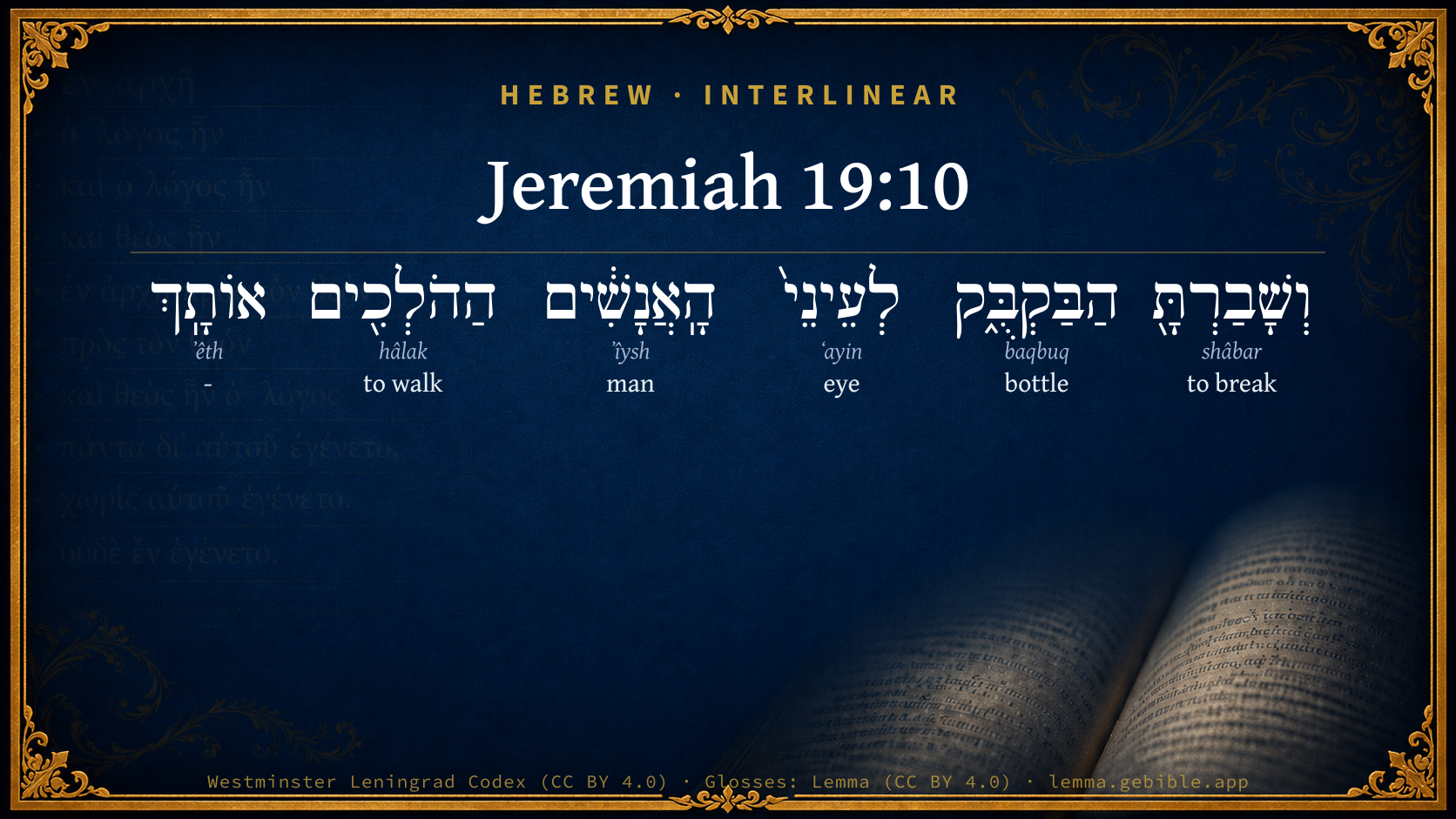
Jeremiah 19:10

Hebrew (Westminster Leningrad Codex) Jeremiah 19:10 appears in the Hebrew Old Testament. The text above is from the Westminster Leningrad Codex. Each word links to its Strong’s number, a concise gloss, and parsing drawn from the Open Scriptures Hebrew Bible morphology. Click any word for its full Brown-Driver-Briggs (BDB) entry.
Download image
Cite this verse

Jeremiah 19:10 (World English Bible). Public Domain. Lemma interlinear Bible study tool, https://lemma.gebible.app/v/jeremiah/19/10.

Show BibTeX & RIS
BibTeX
RIS
English Translation
Then shall you break the bottle in the sight of the men who go with you,
World English Bible · Public Domain
Download a study sheet

One document with this verse’s original text, its word-by-word gloss line, the meaning frame, cross-references with their text, attributed commentary, and full source and license credits — printable, and it pastes into notes with its structure intact.

This verse Autodidact and up

Study sheet (.html) Plain text (.txt)

A passage Seminary Student

Up to 50 verses in one chapter. A passage sheet keeps up to 6 commentary sources and 12 cross-references per verse, in the order this page ranks them, and says so on the sheet whenever that leaves anything out. Ask for a single verse and you get the Autodidact verse sheet above.

Everything on this page stays free to read, with no account — the sheet is a download of what is already on screen, not access to it.

Want to remove ads? Support Godless Engineer
Compare translations 3

The same verse in 3 English versions, stacked beneath the original-language interlinear above. Click any original word for its lexicon entry.

Each is an independent rendering of the whole verse — the interlinear is not word-aligned to these translations.

Highlighted words mark where these versions differ — a whole-verse word diff, not a word-by-word alignment.

  • World English Bible Public Domain
    Then shall you break the bottle in the sight of the men who go with you,
  • King James Version Public Domain
    Then shalt thou break the bottle in the sight of the men that go with thee,
  • unfoldingWord Literal Text CC BY-SA 4.0
    “And you shall break the jar before the eyes of the men who are going with you.

unfoldingWord Literal Text — © unfoldingWord, licensed CC BY-SA 4.0. Word-aligned USFM3 via Door43 (git.door43.org/unfoldingWord/en_ult).

Versions to compare (up to 4)

3 of 4 selected

Show all 18 translations

Every available English version of this verse, each an independent rendering of the whole verse.

  • World English Bible Public Domain
    Then shall you break the bottle in the sight of the men who go with you,
  • Berean Standard Bible Public Domain
    Then you are to shatter the jar in the presence of the men who accompany you,
  • Majority Standard Bible Public Domain
    Then you are to shatter the jar in the presence of the men who accompany you,
  • King James Version Public Domain
    Then shalt thou break the bottle in the sight of the men that go with thee,
  • American Standard Version (1901) Public Domain
    Then shalt thou break the bottle in the sight of the men that go with thee,
  • Revised Version (1885) Public Domain
    Then shalt thou break the bottle in the sight of the men that go with thee,
  • Geneva Bible (1599) Public Domain
    Then shalt thou breake the bottell in the sight of the men that go with thee,
  • Douay-Rheims (1899) Public Domain
    And thou shalt break the bottle in the sight of the men that shall go with thee.
  • Young's Literal Translation Public Domain
    `And thou hast broken the bottle before the eyes of the men who are going with thee,
  • Literal Standard Version CC BY-SA 4.0
    “And you have broken the bottle before the eyes of the men who are going with you,
  • Unlocked Literal Bible CC BY-SA 4.0
    Then you will break the clay flask in the sight of the men who went with you.
  • unfoldingWord Literal Text CC BY-SA 4.0
    “And you shall break the jar before the eyes of the men who are going with you.
  • Darby Bible Public Domain
    And thou shalt break the flagon in the sight of the men that go with thee,
  • World Messianic Bible Public Domain
    “Then you shall break the container in the sight of the men who go with you,
  • Webster's Bible Public Domain
    Then shalt thou break the bottle in the sight of the men that go with thee,
  • Free Bible Version CC BY-SA 4.0
    Then smash the jar in front of the people with you.
  • Bible in Basic English Public Domain
    Then let the potter's bottle be broken before the eyes of the men who have gone with you,
  • JPS Tanakh (1917) Public Domain
    Then shalt thou break the bottle in the sight of the men that go with thee,

Literal Standard Version (2020), Covenant Press — licensed CC BY-SA 4.0. Text via the HelloAO Bible API (eBible.org). Unlocked Literal Bible (unfoldingWord) — licensed CC BY-SA 4.0. Text via the HelloAO Bible API (eBible.org). unfoldingWord Literal Text — © unfoldingWord, licensed CC BY-SA 4.0. Word-aligned USFM3 via Door43 (git.door43.org/unfoldingWord/en_ult). Free Bible Version, Dr. Jonathan Gallagher — licensed CC BY-SA 4.0. Text via the HelloAO Bible API (eBible.org).

Word by word

More ways to search: Search by grammar → Find every occurrence → Compare this word →

Practice this passage: Drill this verse → Learn its vocabulary →

About this verse

These counts appear in no published source. They are computed here, from the morphology-tagged text and Lemma’s own curated glosses. What Lemma adds →

6
words
6
distinct lemmas
Prophets
section

Notable vocabulary

The rarest word here is הַבַּקְבֻּ֑ק bottle H1228 — appearing just 3 times in the whole Hebrew Bible.

Shared distinctive vocabulary

הַבַּקְבֻּ֑ק bottle H1228 occurs in 3 verses of the Hebrew Bible. Also found in:

Grammatical profile

  • 2 verbs
  • 3 nouns
  • 1 particle

Verb forms

  • וְשָׁבַרְתָּ֖ Qal · Sequential Perfect
  • הַהֹלְכִ֖ים Qal · Participle Active

Cross-references

3

Topical passages linked to Jeremiah 19:10 in the Treasury of Scripture Knowledge — connected by theme and wording, ordered by reader-vote popularity; previews shown in the World English Bible.

  • Jeremiah 48:12 Therefore, behold, the days come, says Yahweh, that I will send to him those who pour off, and they shall pour him off; and they shall empty his vessels, and break their bottles in pieces.
  • Jeremiah 51:63–64 It shall be, when you have made an end of reading this book, that you shall bind a stone to it, and cast it into the midst of the Euphrates:
  • Jeremiah 19:1 Thus said Yahweh, Go, and buy a potter's earthen bottle, and [take] of the elders of the people, and of the elders of the priests;

Cross-references courtesy of OpenBible.info (CC BY 4.0).

Hebrew and Greek witnesses Masoretic Hebrew ↔ Greek Septuagint

The same verse in the two great witnesses to the Old Testament, shown verse-for-verse.

These are two independent witnesses, not word-aligned to each other, and the Septuagint is shown in lemma (dictionary) form.

Hebrew Jeremiah 19:10 Masoretic · Westminster Leningrad Codex

וְשָׁבַרְתָּ֖ הַבַּקְבֻּ֑ק לְעֵינֵי֙ הָֽאֲנָשִׁ֔ים הַהֹלְכִ֖ים אוֹתָֽךְ

Then shall you break the bottle in the sight of the men who go with you,

World English Bible · Public Domain

Greek LXX Structure differs

In the Septuagint, Jeremiah is about an eighth shorter than the Hebrew and arranges its material differently — the Oracles Against the Nations (Hebrew chapters 46–51) appear in the middle of the Greek book, after 25:13. Because the chapter and verse boundaries do not line up, a verse-for-verse comparison with the Hebrew is not shown.

A verse-for-verse comparison isn’t shown here because the chapters and verses don’t line up. Switch to the LXX edition with the MT / LXX toggle above to read the Greek directly.

On this verse, Joseph Benson's Commentary discusses the Septuagint’s reading. Read the note in Commentary ↓

Hebrew: Westminster Leningrad Codex (CC BY 4.0). Greek: Septuagint (public domain); English from a public-domain English Septuagint. How the Septuagint differs from the Hebrew →

Targum (Aramaic paraphrase)

1

The Targum is the ancient Jewish Aramaic paraphrase of the Hebrew Scriptures — an interpretive translation, not the Hebrew text itself. Onkelos (literal) and Pseudo-Jonathan (expansive) render the Torah, and Jonathan the Prophets. Coverage is partial: where no permissively-licensed English translation exists for a verse, only the Aramaic is shown. This is verse-level text, not a word-by-word alignment to the Hebrew.

  1. Targum Jonathan Prophets (Joshua–Malachi)
    וְתִתְבַּר זְלוּעַ לְעֵינֵי גַבְרַיָא דְאֶזְלִין עִמָךְ:

    (no public-domain English translation for this verse)

    Targum Jonathan — Aramaic: “Mikraot Gedolot” (public domain). English: “Sefaria Community Translation” (CC0 1.0 (public-domain dedication)); “London "Chaldee Paraphrase," 1871” (public domain). Text via Sefaria.

Commentary

Notes on Jeremiah 19:10 from classic Christian and Jewish commentators (each source and its license shown beneath its notes). The classic Christian expositions comment on the surrounding passage and are grouped to its opening verse, so a note may address several verses; the Jewish commentaries on the Tanakh (Rashi and others) are per-verse, so they appear only where the commentator wrote on this verse.

Lemma curates 59 commentaries, every one of them public domain or Creative Commons licensed, each selected and text-cleaned for this edition rather than reprinted as found. About our sources →

Matthew Henry's Commentary

The message of wrath delivered in the foregoing verses is here enforced, that it might gain credit, two ways: -

I. By a visible sign. The prophet was to take along with him an earthen bottle (Jer 19:1), and, when he had delivered his message, he was to break the bottle to pieces (Jer 19:10), and the same that were auditors of the sermon must be spectators of the sign. He had compared this people, in the chapter before, to the potter's clay, which is easily marred in the making. But some might say, "It is past that with us; we have been made and hardened long since." "And what though you be," says he, "the potter's vessel is as soon broken in the hand of any man as the vessel while it is soft clay is marred in the potter's hand, and its case is, in this respect, much worse, that the vessel while it is soft clay, though it be marred, may be moulded again, but, after it is hardened, when it is broken it can never be pieced again." Perhaps what they see will affect them more than what they only hear talk of; that is the intention of sacramental signs, and teaching by symbols was anciently used. In the explication of this sign he must inculcate what he had before said, with a further reference to the place where this was done, in the valley of Tophet. 1. As the bottle was easily, irresistibly, and irrecoverably broken by the Chaldean army, Jer 19:11. They depended much upon the firmness of their constitution, and the fixedness of their courage, which they thought hardened them like a vessel of brass; but the prophet shows that all that did but harden them like a vessel of earth, which, though hard, is brittle and sooner broken than that which is not so hard. Though they were made vessels of honour, still they were vessels of earth, and so they shall be made to know if they dishonour God and themselves, and serve not the purposes for which they were made. It is God himself, who made them, that resolves to unmake them: I will break this people and this city, dash them in pieces like a potter's vessel; the doom of the heathen (Psa 2:9, Rev 2:27), but now Jerusalem's doom, Isa 30:14. A potter's vessel, when once broken, cannot be made whole again, cannot be cured, so the word is. The ruin of Jerusalem shall be an utter ruin; no hand can repair it but his that broke it; and if they return to him, though he has torn, he will heal. 2. This was done in Tolphet, to signify two things: - (1.) That Tophet should be the receptacle of the slain: They shall bury in Tophet till there be no place to bury any more there; they shall jostle for room to lay their dead, and a very little room will then serve those who, while they lived, laid house to house and field to field. Those that would be placed alone in the midst of the earth while they were above ground, and obliged all about them to keep their distance, must lie with the multitude when they are underground, for there are innumerable before them. (2.) That Tophet should be a resemblance of the whole city (Jer 19:12): I will make this city as Tophet. As they had filled the valley of Tophet with the slain which they sacrificed to their idols, so God will fill the whole city with the slain that shall fall as sacrifices to the justice of God. We read (Kg2 23:10) of Josiah's defiling Tophet, because it had been abused to idolatry, which he did (as should seem, Jer 19:14) by filling it with the bones of men; and, whatever it was before, thenceforward it was looked upon as a detestable place. Dead carcases, and other filth of the city, were carried thither, and a fire was continually kept there for the burning of it. This was the posture of that valley when Jeremiah was sent thither to prophesy; and so execrable a place was it looked upon to be that, in the language of our Saviour's time, hell was called, in allusion to it, Gehenna, the valley of Hinnom. "Now" (says God) "since that blessed reformation, when Tophet was defiled, did not proceed as it ought to have done, nor prove a thorough reformation, but though the idols in Tophet were abolished and made odious those in Jerusalem remained, therefore will I do with the city as Josiah did by Tophet, fill it with the bodies of men, and make it a heap of rubbish." Even the houses of Jerusalem, and those of the kings of Judah, the royal palaces not excepted, shall be defiled as the place of Tophet (Jer 19:13), and for the same reason, because of the idolatries that have been committed there; since they will not defile them by a reformation, God will defile them by a destruction, because upon the roofs of their houses they have burnt incense unto the host of heaven. The flat roofs of their houses were sometimes used by devout people as convenient places for prayer (Act 10:9), and by idolaters they were used as high places, on which they sacrificed to strange gods, especially to the host of heaven, the sun, moon, and stars, that there they might be so much nearer to them and have a clearer and fuller view of them. We read of those that worshipped the host of heaven upon the house-tops (Zep 1:5), and of altars on the top of the upper chamber of Ahaz, Kg2 23:12. This sin upon the house-tops brought a curse into the house, which consumed it, and made it a dunghill like Tophet.

II. By a solemn recognition and ratification of what he had said in the court of the Lord's house, Jer 19:14, Jer 19:15. The prophet returned from Tophet to the temple, which stood upon the hill over that valley, and there confirmed, and probably repeated, what he had said in the valley of Tophet, for the benefit of those who had not heard it; what he had said he would stand to. Here, as often before, he both assures them of judgments coming upon them and assigns the cause of them, which was their sin. Both these are here put together in a little compass, with a reference to all that had gone before. 1. The accomplishment of the prophecies is here the judgment threatened. The people flattered themselves with a conceit that God would be better than his word, that the threatening was but to frighten them and keep them in awe a little; but the prophet tells them that they deceive themselves if they think so: For thus saith the Lord of hosts, who is able to make his words good, I will bring upon this city, and upon all her towns, all the smaller cities that belong to Jerusalem the metropolis, all the evil that I have pronounced against it. Note, Whatever men may think to the contrary, the executions of Providence will fully answer the predictions of the word, and God will appear as terrible against sin and sinners as the scripture makes him; nor shall the unbelief of men make either his promises or his threatenings of no effect or of less effect than they were thought to be of. 2. The contempt of the prophecies is here the sin charged upon them, as the procuring cause of this judgment. It is because they have hardened their necks, and would not bow and bend them to the yoke of God's commands, would not hear my words, that is, would not heed them and yield obedience to them. Note, The obstinacy of sinners in their sinful ways is altogether their own fault; if their necks are hardened, it is their own act and deed, they have hardened them; if they are deaf to the word of God, it is because they have stopped their own ears. We have need therefore to pray that God, by his grace, would deliver us from hardness of heart and contempt of his word and commandments.

Matthew Henry's Commentary on the Whole Bible (1708–1710) — public domain (CC PDM 1.0). Text via the HelloAO Bible API.

The Cambridge Bible for Schools and Colleges

gen. ed. J. J. S. Perowne

10–13. See introd. summary to section. Jer_19:10 links on to Jer_19:2. This and the next sub-section (Jer_19:14 to Jer_20:6) are thought to be taken from the memoirs of Jeremiah by Baruch (see Intr. pp. xli. f.), as in them the prophet is spoken of in the third person.

“The people … have the same custom of breaking a jar, when they wish to express their utmost detestation of any one. They come behind or near him, and smash the jar to atoms, thus imprecating upon him and his a like hopeless ruin.” Thomson, The Land and the Book, p. 641.

The Cambridge Bible for Schools and Colleges (gen. ed. J. J. S. Perowne; Cambridge University Press, 1878–1918) — public domain. Text from a community e-Sword module.

Trapp's Complete Commentary

John Trapp

Jer 19:10 Then shalt thou break the bottle in the sight of the men that go with thee,

Ver. 10. Then shalt thou break the bottle.] That the eyes of the bystanders and beholders may affect their hearts. Non alia ratio Sacramentorum est.

John Trapp, A Commentary or Exposition upon All the Books of the Old and New Testament (1647–1656) — public domain. Text from a community e-Sword module.

Joseph Benson's Commentary

Jer 19:10-13. Then shalt thou break the bottle, &c. — This was intended to be a symbolical representation of the ruin threatened against them, used in order to strike the beholders more powerfully than mere words could do. Of such symbolical actions as these there are several instances in the Scriptures. Thus saith the Lord, Even so will I break this people — That is, as Jeremiah breaketh the bottle: That cannot be made whole again — That is, the ruin of Jerusalem shall be an utter ruin: no hand can repair it but his that broke it; and if they return to him, though he has torn, he will heal. In fact, Jerusalem was so utterly destroyed by the Chaldeans that there was little left standing of it. So that after their captivity they were obliged to build a new city in the place of the former. And they shall bury them in Tophet — These words are omitted by the LXX.; till there be no place to bury — Till there is no room to bury more; for the meaning is, that the whole valley of Tophet should be so filled with dead bodies, that there should be no room to lay any more there; by which is expressed the greatness of the slaughter. And even make this city as Tophet — A place of slaughter. And the houses of Jerusalem shall be defiled as Tophet — Namely, polluted with dead bodies. Because of the houses upon whose roofs they have burned incense — The houses of the Jews were built with flat roofs, Deu 22:8, and there they dedicated altars to the host of heaven, where they could have a full view of them.

Joseph Benson's Commentary on the Old and New Testaments (1811–1818) — public domain. Text from a community e-Sword module.

Tyndale Open Study Notes

Tyndale Open Resources

19:10-13 Judah, the nation that these leaders represented, would be utterly shattered and broken beyond all hope of repair. Never again would Judah be a sovereign nation with a Davidic king (see 33:17-18), and the city of Jerusalem would be defiled like Topheth, the unclean valley (see study note on 7:30-34).

Tyndale Open Study Notes — © Tyndale Open Resources, licensed CC BY-SA 4.0. Text via the HelloAO Bible API.

Jamieson, Fausset & Brown

Robert Jamieson, A. R. Fausset & David Brown

break . . . bottle--a symbolical action, explained in Jer 19:11.

the men--the elders of the people and of the priests (Jer 19:1; compare Jer 51:63-64).

Jamieson, Fausset & Brown — Commentary Critical and Explanatory on the Whole Bible (1871) — public domain (CC PDM 1.0). Text via the HelloAO Bible API.

John Calvin's Commentaries

Jeremiah summoned witnesses, that the confirmation of the prophecy might be more fully attested to the people. With regard to the history of this transaction we may add, that he was first sent to the house of the potter, from whence he procured the bottle; he then went to Tophet, and there spoke against their impious and corrupt superstitions; and at last, to seal the prophecy, he broke the bottle in the presence of the witnesses whom he had brought with him. And we have said that it was necessary thus to deal with a people, not only ignorant and stupid, but, which is worse, perverse and obstinate. There was not only importance in the sign, that they might thence learn the doom of the city and of the whole land, but it was also a solemn sealing of the prophecy; and on this account he was commanded to break the vessel, even that he might show, by a visible act, the near approach of God’s vengeance, of which the Jews had no apprehension. It follows —

John Calvin's Commentaries (1540-1563) — public domain. Text from the Calvin Translation Society English edition (1840s-50s) via the Christian Classics Ethereal Library (ccel.org). Calvin's coverage is partial (roughly two-thirds of the Bible); uncommented books and verses are honest gaps, never fabricated. The 19th-century editor's footnotes and remarks are omitted so the notes are faithfully Calvin's own voice.

Ellicott's Commentary for English Readers

(10) Then shalt thou break the bottle . . .—Those who heard the prophet and saw his act were not unfamiliar with the imagery. The words of Psa_2:9 had portrayed the Messianic king as ruling over the nations, even as “breaking them in pieces like a potter’s vessel.” But it was a new and strange thing to hear these words applied to themselves, to see their own nation treated, not as the potter’s clay that could be remodelled, as in Jer_18:1-6, either for a nobler, or, at least, for some serviceable use, but as the vessel which once broken could never be restored. Happily for Israel, there was a depth of Divine compassion which the parable failed to represent. The after-history showed that though, as far as that generation went, the punishment was final, and their existing polity could never be made whole again, there was yet hope for the nation. The things that were “impossible with man” were “possible with God.” The fragments of the broken vessel might be gathered from the heap of rubbish on which the prophet had flung them, and brought into a new shape, for uses less glorious indeed than that for which it had been originally designed, but far other than those of a mere vessel of dishonour.

A Bible Commentary for English Readers, edited by Charles John Ellicott (1878–1897) — public domain. Text from a community e-Sword module.

John Gill's Exposition

Then shall thou break the bottle in the sight of the men that go with thee. The earthen bottle he was bid to get of the potter, Jer 19:1; this he is ordered to break in pieces before the eyes of the ancients of and of the priests that went with him out Jerusalem to Tophet, as an emblem of the easy, sure, and utter destruction of Jerusalem; for nothing is more easily broken than an earthen vessel; and so easily was Jerusalem destroyed by the Chaldean army; nor can an earthen pot resist any force that is used against it; nor could the inhabitants of Jerusalem withstand the force of Nebuchadnezzar's army; and an earthen vessel once broken cannot be put together again; a new one must be made; which was the case both of the city and temple; and which, upon the return from the captivity, were not repaired, but rebuilt.

; this he is ordered to break in pieces before the eyes of the ancients of and of the priests that went with him out Jerusalem to Tophet, as an emblem of the easy, sure, and utter destruction of Jerusalem; for nothing is more easily broken than an earthen vessel; and so easily was Jerusalem destroyed by the Chaldean army; nor can an earthen pot resist any force that is used against it; nor could the inhabitants of Jerusalem withstand the force of Nebuchadnezzar's army; and an earthen vessel once broken cannot be put together again; a new one must be made; which was the case both of the city and temple; and which, upon the return from the captivity, were not repaired, but rebuilt.

Jeremiah 19:11

jer 19:11

jer 19:11

jer 19:11And shalt say unto them, thus saith the Lord of hosts,.... Of armies above and below; and so able to execute what he here threatens:

even so will I break this people and this city: the people, the inhabitants of this city, and that itself, by the sword, famine, burning, and captivity:

as one breaketh a potter's vessel, that cannot be made whole again; or "healed" (r); a potter's vessel, upon the wheel, such an one as the prophet had seen, and to which the Jews are compared, Jer 18:3; being marred, may be restored and put into another form and shape; but one that is dried and hardened, when broke, can never be put together again; so a vessel, of gold, silver, and brass, when broke, may be made whole again; but an earthen vessel never can; a fit emblem therefore this to represent utter and irrecoverable ruin; see Isa 30:14. Jerom here again observes, that this is clearly spoken, not of the Babylonish, but of the Roman captivity; after the former the city was rebuilt, and the people returned to Judea, and restored to former plenty; but since the latter, under Vespasian, Titus, and Hadrian, the ruins of Jerusalem remain, and will till the conversion of the Jews:

and they shall bury them in Tophet, till there be no place to bury: where there should be such great numbers slain; or whither such multitudes of the slain should be brought out of the city to be buried there, that at length there would not be room enough to receive the dead into it; or, as the Syriac version renders it, "and in Tophet they shall bury, for want of a place to bury" in; in such a filthy, abominable, and accursed place shall their carcasses lie, where they were guilty of idolatry, and sacrificed their innocent babes, there being no other place to inter them in: an emblem this of their souls suffering in hell the vengeance of eternal fire.

(r) "sanari", Montanus; "curari", Pagninus, Junius & Tremellius.

John Gill's Exposition of the Whole Bible (1746–1763) — public domain (CC PDM 1.0). Text via the HelloAO Bible API.

Matthew Poole's English Annotations

The earthen bottle, which, Jer 19:1, he was commanded to carry with him into the valley of the son of Hinnom, (where he now was,) in the sight of the ancients of the priests, and of the people, the men who there were appointed to go with the prophet. This symbolical or sacramental teaching by signs was much in use by the prophets.

Matthew Poole's English Annotations on the Holy Bible (1683–1685) — public domain. Text from a community e-Sword/MySword module.

Whedon's Commentary on the Bible

Daniel D. Whedon

10. Then shall thou break the bottle — The coming calamity is set forth by this vivid symbol. Jeremiah does this in the sight of the elders, in order to arrest their attention and open their ears to his words.

Daniel D. Whedon (gen. ed.), Commentary on the Old and New Testaments (1874–1909) — public domain. Text from a community e-Sword module.

unfoldingWord translationNotes

Door43 World Missions Community

in the sight of the men who went with you

The abstract noun "sight" can be expressed with the verb "watching." AT: "while the men who went with you are watching" (See: Abstract Nouns)

Yahweh of hosts says this

Jeremiah often uses these words to introduce an important message from Yahweh. See how you translated this in Jeremiah 6:6.

this is Yahweh's declaration

Yahweh speaks of himself by name to express the certainty of what he is declaring. See how you translated this in Jeremiah 1:8. AT: "this is what Yahweh has declared" or "this is what I, Yahweh, have declared" (See: First, Second, or Third Person)

it could not be repaired again

This can be stated in active form. AT: "no one can repair it again" (See: Active or Passive)

translationWords

Yahweh of hosts

bury

unfoldingWord translationNotes — © Distant Shores Media and the Door43 World Missions Community, licensed CC BY-SA 4.0. Source: git.door43.org/Door43/en_tn.

Lesson kit

Teaching starters — assembled from the data on this page, not authored interpretation. Every prompt links to the verse data it draws on. Edit before teaching.

Jeremiah, in the Prophets, opens this verse with 6 words (6 distinct Hebrew lemmas). Its most distinctive word is baqbuq (“bottle”). A historical commentator’s framing appears above. Read the whole chapter for the surrounding context.

Discussion questions

  1. The word baqbuq carries the sense “bottle.” How does it shape the verse?
  2. 1 Kings 14:3 shares the word «bottle» with this verse. How do the two illuminate each other?
  3. These translations render this verse differently. What is at stake in choosing one wording over another?
  4. The verb «וְשָׁבַרְתָּ֖» is Qal Sequential Perfect. How does its form color the action?
  5. Reading how Matthew Henry's Commentary and The Cambridge Bible for Schools and Colleges read this verse, where do the two commentators agree and where do they part?

Things to notice

Reading settings

Reading text

Shown beneath each verse's original-language words.

Old Testament
Old Testament edition

Read the OT as the Masoretic Hebrew (MT) or the Greek Septuagint (LXX).

English shown for the Greek Septuagint (in the Hebrew ↔ Greek comparison).

Comparing translations? Open the Compare panel on any verse page to stack up to four side by side.