
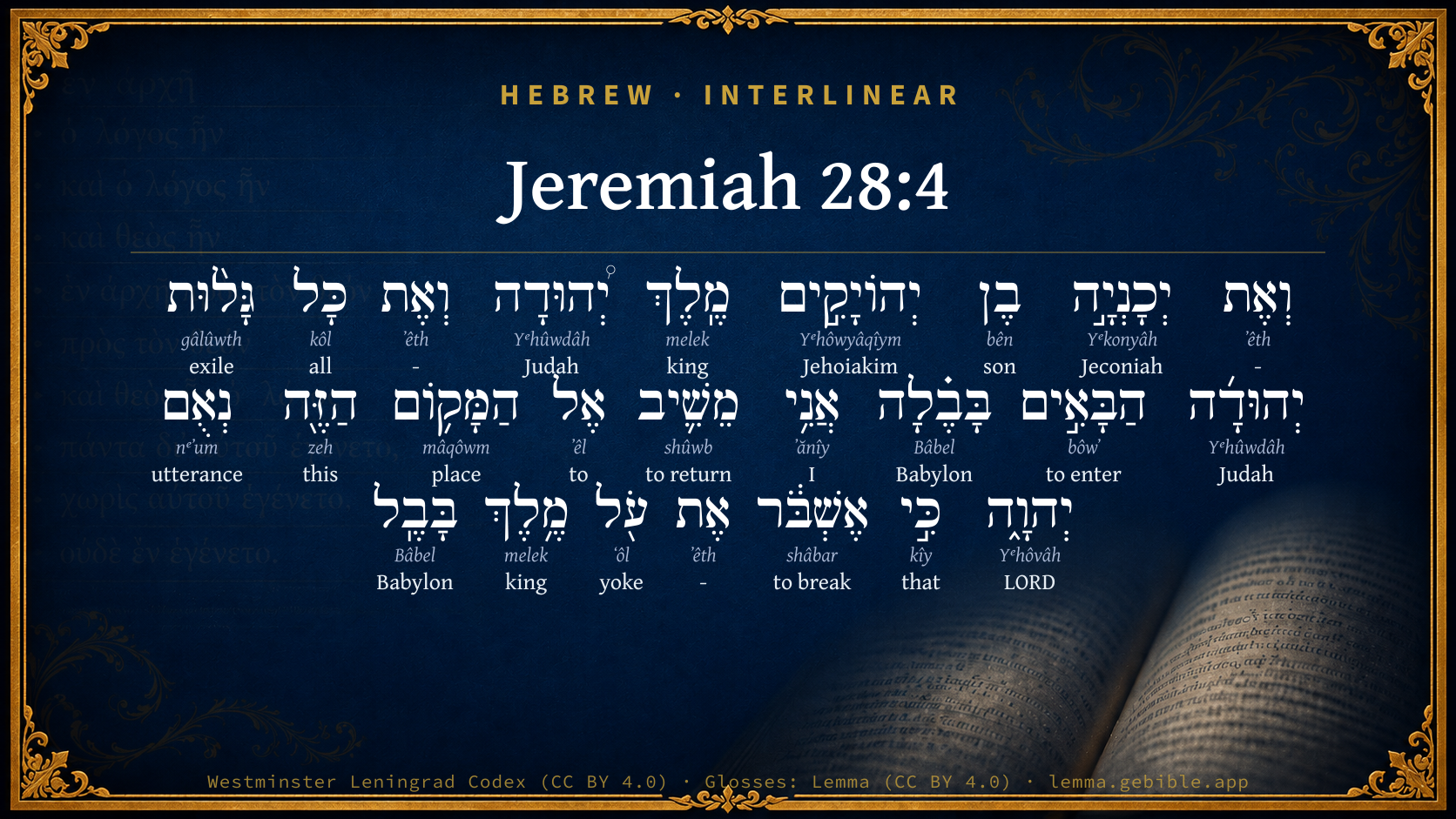
Jeremiah 28:4

Hebrew (Westminster Leningrad Codex) Jeremiah 28:4 appears in the Hebrew Old Testament. The text above is from the Westminster Leningrad Codex. Each word links to its Strong’s number, a concise gloss, and parsing drawn from the Open Scriptures Hebrew Bible morphology. Click any word for its full Brown-Driver-Briggs (BDB) entry.
Download image
Cite this verse

Jeremiah 28:4 (World English Bible). Public Domain. Lemma interlinear Bible study tool, https://lemma.gebible.app/v/jeremiah/28/4.

Show BibTeX & RIS
BibTeX
RIS
English Translation
and I will bring again to this place Jeconiah the son of Jehoiakim, king of Judah, with all the captives of Judah, who went to Babylon, says Yahweh; for I will break the yoke of the king of Babylon.
World English Bible · Public Domain
Download a study sheet

One document with this verse’s original text, its word-by-word gloss line, the meaning frame, cross-references with their text, attributed commentary, and full source and license credits — printable, and it pastes into notes with its structure intact.

This verse Autodidact and up

Study sheet (.html) Plain text (.txt)

A passage Seminary Student

Up to 50 verses in one chapter. A passage sheet keeps up to 6 commentary sources and 12 cross-references per verse, in the order this page ranks them, and says so on the sheet whenever that leaves anything out. Ask for a single verse and you get the Autodidact verse sheet above.

Everything on this page stays free to read, with no account — the sheet is a download of what is already on screen, not access to it.

Want to remove ads? Support Godless Engineer
Compare translations 3

The same verse in 3 English versions, stacked beneath the original-language interlinear above. Click any original word for its lexicon entry.

Each is an independent rendering of the whole verse — the interlinear is not word-aligned to these translations.

Highlighted words mark where these versions differ — a whole-verse word diff, not a word-by-word alignment.

  • World English Bible Public Domain
    and I will bring again to this place Jeconiah the son of Jehoiakim, king of Judah, with all the captives of Judah, who went to Babylon, says Yahweh; for I will break the yoke of the king of Babylon.
  • King James Version Public Domain
    And I will bring again to this place Jeconiah the son of Jehoiakim king of Judah, with all the captives of Judah, that went into Babylon, saith the LORD: for I will break the yoke of the king of Babylon.
  • unfoldingWord Literal Text CC BY-SA 4.0
    And I am bringing back to this place Jeconiah the son of Jehoiakim, king of Judah, and all the exile of Judah, the ones going to Babylon’— the declaration of Yahweh— ‘for I will break the yoke of the king of Babylon.’”

unfoldingWord Literal Text — © unfoldingWord, licensed CC BY-SA 4.0. Word-aligned USFM3 via Door43 (git.door43.org/unfoldingWord/en_ult).

Versions to compare (up to 4)

3 of 4 selected

Show all 18 translations

Every available English version of this verse, each an independent rendering of the whole verse.

  • World English Bible Public Domain
    and I will bring again to this place Jeconiah the son of Jehoiakim, king of Judah, with all the captives of Judah, who went to Babylon, says Yahweh; for I will break the yoke of the king of Babylon.
  • Berean Standard Bible Public Domain
    And I will restore to this place Jeconiah son of Jehoiakim king of Judah, along with all the exiles from Judah who went to Babylon,’ declares the LORD, ‘for I will break the yoke of the king of Babylon.’”
  • Majority Standard Bible Public Domain
    And I will restore to this place Jeconiah son of Jehoiakim king of Judah, along with all the exiles from Judah who went to Babylon,’ declares the LORD, ‘for I will break the yoke of the king of Babylon.’”
  • King James Version Public Domain
    And I will bring again to this place Jeconiah the son of Jehoiakim king of Judah, with all the captives of Judah, that went into Babylon, saith the LORD: for I will break the yoke of the king of Babylon.
  • American Standard Version (1901) Public Domain
    and I will bring again to this place Jeconiah the son of Jehoiakim, king of Judah, with all the captives of Judah, that went to Babylon, saith Jehovah; for I will break the yoke of the king of Babylon.
  • Revised Version (1885) Public Domain
    and I will bring again to this place Jeconiah the son of Jehoiakim, king of Judah with all the captives of Judah, that went to Babylon, saith the LORD: for I will break the yoke of the king of Babylon.
  • Geneva Bible (1599) Public Domain
    And I will bring againe to this place Ieconiah the sonne of Iehoiakim King of Iudah, with all them that were caried away captiue of Iudah, and went into Babel, saith the Lord: for I will breake the yoke of the King of Babel.
  • Douay-Rheims (1899) Public Domain
    And I will bring back to this place Jechonias the son of Joakim king of Juda, and all the captives of Juda, that are gone to Babylon, saith the Lord: for I will break the yoke of the king of Babylon.
  • Young's Literal Translation Public Domain
    And Jeconiah son of Jehoiakim, king of Judah, and all the removed of Judah, who are entering Babylon, I am bringing back unto this place -- an affirmation of Jehovah; for I do break the yoke of the king of Babylon.'
  • Literal Standard Version CC BY-SA 4.0
    and Jeconiah son of Jehoiakim, king of Judah, and all the expulsion of Judah, who are entering Babylon, I am bringing back to this place—a declaration of YHWH; for I break the yoke of the king of Babylon.”
  • Unlocked Literal Bible CC BY-SA 4.0
    Then I will bring back to this place Jehoiachin son of Jehoiakim, king of Judah, and all the captives of Judah who were sent to Babylon—this is Yahweh's declaration—for I will break the yoke of the king of Babylon.”
  • unfoldingWord Literal Text CC BY-SA 4.0
    And I am bringing back to this place Jeconiah the son of Jehoiakim, king of Judah, and all the exile of Judah, the ones going to Babylon’— the declaration of Yahweh— ‘for I will break the yoke of the king of Babylon.’”
  • Darby Bible Public Domain
    and I will bring again to this place Jeconiah the son of Jehoiakim, the king of Judah, with all the captives of Judah that went to Babylon, saith Jehovah: for I will break the yoke of the king of Babylon.
  • World Messianic Bible Public Domain
    I will bring again to this place Jeconiah the son of Jehoiakim, king of Judah, with all the captives of Judah, who went to Babylon,’ says the LORD; ‘for I will break the yoke of the king of Babylon.’”
  • Webster's Bible Public Domain
    And I will bring again to this place Jeconiah the son of Jehoiakim king of Judah, with all the captives of Judah, that went into Babylon, saith the LORD; for I will break the yoke of the king of Babylon.
  • Free Bible Version CC BY-SA 4.0
    I will also bring back to Jerusalem Jehoiachin, son of Jehoiakim, king of Judah, together with all the exiles from Judah who were taken to Babylon, declares the Lord, because I'm going to break the yoke of the king of Babylon.”
  • Bible in Basic English Public Domain
    And I will let Jeconiah, the son of Jehoiakim, king of Judah, come back to this place, with all the prisoners of Judah who went to Babylon, says the Lord: for I will have the yoke of the king of Babylon broken.
  • JPS Tanakh (1917) Public Domain
    and I will bring back to this place Jeconiah the son of Jehoiakim, king of Judah, with all the captives of Judah, that went to Babylon, saith the LORD; for I will break the yoke of the king of Babylon.'

Literal Standard Version (2020), Covenant Press — licensed CC BY-SA 4.0. Text via the HelloAO Bible API (eBible.org). Unlocked Literal Bible (unfoldingWord) — licensed CC BY-SA 4.0. Text via the HelloAO Bible API (eBible.org). unfoldingWord Literal Text — © unfoldingWord, licensed CC BY-SA 4.0. Word-aligned USFM3 via Door43 (git.door43.org/unfoldingWord/en_ult). Free Bible Version, Dr. Jonathan Gallagher — licensed CC BY-SA 4.0. Text via the HelloAO Bible API (eBible.org).

Word by word

More ways to search: Search by grammar → Find every occurrence → Compare this word →

Practice this passage: Drill this verse → Learn its vocabulary →

יְכָנְיָ֣ה
Yᵉkonyâh
H3204
“Jeconiah”
Noun, Proper
Part of Speech
Noun
Type
Proper
Full BDB Definition

Origin: from H3559 and H3050

TWOT: None

Jeconiah = "Jehovah will establish" - son of king Jehoiakim of Judah and king of Judah for 3 months and 10 days before he surrendered to Nebuchadnezzar and was taken captive to Babylon where he was imprisoned for the next 36 years; released at the death of Nebuchadnezzar and lived in Babylon until his death - primary spelling 'Jehoiachin'
  1. וְאֶת ʼêth H853 “and · -” Conjunction + Particle, Direct Object
  2. בֶן bên H1121 “son of” Noun, Common, Masculine, Singular, Construct
  3. יְהוֹיָקִ֣ים Yᵉhôwyâqîym H3079 “Jehoiakim” Noun, Proper
  4. מֶֽלֶךְ melek H4428 “king of” Noun, Common, Masculine, Singular, Construct
  5. יְ֠הוּדָה Yᵉhûwdâh H3063 “Judah” Noun, Proper
  6. וְאֶת ʼêth H853 “and · -” Conjunction + Particle, Direct Object
  7. כָּל kôl H3605 “all of” Noun, Common, Masculine, Singular, Construct
  8. גָּל֨וּת gâlûwth H1546 “exile of” Noun, Common, Feminine, Singular, Construct
  9. יְהוּדָ֜ה Yᵉhûwdâh H3063 “Judah” Noun, Proper
  10. הַבָּאִ֣ים bôwʼ H935 “the · entering” Particle, Definite Article + Verb, Qal, Participle Active, Masculine, Plural, Absolute
  11. בָּבֶ֗לָה Bâbel H894 “Babylon · toward” Noun, Proper + Suffix, Demonstrative
  12. אֲנִ֥י ʼănîy H589 “I” Pronoun, Personal, 1st Person, Common, Singular
  13. מֵשִׁ֛יב shûwb H7725 “returning” Verb, Hiphil, Participle Active, Masculine, Singular, Absolute
  14. אֶל ʼêl H413 “to” Preposition
  15. הַמָּק֥וֹם mâqôwm H4725 “the · place” Particle, Definite Article + Noun, Common, Masculine, Singular, Absolute
  16. הַזֶּ֖ה zeh H2088 “the · this” Particle, Definite Article + Pronoun, Demonstrative, Masculine, Singular
  17. נְאֻם nᵉʼum H5002 “utterance of” Noun, Common, Masculine, Singular, Construct
  18. יְהוָ֑ה Yᵉhôvâh H3068 “LORD” Noun, Proper
  19. כִּ֣י kîy H3588 “that” Conjunction
  20. אֶשְׁבֹּ֔ר shâbar H7665 “to break” Verb, Qal, Imperfect, 1st Person, Common, Singular
  21. אֶת ʼêth H853 “-” Particle, Direct Object
  22. עֹ֖ל ʻôl H5923 “yoke of” Noun, Common, Masculine, Singular, Construct
  23. מֶ֥לֶךְ melek H4428 “king of” Noun, Common, Masculine, Singular, Construct
  24. בָּבֶֽל Bâbel H894 “Babylon” Noun, Proper

About this verse

These counts appear in no published source. They are computed here, from the morphology-tagged text and Lemma’s own curated glosses. What Lemma adds →

25
words
20
distinct lemmas
Prophets
section

Notable vocabulary

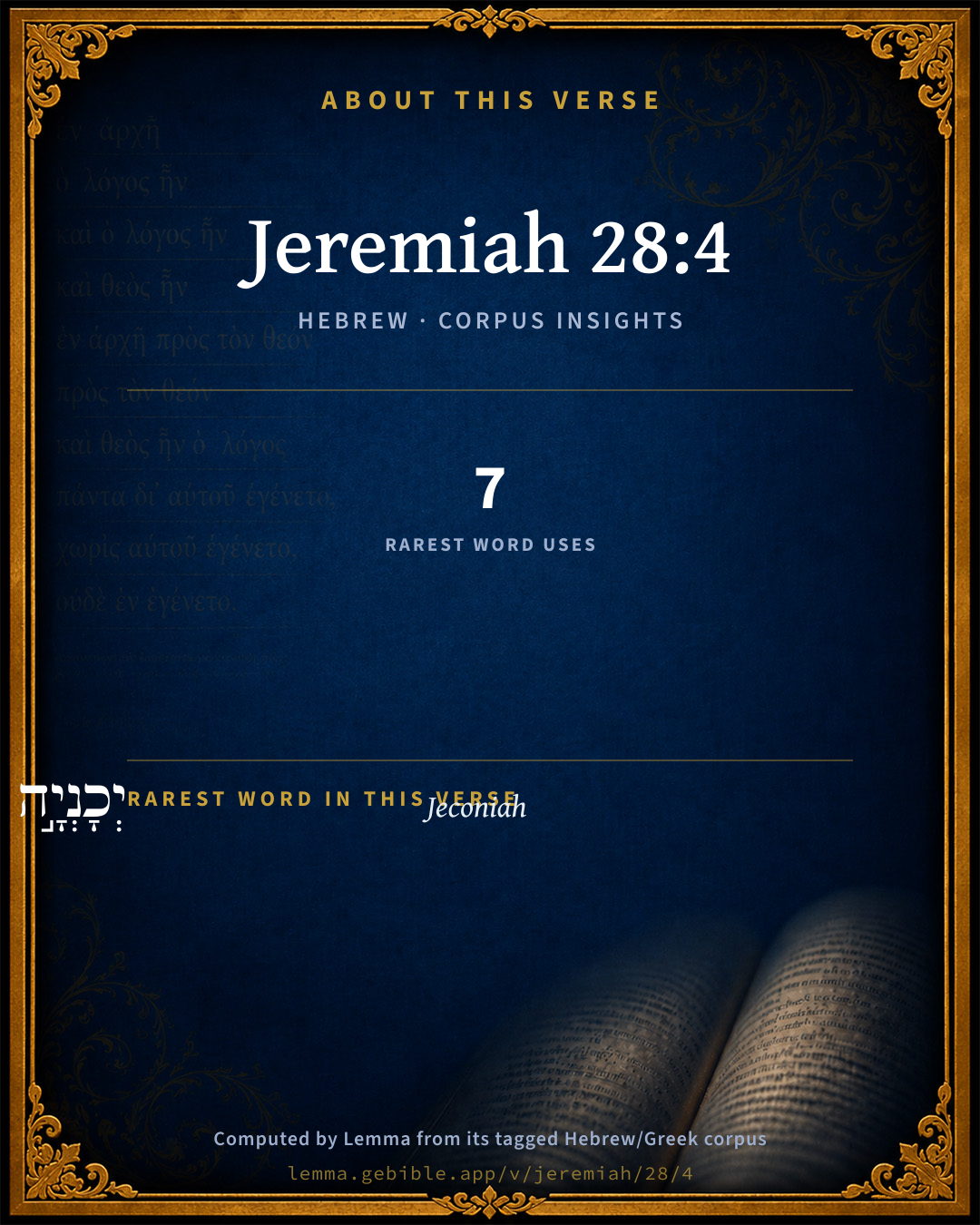
The rarest word here is יְכָנְיָ֣ה Jeconiah H3204 — appearing just 7 times in the whole Hebrew Bible.

Shared distinctive vocabulary

יְכָנְיָ֣ה Jeconiah H3204 occurs in 7 verses of the Hebrew Bible. Also found in:

Grammatical profile

  • 3 verbs
  • 15 nouns
  • 2 pronouns
  • 1 preposition
  • 1 conjunction
  • 3 particles

Verb forms

  • הַבָּאִ֣ים Qal · Participle Active
  • מֵשִׁ֛יב Hiphil · Participle Active
  • אֶשְׁבֹּ֔ר Qal · Imperfect

Repetition

Words recur within this verse — often emphatic in Hebrew:

  • מֶֽלֶךְ king H4428 ×2
  • יְ֠הוּדָה Judah H3063 ×2
  • בָּבֶ֗לָה Babylon H894 ×2

Cross-references

14

Topical passages linked to Jeremiah 28:4 in the Treasury of Scripture Knowledge — connected by theme and wording, ordered by reader-vote popularity; previews shown in the World English Bible.

  • Jeremiah 22:24 As I live, says Yahweh, though Coniah the son of Jehoiakim king of Judah were the signet on my right hand, yet would I pluck you there;
  • 2 Kings 25:27–30 It happened in the seven and thirtieth year of the captivity of Jehoiachin king of Judah, in the twelfth month, on the seven and twentieth day of the month, that Evilmerodach king of Babylon, in the year that he began to reign, did lift up the head of Jehoiachin king of Judah out of prison;
  • Jeremiah 24:1 Yahweh shown me, and, behold, two baskets of figs set before the temple of Yahweh, after that Nebuchadrezzar king of Babylon had carried away captive Jeconiah the son of Jehoiakim, king of Judah, and the princes of Judah, with the craftsmen and smiths, from Jerusalem, and had brought them to Babylon.
  • Jeremiah 28:2 Thus speaks Yahweh of Hosts, the God of Israel, saying, I have broken the yoke of the king of Babylon.
  • Genesis 27:40 By your sword will you live, and you will serve your brother. It will happen, when you will break loose, That you shall shake his yoke from off your neck."
  • Isaiah 9:4 For the yoke of his burden, and the staff of his shoulder, the rod of his oppressor, you have broken as in the day of Midian.
  • Jeremiah 2:20 For of old time I have broken your yoke, and burst your bonds; and you said, I will not serve; for on every high hill and under every green tree you did bow yourself, playing the prostitute.
  • Jeremiah 22:10 Don't you weep for the dead, neither bemoan him; but weep sore for him who goes away; for he shall return no more, nor see his native country.
  • Jeremiah 22:26–28 I will cast you out, and your mother who bore you, into another country, where you were not born; and there shall you die.
  • Jeremiah 24:5 Thus says Yahweh, the God of Israel: Like these good figs, so will I regard the captives of Judah, whom I have sent out of this place into the land of the Chaldeans, for good.
  • Jeremiah 28:10 Then Hananiah the prophet took the bar from off the prophet Jeremiah's neck, and broke it.
  • Jeremiah 30:8 It shall come to pass in that day, says Yahweh of Hosts, that I will break his yoke from off your neck, and will burst your bonds; and strangers shall no more make him their bondservant;
  • Jeremiah 52:31–34 It happened in the seven and thirtieth year of the captivity of Jehoiachin king of Judah, in the twelfth month, in the five and twentieth day of the month, that Evilmerodach king of Babylon, in the [first] year of his reign, lifted up the head of Jehoiachin king of Judah, and brought him forth out of prison;
  • Nahum 1:13 Now will I break his yoke from off you, and will burst your bonds apart."

Cross-references courtesy of OpenBible.info (CC BY 4.0).

Hebrew and Greek witnesses Masoretic Hebrew ↔ Greek Septuagint

The same verse in the two great witnesses to the Old Testament, shown verse-for-verse.

These are two independent witnesses, not word-aligned to each other, and the Septuagint is shown in lemma (dictionary) form.

Hebrew Jeremiah 28:4 Masoretic · Westminster Leningrad Codex

וְאֶת יְכָנְיָ֣ה בֶן יְהוֹיָקִ֣ים מֶֽלֶךְ יְ֠הוּדָה וְאֶת כָּל גָּל֨וּת יְהוּדָ֜ה הַבָּאִ֣ים בָּבֶ֗לָה אֲנִ֥י מֵשִׁ֛יב אֶל הַמָּק֥וֹם הַזֶּ֖ה נְאֻם יְהוָ֑ה כִּ֣י אֶשְׁבֹּ֔ר אֶת עֹ֖ל מֶ֥לֶךְ בָּבֶֽל

and I will bring again to this place Jeconiah the son of Jehoiakim, king of Judah, with all the captives of Judah, who went to Babylon, says Yahweh; for I will break the yoke of the king of Babylon.

World English Bible · Public Domain

Greek LXX Structure differs

In the Septuagint, Jeremiah is about an eighth shorter than the Hebrew and arranges its material differently — the Oracles Against the Nations (Hebrew chapters 46–51) appear in the middle of the Greek book, after 25:13. Because the chapter and verse boundaries do not line up, a verse-for-verse comparison with the Hebrew is not shown.

A verse-for-verse comparison isn’t shown here because the chapters and verses don’t line up. Switch to the LXX edition with the MT / LXX toggle above to read the Greek directly.

Hebrew: Westminster Leningrad Codex (CC BY 4.0). Greek: Septuagint (public domain); English from a public-domain English Septuagint. How the Septuagint differs from the Hebrew →

Targum (Aramaic paraphrase)

1

The Targum is the ancient Jewish Aramaic paraphrase of the Hebrew Scriptures — an interpretive translation, not the Hebrew text itself. Onkelos (literal) and Pseudo-Jonathan (expansive) render the Torah, and Jonathan the Prophets. Coverage is partial: where no permissively-licensed English translation exists for a verse, only the Aramaic is shown. This is verse-level text, not a word-by-word alignment to the Hebrew.

  1. Targum Jonathan Prophets (Joshua–Malachi)
    וְיַת שִׁבְטָא דְבֵית יְהוּדָה וְיַת כָּל גָלוּת יְהוּדָה דְאִתְגְלִיאוּ לְבָבֶל אֲנָא מֵתִיב לְאַתְרָא הָדֵין אֲמַר יְיָ אֲרֵי אִתְּבַר יַת נִיר מַלְכָּא דְבָבֶל:

    (no public-domain English translation for this verse)

    Targum Jonathan — Aramaic: “Mikraot Gedolot” (public domain). English: “Sefaria Community Translation” (CC0 1.0 (public-domain dedication)); “London "Chaldee Paraphrase," 1871” (public domain). Text via Sefaria.

Commentary

Notes on Jeremiah 28:4 from classic Christian and Jewish commentators (each source and its license shown beneath its notes). The classic Christian expositions comment on the surrounding passage and are grouped to its opening verse, so a note may address several verses; the Jewish commentaries on the Tanakh (Rashi and others) are per-verse, so they appear only where the commentator wrote on this verse.

Lemma curates 59 commentaries, every one of them public domain or Creative Commons licensed, each selected and text-cleaned for this edition rather than reprinted as found. About our sources →

Tyndale Open Study Notes

Tyndale Open Resources

28:4 The false prophet’s message claimed that Jehoiachin would return, which implied that Zedekiah held a lower status as ruler over the kingdom of Judah (see study note on Ezek 1:2). • I, the Lord, have spoken: Hananiah closed with the same strong appeal to divine authority that Jeremiah often used.

Tyndale Open Study Notes — © Tyndale Open Resources, licensed CC BY-SA 4.0. Text via the HelloAO Bible API.

Jamieson, Fausset & Brown

Robert Jamieson, A. R. Fausset & David Brown

bring again . . . Jeconiah--not necessarily implying that Hananiah wished Zedekiah to be superseded by Jeconiah. The main point intended was that the restoration from Babylon should be complete. But, doubtless, the false prophet foretold Jeconiah's return (Kg2 24:12-15), to ingratiate himself with the populace, with whom Jeconiah was a favorite (see on Jer 22:24).

Jamieson, Fausset & Brown — Commentary Critical and Explanatory on the Whole Bible (1871) — public domain (CC PDM 1.0). Text via the HelloAO Bible API.

John Calvin's Commentaries

Hananiah promised as to the king himself, what he had just predicted respecting the vessels of the Temple and of the palace. But it may be asked, how did he dare to give hope as to the restoration of Jeconiah, since that could not have been acceptable to Zedekiah? for Jeconiah could not have again gained what he had lost without the abdication of Zechariah; but he would have never submitted willingly to lose his own dignity and to become a private man, and to allow him who had been deprived of this high honor to return again. But there is no doubt but that he relied on the favor of the people, and that he was fully persuaded that if Zedekiah could ill bear to be thus degraded, he would yet be constrained to shew a different feeling; for Zedekiah himself regarded his own reign as not honorable, as he sat not in David’s throne by the right of succession. He had been set on the throne by a tyrant, and he dared not to make any other pretense to the people than that he wished Jeconiah to return and to possess the kingdom of which he had been deprived. As then this impostor knew that the king dared not to shew any displeasure, but that his prophecy would be gratifying and acceptable to the people, he boldly promised what we here read respecting the return of Jeconiah.

He hence says in God’s name, Jeconiah, the son of Jehoiakim, the king of Judah, and all the captive people, who have been led away to Babylon, will I restore to this place. We see that he was ever inflated with the same arrogance, and that he wholly disregarded God, whose name he thus in sport profaned. But all this flowed from this fountain, even because he had been blinded by the righteous judgment of God.

he then confirms his own prophecy, repeating its beginning, I have broken the yoke of the king of Babylon He had made open for himself an entrance, by saying that the destruction of the Babylonian monarchy was at hand; and now, after having given utterance to what seemed good to him on the whole affair, he refers again to that event. As then he promised that the monarchy would not stand longer than two years, the Jews might have supposed that they would become free, and might thus have hoped for a happy state of things; and this was the design of the impostor; but what was the answer of Jeremiah? His opposition to him was frank and firm; but as he saw that he had incurred the ill-will of the people, he was anxious to remove it; and before he repeated what he had said of their seventy years in exile, he shewed that he had not eagerly received his commission, as though he had been alienated from his people, or had disregarded their welfare, or had been carried away by some morbid feeling to bring a sad and mournful message. He therefore said, —

John Calvin's Commentaries (1540-1563) — public domain. Text from the Calvin Translation Society English edition (1840s-50s) via the Christian Classics Ethereal Library (ccel.org). Calvin's coverage is partial (roughly two-thirds of the Bible); uncommented books and verses are honest gaps, never fabricated. The 19th-century editor's footnotes and remarks are omitted so the notes are faithfully Calvin's own voice.

Ellicott's Commentary for English Readers

(4) And I will bring again to this place Jeconiah the son of Jehoiakim . . .—We get here a new glimpse into the nature of the anti-Chaldæan confederacy. Zedekiah was to be deposed as too submissive to Nebuchadnezzar, and the young Jeconiah was to be brought back from his prison at Babylon, and re-established in the kingdom as the representative of the policy of resistance, resting on the support of Pharaoh-Hophra.

A Bible Commentary for English Readers, edited by Charles John Ellicott (1878–1897) — public domain. Text from a community e-Sword module.

The Cambridge Bible for Schools and Colleges

gen. ed. J. J. S. Perowne

4. Jeconiah] It shews that the exiled king must still have had a substantial following in Jerusalem, when Hananiah ventured upon this forecast in the face of the de facto ruler.

The Cambridge Bible for Schools and Colleges (gen. ed. J. J. S. Perowne; Cambridge University Press, 1878–1918) — public domain. Text from a community e-Sword module.

John Gill's Exposition

And I will bring again to this place Jeconiah the son of Jehoiakim king of Judah,.... This he knew would please the people, who looked upon Zedekiah only as a deputy of the king of Babylon, and not properly their king; but Jeconiah, as he is here called; and he knew that Zedekiah dared not resent this, but was obliged to feigned a desire of Jeconiah's return, though otherwise not agreeable to him:

with all the captives of Judah that went into Babylon, saith the Lord; the princes, officers, and others, that should be living at the time fixed:

for I will break the yoke of the king of Babylon; weaken his power over other nations, and particularly deliver the king of Judah from his bondage, and from subjection to him.

John Gill's Exposition of the Whole Bible (1746–1763) — public domain (CC PDM 1.0). Text via the HelloAO Bible API.

Albert Barnes' Notes on the Bible

Jeconiah - Zedekiah not being popular, the people would have preferred the young king, who had not reigned long enough to make enemies. Probably also Zedekiah had started for Babylon Jer 51:59.

Albert Barnes' Notes on the Bible (1834–1885) — public domain. Text from a community e-Sword/MySword module.

Matthew Poole's English Annotations

Only it is admirable, that being so nigh the king’s court he should mention the return of Jehoiachin, or Jeconiah, which, had it been true, must have been to the prejudice of Zedekiah, for Jeconiah was the right heir to the crown, being the son of Jehoiakim. Zedekiah his uncle was put in by the conqueror, but it is probable he saw Jehoiachin was more acceptable to the people, and that the faction for the nephew was greater than for the uncle. False teachers are always on the greatest side, either for number or for power.

Matthew Poole's English Annotations on the Holy Bible (1683–1685) — public domain. Text from a community e-Sword/MySword module.

Whedon's Commentary on the Bible

Daniel D. Whedon

4. The mention of Jeconiah suggests the probability that there were many to whom his return would be specially grateful — that there was an influential party identified with the exiled king.

Daniel D. Whedon (gen. ed.), Commentary on the Old and New Testaments (1874–1909) — public domain. Text from a community e-Sword module.

The Pulpit Commentary

And I will bring again... Jeconiah. Hananiah thus directly contradicts the assurance of Jeremiah (Jer_22:26, Jer_22:27) that Jehoiachin would not return, but would die in a foreign land. Has he a political object in his favorable prognostication for the deposed king? Does he, in short, belong to a Jehoiachin party opposed to the friends of Zedekiah? The view is possible, and may seem to be confirmed by the emphatic repetition of the fall of Nebuchadnezzar, the liege lord of Zedekiah. Still there is evidence enough in modern history that the return of an exile is not necessarily tantamount to his reinstatement in his office.

The Pulpit Commentary (1880–1919), ed. H.D.M. Spence-Jones & Joseph S. Exell — public domain. Text from a community e-Sword module.

Lesson kit

Teaching starters — assembled from the data on this page, not authored interpretation. Every prompt links to the verse data it draws on. Edit before teaching.

Jeremiah, in the Prophets, opens this verse with 25 words (20 distinct Hebrew lemmas). Its most distinctive word is Yᵉkonyâh (“Jeconiah”). A historical commentator’s framing appears above. Read the whole chapter for the surrounding context.

Discussion questions

  1. The word Yᵉkonyâh carries the sense “Jeconiah.” How does it shape the verse?
  2. How does 1 Chronicles 3:16, which shares the word «Jeconiah», read alongside this verse?
  3. What does the repetition of “king” (2× in this one verse) do in this verse?
  4. These translations render this verse differently; the difference is in the English rendering, not the original. What questions does that raise?
  5. «הַבָּאִ֣ים» is a Qal Participle Active verb. How does that grammatical form shape the action described?
  6. Compare how Tyndale Open Study Notes and Jamieson, Fausset & Brown read this verse. Where do they agree or differ?

Things to notice

Reading settings

Reading text

Shown beneath each verse's original-language words.

Old Testament
Old Testament edition

Read the OT as the Masoretic Hebrew (MT) or the Greek Septuagint (LXX).

English shown for the Greek Septuagint (in the Hebrew ↔ Greek comparison).

Comparing translations? Open the Compare panel on any verse page to stack up to four side by side.