Isaiah 45:2

Hebrew (Westminster Leningrad Codex) Isaiah 45:2 appears in the Hebrew Old Testament. The text above is from the Westminster Leningrad Codex. Each word links to its Strong’s number, a concise gloss, and parsing drawn from the Open Scriptures Hebrew Bible morphology. Click any word for its full Brown-Driver-Briggs (BDB) entry.
Download image
Cite this verse

Isaiah 45:2 (World English Bible). Public Domain. Lemma interlinear Bible study tool, https://lemma.gebible.app/v/isaiah/45/2.

Show BibTeX & RIS
BibTeX
RIS
English Translation
I will go before you, and make the rough places smooth; I will break in pieces the doors of brass, and cut in sunder the bars of iron;
World English Bible · Public Domain
Download a study sheet

One document with this verse’s original text, its word-by-word gloss line, the meaning frame, cross-references with their text, attributed commentary, and full source and license credits — printable, and it pastes into notes with its structure intact.

This verse Autodidact and up

Study sheet (.html) Plain text (.txt)

A passage Seminary Student

Up to 50 verses in one chapter. A passage sheet keeps up to 6 commentary sources and 12 cross-references per verse, in the order this page ranks them, and says so on the sheet whenever that leaves anything out. Ask for a single verse and you get the Autodidact verse sheet above.

Everything on this page stays free to read, with no account — the sheet is a download of what is already on screen, not access to it.

Want to remove ads? Support Godless Engineer
Compare translations 3

The same verse in 3 English versions, stacked beneath the original-language interlinear above. Click any original word for its lexicon entry.

Each is an independent rendering of the whole verse — the interlinear is not word-aligned to these translations.

Highlighted words mark where these versions differ — a whole-verse word diff, not a word-by-word alignment.

  • World English Bible Public Domain
    I will go before you, and make the rough places smooth; I will break in pieces the doors of brass, and cut in sunder the bars of iron;
  • King James Version Public Domain
    I will go before thee, and make the crooked places straight: I will break in pieces the gates of brass, and cut in sunder the bars of iron:
  • unfoldingWord Literal Text CC BY-SA 4.0
    “I, I will go to your face, and I will flatten the swollen; I will shatter doors of bronze, and I will cut through bars of iron.

unfoldingWord Literal Text — © unfoldingWord, licensed CC BY-SA 4.0. Word-aligned USFM3 via Door43 (git.door43.org/unfoldingWord/en_ult).

Versions to compare (up to 4)

3 of 4 selected

Show all 18 translations

Every available English version of this verse, each an independent rendering of the whole verse.

  • World English Bible Public Domain
    I will go before you, and make the rough places smooth; I will break in pieces the doors of brass, and cut in sunder the bars of iron;
  • Berean Standard Bible Public Domain
    “I will go before you and level the mountains; I will break down the gates of bronze and cut through the bars of iron.
  • Majority Standard Bible Public Domain
    “I will go before you and level the mountains; I will break down the gates of bronze and cut through the bars of iron.
  • King James Version Public Domain
    I will go before thee, and make the crooked places straight: I will break in pieces the gates of brass, and cut in sunder the bars of iron:
  • American Standard Version (1901) Public Domain
    I will go before thee, and make the rough places smooth; I will break in pieces the doors of brass, and cut in sunder the bars of iron;
  • Revised Version (1885) Public Domain
    I will go before thee, and make the rugged places plain: I will break in pieces the doors of brass, and cut in sunder the bars of iron:
  • Geneva Bible (1599) Public Domain
    I will goe before thee and make the crooked streight: I will breake the brasen doores, and burst the yron barres.
  • Douay-Rheims (1899) Public Domain
    I will go before thee, and will humble the great ones of the earth: I will break in pieces the gates of brass, and will burst the bars of iron.
  • Young's Literal Translation Public Domain
    `I go before thee, and crooked places make straight, Two-leaved doors of brass I shiver, And bars of iron I cut asunder,
  • Literal Standard Version CC BY-SA 4.0
    “I go before you, and make crooked places straight, || I shatter doors of bronze, || And I cut bars of iron apart,
  • Unlocked Literal Bible CC BY-SA 4.0
    “I will go before you and level the mountains; I will break in pieces the doors of bronze and cut in pieces their iron bars,
  • unfoldingWord Literal Text CC BY-SA 4.0
    “I, I will go to your face, and I will flatten the swollen; I will shatter doors of bronze, and I will cut through bars of iron.
  • Darby Bible Public Domain
    I will go before thee, and make the elevated places plain; I will break in pieces the brazen doors, and cut asunder the bars of iron;
  • World Messianic Bible Public Domain
    “I will go before you and make the rough places smooth. I will break the doors of bronze in pieces and cut apart the bars of iron.
  • Webster's Bible Public Domain
    I will go before thee, and make the crooked places straight: I will break in pieces the gates of brass, and cut asunder the bars of iron:
  • Free Bible Version CC BY-SA 4.0
    I will go ahead of you and level the mountains. I will break down bronze gates and cut through iron bars.
  • Bible in Basic English Public Domain
    I will go before you, and make the rough places level: the doors of brass will be broken, and the iron rods cut in two:
  • JPS Tanakh (1917) Public Domain
    I will go before thee, and make the crooked places straight; I will break in pieces the doors of brass, and cut in sunder the bars of iron;

Literal Standard Version (2020), Covenant Press — licensed CC BY-SA 4.0. Text via the HelloAO Bible API (eBible.org). Unlocked Literal Bible (unfoldingWord) — licensed CC BY-SA 4.0. Text via the HelloAO Bible API (eBible.org). unfoldingWord Literal Text — © unfoldingWord, licensed CC BY-SA 4.0. Word-aligned USFM3 via Door43 (git.door43.org/unfoldingWord/en_ult). Free Bible Version, Dr. Jonathan Gallagher — licensed CC BY-SA 4.0. Text via the HelloAO Bible API (eBible.org).

Word by word

More ways to search: Search by grammar → Find every occurrence → Compare this word →

Practice this passage: Drill this verse → Learn its vocabulary →

וַהֲדוּרִ֖ים
hâdar
H1921
“and · swellings”
Conjunction + Noun, Common, Masculine, Plural, Absolute
Part of Speech
Conjunction + Noun
Type
Common
Gender
Masculine
Number
Plural
State
Absolute
Full BDB Definition

Origin: a primitive root

TWOT: 477

to honour, adorn, glorify, be high - (Qal) - to swell - swelling (passive participle) - to honour, pay honour to, show partiality - to adorn - adorned (passive participle) - (Niphal) to be honoured - (Hithpael) to honour oneself, claim honour
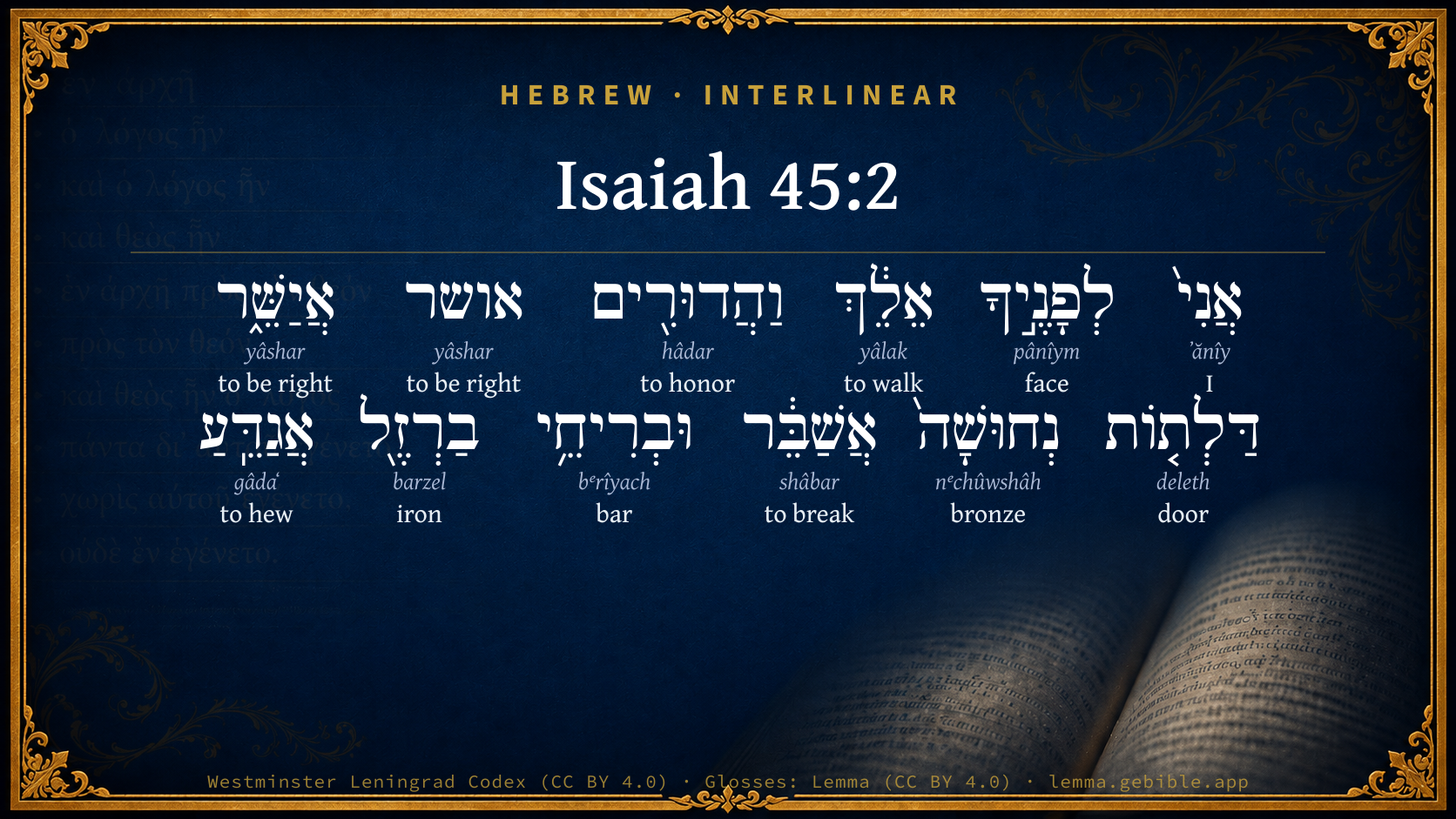
  1. אֲנִי֙ ʼănîy H589 “I” Pronoun, Personal, 1st Person, Common, Singular
  2. לְפָנֶ֣יךָ pânîym H6440 “to/for · face(s) · your” Preposition + Noun, Common, Both, Plural, Construct + Suffix, Personal, 2nd Person, Masculine, Singular
  3. אֵלֵ֔ךְ yâlak H3212 “to walk” Verb, Qal, Imperfect, 1st Person, Common, Singular
  4. אושר yâshar H3474 “to be right” Verb, Hiphil, Imperfect, 1st Person, Common, Singular
  5. אֲיַשֵּׁ֑ר yâshar H3474 “to be right” Verb, Piel, Imperfect, 1st Person, Common, Singular
  6. דַּלְת֤וֹת deleth H1817 “doors of” Noun, Common, Feminine, Plural, Construct
  7. נְחוּשָׁה֙ nᵉchûwshâh H5154 “bronze” Noun, Common, Feminine, Singular, Absolute
  8. אֲשַׁבֵּ֔ר shâbar H7665 “to break” Verb, Piel, Imperfect, 1st Person, Common, Singular
  9. וּבְרִיחֵ֥י bᵉrîyach H1280 “and · bars of” Conjunction + Noun, Common, Masculine, Plural, Construct
  10. בַרְזֶ֖ל barzel H1270 “iron” Noun, Common, Masculine, Singular, Absolute
  11. אֲגַדֵּֽעַ gâdaʻ H1438 “to hew” Verb, Piel, Imperfect, 1st Person, Common, Singular

About this verse

These counts appear in no published source. They are computed here, from the morphology-tagged text and Lemma’s own curated glosses. What Lemma adds →

12
words
11
distinct lemmas
Prophets
section

Notable vocabulary

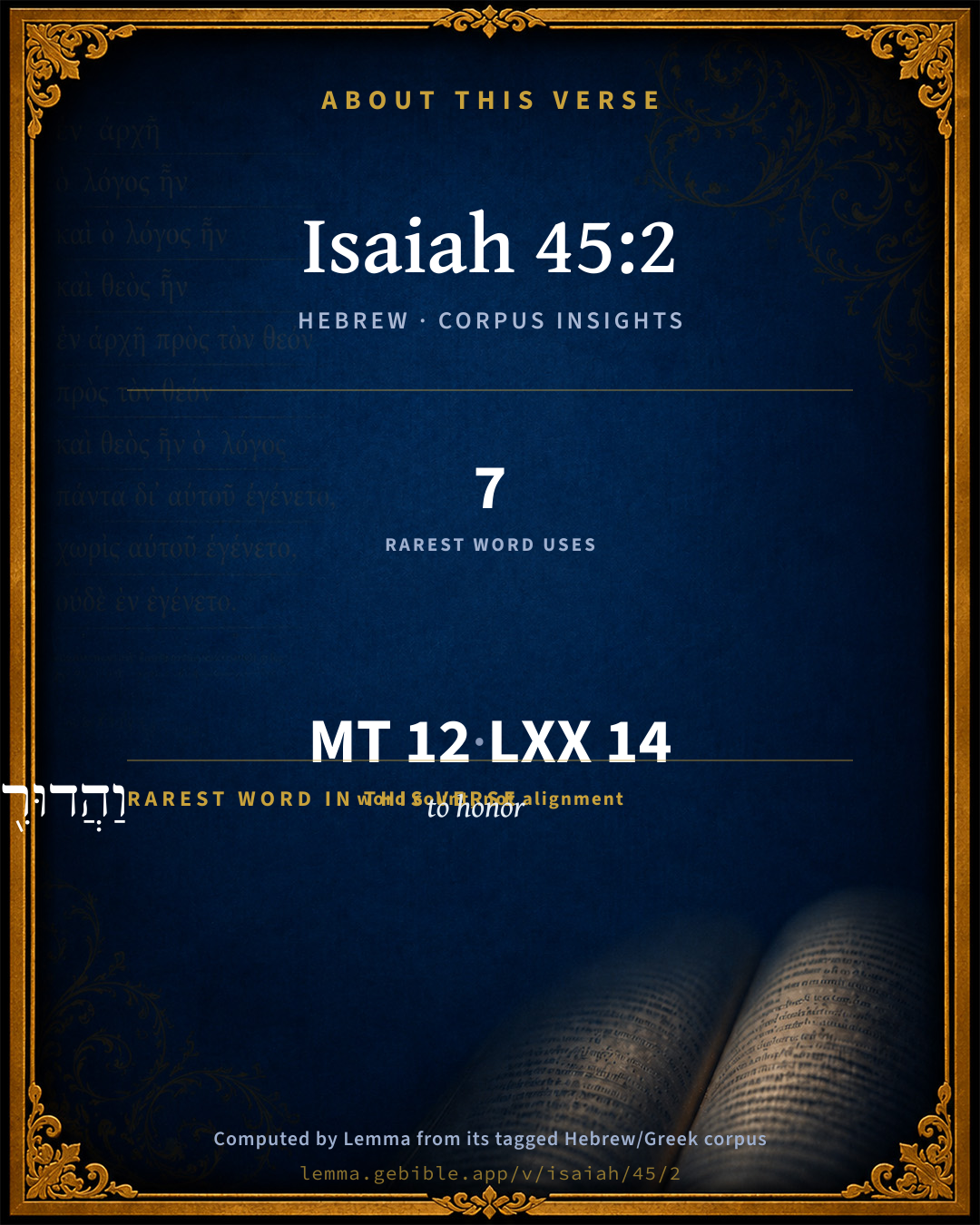
The rarest word here is וַהֲדוּרִ֖ים to honor H1921 — appearing just 7 times in the whole Hebrew Bible.

Shared distinctive vocabulary

וַהֲדוּרִ֖ים to honor H1921 occurs in 7 verses of the Hebrew Bible. Also found in:

Grammatical profile

  • 5 verbs
  • 6 nouns
  • 1 pronoun

Verb forms

  • אֵלֵ֔ךְ Qal · Imperfect
  • אושר Hiphil · Imperfect
  • אֲיַשֵּׁ֑ר Piel · Imperfect
  • אֲשַׁבֵּ֔ר Piel · Imperfect
  • אֲגַדֵּֽעַ Piel · Imperfect

Repetition

A word recurs within this verse — often emphatic in Hebrew:

  • אושר to be right H3474 ×2

Hebrew & Septuagint length

In English translation the verse runs 28 words from the Hebrew and 20 from the Septuagint (LXX English) — the Septuagint runs noticeably shorter here. See the side-by-side →

A rough comparison of the two English renderings, which tokenize alike — not a word-level alignment.

Word counts can differ between the Hebrew and the Greek without any difference in meaning — e.g. the Hebrew direct-object marker אֵת has no separate Greek word, and Greek often adds the article ὁ.

In the original languages it is 12 Hebrew tokens and 14 Greek tokens — but the two are counted differently (Hebrew bundles its prefixes and suffixes into one token; the Greek is in lemma form), so that isn’t a like-for-like length.

Cross-references

7

Topical passages linked to Isaiah 45:2 in the Treasury of Scripture Knowledge — connected by theme and wording, ordered by reader-vote popularity; previews shown in the World English Bible.

  • Isaiah 40:4 Every valley shall be exalted, and every mountain and hill shall be made low; and the uneven shall be made level, and the rough places a plain:
  • Isaiah 42:16 I will bring the blind by a way that they don't know; in paths that they don't know will I lead them; I will make darkness light before them, and crooked places straight. These things will I do, and I will not forsake them.
  • Luke 3:5 Every valley will be filled. Every mountain and hill will be brought low. The crooked will become straight, And the rough ways smooth.
  • Psalms 107:16 For he has broken the gates of brass, And cut through bars of iron.
  • Jeremiah 51:30 The mighty men of Babylon have forborne to fight, they remain in their strongholds; their might has failed; they are become as women: her dwelling-places are set on fire; her bars are broken.
  • Isaiah 13:4–17 The noise of a multitude in the mountains, as of a great people! the noise of a tumult of the kingdoms of the nations gathered together! Yahweh of Hosts is mustering the host for the battle.
  • Acts 1:15 In these days, Peter stood up in the midst of the disciples (and the number of names was about one hundred twenty), and said,

Cross-references courtesy of OpenBible.info (CC BY 4.0).

Hebrew and Greek witnesses Masoretic Hebrew ↔ Greek Septuagint

The same verse in the two great witnesses to the Old Testament, shown verse-for-verse.

Here the Septuagint runs noticeably shorter than the Hebrew — LXX2012 (modern English Septuagint) 20 words vs World English Bible 28. A rough length comparison of the two English translations, not a word-level alignment — read both below.

These are two independent witnesses, not word-aligned to each other, and the Septuagint is shown in lemma (dictionary) form.

Hebrew Isaiah 45:2 Masoretic · Westminster Leningrad Codex

אֲנִי֙ לְפָנֶ֣יךָ אֵלֵ֔ךְ וַהֲדוּרִ֖ים אושר אֲיַשֵּׁ֑ר דַּלְת֤וֹת נְחוּשָׁה֙ אֲשַׁבֵּ֔ר וּבְרִיחֵ֥י בַרְזֶ֖ל אֲגַדֵּֽעַ

I will go before you, and make the rough places smooth; I will break in pieces the doors of brass, and cut in sunder the bars of iron;

World English Bible · Public Domain

Greek LXX Isaiah 45:2 Septuagint · lemma form

ἐγώ ἔμπροσθεν σύ πορεύομαι καί ὄρος ὁμαλίζω θύρα χαλκοῦς συντρίβω καί μοχλός σίδηρος συνκλαίω

I will go before you, and will level mountains: I will break to pieces brazen doors, and burst iron bars.

LXX2012 (modern English Septuagint) · Public Domain

On this verse, Adam Clarke's Commentary discusses the Septuagint’s reading. Read the note in Commentary ↓

Hebrew: Westminster Leningrad Codex (CC BY 4.0). Greek: Septuagint (public domain); English from LXX2012 (modern English Septuagint) (Public Domain). How the Septuagint differs from the Hebrew →

Targum (Aramaic paraphrase)

1

The Targum is the ancient Jewish Aramaic paraphrase of the Hebrew Scriptures — an interpretive translation, not the Hebrew text itself. Onkelos (literal) and Pseudo-Jonathan (expansive) render the Torah, and Jonathan the Prophets. Coverage is partial: where no permissively-licensed English translation exists for a verse, only the Aramaic is shown. This is verse-level text, not a word-by-word alignment to the Hebrew.

  1. Targum Jonathan Prophets (Joshua–Malachi)
    מֵימְרִי קֳדָמָךְ יְהָךְ וְשׁוּרַיָא אֲכַבֵּשׁ דָשִׁין דִנְחָשׁ אֱתַּבֵר וְעַבְרִין דְבַרְזֶל אֲקַצֵץ:

    My WORD shall go before thee, I will have a way in the plains;I will break in pieces the doors of brass, and cut in sunder the bars of iron.

    Targum Jonathan — Aramaic: “Mikraot Gedolot” (public domain). English: “Sefaria Community Translation” (CC0 1.0 (public-domain dedication)); “London "Chaldee Paraphrase," 1871” (public domain). Text via Sefaria.

Commentary

Notes on Isaiah 45:2 from classic Christian and Jewish commentators (each source and its license shown beneath its notes). The classic Christian expositions comment on the surrounding passage and are grouped to its opening verse, so a note may address several verses; the Jewish commentaries on the Tanakh (Rashi and others) are per-verse, so they appear only where the commentator wrote on this verse.

Lemma curates 59 commentaries, every one of them public domain or Creative Commons licensed, each selected and text-cleaned for this edition rather than reprinted as found. About our sources →

Trapp's Complete Commentary

John Trapp

Isa 45:2 I will go before thee, and make the crooked places straight: I will break in pieces the gates of brass, and cut in sunder the bars of iron:

Ver. 2. And make the crooked places even.] Or, The hilly places level.

I will break in pieces the gates of brass.] This God would do, that his temple might be built; {compare Isa 44:28} but in the New Testament, Christ throweth the gates of hell off their hinges, like another Samson, that he may build his Church. {Mat 16:18} And it is this Aedificabo Ecclesiam meam I will build my church, that hath made all the stir in the world.

John Trapp, A Commentary or Exposition upon All the Books of the Old and New Testament (1647–1656) — public domain. Text from a community e-Sword module.

The Biblical Illustrator

Joseph S. Exell

Isa_45:2-3

I will go before thee

God going before

Man must go.

Each man is accomplishing a journey, going through a process. The only question is, How? Man may go, either with God or without Him. Whether we go with God or without Him, we shall find crooked places.

I. We should regard the text as A WARNING. There are crooked places.

II. The text is also A PROMISE. I will go before thee. God does not say where He will straighten our path; He does not say how; the great thing for us to believe is that there is a special promise for us, and to wait in devout hope for its fulfilment. He who waits for God is not misspending his time. Such waiting is true living--such tarrying is the truest speed.

III. The text is also A PLAN. It is in the word before that I find the plan, and it is in that word before that I find the difficulty on the human side. God does not say, I will go alongside thee; we shall go step by step: He says, I will go before thee. Sometimes it may be a long way before us, so that we cannot see Him; and sometimes it may be just in front of us. But whether beyond, far away, or here close at hand, the great idea we have to live upon is that God goes before us.

1. Let us beware of regarding the text as a mere matter of course. There is an essential question of character to be settled. The steps of a good man are ordered by the Lord.

2. Let us beware of regarding this text as a licence for carelessness Let us not say, If God goes before me, and makes all places straight why need I care? To the good man all life is holy; there is no step of indifference; no subject that does not bring out his best desires. The place whereon thou standest is holy ground is the expression of every man who knows what it is to have God going before him. (J. Parker, D. D.)

Treasures of darkness

If we be Zions pilgrims, heavenward bound, we shall find the need of such promises, in their spiritual fulfilment, as God here gave to Cyrus.

I. GODS PRELIMINARY WORK in going before His people, making for them crooked places straight, breaking in pieces gates of brass, and cutting in sunder bars of iron.

1. The first promise lays a foundation for all the rest; I will go before thee. How great must those difficulties be which need God Himself to go before us in order to overcome them! Surely they must be insuperable by any human strength. If we are rightly taught, we shall feel a need for the Lord to go before us, not only now and then, but every step of the way, for unless led and guided by Him, we are sure to go astray. How strikingly was this the case with the children of Israel. You may apply this promise to a variety of things.

(1) It is applicable not only to spiritual, but to temporal trials and perplexities--to His going before us both in providence and grace.

(2). But the words apply to the manifestation of His holy and sacred will.

(3) It is especially in the removal of obstructions that the Lord fulfils this part of the promise.

2. And make crooked things straight. This promise springs out of the former, and is closely connected with it; for it is only by the Lord s going before that things really crooked can be straightened. But what is meant by crooked places, and whence come they?

(1) Some are inherently crooked, that is, it is in their very nature to be so. Thus crooked tempers, dispositions, desires, wills, lusts are in themselves inherently crooked, because being bent out of their original state by sin, they do not now lie level with Gods holy will and Word.

(2) But there are crooked places in the path of Gods family, which are not inherently crooked as being sinful in themselves, but are crooked as made so by the hand of God to us. Of this kind are afflictions in body and mind, poverty in circumstances, trials in the family, persecution from superiors or ungodly relatives, heavy losses in business, bereavement of children, and, in short, a vast variety of circumstances curved into their shape by the hand of God, and so made. crooked things to us. Now, the Lord has promised, to make crooked things straight. Taken in its fullest extent, the promise positively declares that from whatever source they come, or of whatsoever nature they be, the Lord will surely straighten them. By this He manifests His power, wisdom, and faithfulness. But how does He straighten them? In two ways, and this according to their nature. Sometimes by removing them out of the way; and sometimes by reconciling our minds to them.

3. But the Lord also promised Cyrus that He would, by going before him, break in pieces the gates of brass, &c. Cyrus longed to enter the city of Babylon; but when he took a survey of the only possible mode of entrance, he saw it firmly closed against him with gates of brass and iron. Can we not find something in our experience which corresponds to this feeling in Cyrus? There is a longing in the soul after a certain object. We press forward to obtain it, but what do we find in the road? Gates of brass and bars of iron. Look, for instance, at our very prayers. Are not the heavens sometimes brass over our heads, so that, as Jeremiah complains, they cannot pass through? Nay, is not your very heart itself sometimes a gate of brass, as hard, as stubborn, and as inflexible? So the justice, majesty, and holiness of God, when we view these dread perfections of Jehovah with a trembling eye under the guilt of sin, stand before the soul as so many gates of brass. The various enemies, too, which beset the soul; the hindrances and obstacles without and within that stand in the path; the opposition of sin, Satan, self, and the world against all that is good and godlike--may not all these be considered gates of brass barring out the wished-for access into the city?

4. But there are also bars of iron. These strengthen the gates of brass and prevent them from being broken down or burst open, the stronger and harder metal giving firmness and solidity to the softer and weaker one. An unbelieving heart; the secret infidelity of the carnal mind; guilt of conscience produced by a sense of our innumerable wanderings from the Lord; doubts and fears often springing out of our own want of consistency and devotedness; apprehensions of being altogether deceived, from finding so few marks of grace and so much neglect of watchfulness and prayer--all these may be mentioned as bars of iron strengthening the gates of brass. Now, can you break to pieces these gates of brass, or cut in sunder the bars of iron? Here, then, when so deeply wanted, comes in the promise, I will break, &c.

II. THE GIFTS WHICH THE LORD BESTOWS UPON THEM, when He has broken to pieces the gates of brass, and cut in sunder the bars of iron, here called treasures of darkness and hidden riches of secret places.

1. Treasures of darkness. But is not this a strange expression? How can there be darkness in the city of Salvation of which the Lord, the Lamb, is the eternal light? The expression does not mean that the treasures themselves are darkness, but that they were hidden in darkness till they were brought to light. The treasures of Belshazzar, like the Bank bullion, were buried in darkness till they were broken up and given to Cyrus. It is so in a spiritual sense. Are there not treasures in the Lord Jesus? Yet, all these are treasures of darkness, so far as they are hidden from our eyes and hearts, till we are brought by His special power into the city of Salvation.

2. But the Lord promised also to give to Cyrus the hidden riches of secret places, that is, literally, the riches of the city which were stored up in its secret places. But has not this, also a spiritual meaning? Yes. Many are the hidden riches of secret places with which the God of all grace enriches His believing family. Look, for instance, at the Word of God. But observe, how the promises are connected with crooked places, brazen gates, and iron bars, and the going before of the Lord to remove them out of the way. Without this previous work we should be ignorant to our dying day of the treasures of darkness; we should never see nor handle the hidden riches of secret places.

III. THE BLESSED EFFECTS PRODUCED by what the Lord thus does and thus gives--a spiritual and experimental knowledge, that He who has called them by their name is the God of Israel. Observe the expression, I, the Lord, which call thee by thy name. What an individuality it stamps on the person addressed! How it makes religion a personal thing! But what is produced by this special, individual, and personal calling? Knowledge. What knowledge? Spiritual, heartfelt, and experimental. Of what? That the Lord who called them by name is the God of Israel. It is as the God of Israel that He manifests mercy and grace; that He never leaves nor forsakes the objects of His choice; that He fulfils every promise, defeats every enemy, appears in every difficulty, richly pardons every sin, graciously heals every backsliding, and eventually lands them in eternal bliss. Now, perhaps, we can see why Gods people have so many gates of brass and bars of iron, so many trials and severe temptations. This is to bring them into personal acquaintance with God, the covenant God of Israel; to make religion a reality. (J. C. Philpot.)

The Biblical Illustrator, edited by Joseph S. Exell (c. 1880s–1900s) — public domain. Text from a community e-Sword module.

Joseph Benson's Commentary

Isa 45:2-3. I will go before thee — To remove all obstructions, and prepare the way for thee. “The divine protection which attended Cyrus, and rendered his expedition against Babylon easy and prosperous, is finely expressed by this highly poetical image of God’s going before him, and making the mountains level.” I will break in pieces the gates of brass — I will destroy all that oppose thee, and carry thee through the greatest difficulties. “Abydenus says that the wall of Babylon had brazen gates. And Herodotus more particularly: ‘In the wall all round, there are a hundred gates all of brass; and so, in like manner, are the sides and the lintels.’ The gates, likewise, within the city, opening to the river, from the several streets, were of brass; as were those also of the temple of Belus.” And I will give thee the treasures of darkness — Treasures that have been stored up, and long kept in dark and secret places, as well in Babylon (Jer 50:37; and Jer 51:13) as in other countries which Cyrus conquered, and from which, as Pliny and others relate, he took infinite treasures. “Sardes and Babylon,” as we learn from Xenophon, “when taken by Cyrus, were the wealthiest cities in the world. Crœsus, celebrated beyond all the kings of that age for his riches, gave up his treasures to Cyrus, with an exact account, in writing, of the whole, containing the particulars with which each wagon was loaded, when they were carried away: and they were delivered to Cyrus at the palace of Babylon. The gold and silver estimated by weight, according to the account given by Pliny, amount to 126,224,000 pounds sterling.” — Bishop Lowth. That thou mayest know that I am the God of Israel — That I, Jehovah, who have so highly favoured thee, and have mentioned thy name so long beforehand, as the peculiar instrument of my providence, am the true God, and that Israel is my people. If this prophecy was shown to Cyrus, as Josephus says it was, Antiq., lib. 2. cap. 2, (see note on Ezr 1:1,) it is very reasonable to suppose, when he found his own name mentioned in it, and his achievements described so long before, he must thereby be brought to know and acknowledge the God of Israel to be the only living and true God.

Joseph Benson's Commentary on the Old and New Testaments (1811–1818) — public domain. Text from a community e-Sword module.

The Preacher's Complete Homiletical Commentary

Joseph S. Exell (gen. ed.)

CROOKED PLACES MADE STRAIGHT

Isa_45:2. I will go before thee, and make the crooked places straight.

Man must go; the only question is—How? He may go, either with God, or without Him; God does not force Himself upon us. Whether we go with God, or without Him, we shall find crooked places. But having taken God as our leader, we have come to know what is the meaning of having these crooked places made straight for us. Straightness may be in apparent crookedness; amid all the curvature and intricacy, Christians have been brought through upon a course, that for all high purposes—filial education, spiritual culture, and strength—has been practically and really straight. A child might go to the geographer, and say, “What nonsense you talk about the earth being round! Look on this great crag; look on that deep dell; look on yonder great mountain, and the valley at its feet; and yet you talk about the earth being round!” The geographer’s view is comprehensive; he sees a larger world than the child has had time to grasp. We should regard the text—

I. AS A WARNING. There are crooked places. One could wish that we could make one’s own the experience of those that have gone before; but each man must run his own course.

1. There are crooked dispositions,—men of whom you can make nothing. Let the young, especially, be forewarned, and so forearmed. There are those to be met with in life, who, when you think you are walking in the line of their sympathies, will turn perversely upon you; men who, in the midst of your strenuous efforts to serve them, will be as unthankful and ungracious as the rock or the sand that is unblest by all the rich rains of Heaven.

2. There are crooked places in circumstances.

When we think we are proceeding most satisfactorily, we sometimes come to knots and difficulties of which we can make nothing.

3. Crooked places are found in the uncertainties of life. No man can certainly say what will transpire during the next hour; and so, again and again, to our disappointment and mortification, we are compelled to withdraw from our methods, and to abandon that on which we had set our heart.

II. AS A PROMISE. “I will go before thee.” This was a Divine promise made to Cyrus; and God has made the same promise to all who put their trust in Him. It is surely something to have a Father’s promise singing in the heart. Many know the inspiration even of a human promise. We need the triumphant faith that says definitely to God, “Thou didst promise this, and we wait for its fulfilment.” We need patience, too; patience that comes of faith, that God may, so to speak, have time to fulfil His promise. God does not say when He will straighten our path; nor how. He who waits for God is not misspending his time; such tarrying is the truest speed. If we could believe that, how calm, how quiet, how strong, how sublime would be our life!

III. AS A PLAN. We should regard the text as a scheme—a method, a special way of doing things; “I will go before thee.” The word before shows the plan; and it also expresses the difficulty on the human side. God does not say, “I will go alongside thee;” nor, “I will go behind thee;” but before thee. Sometimes, it may be, so far before, that we cannot see Him. There is sovereignty here; but there is love and tenderness too, as when the mother goes before her child that is just learning to walk. The idea of God going before every man, as if he were the only man in the world, does not dwarf God, but rather exalts Him exceedingly. “My Father and your Father,” said Christ, “my God and your God.”

CONCLUSION.—Let us beware of regarding the truth of the text as a mere matter of course. There is an essential question of character to be considered: “The steps of a good man are ordered by the Lord;” “No good thing will He withhold from them that walk uprightly.”

2. Let us beware of regarding this text as a license for carelessness. “The place whereon thou standest is holy ground,” is the expression of every man who knows what it is to have God going before him.—Joseph Parker, D.D., The City Temple, pp. 4–12.

The Preacher's Complete Homiletical Commentary (gen. ed. Joseph S. Exell; Funk & Wagnalls, c. 1892) — public domain (pre-1929). A full-Bible homiletical/sermon-outline anthology covering 65 of 66 books (2 John is absent from the source module). Text from a community e-Sword module.

Geneva Bible (1599)

Geneva Bible translators

I will take away all impediments and lets.

Geneva Bible (1599) marginal notes — public domain. Text via Bolls.life.

Jamieson, Fausset & Brown

Robert Jamieson, A. R. Fausset & David Brown

crooked . . . straight-- (Isa 40:4), rather, "maketh mountains plain" [LOWTH], that is, clear out of thy way all opposing persons and things. The Keri reads as in Isa 45:13, "make straight" (Margin).

gates of brass-- (Psa 107:16). HERODOTUS (1.179) says, Babylon had a hundred massive gates, twenty-five on each of the four sides of the city, all, as well as their posts, of brass.

bars of iron--with which the gates were fastened.

Jamieson, Fausset & Brown — Commentary Critical and Explanatory on the Whole Bible (1871) — public domain (CC PDM 1.0). Text via the HelloAO Bible API.

Adam Clarke's Commentary

Verse 2. The crooked places - "The mountains"] For הדורים hodurim, crooked places, a word not easily accounted for in this place, the Septuagint read הררים hararim, ταορη, the mountains. Two MSS. have הדרים hadarim, without the ו vau, which is hardly distinguishable from the reading of the Septuagint. The Divine protection that attended Cyrus, and rendered his expedition against Babylon easy and prosperous is finely expressed by God's going before him, and making the mountains level. The image is highly poetical: -

At vos, qua veniet, tumidi subsidite montes,

Et faciles curvis vallibus este viae.

OVID, Amor. ii. 16.

"Let the lofty mountains fall down, and make level paths in the crooked valleys."

The gates of brass - "The valves of brass"] Abydenus, apud, Euseb. Praep. Evang. ix. 41, says, that the wall of Babylon had brazen gates. And Herodotus, i., 179. more particularly: "In the wall all round there are a hundred gates, all of brass; and so in like manner are the sides and the lintels." The gates likewise within the city, opening to the river from the several streets, were of brass; as were those also of the temple of Belus. - Herod. i., 180, 181.

Adam Clarke's Commentary on the Bible (1810–1826) — public domain. Text from a community e-Sword/MySword module.

Ellicott's Commentary for English Readers

(2) Make the crooked places straight.—Better, make the dwelling-places smooth—i.e., remove all obstacles (comp. 40:4, 42:16).

A Bible Commentary for English Readers, edited by Charles John Ellicott (1878–1897) — public domain. Text from a community e-Sword module.

The Cambridge Bible for Schools and Colleges

gen. ed. J. J. S. Perowne

2, 3. Speaking directly to His Anointed, Jehovah assures him of His continued support in the enterprise that still lies before him.

the crooked places] Lit. “protuberances” or, “swells.” The original word (see on ch. Isa_63:1), which does not occur elsewhere as a noun, appears to mean “swollen” or “tumid”; and denotes “hills.” Comp. Ovid Amor. 11. 16. 51 (“tumidi subsidite montes”) and Milton’s

“So high as heaved the tumid hills, so low

Down sunk a hollow bottom broad and deep.”

(Paradise Lost, Bk. VII. 288.)

the gates (R.V. doors) of brass] Babylon had 100 gates “all of brass,” according to the description of Herodotus (I. 179). Cf. Psa_107:16.

The Cambridge Bible for Schools and Colleges (gen. ed. J. J. S. Perowne; Cambridge University Press, 1878–1918) — public domain. Text from a community e-Sword module.

John Gill's Exposition

I will go before thee, and make the crooked places straight,.... Or, "level the hilly places" (c); as pioneers do. The sense is, that he would remove all impediments and obstructions out of his way, and cause him to surmount all difficulties:

I will break in pieces the gates of brass, and cut in sunder the bars of iron; with which the brasen gates were barred: in the wall that surrounded Babylon there were a hundred gates, all made of solid brass, twenty five on each side of the square; which, no doubt, are here referred to; which could not hinder the entrance of Cyrus into the city, and the taking of it; though they were not then destroyed by him, but by Darius afterwards (d) these gates of brass are mentioned by Abydenus (e), as made by Nebuchadnezzar, and as continuing till the empire of the Macedonians.

(c) The Septuagint render the word by mountains; Gussetius by eminences, high places, such as stood in the way of passage into countries. The Vulgate Latin interprets it of glorious persons; and Abendana says it is right to understand it in this way; and applies it to Zerubbabel, and those that went up with him to Jerusalem, with the leave of Cyrus, who were good men, and honourable in their works, whom the Lord directed in their way right, and prospered them in the building of the temple, (d) Herodot. l. 1. c. 179. l. 3. c. 159. (e) Apud Euseb. Praepar. Evangel. l. 9. c. 41. p. 457.

John Gill's Exposition of the Whole Bible (1746–1763) — public domain (CC PDM 1.0). Text via the HelloAO Bible API.

Albert Barnes' Notes on the Bible

I will go before thee - To prepare the way for conquest, a proof that it is by the providence of God that the proud conquerors of the earth are enabled to triumph. The idea is, I will take away everything that would retard or oppose your victorious march.

And make the crooked paths straight - (See the note at Isa 40:4). The Chaldee renders this, ‘My word shall go before thee, and I will prostrate the walls.’ Lowth renders it, ‘Make the mountains plain.’ Noyes, ‘Make the high places plain.’ The Septuagint renders it, Ὄρη ὁμαλιῶ Orē homaliō - ‘Level mountains.’ Vulgate, Gloriosos terroe humiliabo - ‘The high places of the earth I will bring down.’ The word הדוּרים hădûrı̂ym is from הדר hâdar, to be large, ample, swollen, tumid; and probably means the swollen tumid places, that is, the hills or elevated places; and the idea is, that God would make them level, or would remove all obstructions out of his way.

I will break in pieces the gates of brass - Ancient cities were surrounded by walls, and secured by strong gates, which were not unfrequently made of brass. To Babylon there were one hundred gates, twenty-five on each side of the city, which, with their posts, were made of brass. ‘In the circumference of the walls,’ says Herodotus (i. 179), ‘at different distances, were a hundred massy gates of brass, whose hinges and frames were of the same metal.’ It was to this, doubtless, that the passage before us refers.

The bars of iron - With which the gates of the city were fastened. ‘One method of securing the gates of fortified places among the ancients, was to cover them with thick plates of iron - a custom which is still used in the East, and seems to be of great antiquity. We learn from Pitts, that Algiers has five gates, and some of these have two, some three other gates within them, and some of them plated all over with iron. Pococke, speaking of a bridge near Antioch, called the iron bridge, says, that there are two towers belonging to it, the gates of which are covered with iron plates. Some of these gates are plated over with brass; such are the enormous gates of the principal mosque at Damascus, formerly the church of John the Baptist’ (Paxton). The general idea in these passages is, that Cyrus would owe his success to divine interposition; and that that interposition would be so striking that it would be manifest that he owed his success to the favor of heaven. This was so clear in the history of Cyrus, that it is recognized by himself, and was also recognized even by the pagan who witnessed the success of his arms. Thus Cyrus says Ezr 1:2, ‘Jehovah, God of heaven, hath given me all the kingdoms of the earth.’ Thus Herodotus (i. 124) records the fact that Harpagus said in a letter to Cyrus, ‘Son of Cambyses, heaven evidently favors you, or you could never have thus risen superior to fortune.’ So Herodotus (i. 205) says that Cyrus regarded himself as endowed with powers more than human:, ‘When he considered the special circumstances of his birth, he believed himself more than human. He reflected also on the prosperity of his arms, and that wherever he had extended his excursions, he had been followed by success and victory.’

Albert Barnes' Notes on the Bible (1834–1885) — public domain. Text from a community e-Sword/MySword module.

Haydock's Catholic Bible Commentary

Brass. Babylon had 100 such gates. (Herodotus i. 179.)

George Leo Haydock (1774–1849), Haydock's Catholic Family Bible and Commentary, 1859 edition — public domain. Excludes Psalms (Douay-Rheims chapter numbering differs from Protestant) and Deuterocanonical books (Catholic canon only).

Matthew Poole's English Annotations

I will go before thee, to remove all obstructions, and to prepare the way for thee, as it follows.

I will break in pieces the gates of brass, and cut in sunder the bars of iron; I will destroy all them that oppose thee, and carry thee through the greatest difficulties.

Matthew Poole's English Annotations on the Holy Bible (1683–1685) — public domain. Text from a community e-Sword/MySword module.

Whedon's Commentary on the Bible

Daniel D. Whedon

2. Gates of brass — See preceding verse. The Lord, by his prophet, promises the removal of every barrier. A hundred years later, Herodotus speaks of great Babylon’s gates of brass that were destroyed. This helps to confirm Isaiah’s knowledge of their existence.

Daniel D. Whedon (gen. ed.), Commentary on the Old and New Testaments (1874–1909) — public domain. Text from a community e-Sword module.

The Pulpit Commentary

I will... make the crooked places straight; rather, I will make the rugged places level. No doubt intended generally, "I will smooth his way before him." The gates of brass... the bars of iron. According to Herodotus, the gates of Babylon were of solid bronze, and one hundred in number (1:179). Solid bronze gates have, however, nowhere been found, and would have been inconvenient from their enormous weight. It is probable that the "gates of brass," or "bronze," whereof we read, were always, like these found at Ballarat, of wood plated with bronze. To the eye these would be "gates of bronze." Gates of towns were, as a matter of course, secured by bars, which would commonly be made of iron, as the strongest material. Iron was well known to the Babylonians (Herod., 1:186).

HOMILIES BY R. TUCK Ver. 2. The secret of assured success.

These figures indicate the removal of all obstacles and hindrances out of the way of him who is called of God, entrusted with some particular work for God, and helped of God in the doing of that work. Historical illustration is found in the fact, as stated by the older writers, that in some unaccountable way the river-gates of Babylon were found open on the approach of Cyrus; or, as stated on the authority of the monuments, that the city capitulated, as a consequence of the defeat of Nabonidus in the field. Professor Sayce says, "Another fact of an equally revolutionary kind, which the inscriptions teach us, is that Babylon was not besieged and taken by Cyrus. It opened its gates to his general long before he came near it, and needed neither fighting nor battle for its occupation." Grote, in his "History of Greece," says, "The way in which the city was treated would lead us to suppose that its acquisition cannot have cost the conqueror either much time or much loss... it is certain that the vast walls and gates were left untouched." The assurances of the text arc even better fulfilled by moving obstacles out of the way, than by Cyrus actually mastering them. Herodotus tells us that Babylon had a hundred gates of brass, with posts and hooks of the same metal.

I OBSTACLES IN THE WAY SHOULD BE NO HINDRANCE TO US. There is hardly anything worth doing in life that is not difficult to do. The difference between men is seen in their attitude in face of difficulties. Illustrate by the position of Israel before the Red Sea. It was a brave thing for Moses to command Israel to "go forward;" but it was a type of the right attitude for us always to take when the way seems obstructed. "I cannot" must give place to "I will, God helping me.

II THE ONE THING TO SEEK IS THE ASSURANCE THAT WE ARE DOING GOD"S WILL. This distinguishes the good man from the mere man of energy. The Cyrus here referred to was raised up by God, and entrusted with a particular work. But it is true that still God calls individuals to special service. He makes plain to them his will And our first anxiety should be to be sure that we are where he has set us, and are doing just what he would have us do. Once let these things be settled, and oppositions and hindrances count for nothing. We want more faith in Divine providence, in the inward inspirations and outward directings of God. Where he sets us we must bear, conquer, and do.

III WAYS ALWAYS OPEN BEFORE THE OBEDIENT, RESOLUTE. TRUSTFUL MAN. Firmness, moral courage, persistency, and, above all, real faith in God, compel difficulties to yield. They are always according to the size of the man himself. If he is big with faith, they grow small; if he is little with fears, they grow big. Obstacles are searching tests of character. Men of faith are like the mountain streams that make their way down amid the rocks; if they cannot get over the rocks, they go round them, but they will not be stopped. R.T.

The Pulpit Commentary (1880–1919), ed. H.D.M. Spence-Jones & Joseph S. Exell — public domain. Text from a community e-Sword module.

John Wesley's Explanatory Notes

Go - To remove all obstructions, to destroy all them that oppose thee, and carry thee through the greatest difficulties.

John Wesley, Explanatory Notes Upon the Whole Bible (1754–1765) — public domain. Text via the GEBible commentary corpus.

J. A. Alexander on Isaiah

Joseph Addison Alexander

“I will go before thee, and uneven places I will level, doors of brass I will break, and bars of iron I will cut.” The first clause describes the removal of difficulties under the figures used for the same purpose in Isa 40:4. The other clause would seem at first sight to contain an analogous figure; but it really includes one of those minute coincidences with history, of which we have already had an example in the preceding verse. Herodotus and Abydenus say expressly that the gates of Babylon were all of brass (Compare Psa 107:16).

Joseph Addison Alexander, The Prophecies of Isaiah (1846–1847; New York: Scribner, 1870–1878) — public domain. Text from a community e-Sword module.

unfoldingWord translationNotes

Door43 World Missions Community

General Information:

Yahweh continues speaking to Cyrus.

level the mountains

Yahweh speaks of removing obstacles that would hinder Cyrus's success as if it were leveling mountains before him. (See: Metaphor)

the mountains

The Hebrew word used in the text is rare and is of an uncertain meaning. Some modern versions have "rough places" or "crooked places."

their iron bars

This refers to the iron bars on the bronze gates.

the treasures of darkness

Here "darkness" refers to places that are secret. AT: "treasures in dark places" or "the treasures in secret places" (See: Abstract Nouns)

translationWords

bronze

darkness

Yahweh

call

name

God

Israel

unfoldingWord translationNotes — © Distant Shores Media and the Door43 World Missions Community, licensed CC BY-SA 4.0. Source: git.door43.org/Door43/en_tn.

Rashi

Rabbi Shlomo Yitzchaki (Rashi)

and I will straighten out crooked paths Heb. וַהֲדוּרִים אֲיַשֵּׁר. Jonathan renders: I will level the walls. Comp. (Shab. 77b) “the surrounding area (הדר הדרנא),” since the wall surrounds the city. The word may also be explained as: I will straighten out crooked paths before him.

Rashi on the Tanakh — English translations: “The Judaica Press complete Tanach with Rashi, translated by A. J. Rosenberg” (CC BY 4.0); “Pentateuch with Rashi's commentary by M. Rosenbaum and A.M. Silbermann, 1929-1934” (public domain); “The Metsudah Tanach series, Lakewood, N.J” (CC BY 4.0); and “The Book of Joshua, Metsudah Publications, 1997” (CC BY 4.0). Text via Sefaria.

Ibn Ezra

Rabbi Abraham ibn Ezra

I. The support of God or the heavenly prince of Persia is to be understood; comp. Dan. 10:20.

והדורים The crooked places. It is the opposite of ישר straight. Some derive it from הדר glory; it means mountains, and is as to its form either adjective or participle passive.

דלתות The doors that are in the gates of the city.

Ibn Ezra on the Tanakh — English translations: “Sefaria Community Translation” (CC0 1.0 (public-domain dedication)); “Yalkut, Sifsei Chachomim Chumash, Metsudah Publications, 2009” (CC BY 4.0); and “Commentary of Ibn Ezra on Isaiah - trans. by M. Friedlander, 1873” (public domain). Text via Sefaria.

Lesson kit

Teaching starters — assembled from the data on this page, not authored interpretation. Every prompt links to the verse data it draws on. Edit before teaching.

Isaiah, in the Prophets, opens this verse with 12 words (11 distinct Hebrew lemmas). Its most distinctive word is hâdar (“to honor”). The Greek Septuagint runs shorter here. A historical commentator’s framing appears above. Read the whole chapter for the surrounding context.

Discussion questions

  1. How does “to honor” (hâdar) shape what this verse is saying?
  2. Exodus 23:3 shares the word «to honor» with this verse. How do the two illuminate each other?
  3. “to be right” occurs 2× in this one verse. What is the effect of the repetition?
  4. Compared with the Hebrew, the Septuagint runs shorter here. What questions does that raise?
  5. These translations render this verse differently. What is at stake in choosing one wording over another?
  6. The verb «אֵלֵ֔ךְ» is Qal Imperfect. How does its form color the action?
  7. Reading how Trapp's Complete Commentary and The Biblical Illustrator read this verse, where do the two commentators agree and where do they part?

Things to notice

Reading settings

Reading text

Shown beneath each verse's original-language words.

Old Testament
Old Testament edition

Read the OT as the Masoretic Hebrew (MT) or the Greek Septuagint (LXX).

English shown for the Greek Septuagint (in the Hebrew ↔ Greek comparison).

Comparing translations? Open the Compare panel on any verse page to stack up to four side by side.