
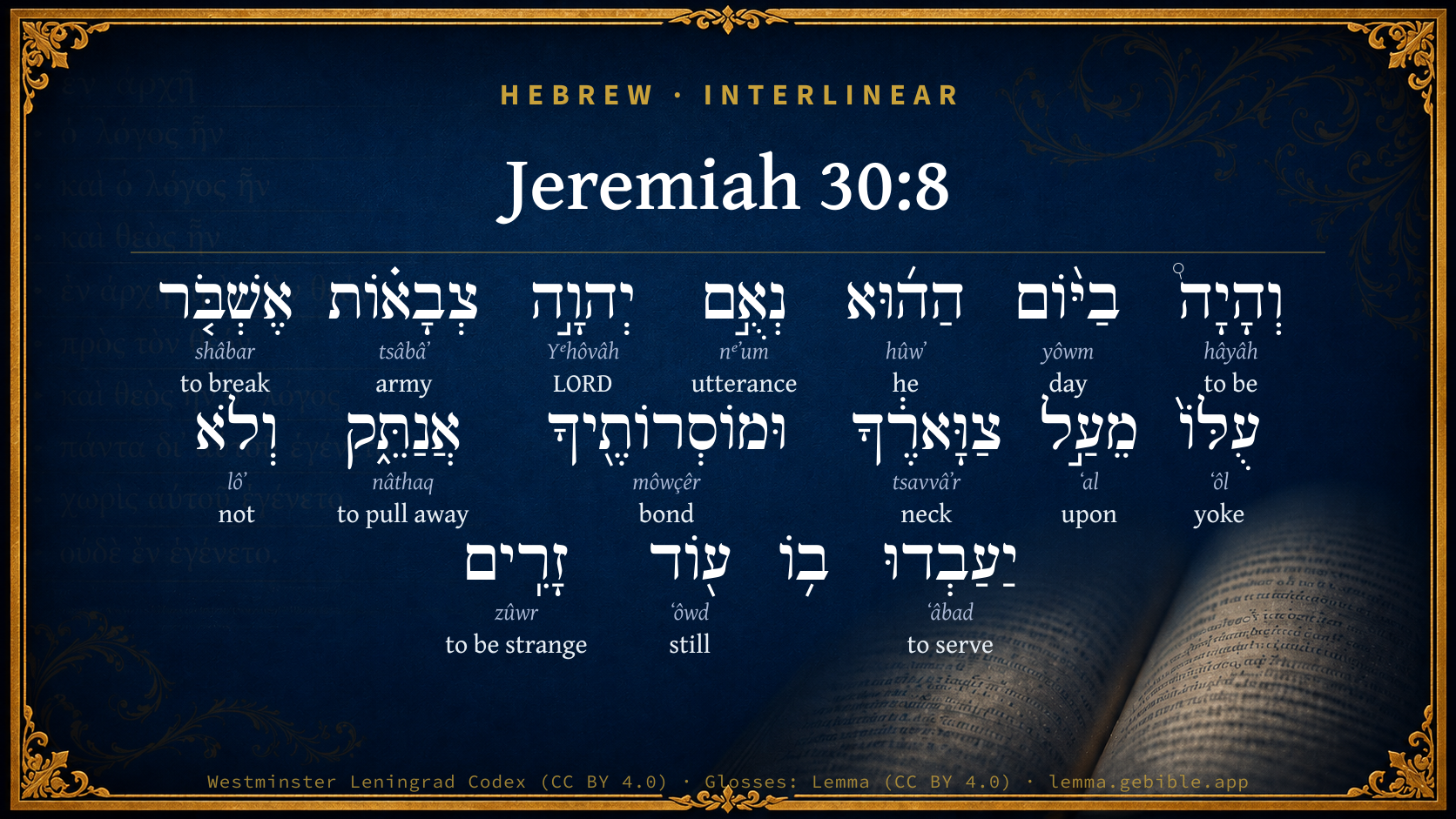
Jeremiah 30:8

Hebrew (Westminster Leningrad Codex) Jeremiah 30:8 appears in the Hebrew Old Testament. The text above is from the Westminster Leningrad Codex. Each word links to its Strong’s number, a concise gloss, and parsing drawn from the Open Scriptures Hebrew Bible morphology. Click any word for its full Brown-Driver-Briggs (BDB) entry.
Download image
Cite this verse

Jeremiah 30:8 (World English Bible). Public Domain. Lemma interlinear Bible study tool, https://lemma.gebible.app/v/jeremiah/30/8.

Show BibTeX & RIS
BibTeX
RIS
English Translation
It shall come to pass in that day, says Yahweh of Hosts, that I will break his yoke from off your neck, and will burst your bonds; and strangers shall no more make him their bondservant;
World English Bible · Public Domain
Download a study sheet

One document with this verse’s original text, its word-by-word gloss line, the meaning frame, cross-references with their text, attributed commentary, and full source and license credits — printable, and it pastes into notes with its structure intact.

This verse Autodidact and up

Study sheet (.html) Plain text (.txt)

A passage Seminary Student

Up to 50 verses in one chapter. A passage sheet keeps up to 6 commentary sources and 12 cross-references per verse, in the order this page ranks them, and says so on the sheet whenever that leaves anything out. Ask for a single verse and you get the Autodidact verse sheet above.

Everything on this page stays free to read, with no account — the sheet is a download of what is already on screen, not access to it.

Want to remove ads? Support Godless Engineer
Compare translations 3

The same verse in 3 English versions, stacked beneath the original-language interlinear above. Click any original word for its lexicon entry.

Each is an independent rendering of the whole verse — the interlinear is not word-aligned to these translations.

Highlighted words mark where these versions differ — a whole-verse word diff, not a word-by-word alignment.

  • World English Bible Public Domain
    It shall come to pass in that day, says Yahweh of Hosts, that I will break his yoke from off your neck, and will burst your bonds; and strangers shall no more make him their bondservant;
  • King James Version Public Domain
    For it shall come to pass in that day, saith the LORD of hosts, that I will break his yoke from off thy neck, and will burst thy bonds, and strangers shall no more serve themselves of him:
  • unfoldingWord Literal Text CC BY-SA 4.0
    For it will be in that day—this is the declaration of Yahweh of hosts—that I will break the yoke off your neck, and I will shatter your chains, so foreigners will no longer enslave you.

unfoldingWord Literal Text — © unfoldingWord, licensed CC BY-SA 4.0. Word-aligned USFM3 via Door43 (git.door43.org/unfoldingWord/en_ult).

Versions to compare (up to 4)

3 of 4 selected

Show all 18 translations

Every available English version of this verse, each an independent rendering of the whole verse.

  • World English Bible Public Domain
    It shall come to pass in that day, says Yahweh of Hosts, that I will break his yoke from off your neck, and will burst your bonds; and strangers shall no more make him their bondservant;
  • Berean Standard Bible Public Domain
    On that day, declares the LORD of Hosts, I will break the yoke off their necks and tear off their bonds, and no longer will strangers enslave them.
  • Majority Standard Bible Public Domain
    On that day, declares the LORD of Hosts, I will break the yoke off their necks and tear off their bonds, and no longer will strangers enslave them.
  • King James Version Public Domain
    For it shall come to pass in that day, saith the LORD of hosts, that I will break his yoke from off thy neck, and will burst thy bonds, and strangers shall no more serve themselves of him:
  • American Standard Version (1901) Public Domain
    And it shall come to pass in that day, saith Jehovah of hosts, that I will break his yoke from off thy neck, and will burst thy bonds; and strangers shall no more make him their bondman;
  • Revised Version (1885) Public Domain
    And it shall come to pass in that day, saith the LORD of hosts, that I will break his yoke from off thy neck, and will burst thy bands; and strangers shall no more serve themselves of him:
  • Geneva Bible (1599) Public Domain
    For in that day, sayth the Lord of hostes, I will breake his yoke from off thy necke, and breake thy bondes, and strangers shall no more serue themselues of him.
  • Douay-Rheims (1899) Public Domain
    And it shall come to pass in that day, saith the Lord of hosts, that I will break his yoke from off thy neck, and will burst his bands: and strangers shall no more rule over him:
  • Young's Literal Translation Public Domain
    And it hath come to pass, in that day, An affirmation of Jehovah of Hosts, I break his yoke from off thy neck, And thy bands I draw away, And lay no more service on him do strangers.
  • Literal Standard Version CC BY-SA 4.0
    And it has come to pass in that day, || A declaration of YHWH of Hosts, || I break his yoke from off your neck, || And I draw away your bands, || And strangers lay no more service on him.
  • Unlocked Literal Bible CC BY-SA 4.0
    For it will be in that day—this is the declaration of Yahweh of hosts—that I will break the yoke off your neck, and I will shatter your chains, so foreigners will no longer enslave you.
  • unfoldingWord Literal Text CC BY-SA 4.0
    For it will be in that day—this is the declaration of Yahweh of hosts—that I will break the yoke off your neck, and I will shatter your chains, so foreigners will no longer enslave you.
  • Darby Bible Public Domain
    And it shall come to pass in that day, saith Jehovah of hosts, I will break his yoke from off thy neck, and will burst thy bonds, and strangers shall no more reduce him to servitude.
  • World Messianic Bible Public Domain
    It will come to pass in that day, says the LORD of Hosts, that I will break his yoke from off your neck, and will burst your bonds. Strangers will no more make them their bondservants;
  • Webster's Bible Public Domain
    For it shall come to pass in that day, saith the LORD of hosts, that I will break his yoke from off thy neck, and will burst thy bonds, and strangers shall no more bring him into subjection:
  • Free Bible Version CC BY-SA 4.0
    On that day, declares the Lord Almighty, I will break the yoke from their necks and tear off their chains. Foreigners won't make them slaves anymore.
  • Bible in Basic English Public Domain
    For it will come about on that day, says the Lord of armies, that his yoke will be broken off his neck, and his bands will be burst; and men of strange lands will no longer make use of him as their servant:
  • JPS Tanakh (1917) Public Domain
    And it shall come to pass in that day, saith the LORD of hosts, that I will break his yoke from off thy neck, and will burst thy bands; and strangers shall no more make him their bondman;

Literal Standard Version (2020), Covenant Press — licensed CC BY-SA 4.0. Text via the HelloAO Bible API (eBible.org). Unlocked Literal Bible (unfoldingWord) — licensed CC BY-SA 4.0. Text via the HelloAO Bible API (eBible.org). unfoldingWord Literal Text — © unfoldingWord, licensed CC BY-SA 4.0. Word-aligned USFM3 via Door43 (git.door43.org/unfoldingWord/en_ult). Free Bible Version, Dr. Jonathan Gallagher — licensed CC BY-SA 4.0. Text via the HelloAO Bible API (eBible.org).

Word by word

More ways to search: Search by grammar → Find every occurrence → Compare this word →

Practice this passage: Drill this verse → Learn its vocabulary →

וּמוֹסְרוֹתֶ֖יךָ
môwçêr
H4147
“and · bonds · your”
Conjunction + Noun, Common, Both, Plural, Construct + Suffix, Personal, 2nd Person, Masculine, Singular
Part of Speech
Conjunction + Noun
Type
Common
Gender
Both
Number
Plural
State
Construct
Full BDB Definition

Origin: from H3256

TWOT: 141f

band, bond
  1. וְהָיָה֩ hâyâh H1961 “and · to be” Conjunction + Verb, Qal, Sequential Perfect, 3rd Person, Masculine, Singular
  2. בַיּ֨וֹם yôwm H3117 “in/at the · day” Preposition, Determined + Noun, Common, Masculine, Singular, Absolute
  3. הַה֜וּא hûwʼ H1931 “the · he” Particle, Definite Article + Pronoun, Personal, 3rd Person, Masculine, Singular
  4. נְאֻ֣ם nᵉʼum H5002 “utterance of” Noun, Common, Masculine, Singular, Construct
  5. יְהוָ֣ה Yᵉhôvâh H3068 “LORD” Noun, Proper
  6. צְבָא֗וֹת tsâbâʼ H6635 “armies” Noun, Common, Both, Plural, Absolute
  7. אֶשְׁבֹּ֤ר shâbar H7665 “to break” Verb, Qal, Imperfect, 1st Person, Common, Singular
  8. עֻלּוֹ֙ ʻôl H5923 “yoke · his” Noun, Common, Masculine, Singular, Construct + Suffix, Personal, 3rd Person, Masculine, Singular
  9. מֵעַ֣ל ʻal H5921 “from · upon” Preposition + Preposition
  10. צַוָּארֶ֔ךָ tsavvâʼr H6677 “neck · your” Noun, Common, Masculine, Singular, Construct + Suffix, Personal, 2nd Person, Masculine, Singular
  11. אֲנַתֵּ֑ק nâthaq H5423 “to pull away” Verb, Piel, Imperfect, 1st Person, Common, Singular
  12. וְלֹא lôʼ H3808 “and · not” Conjunction + Particle, Negative
  13. יַעַבְדוּ ʻâbad H5647 “to serve” Verb, Qal, Imperfect, 3rd Person, Masculine, Plural
  14. ע֖וֹד ʻôwd H5750 “still” Adverb
  15. זָרִֽים zûwr H2114 “strange” Adjective, Adjective, Masculine, Plural, Absolute

About this verse

These counts appear in no published source. They are computed here, from the morphology-tagged text and Lemma’s own curated glosses. What Lemma adds →

17
words
16
distinct lemmas
Prophets
section

Notable vocabulary

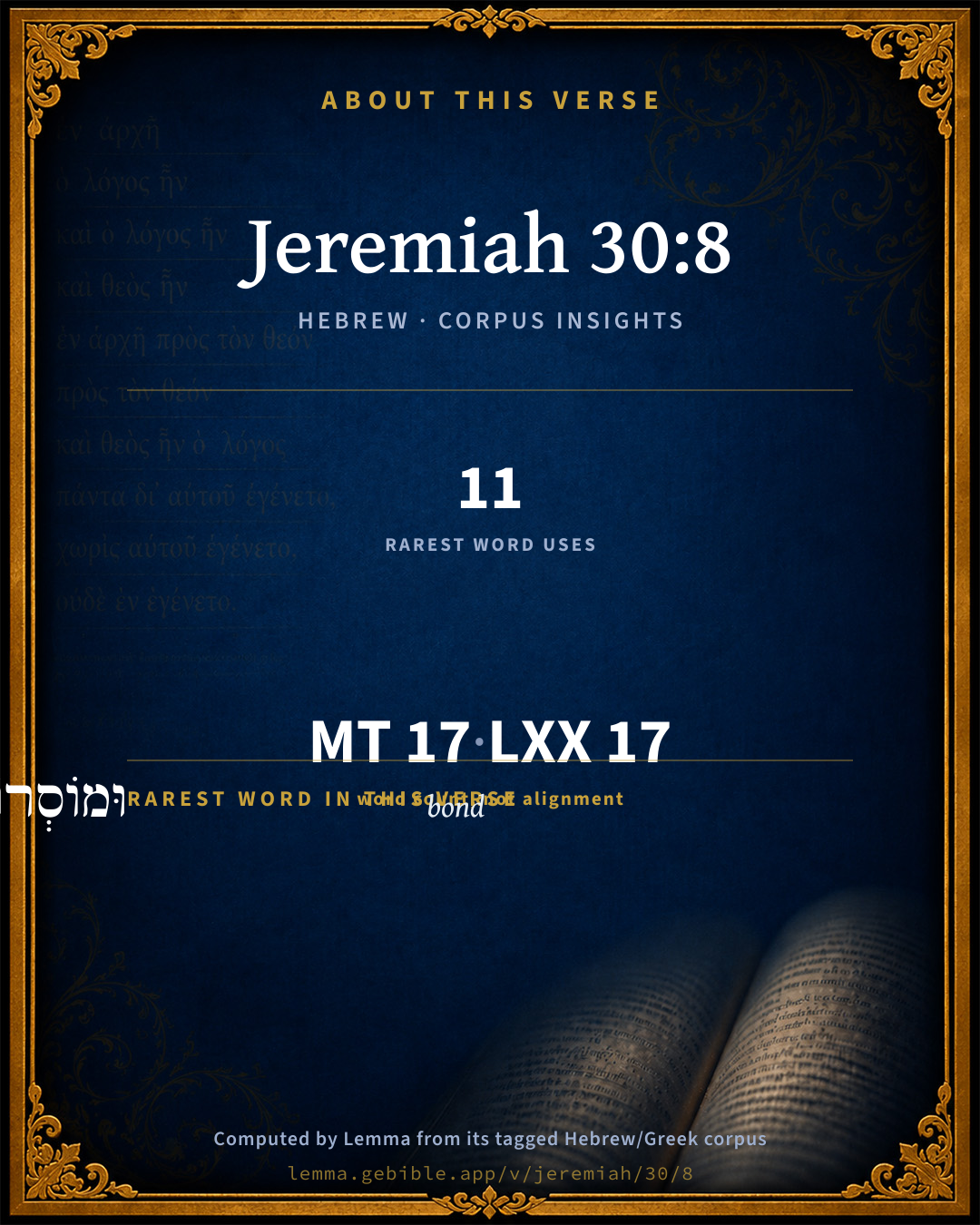
The rarest word here is וּמוֹסְרוֹתֶ֖יךָ bond H4147 — appearing just 11 times in the whole Hebrew Bible.

Shared distinctive vocabulary

וּמוֹסְרוֹתֶ֖יךָ bond H4147 occurs in 11 verses of the Hebrew Bible. Also found in:

Grammatical profile

  • 4 verbs
  • 7 nouns
  • 1 adjective
  • 1 pronoun
  • 2 prepositions
  • 1 adverb
  • 1 particle

Verb forms

  • וְהָיָה֩ Qal · Sequential Perfect
  • אֶשְׁבֹּ֤ר Qal · Imperfect
  • אֲנַתֵּ֑ק Piel · Imperfect
  • יַעַבְדוּ Qal · Imperfect

Hebrew & Septuagint length

In the original languages it is 17 Hebrew tokens and 17 Greek tokens — but the two are counted differently (Hebrew bundles its prefixes and suffixes into one token; the Greek is in lemma form), so that isn’t a like-for-like length.

Cross-references

12

Topical passages linked to Jeremiah 30:8 in the Treasury of Scripture Knowledge — connected by theme and wording, ordered by reader-vote popularity; previews shown in the World English Bible.

  • Nahum 1:13 Now will I break his yoke from off you, and will burst your bonds apart."
  • Ezekiel 34:27 The tree of the field shall yield its fruit, and the earth shall yield its increase, and they shall be secure in their land; and they shall know that I am Yahweh, when I have broken the bars of their yoke, and have delivered them out of the hand of those who made slaves of them.
  • Isaiah 9:4 For the yoke of his burden, and the staff of his shoulder, the rod of his oppressor, you have broken as in the day of Midian.
  • Jeremiah 27:2 Thus says Yahweh to me: Make you bonds and bars, and put them on your neck;
  • Jeremiah 28:10 Then Hananiah the prophet took the bar from off the prophet Jeremiah's neck, and broke it.
  • Isaiah 10:27 It shall happen in that day, that his burden shall depart from off your shoulder, and his yoke from off your neck, and the yoke shall be destroyed by reason of fatness.
  • Isaiah 14:25 that I will break the Assyrian in my land, and on my mountains tread him under foot: then shall his yoke depart from off them, and his burden depart from off their shoulder.
  • Jeremiah 2:20 For of old time I have broken your yoke, and burst your bonds; and you said, I will not serve; for on every high hill and under every green tree you did bow yourself, playing the prostitute.
  • Jeremiah 25:14 For many nations and great kings shall make bondservants of them, even of them; and I will recompense them according to their deeds, and according to the work of their hands.
  • Jeremiah 27:7 All the nations shall serve him, and his son, and his son's son, until the time of his own land come: and then many nations and great kings shall make him their bondservant.
  • Jeremiah 28:13 Go, and tell Hananiah, saying, Thus says Yahweh: You have broken the bars of wood; but you have made in their place bars of iron.
  • Jeremiah 28:4 and I will bring again to this place Jeconiah the son of Jehoiakim, king of Judah, with all the captives of Judah, who went to Babylon, says Yahweh; for I will break the yoke of the king of Babylon.

Cross-references courtesy of OpenBible.info (CC BY 4.0).

Hebrew and Greek witnesses Masoretic Hebrew ↔ Greek Septuagint

The same verse in the two great witnesses to the Old Testament, shown verse-for-verse.

These are two independent witnesses, not word-aligned to each other, and the Septuagint is shown in lemma (dictionary) form.

Hebrew Jeremiah 30:8 Masoretic · Westminster Leningrad Codex

וְהָיָה֩ בַיּ֨וֹם הַה֜וּא נְאֻ֣ם יְהוָ֣ה צְבָא֗וֹת אֶשְׁבֹּ֤ר עֻלּוֹ֙ מֵעַ֣ל צַוָּארֶ֔ךָ וּמוֹסְרוֹתֶ֖יךָ אֲנַתֵּ֑ק וְלֹא יַעַבְדוּ ב֥וֹ ע֖וֹד זָרִֽים

It shall come to pass in that day, says Yahweh of Hosts, that I will break his yoke from off your neck, and will burst your bonds; and strangers shall no more make him their bondservant;

World English Bible · Public Domain

Greek LXX Structure differs

In the Septuagint, Jeremiah is about an eighth shorter than the Hebrew and arranges its material differently — the Oracles Against the Nations (Hebrew chapters 46–51) appear in the middle of the Greek book, after 25:13. Because the chapter and verse boundaries do not line up, a verse-for-verse comparison with the Hebrew is not shown.

A verse-for-verse comparison isn’t shown here because the chapters and verses don’t line up. Switch to the LXX edition with the MT / LXX toggle above to read the Greek directly.

On this verse, The Cambridge Bible for Schools and Colleges discusses the Septuagint’s reading. Read the note in Commentary ↓

Hebrew: Westminster Leningrad Codex (CC BY 4.0). Greek: Septuagint (public domain); English from a public-domain English Septuagint. How the Septuagint differs from the Hebrew →

Targum (Aramaic paraphrase)

1

The Targum is the ancient Jewish Aramaic paraphrase of the Hebrew Scriptures — an interpretive translation, not the Hebrew text itself. Onkelos (literal) and Pseudo-Jonathan (expansive) render the Torah, and Jonathan the Prophets. Coverage is partial: where no permissively-licensed English translation exists for a verse, only the Aramaic is shown. This is verse-level text, not a word-by-word alignment to the Hebrew.

  1. Targum Jonathan Prophets (Joshua–Malachi)
    וִיהֵי בְעִידָנָא הַהִיא אֲמַר יְיָ צְבָאוֹת אֶתְּבַר נִיר עַמְמַיָא מִצַוְארֵיכוֹן וְחַנְקֵיכוֹן אֶפְסַק וְלָא יִשְׁתַּעְבְּדוּן בְּיִשְׂרָאֵל עוֹד עַמְמַיָא:

    (no public-domain English translation for this verse)

    Targum Jonathan — Aramaic: “Mikraot Gedolot” (public domain). English: “Sefaria Community Translation” (CC0 1.0 (public-domain dedication)); “London "Chaldee Paraphrase," 1871” (public domain). Text via Sefaria.

Commentary

Notes on Jeremiah 30:8 from classic Christian and Jewish commentators (each source and its license shown beneath its notes). The classic Christian expositions comment on the surrounding passage and are grouped to its opening verse, so a note may address several verses; the Jewish commentaries on the Tanakh (Rashi and others) are per-verse, so they appear only where the commentator wrote on this verse.

Lemma curates 59 commentaries, every one of them public domain or Creative Commons licensed, each selected and text-cleaned for this edition rather than reprinted as found. About our sources →

Trapp's Complete Commentary

John Trapp

Jer 30:8 For it shall come to pass in that day, saith the LORD of hosts, [that] I will break his yoke from off thy neck, and will burst thy bonds, and strangers shall no more serve themselves of him:

Ver. 8. I will break his yoke from off thy neck.] The forementioned misery did but make way for this mercy, that it might be the more magnified. Let the saints but see from what, to what, and by what Jesus Christ hath delivered them, and they cannot but be thankful.

John Trapp, A Commentary or Exposition upon All the Books of the Old and New Testament (1647–1656) — public domain. Text from a community e-Sword module.

Joseph Benson's Commentary

Jer 30:8-9. It shall come to pass in that day — In the day when Jacob shall be saved out of all his troubles, Jer 30:7. The phrase that day often denotes an extraordinary or remarkable time for some signal events of Providence: see Isa 4:2. That I will break his yoke from off thy neck — This promise was in part fulfilled when Cyrus set the Jews free from the Babylonish yoke, and gave them liberty to return to their own country. And strangers shall no more serve themselves of him — In this latter part of the sentence the Jewish state, or rather that of Israel and Judah, is spoken of in the third person, him; in the foregoing part in the second person, thy neck. But they shall serve the Lord their God — They shall live in subjection and obedience to the one living and true God, and to David their king — That is, the Messiah, who is often called by the name of David in the prophets, as the person in whom all the promises made to David were to be fulfilled. See the margin. Here it is promised that, after this restoration, the Jews and Israelites “should no more fall under the dominion of foreigners, but be governed by princes and magistrates of their own nation, independent of any but God and David their king. But this was not the case with the Jews that returned from Babylon. They then indeed had a leader, Zerubbabel, one of their own nation, and also of the family of David. But both the nation and their leader continued still in a state of vassalage and the most servile dependance upon the Persian monarchy. And when the Grecian monarchy succeeded, they changed their masters only, but not their condition; till, at length, under the Asmonæan princes, they had, for a while, an independent government of their own, but without any title to the name of David. At last they fell under the Roman yoke, since which time their situation has been such as not to afford the least ground to pretend that the promised restoration has yet taken place. It remains, therefore, to be brought about, in future, under the reign of the Messiah, emphatically distinguished by the name of David; when every particular circumstance predicted concerning it will, no doubt, be verified by a distinct and unequivocal accomplishment.” — Blaney. Whom I will raise up unto them — An expression elsewhere used by the holy writers when they speak of the coming of Christ. See the margin. Hence this prophecy must be considered as implying the conversion of the Jews to the Christian faith, God, according to his promises, having constituted Christ the Prince and the Saviour to whom every knee must bow, and whom every tongue must confess.

Joseph Benson's Commentary on the Old and New Testaments (1811–1818) — public domain. Text from a community e-Sword module.

Whedon's Commentary on the Bible

Daniel D. Whedon

ISRAEL’S DELIVERANCE, Jer_30:8-11.

8. His yoke — Israel’s yoke, see on 1Ki_12:4; Isa_9:3.

Strangers… no more serve themselves — Their captivity shall come to a perpetual end.

Daniel D. Whedon (gen. ed.), Commentary on the Old and New Testaments (1874–1909) — public domain. Text from a community e-Sword module.

Tyndale Open Study Notes

Tyndale Open Resources

30:8 Although the return of the exiles began in 538 BC, foreigners were still their masters for most of Israel’s history from the Exile through the Roman period. However, Israel experienced a measure of freedom during that time.

Tyndale Open Study Notes — © Tyndale Open Resources, licensed CC BY-SA 4.0. Text via the HelloAO Bible API.

Geneva Bible (1599)

Geneva Bible translators

To wit, of Jacob.

Of the King of Babylon.

When I shall visit Babylon.

Geneva Bible (1599) marginal notes — public domain. Text via Bolls.life.

Jamieson, Fausset & Brown

Robert Jamieson, A. R. Fausset & David Brown

his yoke . . . thy neck--his, that is, Jacob's (Jer 30:7), the yoke imposed on him. The transition to the second person is frequent, God speaking of Jacob or Israel, at the same time addressing him directly. So "him" rightly follows; "foreigners shall no more make him their servant" (Jer 25:14). After the deliverance by Cyrus, Persia, Alexander, Antiochus, and Rome made Judah their servant. The full of deliverance meant must, therefore, be still future.

Jamieson, Fausset & Brown — Commentary Critical and Explanatory on the Whole Bible (1871) — public domain (CC PDM 1.0). Text via the HelloAO Bible API.

Adam Clarke's Commentary

Verse 8. I will break his yoke] That is, the yoke of Nebuchadnezzar.

Of him.] Of Jacob, (Jer 30:7,) viz., the then captive Jews.

Adam Clarke's Commentary on the Bible (1810–1826) — public domain. Text from a community e-Sword/MySword module.

John Calvin's Commentaries

Jeremiah proceeds with what he touched upon in the last verse, even that the Lord, after having chastised his people, would at length shew mercy to them, so as to receive them into favor. He says, in short, that their captivity would not be perpetual. But we must remember what we have before stated, that is, that deliverance is only promised to the faithful, who would patiently and resignedly submit to God and not disregard his paternal correction. If, then, we desire God to be propitious to us, we must suffer ourselves to be paternally chastised by him; for if we resist when goaded, no pardon can by any means be expected, for we then, as it were, wilfully provoke God by our hardness.

He therefore says, in that day, that is, when the appointed time was completed. The false prophets inflamed the people with false expectation, as though their deliverance was to take place after two years. God bade the faithful to wait, and not to be thus in a hurry; he had assigned a day for them, and that was, as we have seen, the seventieth year. He then mentions the yoke, that is, of the king of Babylon, and taking another view, the chains The yoke was what Nebuchadnezzar laid on the Jews; and the chains of the people were those by which Nebuchadnezzar had bound them. At last he adds, And rule over them shall no more strangers The verb עבד, obed, is to be taken here in a causative sense; even the form of the sentence shews this, and they who render the words, “and strangers shall not serve them,” wrest the meaning; for it could not be a promise; and this is inconsistent with the context, and requires no confutation, as it is evidently unsuitable. If the verb be taken in the sense of serving, then “strangers” must be in the dative case. We have seen before a similar phrase in Jeremiah 25:14, where the Prophet says that neither kings nor strong nations would any longer rule over the Jews. The same verb is used, and the same form of expression. Strangers, then, shall make them serve no more; that is, they shall not rule over them so as slavishly to oppress them.

We now perceive the design of the Prophet; he exhorts the Jews to patience, and shews that though their exile would be long, yet their deliverance was certain. It follows, —

John Calvin's Commentaries (1540-1563) — public domain. Text from the Calvin Translation Society English edition (1840s-50s) via the Christian Classics Ethereal Library (ccel.org). Calvin's coverage is partial (roughly two-thirds of the Bible); uncommented books and verses are honest gaps, never fabricated. The 19th-century editor's footnotes and remarks are omitted so the notes are faithfully Calvin's own voice.

Ellicott's Commentary for English Readers

(8) For it shall come to pass in that day . . .—Better, And it shall come. Here there comes in the ground of the hope uttered in the words “he shall be saved out of it,” which keeps the prophet from sinking under the burden of his sorrow. The second and third person are strangely mingled. Jehovah speaks to Israel, “thy bonds,” “thy yoke,” and “his yoke” is that of the oppressor, i.e., of the Babylonian ruler, and then, the person changing, “strangers shall no more get service done for them by him” i.e., by Israel. The prophet echoes the words of Isa_10:27.

A Bible Commentary for English Readers, edited by Charles John Ellicott (1878–1897) — public domain. Text from a community e-Sword module.

The Cambridge Bible for Schools and Colleges

gen. ed. J. J. S. Perowne

8. thy neck … thy bands] rather (with LXX) the 3rd person in both cases. It is a description of Israel’s future deliverance, not an address to him. Dr. suggests that the scribe who substituted “thy” may have had Isa_10:27 in his mind.

bands] The Heb. is the word so rendered in the text of Jer_27:2, where see note.

serve themselves of him] For the phrase cp. Jer_25:14, Jer_27:7.

The Cambridge Bible for Schools and Colleges (gen. ed. J. J. S. Perowne; Cambridge University Press, 1878–1918) — public domain. Text from a community e-Sword module.

John Gill's Exposition

For it shall come to pass in that day, saith the Lord of hosts,.... When the time is come for Jacob to be saved out of his trouble:

that I will break his yoke from off thy neck; not the yoke of the king of Babylon, but of antichrist, and of all the antichristian states, by whom the people of God have been oppressed; so the Targum,

"I will break the yoke of the peoples (the antichristian nations) from off your necks.''

Jarchi interprets it of the yoke of the nations of the world from off Israel; and Kimchi of the yoke of Gog and Magog, or of every nation:

and will burst thy bonds; by which they were kept in bondage, both with respect to civil and religious things; but now he that led into captivity shall go into captivity himself, Rev 13:10;

and strangers shall no more serve themselves of him; this shows that this prophecy cannot be understood of deliverance from the Babylonish captivity; because, after this, strangers did serve themselves of the Jews, and they were servants unto them; as to the Persians, and Grecians, and especially the Romans, by whom they were entirely subdued and ruined; and to this day all nations almost serve themselves of them; but when they shall be called and converted, as they shall be free from the yoke of sin and Satan, and from the yoke of the ceremonial law, and the traditions of their elders, in a religious sense; so from the yoke of the nations of the world, in a civil sense.

John Gill's Exposition of the Whole Bible (1746–1763) — public domain (CC PDM 1.0). Text via the HelloAO Bible API.

Albert Barnes' Notes on the Bible

Bonds - See Jer 27:2 note.

Shall no more serve themselves - i. e., shall no more exact forced labor of him Jer 22:13.

Albert Barnes' Notes on the Bible (1834–1885) — public domain. Text from a community e-Sword/MySword module.

Haydock's Catholic Bible Commentary

Strangers. Idols. The people were not so prone to worship them. Yet the Jews were almost constantly subject to foreigners (Calmet) despectissima pars servientium, Macedonibus invalidis....sibi ipsis reges imposuere. (Tacitus, Hist. 5.) --- Christ granted a more perfect liberty to the faithful, John viii. 33. (Calmet)

George Leo Haydock (1774–1849), Haydock's Catholic Family Bible and Commentary, 1859 edition — public domain. Excludes Psalms (Douay-Rheims chapter numbering differs from Protestant) and Deuterocanonical books (Catholic canon only).

Matthew Poole's English Annotations

In that day; not in that great day before mentioned, but in the day when God should deliver the seed of Jacob out of trouble. God threatens to break the yoke of the king of Babylon, that is, to break that power of his which for seventy years he should exercise in keeping the Jews under; and he would break the bonds in which they should be kept, and foreign nations should no more serve themselves upon the Jews.

Matthew Poole's English Annotations on the Holy Bible (1683–1685) — public domain. Text from a community e-Sword/MySword module.

The Pulpit Commentary

His yoke. Not that imposed by the enemy, (as Isa_10:22 and Isa_14:25 might suggest) but that suffered by Jacob. This is clear from the last clause of the verse.

The Pulpit Commentary (1880–1919), ed. H.D.M. Spence-Jones & Joseph S. Exell — public domain. Text from a community e-Sword module.

John Wesley's Explanatory Notes

In that day - In the day when God should deliver the seed of Jacob out of trouble. His yoke - The yoke of the king of Babylon, that power of his, which for seventy years he exercised over the Jews. Of him - Of the Jews.

John Wesley, Explanatory Notes Upon the Whole Bible (1754–1765) — public domain. Text via the GEBible commentary corpus.

unfoldingWord translationNotes

Door43 World Missions Community

General Information:

Yahweh continues to speak to the Israelites.

I will break the yoke off your neck, and I will shatter your chains

Being a slave is spoken of as wearing a yoke like an animal and wearing chains like a prisoner. (See: Metaphor)

they will worship Yahweh their God ... their king ... over them

Yahweh continues speaking about the descendants of Jacob. AT: "you will worship Yahweh your God ... your king ... over you" (See: First, Second, or Third Person)

David their king

This is a metonym for one of David's descendants. AT: "a man descended from their King David" (See: Metonymy)

translationWords

Yahweh of hosts

yoke

alien

enslave

worship

servant

David

king

unfoldingWord translationNotes — © Distant Shores Media and the Door43 World Missions Community, licensed CC BY-SA 4.0. Source: git.door43.org/Door43/en_tn.

Rashi

Rabbi Shlomo Yitzchaki (Rashi)

I will break his yoke The yoke of the heathens will be removed from Israel.

Rashi on the Tanakh — English translations: “The Judaica Press complete Tanach with Rashi, translated by A. J. Rosenberg” (CC BY 4.0); “Pentateuch with Rashi's commentary by M. Rosenbaum and A.M. Silbermann, 1929-1934” (public domain); “The Metsudah Tanach series, Lakewood, N.J” (CC BY 4.0); and “The Book of Joshua, Metsudah Publications, 1997” (CC BY 4.0). Text via Sefaria.

Lesson kit

Teaching starters — assembled from the data on this page, not authored interpretation. Every prompt links to the verse data it draws on. Edit before teaching.

Jeremiah, in the Prophets, opens this verse with 17 words (16 distinct Hebrew lemmas). Its most distinctive word is môwçêr (“bond”). A historical commentator’s framing appears above. Read the whole chapter for the surrounding context.

Discussion questions

  1. The word môwçêr carries the sense “bond.” How does it shape the verse?
  2. Job 39:5 shares the word «bond» with this verse. How do the two illuminate each other?
  3. The translations on this page render this verse differently — a whole-verse word diff, not a word-by-word alignment. What might account for the different wordings?
  4. The verb «וְהָיָה֩» is Qal Sequential Perfect. How does its form color the action?
  5. Reading how Trapp's Complete Commentary and Joseph Benson's Commentary read this verse, where do the two commentators agree and where do they part?

Things to notice

Reading settings

Reading text

Shown beneath each verse's original-language words.

Old Testament
Old Testament edition

Read the OT as the Masoretic Hebrew (MT) or the Greek Septuagint (LXX).

English shown for the Greek Septuagint (in the Hebrew ↔ Greek comparison).

Comparing translations? Open the Compare panel on any verse page to stack up to four side by side.