
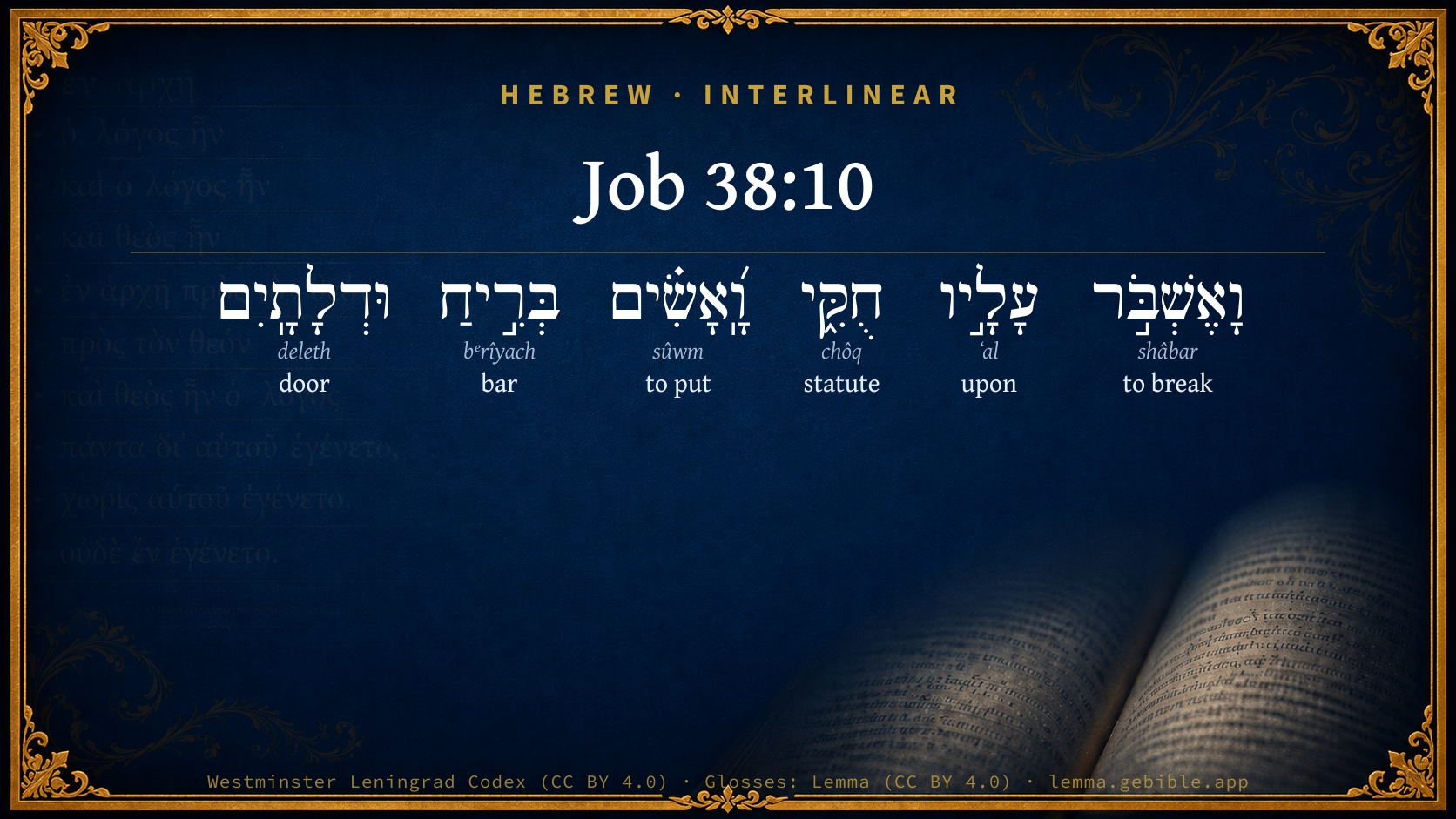
Job 38:10

Hebrew (Westminster Leningrad Codex) Job 38:10 appears in the Hebrew Old Testament. The text above is from the Westminster Leningrad Codex. Each word links to its Strong’s number, a concise gloss, and parsing drawn from the Open Scriptures Hebrew Bible morphology. Click any word for its full Brown-Driver-Briggs (BDB) entry.
Download image
Cite this verse

Job 38:10 (World English Bible). Public Domain. Lemma interlinear Bible study tool, https://lemma.gebible.app/v/job/38/10.

Show BibTeX & RIS
BibTeX
RIS
English Translation
Marked out for it my bound, Set bars and doors,
World English Bible · Public Domain
Download a study sheet

One document with this verse’s original text, its word-by-word gloss line, the meaning frame, cross-references with their text, attributed commentary, and full source and license credits — printable, and it pastes into notes with its structure intact.

This verse Autodidact and up

Study sheet (.html) Plain text (.txt)

A passage Seminary Student

Up to 50 verses in one chapter. A passage sheet keeps up to 6 commentary sources and 12 cross-references per verse, in the order this page ranks them, and says so on the sheet whenever that leaves anything out. Ask for a single verse and you get the Autodidact verse sheet above.

Everything on this page stays free to read, with no account — the sheet is a download of what is already on screen, not access to it.

Want to remove ads? Support Godless Engineer
Compare translations 3

The same verse in 3 English versions, stacked beneath the original-language interlinear above. Click any original word for its lexicon entry.

Each is an independent rendering of the whole verse — the interlinear is not word-aligned to these translations.

Highlighted words mark where these versions differ — a whole-verse word diff, not a word-by-word alignment.

  • World English Bible Public Domain
    Marked out for it my bound, Set bars and doors,
  • King James Version Public Domain
    And brake up for it my decreed place, and set bars and doors,
  • unfoldingWord Literal Text CC BY-SA 4.0
    And I broke upon it my boundary, and I set a bar and doors,

unfoldingWord Literal Text — © unfoldingWord, licensed CC BY-SA 4.0. Word-aligned USFM3 via Door43 (git.door43.org/unfoldingWord/en_ult).

Versions to compare (up to 4)

3 of 4 selected

Show all 18 translations

Every available English version of this verse, each an independent rendering of the whole verse.

  • World English Bible Public Domain
    Marked out for it my bound, Set bars and doors,
  • Berean Standard Bible Public Domain
    when I fixed its boundaries and set in place its bars and doors,
  • Majority Standard Bible Public Domain
    when I fixed its boundaries and set in place its bars and doors,
  • King James Version Public Domain
    And brake up for it my decreed place, and set bars and doors,
  • American Standard Version (1901) Public Domain
    And marked out for it my bound, And set bars and doors,
  • Revised Version (1885) Public Domain
    And prescribed for it my decree, and set bars and doors,
  • Geneva Bible (1599) Public Domain
    When I stablished my commandement vpon it, and set barres and doores,
  • Douay-Rheims (1899) Public Domain
    I set my bounds around it, and made it bars and doors:
  • Young's Literal Translation Public Domain
    And I measure over it My statute, And place bar and doors,
  • Literal Standard Version CC BY-SA 4.0
    And I measure My statute over it, || And place bar and doors,
  • Unlocked Literal Bible CC BY-SA 4.0
    That was when I marked out for the sea my boundary, and when I placed its bars and doors,
  • unfoldingWord Literal Text CC BY-SA 4.0
    And I broke upon it my boundary, and I set a bar and doors,
  • Darby Bible Public Domain
    When I cut out for it my boundary, and set bars and doors,
  • World Messianic Bible Public Domain
    marked out for it my bound, set bars and doors,
  • Webster's Bible Public Domain
    And broke up for it my decreed place, and set bars and doors,
  • Free Bible Version CC BY-SA 4.0
    I set its limits, marking its borders.
  • Bible in Basic English Public Domain
    Ordering a fixed limit for it, with locks and doors;
  • JPS Tanakh (1917) Public Domain
    And prescribed for it My decree, and set bars and doors,

Literal Standard Version (2020), Covenant Press — licensed CC BY-SA 4.0. Text via the HelloAO Bible API (eBible.org). Unlocked Literal Bible (unfoldingWord) — licensed CC BY-SA 4.0. Text via the HelloAO Bible API (eBible.org). unfoldingWord Literal Text — © unfoldingWord, licensed CC BY-SA 4.0. Word-aligned USFM3 via Door43 (git.door43.org/unfoldingWord/en_ult). Free Bible Version, Dr. Jonathan Gallagher — licensed CC BY-SA 4.0. Text via the HelloAO Bible API (eBible.org).

Word by word

More ways to search: Search by grammar → Find every occurrence → Compare this word →

Practice this passage: Drill this verse → Learn its vocabulary →

About this verse

These counts appear in no published source. They are computed here, from the morphology-tagged text and Lemma’s own curated glosses. What Lemma adds →

6
words
6
distinct lemmas
Wisdom
section

Shared distinctive vocabulary

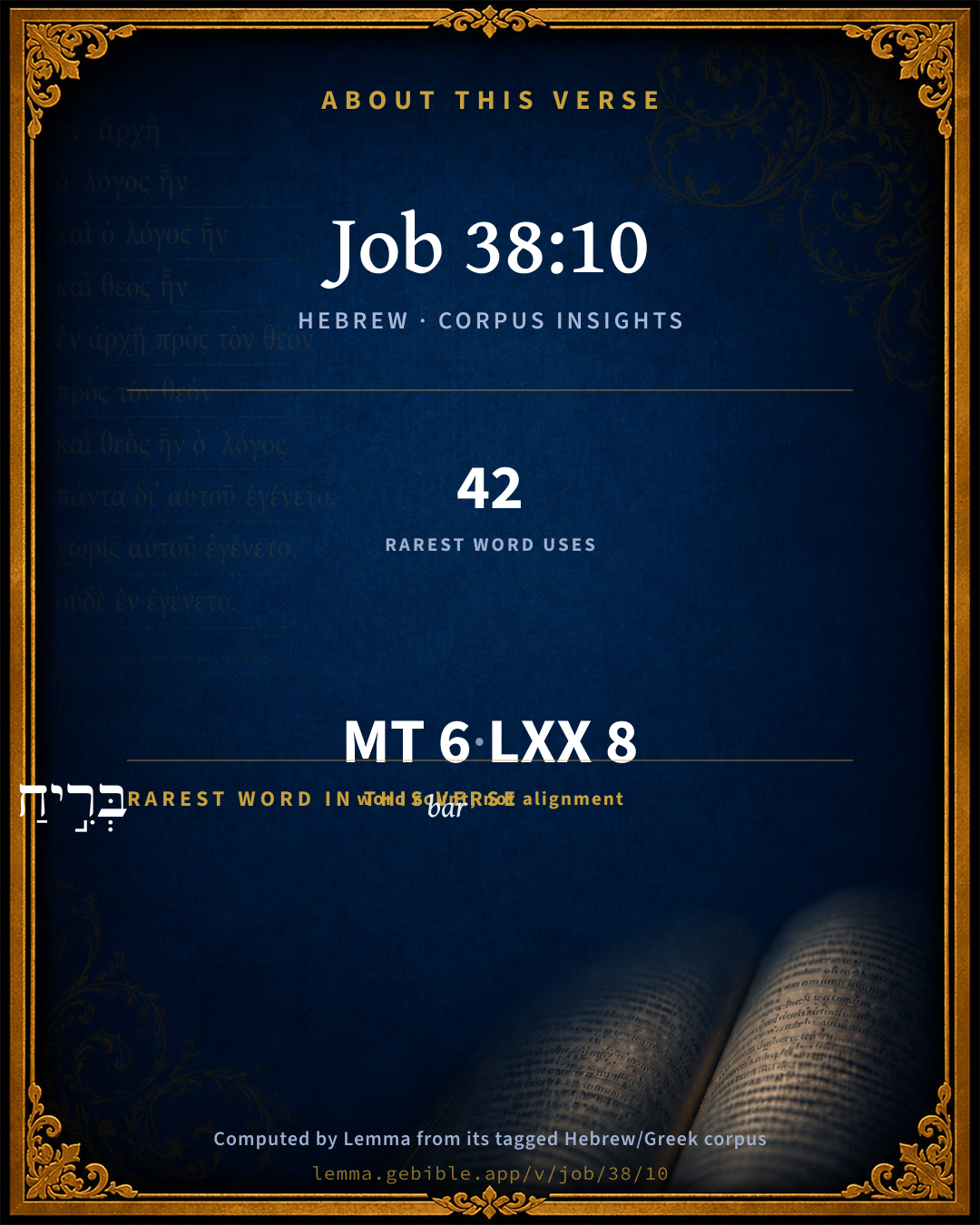
בְּרִ֣יחַ bar H1280 occurs in 37 verses of the Hebrew Bible. Also found in:

Grammatical profile

  • 2 verbs
  • 3 nouns
  • 1 preposition

Verb forms

  • וָאֶשְׁבֹּ֣ר Qal · Sequential Imperfect
  • וָֽ֝אָשִׂ֗ים Qal · Sequential Imperfect

Hebrew & Septuagint length

In English translation the verse runs 10 words from the Hebrew and 12 from the Septuagint (LXX English) — closely comparable.

A rough comparison of the two English renderings, which tokenize alike — not a word-level alignment.

Word counts can differ between the Hebrew and the Greek without any difference in meaning — e.g. the Hebrew direct-object marker אֵת has no separate Greek word, and Greek often adds the article ὁ.

In the original languages it is 6 Hebrew tokens and 8 Greek tokens — but the two are counted differently (Hebrew bundles its prefixes and suffixes into one token; the Greek is in lemma form), so that isn’t a like-for-like length.

Cross-references

6

Topical passages linked to Job 38:10 in the Treasury of Scripture Knowledge — connected by theme and wording, ordered by reader-vote popularity; previews shown in the World English Bible.

  • Psalms 104:9 You have set a boundary that they may not pass over; That they don't turn again to cover the earth.
  • Jeremiah 5:22 Don't you fear me? says Yahweh: won't you tremble at my presence, who have placed the sand for the bound of the sea, by a perpetual decree, that it can't pass it? and though the waves of it toss themselves, yet they can't prevail; though they roar, yet they can't pass over it.
  • Job 26:10 He has described a boundary on the surface of the waters, And to the confines of light and darkness.
  • Psalms 33:7 He gathers the waters of the sea together as a heap. He lays up the deeps in storehouses.
  • Genesis 1:9–10 God said, "Let the waters under the sky be gathered together to one place, and let the dry land appear," and it was so.
  • Genesis 9:15 and I will remember my covenant, which is between me and you and every living creature of all flesh, and the waters will no more become a flood to destroy all flesh.

Cross-references courtesy of OpenBible.info (CC BY 4.0).

Hebrew and Greek witnesses Masoretic Hebrew ↔ Greek Septuagint

The same verse in the two great witnesses to the Old Testament, shown verse-for-verse.

These are two independent witnesses, not word-aligned to each other, and the Septuagint is shown in lemma (dictionary) form.

Hebrew Job 38:10 Masoretic · Westminster Leningrad Codex

וָאֶשְׁבֹּ֣ר עָלָ֣יו חֻקִּ֑י וָֽ֝אָשִׂ֗ים בְּרִ֣יחַ וּדְלָתָֽיִם

Marked out for it my bound, Set bars and doors,

World English Bible · Public Domain

Greek LXX Job 38:10 Septuagint · lemma form

τίθημι δέ αὐτός ὅριον περιτίθημι κλεῖθρον καί πύλη

And I set bounds to it, surrounding it with bars and gates.

LXX2012 (modern English Septuagint) · Public Domain

On this verse, Albert Barnes' Notes on the Bible discusses the Septuagint’s reading. Read the note in Commentary ↓

Hebrew: Westminster Leningrad Codex (CC BY 4.0). Greek: Septuagint (public domain); English from LXX2012 (modern English Septuagint) (Public Domain). How the Septuagint differs from the Hebrew →

Commentary

Notes on Job 38:10 from classic Christian and Jewish commentators (each source and its license shown beneath its notes). The classic Christian expositions comment on the surrounding passage and are grouped to its opening verse, so a note may address several verses; the Jewish commentaries on the Tanakh (Rashi and others) are per-verse, so they appear only where the commentator wrote on this verse.

Lemma curates 59 commentaries, every one of them public domain or Creative Commons licensed, each selected and text-cleaned for this edition rather than reprinted as found. About our sources →

Trapp's Complete Commentary

John Trapp

Job 38:10 And brake up for it my decreed [place], and set bars and doors,

Ver. 10. And brake up for it my decreed place] That great house in the hollows of the earth, Job 38:8, gathering it together by a perpetual and powerful decree, into that place and pit. Tremellius renderetb it, Quum diffregi pro eo terram decreto meo, When I brake up for it the earth by my decree. Others, And laid upon it nay statute; for shabhar signifieth also statuere, decernere, say they; but that is more than I know.

And set bars and doors] Vectes et valvas. See Job 38:8. This is a work of God’s great power; and is therefore much instanced and insisted upon in Scripture, Psa 109:1-31 Jer 5:22, &c. God could have put many other hard questions to Job about the sea; as, why it swelleth not by the inflowing of so many great rivers? why the waters of it are so salt? whence it is that it so ebbeth and floweth? &c. Aristotle showeth himself no very wise man in answering these questions; whom yet Averroes so madly admireth, that he saith there is no error at all to be found in him; and that his doctrine is the chiefest truth.

John Trapp, A Commentary or Exposition upon All the Books of the Old and New Testament (1647–1656) — public domain. Text from a community e-Sword module.

Tyndale Open Study Notes

Tyndale Open Resources

38:10-11 locked it behind barred gates: The sea is depicted as a dangerous creature kept under control.

Tyndale Open Study Notes — © Tyndale Open Resources, licensed CC BY-SA 4.0. Text via the HelloAO Bible API.

Jamieson, Fausset & Brown

Robert Jamieson, A. R. Fausset & David Brown

brake up for--that is, appointed it. Shores are generally broken and abrupt cliffs. The Greek for "shore" means "a broken place." I broke off or measured off for it my limit, that is, the limit which I thought fit (Job 26:10).

Jamieson, Fausset & Brown — Commentary Critical and Explanatory on the Whole Bible (1871) — public domain (CC PDM 1.0). Text via the HelloAO Bible API.

Adam Clarke's Commentary

Verse 10. And brake up for it my decreed place] This refers to the decree, Ge 1:9: "Let the waters under the heavens be gathered together unto one place."

And set bars and doors] And let the dry land appear. This formed the bars and doors of the sea; the land being everywhere a barrier against the encroachments and inundations of the sea; and great rivers, bays, creeks, &c., the doors by which it passes into the interior of continents, &c.

Adam Clarke's Commentary on the Bible (1810–1826) — public domain. Text from a community e-Sword/MySword module.

Ellicott's Commentary for English Readers

(10) And brake up for it my decreed place.—Rather, And prescribed for it my decree: that is to say, determined the boundaries of its abode. When we bear in mind the vast forces and unstable nature of the sea, it seems a marvel that it acknowledges any limits, and is held in restraint by them.

A Bible Commentary for English Readers, edited by Charles John Ellicott (1878–1897) — public domain. Text from a community e-Sword module.

The Cambridge Bible for Schools and Colleges

gen. ed. J. J. S. Perowne

10. brake up for it my decreed place] Rather, and brake for it my bound, i. e. set it my appointed boundary. The expression “brake” may refer to the deep and abrupt precipices which mark the coast line in many places.

The figures in these verses are very splendid. First, the ocean is represented as an infant giant, breaking forth from the womb. (It is not necessary perhaps to ask whether the interior of the earth be thought of as the “womb” of the ocean, or whether “womb” merely belongs to the figure of the ocean’s birth.) Then the infant ocean was swathed in clouds and thick clouds were its swaddling bands. Finally the new-born monster must be tamed by almighty power, and an impassable bound set to its proud fury.

The Cambridge Bible for Schools and Colleges (gen. ed. J. J. S. Perowne; Cambridge University Press, 1878–1918) — public domain. Text from a community e-Sword module.

John Gill's Exposition

And brake up for it my decreed place,.... Or, as Mr. Broughton translates it, "and brake the earth for it by my decree": made a vast chasm in the earth to hold the waters of the sea, which was provided as a sort of cradle to put this swaddled infant in; God cleaved the earth, raised the hills and sank the valleys, which became as channels to convey the waters that ran off the earth to their appointed place, which beautifully expressed in Psa 104:7; and refers there, as here, to the work of creation on the second day, Gen 1:9 (h);

and set bars and doors; to keep it in its decreed appointed place, that the waters might not go over the earth; these are the shores, as the Targum, the cliffs and rocks upon them, the boundaries of the sea; to which may be added, and what is amazing, the sand upon the seashore is such a boundary to it that it cannot pass, Jer 5:22; but these would be insufficient was it not for the power and will of God, next expressed.

(h) Or determined, that is, appointed for it its convenient, proper, and fixed place; so David de Pomis, Lexic. fol. 203. 1.

John Gill's Exposition of the Whole Bible (1746–1763) — public domain (CC PDM 1.0). Text via the HelloAO Bible API.

Albert Barnes' Notes on the Bible

And brake up for it my decreed place - Margin, “established my decree upon it.” So Herder, “I fixed my decrees upon it.” Luther renders it, “Da ich ihm den Lauf brach mit meinem Damm” - “then I broke its course with my barrier.” Umbreit renders it, “I measured out to it my limits;” that is, the limits or bounds which I judged to be proper. So the Vulgate, “Circumdedi illud terminis meis” - “I surrounded it with my limits,” or with such limits as I chose to affix. The Septuagint renders it, “I placed boundaries to it.” Coverdale, “I gave it my commandment.” This is undoubtedly the sense which: the connection demands; and the idea in the common version, that God had broken up his fixed plans in order to accommodate the new-born ocean, is not in accordance with the parallelism. The Hebrew word (שׁבר shâbar) indeed commonly means “to break, to break in pieces.” But, according to Gesenius, and as the place here demands, it may have the sense of measuring off, defining, appointing, “from the idea of breaking into portions;” and then the sense will be, “I measured for it (the sea) my appointed bound.”

This meaning of the word is, however, more probably derived from the Arabic, where the word שׁבר shâbar means to measure with the span (Castell), and hence, the idea here of measuring out the limits of the ocean. The sense is, that God measured out or determined the limits of the sea. The idea of breaking up a limit or boundary which had been before fixed, it is believed, is not in the text. The word rendered “my decreed place” (חקי chuqiy) refers commonly to a law, statute, or ordinance, meaning originally anything that was “engraved” (חקק châqaq) and then, because laws were engraved on tablets of brass or stone, any statute or decree. Hence, it means anything prescribed or appointed, and hence, a “bound,” or “limit;” see the notes at Job 26:10; compare Pro 8:29, “When he gave to the sea his decree (חקו chuqô) that the waters should not pass his commandment.” The idea in the passage before us is, that God fixed the limits of the ocean by his own purpose or pleasure.

And set bars - Doors were formerly fastened, as they are often now, by cross-bars; and the idea here is, that God had inclosed the ocean, and so fastened the doors from where, it would issue out, that it could not pass.

Albert Barnes' Notes on the Bible (1834–1885) — public domain. Text from a community e-Sword/MySword module.

Haydock's Catholic Bible Commentary

Set. Protestants, "brake up for it my decreed place." Marginal note, "established my decree upon it;" (Haydock) or, "I gave order to break it," against the shore, Jeremias v. 22., and Amos v. 8.

George Leo Haydock (1774–1849), Haydock's Catholic Family Bible and Commentary, 1859 edition — public domain. Excludes Psalms (Douay-Rheims chapter numbering differs from Protestant) and Deuterocanonical books (Catholic canon only).

Matthew Poole's English Annotations

Brake up for it my decreed place, i.e. made those valleys, or channels, and hollow places in the earth, which might serve for a cradle to receive and hold this great and goodly infant when it came out of the womb. See Gen 1:9,10; Psa 33:7. Or, ordained or established my decree upon or concerning it. Set bars and doors, i.e. fixed its bounds as strongly as if they were fortified with bars and doors.

Matthew Poole's English Annotations on the Holy Bible (1683–1685) — public domain. Text from a community e-Sword/MySword module.

Whedon's Commentary on the Bible

Daniel D. Whedon

10. Brake up… decreed place — Rather, And broke over it my decree. The tumultuous violence of the ocean is still in the poet’s mind — its struggles were Titanic as it came into contact with the divine law. “The breaking of the land upon it represents, better than any other linguistic painting could do, its wild stubbornness. It is really the sea breaking itself against law; but there is great vividness and even sublimity in the converse of the figure.”-T. Lewis. Schlottmann sees in this sublime description an ambition on the part of the young sea infinitely to extend its mass and limits; (comp. Job_7:12, with note;) but these are broken off with violence by one more powerful, even God himself, and so forever confined within prescribed limits. Job may take comfort; God can also set bars and doors to sorrow’s waves.

Daniel D. Whedon (gen. ed.), Commentary on the Old and New Testaments (1874–1909) — public domain. Text from a community e-Sword module.

The Pulpit Commentary

And brake up for it my decreed place; rather, as in the margin, and established my decree upon it; or, as in the Revised Version, and prescribed for it my decree. The decree itself is given in ver. 11. And set bars and doors (see above, ver. 8, where the imagery of "doors" has been already introduced). As Professor Lee observes, "The term contains a metaphor taken from the large folding-doors of a city, which are usually set up for the purpose of stepping the progress of an invading enemy, and are hence supplied with bolts and bars" ("Book of Job," p. 490). Representations of such folding-doors are common in the Assyrian sculptures; and in one instance the doors themselves, or, to speak more exactly, their outer bronze easing, has been recovered (see a paper in the "Transactions of the Society of Biblical Archaeology," on the Bronze Gates discovered by Mr. Rassam at Balawat, vol. 7. pp. 85-115). These gates were twenty-two feet high and six feet broad each.

The Pulpit Commentary (1880–1919), ed. H.D.M. Spence-Jones & Joseph S. Exell — public domain. Text from a community e-Sword module.

John Wesley's Explanatory Notes

Break up - Made those hollow places in the earth, which might serve for a cradle to receive and hold this great and goodly infant when it came out of the womb. And set - Fixed its bounds as strongly as if they were fortified with bars and doors.

John Wesley, Explanatory Notes Upon the Whole Bible (1754–1765) — public domain. Text via the GEBible commentary corpus.

unfoldingWord translationNotes

Door43 World Missions Community

I marked out for the sea my boundary

"I made a boundary for the sea"

boundary

Yahweh set a limit beyond which the sea was not allowed to cross.

I placed its bars and doors

Yahweh compares the way that he made a boundary for the sea to containing the sea with bars and doors. AT: "I set up its barriers" (See: Metaphor)

bars

long pieces of wood or metal that are used to keep a door shut

when I said to it

"when I said to the sea." Yahweh speaks to the sea as though it were a person. (See: Personification)

You may come this far, but no farther

The words "this far" mean only as far as the boundary that Yahweh set up. AT: "You may come as far as this boundary, but no farther" (See: Assumed Knowledge and Implicit Information)

to the pride of your waves

"to the power of your waves." The waves are spoken of as if they could have pride. The abstract noun "pride" can be translated as the adjective "proud." AT: "to your proud waves" or "to your powerful waves" (See: Personification and Abstract Nouns)

translationWords

proud

unfoldingWord translationNotes — © Distant Shores Media and the Door43 World Missions Community, licensed CC BY-SA 4.0. Source: git.door43.org/Door43/en_tn.

Rashi

Rabbi Shlomo Yitzchaki (Rashi)

and broke I made breaks in it [the sea] all around to keep it back within them, and they are its boundary, which it shall not pass, as in (Joshua 7:5), “and they pursued them until the quarries (השברים)” which are the ditches around the city.

Rashi on the Tanakh — English translations: “The Judaica Press complete Tanach with Rashi, translated by A. J. Rosenberg” (CC BY 4.0); “Pentateuch with Rashi's commentary by M. Rosenbaum and A.M. Silbermann, 1929-1934” (public domain); “The Metsudah Tanach series, Lakewood, N.J” (CC BY 4.0); and “The Book of Joshua, Metsudah Publications, 1997” (CC BY 4.0). Text via Sefaria.

Lesson kit

Teaching starters — assembled from the data on this page, not authored interpretation. Every prompt links to the verse data it draws on. Edit before teaching.

Job, in the Wisdom, opens this verse with 6 words (6 distinct Hebrew lemmas). Its most distinctive word is bᵉrîyach (“bar”). A historical commentator’s framing appears above. Read the whole chapter for the surrounding context.

Discussion questions

  1. The word bᵉrîyach carries the sense “bar.” How does it shape the verse?
  2. How does Exodus 26:26, which shares the word «bar», read alongside this verse?
  3. These translations render this verse differently. What is at stake in choosing one wording over another?
  4. «וָאֶשְׁבֹּ֣ר» is a Qal Sequential Imperfect verb. How does that grammatical form shape the action described?
  5. Compare how Trapp's Complete Commentary and Tyndale Open Study Notes read this verse. Where do they agree or differ?

Things to notice

Reading settings

Reading text

Shown beneath each verse's original-language words.

Old Testament
Old Testament edition

Read the OT as the Masoretic Hebrew (MT) or the Greek Septuagint (LXX).

English shown for the Greek Septuagint (in the Hebrew ↔ Greek comparison).

Comparing translations? Open the Compare panel on any verse page to stack up to four side by side.