Amos 8:6

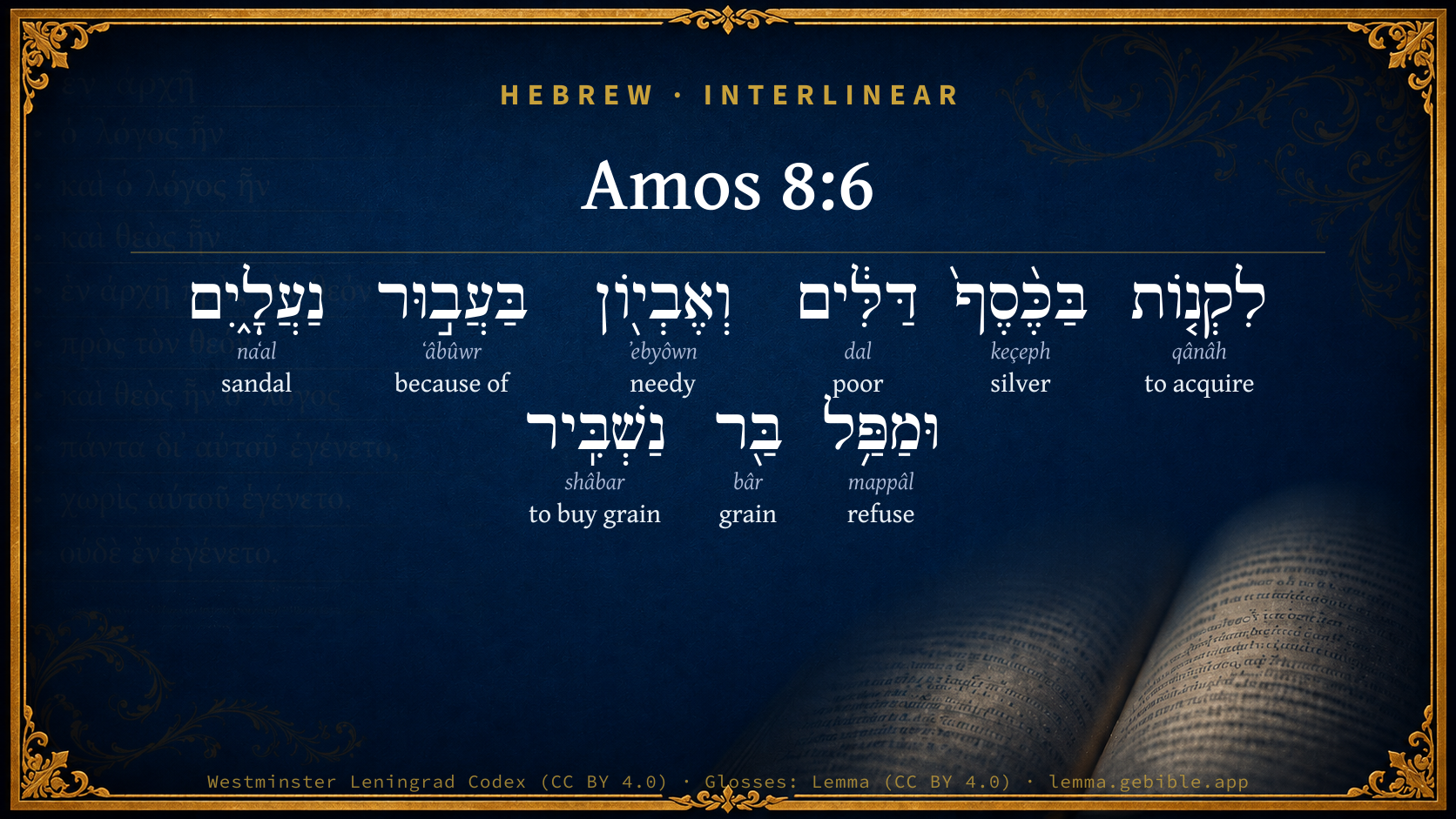
Hebrew (Westminster Leningrad Codex) Amos 8:6 appears in the Hebrew Old Testament. The text above is from the Westminster Leningrad Codex. Each word links to its Strong’s number, a concise gloss, and parsing drawn from the Open Scriptures Hebrew Bible morphology. Click any word for its full Brown-Driver-Briggs (BDB) entry.
Download image
Cite this verse

Amos 8:6 (World English Bible). Public Domain. Lemma interlinear Bible study tool, https://lemma.gebible.app/v/amos/8/6.

Show BibTeX & RIS
BibTeX
RIS
English Translation
That we may buy the poor for silver, And the needy for a pair of shoes, And sell the sweepings with the wheat?'"
World English Bible · Public Domain
Download a study sheet

One document with this verse’s original text, its word-by-word gloss line, the meaning frame, cross-references with their text, attributed commentary, and full source and license credits — printable, and it pastes into notes with its structure intact.

This verse Autodidact and up

Study sheet (.html) Plain text (.txt)

A passage Seminary Student

Up to 50 verses in one chapter. A passage sheet keeps up to 6 commentary sources and 12 cross-references per verse, in the order this page ranks them, and says so on the sheet whenever that leaves anything out. Ask for a single verse and you get the Autodidact verse sheet above.

Everything on this page stays free to read, with no account — the sheet is a download of what is already on screen, not access to it.

Want to remove ads? Support Godless Engineer
Compare translations 3

The same verse in 3 English versions, stacked beneath the original-language interlinear above. Click any original word for its lexicon entry.

Each is an independent rendering of the whole verse — the interlinear is not word-aligned to these translations.

Highlighted words mark where these versions differ — a whole-verse word diff, not a word-by-word alignment.

  • World English Bible Public Domain
    That we may buy the poor for silver, And the needy for a pair of shoes, And sell the sweepings with the wheat?'"
  • King James Version Public Domain
    That we may buy the poor for silver, and the needy for a pair of shoes; yea, and sell the refuse of the wheat?
  • unfoldingWord Literal Text CC BY-SA 4.0
    This is so we can sell bad wheat, buy the poor with silver, and the needy for a pair of sandals.”

unfoldingWord Literal Text — © unfoldingWord, licensed CC BY-SA 4.0. Word-aligned USFM3 via Door43 (git.door43.org/unfoldingWord/en_ult).

Versions to compare (up to 4)

3 of 4 selected

Show all 18 translations

Every available English version of this verse, each an independent rendering of the whole verse.

  • World English Bible Public Domain
    That we may buy the poor for silver, And the needy for a pair of shoes, And sell the sweepings with the wheat?'"
  • Berean Standard Bible Public Domain
    Let us buy the poor with silver and the needy for a pair of sandals, selling even the chaff with the wheat!”
  • Majority Standard Bible Public Domain
    Let us buy the poor with silver and the needy for a pair of sandals, selling even the chaff with the wheat!”
  • King James Version Public Domain
    That we may buy the poor for silver, and the needy for a pair of shoes; yea, and sell the refuse of the wheat?
  • American Standard Version (1901) Public Domain
    that we may buy the poor for silver, and the needy for a pair of shoes, and sell the refuse of the wheat?
  • Revised Version (1885) Public Domain
    that we may buy the poor for silver, and the needy for a pair of shoes, and sell the refuse of the wheat.
  • Geneva Bible (1599) Public Domain
    That we may buy the poore for siluer, and the needie for shooes: yea, and sell the refuse of the wheate.
  • Douay-Rheims (1899) Public Domain
    That we may possess the needy for money, and the poor for a pair of shoes, and may sell the refuse of the corn?
  • Young's Literal Translation Public Domain
    To purchase with money the poor, And the needy for a pair of sandals, Yea, the refuse of the pure corn we sell.
  • Literal Standard Version CC BY-SA 4.0
    To purchase the poor with money, || And the needy for a pair of sandals, || Indeed, the refuse of the pure grain we sell.”
  • Unlocked Literal Bible CC BY-SA 4.0
    This is so we can sell bad wheat, buy the poor with silver, and the needy for a pair of sandals.”
  • unfoldingWord Literal Text CC BY-SA 4.0
    This is so we can sell bad wheat, buy the poor with silver, and the needy for a pair of sandals.”
  • Darby Bible Public Domain
    that we may buy the poor for silver, and the needy for a pair of shoes; and that we may sell the refuse of the wheat.
  • World Messianic Bible Public Domain
    that we may buy the poor for silver, and the needy for a pair of sandals, and sell the sweepings with the wheat?’”
  • Webster's Bible Public Domain
    That we may buy the poor for silver, and the needy for a pair of shoes; and even sell the refuse of the wheat?
  • Free Bible Version CC BY-SA 4.0
    You buy the poor for silver, the needy for a pair of sandals, and you sell grain mixed with chaff.
  • Bible in Basic English Public Domain
    Getting the poor for silver, and him who is in need for the price of two shoes, and taking a price for the waste parts of the grain.
  • JPS Tanakh (1917) Public Domain
    That we may buy the poor for silver, and the needy for a pair of shoes, and sell the refuse of the corn?'

Literal Standard Version (2020), Covenant Press — licensed CC BY-SA 4.0. Text via the HelloAO Bible API (eBible.org). Unlocked Literal Bible (unfoldingWord) — licensed CC BY-SA 4.0. Text via the HelloAO Bible API (eBible.org). unfoldingWord Literal Text — © unfoldingWord, licensed CC BY-SA 4.0. Word-aligned USFM3 via Door43 (git.door43.org/unfoldingWord/en_ult). Free Bible Version, Dr. Jonathan Gallagher — licensed CC BY-SA 4.0. Text via the HelloAO Bible API (eBible.org).

Word by word

More ways to search: Search by grammar → Find every occurrence → Compare this word →

Practice this passage: Drill this verse → Learn its vocabulary →

וּמַפַּ֥ל
mappâl
H4651
“and · refuse of”
Conjunction + Noun, Common, Masculine, Singular, Construct
Part of Speech
Conjunction + Noun
Type
Common
Gender
Masculine
Number
Singular
State
Construct
Full BDB Definition

Origin: from H5307

TWOT: 1392b

refuse, hanging parts - fallings, refuse - hanging parts (of a crocodile)
  1. לִקְנ֤וֹת qânâh H7069 “to acquire” Preposition + Verb, Qal, Infinitive Construct
  2. בַּכֶּ֨סֶף֙ keçeph H3701 “in/at the · silver” Preposition, Determined + Noun, Common, Masculine, Singular, Absolute
  3. דַּלִּ֔ים dal H1800 “poor” Adjective, Adjective, Masculine, Plural, Absolute
  4. וְאֶבְי֖וֹן ʼebyôwn H34 “and · needy” Conjunction + Adjective, Adjective, Masculine, Singular, Absolute
  5. בַּעֲב֣וּר ʻâbûwr H5668 “in/at · because of of” Preposition + Noun, Common, Masculine, Singular, Construct
  6. נַעֲלָ֑יִם naʻal H5275 “sandals” Noun, Common, Feminine, Dual, Absolute
  7. בַּ֖ר bâr H1250 “grain” Noun, Common, Masculine, Singular, Absolute
  8. נַשְׁבִּֽיר shâbar H7666 “to buy grain” Verb, Hiphil, Imperfect, 1st Person, Common, Plural

About this verse

These counts appear in no published source. They are computed here, from the morphology-tagged text and Lemma’s own curated glosses. What Lemma adds →

9
words
9
distinct lemmas
Prophets
section

Notable vocabulary

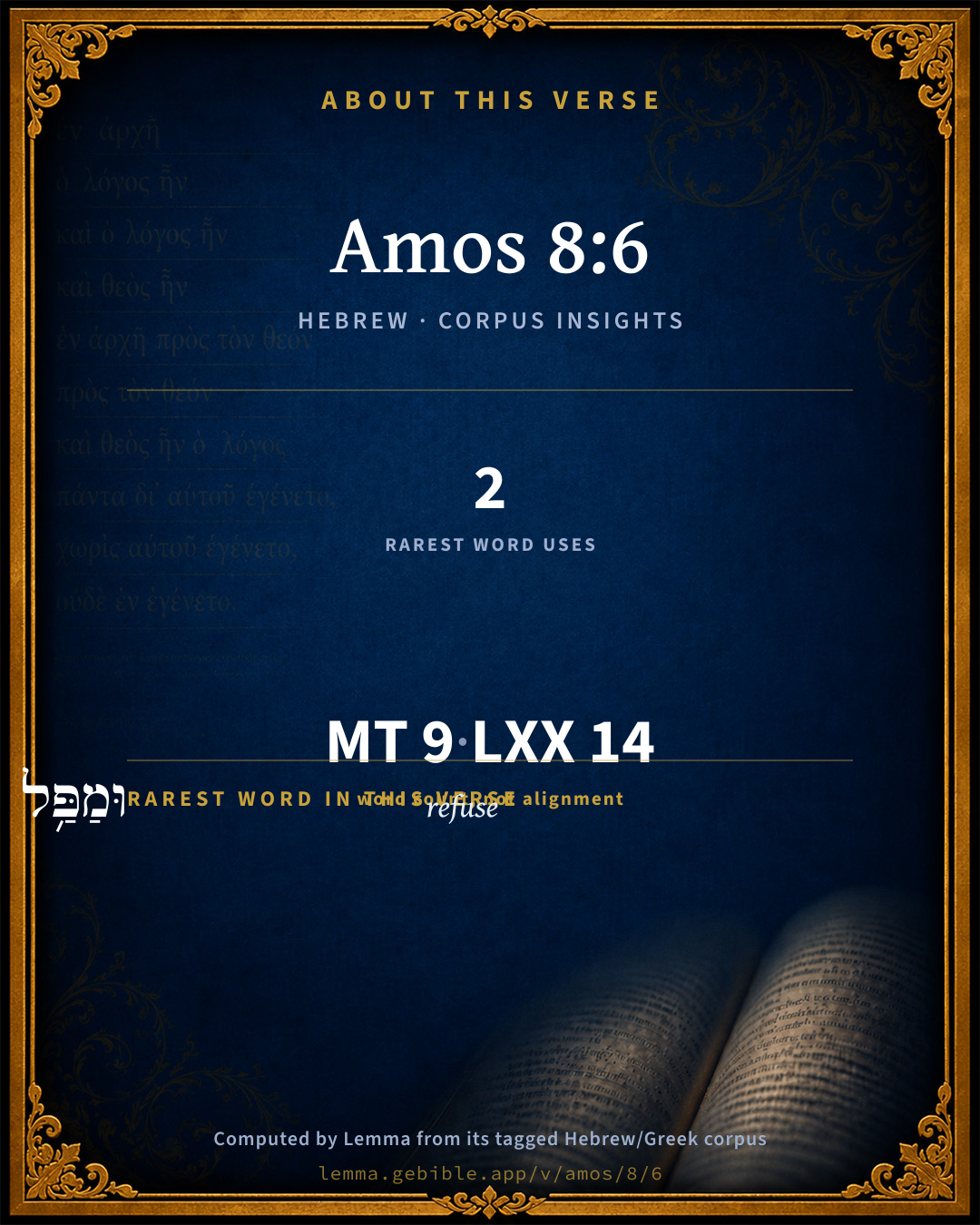
The rarest word here is וּמַפַּ֥ל refuse H4651 — appearing just 2 times in the whole Hebrew Bible.

Shared distinctive vocabulary

וּמַפַּ֥ל refuse H4651 occurs in 2 verses of the Hebrew Bible. Also found in:

Grammatical profile

  • 2 verbs
  • 5 nouns
  • 2 adjectives

Verb forms

  • לִקְנ֤וֹת Qal · Infinitive Construct
  • נַשְׁבִּֽיר Hiphil · Imperfect

Hebrew & Septuagint length

In English translation the verse runs 23 words from the Hebrew and 22 from the Septuagint (LXX English) — closely comparable.

A rough comparison of the two English renderings, which tokenize alike — not a word-level alignment.

Word counts can differ between the Hebrew and the Greek without any difference in meaning — e.g. the Hebrew direct-object marker אֵת has no separate Greek word, and Greek often adds the article ὁ.

In the original languages it is 9 Hebrew tokens and 14 Greek tokens — but the two are counted differently (Hebrew bundles its prefixes and suffixes into one token; the Greek is in lemma form), so that isn’t a like-for-like length.

Cross-references

7

Topical passages linked to Amos 8:6 in the Treasury of Scripture Knowledge — connected by theme and wording, ordered by reader-vote popularity; previews shown in the World English Bible.

  • Amos 2:6 Thus says Yahweh: "For three transgressions of Israel, yes, for four, I will not turn away its punishment; Because they have sold the righteous for silver, And the needy for a pair of shoes;
  • Leviticus 25:39–42 "'If your brother has grown poor among you, and sells himself to you; you shall not make him to serve as a slave.
  • Nehemiah 5:1–5 Then there arose a great cry of the people and of their wives against their brothers the Jews.
  • Nehemiah 5:8 I said to them, We after our ability have redeemed our brothers the Jews, that were sold to the nations; and would you even sell your brothers, and should they be sold to us? Then held they their peace, and found never a word.
  • Joel 3:3 And have cast lots for my people, And have given a boy for a prostitute, And sold a girl for wine, that they may drink.
  • Joel 3:6 And have sold the children of Judah and the children of Jerusalem to the sons of the Greeks, That you may remove them far from their border.
  • Amos 8:4 Hear this, you who desire to swallow up the needy, And cause the poor of the land to fail,

Cross-references courtesy of OpenBible.info (CC BY 4.0).

Hebrew and Greek witnesses Masoretic Hebrew ↔ Greek Septuagint

The same verse in the two great witnesses to the Old Testament, shown verse-for-verse.

These are two independent witnesses, not word-aligned to each other, and the Septuagint is shown in lemma (dictionary) form.

Hebrew Amos 8:6 Masoretic · Westminster Leningrad Codex

לִקְנ֤וֹת בַּכֶּ֨סֶף֙ דַּלִּ֔ים וְאֶבְי֖וֹן בַּעֲב֣וּר נַעֲלָ֑יִם וּמַפַּ֥ל בַּ֖ר נַשְׁבִּֽיר

That we may buy the poor for silver, And the needy for a pair of shoes, And sell the sweepings with the wheat?'"

World English Bible · Public Domain

Greek LXX Amos 8:6 Septuagint · lemma form

ὁ κτάομαι ἐν ἀργύριον πτωχός καί ταπεινός ἀντί ὑπόδημα καί ἀπό πᾶς γένημα ἐνπορεύομαι

That we may buy the poor for silver, and the needy for shoes; and we will trade in every kind of fruit.

LXX2012 (modern English Septuagint) · Public Domain

On this verse, The Pulpit Commentary discusses the Septuagint’s reading. Read the note in Commentary ↓

Hebrew: Westminster Leningrad Codex (CC BY 4.0). Greek: Septuagint (public domain); English from LXX2012 (modern English Septuagint) (Public Domain). How the Septuagint differs from the Hebrew →

Targum (Aramaic paraphrase)

1

The Targum is the ancient Jewish Aramaic paraphrase of the Hebrew Scriptures — an interpretive translation, not the Hebrew text itself. Onkelos (literal) and Pseudo-Jonathan (expansive) render the Torah, and Jonathan the Prophets. Coverage is partial: where no permissively-licensed English translation exists for a verse, only the Aramaic is shown. This is verse-level text, not a word-by-word alignment to the Hebrew.

  1. Targum Jonathan Prophets (Joshua–Malachi)
    לְמִקְנֵי בְּכַסְפָּא מִסְכְּנַיָא חֲשִׁיכַיָא בְּדִיל דְיַחְסְנוּן וּמֵהַמְמַת עִבּוּרָא נְזַבֵּן:

    (no public-domain English translation for this verse)

    Targum Jonathan — Aramaic: “Mikraot Gedolot” (public domain). English: “Sefaria Community Translation” (CC0 1.0 (public-domain dedication)); “London "Chaldee Paraphrase," 1871” (public domain). Text via Sefaria.

Commentary

Notes on Amos 8:6 from classic Christian and Jewish commentators (each source and its license shown beneath its notes). The classic Christian expositions comment on the surrounding passage and are grouped to its opening verse, so a note may address several verses; the Jewish commentaries on the Tanakh (Rashi and others) are per-verse, so they appear only where the commentator wrote on this verse.

Lemma curates 59 commentaries, every one of them public domain or Creative Commons licensed, each selected and text-cleaned for this edition rather than reprinted as found. About our sources →

Trapp's Complete Commentary

John Trapp

Amo 8:6 That we may buy the poor for silver, and the needy for a pair of shoes; [yea], and sell the refuse of the wheat?

Ver. 6. That we may buy the poor for silver, &c.] Thus the poor always pay for it; the modest and mild poor especially, as Amo 8:4. Hence poor and afflicted are put for one and the same, Zep 3:12, and to want and to be abased, Php 4:12; they that want shall be sure to be abased and abused by the wretched rich, who will ever go over the hedge where it is lowest, and catch the poor by drawing him into the nets, Psa 10:9, that is, into their debts, bonds, and mortgages, and at length making such their bondmen by abuse of that permission, Lev 25:39. See Amo 2:3.

Yea, and sell the refuse of the wheat?] Quisqnilias, the husks, more fit for pigs or poultry; hardly man’s meat, and yet held good enough for the poor ( deciduum, purgamenta, the offal); although their flesh was as the flesh of their brethren, and their children as their children, Neh 5:5, however they used them. How far were these rich wretches from considering the poor, as David’s blessed man, Psa 41:1, and as Dr Taylor the martyr did, whose custom was once in a fortnight at least to go to poor men’s houses, look into their cupboards, see how they fared, and what they lacked, that he might either make or procure them a supply from such as were better able.

John Trapp, A Commentary or Exposition upon All the Books of the Old and New Testament (1647–1656) — public domain. Text from a community e-Sword module.

Jamieson, Fausset & Brown

Robert Jamieson, A. R. Fausset & David Brown

buy . . . poor for silver . . . pair of shoes--that is, that we may compel the needy for money, or any other thing of however little worth, to sell themselves to us as bondmen, in defiance of Lev 25:39; the very thing which brings down God's judgment (Amo 2:6).

sell the refuse of . . . wheat--which contains no nutriment, but which the poor eat at a low price, being unable to pay for flour.

Jamieson, Fausset & Brown — Commentary Critical and Explanatory on the Whole Bible (1871) — public domain (CC PDM 1.0). Text via the HelloAO Bible API.

Adam Clarke's Commentary

Verse 6. That we may buy the poor for silver] Buying their services for such a time, with just money enough to clear them from other creditors.

And the needy for a pair of shoes] See Am 2:6.

And sell the refuse of the wheat!] Selling bad wheat and damaged flour to poor people as good, knowing that such cannot afford to prosecute them.

Adam Clarke's Commentary on the Bible (1810–1826) — public domain. Text from a community e-Sword/MySword module.

John Calvin's Commentaries

Here still he speaks of the avarice of the rich, who in time of scarcity held the poor subject to themselves and reduced them to slavery. He had spoken before of the Sabbaths, and he had spoken of deceitful balances; he now adds another kind of fraud, — that by selling the refuse of wheat, they bought for themselves the poor. We indeed know what is the influence of poverty and pressing want, when men are oppressed with famine; they would rather a hundred times sell their life, than not to rescue themselves even by an invaluable price: for what else is food but the support of life? Men therefore will ever value their life more than all other things. Hence the Prophet condemns this iniquity — that the rich gaped for such an opportunity. They saw that corn was high in price; “Now is the time for the poor to come into our possession, for we hold them as though they were ensnared; so then we can buy them for a pair of shoes.” But the other circumstance increases this iniquity, — that they sold the refuse of the wheat; and when they reduced to bondage the poor, they did not feed them; they mingled filth and offscourings with the wheat, as it is wont to be done; for we know that such robbers usually do this, when want presses upon the common people; they sell barley for wheat, and for barley they sell chaff and refuse. This kind of wrong is not new or unusual, as we learn from this passage. Now follows a denunciation of punishment —

John Calvin's Commentaries (1540-1563) — public domain. Text from the Calvin Translation Society English edition (1840s-50s) via the Christian Classics Ethereal Library (ccel.org). Calvin's coverage is partial (roughly two-thirds of the Bible); uncommented books and verses are honest gaps, never fabricated. The 19th-century editor's footnotes and remarks are omitted so the notes are faithfully Calvin's own voice.

Ellicott's Commentary for English Readers

(6) On this perverse straining of the Law, comp. Amo_2:6. Their money-making propensity was carried to such unscrupulous lengths, that they even sold the refuse of corn, little better than mere chaff.

A Bible Commentary for English Readers, edited by Charles John Ellicott (1878–1897) — public domain. Text from a community e-Sword module.

The Cambridge Bible for Schools and Colleges

gen. ed. J. J. S. Perowne

6. The final issue of the rapacious conduct described in Amo_8:5 is that the poor are more and more impoverished, and, falling into debt, have in the end to sell themselves—or their children—as slaves (Lev_25:39) to their rich oppressors, who were only too ready to buy the poor for the silver which they owed them, and the needy for the sake of a pair of sandals, i.e. for a trifle (cf. Amo_2:6), the price of which they were unable to pay.

and sell the refuse of wheat] The final proof of their avarice: they sold what would ordinarily be thrown away, viz. the refuse—lit. the fallings—of the wheat, i.e. “what fell through the sieve, either the bran or the thin, unfilled, grains, which had no meal in them. This they mixed up largely with the meal, making a gain of that which they had once sifted out as worthless; or else, in a time of dearth, they sold to men what was the food of animals, and made a profit on it” (Pusey).

The Cambridge Bible for Schools and Colleges (gen. ed. J. J. S. Perowne; Cambridge University Press, 1878–1918) — public domain. Text from a community e-Sword module.

John Gill's Exposition

That we may buy the poor for silver,.... Thus making them pay dear for their provisions, and using them in this fraudulent manner, by which they would not be able to support themselves and their families; they might purchase them and theirs for slaves, at so small a price as a piece of silver, or a single shekel, worth about half a crown; and this was their end and design in using them after this manner; see Lev 25:39;

and the needy for a pair of shoes; See Gill on Amo 2:6;

yea, and sell the refuse of the wheat; not only did they sell the poor grain and wheat at a dear rate, and in scanty measure, but the worst of it, and such as was not fit to make bread of, only to be given to the cattle; and, by reducing the poor to extreme poverty, they obliged them to take that of them at their own price. It may be rendered, "the fall of wheat" (c); that which fell under the sieve, when the wheat was sifted, as Aben Ezra, Kimchi, and Ben Melech, observe.

(c) "labile frumenti", Montanus; "decidum frumenti", Cocceius; "deciduum triciti", Drusius, Mercerus, Stockius, p. 690.

John Gill's Exposition of the Whole Bible (1746–1763) — public domain (CC PDM 1.0). Text via the HelloAO Bible API.

Albert Barnes' Notes on the Bible

That we may buy - Or, indignantly, “To buy the poor!” literally, “the afflicted,” those in “low” estate. First, by dishonesty and oppression they gained their lands and goods. Then the poor were obliged to sell themselves. The slight price, for which a man was sold, showed the more contempt for “the image of God.” Before, he said, “the needy” were “sold for a pair of sandals” Amo 2:6; here, that they were bought for them. It seems then the more likely that such was a real price for man.

And sell the refuse - Literally, the “falling of wheat,” that is, what fell through the sieve, either the bran, or the thin, unfilled, grains which had no meal in them. This they mixed up largely with the meal, making a gain of that which they had once sifted out as worthless; or else, in a time of dearth, they sold to people what was the food of animals, and made a profit on it. Infancy and inexperience of cupidity, which adulterated its bread only with bran, or sold to the poor only what, although unnourishing, was wholesome! But then, with the multiplied hard-dealing, what manifoldness of the woe!

Albert Barnes' Notes on the Bible (1834–1885) — public domain. Text from a community e-Sword/MySword module.

Haydock's Catholic Bible Commentary

Shoes, for almost nothing. Thus they forced the poor to serve, or to sell their effects.

George Leo Haydock (1774–1849), Haydock's Catholic Family Bible and Commentary, 1859 edition — public domain. Excludes Psalms (Douay-Rheims chapter numbering differs from Protestant) and Deuterocanonical books (Catholic canon only).

Matthew Poole's English Annotations

That we may-buy the poor: either it speaks the aim of these men in oppressing the poor thus, that they might at last buy their persons for servants and drudges, or else it speaks the reason why they would have new moons and sabbaths over, that they might to market to buy the poor.

For silver, i.e. a little silver, at under value, as Amo 2:6.

The needy for a pair of shoes: this explains the former, and shows us that these cruel oppressors lay in wait for the needy to buy them for a very trifle; when these poor owed but for a very little and cheap commodity, as suppose a pair of shoes, these merciless men would take the advantage against them. and make them sell themselves to pay the debt. All which practices are most directly against the law of God.

Sell the refuse; that which is fitter for hogs to month, or for horses to eat, the poor must either buy at dear rate or starve; and this another kind of oppression, corrupted wares at excessive rates, sold to those that were necessitous.

Matthew Poole's English Annotations on the Holy Bible (1683–1685) — public domain. Text from a community e-Sword/MySword module.

The Pulpit Commentary

Buy the poor for silver. (comp. Amo_2:6) The probable meaning is that they so reduced the poor marl by their exactions and injustice, that he was compelled to pay his debt by selling himself into slavery (Lev_25:39; Deu_15:12) For a pair of shoes. For the smallest debt they would deal in this harsh manner. The refuse; literally, that which fell through the sieve; Septuagint, jApo pantomatov ejmporeusomeqa, "We will trade in every kind of produce;" Vulgate, Quisquilias frumenti vendamus, "Let us sell the refuse of corn."

The Pulpit Commentary (1880–1919), ed. H.D.M. Spence-Jones & Joseph S. Exell — public domain. Text from a community e-Sword module.

John Wesley's Explanatory Notes

That we may buy - They would have new moons and sabbaths over, that they might go to market to buy the poor. And when these poor owed but for a very little commodity, as suppose a pair of shoes, these merciless men would take the advantage against them, and make them sell themselves to pay the debt. The refuse - This was another kind of oppression, corrupted wares, sold to those that were necessitous.

John Wesley, Explanatory Notes Upon the Whole Bible (1754–1765) — public domain. Text via the GEBible commentary corpus.

Rashi

Rabbi Shlomo Yitzchaki (Rashi)

in order to inherit them Heb. בַּעֲבוּר נַעֲלָיִם. [from Jonathan]

and the refuse of the corn we will sell—[Jonathan renders:] And the sweepings of the grains we will sell. The refuse that fell from the wheat into the sieve, to sell at high prices to the poor.

Rashi on the Tanakh — English translations: “The Judaica Press complete Tanach with Rashi, translated by A. J. Rosenberg” (CC BY 4.0); “Pentateuch with Rashi's commentary by M. Rosenbaum and A.M. Silbermann, 1929-1934” (public domain); “The Metsudah Tanach series, Lakewood, N.J” (CC BY 4.0); and “The Book of Joshua, Metsudah Publications, 1997” (CC BY 4.0). Text via Sefaria.

Lesson kit

Teaching starters — assembled from the data on this page, not authored interpretation. Every prompt links to the verse data it draws on. Edit before teaching.

Amos, in the Prophets, opens this verse with 9 words (9 distinct Hebrew lemmas). Its most distinctive word is mappâl (“refuse”). A historical commentator’s framing appears above. Read the whole chapter for the surrounding context.

Discussion questions

  1. The word mappâl carries the sense “refuse.” How does it shape the verse?
  2. Job 41:23 shares the word «refuse» with this verse. How do the two illuminate each other?
  3. These translations render this verse differently. What is at stake in choosing one wording over another?
  4. The verb «לִקְנ֤וֹת» is Qal Infinitive Construct. How does its form color the action?
  5. Reading how Trapp's Complete Commentary and Jamieson, Fausset & Brown read this verse, where do the two commentators agree and where do they part?

Things to notice

Reading settings

Reading text

Shown beneath each verse's original-language words.

Old Testament
Old Testament edition

Read the OT as the Masoretic Hebrew (MT) or the Greek Septuagint (LXX).

English shown for the Greek Septuagint (in the Hebrew ↔ Greek comparison).

Comparing translations? Open the Compare panel on any verse page to stack up to four side by side.