Ezekiel 6:4

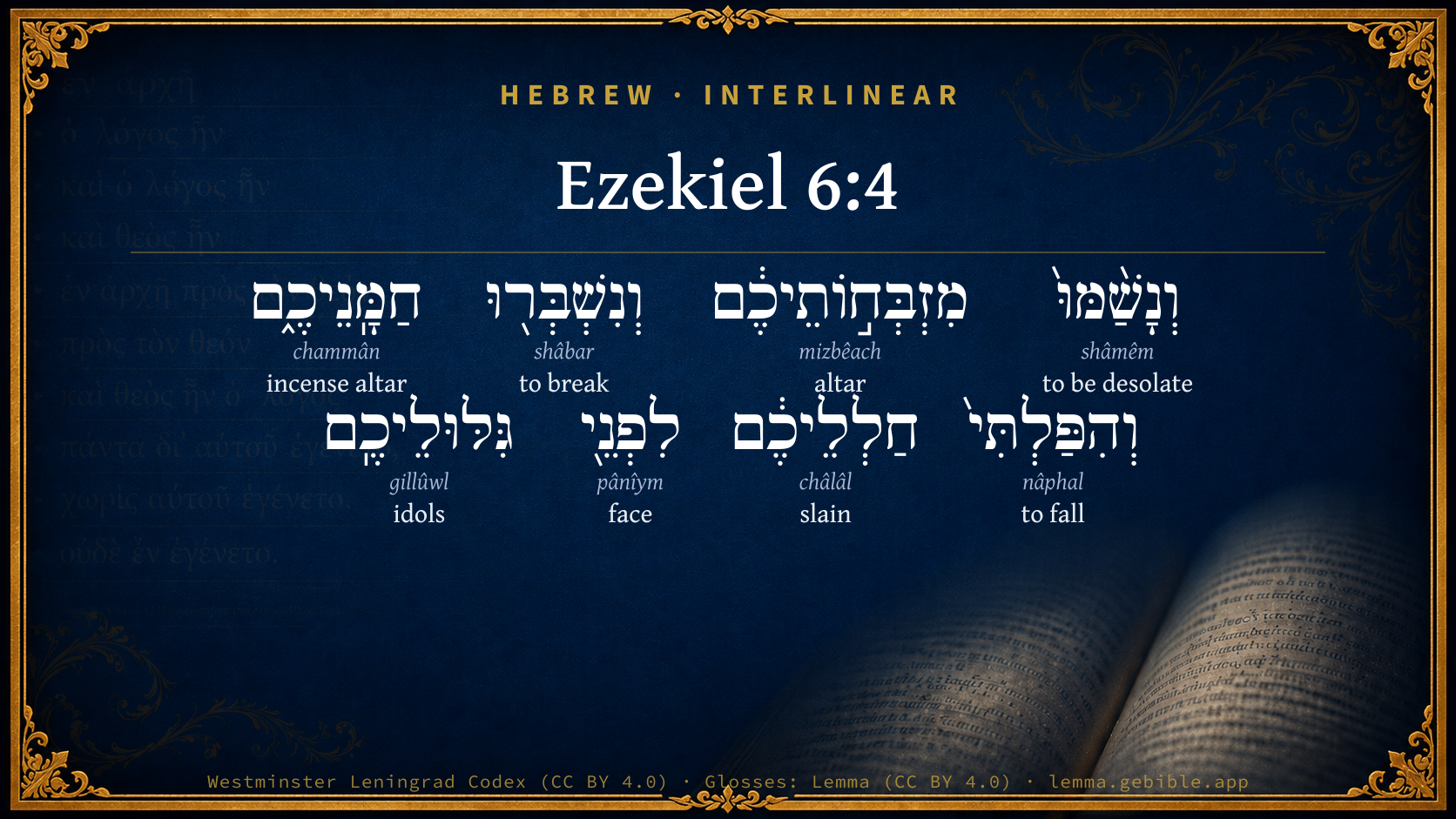
Hebrew (Westminster Leningrad Codex) Ezekiel 6:4 appears in the Hebrew Old Testament. The text above is from the Westminster Leningrad Codex. Each word links to its Strong’s number, a concise gloss, and parsing drawn from the Open Scriptures Hebrew Bible morphology. Click any word for its full Brown-Driver-Briggs (BDB) entry.
Download image
Cite this verse

Ezekiel 6:4 (World English Bible). Public Domain. Lemma interlinear Bible study tool, https://lemma.gebible.app/v/ezekiel/6/4.

Show BibTeX & RIS
BibTeX
RIS
English Translation
Your altars shall become desolate, and your sun-images shall be broken; and I will cast down your slain men before your idols.
World English Bible · Public Domain
Download a study sheet

One document with this verse’s original text, its word-by-word gloss line, the meaning frame, cross-references with their text, attributed commentary, and full source and license credits — printable, and it pastes into notes with its structure intact.

This verse Autodidact and up

Study sheet (.html) Plain text (.txt)

A passage Seminary Student

Up to 50 verses in one chapter. A passage sheet keeps up to 6 commentary sources and 12 cross-references per verse, in the order this page ranks them, and says so on the sheet whenever that leaves anything out. Ask for a single verse and you get the Autodidact verse sheet above.

Everything on this page stays free to read, with no account — the sheet is a download of what is already on screen, not access to it.

Want to remove ads? Support Godless Engineer
Compare translations 3

The same verse in 3 English versions, stacked beneath the original-language interlinear above. Click any original word for its lexicon entry.

Each is an independent rendering of the whole verse — the interlinear is not word-aligned to these translations.

Highlighted words mark where these versions differ — a whole-verse word diff, not a word-by-word alignment.

  • World English Bible Public Domain
    Your altars shall become desolate, and your sun-images shall be broken; and I will cast down your slain men before your idols.
  • King James Version Public Domain
    And your altars shall be desolate, and your images shall be broken: and I will cast down your slain men before your idols.
  • unfoldingWord Literal Text CC BY-SA 4.0
    Then your altars will become desolate and your pillars will be destroyed, and I will throw down your dead in front of their idols.

unfoldingWord Literal Text — © unfoldingWord, licensed CC BY-SA 4.0. Word-aligned USFM3 via Door43 (git.door43.org/unfoldingWord/en_ult).

Versions to compare (up to 4)

3 of 4 selected

Show all 18 translations

Every available English version of this verse, each an independent rendering of the whole verse.

  • World English Bible Public Domain
    Your altars shall become desolate, and your sun-images shall be broken; and I will cast down your slain men before your idols.
  • Berean Standard Bible Public Domain
    Your altars will be demolished and your incense altars will be smashed; and I will cast down your slain before your idols.
  • Majority Standard Bible Public Domain
    Your altars will be demolished and your incense altars will be smashed; and I will cast down your slain before your idols.
  • King James Version Public Domain
    And your altars shall be desolate, and your images shall be broken: and I will cast down your slain men before your idols.
  • American Standard Version (1901) Public Domain
    And your altars shall become desolate, and your sun-images shall be broken; and I will cast down your slain men before your idols.
  • Revised Version (1885) Public Domain
    your altars shall become desolate, and your sun-images shall be broken: and I will cast down your slain men before your idols.
  • Geneva Bible (1599) Public Domain
    And your altars shalbe desolate, and your images of the sunne shalbe broken: and I will cast downe your slaine men before your idoles.
  • Douay-Rheims (1899) Public Domain
    And I will throw down your altars, and your idols shall be broken in pieces: and I will cast down your slain before your idols.
  • Young's Literal Translation Public Domain
    And desolated have been your altars, And broken your images, And I have caused your wounded to fall before your idols,
  • Literal Standard Version CC BY-SA 4.0
    And your altars have been desolated, || And your images have been broken, || And I have caused your wounded to fall before your idols,
  • Unlocked Literal Bible CC BY-SA 4.0
    Then your altars will become desolate and your pillars will be destroyed, and I will throw down your dead in front of their idols.
  • unfoldingWord Literal Text CC BY-SA 4.0
    Then your altars will become desolate and your pillars will be destroyed, and I will throw down your dead in front of their idols.
  • Darby Bible Public Domain
    And your altars shall be desolate, and your sun-images shall be broken; and I will cast down your slain [men] before your idols;
  • World Messianic Bible Public Domain
    Your altars will become desolate, and your incense altars will be broken. I will cast down your slain men before your idols.
  • Webster's Bible Public Domain
    And your altars shall be desolate, and your images shall be broken: and I will cast down your slain men before your idols.
  • Free Bible Version CC BY-SA 4.0
    Your pagan altars will be torn down, and your incense altars will be smashed to pieces. I will kill your idol worshipers right in front of their idols.
  • Bible in Basic English Public Domain
    And your altars will be made waste, and your sun-images will be broken: and I will have your dead men placed before your images.
  • JPS Tanakh (1917) Public Domain
    And your altars shall become desolate, and your sun-images shall be broken; and I will cast down your slain men before your idols.

Literal Standard Version (2020), Covenant Press — licensed CC BY-SA 4.0. Text via the HelloAO Bible API (eBible.org). Unlocked Literal Bible (unfoldingWord) — licensed CC BY-SA 4.0. Text via the HelloAO Bible API (eBible.org). unfoldingWord Literal Text — © unfoldingWord, licensed CC BY-SA 4.0. Word-aligned USFM3 via Door43 (git.door43.org/unfoldingWord/en_ult). Free Bible Version, Dr. Jonathan Gallagher — licensed CC BY-SA 4.0. Text via the HelloAO Bible API (eBible.org).

Word by word

More ways to search: Search by grammar → Find every occurrence → Compare this word →

Practice this passage: Drill this verse → Learn its vocabulary →

חַמָּֽנֵיכֶ֑ם
chammân
H2553
“incense altars · your”
Noun, Common, Masculine, Plural, Construct + Suffix, Personal, 2nd Person, Masculine, Plural
Part of Speech
Noun
Type
Common
Gender
Masculine
Number
Plural
State
Construct
Full BDB Definition

Origin: from H2535

TWOT: TWOT- 677d

incense altar, sun-pillar, idol, image - used in idolatrous worship
  1. וְנָשַׁ֨מּוּ֙ shâmêm H8074 “and · to be desolate” Conjunction + Verb, Niphal, Sequential Perfect, 3rd Person, Common, Plural
  2. מִזְבְּח֣וֹתֵיכֶ֔ם mizbêach H4196 “altars · your” Noun, Common, Masculine, Plural, Construct + Suffix, Personal, 2nd Person, Masculine, Plural
  3. וְנִשְׁבְּר֖וּ shâbar H7665 “and · to break” Conjunction + Verb, Niphal, Sequential Perfect, 3rd Person, Common, Plural
  4. וְהִפַּלְתִּי֙ nâphal H5307 “and · to fall” Conjunction + Verb, Hiphil, Sequential Perfect, 1st Person, Common, Singular
  5. חַלְלֵיכֶ֔ם châlâl H2491 “slain · your” Adjective, Adjective, Masculine, Plural, Construct + Suffix, Personal, 2nd Person, Masculine, Plural
  6. לִפְנֵ֖י pânîym H6440 “to/for · face(s) of” Preposition + Noun, Common, Both, Plural, Construct
  7. גִּלּוּלֵיכֶֽם gillûwl H1544 “idols · your” Noun, Common, Masculine, Plural, Construct + Suffix, Personal, 2nd Person, Masculine, Plural

About this verse

These counts appear in no published source. They are computed here, from the morphology-tagged text and Lemma’s own curated glosses. What Lemma adds →

8
words
8
distinct lemmas
Prophets
section

Notable vocabulary

The rarest word here is חַמָּֽנֵיכֶ֑ם incense altar H2553 — appearing just 8 times in the whole Hebrew Bible.

Shared distinctive vocabulary

חַמָּֽנֵיכֶ֑ם incense altar H2553 occurs in 8 verses of the Hebrew Bible. Also found in:

Grammatical profile

  • 3 verbs
  • 4 nouns
  • 1 adjective

Verb forms

  • וְנָשַׁ֨מּוּ֙ Niphal · Sequential Perfect
  • וְנִשְׁבְּר֖וּ Niphal · Sequential Perfect
  • וְהִפַּלְתִּי֙ Hiphil · Sequential Perfect

Hebrew & Septuagint length

In English translation the verse runs 22 words from the Hebrew and 23 from the Septuagint (LXX English) — closely comparable.

A rough comparison of the two English renderings, which tokenize alike — not a word-level alignment.

Word counts can differ between the Hebrew and the Greek without any difference in meaning — e.g. the Hebrew direct-object marker אֵת has no separate Greek word, and Greek often adds the article ὁ.

Cross-references

10

Topical passages linked to Ezekiel 6:4 in the Treasury of Scripture Knowledge — connected by theme and wording, ordered by reader-vote popularity; previews shown in the World English Bible.

  • 2 Chronicles 14:5 Also he took away out of all the cities of Judah the high places and the sun-images: and the kingdom was quiet before him.
  • Leviticus 26:30 I will destroy your high places, and cut down your incense altars, and cast your dead bodies upon the bodies of your idols; and my soul will abhor you.
  • 1 Kings 13:2 He cried against the altar by the word of Yahweh, and said, altar, altar, thus says Yahweh: Behold, a son shall be born to the house of David, Josiah by name; and on you shall he sacrifice the priests of the high places who burn incense on you, and men's bones shall they burn on you.
  • 2 Kings 23:14 He broke in pieces the pillars, and cut down the Asherim, and filled their places with the bones of men.
  • 2 Kings 23:16–20 As Josiah turned himself, he spied the tombs that were there in the mountain; and he sent, and took the bones out of the tombs, and burned them on the altar, and defiled it, according to the word of Yahweh which the man of God proclaimed, who proclaimed these things.
  • 2 Chronicles 34:4–5 They broke down the altars of the Baals in his presence; and the sun-images that were on high above them he hewed down; and the Asherim, and the engraved images, and the molten images, he broke in pieces, and made dust of them, and strewed it on the graves [of those] who had sacrificed to them.
  • Jeremiah 8:1–2 At that time, says Yahweh, they shall bring out the bones of the kings of Judah, and the bones of his princes, and the bones of the priests, and the bones of the prophets, and the bones of the inhabitants of Jerusalem, out of their graves;
  • Jeremiah 43:13 He shall also break the pillars of Beth-shemesh, that is in the land of Egypt; and the houses of the gods of Egypt shall he burn with fire.
  • Ezekiel 6:5–6 I will lay the dead bodies of the children of Israel before their idols; and I will scatter your bones round about your altars.
  • Ezekiel 6:13 You shall know that I am Yahweh, when their slain men shall be among their idols round about their altars, on every high hill, on all the tops of the mountains, and under every green tree, and under every thick oak, the places where they offered sweet savor to all their idols.

Cross-references courtesy of OpenBible.info (CC BY 4.0).

Hebrew and Greek witnesses Masoretic Hebrew ↔ Greek Septuagint

The same verse in the two great witnesses to the Old Testament, shown verse-for-verse.

These are two independent witnesses, not word-aligned to each other, and the Septuagint is shown in lemma (dictionary) form.

Hebrew Ezekiel 6:4 Masoretic · Westminster Leningrad Codex

וְנָשַׁ֨מּוּ֙ מִזְבְּח֣וֹתֵיכֶ֔ם וְנִשְׁבְּר֖וּ חַמָּֽנֵיכֶ֑ם וְהִפַּלְתִּי֙ חַלְלֵיכֶ֔ם לִפְנֵ֖י גִּלּוּלֵיכֶֽם

Your altars shall become desolate, and your sun-images shall be broken; and I will cast down your slain men before your idols.

World English Bible · Public Domain

Greek LXX Ezekiel 6:4 Septuagint · lemma form

καί συντρίβω ὁ θυσιαστήριον σύ καί ὁ τέμενος σύ καί καταβάλλω τραυματίας σύ ἐνώπιον ὁ εἴδωλον σύ

And your altars shall be broken to pieces, and your consecrated plats; and I will cast down your slain men before your idols.

LXX2012 (modern English Septuagint) · Public Domain

Hebrew: Westminster Leningrad Codex (CC BY 4.0). Greek: Septuagint (public domain); English from LXX2012 (modern English Septuagint) (Public Domain). How the Septuagint differs from the Hebrew →

Targum (Aramaic paraphrase)

1

The Targum is the ancient Jewish Aramaic paraphrase of the Hebrew Scriptures — an interpretive translation, not the Hebrew text itself. Onkelos (literal) and Pseudo-Jonathan (expansive) render the Torah, and Jonathan the Prophets. Coverage is partial: where no permissively-licensed English translation exists for a verse, only the Aramaic is shown. This is verse-level text, not a word-by-word alignment to the Hebrew.

  1. Targum Jonathan Prophets (Joshua–Malachi)
    וְיִצְדוּן אֱגוֹרֵיכוֹן וְיִתְבְּרוּן חֲנִיסְנְסֵיכוֹן וְאַרְמִי קְטִילֵיכוֹן קֳדָם פִּגוּר טַעֲוַתְכוֹן:

    (no public-domain English translation for this verse)

    Targum Jonathan — Aramaic: “Mikraot Gedolot” (public domain). English: “Sefaria Community Translation” (CC0 1.0 (public-domain dedication)); “London "Chaldee Paraphrase," 1871” (public domain). Text via Sefaria.

Commentary

Notes on Ezekiel 6:4 from classic Christian and Jewish commentators (each source and its license shown beneath its notes). The classic Christian expositions comment on the surrounding passage and are grouped to its opening verse, so a note may address several verses; the Jewish commentaries on the Tanakh (Rashi and others) are per-verse, so they appear only where the commentator wrote on this verse.

Lemma curates 59 commentaries, every one of them public domain or Creative Commons licensed, each selected and text-cleaned for this edition rather than reprinted as found. About our sources →

Trapp's Complete Commentary

John Trapp

Eze 6:4 And your altars shall be desolate, and your images shall be broken: and I will cast down your slain [men] before your idols.

Ver. 4. Your images shall be broken down.] Heb., Your sun images, whence also Jupiter Hammon had his name, which Macrobius {a} saith was the same with the sun. See 2Ch 23:5.

And I will cast down your slain men.] Cruentatos vulneratos, vel interfectos vestros; such as when wounded, fly to their idols for safety.

Before your idols.] Heb., Your dii stercorei, dunghill deities, more loathsome than any excrements.

{a} Lib. i. Sat., cap. 23.

John Trapp, A Commentary or Exposition upon All the Books of the Old and New Testament (1647–1656) — public domain. Text from a community e-Sword module.

Tyndale Open Study Notes

Tyndale Open Resources

6:4-7 The corpses and bones of the dead worshipers scattered around an altar would defile the altar and make it unfit for use. • idols: The Hebrew term for idols (literally round things) probably alludes to dung; when used in this way, it is a term of strong derision.

Tyndale Open Study Notes — © Tyndale Open Resources, licensed CC BY-SA 4.0. Text via the HelloAO Bible API.

Geneva Bible (1599)

Geneva Bible translators

Read 2 Kings 23:11.

Geneva Bible (1599) marginal notes — public domain. Text via Bolls.life.

Jamieson, Fausset & Brown

Robert Jamieson, A. R. Fausset & David Brown

images--called so from a Hebrew root, "to wax hot," implying the mad ardor of Israel after idolatry [CALVIN]. Others translate it, "sun images"; and so in Eze 6:6 (see Kg2 23:11; Ch2 34:4; Isa 17:8, Margin).

cast your slain men before your idols--The foolish objects of their trust in the day of evil should witness their ruin.

Jamieson, Fausset & Brown — Commentary Critical and Explanatory on the Whole Bible (1871) — public domain (CC PDM 1.0). Text via the HelloAO Bible API.

Adam Clarke's Commentary

Verse 4. Your images shall be broken] Literally, your sun images; representations of the sun, which they worshipped. See the margin.

Adam Clarke's Commentary on the Bible (1810–1826) — public domain. Text from a community e-Sword/MySword module.

John Calvin's Commentaries

Hence it appears how greatly obedience pleases God, and how true it is that it is better than sacrifices. (1 Samuel 15:22; I Kings 12.) For it is certain that the Israelites extolled their own fictions exorbitantly, as if they were worshipping God correctly In the beginning, indeed, Jeroboam cunningly devised those new rites, that he might alienate the ten tribes from the family of David, and at length the error spread, so that they thought that God approved that impious worship. But we see that God abominates them. We should always hold this principle, that although men think that they obey God when they thrust in their own fictions, yet they produce no other effect than to provoke the wrath of God against them. This vengeance, therefore, had not been taken against altars, unless God had been greatly offended with the impious mixture. Your altars, therefore, shall come to ruin and destruction, and then your idols shall be destroyed. Here some understand the idols of the sun, as the noun is taken from heat, which is afterwards repeated: but this divination seems to be too contracted Hence I do not doubt that the idols are so called on account of the mad love with which the worshippers were seized: for throughout the Prophets they are said to be like adulterers, and our Prophet also uses the same language. Idols therefore may very properly derive their name from heat, because their superstitious worshippers inflame themselves with love, and like adulterers run after harlots, as we shall again see. He afterwards uses another word, when he says, I will lay prostrate your slain before your idols: for they call idols גלולים, gelolim, on account of their foulness, nay even filth. We see then in the first place that the fury with which the Israelites were inflamed is condemned by the Prophet, since they perverted the pure and lawful worship of God: then he reproves their enormity because they willingly remained in filth and defilement. But here also we are taught how mightily God is angry with all superstitions, when he not only cites mankind to his tribunal because they profane true piety, but is angry with external instruments — as stones and wood, and, as it were, involves these instruments of idolatry with their authors. It follows —

John Calvin's Commentaries (1540-1563) — public domain. Text from the Calvin Translation Society English edition (1840s-50s) via the Christian Classics Ethereal Library (ccel.org). Calvin's coverage is partial (roughly two-thirds of the Bible); uncommented books and verses are honest gaps, never fabricated. The 19th-century editor's footnotes and remarks are omitted so the notes are faithfully Calvin's own voice.

Ellicott's Commentary for English Readers

(4) Your images.—The original word indicates, as is shown in the margin, that these were images used in connection with the worship of the sun. The whole verse is taken from Lev_26:30. The same woes were there foretold by Moses in the contingency of the people’s disobedience; that contingency had now come to pass, the promised judgments had already begun, and Ezekiel declares that the fulfilment of them was close at hand.

Your slain men before your idols.—Their idols should be worshipped no longer by the living, but by the prostrate bodies of their dead worshippers. In this and the following verse a kind of poetic justice is described. There was nothing so utterly defiling under the Mosaic law as the touch of a dead body. (See Num_9:6-10; 2Ki_23:14; 2Ki_23:16.) The Israelites had defiled the land with idols, now the idols themselves should be defiled with their dead bodies.

A Bible Commentary for English Readers, edited by Charles John Ellicott (1878–1897) — public domain. Text from a community e-Sword module.

The Cambridge Bible for Schools and Colleges

gen. ed. J. J. S. Perowne

4. your images] As marg., sun-images, i.e. symbols of the sun-god, probably in the shape of a pyramid or obelisk. They stood beside the altars. So again Eze_6:6.

your idols] The term used is an opprobrious or contemptuous epithet, applied to idols, though its precise meaning is doubtful. Most probably it means block-gods; though others connect it with the word dung (ch. Eze_4:12) and render dung-gods, which is less probable. The term occurs in Ez. nearly 40 times, otherwise Lev_26:30; Deu_29:17; Jer_50:2; 1Ki_15:12; 1Ki_21:26; 2Ki_17:12; 2Ki_21:11; 2Ki_21:21; 2Ki_23:24. These idols were probably of Jehovah for the most part.

The Cambridge Bible for Schools and Colleges (gen. ed. J. J. S. Perowne; Cambridge University Press, 1878–1918) — public domain. Text from a community e-Sword module.

John Gill's Exposition

And I will lay the dead carcasses of the children of Israel before their idols,.... Which is repeated for the confirmation of it:

and I will scatter your bones round about your altars: which were reckoned a pollution of them; see Kg2 23:14.

John Gill's Exposition of the Whole Bible (1746–1763) — public domain (CC PDM 1.0). Text via the HelloAO Bible API.

Albert Barnes' Notes on the Bible

Images - See the margin and margin reference, and the Eze 8:16 note.

Idols - The Phoenicians were in the habit of setting up “heaps” or “pillars” of stone in honor of their gods, which renders the use of the word more appropriate.

Albert Barnes' Notes on the Bible (1834–1885) — public domain. Text from a community e-Sword/MySword module.

Haydock's Catholic Bible Commentary

Idols. Protestant marginal note, "sun-images," as [in] ver. 6. The sun was much worshipped, chap. viii. 16. (Haydock)

George Leo Haydock (1774–1849), Haydock's Catholic Family Bible and Commentary, 1859 edition — public domain. Excludes Psalms (Douay-Rheims chapter numbering differs from Protestant) and Deuterocanonical books (Catholic canon only).

Matthew Poole's English Annotations

Your altars; God’s altar was only at Jerusalem, these were their altars.

Desolate; no priest to attend, no sacrifice offered, nor a votary come to them.

Images; statues, and perhaps the particular images made to the sun, as the Hebrew word including heat may signify. Or the open places on the tops of your houses, where you worshipped the sun, 2Ki 23:5; and Isa 27:9, mentions this piece of idolatry.

Broken; either torn down from their places to be carried captives, which was a part of heathen conquerors’ insolence, or torn in pieces in contempt, and to be destroyed.

I will cast down; my hand shall guide the pursuing enemy, who shall slay your men before the altars of those idols they worshipped formerly, and to whom, as senseless as the idols, they flee for refuge, as perhaps Sennacherib did, Isa 37:38.

Matthew Poole's English Annotations on the Holy Bible (1683–1685) — public domain. Text from a community e-Sword/MySword module.

Whedon's Commentary on the Bible

Daniel D. Whedon

4. Images — Sun images, dedicated to Baal (2Ch_34:4). These were usually pillars or obelisks which were set up close to the altar or in front of the temple doors.

Idols — Rather, idol blocks or doll images, possibly dung gods. (See also Eze_6:6; Eze_6:9; Eze_6:13.) This is a favorite term with Ezekiel, and it is the most contemptuous epithet possible. The prophet had the utmost scorn of idols and satirized them without mercy. (See Isa_40:19; Isa_44:9-17.) This word for idols is used in “Ezekiel’s favorite text-books” (Lev_26:30; Deu_29:17).

Daniel D. Whedon (gen. ed.), Commentary on the Old and New Testaments (1874–1909) — public domain. Text from a community e-Sword module.

The Pulpit Commentary

Your images, etc. The "sun images" of the Revised Version shows why these are mentioned as distinct from the "idols." The chammanim were pillars or obelisks identified with the worship of Baal as the sun god, standing on his altars, (2Ch_34:4) coupled with the "groves," or Asherim, (Isa_17:8 Isa_27:9) and with the "high places" in 2Ch_14:5. I will cast down your slain men before your idols. As in the prophecy against Bethel, (1Ki_13:2) and in Josiah"s action, (2Ki 33:16) this was the ne plus ultra of desecration. Where throe had been the sweet savour of incense there should be the sickening odour of the carcases of the slain. The word for "idols" (gillulim), though found elsewhere, notably in Ezekiel"s favourite textbooks (Lev_26:30; Deu_29:17) is more prominent in his writings (where it occurs thirty-six times) then in any other book of the Old Testament, and means, primarily, a cairn or heap of stones, which, like the "sun images," came to be associated with Baal. Ezekiel repeats both words in ver. 6, with all the emphasis of scorn. He predicts the coming of a time when the work of destruction should be done more thoroughly than even Josiah lind done it. When that time came, the familiar formula, "Ye shall know that I am the Lord," should receive yet another fulfilment.

The Pulpit Commentary (1880–1919), ed. H.D.M. Spence-Jones & Joseph S. Exell — public domain. Text from a community e-Sword module.

John Wesley's Explanatory Notes

Cast down - Before the altars of your idols, which you fly to for refuge.

John Wesley, Explanatory Notes Upon the Whole Bible (1754–1765) — public domain. Text via the GEBible commentary corpus.

unfoldingWord translationNotes

Door43 World Missions Community

General Information:

These are Yahweh's words to the people of Israel.

Then your altars will become desolate and your pillars will be destroyed

This can be translated in active form. AT: "People will no longer worship at your altars and your enemy will destroy your pillars" (See: Active or Passive)

I will throw down ... I will lay ... and scatter

Yahweh was speaking of sending soldiers (Ezekiel 6:3) to do these things. AT: "I will send soldiers to throw down ... They will lay ... and scatter" (See: Assumed Knowledge and Implicit Information)

your dead

"your people who have died"

translationWords

altar

desolate

column

false god

unfoldingWord translationNotes — © Distant Shores Media and the Door43 World Missions Community, licensed CC BY-SA 4.0. Source: git.door43.org/Door43/en_tn.

Rashi

Rabbi Shlomo Yitzchaki (Rashi)

your sun gods חַמָּנֵיכֶם, a class of pagan idols made on the roofs [dedicated] to the sun.

Rashi on the Tanakh — English translations: “The Judaica Press complete Tanach with Rashi, translated by A. J. Rosenberg” (CC BY 4.0); “Pentateuch with Rashi's commentary by M. Rosenbaum and A.M. Silbermann, 1929-1934” (public domain); “The Metsudah Tanach series, Lakewood, N.J” (CC BY 4.0); and “The Book of Joshua, Metsudah Publications, 1997” (CC BY 4.0). Text via Sefaria.

Lesson kit

Teaching starters — assembled from the data on this page, not authored interpretation. Every prompt links to the verse data it draws on. Edit before teaching.

Ezekiel, in the Prophets, opens this verse with 8 words (8 distinct Hebrew lemmas). Its most distinctive word is chammân (“incense altar”). A historical commentator’s framing appears above. Read the whole chapter for the surrounding context.

Discussion questions

  1. How does “incense altar” (chammân) shape what this verse is saying?
  2. How does Leviticus 26:30, which shares the word «incense altar», read alongside this verse?
  3. These translations render this verse differently; the difference is in the English rendering, not the original. What questions does that raise?
  4. «וְנָשַׁ֨מּוּ֙» is a Niphal Sequential Perfect verb. How does that grammatical form shape the action described?
  5. Compare how Trapp's Complete Commentary and Tyndale Open Study Notes read this verse. Where do they agree or differ?

Things to notice

Reading settings

Reading text

Shown beneath each verse's original-language words.

Old Testament
Old Testament edition

Read the OT as the Masoretic Hebrew (MT) or the Greek Septuagint (LXX).

English shown for the Greek Septuagint (in the Hebrew ↔ Greek comparison).

Comparing translations? Open the Compare panel on any verse page to stack up to four side by side.