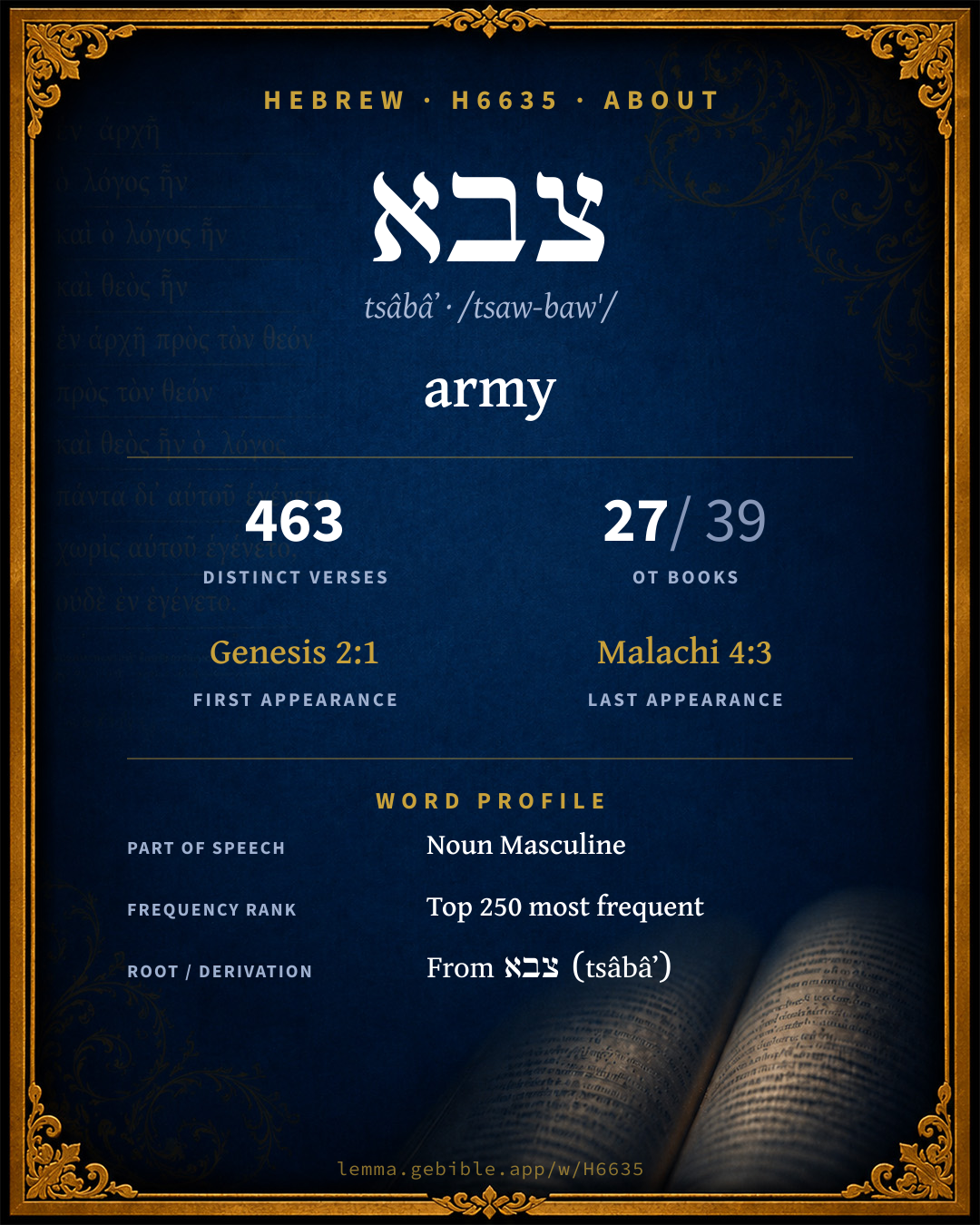
צָבָא
army
also: war, warfare, host fuller range ↓
Full lexicon entry — Brown-Driver-Briggs (BDB)
From Brown-Driver-Briggs (BDB)
Where this word appears
See every Absolute-state word in the Hebrew Bible →
Grammar key — what these labels mean
Part of speech
- Noun
- A naming word — a person, place, thing, or idea.
Noun type
- Common
- A common noun — a general class of person, place, or thing (“king,” “city,” “water”), not a specific name.
State
- Absolute
- The independent form of a noun, not bound to a following word.
- Construct
- A noun bound to a following noun in a possessive / “of” relationship (the construct chain).
Gender
- Both
- Attested as both masculine and feminine.
Number
- Plural
- More than one (in Hebrew, generally three or more).
- Singular
- One.
23 verses where H6635 appears in the Absolute state in the Book of 1 Chronicles. Filtered view — show all forms. Click any verse to open its interlinear word-by-word view. Verse text shown in the World English Bible for context — . Each verse’s Hebrew form is shown with its reference; the English is not keyword-highlighted, since the data carries no word-level English alignment. Use “Compare translations” on any verse to read it across multiple English versions. This concordance covers the Hebrew Bible; Septuagint (Greek Old Testament) occurrences are not indexed here.
1 Chronicles
- 1 Chronicles 5:18 צָבָֽא n c bs The sons of Reuben, and the Gadites, and the half-tribe of Manasseh, of valiant men, men able to bear buckler and sword, and to shoot with bow, and skillful in war, were forty-four thousand seven hundred and sixty, that were able to go forth to war.
- 1 Chronicles 7:11 צָבָ֖א n c bs All these were sons of Jediael, according to the heads of their fathers' [houses], mighty men of valor, seventeen thousand and two hundred, who were able to go forth in the host for war.
- 1 Chronicles 7:40 בַּ/צָּבָא֙ prep det + n c bs All these were the children of Asher, heads of the fathers' houses, choice and mighty men of valor, chief of the princes. The number of them reckoned by genealogy for service in war was twenty-six thousand men.
- 1 Chronicles 11:9 צְבָא֖וֹת n c bp David grew greater and greater; for Yahweh of Hosts was with him.
- 1 Chronicles 12:8 צָבָא֙ n c bs Of the Gadites there separated themselves to David to the stronghold in the wilderness, mighty men of valor, men trained for war, that could handle shield and spear; whose faces were like the faces of lions, and they were as swift as the roes on the mountains;
- 1 Chronicles 12:14 הַ/צָּבָ֑א ptcl def.art + n c bs These of the sons of Gad were captains of the host: he who was least was equal to one hundred, and the greatest to one thousand.
- 1 Chronicles 12:21 בַּ/צָּבָֽא prep det + n c bs They helped David against the band of rovers: for they were all mighty men of valor, and were captains in the host.
- 1 Chronicles 12:23 לַ/צָּבָ֔א prep det + n c bs These are the numbers of the heads of those who were armed for war, who came to David to Hebron, to turn the kingdom of Saul to him, according to the word of Yahweh.
- 1 Chronicles 12:24 צָבָֽא n c bs The children of Judah who bore shield and spear were six thousand and eight hundred, armed for war.
- 1 Chronicles 12:25 לַ/צָּבָ֔א prep det + n c bs Of the children of Simeon, mighty men of valor for the war, seven thousand and one hundred.
- 1 Chronicles 12:33 צָבָ֗א n c bs Of Zebulun, such as were able to go out in the host, who could set the battle in array, with all manner of instruments of war, fifty thousand, and who could order [the battle array, and were] not of double heart.
- 1 Chronicles 12:36 צָבָ֛א n c bs Of Asher, such as were able to go out in the host, who could set the battle in array, forty thousand.
- 1 Chronicles 17:7 צְבָא֔וֹת n c bp Now therefore thus shall you tell my servant David, Thus says Yahweh of Hosts, I took you from the sheep pen, from following the sheep, that you should be prince over my people Israel:
- 1 Chronicles 17:24 צְבָאוֹת֙ n c bp Let your name be established and magnified forever, saying, Yahweh of Hosts is the God of Israel, even a God to Israel: and the house of David your servant is established before you.
- 1 Chronicles 18:15 הַ/צָּבָ֑א ptcl def.art + n c bs Joab the son of Zeruiah was over the host; and Jehoshaphat the son of Ahilud was recorder;
- 1 Chronicles 19:8 צָבָ֖א n c bs When David heard of it, he sent Joab, and all the host of the mighty men.
- 1 Chronicles 19:18 הַ/צָּבָ֖א ptcl def.art + n c bs The Syrians fled before Israel; and David killed of the Syrians [the men of] seven thousand chariots, and forty thousand footmen, and killed Shophach the captain of the host.
- 1 Chronicles 20:1 הַ/צָּבָ֜א ptcl def.art + n c bs It happened, at the time of the return of the year, at the time when kings go out [to battle], that Joab led forth the army, and wasted the country of the children of Ammon, and came and besieged Rabbah. But David stayed at Jerusalem. Joab struck Rabbah, and overthrew it.
- 1 Chronicles 25:1 הַ/צָּבָ֜א ptcl def.art + n c bs Moreover, David and the captains of the host set apart for the service certain of the sons of Asaph, and of Heman, and of Jeduthun, who should prophesy with harps, with psalteries, and with cymbals: and the number of those who did the work according to their service was:
- 1 Chronicles 26:26 הַ/צָּבָֽא ptcl def.art + n c bs This Shelomoth and his brothers were over all the treasures of the dedicated things, which David the king, and the heads of the fathers' [houses], the captains over thousands and hundreds, and the captains of the host, had dedicated.
- 1 Chronicles 27:3 הַ/צְּבָא֖וֹת ptcl def.art + n c bp [He was] of the children of Perez, the chief of all the captains of the host for the first month.
- 1 Chronicles 27:5 הַ/צָּבָ֤א ptcl def.art + n c bs The third captain of the host for the third month was Benaiah, the son of Jehoiada the priest, chief: and in his division were twenty-four thousand.
- 1 Chronicles 27:34 צָבָ֥א n c bs and after Ahithophel was Jehoiada the son of Benaiah, and Abiathar: and the captain of the king's host was Joab.
About this entry
At a glance — auto-summarized from this page’s data, not written by a person. Every figure links to its source below. This summary describes the numbers; it doesn’t interpret them.
צבא (tsâbâʼ) is a Hebrew noun most often rendered “army.” Translators differ — “hosts” in the King James Version, then “armies” (unfoldingWord Literal Text), as the renderings breakdown shows. With 463 verses in 27 books, it is a common word in the Hebrew Bible. It first appears in Genesis 2:1. Beyond its headline sense, its full sense range takes in “war”, “warfare”, and “host”. For the data behind this summary, explore the sense tree and the renderings breakdown below.
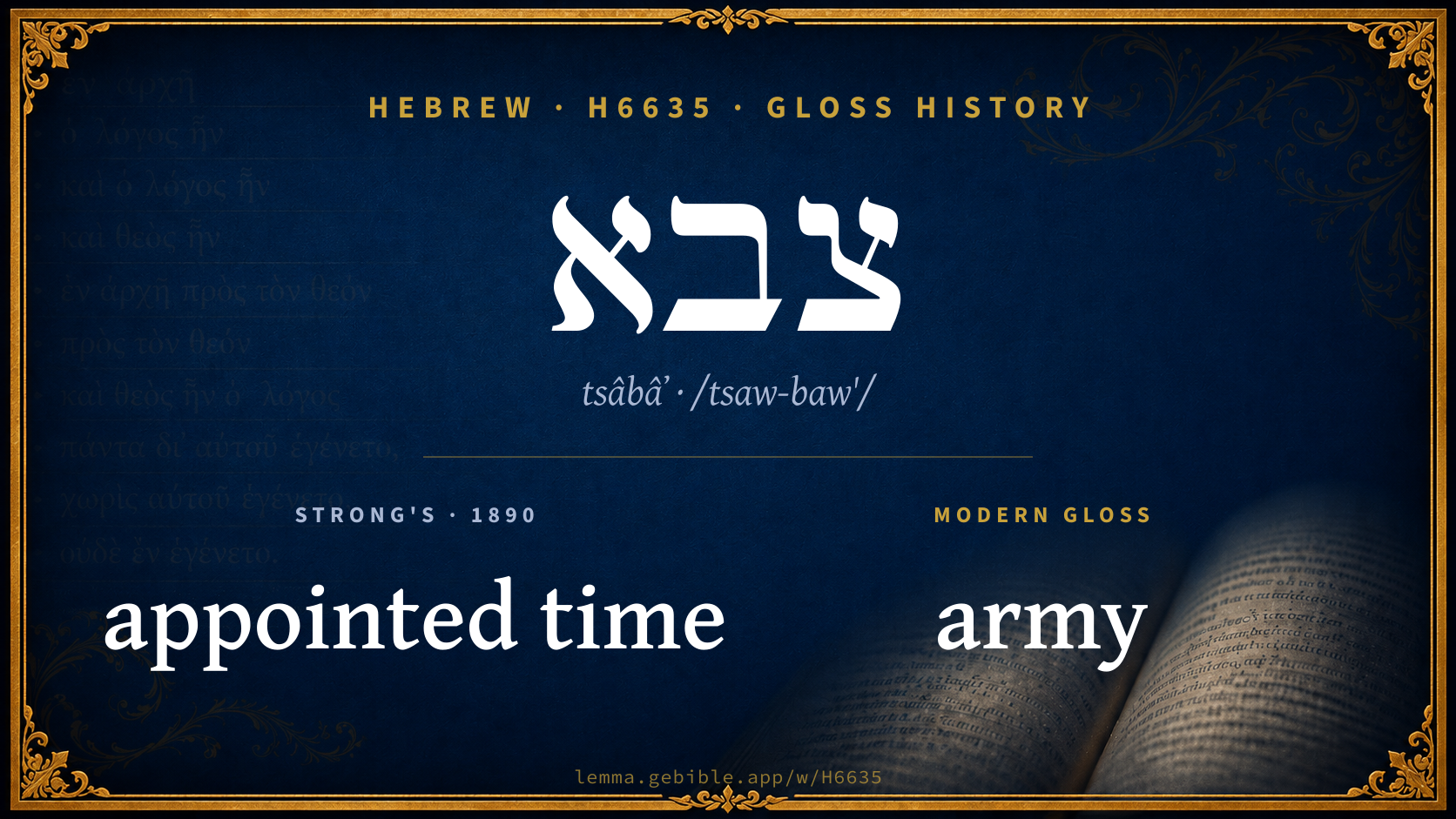
Gloss history
Strong's 1890 vs modern scholarship
About this word
Strong's H6635 catalogs a Hebrew word from the Hebrew Old Testament.
These counts are not copied from any lexicon or concordance. They are computed here, from the morphology-tagged Hebrew Old Testament. What Lemma adds →
- 463
- distinct verses
- The word appears in 463 distinct verses.
- 27 / 39
- OT books
- The word appears in 27 of 39 Old Testament books.
- #105
- by frequency
- Top 250 most frequent Hebrew words (rank 105 of 8,640 Hebrew words by occurrence).
View all 463 occurrences in the concordance →
By section of the Old Testament
By traditional corpus
Conventional, traditional groupings — biblical authorship is debated, so this is a traditional corpus grouping, not an authorship claim. Each share is this word’s portion of its verses in that division of the Hebrew canon. Each figure is a share of the word’s 463 distinct verses.
- Prophets (Nevi'im) 309 verses · 67%
- Torah (Pentateuch) 84 verses · 18%
- Writings (Ketuvim) 70 verses · 15%
How translations render this word
Counts come from each version’s own published word-to-Strong’s tagging or interlinear alignment — an approximate guide to how each version renders this word, not a word-level alignment the data otherwise carries. Because each total is that version’s own tagged count, the per-version totals vary from one another and need not match the appearance or distinct-verse counts above. These counts may also differ from a printed concordance because Lemma counts each distinctly tagged rendering and does not collapse phrase taggings into a single head-word total. This is a fixed set of word-tagged versions (KJV, ASV, BSB, ULT) and does not change with the reading translation you choose elsewhere. Each version’s license is shown beside its name below (and on Sources).
BDB lists this Strong’s number as 3 distinct words (homographs). Each count above pools all of them and is not split by sense — see the Senses section below. A low-frequency rendering may belong to a different one of those words, not the primary meaning.
- King James Version†: Hosts 288×, Host 56×, War 39×
- American Standard Version†: Hosts 288×, Host 56×, War 31×
- Berean Standard Bible†: Hosts 285×, Army 64×, Host 22×
- unfoldingWord Literal Text†: Armies 189×, Army 89×, Hosts 56×
King James Version Public Domain
Renders H6635 across 483† tagged occurrences — most commonly:
Plus other, less common renderings. Plus 25 renderings that appear only once — usually multi-word phrases or single function words the recovered tagging swept in, not distinct renderings. Not rendered by a distinct English word in 2 further occurrences.
American Standard Version Public Domain
Renders H6635 across 483† tagged occurrences — most commonly:
Plus other, less common renderings. Plus 34 renderings that appear only once — usually multi-word phrases or single function words the recovered tagging swept in, not distinct renderings.
Berean Standard Bible Public Domain
Renders H6635 across 466† tagged occurrences — most commonly:
Plus 25 renderings that appear only once — usually multi-word phrases or single function words the recovered tagging swept in, not distinct renderings. Not rendered by a distinct English word in 17 further occurrences.
unfoldingWord Literal Text CC BY-SA 4.0
Renders H6635 across 439† tagged occurrences — most commonly:
Plus 15 renderings that appear only once — usually multi-word phrases or single function words the recovered tagging swept in, not distinct renderings.
17 senses and sub-senses in the full BDB
Hebrew verbs can shift meaning by stem (binyan): Qal is the basic action, Niphal is often passive or reflexive, Piel often intensifies or makes it factitive, and Hiphil is typically causative. The senses below are grouped under the stem BDB assigns to each.
What do BDB’s symbols mean?
BDB uses these scholarly abbreviations:
| Symbol | Meaning |
|---|---|
| 𝔊 | the Septuagint (the ancient Greek translation, LXX) |
| 𝔙 | the Vulgate (the Latin translation) |
| 𝔖 | the Syriac version (the Peshitta) |
| 𝔗 | the Targum (the Aramaic translation) |
| ψ | the Psalms |
| √ | root (the underlying root or stem) |
| ‖ | parallel passage (a synonymous or contrasted parallel) |
| † | the dagger: every passage where the word occurs is cited |
The 17 senses and sub-senses the full Brown-Driver-Briggs lexicon distinguishes for this word, in lexicon order (not ranked by frequency), with BDB’s own verbatim wording and sub-sense lettering. Shown in Hebrew script with BDB’s own scholarly abbreviations. The condensed entry is in the Lexicon Entry tab. See also the Forms in the corpus table below.
צבא I wage war, serve (Sab. צֿבא wage war with, also n. army, campaign HomChrest. 125 CIS iv. 299, 1. 2 DHM VOJ i. 28
Qal
- Pf. 3 mpl. צָֽבְאוּ Ex 38:8 Zc 14:12; Impf. 3 mpl. יִצְבְּאוּ Nu 31:7; Inf. cstr. לִצְבֹּא Is 31:4; לִצְבֹא Nu 4:23; 8:24; Pt. pl. צֹבְאִים Nu 31:42; Is 29:7, 8; sf. צֹבֶיהָ Is 29:7 (Ges§ 75 oo; Di צָרֶיהָ); fpl. צֹבְאֹת Ex 38:8; צֹבְאוֹת 1 S 2:22;— e.g. Exodus 38:8
- 1. wage war, fight, c. עַל against, Nu 31:7 (P) Is 29:7, 8; 31:4; Zc 14:12, c. sf. Is 29:7 (?); abs. Nu 31:42 (P). e.g. Numbers 31:7
- 2. serve at sacred tent, Levites, c. acc. צָבָא Nu 4:23; 8:24 (P); women Ex 38:8(×2) (P) 1 S 2:22. e.g. Numbers 4:23
Hiphil
- Pt. הַמַּצְבִּא אֶת־עַם וגו׳ 2 K 25:19 = Je 52:25 muster. e.g. 2 Kings 25:19
צבא II
- 1. army, host:
- a. organized for war Ju 8:6; 9:29 (J) Is 34:2; Je 51:3; 2 Ch 28:9; צְבָאוֹ his host Nu 2:4, 6 + 10 times 2 (P), לְצִבְאֹתָם 1:3, 52; 2:3, 9 + 11 times 2, 10, 33:1 (P); אַלְפֵי הצ׳ 31:48 (P); צ׳ ישׂראל 2 Ch 25:7; חֵיל (ה)צ׳ 1 Ch 20:1; 2 Ch 26:13; גְּדוּדֵי צ׳ 1 Ch 7:4; כל־הצבא 2 S 3:23; 10:7; 1 Ch 19:8; 2 Ch 26:14; שַׂר (ה)צ׳ captain of (the) host Gn 21:22, 32 (E) 26:26 (J) Ju 4:2, 7; 1 S 12:9 + 21 times; שָׂרֵי (ה)צבא 1 K 1:25 (but read שַׂר), 1 Ch 25:1; 26:26; 2 Ch 33:11; שָׂרִים בצ׳ 1 Ch 12:22; שָׂרֵי (ה)צבאות Dt 20:9; 1 K 2:5; 1 Ch 27:3; רָאשֵׁי הצ׳ 1 Ch 12:14; מַלְכֵי צבאות ψ 68:13; עַל (ה)צ׳ over the host (as captain) Nu 10:14, 15 + 10 times Nu 10 (P), 2 S 8:16 = 1 Ch 18:15; 2 S 17:25; 1 K 2:35; 4:4; אל־כל הצ׳ 2 S 20:23 (אל for על); עַל־צִבְאֹתָם Ex 6:26; 12:51 (P); הוציא צבאות lead out armies Ex 7:4; 12:17 (P); יצא צ׳ army goes forth (to war) Ex 12:41; 1 Ch 7:11; לֹא תֵצֵא בְּצִבְאוֹתֵינוּ ψ 44:10, of י׳ going with our armies = 60:12 = 108:12; fig. of great number, צבא רב 68:12.—On חֲלִיפוֹת וְצָבָא Jb 10:17 v. Di; Bu proposes תַּחֲלֵף צְבָאֲ(ךָ) i.e. thou dost renew (thine) army against me. e.g. Judges 8:6
- b. host (organized body) of angels (cf. Lu 2:13), צבא השׁמים (כל) all the host of heaven 1 K 22:19 = 2 Ch 18:18; Ne 9:6; כל צבאיו ψ 103:21; 148:2; צבא הַמָּרוֹם Is 24:21 host of the high (angel-princes; ‖ earthly monarchs); צבא השׁמים Dn 8:10, הצבא v 10 (al. vb fig. of Israel); שׂר צ׳ י׳ captain of the host of י׳ Jos 5:14, 15 (theophanic angel); שׂר הצבא Dn 8:11 (angel-prince of Israel, others, God). e.g. 1 Kings 22:19
- c. of sun, moon and stars, כל צבא השׁמים Dt 4:19; 17:3; 2 K 17:16; 21:3, 5 = 2 Ch 33:3, 5; 2 K 23:4, 5 Je 8:2; 19:13 (all as objects of worship), Is 34:4; צ׳ השׁמים Je 33:22; Zp 1:5; כל צבאם Ne 9:6 ψ 33:6; Is 34:4; 45:12; צבאם Is 40:26.—Je 3:19 v. i. צְבִי. e.g. Deuteronomy 4:19
- d. of the entire creation, כל צבאם Gn 2:1. e.g. Genesis 2:1
- 2. war, warfare, service: יָצָא צָבָא go out to war Nu 1:3, 20 + 12 times Nu 1, 26:2 (P) 1 Ch 5:18; 7:11; 12:33, 36; 2 Ch 25:5; 26:11; יצא בצ׳ Nu 31:36 (P) Dt 24:5; יצא לצ׳ Nu 31:27, 28 (P); עלה לצ׳ go up to war Jos 22:12, 33 (P); בא מצ׳ come from war Nu 31:14; 2 Ch 28:12; קבץ לצ׳ 1 S 28:1; שׁלח לצ׳ Nu 31:4, 6(×2) (P); התיחשׂם בּצ׳ 1 Ch 7:40; צ׳ תִנָּתֵן Dn 8:12; אַנְשֵׁי (ה)צ׳ men of war Nu 31:21, 53 (P) 1 Ch 12:9, cf. עַם הצ׳ Nu 31:32 (P); v. also II. חלץ; גִבּוֹרֵי חַיִל לצ׳ 1 Ch 12:25; כְּלֵי צ׳ 1 Ch 12:37 instruments of war. e.g. Numbers 1:3
- 3. service:
- a. of Levites in sacred places Nu 4:3, 23, 30, 35, 39, 43; 8:24, 25; קֹדֶשׁ וְצָבָא Dn 8:13 (al. as v 11, 1 b). e.g. Numbers 4:3
- b. of hard service of troubled life Jb 7:1; 14:14; Is 40:2 Dn 10:1. e.g. Job 7:1
- 4. צְבָאוֹת, in name of י׳ as God of war, prob. first in time of warlike David (some connect with sacred ark, but ark older), explained יהוה צבאות אֱלֹהֵי מערכות ישׂראל 1 S 17:45 י׳ Sebaoth God of the battle array of Israel (the thought of angels and stars as army of God is later); e.g. 1 Samuel 17:45
- a. earliest form c. art.: י׳ אֱלֹהֵי הַצְּבָאוֹת Am 3:13; 6:14; 9:5 (אֱלֹהֵי om. by error, cf. We), Ho 12:6. e.g. Amos 3:13
- b. without art., definite by usage, י׳ אֱלֹהֵי צְבָאוֹת 2 S 5:10; Am 5:14, 15, 16; 6:8; 1 K 19:10, 14; Je 5:14; 15:16 ψ 89:9; י׳ אֱלֹהֵי צְבָאֹת אֱלֹהֵי יִשְׂרָאֵל Je 35:17; 38:17; 44:7; 2 S 7:27 = 1 Ch 17:24; Is 21:10; 37:16; 1st אֱלֹהֵי om. Je 7:3, 21 + 30 times Je; Zp 2:9; י׳ אלהים צ׳ אלהי ישׂראל ψ 59:6 (אלהים variant of י׳); י׳ א׳ צ׳ שְׁמוֹ, י׳ God of hosts his name Am 4:13; 5:27, later reduced to י׳ צ׳ שְׁמוֹ Is 47:4; 48:2; 51:15; 54:5; Je 10:16; 31:35 + 6 times Je. e.g. 2 Samuel 5:10
- c. as n.pr. Sebaoth: י׳ צבאות, י׳ Sebaoth (Lord of hosts, Vrss, owing to Qr אֲדֹנָי, but this never cstr. אֲדֹנֵי; al. י׳ of hosts, but י׳ is n.pr.; צ׳ for earlier אלהי צ׳; cf. Σαβαωθ Ja 5:4; Rom 9:29): 1 S 1:3, 11; 4:4; 15:2; 17:45; 2 S 6:2, 18; 7:8, 26; 1 K 18:15; 2 K 3:14; 19:31; 1 Ch 11:9; 17:7 ψ 24:10 + 6 times ψψ, Mi 4:4; Na 2:14; 3:5 Hb 2:13; Zp 2:10; Is 1:9; 2:12; 5:7, 9, 16, 24 + 35 times Is 6–39; Is 2 only 44:6; 45:13; Je 6:6, 9; 8:3; 9:6, 16 + 26 times Je, Hg 1:2, 5 + 12 times Hg, Zc 1:3(×3), 4 + 40 times Zc 1–8; 9:15 + 8 times 10–14, Mal 1:4, 6, 8 + 21 times Mal; האדון י׳ צ׳ Is 1:24 + 4 times Is (incl. 10:16 Baer Gi > van d. H. אֲדֹנָי for י׳); אֲדֹנָי י׳ צ׳ 3:15 + (on these phr. v. אָדוֹן 1, 6); אלהים צ׳ (א׳ later Qr for orig. י׳) ψ 80:8, 15; י׳ אלהים צ׳ (earlier י׳ + later [inserted] א׳) ψ 80:5, 20; 84:9.—cf. Driver Hastings DB (1900), Lord of Hosts and reff., Löhr Amos (Belhefte zur ZAW iv (1900), 38–67). e.g. 1 Samuel 1:3
Senses from the full Brown-Driver-Briggs lexicon (Brown, Driver, Briggs; Oxford 1906 — public domain), digitized via Sefaria, supplemented by the OpenScriptures HebrewLexicon (CC BY 4.0). Full attribution on Sources.
Word origin
I. vb. wage war, serve (Sab. צֿבא wage war with, also n. army, campaign HomChrest. 125 CIS iv. 299, 1. 2 DHM VOJ i. 28; Ethiopic ጸብአ: (> ፀብአ:) wage war; Assyrian ṣâbu, man, soldier; NöZMG xl (1886), 726 al. cp. (on account of Sab. Ethiopic ץֿ) Arabic ضَبَأَ conceal oneself, hence lie in wait; this is phonetically suitable, but better in meaning would be صَبَأَ go or come forth (against one), etc., so Thes LagBN 21; Frä232 cp. صَبِىٌّ young man);—
II. n.m. 2 Ch 28:9 (poss. f. Is 40:2; Dn 8:12, but v. Albr ZAW xv (1895), 319; Bev Dn) army, war, warfare;—abs. צ׳ Nu 1:3 + (מִצָּבָה Zc 9:8 v. p. 663 a); cstr. צְבָא Nu 10:15 +; sf. צְבָאִי Jb 14:14; צְבָאֲךָ Ju 8:9; 9:29; צְבָאָיו ψ 103:21; 148:2 (Kt צבאו; so read prob. in both), etc.; pl. צְבָאוֹת Nu 20:9 + 278 times; cstr. צִבְאוֹת Ex 12:41 + 2 times; sf. צִבְאֹתַי 7:4; צִבְאֹתָם 6:26 +, etc.;—
I. v. further i, ii. צְבִי.
— Brown-Driver-Briggs (Oxford 1906, public domain), digitized via Sefaria, supplemented by the OpenScriptures HebrewLexicon (CC BY 4.0). See Sources.
Derived from צבא (tsâbâʼ) (H6633) — to wage war.
Jastrow Dictionary
A second Hebrew/Aramaic lexicon for comparison, covering Aramaic and post-biblical (Talmudic, Targumic, Midrashic) usage that the biblical-Hebrew BDB does not. Matched by lemma rather than by Strong’s number, so a lemma may carry more than one Jastrow headword (shown separately below), and the entries cover usage well beyond the Bible.
צַבָּא
- ch. = צָב I. Targ. O. Lev. XI, 29 (v. Berl. Targ. O. II, p. 34).
צִבָּא
- , v. צִיבָּא
צָבָא
- , v. צבי h. a. ch.
צָבָא ²
- צבא to join, follow, v. צָוָה a. צָבַת)service; army, host. Gen. R. s. 10 שלשה צבאים הן צ׳ לשמים וכ׳ there are three kinds of services, there is a service for heaven and earth (ref. to Gen. II, 1); צ׳ לתלמידים there is a service for students (ref. to Job XIV, 14); צ׳ ליסורים a service (message) for sufferings (ref. to ib. VII,. Ib. זכה צ׳ לו אם לאו צ׳ עליו if he is favored, a host (of divine powers) is for him; if not, a host (of hostile forces) is against him. Cant. R. to II, 7 (ref. to צבאות, ib.) בצ׳ של מעלה ובצ׳ של מטה by the host above (the angels) and by the host below (humanity). Ib. אם תשמרו … כצ׳ של מעלה וכ׳ if you guard mine oath, I will make you resemble the host above; if not, I will make you resemble the host below (the animals). Keth. 3ᵇ דאמרי שר צ׳ בא לעיר it was said, a (Roman) general is coming to the place (and will seize things for his maintenance); a. fr.—Pl. צְבָאִים; (fem.) צְבָאוֹת. Gen. R. l. c., v. supra. Ib. הרבה צ׳ מינה וכ׳ the Lord has appointed many hosts (messengers) to revenge the wrongs &c. Cant. R. l. c. בשתי צ׳ וכ׳ he adjured them by the two hosts (v. supra). Ib. בצ׳ … שעשו צביוני וכ׳ ‘by the hosts’, that means the patriarchs who did my will &c. Num. R. s. 2 והם צִבְאוֹתַי and they (the Israelites) are my hosts. Ib. שהם היו צִבְאוֹתָיו וכ׳ they were his hosts, and he wanted to count them &c. Ib. כך צ׳ יש לי בעולמי וכ׳ so and so many troops have I that do my will; a. fr.—(אלהים) ה׳ צבאות the Lord of Hosts. Targ. Jer. V, 14; a. e.—Ber. 7ᵃ.—[צְבָאִים, pl. of צְבִי, q. v.] e.g. Genesis 2:1
צבי
- to swell. Y. B. Kam. VIII, beg. 6ᵇ אם כוייו … וצָבַת if one burnt a person with a heated spit on the palm of his hand, and it swelled; ib. על ראשו וצבת, (read וצבה) a. e.—[Ber. 6ᵇ לִצְבּוֹת Ar., v. צָבַת.]
- same. Y. Sot. V, beg. 20ᵃ (line 20) מים מגולין שתה ונ׳ (ed. Krot. שתת ונצבית, corr. acc.) he drank uncovered water (poisoned by a serpent) and his belly was swollen. Ib. (line 25) שתת ונִצְבֵּית she drank &c.
- 1. to cause to swell. Lev. R. s. 17; Yalk. Ps. 808 [read:] ולא צִבִּיתִים, v. עוֹנָה II.
- 2. to cause the appearance of being swollen. Tosef. Peah IV, 14 המְצַבֶּה את כריסו he that feigns a swollen belly; Y. ib. VIII, 21ᵇ top המְצַבֵּא; Keth. 68ᵃ המצב׳ את בטנו.
A Dictionary of the Targumim, the Talmud Babli and Yerushalmi, and the Midrashic Literature (Marcus Jastrow; London, Luzac, 1903) — Public Domain. Digitized via Sefaria. Digitized via Sefaria. Full attribution on Sources.
Forms in the corpus
The 91 distinct written forms H6635 takes in the Hebrew Bible, most frequent first — each parse links to that state’s occurrences in the concordance. Hebrew forms include their vowel points and cantillation, so a single lemma takes many written forms.
The 60 most common forms are shown; 31 rarer forms follow in the full concordance.
Same root — word family
Other BDB entries built from the same root as H6635, grouped by Strong’s listed origin. These share a root / origin per the lexicon — not necessarily a shared meaning. Each links to that word’s own entry.
Derives from
Proper names from this root
People and places named from this root — a name, not an additional meaning of the word.
Compare all same-root words → 1 of the same-root words is a proper name (a person or place). They share a root, not necessarily a meaning.
Septuagint verse parallels
This word appears in 432 verses that also exist in the Greek Old Testament (Septuagint), out of the 463 Hebrew verses it occurs in. You can read those verses in Greek by switching the Old Testament edition to the Septuagint.
Read these verses in the Septuagint
- Genesis 2:1
- Exodus 6:26
- Numbers 1:3
- Deuteronomy 4:19
- Joshua 4:13
- Judges 4:2
- 1 Samuel 1:3
- 2 Samuel 2:8
- 1 Kings 1:19
- 2 Kings 3:14
- 1 Chronicles 5:18
- 2 Chronicles 17:18
This is a verse-level parallel only — the same verses exist in both the Hebrew and Greek Old Testaments. No word-level Hebrew↔Greek correspondence is claimed: the data carries no such alignment, so no Greek word is shown as this Hebrew word’s translation. Coverage is not total — the Septuagint omits the deuterocanon and renumbers the Psalms, so some Hebrew verses have no direct Greek parallel.