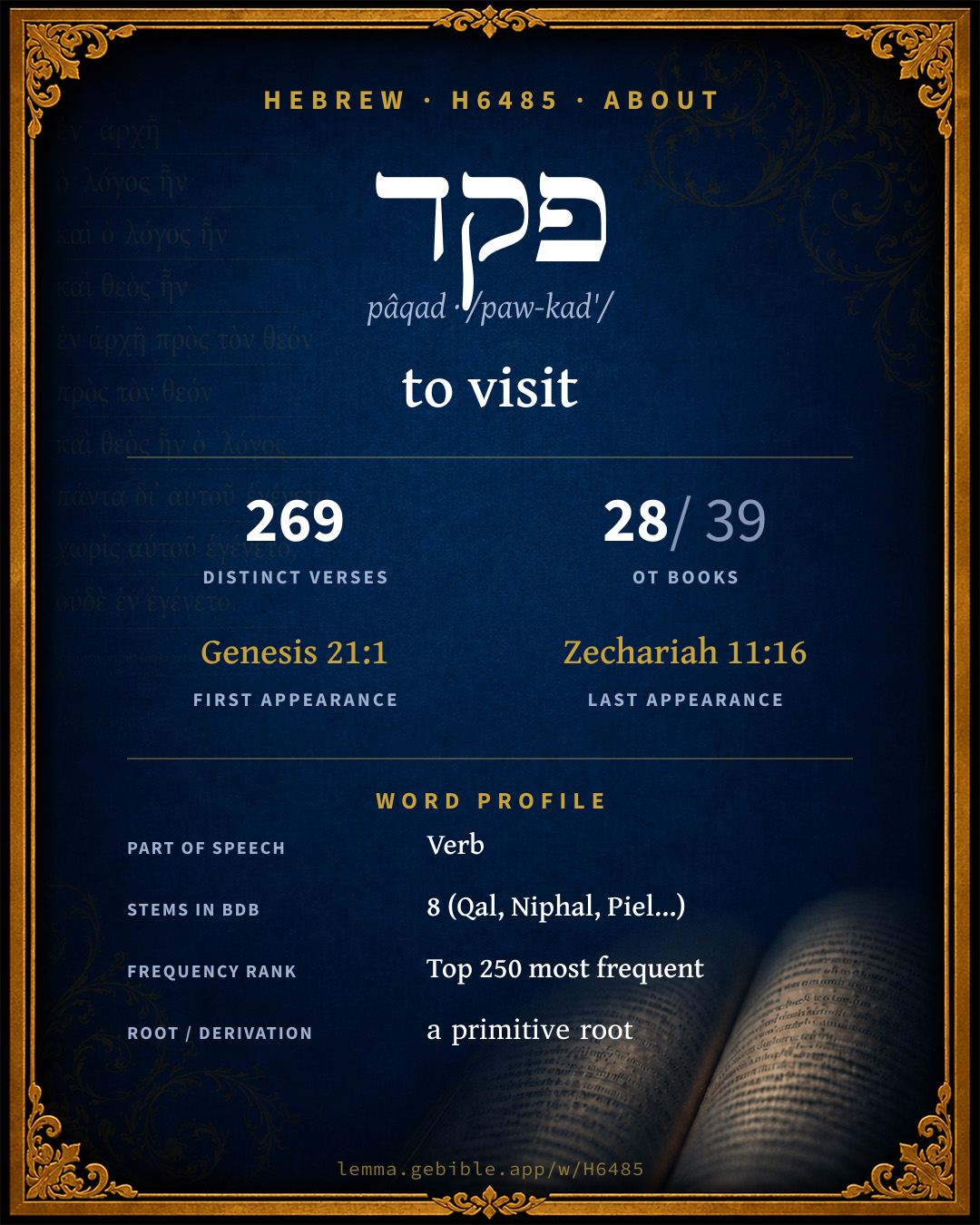
פָּקַד
to visit
‘to visit’ is one of 2 main senses fuller range ↓
Full lexicon entry — Brown-Driver-Briggs (BDB)
From Brown-Driver-Briggs (BDB)
Where this word appears
See every Qal verb in the Hebrew Bible →
Grammar key — what these labels mean
Part of speech
- Verb
- An action or state-of-being word.
Stem
- Qal
- The basic, simple active stem — the plain form of the verb (“he wrote”). Here: ‘pay attention to’
- Hiphil
- The causative active stem (“he caused / brought about”). Here: ‘commit’
- Hophal
- The passive counterpart of the Hiphil (“he was caused to…”). Here: ‘be visited in punishment’
- Niphal
- Usually the simple passive or reflexive of the Qal (“he was written”). Here: ‘be’
- Hithpael
- The reflexive or reciprocal stem (the subject acts on itself). Here: ‘be mustered’
- Pual
- The passive counterpart of the Piel. Here: ‘be passed in review’
- Piel
- An intensive or resultative active stem.
Form
- Perfect
- A completed action or state — Hebrew marks aspect (completeness) more than strict tense (“he wrote”).
- Participle Passive
- A verbal adjective expressing action received (“written”).
- Sequential Perfect
- A perfect with prefixed waw continuing a preceding imperfect or command (waw-consecutive perfect).
- Sequential Imperfect
- An imperfect with prefixed waw — the standard past-narrative form (waw-consecutive imperfect).
- Imperfect
- An incomplete, ongoing, or future action (“he will / would write”).
- Participle Active
- A verbal adjective expressing ongoing or characteristic action (“writing / one who writes”).
- Infinitive Construct
- A bound verbal noun, frequently with prepositions (“to write / in writing”).
- Infinitive Absolute
- An unbound verbal noun, often intensifying or standing in for a finite verb.
- Imperative
- A direct command (“write!”).
- Jussive
- A third- or second-person volitional form expressing wish or command (“let him write”).
State
- Construct
- A noun bound to a following noun in a possessive / “of” relationship (the construct chain).
- Absolute
- The independent form of a noun, not bound to a following word.
Person
- 3rd Person
- The one spoken about (“he / she / it / they”).
- 1st Person
- The speaker (“I / we”).
- 2nd Person
- The one addressed (“you”).
Gender
- Masculine
- Grammatically masculine.
- Common
- Either gender — not distinguished for this form.
- Feminine
- Grammatically feminine.
Number
- Singular
- One.
- Plural
- More than one (in Hebrew, generally three or more).
4 distinct verses where H6485 appears in the Hothpaal stem, across 2 books. Filtered view — show all forms. Click any verse to open its interlinear word-by-word view. Verse text shown in the World English Bible for context — . Each verse’s Hebrew form is shown with its reference; the English is not keyword-highlighted, since the data carries no word-level English alignment. Use “Compare translations” on any verse to read it across multiple English versions. This concordance covers the Hebrew Bible; Septuagint (Greek Old Testament) occurrences are not indexed here.
Numbers 3 verses
- Numbers 1:47 הָתְפָּקְד֖וּ Hothpaal pf 3cp But the Levites after the tribe of their fathers were not numbered among them.
- Numbers 2:33 הָתְפָּקְד֔וּ Hothpaal pf 3cp But the Levites were not numbered among the children of Israel; as Yahweh commanded Moses.
- Numbers 26:62 פְקֻדֵי/הֶ֗ם הָתְפָּקְד֗וּ Qal ptcp.pass mp cs + sfx pers 3mp Hothpaal pf 3cp Those who were numbered of them were twenty-three thousand, every male from a month old and upward: for they were not numbered among the children of Israel, because there was no inheritance given them among the children of Israel.
1 Kings 1 verse
About this entry
At a glance — auto-summarized from this page’s data, not written by a person. Every figure links to its source below. This summary describes the numbers; it doesn’t interpret them.
פקד — transliterated pâqad — is a Hebrew verb carrying the sense “to visit.” Where the King James Version says “were numbered,” newer translations reach for “i will punish” (Berean Standard Bible) and “counted ones” (unfoldingWord Literal Text); the renderings breakdown has the detail. The Hebrew Bible uses it across 269 verses — common. More than a third of its appearances fall in Numbers. Different stems carry different senses — BDB groups them under 8 stems, among them Qal and Niphal. Dig into 269-verse concordance and the renderings breakdown below.
Gloss history
Strong's 1890 vs modern scholarship

About this word
Strong's H6485 catalogs a Hebrew word from the Hebrew Old Testament.
These counts are not copied from any lexicon or concordance. They are computed here, from the morphology-tagged Hebrew Old Testament. What Lemma adds →
- 269
- distinct verses
- The word appears in 269 distinct verses.
- 28 / 39
- OT books
- The word appears in 28 of 39 Old Testament books.
- #161
- by frequency
- Top 250 most frequent Hebrew words (rank 161 of 8,640 Hebrew words by occurrence).
View all 269 occurrences in the concordance →
By section of the Old Testament
By traditional corpus
Conventional, traditional groupings — biblical authorship is debated, so this is a traditional corpus grouping, not an authorship claim. Each share is this word’s portion of its verses in that division of the Hebrew canon. Each figure is a share of the word’s 269 distinct verses.
- Prophets (Nevi'im) 123 verses · 46%
- Torah (Pentateuch) 114 verses · 42%
- Writings (Ketuvim) 32 verses · 12%
How translations render this word
Counts come from each version’s own published word-to-Strong’s tagging or interlinear alignment — an approximate guide to how each version renders this word, not a word-level alignment the data otherwise carries. Because each total is that version’s own tagged count, the per-version totals vary from one another and need not match the appearance or distinct-verse counts above. These counts may also differ from a printed concordance because Lemma counts each distinctly tagged rendering and does not collapse phrase taggings into a single head-word total. This is a fixed set of word-tagged versions (KJV, ASV, BSB, ULT) and does not change with the reading translation you choose elsewhere. Each version’s license is shown beside its name below (and on Sources).
BDB lists this Strong’s number as 2 distinct words (homographs). Each count above pools all of them and is not split by sense — see the Senses section below. A low-frequency rendering may belong to a different one of those words, not the primary meaning.
- King James Version†: Were numbered 45×, Numbered 15×, I will punish 12×
- American Standard Version†: Were numbered 43×, I will punish 13×, Numbered 13×
- Berean Standard Bible†: I will punish 19×, Numbered 16×, Registered 13×
- unfoldingWord Literal Text†: Counted ones 57×, And 13×, Counted 11×
King James Version Public Domain
Renders H6485 across 304† tagged occurrences — most commonly:
Plus other, less common renderings. Plus 109 renderings that appear only once — usually multi-word phrases or single function words the recovered tagging swept in, not distinct renderings. Not rendered by a distinct English word in 1 further occurrence.
American Standard Version Public Domain
Renders H6485 across 302† tagged occurrences — most commonly:
Plus other, less common renderings. Plus 112 renderings that appear only once — usually multi-word phrases or single function words the recovered tagging swept in, not distinct renderings.
Berean Standard Bible Public Domain
Renders H6485 across 293† tagged occurrences — most commonly:
Plus other, less common renderings. Plus 120 renderings that appear only once — usually multi-word phrases or single function words the recovered tagging swept in, not distinct renderings. Not rendered by a distinct English word in 9 further occurrences.
unfoldingWord Literal Text CC BY-SA 4.0
Renders H6485 across 324† tagged occurrences — most commonly:
Plus other, less common renderings. Plus 111 renderings that appear only once — usually multi-word phrases or single function words the recovered tagging swept in, not distinct renderings.
28 senses and sub-senses in the full BDB
Hebrew verbs can shift meaning by stem (binyan): Qal is the basic action, Niphal is often passive or reflexive, Piel often intensifies or makes it factitive, and Hiphil is typically causative. The senses below are grouped under the stem BDB assigns to each. This entry also uses Pual (the passive of Piel), Hithpael (reflexive or reciprocal), Hothp (the passive of Hithpael), and Hophal (the passive of Hiphil).
What do BDB’s symbols mean?
BDB uses these scholarly abbreviations:
| Symbol | Meaning |
|---|---|
| 𝔊 | the Septuagint (the ancient Greek translation, LXX) |
| 𝔙 | the Vulgate (the Latin translation) |
| 𝔖 | the Syriac version (the Peshitta) |
| 𝔗 | the Targum (the Aramaic translation) |
| ψ | the Psalms |
| √ | root (the underlying root or stem) |
| ‖ | parallel passage (a synonymous or contrasted parallel) |
| † | the dagger: every passage where the word occurs is cited |
The 28 senses and sub-senses the full Brown-Driver-Briggs lexicon distinguishes for this word, in lexicon order (not ranked by frequency), with BDB’s own verbatim wording and sub-sense lettering. Shown in Hebrew script with BDB’s own scholarly abbreviations. The condensed entry is in the Lexicon Entry tab. See also the Forms in the corpus table below.
פקד I attend to, visit, muster, appoint (NH id., visit, enjoin
Qal
- Pf. 3 ms. פ׳ Ex 4:31 +; 1 s. פָּקַדְתִּי 3:16 +, etc.; Impf. 3 ms. יִפְקֹד Gn 50:24 +, etc.; Imv. ms. פְּקֹד Nu 3:15 +, etc.; Inf. abs. פָּקֹד Gn 50:24 +; cstr. לִפְקֹד 2 S 24:4 +, etc.; Pt. act. פֹּקֵד Ex 20:5 +; pass. פְּקֻדִים(הַ) 30:14 +, cstr. פְּקוּדֵי Nu 31:14 +, etc.;— e.g. Exodus 4:31
- A.
- 1.
- a. pay attention to, observe (with care, practical interest), of י׳ c. acc. pers. + rei Ex 3:16 (J), c. acc. pers. 4:31 (J; ‖ רָאָה), ψ 8:5 (with providence, cf. פְּקֻדָּה Jb 10:12; ‖ זָכַר); c. acc. rei 1 S 15:2 ψ 80:15 (‖ הִבִּיט, רָאָה), La 4:22 (‖ גִּלָּה עַל), יִזְכֹּר עֲוֹנָם וְיִפְקֹד חַטֹּאתָם Ho 8:13 = 9:9 = Je 14:10; 1 S 17:18 observe thy brothers as to well-being (לְשָׁלוֹם; i.e. see how they fare). e.g. Exodus 3:16
- b. attend to, in act, see to, c. acc. pers. 2 K 9:34; acc. of sheep Je 23:2 (in fig.); cf. Zc 10:3b; 11:16. e.g. 2 Kings 9:34
- c. seek (with interest, desire), seek י׳ Is 26:16; in bad sense, look about for Ez 23:21. Hence e.g. Isaiah 26:16
- d. seek in vain, need, miss, lack (cf. Niph., and Arabic Ethiopic supr.), c. acc. pers. 1 S 20:6; Is 34:16, rei 1 S 25:15 Je 3:16. e.g. 1 Samuel 20:6
- 2. specif. visit, c. acc., for different purposes: with (ב) a present Ju 15:1; especially of י׳, visit graciously Gn 21:1; 50:24, 25 = Ex 13:19 (all E), Is 23:17; Je 15:15 (‖ זָכַר), 27:22; 29:10; 32:5 ψ 65:10 Ru 1:6 +; בִּישׁוּעָתֶ֑ךָ 106:4 (‖ זָכַר); visit to search, test, acc. pers. Jb 7:18 (‖ בָּחַן), ψ 17:3 (‖ id.; obj. om.), abs. Jb 31:14; to punish Je 6:15; 49:8; 50:31 ψ 59:6; acc. pers. om. Ex 32:34a Is 26:14, c. עַל rei (of sin) Je 5:9, 29; 9:8 (here + ב pers.); acc. rei ψ 89:33; abs., of י׳’s anger Jb 35:15. e.g. Judges 15:1
- 3. c. עַל pers., visit upon, י׳ subj., + acc. rei (of sin) Am 3:2, 14 Ho 1:4; 2:15; Ex 20:5; 34:7 Dt 5:9 + 10 times; acc. rei om., = punish Is 10:12 Je 9:24; 11:22; 13:21 + 10 times Je, + 8 times; + כ rei Ho 12:3 Je 21:14; + cl. of sin Ho 4:14; c. אֶל pers. Je 50:18(×2), אֶל + עַל 46:25; indef. subj. c. עַל of vineyard = injure Is 27:3. e.g. Amos 3:2
- 4. pass in review, muster (nearly = number), c. acc., 1 S 11:8; 13:15; 2 S 24:2, 4 + 11 times + Nu 1:3, 19, 44, 49 + 16 times Nu (P); acc. om. 1 S 14:17(×2) Nu 3:42; obj. נָוֶה Jb 5:24; especially pt. pass., persons or things mustered (numbered), Ex 30:12, 13, 14; 38:25, 26;Nu 1:21, 22 + 67 times Nu, + 1 Ch 23:24. e.g. 1 Samuel 11:8
- 1.
- B. appoint:
- 1. c. acc. pers. + אִתָּם Gn 40:4, + עַל pers. over whom Je 15:3; 51:27; Nu 27:16, + אֶל (for עַל) Je 49:19 = 50:44; c. acc. pers. alone Nu 3:10, + בְּרֹאשׁ הָעָם Dt 20:9; pt. pass. pl. appointed ones, officers, of (fighting) host Nu 31:14, 48; 2 K 11:15 2 Ch 23:14. e.g. Genesis 40:4
- 2. c. acc. rei, appoint, assign, + עַל pers. to whom, Nu 4:27 (on text v. Di); c. acc. rei only, v 32; cf. Jb 34:13; 36:23; lay upon (עַל pers.) as a charge, Zp 3:7 (reading מֵעֵינֶיהָ, 𝔊 We Now, for מְעוֹנָהּ); + inf. 2 Ch 36:23 = Ezr 1:2; = deposit, c. acc. rei + ב loc., 2 K 5:24 (cf. פִּקָּדוֹן). e.g. Numbers 4:27
Niphal
- Pf. 3 ms. נִפְקַד 1 S 25:7 +; 2 ms. וְנִפְקַדְתָּ֫ 20:18; Impf. 3 ms. יִפָּקֵד v 18 +, etc.; Inf. הִפָּקֵד abs. 1 K 20:39; cstr. Ju 21:3;— e.g. 1 Samuel 25:7
- 1. be (sought, i.e. needed) missed, lacking 1 S 20:18 + v 19 (𝔊, for MT תֵּרֵד, We Dr al.), 25:7 1 K 20:39 (+ inf. abs.), 2 K 10:19(×2) Je 23:4 (Gr Gie conj. יִפְחָ֖דוּ), + מִן part. Ju 21:3; 1 S 25:21; 2 S 2:30 Nu 31:49; of seat 1 S 20:18, place v 25:27 (i.e. be empty). e.g. 1 Samuel 20:18
- 2. be visited (graciously) Ez 38:8; Is 24:22, cf. 29:6 (ב accomp.; v. Di). e.g. Ezekiel 38:8
- 3. be visited upon, עַל pers., Nu 16:29 (subj. פְּקֻדָּה); בַּל יִפּ׳ רָ֑ע Pr 19:23 evil shall not be visited (sc. upon him; read perhaps שׂבֵר עָלָיו for שָׂבֵעַ יָלְין v. Toy). e.g. Numbers 16:29
- 4. be appointed Ne 7:1, + עַל 12:44. e.g. Nehemiah 7:1
Piel
- (intens.) muster a host, Pt. מְפַקֵּד Is 13:4 (of י׳). e.g. Isaiah 13:4
Pual
- be passed in review, Pf. 3 ms. פֻּקַּד Ex 38:21; be caused to miss, deprived of, 1 s. פֻּקַּדְתִּי Is 38:10 c. acc. rei. Is 38:10 sense dub., Ges am (shall be) missed for; Hi Di De CheComm. am punished, muleted of. e.g. Exodus 38:21
Hithpael
- be mustered, Pf. 3 pl. הִתְפָּֽקְדוּ Ju 20:15, 17; Impf. 3 ms. וַיִּתְפָּקֵד 21:9; 3 mpl. 20:15 (on form v. Ges§ 541). e.g. Judges 20:15
Hothp
- id., Pf. 3 pl. הָתְפָּֽקְדוּ 1 K 20:27 Nu 1:47; 2:33; 26:62 (Gesl.c.). e.g. 1 Kings 20:27
Hiphil
- Pf. 3 ms. הִפְקִיד Gn 39:5 +, 2 ms. sf. הִפְקַדְתּוֹ 1 S 29:4, etc.; Impf. 3 ms. יַפְקִיד Is 10:28, etc.; Imv. ms. הַפְקֵד Nu 1:50 ψ 109:6, etc.;— e.g. Genesis 39:5
- 1. c. acc. pers., set (over), make overseer, 2 K 25:23; + עַל Gn 39:4 Je 1:10 Nu 1:50 + 8 times, fig., acc. of punishment, Lv 26:16; + ב Je 40:5 + 3 times; + ב and על Gn 39:5; + ל 1 K 11:28; + אֲשֶׁר שָׁם 1 S 29:4 where thou hast stationed him, ins. also v 10 𝔊 The We Dr al.; + אִתּוֹ Je 40:7, cf. 41:10. e.g. 2 Kings 25:23
- 2. c. acc. rei (implic.),
- a. commit, entrust (cf. פִּקָּדוֹן), עַל־יַד פ׳ 1 K 14:27 = 2 Ch 12:10; c. acc. רוּחִי + בְּיָֽדְךָ ψ 31:6. e.g. 1 Kings 14:27
- b. deposit, c. acc. rei + ב loc. Je 36:20, + ל loc. Is 10:28; acc. pers. (Jer. as prisoner) + ב loc. Je 37:21. e.g. Jeremiah 36:20
Hophal
- 1. be visited in punishment, Pf. 3 ms. הָפְקַד Je 6:6 (impers.; but 𝔊 ψευδής, read הַשֶּׁקֶר JDMich, הַפֶּרֶק Gie). e.g. Jeremiah 6:6
- 2. be deposited, אִתּוֹ Lv 5:23 (subj. הַפִּקָּדוֹן) e.g. Leviticus 5:23
- 3. be made overseer, Pt. מֻפְקָדִים(הַ), c. בֵּית 2 K 22:9; 12:12 Qr (Kt הפקדים); בְּבֵית י׳ 22:5 (Qr del. ב), 2 Ch 34:10; c. עַל pers. 2 Ch 34:12; abs. v 17. e.g. 2 Kings 22:9
פקד II pl.[m.] abstr. musterings, i.e. expenses
Senses from the full Brown-Driver-Briggs lexicon (Brown, Driver, Briggs; Oxford 1906 — public domain), digitized via Sefaria, supplemented by the OpenScriptures HebrewLexicon (CC BY 4.0). Full attribution on Sources.
Word origin
I. vb. attend to, visit, muster, appoint (NH id., visit, enjoin; Ph. פקד attend to, provide; Assyrian paḳâdu = BH; Arabic فَقَدَ; faqada) lose, miss; also (Dozy) give heed, attention, to; Ethiopic ፈቀደ; visit, muster, desire, need, etc.; Nab. פקד command (Cook), so 𝔗 פְּקַד Pa. Syriac ܦܩܰܕ, also visit);—
I. n.pl.[m.] abstr. musterings, i.e. expenses;—cstr. פְּקוּדֵי Ex 38:21 (v. Di).
— Brown-Driver-Briggs (Oxford 1906, public domain), digitized via Sefaria, supplemented by the OpenScriptures HebrewLexicon (CC BY 4.0). See Sources.
Origin: a primitive root
Jastrow Dictionary
A second Hebrew/Aramaic lexicon for comparison, covering Aramaic and post-biblical (Talmudic, Targumic, Midrashic) usage that the biblical-Hebrew BDB does not. Matched by lemma rather than by Strong’s number, so a lemma may carry more than one Jastrow headword (shown separately below), and the entries cover usage well beyond the Bible.
פָּקַד
- (b. h.) [to search, examine]
- 1. to visit; (euphem.) to have marital connection with. Yeb. 62ᵇ ואינו פוֹקְדָהּ and does not visit her (in due time, v. עוֹנָה I). Ib. חייב אדם לִפְקוֹד וכו׳ a man is bound to visit his wife before going on a journey.—Treat. S’maḥ. ch. VIII יוצאין … ופוֹקְדִין על המתים וכ׳ you may go out to the burial ground and call upon the dead until three days (after being placed in the sepulchral chamber), and there is no superstitious practice in that; מעשה שפְּקָדוֹ אחד וכ׳ it occurred that one visited an entombed person, and the latter (was found living and) lived twenty years thereafter; a. fr.
- 2. (of the Lord) to visit, remember, decree upon. Tanḥ. Vayera 14 בלשון … אני פוֹקְדָךְ with the same expression … I will remember thee (bless thee with issue). Ib. הרוני פוֹקֵד לאברהם וכ׳ I will remember Abraham (relieve him from impotence) at the same time with Abimelech (ref. to Gen. XX, 17-XXI, 1). Pesik. R. s. 43 כשבא לפקוד את חנה when the Lord came to visit Hannah; a. v. fr.—Part. pass. פָּקוּד; f. פְּקוּדָה; pl. פְּקוּדִים, פְּקוּדִין; פְּקוּדוֹת. Snh. 97ᵃ עד שהראשונה פ׳ שנייה וכ׳ while the first calamity is remembered (by the Lord for delivery), the second quickly comes. e.g. Genesis 20:17
- 3. to count, muster; v. פָּקוּד, פְּקִידָה, פִּיקּוּד.
- 4. (denom. of פָּקִיד, interch. with Hif.) to give in charge, entrust, deposit. Pesik. R. l. c. בעל פקדונות אני … פּוֹקֵד אצלי אני נותן לו I (the Lord) am a trustee, whatever a man deposits with me, I give back to him. Ib. נפשות פְּקַדְתֶּם אצלי וכ׳ you (Abraham and Sarah) deposited souls with me (converted souls to the belief in me), I will pay you back in souls (ref. to Gen. XXI, 1); a. fr. e.g. Genesis 21:1
- 5. (denom. of פָּקִיד) to command, order. Ib. s. 42 פָּקַדְתִּי לאדם וכ׳ I gave Adam a command, and he did not do it; פקדתי למלאך וכ׳ I commissioned the angel of death, and he did (what I commanded him). Shebu. VII, 7 (45ᵃ) שבועה שלא פְּקָדָנוּ אבא we swear that our father has not left us any order (concerning this case); Y. Keth. VII, 33ᵇ פִּיקְּדָנוּ. Shebu. 48ᵇ מה לי שלא פְקָרַנֵי אבא ושלא פקדני אחי what is the difference between the oath of an heir ‘that my father has not left me an order’, and ‘that my brother &c.’?; a. fr.
- same, v. supra.
- , Nithpa. נִתְפַּקֵּד
- 1. to be visited, remembered, decreed upon. Gen. R. s. 53 בשעה שנִפְקְדָה … נִפְקְדוּ עמה when Sarah was visited &c., v. עֲקָרָה. Ib. אינו דין שתִּפָּקֵד is it not right that she should be visited? Tanḥ. Vayera 13 תהי נִפְקֶדֶת she shall be remembered. R. Hash. 11ᵃ. Pesik. R. s. 42 בדין הוא שיִפָּקֵד אברהם it is right that Abraham be visited. Ib. שתִּתְפַּקֵּד אף היא that she be likewise visited. Lev. R. s. 29; Pesik. Baḥod., p. 150ᵇ (quot. from Rab’s New Year’s prayer) ובריות בו יִפָּקֵדוּ להזכירם וכ׳ and creatures are passed upon on that day to record them for life or for death; a. fr.
- 2. to be commanded, commissioned. Pesik. R. l. c. יש שנתפ׳ ולא עשה וכ׳ some are commanded and do not (what they are ordered to) &c. Mekh. B’shall., Vayassʿa, s. 4 עשו מה שנִתְפַּקְּדוּ they did what they were commanded to do; a. e.
- 1. to give in charge, deposit. B. Mets. III, 1 המַפְקִיד אצל וכ׳ if a man deposits for safe-keeping with his neighbor &c. Ib. 36ᵃ sq. כל המפקיד על דעת אשתו ובניו הוא מפקיד he who deposits with his neighbor, does so with the presumptive condition that the latter’s wife and children be also trustees (and it was no breach of trust to leave the deposit in their charge). Gen. R. s. 53 עמלק ה׳ אצלי וכ׳ Amalek deposited with me bundles of thorns (wrong-doings) &c.; שרה הִפְקִידָה אצלי וכ׳ Sarah deposited with me virtues and good deeds &c. Pesik. R. s. 43; a. fr.—B. Mets. 35ᵃ ופרקין המפקיד הוה and our subject at college was hammafḳid (the Mishnah B. Mets. l. c. and the discussions concerning it).—Part. pass. מוּפְקָד; f. מוּפְקֶדֶת &c. B. Kam. 105ᵃ כגון שהיתה … מופ׳ ביד אחרים when his father’s bag was left in trust with other people; a. e.
- 2. to take charge of. Yalk. Deut. 847 הַפְקֵד לי הפקדון הזה take this object in charge for me.
פְּקַד
- 1. to command. Targ. O. Lev. VIII, 31 פַּקְדִּית Mss. (oth. ed. Ithpa.; ed. Berl. Pa., v. infra).
- 2. [to give in charge,] to store up.—Part. pass. פָּקִיד; pl. פְּקִידי. Keth. 5ᵇ מִיפְּקַד פקיד, v. חֲבַר. Pes. 33ᵇ משקין מיפקד פקידי (Rashi: מִיפְּקִיד) liquids (in grapes) are stored up (the shell being merely a vessel), opp. מיבלע בליעי.
- to command, commission. Targ. Gen. VII, 5; 9 (ed. Berl. פַּק׳, without Dagesh). Ib. XLIX, 33. Targ. Ps. LXVIII, 29. Targ. Am. IX, 3, sq. (ed. Wil. אַפְקִיד Af.); a. v. fr.—Pesik. Baḥod., p. 155ᵇ רבי … הוה מְפַקֵּד לחבריה וכ׳ R. Z. commanded the students (saying), go and hear R. L. preach; Y. R. Hash. IV, beg. 59ᵇ. Y. Ber. IV, 7ᶜ bot.; ib. דרבי מיפקד (corr. acc.). Koh. R. to III, 2 הוה מפקד גו ביתיה gave orders in his house (made his will); a. fr.—Part. pass. מְפַקַּד, v. infra.
- 1. same, v. supra.—2)
- to give in charge, deposit. B. Mets. 36ᵃ הוו מַפְקְדֵי מרייהו וכ׳ used to leave their hoes in charge of a certain old woman; יומא חד אפקדינהו וכ׳ one day they left them with &c.; a. fr.
- 1. to be commanded. Targ. O. Lev. VIII, 31, v. supra. Ib. 35. Targ. Ex. XXXIV, 34; a. fr.—Ab. Zar. 14ᵃ; 21ᵃ מִיפְקְדִינָן Rashi (ed. מְפַקְּדִינָן, Part. pass. Pa.), v. פָּנִים.
- 2. to be given in charge, be deposited. Targ. Lev. V, 23 (O. ed. Lsb. אִתַּפְקַד).—Keth. 5ᵇ; Pes. 33ᵇ, v. supra.
A Dictionary of the Targumim, the Talmud Babli and Yerushalmi, and the Midrashic Literature (Marcus Jastrow; London, Luzac, 1903) — Public Domain. Digitized via Sefaria. Digitized via Sefaria. Full attribution on Sources.
Forms in the corpus
The 206 distinct written forms H6485 takes in the Hebrew Bible, most frequent first — each parse links to that stem’s occurrences in the concordance. Hebrew forms include their vowel points and cantillation, so a single lemma takes many written forms.
The 60 most common forms are shown; 146 rarer forms follow in the full concordance.
Same root — word family
Other BDB entries built from the same root as H6485, grouped by Strong’s listed origin. These share a root / origin per the lexicon — not necessarily a shared meaning. Each links to that word’s own entry.
Derived from this word
- מפקד miphqâd H4662 appointment
- פקדה pᵉquddâh H6486 visitation
- פקדון piqqâdôwn H6487 store
- פקוד piqqûwd H6490 statute
- פקיד pâqîyd H6496 officer
Proper names from this root
People and places named from this root — a name, not an additional meaning of the word.
Compare all same-root words → Showing 4 of 7 — not the complete family. 1 of the same-root words is a proper name (a person or place). They share a root, not necessarily a meaning.
Septuagint verse parallels
This word appears in 253 verses that also exist in the Greek Old Testament (Septuagint), out of the 269 Hebrew verses it occurs in. You can read those verses in Greek by switching the Old Testament edition to the Septuagint.
Read these verses in the Septuagint
- Genesis 21:1
- Exodus 3:16
- Leviticus 6:4
- Numbers 1:3
- Deuteronomy 5:9
- Joshua 8:10
- Judges 15:1
- Ruth 1:6
- 1 Samuel 2:21
- 2 Samuel 2:30
- 1 Kings 11:28
- 2 Kings 3:6
This is a verse-level parallel only — the same verses exist in both the Hebrew and Greek Old Testaments. No word-level Hebrew↔Greek correspondence is claimed: the data carries no such alignment, so no Greek word is shown as this Hebrew word’s translation. Coverage is not total — the Septuagint omits the deuterocanon and renumbers the Psalms, so some Hebrew verses have no direct Greek parallel.