

Isaiah 26:16

Hebrew (Westminster Leningrad Codex) Isaiah 26:16 appears in the Hebrew Old Testament. The text above is from the Westminster Leningrad Codex. Each word links to its Strong’s number, a concise gloss, and parsing drawn from the Open Scriptures Hebrew Bible morphology. Click any word for its full Brown-Driver-Briggs (BDB) entry.
Download image
Cite this verse

Isaiah 26:16 (World English Bible). Public Domain. Lemma interlinear Bible study tool, https://lemma.gebible.app/v/isaiah/26/16.

Show BibTeX & RIS
BibTeX
RIS
English Translation
Yahweh, in trouble have they visited you; they poured out a prayer [when] your chastening was on them.
World English Bible · Public Domain
Download a study sheet

One document with this verse’s original text, its word-by-word gloss line, the meaning frame, cross-references with their text, attributed commentary, and full source and license credits — printable, and it pastes into notes with its structure intact.

This verse Autodidact and up

Study sheet (.html) Plain text (.txt)

A passage Seminary Student

Up to 50 verses in one chapter. A passage sheet keeps up to 6 commentary sources and 12 cross-references per verse, in the order this page ranks them, and says so on the sheet whenever that leaves anything out. Ask for a single verse and you get the Autodidact verse sheet above.

Everything on this page stays free to read, with no account — the sheet is a download of what is already on screen, not access to it.

Want to remove ads? Support Godless Engineer
Compare translations 3

The same verse in 3 English versions, stacked beneath the original-language interlinear above. Click any original word for its lexicon entry.

Each is an independent rendering of the whole verse — the interlinear is not word-aligned to these translations.

Highlighted words mark where these versions differ — a whole-verse word diff, not a word-by-word alignment.

  • World English Bible Public Domain
    Yahweh, in trouble have they visited you; they poured out a prayer [when] your chastening was on them.
  • King James Version Public Domain
    LORD, in trouble have they visited thee, they poured out a prayer when thy chastening was upon them.
  • unfoldingWord Literal Text CC BY-SA 4.0
    Yahweh, in distress they visited you; they poured out a prayer your discipline on them.

unfoldingWord Literal Text — © unfoldingWord, licensed CC BY-SA 4.0. Word-aligned USFM3 via Door43 (git.door43.org/unfoldingWord/en_ult).

Versions to compare (up to 4)

3 of 4 selected

Show all 18 translations

Every available English version of this verse, each an independent rendering of the whole verse.

  • World English Bible Public Domain
    Yahweh, in trouble have they visited you; they poured out a prayer [when] your chastening was on them.
  • Berean Standard Bible Public Domain
    O LORD, they sought You in their distress; when You disciplined them, they poured out a quiet prayer.
  • Majority Standard Bible Public Domain
    O LORD, they sought You in their distress; when You disciplined them, they poured out a quiet prayer.
  • King James Version Public Domain
    LORD, in trouble have they visited thee, they poured out a prayer when thy chastening was upon them.
  • American Standard Version (1901) Public Domain
    Jehovah, in trouble have they visited thee; they poured out a prayer `when' thy chastening was upon them.
  • Revised Version (1885) Public Domain
    LORD, in trouble have they visited thee, they poured out a prayer when thy chastening was upon them.
  • Geneva Bible (1599) Public Domain
    Lord, in trouble haue they visited thee: they powred out a prayer when thy chastening was vpon them.
  • Douay-Rheims (1899) Public Domain
    Lord, they have sought after thee in distress, in the tribulation of murmuring thy instruction was with them.
  • Young's Literal Translation Public Domain
    O Jehovah, in distress they missed Thee, They have poured out a whisper, Thy chastisement `is' on them.
  • Literal Standard Version CC BY-SA 4.0
    O YHWH, in distress they missed You, || They have poured out a whisper, || Your discipline [is] on them.
  • Unlocked Literal Bible CC BY-SA 4.0
    Yahweh, in trouble have they looked to you; they whispered prayers when your discipline was on them.
  • unfoldingWord Literal Text CC BY-SA 4.0
    Yahweh, in distress they visited you; they poured out a prayer your discipline on them.
  • Darby Bible Public Domain
    Jehovah, in trouble they sought thee; they poured out [their] whispered prayer when thy chastening was upon them.
  • World Messianic Bible Public Domain
    LORD, in trouble they have visited you. They poured out a prayer when your chastening was on them.
  • Webster's Bible Public Domain
    LORD, in trouble have they visited thee, they poured out a prayer when thy chastening was upon them.
  • Free Bible Version CC BY-SA 4.0
    Lord, when we were suffering we came to you, pouring out our prayers like whispers as you disciplined us.
  • Bible in Basic English Public Domain
    Lord, in trouble our eyes have been turned to you, we sent up a prayer when your punishment was on us.
  • JPS Tanakh (1917) Public Domain
    LORD, in trouble have they sought Thee, silently they poured out a prayer when Thy chastening was upon them.

Literal Standard Version (2020), Covenant Press — licensed CC BY-SA 4.0. Text via the HelloAO Bible API (eBible.org). Unlocked Literal Bible (unfoldingWord) — licensed CC BY-SA 4.0. Text via the HelloAO Bible API (eBible.org). unfoldingWord Literal Text — © unfoldingWord, licensed CC BY-SA 4.0. Word-aligned USFM3 via Door43 (git.door43.org/unfoldingWord/en_ult). Free Bible Version, Dr. Jonathan Gallagher — licensed CC BY-SA 4.0. Text via the HelloAO Bible API (eBible.org).

Word by word

More ways to search: Search by grammar → Find every occurrence → Compare this word →

Practice this passage: Drill this verse → Learn its vocabulary →

About this verse

These counts appear in no published source. They are computed here, from the morphology-tagged text and Lemma’s own curated glosses. What Lemma adds →

7
words
6
distinct lemmas
Prophets
section

Notable vocabulary

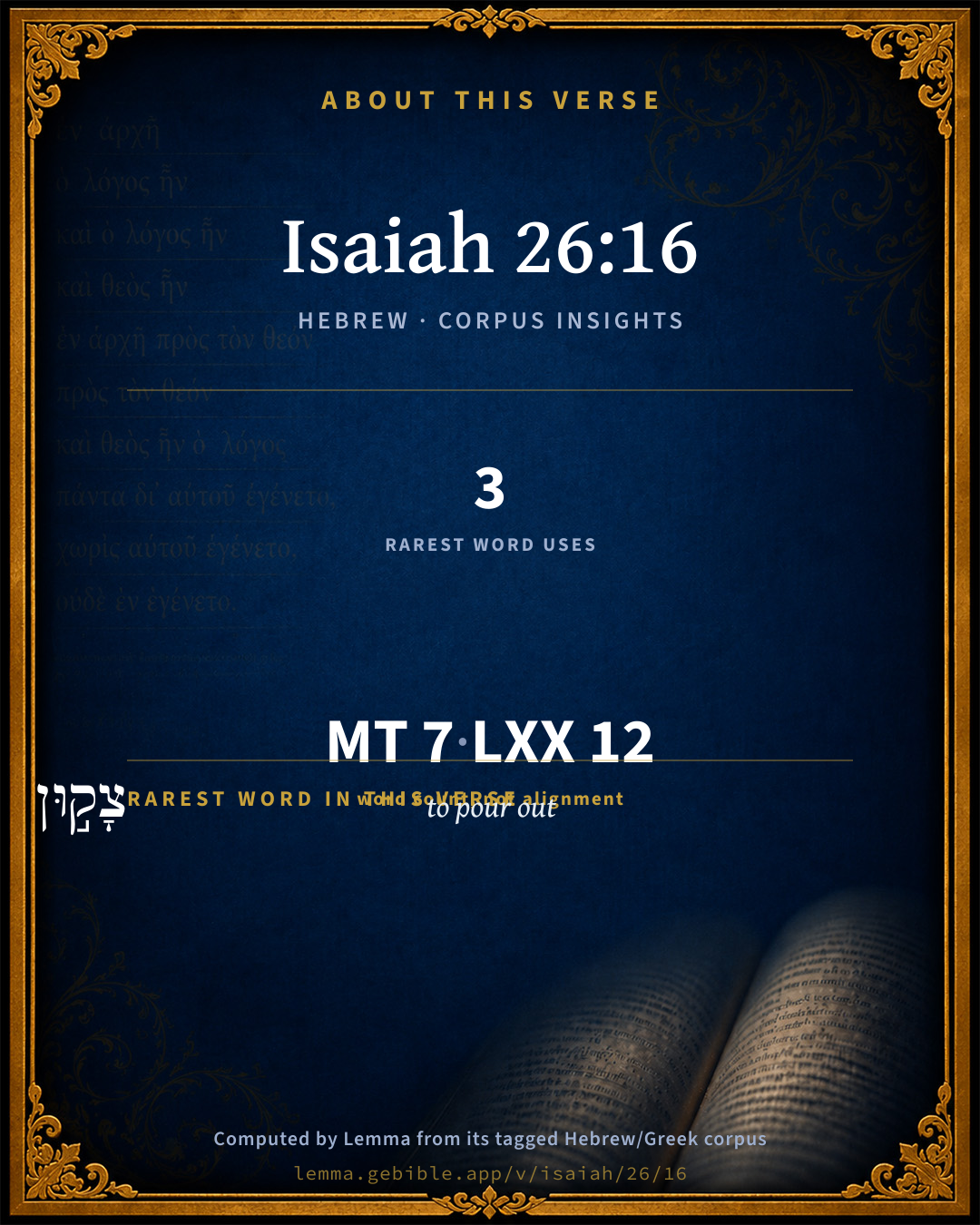
The rarest word here is צָק֣וּן to pour out H6694 — appearing just 3 times in the whole Hebrew Bible.

Shared distinctive vocabulary

צָק֣וּן to pour out H6694 occurs in 3 verses of the Hebrew Bible. Also found in:

Grammatical profile

  • 2 verbs
  • 3 nouns
  • 1 adjective
  • 1 preposition

Verb forms

  • פְּקָד֑וּךָ Qal · Perfect
  • צָק֣וּן Qal · Perfect

Hebrew & Septuagint length

In English translation the verse runs 18 words from the Hebrew and 14 from the Septuagint (LXX English) — closely comparable.

A rough comparison of the two English renderings, which tokenize alike — not a word-level alignment.

Word counts can differ between the Hebrew and the Greek without any difference in meaning — e.g. the Hebrew direct-object marker אֵת has no separate Greek word, and Greek often adds the article ὁ.

In the original languages it is 7 Hebrew tokens and 12 Greek tokens — but the two are counted differently (Hebrew bundles its prefixes and suffixes into one token; the Greek is in lemma form), so that isn’t a like-for-like length.

Cross-references

16

Topical passages linked to Isaiah 26:16 in the Treasury of Scripture Knowledge — connected by theme and wording, ordered by reader-vote popularity; previews shown in the World English Bible.

  • Hosea 5:15 I will go and return to my place, until they acknowledge their offense, And seek my face. In their affliction they will seek me earnestly."
  • Psalms 50:15 Call on me in the day of trouble. I will deliver you, and you will honor me."
  • Deuteronomy 4:29–30 But from there you shall seek Yahweh your God, and you shall find him, when you search after him with all your heart and with all your soul.
  • Judges 10:9–10 The children of Ammon passed over the Jordan to fight also against Judah, and against Benjamin, and against the house of Ephraim; so that Israel was sore distressed.
  • 1 Samuel 1:15 Hannah answered, No, my lord, I am a woman of a sorrowful spirit: I have drunk neither wine nor strong drink, but I poured out my soul before Yahweh.
  • 2 Chronicles 6:37–38 yet if they shall repent themselves in the land where they are carried captive, and turn again, and make supplication to you in the land of their captivity, saying, We have sinned, we have done perversely, and have dealt wickedly;
  • 2 Chronicles 33:12–13 When he was in distress, he begged Yahweh his God, and humbled himself greatly before the God of his fathers.
  • Psalms 42:4 These things I remember, and pour out my soul within me, How I used to go with the crowd, and led them to the house of God, With the voice of joy and praise, a multitude keeping a holy day.
  • Psalms 77:1–2 My cry goes to God! Indeed, I cry to God for help, And for him to listen to me.
  • Psalms 91:15 He will call on me, and I will answer him. I will be with him in trouble. I will deliver him, and honor him.
  • Psalms 142:2 I pour out my complaint before him. I tell him my troubles.
  • Isaiah 37:3 They said to him, Thus says Hezekiah, This day is a day of trouble, and of rebuke, and of rejection; for the children have come to the birth, and there is no strength to bring forth.
  • Jeremiah 22:23 Inhabitant of Lebanon, who makes your nest in the cedars, how greatly to be pitied shall you be when pangs come on you, the pain as of a woman in travail!
  • Lamentations 2:19 Arise, cry out in the night, at the beginning of the watches; Pour out your heart like water before the face of the Lord: Lift up your hands toward him for the life of your young children, that faint for hunger at the head of every street.
  • Hosea 7:14 They haven't cried to me with their heart, But they howl on their beds. They assemble themselves for grain and new wine. They turn away from me.
  • Revelation 3:19 As many as I love, I reprove and chasten. Be zealous therefore, and repent.

Cross-references courtesy of OpenBible.info (CC BY 4.0).

Hebrew and Greek witnesses Masoretic Hebrew ↔ Greek Septuagint

The same verse in the two great witnesses to the Old Testament, shown verse-for-verse.

These are two independent witnesses, not word-aligned to each other, and the Septuagint is shown in lemma (dictionary) form.

Hebrew Isaiah 26:16 Masoretic · Westminster Leningrad Codex

יְהוָ֖ה בַּצַּ֣ר פְּקָד֑וּךָ צָק֣וּן לַ֔חַשׁ מוּסָרְךָ֖ לָֽמוֹ

Yahweh, in trouble have they visited you; they poured out a prayer [when] your chastening was on them.

World English Bible · Public Domain

Greek LXX Isaiah 26:16 Septuagint · lemma form

κύριος ἐν θλῖψις μιμνήσκω σύ ἐν θλῖψις μικρός ὁ παιδεία σύ ἐγώ

Lord, in affliction I remembered you; your chastening was to us with small affliction.

LXX2012 (modern English Septuagint) · Public Domain

On this verse, Adam Clarke's Commentary discusses the Septuagint’s reading. Read the note in Commentary ↓

Hebrew: Westminster Leningrad Codex (CC BY 4.0). Greek: Septuagint (public domain); English from LXX2012 (modern English Septuagint) (Public Domain). How the Septuagint differs from the Hebrew →

Targum (Aramaic paraphrase)

1

The Targum is the ancient Jewish Aramaic paraphrase of the Hebrew Scriptures — an interpretive translation, not the Hebrew text itself. Onkelos (literal) and Pseudo-Jonathan (expansive) render the Torah, and Jonathan the Prophets. Coverage is partial: where no permissively-licensed English translation exists for a verse, only the Aramaic is shown. This is verse-level text, not a word-by-word alignment to the Hebrew.

  1. Targum Jonathan Prophets (Joshua–Malachi)
    יְיָ בְּעָקָא הֲווֹ דְכִירִין לִדְחַלְתָּךְ בְּעָקַתְהוֹן הֲווֹ מַלְפִין אוּלְפַן אוֹרַיְתָךְ בַּחֲשָׁי:

    O Lord, in distress they remembered thy fear; in their trouble they were ardently learning the doctrine of thy law.

    Targum Jonathan — Aramaic: “Mikraot Gedolot” (public domain). English: “Sefaria Community Translation” (CC0 1.0 (public-domain dedication)); “London "Chaldee Paraphrase," 1871” (public domain). Text via Sefaria.

Commentary

Notes on Isaiah 26:16 from classic Christian and Jewish commentators (each source and its license shown beneath its notes). The classic Christian expositions comment on the surrounding passage and are grouped to its opening verse, so a note may address several verses; the Jewish commentaries on the Tanakh (Rashi and others) are per-verse, so they appear only where the commentator wrote on this verse.

Lemma curates 59 commentaries, every one of them public domain or Creative Commons licensed, each selected and text-cleaned for this edition rather than reprinted as found. About our sources →

Trapp's Complete Commentary

John Trapp

Isa 26:16 LORD, in trouble have they visited thee, they poured out a prayer [when] thy chastening [was] upon them.

Ver. 16. Lord, in trouble have they visited thee.] Pulcherrimus afflictationum fructus, precandi ardor et assiduitas. Affliction exciteth devotion, as blowing doth the fire. Christ in his agony prayed most earnestly. {Luk 22:44} Martha and Mary, when their brother Lazarus was sick, sent messengers to Jesus; {Joh 11:3} Quos putas nisi suspiria continuata, nisi preces irremissas, saith Scultetus - i.e., what were those messengers but their continued groans and earnest prayers? See Hos 5:15. {See Trapp on "Hos 5:15"} Prayer is the daughter of affliction, and the mother of comfort.

They poured out.] Freely and largely, and well watered. {as 1Sa 1:10; 1Sa 7:6; 1Sa 7:9-10} Not dropped, but poured; not prayers, but a prayer; one continual act: and as in the speaking of three or four words there is much efficacy in a charm, so their prayers were very prevalent.

A prayer.] Heb., A charm, a mussitation, a submiss and lowly speech. Spells and enchantments were conceived to be full of efficacy, containing much in few: think the same of prayer. But how much was he mistaken in this kind of charm or spell who would haunt the taverns, play houses, and whore houses at London all day: but he dared not go forth without private prayer in the morning, and then would say at his departure, Now, devil, do thy worst.

John Trapp, A Commentary or Exposition upon All the Books of the Old and New Testament (1647–1656) — public domain. Text from a community e-Sword module.

The Biblical Illustrator

Joseph S. Exell

Isa_26:16

Lord, in trouble have they visited Thee

God a harbour of refuge

It is a blessed loss that makes us find our God! What we gain is in finitely more than what we have lost.

What a mercy that God is willing to hear us in the time of trouble, that all our putting off and rejection of Him do not make Him put us off! I remember one who wished to hire a conveyance to go to a certain town, and he went to the place where he could hire it, and asked the price; he thought that it was too much, so he went round the town to other people, and found that he could not get it any cheaper; but when he came back to the place visited first, the man said to him, Oh, no, no! I will not let my horses to you. You have been round to everybody else, and now you come back to me because you cannot get what you want elsewhere; I will have nothing to do with you. That is mans way of dealing with his fellow man; but it is not the Lords method of dealing with us. When you and I have gone round to everybody else, the Lord still welcomes us when we come back to Him. Yes, just as harbours of refuge are meant for ships in distress that would not have put in there except for the storm and danger, such is the mercy of the Lord God in Jesus Christ. If you are forced to accept it, you are still welcome to it. If you are driven to it by stress of weather, you may come in, for the harbour was made for just such as you are. (C. H. Spurgeon.)

The Biblical Illustrator, edited by Joseph S. Exell (c. 1880s–1900s) — public domain. Text from a community e-Sword module.

Joseph Benson's Commentary

Isa 26:16-18. O Lord, in trouble — Amidst the various calamities brought upon them for their correction and especially in their captivity; have they — Namely, thy people; visited thee — Come into thy presence with their prayers and supplications; they poured out a prayer — Prayed much and earnestly, as the expression implies; when thy chastening was upon them — When thou wast punishing them for their sins. Like as a woman is in pain, &c. — A comparison often used to express men’s consternation under great calamities, from which they cannot deliver themselves; so have we been in thy sight — Such has been our anguish and danger, of which thou, O Lord, hast been a witness. We have been with child — That is, we have had great expectation of a speedy and happy deliverance, have been big with hopes; and we have been in pain — Have comforted ourselves with this, that the joyful birth would make us forget our misery, but, alas! we have, as it were, brought forth wind — We have had the torment of a woman in child-bearing, but not the comfort of a living child. “We have had no good issue of all our pangs and throes; they did not produce deliverance and ease, as in the case of travailing women, but all our own labours proved abortive: in vain we struggled with our enemies, who were still too mighty for us,” and we were utterly unable to effect our deliverance. To bring forth wind, is much the same kind of phrase with feeding on wind, and reaping wind, Hos 12:1; Hos 8:7; and signifies, to take a great deal of pains to no purpose. This seems to be spoken of the siege which the Jewish people endured, and of all their other labours and sufferings to prevent their coming under the Chaldean yoke. Thus the attempt of Zedekiah to withstand Nebuchadnezzar we find only brought greater evils upon the country, 2Ch 36:13. We have not wrought any deliverance in the earth — In our land, where we had far greater advantages than we could have had elsewhere. Neither have the inhabitants of the world — The Assyrians, Chaldeans, or our other enemies; fallen — By our means.

Joseph Benson's Commentary on the Old and New Testaments (1811–1818) — public domain. Text from a community e-Sword module.

The Preacher's Complete Homiletical Commentary

Joseph S. Exell (gen. ed.)

PRAYER IN TROUBLE

Isa_26:16. “Lord, in trouble,” &c.

Every man knows what trouble is; what it is to lie under the chastening hand of God. In the day of trouble, we feel our dependence on external help. Some in adversity seek friends whom they neglect in prosperity. Happy is he who, when trouble comes, finds himself surrounded by true friends. Acquire the art of keeping your friends. But there are troubles to which human sympathy and help are inadequate. Times when men’s thoughts drift towards God. Trouble reminds us of the unseen, the spiritual, the eternal. It quickens the spiritual sense by casting the fierce light of eternity on the things of time. Men visit God in trouble by pouring out to Him their prayers.

I. Some pray in trouble, who are prayerless at other times. Multitudes live entirely without prayer. Taught by mothers in infancy. For a considerable part of ripening youth they maintained the habit. But began to neglect, were afraid of ridicule, or fell into sinful indulgence; it would appal them to think how long it is since they poured out one prayer to God. Surprising that with God so near, so many should habitually turn away and never seek His face. But some heavy trouble comes. They pause, recollect themselves, remember the long years of misspent time, pray, promise, and vow (H. E. I., 69).

Does this always continue when the trouble has departed? Is not this often the history? The cloud breaks, the sun bursts out again, the man forgets that the sun was ever hid. Ship in storm. Cries, prayers, vows. Ship is saved. Prayers cease; revelry is resumed. How often on the bed of sickness are prayers and promises uttered which are forgotten with returning health. Pharaoh alarmed by the successive plagues. Besought Moses to pray. Hardened his heart again. The children of Israel repeatedly fell into idolatry. Visited with judgments. Cried to the Lord. When punishment was withdrawn returned to the sin. Conviction is not conversion; awakening not repentance. If the heart remains unchanged, a man will only pray as long as he is alarmed (H. E. I., 3877–3879.)

II. Some begin to pray in trouble, and continue to pray afterwards. Many have had to thank God for trouble. Borne along the stream of prosperity towards destruction. Some obstruction. It was unwelcome. It compelled examination. It revealed the yawning falls a little way beyond. Just in time to return. Every human soul requires one such grand interruption of its career. Grace of God employs various means for its effectuation. Trouble is one (Hos_5:15). The soul’s deep sin, danger, need, has been revealed. The cry has gone up to heaven. It was the cry of true repentance and humble faith in the Crucified One. Comes from the trouble a new man—a praying man (Manasseh, 2Ch_33:10-13. The prodigal son, Luk_15:14-21).

III. Some pray habitually, but especially in trouble. Prayer is the special characteristic of a Christian. It is his “vital breath.” He cannot fail to establish stated seasons of prayer, both public and private. He endeavours to maintain the spirit of prayer. By its aid the blood of the spiritual life is kept in circulation. An important sense in which he prays “without ceasing” (H. E. I., 3866–3879; P. D., 2839). And every remarkable event is made the occasion of special prayer. Certainly trouble is one of these. Do you not go to God in your sorrows, as a child goes to his father or his mother? Bishop Reynolds says: “A godly heart is like those flowers which shut when the sun sets, and open again when the sun returns and shines upon them. Hannah prayed silently so long as she was in bitterness of spirit; but as soon as God answered her prayer and filled her heart with joy, presently her mouth was enlarged into a song of thanksgiving.” In trouble you pray,

1. for deliverance, in submission to the Divine will.

2. More especially for a sanctified use of trouble; complete submission, faith, purification (Php_4:6-7).—J. Rawlinson.

The Preacher's Complete Homiletical Commentary (gen. ed. Joseph S. Exell; Funk & Wagnalls, c. 1892) — public domain (pre-1929). A full-Bible homiletical/sermon-outline anthology covering 65 of 66 books (2 John is absent from the source module). Text from a community e-Sword module.

Tyndale Open Study Notes

Tyndale Open Resources

26:16 While waiting for God’s salvation (26:1), the godly were in distress and longed for their vindication. They prayed beneath the burden of God’s discipline. In Hezekiah’s time, Judah was in distress when Sennacherib attacked and destroyed the whole nation except for Jerusalem.

Tyndale Open Study Notes — © Tyndale Open Resources, licensed CC BY-SA 4.0. Text via the HelloAO Bible API.

Geneva Bible (1599)

Geneva Bible translators

That is, the faithful by the rods were moved to pray unto thee for deliverance.

Geneva Bible (1599) marginal notes — public domain. Text via Bolls.life.

Jamieson, Fausset & Brown

Robert Jamieson, A. R. Fausset & David Brown

visited--sought.

poured out-- (Psa 62:8), as a vessel emptying out all its contents.

prayer--literally, "a whispered prayer," Margin, "a secret sighing" to God for help (compare Jer 13:17; Deu 8:16).

Jamieson, Fausset & Brown — Commentary Critical and Explanatory on the Whole Bible (1871) — public domain (CC PDM 1.0). Text via the HelloAO Bible API.

Adam Clarke's Commentary

Verse 16. Lord, in trouble have they visited thee - "O JEHOVAH, in affliction we have sought thee"] So the Septuagint and two MSS. have פקדנוך pekadnucha, in the first person plural. And so perhaps it should be צקנו tsaknu, in the first person; but how the Septuagint read this word is not clear; and this last member of the verse is extremely obscure.

For למו lamo, "on them," the Septuagint read לנו lanu, "on us," in the first person likewise; a frequent mistake; See Clarke on Isa 10:29.

Adam Clarke's Commentary on the Bible (1810–1826) — public domain. Text from a community e-Sword/MySword module.

Ellicott's Commentary for English Readers

(16) Lord, in trouble have they visited thee.—Better, have they missed Thee (as in 1Sa_20:6; 1Sa_25:15), or sought after Thee, or, remembered Thee.

They poured out a prayer . . .—The word for “prayer” is a peculiar one, commonly used, as in Isa_3:3; Isa_8:19, for the whispered incantations of the heathen. Here it appears to mean the low-toned prayers, pitched as in a minor key, of the afflicted. In Isa_29:4 we have the same thought more fully developed.

A Bible Commentary for English Readers, edited by Charles John Ellicott (1878–1897) — public domain. Text from a community e-Sword module.

The Cambridge Bible for Schools and Colleges

gen. ed. J. J. S. Perowne

16. in trouble (“distress” or “straits,” as ch. Isa_25:4) have they visited thee] i.e. sought after thee. The verb might also mean “missed thee”—felt their need of thee. This was no doubt a spiritual gain, but the author’s complaint is that so little outward benefit has accrued from the nation’s discipline of sorrow.

they poured out … upon them] A difficult clause. The rendering of A.V. (and R.V.) is perhaps the best that can be made of the received text, but it can hardly be defended. The root-meaning of the word for “prayer” is “whisper,” but in usage it is confined to the sense of “enchantment.” It is questionable if it could mean “whispered prayer,” although the cognate verb in 2Sa_12:19 and Psa_41:7 might be appealed to in support of this view. Moreover, the verbal form “they poured out” is anomalous, and the syntax of “when thy chastisement was upon them” is at least hard. The only alternative translation that requires notice is that of Koppe (adopted by several good commentators): “the binding of a spell was thy chastisement unto them,” i.e. it acted on them with the potency of a spell. The construction there is easy enough and the textual change is only in the vowel-points; but the noun “binding” (“pressure”) does not occur, and the simile is perhaps too bold.

16–18. The poet plunges abruptly into a train of reflection on the depressing side of the nation’s experience.

The Cambridge Bible for Schools and Colleges (gen. ed. J. J. S. Perowne; Cambridge University Press, 1878–1918) — public domain. Text from a community e-Sword module.

John Gill's Exposition

Lord, in trouble have they visited thee,.... This, and the two following verses Isa 26:17, represent the troubles and disappointments of the church and people of God, before the destruction of antichrist; in which time of trouble they will visit the Lord, frequent the throne of grace, as saints in afflictions are wont to do; and sometimes this is the end to be answered by afflictions, Hos 5:15,

they poured out a prayer; or "muttering" (e); they will pray with a low voice, in an humble and submissive way, as persons in dejected circumstances; not a few words, but many, will they use; their petitions will be numerous; they will continue praying, and be constant at it, and out of the abundance of their hearts their mouth will speak; and they will pour out their souls and their complaints to the Lord, though privately, and with a low voice, and with groans unutterable:

when thy chastening was upon them; the afflicting hand of God, not as a punishment, but as a fatherly chastisement upon them; so all their persecutions from men are considered as permitted by the Lord for their instruction and correction; and these will not drive them from God, but bring them to him to seek him by prayer and supplication.

(e) "mussitationem", Montanus; "submissam orationem", Junius & Tremellius.

John Gill's Exposition of the Whole Bible (1746–1763) — public domain (CC PDM 1.0). Text via the HelloAO Bible API.

Albert Barnes' Notes on the Bible

Poured out a prayer - Margin, ‘Secret speech.’ The Hebrew word לחשׁ lachash means properly a whispering, muttering; and thru a sighing, a calling for help. This is the sense here. In their calamity they sighed, and called on God for help.

Albert Barnes' Notes on the Bible (1834–1885) — public domain. Text from a community e-Sword/MySword module.

Haydock's Catholic Bible Commentary

They. Septuagint, "We," &c. (Calmet) --- Affliction is a wholesome medicine. (Haydock)

George Leo Haydock (1774–1849), Haydock's Catholic Family Bible and Commentary, 1859 edition — public domain. Excludes Psalms (Douay-Rheims chapter numbering differs from Protestant) and Deuterocanonical books (Catholic canon only).

Matthew Poole's English Annotations

They, to wit, thy people, as appears both from the matter of this verse, and from the following verses.

Visited thee; come into thy presence, with their prayers and supplications, as the next clause explains it.

They poured out; which notes the plenty or rather the earnestness of their prayers, as Psa 42:4; 142:2.

A prayer, Heb. a muttering or lowly speech, such as charmers use, and such as Hezekiah used when he was in great distress, Isa 38:14, Like a crane or swallow, so did I chatter: I did mourn as a dove; and such as is usual in case of great humiliation and dejection of mind. When thy chastening was upon them; when thou wast punishing them for their sins.

Matthew Poole's English Annotations on the Holy Bible (1683–1685) — public domain. Text from a community e-Sword/MySword module.

Whedon's Commentary on the Bible

Daniel D. Whedon

16-18. Back to Israel’s night of affliction — perhaps before, and certainly during, the captivity — is the glance again taken. See Isa_26:8-9.

In trouble… they visited thee — “They,” the then faithful of Israel, sought to find thee.

They poured out a prayer — Not an audible, but a whispered, prayer: like Hannah’s prayer, from the heart’s depths. So the word here means. Its object was the nation’s salvation from overthrow and captivity. So felt the prophets and holy ones of Judah. But in vain. Calamities would come, because Judah’s sin, now socially and poetically crystallized, required them. The prayer was an agony, like that of women near to birth-giving. The prayer continued long into the night of the captivity. In ineffectual praying they almost gave themselves up as dead.

Daniel D. Whedon (gen. ed.), Commentary on the Old and New Testaments (1874–1909) — public domain. Text from a community e-Sword module.

The Pulpit Commentary

Lord, in trouble have they visited thee. Here, at any rate, the redeemed go back in thought to their time of trouble. They remember that what brought them back to God from that alienation which they have confessed (ver. 13) was the affliction which they so long endured. Their present bliss is the result of their former woe, and recalls the thought of it. They poured out a prayer; rather, as in the margin, a secret speech, or a low whisper (Kay); comp. Isa_29:4. The word elsewhere means "the muttering of a charm," but must here signify the whispered prayer" of one in deep humiliation.

Prayer in trouble.

"Lord, in trouble have they visited thee, they poured out a prayer when thy chastening was upon them." The "other lords," mentioned in the thirteenth verse, are all impotent in the hour of tribulation. Truly they are dead, as Carlyle says. "These idols of yours are wood; you pour wax and oil on them; the flies stick on them; they are not God, I tell you; they are black wood." So at the Reformation. Speaking of Luther, he says, "The quiet German heart., modest, patient of much, had at length got more than it could bear. Formalism, pagan-popeism, and other falsehood and corrupt semblance, had ruled long enough; and here once more was a man found who durst tell all men that God"s world stood, not on semblances, but realities; that life was a truth, and not a lie!" There are idolatries in every age; but the idols of rank and fame and pleasure are of no avail in the hour of trouble.

I HERE IS RECEPTION. The Lord receives them. He does not spurn their approach because they have kept away till then. The great Father never reproaches the repentant, returning Israel. No. Unlike the proud, resentful spirit of man, "the Lord God is gracious and merciful, slow to anger, and of great kindness." The haughty spirit of man would resent the approach of one who was simply driven by stress of weather into the haven of his protection.

II HERE IS REALITY. They are filled with earnestness. It is no easy ritual of the lips. They "poured out" a prayer. Very expressive indeed is that. The rock was rent, and the waters flowed forth. The poor bruised heart could contain its agony no longer. There was confession. There was that blessed "outness" which of itself brings relief. These men had seen the pouring forth of the swollen Jordan, and of the storm-filled streams of Lebanon. So is it that the earnestness of the soul at once engages the attention and interest of God. It matters little whether prayer be liturgical or free, whether it be in the sanctuary or the closet, so long as the soul seeks God as the hart desireth the water-brooks; and the literal rendering of "prayer" here is "secret speech.

III HERE IS DISCIPLINE. "When thy chastening was upon them." This is very different from self-chosen and self-inflicted chastisement. Some Christians in every age have become self-tormentors: some, with the Flagellants, in the infliction of physical torture, and some in constant introspection painful searching of their own motives, and mourning over their own want of faith and of feeling. But this text speaks of God"s own discipline a Father"s discipline, and therefore a wise, a kind, and a safe discipline. Moreover, it is but for "a season." We read, "when thy discipline was upon them," which, in its very language, suggests that it is not a lasting condition. The Jews came back from exile. Their punishments for idolatry gave place to pardon and restoration. So it is now. God does not delight in the sufferings of his children. "Tribulation worketh patience;" our "weeping may endure for a night, but joy cometh in the morning." In the heart of the prickly encasement there is opening out a beautiful flower. W.M.S.

Prayer forced by trouble.

One of the commonest, and often one of the most painful, of human experiences. The scoffer bends the knee when life is placed in sudden peril. The prayerless cry mightily when death stares them in the face. Prayerlessness is only a fair-weather attainment. Like the children who do not seem to care for mother when health abounds, but run to her at once when the head is aching; so we can bravely do without God while the sun shines, but want him when the black thunder-clouds come creeping up against the wind. Let the cholera come into our midst, and almost abjectly the nation begins to ask for days of humiliation and prayer. As this subject is a somewhat familiar one, the following divisions may give some freshness to the treatment of it.

I A SPIRIT OF INDEPENDENCE IS NOURISHED BY PROSPERITIES AND SUCCESSES. The ordinary man does not feel the need of God when all goes well with him. He does not need prayer, for he is not conscious of anything to pray for. If man can stand alone, why should we seek God? And the Christian man, who believes in prayer, is under grave and serious temptation to neglect prayer when he is successful, and free from care. As soon as we become satisfied with ourselves we begin to lose our "first love." The spirit of independence and the spirit, of prayer never did, and- never can, dwell together. Ivy is a poor thing if it grows up independently. Its beauty unfolds only when it leans on another on one who has independent strength.

II A SPIRIT OF DEPENDENCE IS NOURISHED BY CALAMITIES. In a thousand forms they come to us, but their message is always the same. They say to us, "See, you cannot, by yourself." Life is not all sunshine and prosperity. We must take it as a whole, take it as it is. We must reckon for trouble. And for life as a whole we need God; we ought to be dependent; we should be happy in our dependence. Jacob, in his anxiety at meeting Esau, was forced to dependence and prayer. Joshua, discomfited before At, was forced to prayer. Jehoshaphat, threatened by national foes, flies to prayer. Hezekiah, stricken with disease and facing death, turns his face to the wall, and prays. Then impress the graciousness of the Divine ways with us. Watching over our eternal interests, God saves us again from the perils of independence, and calls us back to dependence, by putting trouble into our lives, and we learn to say, "Before I was afflicted I went astray, but now will I keep thy Word. R.T.

The Pulpit Commentary (1880–1919), ed. H.D.M. Spence-Jones & Joseph S. Exell — public domain. Text from a community e-Sword module.

John Wesley's Explanatory Notes

They - Thy people. Visited - Come into thy presence, with their prayers and supplications.

John Wesley, Explanatory Notes Upon the Whole Bible (1754–1765) — public domain. Text via the GEBible commentary corpus.

Keil & Delitzsch

C. F. Keil & F. Delitzsch

The tephillâh now returns to the retrospective glance already cast in Isa 26:8, Isa 26:9 into that night of affliction, which preceded the redemption that had come. "Jehovah, in trouble they missed Thee, poured out light supplication when Thy chastisement came upon them. As a woman with child, who draws near to her delivery, writhes and cries out in her pangs, so were we in Thy sight, O Jehovah. We went with child, we writhed; it was as if we brought forth wind. We brought no deliverance to the land, and the inhabitants of the world did not come to the light." The substantive circumstantial clause in the parallel line, למו מוּסר, castigatione tua eos affilgente (ל as in Isa 26:9), corresponds to בּצּר; and לחשׁ צקוּן, a preterite עצוּק etire = יצק, Job 28:2; Job 29:6, to be poured out and melt away) with Nun paragogic (which is only met with again in Deu 8:3, Deu 8:16, the yekōshūn in Isa 29:21 being, according to the syntax, the future of kōsh), answers to pâkad, which is used here as in Isa 34:16; Sa1 20:6; Sa1 25:15, in the sense of lustrando desiderare. Lachash is a quiet, whispering prayer (like the whispering of forms of incantation in Isa 3:3); sorrow renders speechless in the long run; and a consciousness of sin crushes so completely, that a man does not dare to address God aloud (Isa 29:4). Pregnancy and pangs are symbols of a state of expectation strained to the utmost, the object of which appears all the closer the more the pains increase. Often, says the perfected church, as it looks back upon its past history, often did we regard the coming of salvation as certain; but again and again were our hopes deceived. The first כּמו is equivalent to כּ, "as a woman with child," etc. (see at Isa 8:22); the second is equivalent to כּאשׁר, "as it were, we brought forth wind." This is not an inverted expression, signifying we brought forth as it were wind; but כמו governs the whole sentence in the sense of "(it was) as if." The issue of all their painful toil was like the result of a false pregnancy (empneumatosis), a delivery of wind. This state of things also proceeded from Jehovah, as the expression "before Thee" implies. It was a consequence of the sins of Israel, and of a continued want of true susceptibility to the blessings of salvation. Side by side with their disappointed hope, Isa 26:18 places the ineffectual character of their won efforts. Israel's own doings - no, they could never make the land into ישׁוּעת (i.e., bring it into a state of complete salvation); and (so might the final clause be understood) they waited in vain for the judgment of Jehovah upon the sinful world that was at enmity against them, or they made ineffectual efforts to overcome it. This explanation is favoured by the fact, that throughout the whole of this cycle of prophecies yōshbē tēbēl does not mean the inhabitants of the holy land, but of the globe at large in the sense of "the world" (Isa 26:21; Isa 24:5-6). Again, the relation of יפּלוּ to the תּפּיל in Isa 26:19, land the figure previously employed of the pains of child-birth, speak most strongly in favour of the conclusion, that nâphal is here used for the falling of the fruit of the womb (cf., Wis. 7:3, Il. xix. 110, καταπεσεῖν and πεσεῖν). And yōshbē tēbēl (the inhabitants of the world) fits in with this sense (viz., that the expected increase of the population never came), from the fact that in this instance the reference is not to the inhabitants of the earth; but the words signify inhabitants generally, or, as we should say, young, new-born "mortals." The punishment of the land under the weight of the empire still continued, and a new generation did not come to the light of day to populate the desolate land (cf., Psychol. p. 414).

Keil & Delitzsch — Biblical Commentary on the Old Testament (1861–1891) — public domain (CC PDM 1.0). Text via the HelloAO Bible API. (Old Testament only.)

J. A. Alexander on Isaiah

Joseph Addison Alexander

“Jehovah, in distress they visited Thee; they uttered a whisper; Thy chastisement was on them.” It was not merely after their deliverance that they turned from idols unto God. Their deliverance itself was owing to their humble prayers. ‘Visit’ is here used in the unusual but natural sense of seeking God in supplication. The translation ‘they uttered a whisper’ is not only admissible but beautifully expressive of submissive humble prayer, like that of Hannah when she spake in her heart and only her lips moved, but her voice was not heard, although, as she said herself, she poured out her soul before God, which is the exact sense of the word in this place. A like expression is applied to prayer in the title of Psalms 102. It is implied, though not expressed, that their prayer was humble and submissive because they felt that what they suffered was a chastisement from God.

Joseph Addison Alexander, The Prophecies of Isaiah (1846–1847; New York: Scribner, 1870–1878) — public domain. Text from a community e-Sword module.

unfoldingWord translationNotes

Door43 World Missions Community

they looked to you

Here "they" refers to the people of Israel. This would include Isaiah. AT: "we looked to you" (See: First, Second, or Third Person)

looked to you

This idiom means they asked Yahweh for help. (See: Idiom)

when your discipline was on them

The abstract noun "discipline" can be stated as a verb. AT: "when you disciplined them" (See: Abstract Nouns)

As a pregnant woman ... cries out in her labor pains

This compares the people to a woman giving birth. This emphasizes their suffering and crying when Yahweh disciplined them. (See: Simile)

translationWords

Yahweh

discipline

labor pains

unfoldingWord translationNotes — © Distant Shores Media and the Door43 World Missions Community, licensed CC BY-SA 4.0. Source: git.door43.org/Door43/en_tn.

Rashi

Rabbi Shlomo Yitzchaki (Rashi)

O Lord, in their straits they remembered You They do not question Your retributions.

they pour out prayer the pouring of speech and prayer.

when Your chastening is upon them When they are chastened, when Your chastening comes upon them; and so is their prayer.

Rashi on the Tanakh — English translations: “The Judaica Press complete Tanach with Rashi, translated by A. J. Rosenberg” (CC BY 4.0); “Pentateuch with Rashi's commentary by M. Rosenbaum and A.M. Silbermann, 1929-1934” (public domain); “The Metsudah Tanach series, Lakewood, N.J” (CC BY 4.0); and “The Book of Joshua, Metsudah Publications, 1997” (CC BY 4.0). Text via Sefaria.

Ibn Ezra

Rabbi Abraham ibn Ezra

In trouble. In their trouble.

צקון They poured out. The נ is paragogic, as in ידעון they knew (Deut. 8:3); the word is besides irregular; the regular form is יצקו; the first radical is dropped in צקון; comp. ירד═רד he went down (Judg. 19:11). As to the phrase they poured out a prayer, comp. he will pour out his prayer (Ps. 102:1).

מוסרך למו Thy chastening upon them. They mention in their prayer the punishment which thou hast inflicted upon them.

Ibn Ezra on the Tanakh — English translations: “Sefaria Community Translation” (CC0 1.0 (public-domain dedication)); “Yalkut, Sifsei Chachomim Chumash, Metsudah Publications, 2009” (CC BY 4.0); and “Commentary of Ibn Ezra on Isaiah - trans. by M. Friedlander, 1873” (public domain). Text via Sefaria.

Lesson kit

Teaching starters — assembled from the data on this page, not authored interpretation. Every prompt links to the verse data it draws on. Edit before teaching.

Isaiah, in the Prophets, opens this verse with 7 words (6 distinct Hebrew lemmas). Its most distinctive word is tsûwq (“to pour out”). A historical commentator’s framing appears above. Read the whole chapter for the surrounding context.

Discussion questions

  1. How does “to pour out” (tsûwq) shape what this verse is saying?
  2. Job 28:2 shares the word «to pour out» with this verse. How do the two illuminate each other?
  3. These translations render this verse differently. What is at stake in choosing one wording over another?
  4. The verb «פְּקָד֑וּךָ» is Qal Perfect. How does its form color the action?
  5. Reading how Trapp's Complete Commentary and The Biblical Illustrator read this verse, where do the two commentators agree and where do they part?

Things to notice

Reading settings

Reading text

Shown beneath each verse's original-language words.

Old Testament
Old Testament edition

Read the OT as the Masoretic Hebrew (MT) or the Greek Septuagint (LXX).

English shown for the Greek Septuagint (in the Hebrew ↔ Greek comparison).

Comparing translations? Open the Compare panel on any verse page to stack up to four side by side.