1 Kings 20:26

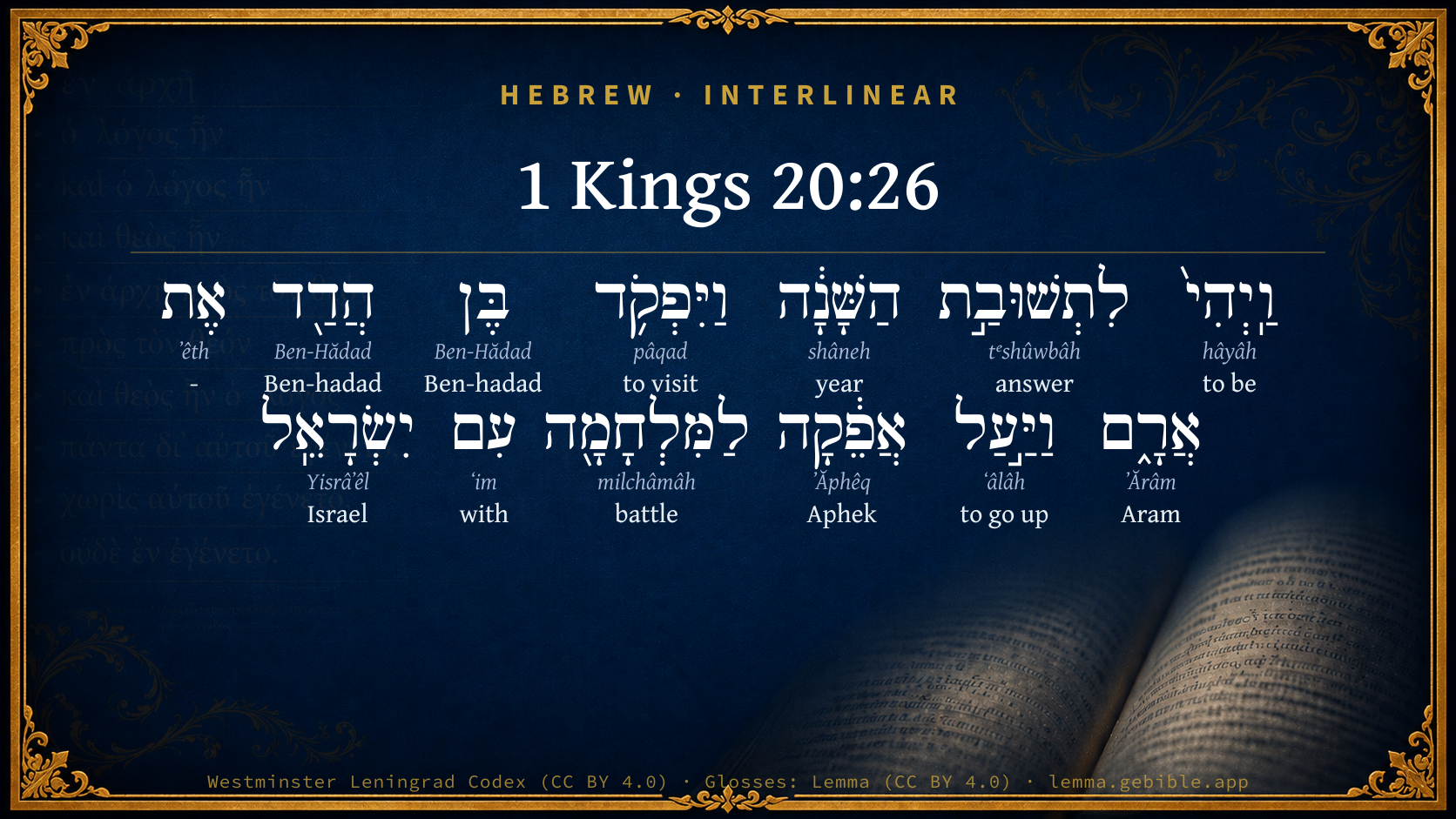
Hebrew (Westminster Leningrad Codex) 1 Kings 20:26 appears in the Hebrew Old Testament. The text above is from the Westminster Leningrad Codex. Each word links to its Strong’s number, a concise gloss, and parsing drawn from the Open Scriptures Hebrew Bible morphology. Click any word for its full Brown-Driver-Briggs (BDB) entry.
Download image
Cite this verse

1 Kings 20:26 (World English Bible). Public Domain. Lemma interlinear Bible study tool, https://lemma.gebible.app/v/1-kings/20/26.

Show BibTeX & RIS
BibTeX
RIS
English Translation
It happened at the return of the year, that Ben Hadad mustered the Syrians, and went up to Aphek, to fight against Israel.
World English Bible · Public Domain
Download a study sheet

One document with this verse’s original text, its word-by-word gloss line, the meaning frame, cross-references with their text, attributed commentary, and full source and license credits — printable, and it pastes into notes with its structure intact.

This verse Autodidact and up

Study sheet (.html) Plain text (.txt)

A passage Seminary Student

Up to 50 verses in one chapter. A passage sheet keeps up to 6 commentary sources and 12 cross-references per verse, in the order this page ranks them, and says so on the sheet whenever that leaves anything out. Ask for a single verse and you get the Autodidact verse sheet above.

Everything on this page stays free to read, with no account — the sheet is a download of what is already on screen, not access to it.

Want to remove ads? Support Godless Engineer
Compare translations 3

The same verse in 3 English versions, stacked beneath the original-language interlinear above. Click any original word for its lexicon entry.

Each is an independent rendering of the whole verse — the interlinear is not word-aligned to these translations.

Highlighted words mark where these versions differ — a whole-verse word diff, not a word-by-word alignment.

  • World English Bible Public Domain
    It happened at the return of the year, that Ben Hadad mustered the Syrians, and went up to Aphek, to fight against Israel.
  • King James Version Public Domain
    And it came to pass at the return of the year, that Benhadad numbered the Syrians, and went up to Aphek, to fight against Israel.
  • unfoldingWord Literal Text CC BY-SA 4.0
    And it happened at the return of the year that Ben Hadad mustered Aram. And he went up to Aphek for battle with Israel.

unfoldingWord Literal Text — © unfoldingWord, licensed CC BY-SA 4.0. Word-aligned USFM3 via Door43 (git.door43.org/unfoldingWord/en_ult).

Versions to compare (up to 4)

3 of 4 selected

Show all 18 translations

Every available English version of this verse, each an independent rendering of the whole verse.

  • World English Bible Public Domain
    It happened at the return of the year, that Ben Hadad mustered the Syrians, and went up to Aphek, to fight against Israel.
  • Berean Standard Bible Public Domain
    In the spring, Ben-hadad mobilized the Arameans and went up to Aphek to fight against Israel.
  • Majority Standard Bible Public Domain
    In the spring, Ben-hadad mobilized the Arameans and went up to Aphek to fight against Israel.
  • King James Version Public Domain
    And it came to pass at the return of the year, that Benhadad numbered the Syrians, and went up to Aphek, to fight against Israel.
  • American Standard Version (1901) Public Domain
    And it came to pass at the return of the year, that Ben-hadad mustered the Syrians, and went up to Aphek, to fight against Israel.
  • Revised Version (1885) Public Domain
    And it came to pass at the return of the year, that Ben-hadad mustered the Syrians, and went up to Aphek, to fight against Israel.
  • Geneva Bible (1599) Public Domain
    And after the yeere was gone about, Ben-hadad nombred the Aramites, and went vp to Aphek to fight against Israel.
  • Douay-Rheims (1899) Public Domain
    Wherefore at the return of the year, p Benadad mustered the Syrians, ancient up to Aphec, to fight against Israel.
  • Young's Literal Translation Public Domain
    And it cometh to pass at the turn of the year, that Ben-Hadad inspecteth the Aramaeans, and goeth up to Aphek, to battle with Israel,
  • Literal Standard Version CC BY-SA 4.0
    And it comes to pass at the turn of the year, that Ben-Hadad inspects the Arameans, and goes up to Aphek, to battle with Israel,
  • Unlocked Literal Bible CC BY-SA 4.0
    After the beginning of the new year, Ben Hadad mustered the Arameans and went up to Aphek to fight against Israel.
  • unfoldingWord Literal Text CC BY-SA 4.0
    And it happened at the return of the year that Ben Hadad mustered Aram. And he went up to Aphek for battle with Israel.
  • Darby Bible Public Domain
    And it came to pass, at the return of the year, that Ben-Hadad numbered the Syrians, and went up to Aphek, to fight against Israel.
  • World Messianic Bible Public Domain
    At the return of the year, Ben Hadad mustered the Syrians and went up to Aphek to fight against Israel.
  • Webster's Bible Public Domain
    And it came to pass at the return of the year, that Ben-hadad numbered the Syrians, and went up to Aphek, to fight against Israel.
  • Free Bible Version CC BY-SA 4.0
    When spring came Ben-hadad called up the Aramean army and went to attack Israel at Aphek.
  • Bible in Basic English Public Domain
    So, a year later, Ben-hadad got the Aramaeans together and went up to Aphek to make war on Israel.
  • JPS Tanakh (1917) Public Domain
    And it came to pass at the return of the year, that Ben-hadad mustered the Arameans, and went up to Aphek, to fight against Israel.

Literal Standard Version (2020), Covenant Press — licensed CC BY-SA 4.0. Text via the HelloAO Bible API (eBible.org). Unlocked Literal Bible (unfoldingWord) — licensed CC BY-SA 4.0. Text via the HelloAO Bible API (eBible.org). unfoldingWord Literal Text — © unfoldingWord, licensed CC BY-SA 4.0. Word-aligned USFM3 via Door43 (git.door43.org/unfoldingWord/en_ult). Free Bible Version, Dr. Jonathan Gallagher — licensed CC BY-SA 4.0. Text via the HelloAO Bible API (eBible.org).

Word by word

More ways to search: Search by grammar → Find every occurrence → Compare this word →

Practice this passage: Drill this verse → Learn its vocabulary →

לִתְשׁוּבַ֣ת
tᵉshûwbâh
H8666
“to/for · answer of”
Preposition + Noun, Common, Feminine, Singular, Construct
Part of Speech
Preposition + Noun
Type
Common
Gender
Feminine
Number
Singular
State
Construct
Full BDB Definition

Origin: from H7725

TWOT: 2340f

a recurrence, an answer, return - return - completion of a year, return of a year - at the return (construct) - answer, reply
  1. וַֽיְהִי֙ hâyâh H1961 “and · to be” Conjunction + Verb, Qal, Sequential Imperfect, 3rd Person, Masculine, Singular
  2. הַשָּׁנָ֔ה shâneh H8141 “the · year” Particle, Definite Article + Noun, Common, Feminine, Singular, Absolute
  3. וַיִּפְקֹ֥ד pâqad H6485 “and · to visit” Conjunction + Verb, Qal, Sequential Imperfect, 3rd Person, Masculine, Singular
  4. בֶּן Ben-Hădad H1130 “Ben-hadad” Noun, Proper
  5. הֲדַ֖ד Ben-Hădad H1130 “Ben-hadad” Noun, Proper
  6. אֶת ʼêth H853 “-” Particle, Direct Object
  7. אֲרָ֑ם ʼĂrâm H758 “Aram” Noun, Proper
  8. וַיַּ֣עַל ʻâlâh H5927 “and · to go up” Conjunction + Verb, Qal, Sequential Imperfect, 3rd Person, Masculine, Singular
  9. אֲפֵ֔קָה ʼĂphêq H663 “Aphek · toward” Noun, Proper + Suffix, Demonstrative
  10. לַמִּלְחָמָ֖ה milchâmâh H4421 “to/for the · battle” Preposition, Determined + Noun, Common, Feminine, Singular, Absolute
  11. עִם ʻim H5973 “with” Preposition
  12. יִשְׂרָאֵֽל Yisrâʼêl H3478 “Israel” Noun, Proper

About this verse

These counts appear in no published source. They are computed here, from the morphology-tagged text and Lemma’s own curated glosses. What Lemma adds →

13
words
12
distinct lemmas
Historical
section

Notable vocabulary

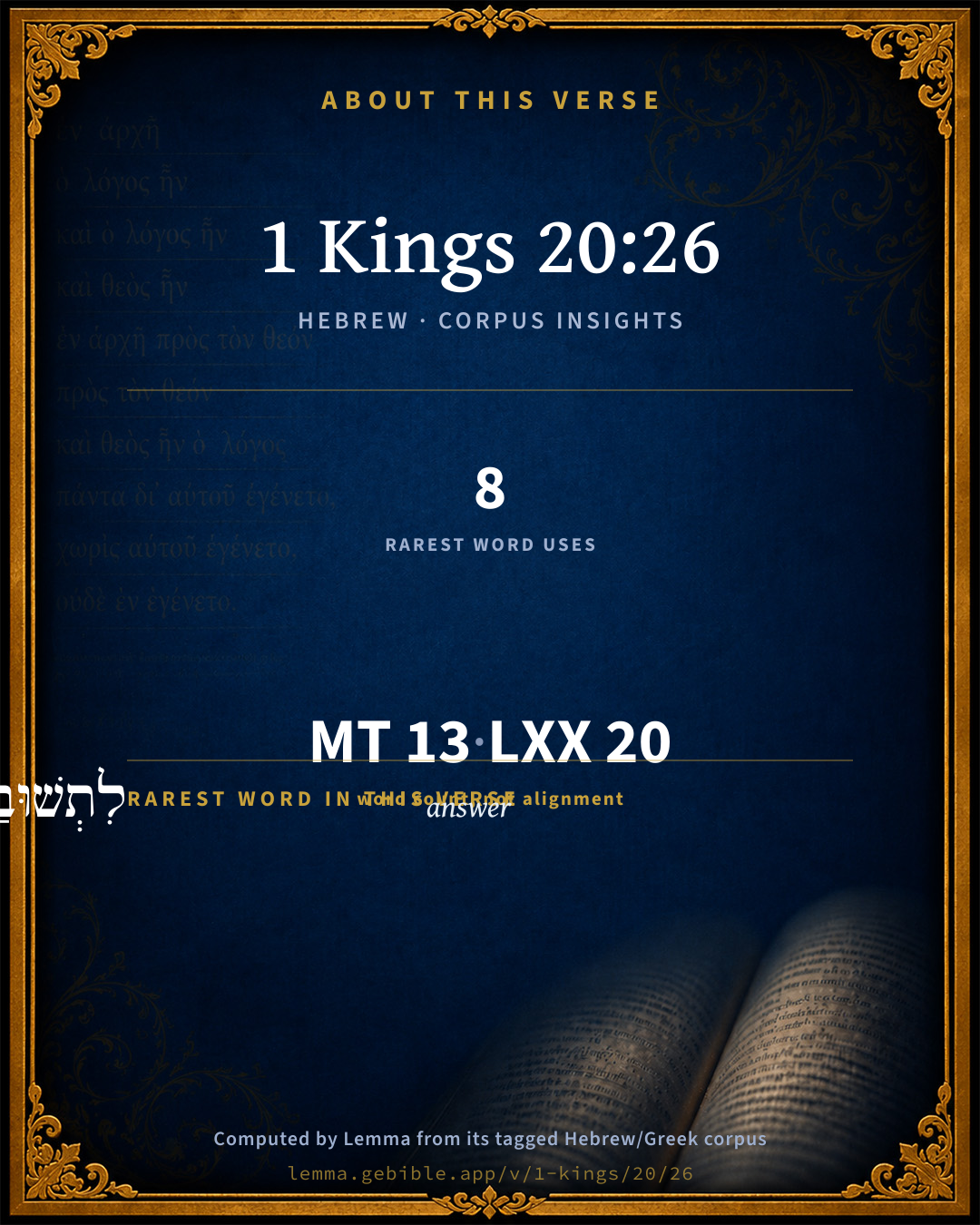
The rarest word here is לִתְשׁוּבַ֣ת answer H8666 — appearing just 8 times in the whole Hebrew Bible.

Shared distinctive vocabulary

לִתְשׁוּבַ֣ת answer H8666 occurs in 8 verses of the Hebrew Bible. Also found in:

Grammatical profile

  • 3 verbs
  • 8 nouns
  • 1 preposition
  • 1 particle

Verb forms

  • וַֽיְהִי֙ Qal · Sequential Imperfect
  • וַיִּפְקֹ֥ד Qal · Sequential Imperfect
  • וַיַּ֣עַל Qal · Sequential Imperfect

Repetition

A word recurs within this verse — often emphatic in Hebrew:

  • בֶּן Ben-hadad H1130 ×2

Hebrew & Septuagint length

In English translation the verse runs 23 words from the Hebrew and 28 from the Septuagint (LXX English) — closely comparable.

A rough comparison of the two English renderings, which tokenize alike — not a word-level alignment.

Word counts can differ between the Hebrew and the Greek without any difference in meaning — e.g. the Hebrew direct-object marker אֵת has no separate Greek word, and Greek often adds the article ὁ.

In the original languages it is 13 Hebrew tokens and 20 Greek tokens — but the two are counted differently (Hebrew bundles its prefixes and suffixes into one token; the Greek is in lemma form), so that isn’t a like-for-like length.

Cross-references

8

Topical passages linked to 1 Kings 20:26 in the Treasury of Scripture Knowledge — connected by theme and wording, ordered by reader-vote popularity; previews shown in the World English Bible.

  • 2 Kings 13:17 He said, Open the window eastward; and he opened it. Then Elisha said, Shoot; and he shot. He said, Yahweh's arrow of victory, even the arrow of victory over Syria; for you shall strike the Syrians in Aphek, until you have consumed them.
  • 1 Kings 20:22 The prophet came near to the king of Israel, and said to him, Go, strengthen yourself, and mark, and see what you do; for at the return of the year the king of Syria will come up against you.
  • Joshua 13:4 on the south; all the land of the Canaanites, and Mearah that belongs to the Sidonians, to Aphek, to the border of the Amorites;
  • Joshua 19:30 Ummah also, and Aphek, and Rehob: twenty-two cities with their villages.
  • Judges 1:31 Asher didn't drive out the inhabitants of Acco, nor the inhabitants of Sidon, nor of Ahlab, nor of Achzib, nor of Helbah, nor of Aphik, nor of Rehob;
  • 1 Samuel 4:1 The word of Samuel came to all Israel. Now Israel went out against the Philistines to battle, and encamped beside Ebenezer: and the Philistines encamped in Aphek.
  • 1 Samuel 29:1 Now the Philistines gathered together all their hosts to Aphek: and the Israelites encamped by the spring which is in Jezreel.
  • 1 Kings 20:30 But the rest fled to Aphek, into the city; and the wall fell on twenty-seven thousand men who were left. Ben Hadad fled, and came into the city, into an inner chamber.

Cross-references courtesy of OpenBible.info (CC BY 4.0).

Hebrew and Greek witnesses Masoretic Hebrew ↔ Greek Septuagint

The same verse in the two great witnesses to the Old Testament, shown verse-for-verse.

These are two independent witnesses, not word-aligned to each other, and the Septuagint is shown in lemma (dictionary) form.

Hebrew 1 Kings 20:26 Masoretic · Westminster Leningrad Codex

וַֽיְהִי֙ לִתְשׁוּבַ֣ת הַשָּׁנָ֔ה וַיִּפְקֹ֥ד בֶּן הֲדַ֖ד אֶת אֲרָ֑ם וַיַּ֣עַל אֲפֵ֔קָה לַמִּלְחָמָ֖ה עִם יִשְׂרָאֵֽל

It happened at the return of the year, that Ben Hadad mustered the Syrians, and went up to Aphek, to fight against Israel.

World English Bible · Public Domain

Greek LXX 1 Kings 20:26 Septuagint · lemma form

καί βδελύσσω σφόδρα πορεύομαι ὀπίσω ὁ βδέλυγμα κατά πᾶς ὅς ποιέω ὁ ἀμορραῖος ὅς ἐκὀλεθρεύω κύριος ἀπό πρόσωπον υἱός ἰσραήλ

And he did very abominably in following after the abominations, according to all that the Amorite did, whom the Lord utterly destroyed from before the children of Israel.

LXX2012 (modern English Septuagint) · Public Domain

Hebrew: Westminster Leningrad Codex (CC BY 4.0). Greek: Septuagint (public domain); English from LXX2012 (modern English Septuagint) (Public Domain). How the Septuagint differs from the Hebrew →

Targum (Aramaic paraphrase)

1

The Targum is the ancient Jewish Aramaic paraphrase of the Hebrew Scriptures — an interpretive translation, not the Hebrew text itself. Onkelos (literal) and Pseudo-Jonathan (expansive) render the Torah, and Jonathan the Prophets. Coverage is partial: where no permissively-licensed English translation exists for a verse, only the Aramaic is shown. This is verse-level text, not a word-by-word alignment to the Hebrew.

  1. Targum Jonathan Prophets (Joshua–Malachi)
    וַהֲוָה לִזְמַן סוֹפָא דְשַׁתָּא וּמְנָא בַר הֲדַד יַת אֱנַשׁ אֲרָם וּסְלֵיק לַאֲפֵק לְאַגָחָא קְרָבָא עִם יִשְׂרָאֵל:

    (no public-domain English translation for this verse)

    Targum Jonathan — Aramaic: “Mikraot Gedolot” (public domain). English: “Sefaria Community Translation” (CC0 1.0 (public-domain dedication)); “London "Chaldee Paraphrase," 1871” (public domain). Text via Sefaria.

Commentary

Notes on 1 Kings 20:26 from classic Christian and Jewish commentators (each source and its license shown beneath its notes). The classic Christian expositions comment on the surrounding passage and are grouped to its opening verse, so a note may address several verses; the Jewish commentaries on the Tanakh (Rashi and others) are per-verse, so they appear only where the commentator wrote on this verse.

Lemma curates 59 commentaries, every one of them public domain or Creative Commons licensed, each selected and text-cleaned for this edition rather than reprinted as found. About our sources →

Trapp's Complete Commentary

John Trapp

1Ki 20:26 And it came to pass at the return of the year, that Benhadad numbered the Syrians, and went up to Aphek, to fight against Israel.

Ver. 26. And went up to Aphek.] Which was, saith Lyra, a strong city in Asher, taken from the Israelites by the Syrians, before which lay a great plain of the same name; famous for many great battles there fought. Benhadad chose to fight here, that if he were worsted, he might repair to it for refuge. But how reckless was Pompey, who, when to fight with Caesar, that great soldier and conqueror, never considered into what place he were best to retire if he lost the day, as indeed he did, and no wonder.

John Trapp, A Commentary or Exposition upon All the Books of the Old and New Testament (1647–1656) — public domain. Text from a community e-Sword module.

Joseph Benson's Commentary

1Ki 20:26-27. Ben-hadad numbered the Syrians, and went up to Aphek —

A city in the tribe of Asher; which, it is probable, was one of those that Ben-hadad’s father had taken from the king of Israel, (1Ki 20:34,) not far from which was the plain of Galilee, where he intended to fight. And the children of Israel went against them — Being encouraged by the remembrance of their former success, and an expectation of assistance from God. And pitched before them — Probably upon some hilly ground where they might secure themselves, and watch for advantage against their enemies; which might be the reason why the Syrians durst not assault them before the seventh day, 1Ki 20:29. Like two little flocks of kids — Few and weak; being also, for convenience of fighting, and that they might seem more than they were, divided into two bodies.

Joseph Benson's Commentary on the Old and New Testaments (1811–1818) — public domain. Text from a community e-Sword module.

Tyndale Open Study Notes

Tyndale Open Resources

20:26 Aphek was east of the Sea of Galilee in northern Ramoth-gilead. Ben-hadad’s officers assumed that this location would favor the Aramean chariots and take away the power of Israel’s “gods of the hills.”

Tyndale Open Study Notes — © Tyndale Open Resources, licensed CC BY-SA 4.0. Text via the HelloAO Bible API.

Adam Clarke's Commentary

Verse 26. Ben-hadad numbered the Syrians, and went up to Aphek] There were several towns of this name; see the notes on Jos 12:18. It is supposed that the town mentioned here was situated in Libanus, upon the river Adonis, between Heliopolis and Biblos.

Adam Clarke's Commentary on the Bible (1810–1826) — public domain. Text from a community e-Sword/MySword module.

Ellicott's Commentary for English Readers

(26) Aphek.—The name, signifying simply a “fortress,” as applied to several different places. There are two places which suit well enough with the Aphek of this passage and 2Ki_13:17, as being a battlefield in the plain country between Israel and Syria. One is the Aphek of 1Sa_29:1, evidently in the plain of Esdraelon; the other a place on the road to Damascus, about six miles east of the Sea of Galilee.

A Bible Commentary for English Readers, edited by Charles John Ellicott (1878–1897) — public domain. Text from a community e-Sword module.

The Cambridge Bible for Schools and Colleges

gen. ed. J. J. S. Perowne

26. numbered] R.V. mustered, and so in the next verse. See above on 1Ki_20:15.

up to Aphek] There were several places of this name. One was at the foot of Lebanon, in the tribe of Asher (see Jos_13:4; Jos_19:30). Another was in the hill country on the east of the sea of Galilee. But as Ben-hadad’s policy was to fight in the plain, the Aphek here intended must be the city of that name which lay in the plain of Jezreel. On the fitness of this place for a large encampment cf. 1Sa_29:1.

The Cambridge Bible for Schools and Colleges (gen. ed. J. J. S. Perowne; Cambridge University Press, 1878–1918) — public domain. Text from a community e-Sword module.

John Gill's Exposition

And it came to pass at the return of the year,.... In the spring, or autumn, as some think; see Gill on Sa2 11:1.

that Benhadad numbered the Syrians; took a muster of his army, to see if he had got the number he had before:

and went up to Aphek, to fight against Israel; not that in Judah, Jos 15:53, rather that in Asher, Jos 19:30, but it seems to be that which Adrichomius (l) places in Issachar, near to the famous camp of Esdraelon, or valley of Jezreel, where it is probable the king of Syria intended to have fought; the battle; and some travellers, as he observes, say (m), the ruins of that city are still shown in that great camp or plain, not far from Gilboa, to the east of Mount Carmel, and five miles from Tabor; according to Bunting (n), it was fourteen miles from Samaria; but it may be Aphaca near Mount Lebanon, and the river Adonis (o), is meant.

(l) Theatrum Terrae Sanct. p. 35. (m) Brocard. & Breidenbach. in ib. (n) Travels, &c. p. 164. (o) Vid. Sozomen. Hist. l. 2. c. 5.

John Gill's Exposition of the Whole Bible (1746–1763) — public domain (CC PDM 1.0). Text via the HelloAO Bible API.

Albert Barnes' Notes on the Bible

Aphek - There were several places of this name in Palestine (see the marginal reference). This Aphek has been almost certainly identified with the modern Fik, a large village on the present high road from Damascus to Nablous and Jersalem. The expression “went up to Aphek” is appropriate, for Fik, though in a level country, is at a much higher elevation than Damascus.

Albert Barnes' Notes on the Bible (1834–1885) — public domain. Text from a community e-Sword/MySword module.

Haydock's Catholic Bible Commentary

Aphec, belonging to the tribe of Aser, though it does not appear that they ever obtained possession of it, Josue xix. 30. A subterraneous fire and earthquake have caused the city to sink; and a lake, nine miles in circumference, now occupies its place. The ruins may still be discerned in its waters. It is about two hours walk from the plains of Balbec, (Paul Lucas. Levant i. 20.) at the foot of Libanus. The waters must be very thick and bituminous, if what is related by the ancients be true; namely, that the presents, offered to the Aphacite goddess, were tried by them, and deemed agreeable to her, if they sunk; as wool would do, while tiles, and often metals, would swim. (Calmet) Adrichomius places this Aphec on the great plain of Esdrelon, not far from Jezrahel. (Menochius)

George Leo Haydock (1774–1849), Haydock's Catholic Family Bible and Commentary, 1859 edition — public domain. Excludes Psalms (Douay-Rheims chapter numbering differs from Protestant) and Deuterocanonical books (Catholic canon only).

Matthew Poole's English Annotations

Not that Aphek in Judah, of which Jos 13:4; Jos 15:31; but that in Asher, of which Jos 19:30; Jdg 1:31, nigh unto which was the great plain of Galilee. And this seems to be one of those cities which Ben-hadad’s father had taken from Israel, 1Ki 20:34. Here also the Syrians might retreat, if they should be worsted.

Matthew Poole's English Annotations on the Holy Bible (1683–1685) — public domain. Text from a community e-Sword/MySword module.

Whedon's Commentary on the Bible

Daniel D. Whedon

26. Aphek — Many suppose this to have been at the modern Fik, a little to the east of the Sea of Galilee; but Keil observes: “This Aphek lies not only very high, but has also a very difficult mountain pass, where the Syrians, who feared the hill-gods of the Israelites, would not have come to an engagement with them. If we reflect, besides, that the Syrians had advanced the first time as far as Samaria, we cannot doubt that this time they advanced as far as the Aphek known by the victory over Saul in the plain of Esdraelon.” 1Sa_29:1.

Daniel D. Whedon (gen. ed.), Commentary on the Old and New Testaments (1874–1909) — public domain. Text from a community e-Sword module.

The Pulpit Commentary

And it came to pass at the return of the year, that Benhadad numbered the Syrians Heb. Syria, and went up to Aphek As the word signifies "fortress," it is only natural that several different places should bear this name, and the commentators are not agreed as to which of them is here intended. Keil and Bahr identify it with the Aphek hard by Shunem (1Sa_29:1; cf. 28:4), and therefore in the plain of Esdraelon, while Gesenius and Grove the latter because of its connection with rwOvyMih" the plain, a word applied, kat ejxochn to the plain in the tribe of Reuben (Deu_3:10 Deu_4:43; Jos_13:9, Jos_13:16, Jos_13:17, Jos_13:21, etc.) would see in it the Aphek east of the Jordan, the Apheca of Eusebius, and perhaps the place mentioned. 2Ki_13:17 (where, however, see note) This trans-Jordanic Aphek is new represented by the village of Fik, six miles east of the sea of Galilee, and standing, as Aphek must have then stood, on the high road between Damascus and Jerusalem. On the whole, the balance of probability inclines to the latter. It would follow hence that the Israelites, emboldened by their victory of the preceding year, had crossed the river to meet the enemy, to fight against Israel. Heb. to the war with Israel.

The Pulpit Commentary (1880–1919), ed. H.D.M. Spence-Jones & Joseph S. Exell — public domain. Text from a community e-Sword module.

Keil & Delitzsch

C. F. Keil & F. Delitzsch

With the new year (see Kg1 20:22) Benhadad advanced to Aphek again to fight against Israel. Aphek is neither the city of that name in the tribe of Asher (Jos 19:30 and Jos 13:4), nor that on the mountains of Judah (Jos 15:53), but the city in the plain of Jezreel not far from Endor (Sa1 29:1 compared with Sa1 28:4); since Benhadad had resolved that this time he would fight against Israel in the plain.

Keil & Delitzsch — Biblical Commentary on the Old Testament (1861–1891) — public domain (CC PDM 1.0). Text via the HelloAO Bible API. (Old Testament only.)

unfoldingWord translationNotes

Door43 World Missions Community

Aphek

This is the name of a city. (See: How to Translate Names)

to fight against Israel

"Israel" represents the army of Israel. AT: "to fight against the army of Israel" (See: Synecdoche)

The people of Israel were mustered and supplied

This can be stated in active form. AT: "The Israelite army also gathered together, and the commanders gave the arms that they needed for the battle" (See: Active or Passive)

like two little flocks of goats

This simile compares the Israelite army to two little flocks of goats. AT: "The Israelite army appeared to be small and weak like two flocks of goats" (See: Simile)

translationWords

Aram

kingdom of Israel

people group

flocks

goat

unfoldingWord translationNotes — © Distant Shores Media and the Door43 World Missions Community, licensed CC BY-SA 4.0. Source: git.door43.org/Door43/en_tn.

Lesson kit

Teaching starters — assembled from the data on this page, not authored interpretation. Every prompt links to the verse data it draws on. Edit before teaching.

1 Kings, in the Historical, opens this verse with 13 words (12 distinct Hebrew lemmas). Its most distinctive word is tᵉshûwbâh (“answer”). A historical commentator’s framing appears above. Read the whole chapter for the surrounding context.

Discussion questions

  1. What does “answer” (tᵉshûwbâh) contribute to the verse as a whole?
  2. How does 1 Samuel 7:17, which shares the word «answer», read alongside this verse?
  3. What does the repetition of “Ben-hadad” (2× in this one verse) do in this verse?
  4. These translations render this verse differently; the difference is in the English rendering, not the original. What questions does that raise?
  5. «וַֽיְהִי֙» is a Qal Sequential Imperfect verb. How does that grammatical form shape the action described?
  6. Compare how Trapp's Complete Commentary and Joseph Benson's Commentary read this verse. Where do they agree or differ?

Things to notice

Reading settings

Reading text

Shown beneath each verse's original-language words.

Old Testament
Old Testament edition

Read the OT as the Masoretic Hebrew (MT) or the Greek Septuagint (LXX).

English shown for the Greek Septuagint (in the Hebrew ↔ Greek comparison).

Comparing translations? Open the Compare panel on any verse page to stack up to four side by side.