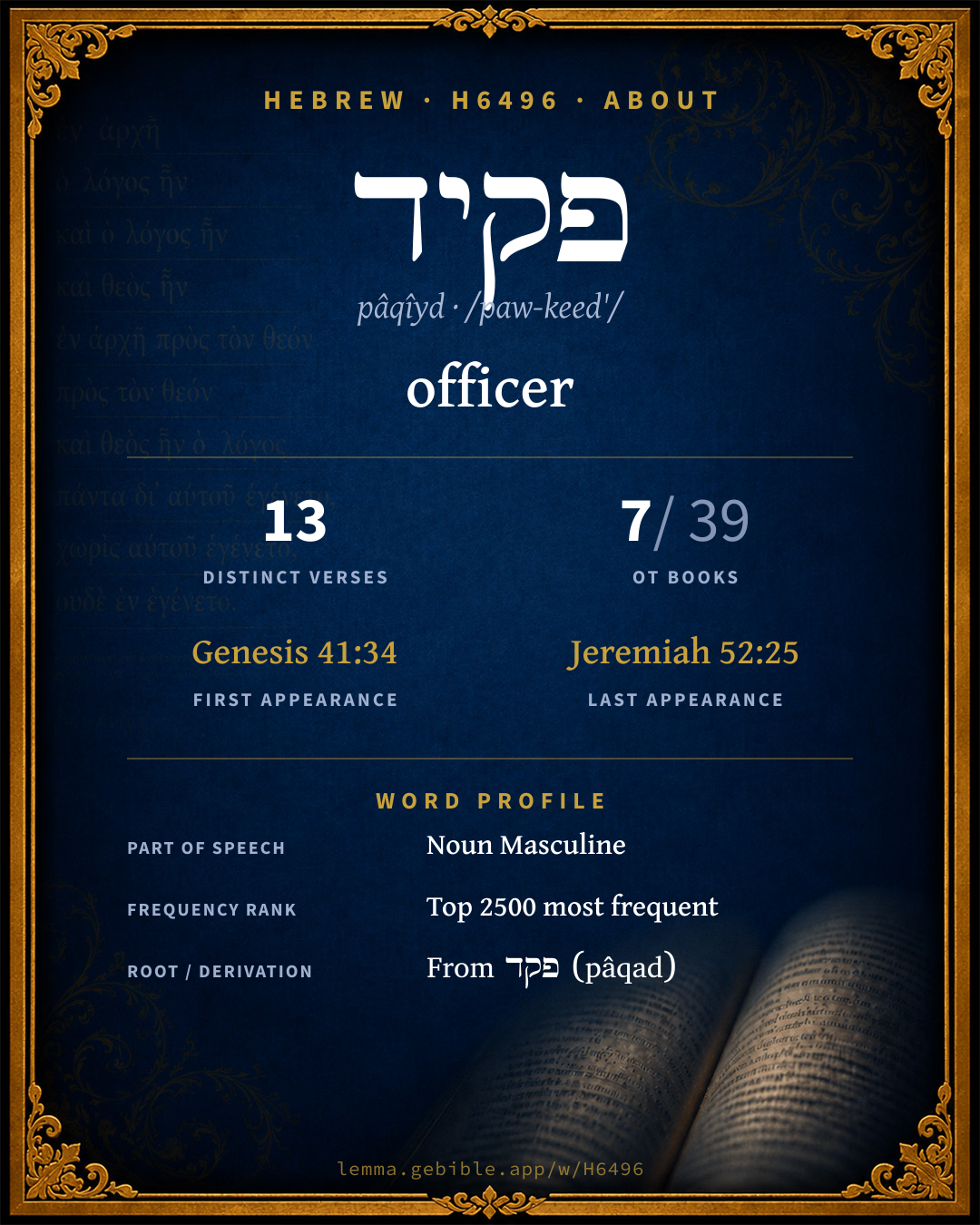
פָּקִיד
officer
Full lexicon entry — Brown-Driver-Briggs (BDB)
From Brown-Driver-Briggs (BDB)
Where this word appears
See every Absolute-state word in the Hebrew Bible →
Grammar key — what these labels mean
Part of speech
- Noun
- A naming word — a person, place, thing, or idea.
Noun type
- Common
- A common noun — a general class of person, place, or thing (“king,” “city,” “water”), not a specific name.
State
- Absolute
- The independent form of a noun, not bound to a following word.
- Construct
- A noun bound to a following noun in a possessive / “of” relationship (the construct chain).
Gender
- Masculine
- Grammatically masculine.
Number
- Plural
- More than one (in Hebrew, generally three or more).
- Singular
- One.
Grammatical forms
- Noun, Common, Masculine, Singular, Absolute 6 times (46%)
- Noun, Common, Masculine, Plural, Absolute 4 times (31%)
- Noun, Common, Masculine, Singular, Construct 3 times (23%)
Parsed forms decoded from the imported morphology (morphhb / Westminster Leningrad Codex — WLC text public domain, morphhb tagging CC BY 4.0), counted across 13 parsed occurrences — not distinct verses.
Every verse where H6496 appears — 13 distinct verses across 7 books. Click any verse to open its interlinear word-by-word view. Verse text shown in the World English Bible for context — . Each verse’s Hebrew form is shown with its reference; the English is not keyword-highlighted, since the data carries no word-level English alignment. Use “Compare translations” on any verse to read it across multiple English versions. This concordance covers the Hebrew Bible; Septuagint (Greek Old Testament) occurrences are not indexed here.
Genesis 1 verse
Judges 1 verse
2 Kings 1 verse
2 Chronicles 2 verses
- 2 Chronicles 24:11 וּ/פְקִיד֙ conj + n c ms cs It was so, that whenever the chest was brought to the king's officers by the hand of the Levites, and when they saw that there was much money, the king's scribe and the chief priest's officer came and emptied the chest, and took it, and carried it to its place again. Thus they did day by day, and gathered money in abundance.
- 2 Chronicles 31:13 פְּקִידִ֗ים n c mp Jehiel, and Azaziah, and Nahath, and Asahel, and Jerimoth, and Jozabad, and Eliel, and Ismachiah, and Mahath, and Benaiah, were overseers under the hand of Conaniah and Shimei his brother, by the appointment of Hezekiah the king, and Azariah the ruler of the house of God.
Nehemiah 4 verses
- Nehemiah 11:9 פָּקִ֣יד n c ms Joel the son of Zichri was their overseer; and Judah the son of Hassenuah was second over the city.
- Nehemiah 11:14 וּ/פָקִ֣יד conj + n c ms and their brothers, mighty men of valor, one hundred twenty-eight; and their overseer was Zabdiel, the son of Haggedolim.
- Nehemiah 11:22 וּ/פְקִ֤יד conj + n c ms cs The overseer also of the Levites at Jerusalem was Uzzi the son of Bani, the son of Hashabiah, the son of Mattaniah, the son of Mica, of the sons of Asaph, the singers, over the business of the house of God.
- Nehemiah 12:42 הַ/פָּקִֽיד ptcl def.art + n c ms and Maaseiah, and Shemaiah, and Eleazar, and Uzzi, and Jehohanan, and Malchijah, and Elam, and Ezer. The singers sang loud, with Jezrahiah their overseer.
Esther 1 verse
Jeremiah 3 verses
- Jeremiah 20:1 פָקִ֥יד n c ms Now Pashhur, the son of Immer the priest, who was chief officer in the house of Yahweh, heard Jeremiah prophesying these things.
- Jeremiah 29:26 פְּקִדִים֙ n c mp Yahweh has made you priest in the place of Jehoiada the priest, that there may be officers in the house of Yahweh, for every man who is mad, and makes himself a prophet, that you should put him in the stocks and in shackles.
- Jeremiah 52:25 פָקִ֣יד n c ms and out of the city he took an officer who was set over the men of war; and seven men of those who saw the king's face, who were found in the city; and the scribe of the captain of the host, who mustered the people of the land; and sixty men of the people of the land, who were found in the midst of the city.
About this entry
At a glance — auto-summarized from this page’s data, not written by a person. Every figure links to its source below. This summary describes the numbers; it doesn’t interpret them.
פקיד — transliterated pâqîyd — is a Hebrew noun carrying the sense “officer.” Debuting at Genesis 41:34, it then recurs through the corpus. The Hebrew Bible uses it across 13 verses — uncommon. More than a quarter of its appearances fall in Nehemiah. It shares a root with פקד, מפקד and פקדה. Each statement above links to its evidence; the full detail follows below.
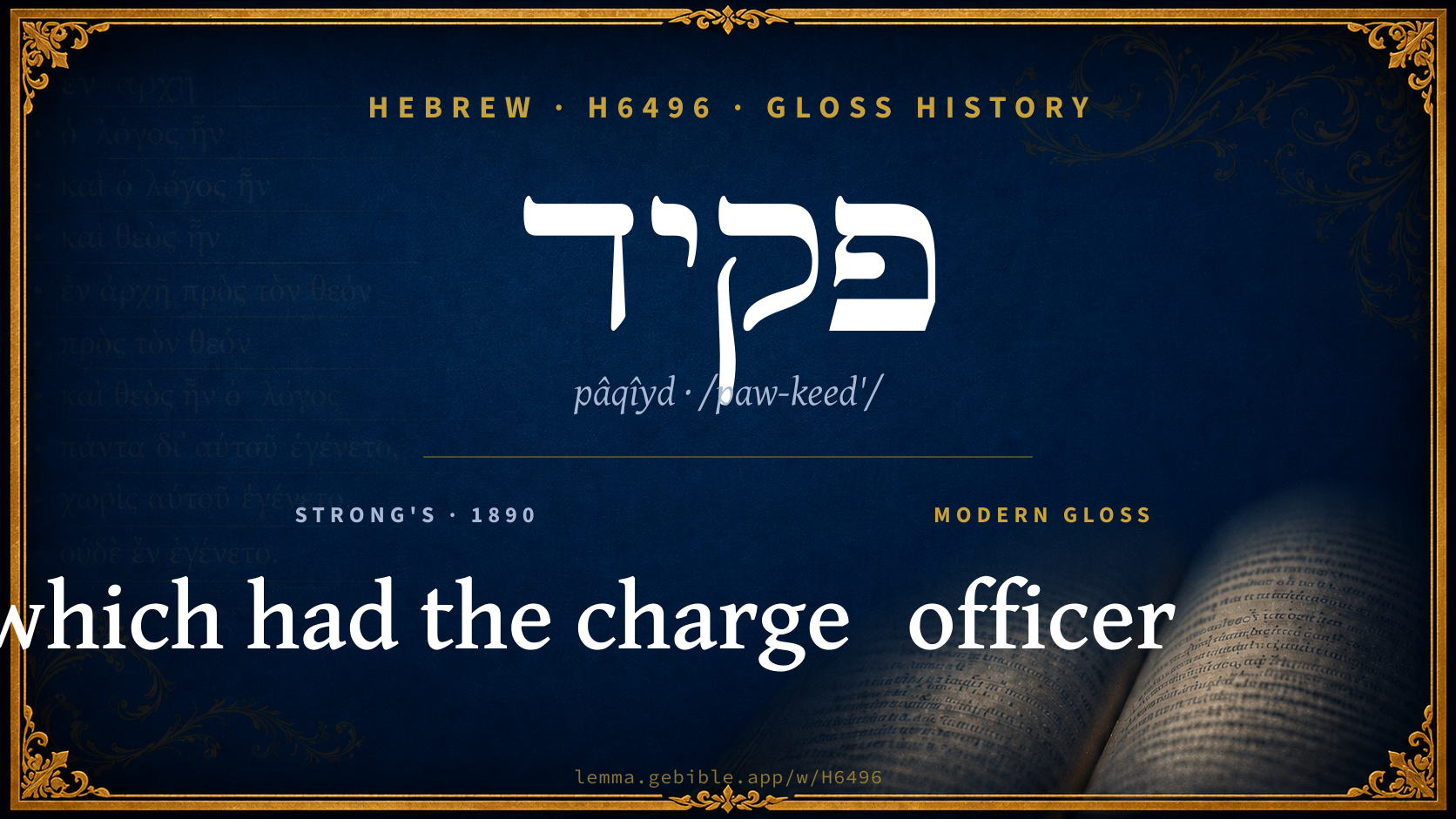
Gloss history
Strong's 1890 vs modern scholarship
About this word
Strong's H6496 catalogs a Hebrew word from the Hebrew Old Testament.
These counts are not copied from any lexicon or concordance. They are computed here, from the morphology-tagged Hebrew Old Testament. What Lemma adds →
- 13
- distinct verses
- The word appears in 13 distinct verses.
- 7 / 39
- OT books
- The word appears in 7 of 39 Old Testament books.
- #2,001
- by frequency
- Top 2500 most frequent Hebrew words (rank 2,001 of 8,640 Hebrew words by occurrence).
View all 13 occurrences in the concordance →
Most concentrated in
- Nehemiah 4 verses 31%
- Jeremiah 3 verses 23%
- 2 Chronicles 2 verses 15%
By section of the Old Testament
By traditional corpus
Conventional, traditional groupings — biblical authorship is debated, so this is a traditional corpus grouping, not an authorship claim. Each share is this word’s portion of its verses in that division of the Hebrew canon. Each figure is a share of the word’s 13 distinct verses.
- Writings (Ketuvim) 7 verses · 54%
- Prophets (Nevi'im) 5 verses · 38%
- Torah (Pentateuch) 1 verse · 8%
How translations render this word
Counts come from each version’s own published word-to-Strong’s tagging or interlinear alignment — an approximate guide to how each version renders this word, not a word-level alignment the data otherwise carries. Because each total is that version’s own tagged count, the per-version totals vary from one another and need not match the appearance or distinct-verse counts above. These counts may also differ from a printed concordance because Lemma counts each distinctly tagged rendering and does not collapse phrase taggings into a single head-word total. This is a fixed set of word-tagged versions (KJV, ASV, BSB, ULT) and does not change with the reading translation you choose elsewhere. Each version’s license is shown beside its name below (and on Sources).
- King James Version: Overseer 3×, Officer 2×, Officers 2×
- American Standard Version: Overseer 3×, Was set 2×
- Berean Standard Bible: Commissioners 2×, Officer 2×
- unfoldingWord Literal Text: Was the overseer 2×
King James Version Public Domain
Renders H6496 across 13 tagged occurrences — most commonly:
Plus 6 renderings that appear only once — usually multi-word phrases or single function words the recovered tagging swept in, not distinct renderings.
American Standard Version Public Domain
Renders H6496 across 13 tagged occurrences — most commonly:
Plus 8 renderings that appear only once — usually multi-word phrases or single function words the recovered tagging swept in, not distinct renderings.
Berean Standard Bible Public Domain
Renders H6496 across 13 tagged occurrences — most commonly:
Plus 9 renderings that appear only once — usually multi-word phrases or single function words the recovered tagging swept in, not distinct renderings.
unfoldingWord Literal Text CC BY-SA 4.0
Renders H6496 across 13 tagged occurrences — most commonly:
Plus 11 renderings that appear only once — usually multi-word phrases or single function words the recovered tagging swept in, not distinct renderings.
Senses in BDB
The 1 sense BDB distinguishes for this word, in lexicon order (not ranked by frequency or importance). The full entry — with sub-senses — is in the Lexicon Entry tab.
- commissioner, deputy, overseer, officer
Word origin
n.m. commissioner, deputy, overseer;—abs. פ׳ Je 20:1 +; cstr. פְּקִיד 2 Ch 24:11; Ne 11:22; sf. פְּקִידוֹ Ju 9:28; pl. פְּקִדִים Gn 41:34 Je 29:26, פְּקִידִים 2 Ch 31:13; Est 2:3;—commissioner, for special duty Gn 41:34 (E), Est 2:3; permanent deputy of king Ju 9:28, of priest 2 Ch 24:11, of Levites 31:13; overseer, one in charge of men, c. עַל of soldiers 2 K 25:19 = Je 52:25, Benjamites Ne 11:9, priests v 14; abs., without עַל Je 29:26 (of priest in temple, reading פָּקִיד Vrss Gie), cf. 20:1 (v. נָגִיד 3); c. sf. of Levites Ne 11:22, singers 12:42.
— Brown-Driver-Briggs (Oxford 1906, public domain), digitized via Sefaria, supplemented by the OpenScriptures HebrewLexicon (CC BY 4.0). See Sources.
Derived from פקד (pâqad) (H6485) — to visit.
Jastrow Dictionary
A second Hebrew/Aramaic lexicon for comparison, covering Aramaic and post-biblical (Talmudic, Targumic, Midrashic) usage that the biblical-Hebrew BDB does not. Matched by lemma rather than by Strong’s number, so a lemma may carry more than one Jastrow headword (shown separately below), and the entries cover usage well beyond the Bible.
פְּקַד
- 1. to command. Targ. O. Lev. VIII, 31 פַּקְדִּית Mss. (oth. ed. Ithpa.; ed. Berl. Pa., v. infra).
- 2. [to give in charge,] to store up.—Part. pass. פָּקִיד; pl. פְּקִידי. Keth. 5ᵇ מִיפְּקַד פקיד, v. חֲבַר. Pes. 33ᵇ משקין מיפקד פקידי (Rashi: מִיפְּקִיד) liquids (in grapes) are stored up (the shell being merely a vessel), opp. מיבלע בליעי.
- to command, commission. Targ. Gen. VII, 5; 9 (ed. Berl. פַּק׳, without Dagesh). Ib. XLIX, 33. Targ. Ps. LXVIII, 29. Targ. Am. IX, 3, sq. (ed. Wil. אַפְקִיד Af.); a. v. fr.—Pesik. Baḥod., p. 155ᵇ רבי … הוה מְפַקֵּד לחבריה וכ׳ R. Z. commanded the students (saying), go and hear R. L. preach; Y. R. Hash. IV, beg. 59ᵇ. Y. Ber. IV, 7ᶜ bot.; ib. דרבי מיפקד (corr. acc.). Koh. R. to III, 2 הוה מפקד גו ביתיה gave orders in his house (made his will); a. fr.—Part. pass. מְפַקַּד, v. infra.
- 1. same, v. supra.—2)
- to give in charge, deposit. B. Mets. 36ᵃ הוו מַפְקְדֵי מרייהו וכ׳ used to leave their hoes in charge of a certain old woman; יומא חד אפקדינהו וכ׳ one day they left them with &c.; a. fr.
- 1. to be commanded. Targ. O. Lev. VIII, 31, v. supra. Ib. 35. Targ. Ex. XXXIV, 34; a. fr.—Ab. Zar. 14ᵃ; 21ᵃ מִיפְקְדִינָן Rashi (ed. מְפַקְּדִינָן, Part. pass. Pa.), v. פָּנִים.
- 2. to be given in charge, be deposited. Targ. Lev. V, 23 (O. ed. Lsb. אִתַּפְקַד).—Keth. 5ᵇ; Pes. 33ᵇ, v. supra.
פָּקִיד
- appointed to examine, officer, commissioner. — Pl. פְּקִידִים. Pesik. R. s. 42 [read:] הרבה פ׳ יש יש שנתפקד וכ׳ there are various kinds of commissioners (of the Lord), some are appointed &c., v. פָּקַד. Num. R. s. 14 וכבשים כנגד פ׳ and lambs were offered (Num. VII, 83) in behalf of the officers; a. e. e.g. Numbers 7:83
A Dictionary of the Targumim, the Talmud Babli and Yerushalmi, and the Midrashic Literature (Marcus Jastrow; London, Luzac, 1903) — Public Domain. Digitized via Sefaria. Digitized via Sefaria. Full attribution on Sources.
Forms in the corpus
The 12 distinct written forms H6496 takes in the Hebrew Bible, most frequent first — each parse links to that state’s occurrences in the concordance. Hebrew forms include their vowel points and cantillation, so a single lemma takes many written forms.
| Form | Parsing | Example | Uses |
|---|---|---|---|
| פָקִ֣יד | Noun, Common, Masculine, Singular, Absolute | 2 Kings 25:19 | 2 |
| הַ/פָּקִֽיד | Noun, Common, Masculine, Singular, Absolute | Nehemiah 12:42 | 1 |
| וּ/פְקִ֤יד | Noun, Common, Masculine, Singular, Construct | Nehemiah 11:22 | 1 |
| וּ/פְקִיד֙ | Noun, Common, Masculine, Singular, Construct | 2 Chronicles 24:11 | 1 |
| וּ/פָקִ֣יד | Noun, Common, Masculine, Singular, Absolute | Nehemiah 11:14 | 1 |
| פָקִ֥יד | Noun, Common, Masculine, Singular, Absolute | Jeremiah 20:1 | 1 |
| פְּקִדִ֖ים | Noun, Common, Masculine, Plural, Absolute | Genesis 41:34 | 1 |
| פְּקִדִים֙ | Noun, Common, Masculine, Plural, Absolute | Jeremiah 29:26 | 1 |
| פְּקִיד֑/וֹ | Noun, Common, Masculine, Singular, Construct | Judges 9:28 | 1 |
| פְּקִידִ֗ים | Noun, Common, Masculine, Plural, Absolute | 2 Chronicles 31:13 | 1 |
| פְּקִידִים֮ | Noun, Common, Masculine, Plural, Absolute | Esther 2:3 | 1 |
| פָּקִ֣יד | Noun, Common, Masculine, Singular, Absolute | Nehemiah 11:9 | 1 |
Same root — word family
Other BDB entries built from the same root as H6496, grouped by Strong’s listed origin. These share a root / origin per the lexicon — not necessarily a shared meaning. Each links to that word’s own entry.
Derives from
Shares the same root
- מפקד miphqâd H4662 appointment
- פקדה pᵉquddâh H6486 visitation
- פקדון piqqâdôwn H6487 store
- פקוד piqqûwd H6490 statute
Derived from this word
Proper names from this root
People and places named from this root — a name, not an additional meaning of the word.
Compare all same-root words → Showing 4 of 8 — not the complete family. 1 of the same-root words is a proper name (a person or place). They share a root, not necessarily a meaning.
Septuagint verse parallels
This word appears in 8 verses that also exist in the Greek Old Testament (Septuagint), out of the 13 Hebrew verses it occurs in. You can read those verses in Greek by switching the Old Testament edition to the Septuagint.
Read these verses in the Septuagint
This is a verse-level parallel only — the same verses exist in both the Hebrew and Greek Old Testaments. No word-level Hebrew↔Greek correspondence is claimed: the data carries no such alignment, so no Greek word is shown as this Hebrew word’s translation. Coverage is not total — the Septuagint omits the deuterocanon and renumbers the Psalms, so some Hebrew verses have no direct Greek parallel.