
Jeremiah 41:2

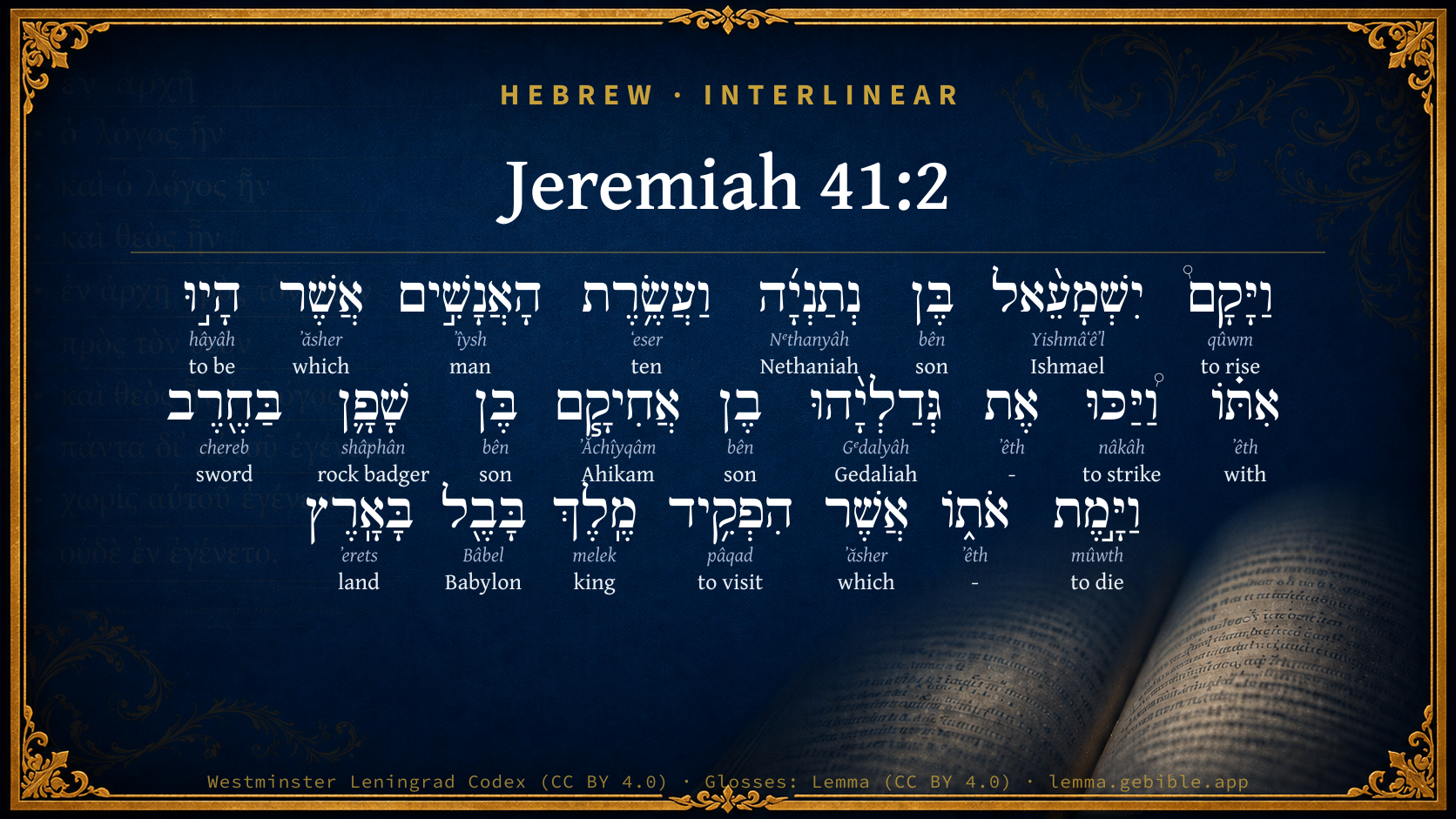
Hebrew (Westminster Leningrad Codex) Jeremiah 41:2 appears in the Hebrew Old Testament. The text above is from the Westminster Leningrad Codex. Each word links to its Strong’s number, a concise gloss, and parsing drawn from the Open Scriptures Hebrew Bible morphology. Click any word for its full Brown-Driver-Briggs (BDB) entry.
Download image
Cite this verse

Jeremiah 41:2 (World English Bible). Public Domain. Lemma interlinear Bible study tool, https://lemma.gebible.app/v/jeremiah/41/2.

Show BibTeX & RIS
BibTeX
RIS
English Translation
Then arose Ishmael the son of Nethaniah, and the ten men who were with him, and struck Gedaliah the son of Ahikam the son of Shaphan with the sword, and killed him, whom the king of Babylon had made governor over the land.
World English Bible · Public Domain
Download a study sheet

One document with this verse’s original text, its word-by-word gloss line, the meaning frame, cross-references with their text, attributed commentary, and full source and license credits — printable, and it pastes into notes with its structure intact.

This verse Autodidact and up

Study sheet (.html) Plain text (.txt)

A passage Seminary Student

Up to 50 verses in one chapter. A passage sheet keeps up to 6 commentary sources and 12 cross-references per verse, in the order this page ranks them, and says so on the sheet whenever that leaves anything out. Ask for a single verse and you get the Autodidact verse sheet above.

Everything on this page stays free to read, with no account — the sheet is a download of what is already on screen, not access to it.

Want to remove ads? Support Godless Engineer
Compare translations 3

The same verse in 3 English versions, stacked beneath the original-language interlinear above. Click any original word for its lexicon entry.

Each is an independent rendering of the whole verse — the interlinear is not word-aligned to these translations.

Highlighted words mark where these versions differ — a whole-verse word diff, not a word-by-word alignment.

  • World English Bible Public Domain
    Then arose Ishmael the son of Nethaniah, and the ten men who were with him, and struck Gedaliah the son of Ahikam the son of Shaphan with the sword, and killed him, whom the king of Babylon had made governor over the land.
  • King James Version Public Domain
    Then arose Ishmael the son of Nethaniah, and the ten men that were with him, and smote Gedaliah the son of Ahikam the son of Shaphan with the sword, and slew him, whom the king of Babylon had made governor over the land.
  • unfoldingWord Literal Text CC BY-SA 4.0
    But Ishmael son of Nethaniah, and the ten men who were with him rose up and attacked Gedaliah son of Ahikam son of Shaphan, with the sword. Ishmael killed Gedaliah, whom the king of Babylon had put in charge of the land.

unfoldingWord Literal Text — © unfoldingWord, licensed CC BY-SA 4.0. Word-aligned USFM3 via Door43 (git.door43.org/unfoldingWord/en_ult).

Versions to compare (up to 4)

3 of 4 selected

Show all 18 translations

Every available English version of this verse, each an independent rendering of the whole verse.

  • World English Bible Public Domain
    Then arose Ishmael the son of Nethaniah, and the ten men who were with him, and struck Gedaliah the son of Ahikam the son of Shaphan with the sword, and killed him, whom the king of Babylon had made governor over the land.
  • Berean Standard Bible Public Domain
    Then Ishmael son of Nethaniah and the ten men who were with him got up and struck down Gedaliah son of Ahikam, the son of Shaphan, with the sword, killing the one whom the king of Babylon had appointed to govern the land.
  • Majority Standard Bible Public Domain
    Then Ishmael son of Nethaniah and the ten men who were with him got up and struck down Gedaliah son of Ahikam, the son of Shaphan, with the sword, killing the one whom the king of Babylon had appointed to govern the land.
  • King James Version Public Domain
    Then arose Ishmael the son of Nethaniah, and the ten men that were with him, and smote Gedaliah the son of Ahikam the son of Shaphan with the sword, and slew him, whom the king of Babylon had made governor over the land.
  • American Standard Version (1901) Public Domain
    Then arose Ishmael the son of Nethaniah, and the ten men that were with him, and smote Gedaliah the son of Ahikam the son of Shaphan with the sword, and slew him, whom the king of Babylon had made governor over the land.
  • Revised Version (1885) Public Domain
    Then arose Ishmael the son of Nethaniah, and the ten men that were with him, and smote Gedaliah the son of Ahikam the son of Shaphan with the sword, and slew him, whom the king of Babylon had made governor over the land.
  • Geneva Bible (1599) Public Domain
    Then arose Ishmael the sonne of Nethaniah with these tenne men that were with him, and smote Gedaliah the sonne of Ahikam the sonne of Shaphan with the sword, and slewe him, whom the King of Babel had made gouernour ouer the lande.
  • Douay-Rheims (1899) Public Domain
    And Ismahel the son of Nathanias arose, and the ten men that were with him, and they struck Godolias the son of Ahicam, the son of Saphan with the sword, and slew him whom the king of Babylon had made governor over the land.
  • Young's Literal Translation Public Domain
    And Ishmael son of Nethaniah riseth, and the ten men who have been with him, and they smite Gedaliah son of Ahikam, son of Shaphan, with the sword, and he putteth him to death whom the king of Babylon hath appointed over the land.
  • Literal Standard Version CC BY-SA 4.0
    And Ishmael son of Nethaniah rises, and the ten men who have been with him, and they strike Gedaliah son of Ahikam, son of Shaphan, with the sword, and he puts him to death whom the king of Babylon has appointed over the land.
  • Unlocked Literal Bible CC BY-SA 4.0
    But Ishmael son of Nethaniah, and the ten men who were with him rose up and attacked Gedaliah son of Ahikam son of Shaphan, with the sword. Ishmael killed Gedaliah, whom the king of Babylon had put in charge of the land.
  • unfoldingWord Literal Text CC BY-SA 4.0
    But Ishmael son of Nethaniah, and the ten men who were with him rose up and attacked Gedaliah son of Ahikam son of Shaphan, with the sword. Ishmael killed Gedaliah, whom the king of Babylon had put in charge of the land.
  • Darby Bible Public Domain
    And Ishmael the son of Nethaniah arose, and the ten men that were with him, and smote Gedaliah the son of Ahikam the son of Shaphan with the sword, and killed him, whom the king of Babylon had appointed over the land.
  • World Messianic Bible Public Domain
    Then Ishmael the son of Nethaniah arose, and the ten men who were with him, and struck Gedaliah the son of Ahikam the son of Shaphan with the sword and killed him, whom the king of Babylon had made governor over the land.
  • Webster's Bible Public Domain
    Then arose Ishmael the son of Nethaniah, and the ten men that were with him, and smote Gedaliah the son of Ahikam, the son of Shaphan with the sword, and slew him, whom the king of Babylon had made governor over the land.
  • Free Bible Version CC BY-SA 4.0
    suddenly Ishmael and his ten men got up and attacked Gedaliah, killing him—the one appointed by the king of Babylon as the country's governor.
  • Bible in Basic English Public Domain
    Then Ishmael, the son of Nethaniah, and the ten men who were with him, got up, and attacking Gedaliah, the son of Ahikam, the son of Shaphan, with the sword, put to death him whom the king of Babylon had made ruler over the land.
  • JPS Tanakh (1917) Public Domain
    Then arose Ishmael the son of Nethaniah, and the ten men that were with him, and smote Gedaliah the son of Ahikam the son of Shaphan with the sword, and slew him, whom the king of Babylon had made governor over the land.

Literal Standard Version (2020), Covenant Press — licensed CC BY-SA 4.0. Text via the HelloAO Bible API (eBible.org). Unlocked Literal Bible (unfoldingWord) — licensed CC BY-SA 4.0. Text via the HelloAO Bible API (eBible.org). unfoldingWord Literal Text — © unfoldingWord, licensed CC BY-SA 4.0. Word-aligned USFM3 via Door43 (git.door43.org/unfoldingWord/en_ult). Free Bible Version, Dr. Jonathan Gallagher — licensed CC BY-SA 4.0. Text via the HelloAO Bible API (eBible.org).

Word by word

More ways to search: Search by grammar → Find every occurrence → Compare this word →

Practice this passage: Drill this verse → Learn its vocabulary →

נְתַנְיָ֜ה
Nᵉthanyâh
H5418
“Nethaniah”
Noun, Proper
Part of Speech
Noun
Type
Proper
Full BDB Definition

Origin: from H5414 and H3050

TWOT: None

Nethaniah = "given of Jehovah" - son of Elishama of the royal family of Judah and father of Ishmael who murdered Gedaliah - father of Jehudi - a Levite, one of the 4 sons of Asaph the minstrel - a Levite in the reign of king Jehoshaphat of Judah
  1. וַיָּקָם֩ qûwm H6965 “and · to rise” Conjunction + Verb, Qal, Sequential Imperfect, 3rd Person, Masculine, Singular
  2. יִשְׁמָעֵ֨אל Yishmâʻêʼl H3458 “Ishmael” Noun, Proper
  3. בֶּן bên H1121 “son of” Noun, Common, Masculine, Singular, Construct
  4. וַעֲשֶׂ֥רֶת ʻeser H6235 “and · ten” Conjunction + Adjective, Cardinal number, Masculine, Singular, Construct
  5. הָאֲנָשִׁ֣ים ʼîysh H376 “the · men” Particle, Definite Article + Noun, Common, Masculine, Plural, Absolute
  6. אֲשֶׁר ʼăsher H834 “which” Particle, Relative
  7. הָי֣וּ hâyâh H1961 “to be” Verb, Qal, Perfect, 3rd Person, Common, Plural
  8. אִתּ֗וֹ ʼêth H854 “with · him” Preposition + Suffix, Personal, 3rd Person, Masculine, Singular
  9. וַ֠יַּכּוּ nâkâh H5221 “and · to strike” Conjunction + Verb, Hiphil, Sequential Imperfect, 3rd Person, Masculine, Plural
  10. אֶת ʼêth H853 “-” Particle, Direct Object
  11. גְּדַלְיָ֨הוּ Gᵉdalyâh H1436 “Gedaliah” Noun, Proper
  12. בֶן bên H1121 “son of” Noun, Common, Masculine, Singular, Construct
  13. אֲחִיקָ֧ם ʼĂchîyqâm H296 “Ahikam” Noun, Proper
  14. בֶּן bên H1121 “son of” Noun, Common, Masculine, Singular, Construct
  15. שָׁפָ֛ן shâphân H8227 “rock badger” Noun, Proper
  16. בַּחֶ֖רֶב chereb H2719 “in/at the · sword” Preposition, Determined + Noun, Common, Feminine, Singular, Absolute
  17. וַיָּ֣מֶת mûwth H4191 “and · to die” Conjunction + Verb, Hiphil, Sequential Imperfect, 3rd Person, Masculine, Singular
  18. אֹת֑וֹ ʼêth H853 “- · him” Particle, Direct Object + Suffix, Personal, 3rd Person, Masculine, Singular
  19. אֲשֶׁר ʼăsher H834 “which” Particle, Relative
  20. הִפְקִ֥יד pâqad H6485 “to visit” Verb, Hiphil, Perfect, 3rd Person, Masculine, Singular
  21. מֶֽלֶךְ melek H4428 “king of” Noun, Common, Masculine, Singular, Construct
  22. בָּבֶ֖ל Bâbel H894 “Babylon” Noun, Proper
  23. בָּאָֽרֶץ ʼerets H776 “in/at the · land” Preposition, Determined + Noun, Common, Both, Singular, Absolute

About this verse

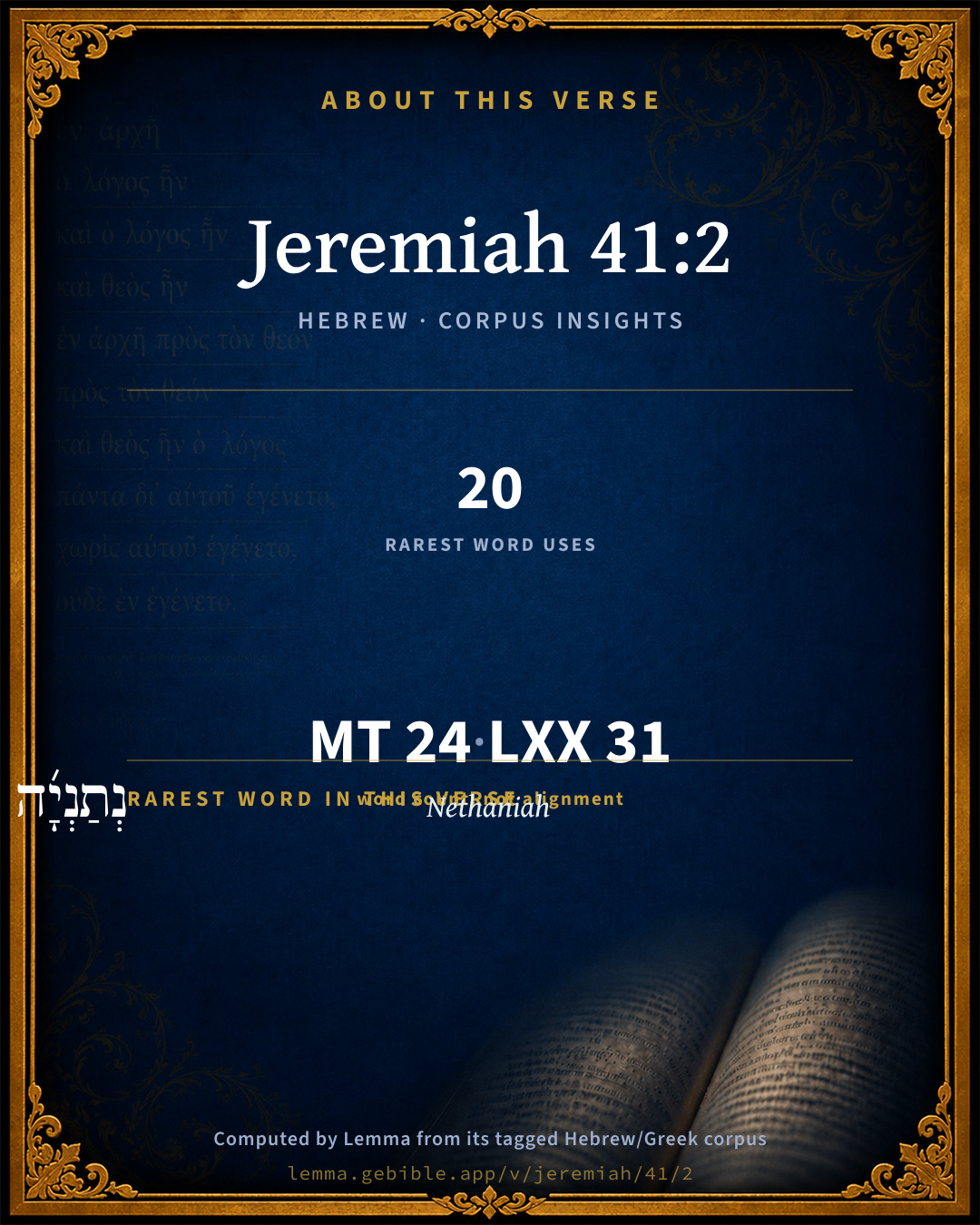
These counts appear in no published source. They are computed here, from the morphology-tagged text and Lemma’s own curated glosses. What Lemma adds →

24
words
20
distinct lemmas
Prophets
section

Notable vocabulary

The rarest word here is נְתַנְיָ֜ה Nethaniah H5418 — appearing just 20 times in the whole Hebrew Bible.

Shared distinctive vocabulary

נְתַנְיָ֜ה Nethaniah H5418 occurs in 20 verses of the Hebrew Bible. Also found in:

Grammatical profile

  • 5 verbs
  • 13 nouns
  • 1 adjective
  • 1 preposition
  • 4 particles

Verb forms

  • וַיָּקָם֩ Qal · Sequential Imperfect
  • הָי֣וּ Qal · Perfect
  • וַ֠יַּכּוּ Hiphil · Sequential Imperfect
  • וַיָּ֣מֶת Hiphil · Sequential Imperfect
  • הִפְקִ֥יד Hiphil · Perfect

Repetition

Words recur within this verse — often emphatic in Hebrew:

  • בֶּן son H1121 ×3
  • אֲשֶׁר which H834 ×2

Hebrew & Septuagint length

In the original languages it is 24 Hebrew tokens and 31 Greek tokens — but the two are counted differently (Hebrew bundles its prefixes and suffixes into one token; the Greek is in lemma form), so that isn’t a like-for-like length.

Cross-references

7

Topical passages linked to Jeremiah 41:2 in the Treasury of Scripture Knowledge — connected by theme and wording, ordered by reader-vote popularity; previews shown in the World English Bible.

  • 2 Kings 25:25 But it happened in the seventh month, that Ishmael the son of Nethaniah, the son of Elishama, of the royal seed came, and ten men with him, and struck Gedaliah, so that he died, and the Jews and the Chaldeans that were with him at Mizpah.
  • Jeremiah 40:5 Now while he was not yet gone back, Go back then, [said he], to Gedaliah the son of Ahikam, the son of Shaphan, whom the king of Babylon has made governor over the cities of Judah, and dwell with him among the people; or go wherever it seems right to you to go. So the captain of the guard gave him food and a present, and let him go.
  • 2 Samuel 3:27 When Abner was returned to Hebron, Joab took him aside into the midst of the gate to speak with him quietly, and struck him there in the body, so that he died, for the blood of Asahel his brother.
  • 2 Samuel 20:9–10 Joab said to Amasa, Is it well with you, my brother? Joab took Amasa by the beard with his right hand to kiss him.
  • Psalms 41:9 Yes, my own familiar friend, in whom I trusted, Who ate bread with me, Has lifted up his heel against me.
  • Psalms 109:5 They have rewarded me evil for good, And hatred for my love.
  • Jeremiah 40:7 Now when all the captains of the forces who were in the fields, even they and their men, heard that the king of Babylon had made Gedaliah the son of Ahikam governor in the land, and had committed to him men, and women, and children, and of the poorest of the land, of those who were not carried away captive to Babylon;

Cross-references courtesy of OpenBible.info (CC BY 4.0).

Hebrew and Greek witnesses Masoretic Hebrew ↔ Greek Septuagint

The same verse in the two great witnesses to the Old Testament, shown verse-for-verse.

These are two independent witnesses, not word-aligned to each other, and the Septuagint is shown in lemma (dictionary) form.

Hebrew Jeremiah 41:2 Masoretic · Westminster Leningrad Codex

וַיָּקָם֩ יִשְׁמָעֵ֨אל בֶּן נְתַנְיָ֜ה וַעֲשֶׂ֥רֶת הָאֲנָשִׁ֣ים אֲשֶׁר הָי֣וּ אִתּ֗וֹ וַ֠יַּכּוּ אֶת גְּדַלְיָ֨הוּ בֶן אֲחִיקָ֧ם בֶּן שָׁפָ֛ן בַּחֶ֖רֶב וַיָּ֣מֶת אֹת֑וֹ אֲשֶׁר הִפְקִ֥יד מֶֽלֶךְ בָּבֶ֖ל בָּאָֽרֶץ

Then arose Ishmael the son of Nethaniah, and the ten men who were with him, and struck Gedaliah the son of Ahikam the son of Shaphan with the sword, and killed him, whom the king of Babylon had made governor over the land.

World English Bible · Public Domain

Greek LXX Structure differs

In the Septuagint, Jeremiah is about an eighth shorter than the Hebrew and arranges its material differently — the Oracles Against the Nations (Hebrew chapters 46–51) appear in the middle of the Greek book, after 25:13. Because the chapter and verse boundaries do not line up, a verse-for-verse comparison with the Hebrew is not shown.

A verse-for-verse comparison isn’t shown here because the chapters and verses don’t line up. Switch to the LXX edition with the MT / LXX toggle above to read the Greek directly.

Hebrew: Westminster Leningrad Codex (CC BY 4.0). Greek: Septuagint (public domain); English from a public-domain English Septuagint. How the Septuagint differs from the Hebrew →

Targum (Aramaic paraphrase)

1

The Targum is the ancient Jewish Aramaic paraphrase of the Hebrew Scriptures — an interpretive translation, not the Hebrew text itself. Onkelos (literal) and Pseudo-Jonathan (expansive) render the Torah, and Jonathan the Prophets. Coverage is partial: where no permissively-licensed English translation exists for a verse, only the Aramaic is shown. This is verse-level text, not a word-by-word alignment to the Hebrew.

  1. Targum Jonathan Prophets (Joshua–Malachi)
    וְקָם יִשְׁמָעֵאל בַּר נְתַנְיָה וְעַסְרָא גַבְרִין דַהֲווֹ עִמֵיהּ וּמְחוֹ יַת גְדַלְיָה בַּר אֲחִיקָם בַּר שָׁפָן בְּחַרְבָּא וּקְטַל יָתֵיהּ דְמָנֵי מַלְכָּא דְבָבֶל בְּאַרְעָא:

    (no public-domain English translation for this verse)

    Targum Jonathan — Aramaic: “Mikraot Gedolot” (public domain). English: “Sefaria Community Translation” (CC0 1.0 (public-domain dedication)); “London "Chaldee Paraphrase," 1871” (public domain). Text via Sefaria.

Commentary

Notes on Jeremiah 41:2 from classic Christian and Jewish commentators (each source and its license shown beneath its notes). The classic Christian expositions comment on the surrounding passage and are grouped to its opening verse, so a note may address several verses; the Jewish commentaries on the Tanakh (Rashi and others) are per-verse, so they appear only where the commentator wrote on this verse.

Lemma curates 59 commentaries, every one of them public domain or Creative Commons licensed, each selected and text-cleaned for this edition rather than reprinted as found. About our sources →

Trapp's Complete Commentary

John Trapp

Jer 41:2 Then arose Ishmael the son of Nethaniah, and the ten men that were with him, and smote Gedaliah the son of Ahikam the son of Shaphan with the sword, and slew him, whom the king of Babylon had made governor over the land.

Ver. 2. Then arose Ishmael.] Taking the opportunity when Gedaliah and his guests were mero graves, saith Josephus, merry with wine, and so less able to resist.

And the ten men that were with.] They and their followers being pugnaces et audaces, barbarous and brutish persons, skilful to destroy. {Eze 21:31}

And smote Gedaliah the son of Ahikam.] See on Jer 41:1.

And slew him whom the king of Babylon had made governor.] Yea, for that very cause, per invidiam et libidinem regnandi. So true is that of the tragedian, {a}

“ Simul ista mundi conditor posuit Deus,

Odium atque regnum. ”

{a} Sen. in Thebaide.

John Trapp, A Commentary or Exposition upon All the Books of the Old and New Testament (1647–1656) — public domain. Text from a community e-Sword module.

Jamieson, Fausset & Brown

Robert Jamieson, A. R. Fausset & David Brown

slew him whom the king of Babylon had made governor--This assigns a reason for their slaying him, as well as showing the magnitude of their crime (Dan 2:21; Rom 13:1).

Jamieson, Fausset & Brown — Commentary Critical and Explanatory on the Whole Bible (1871) — public domain (CC PDM 1.0). Text via the HelloAO Bible API.

Adam Clarke's Commentary

Verse 2. Smote Gedaliah] See the preceding chapter, Jer 40:14.

Adam Clarke's Commentary on the Bible (1810–1826) — public domain. Text from a community e-Sword/MySword module.

Ellicott's Commentary for English Readers

(2) Then arose Ishmael.—The narrative suggests the thought that, as in the massacre of Glencoe, the guests murdered their host at the very time when he was receiving them with open arms.

A Bible Commentary for English Readers, edited by Charles John Ellicott (1878–1897) — public domain. Text from a community e-Sword module.

The Cambridge Bible for Schools and Colleges

gen. ed. J. J. S. Perowne

2. Then arose Ishmael … and the ten men] Gedaliah’s retinue may not have been very large, and were probably quite unsuspecting. The murders seem to have been committed privately at the entertainment. Next day (Jer_41:4) no one knew of it. Ishmael’s action was apparently useless as well as criminal. However, he may have been prepared to go any length to shew spite at the appointment of a ruler who was not, like himself (see Jer_41:1), of the royal house, or his object possibly was to keep the land in a state of unrest, so as to help out Baalis’s ambitious wishes; also, if Baalis was going to annex Judah, Ishmael may have had an eye to the governorship.

The Cambridge Bible for Schools and Colleges (gen. ed. J. J. S. Perowne; Cambridge University Press, 1878–1918) — public domain. Text from a community e-Sword module.

John Gill's Exposition

Then arose Ishmael the son of Nethaniah, and the ten men that were with him,.... After they had eat and drank well, they rose up from their seats at table:

and smote Gedaliah the son of Ahikam the son of Shaphan with the sword,

and slew him; they all drew their swords and thrust at him, and were assisting in the murder of him; though it is probable that it was Ishmael that gave him the mortal wound, since the phrase, "and slew him", is singular. Josephus (d) says that Gedaliah prepared a splendid table, and made a sumptuous entertainment for them, and being drunk himself, which they observed, took the opportunity and slew him, and all at table with him:

whom the king Babylon had made governor over the land; which mentioned; both to aggravate the crime they were guilty of, and to observe the reason of it, and what it was that prompted them to it; for so the words may be rendered, "because the king of Babylon had made him governor over the land" (e).

(d) Antiqu. l. 10. c. 9. sect. 4. (e) "quia illum praefecerat", Vatablus. So Ben Melech.

John Gill's Exposition of the Whole Bible (1746–1763) — public domain (CC PDM 1.0). Text via the HelloAO Bible API.

Matthew Poole's English Annotations

These ten men with their retinue fall upon Gedaliah, and barbarously murder him. Their quarrel against him was, that he was deputy governor to the king of Babylon; so desperately hardened were these Jews, that they would not yet see that God had given their country into the hand of the king of Babylon, who having now a right of conquest over them, had authority to set whom he pleased as his viceroy or deputy governor over them, to whom they ought to have yielded all subjection and obedience.

Matthew Poole's English Annotations on the Holy Bible (1683–1685) — public domain. Text from a community e-Sword/MySword module.

Whedon's Commentary on the Bible

Daniel D. Whedon

2. Had made governor — This was his crime. It was not simply murder, but the slaying of a ruler; striking down not merely a human life but the State in him.

Daniel D. Whedon (gen. ed.), Commentary on the Old and New Testaments (1874–1909) — public domain. Text from a community e-Sword module.

The Pulpit Commentary

Smote Gedaliah. The day of the murder of Gedaliah (the third day of the seventh month) was kept as a fast day by the post-Captivity Jews. (see Zec_7:5 Zec_8:19) It was the day on which the hope of living a separate life in the promised land, for a time at least, vanished; and the murder was avenged by a new captivity (see above).

The Pulpit Commentary (1880–1919), ed. H.D.M. Spence-Jones & Joseph S. Exell — public domain. Text from a community e-Sword module.

Lesson kit

Teaching starters — assembled from the data on this page, not authored interpretation. Every prompt links to the verse data it draws on. Edit before teaching.

Jeremiah, in the Prophets, opens this verse with 24 words (20 distinct Hebrew lemmas). Its most distinctive word is Nᵉthanyâh (“Nethaniah”). A historical commentator’s framing appears above. Read the whole chapter for the surrounding context.

Discussion questions

  1. What does “Nethaniah” (Nᵉthanyâh) contribute to the verse as a whole?
  2. 2 Kings 25:23 shares the word «Nethaniah» with this verse. How do the two illuminate each other?
  3. “son” occurs 3× in this one verse. What is the effect of the repetition?
  4. The translations on this page render this verse differently — a whole-verse word diff, not a word-by-word alignment. What might account for the different wordings?
  5. The verb «וַיָּקָם֩» is Qal Sequential Imperfect. How does its form color the action?
  6. Reading how Trapp's Complete Commentary and Jamieson, Fausset & Brown read this verse, where do the two commentators agree and where do they part?

Things to notice

Reading settings

Reading text

Shown beneath each verse's original-language words.

Old Testament
Old Testament edition

Read the OT as the Masoretic Hebrew (MT) or the Greek Septuagint (LXX).

English shown for the Greek Septuagint (in the Hebrew ↔ Greek comparison).

Comparing translations? Open the Compare panel on any verse page to stack up to four side by side.