
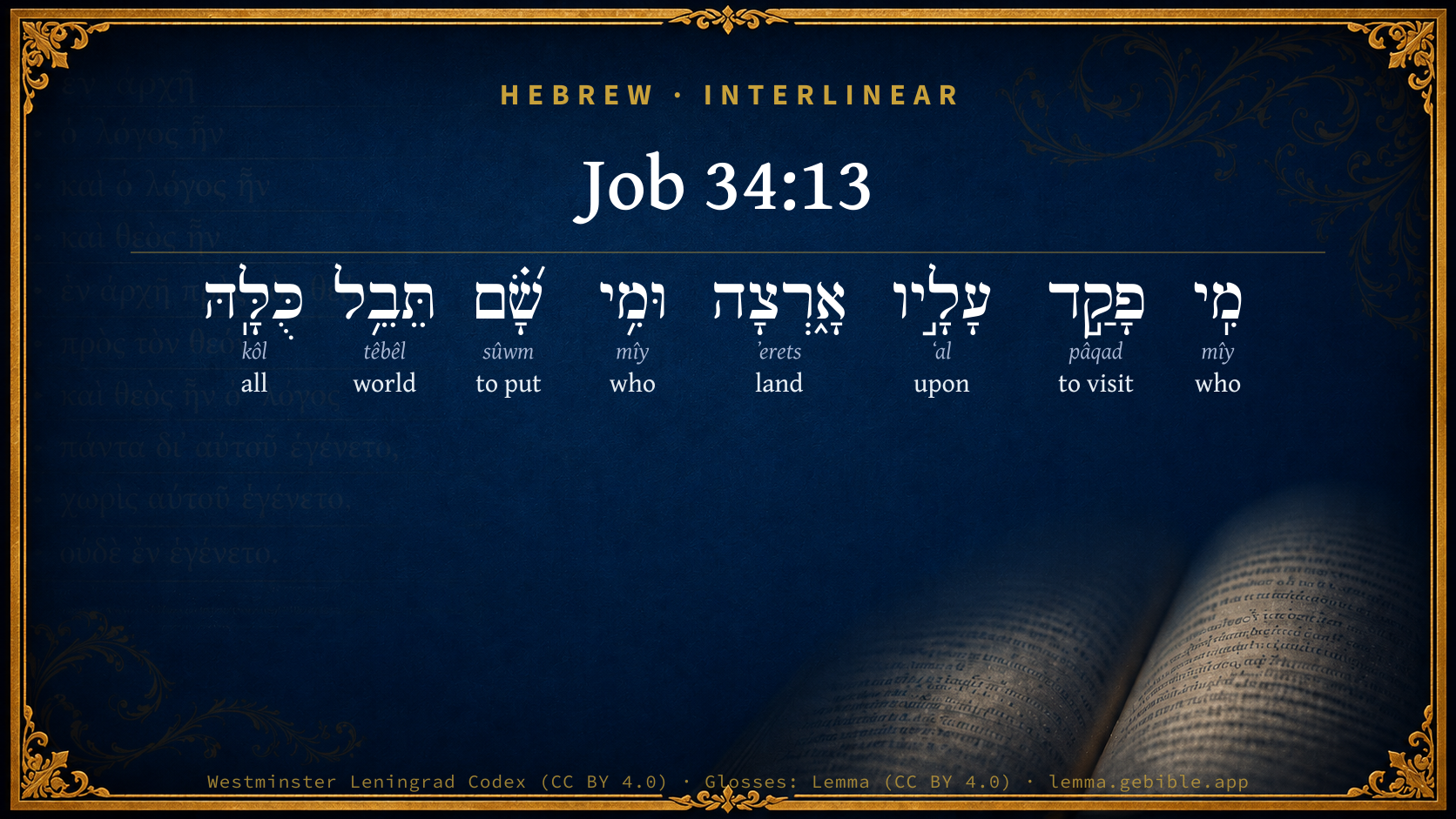
Job 34:13

Hebrew (Westminster Leningrad Codex) Job 34:13 appears in the Hebrew Old Testament. The text above is from the Westminster Leningrad Codex. Each word links to its Strong’s number, a concise gloss, and parsing drawn from the Open Scriptures Hebrew Bible morphology. Click any word for its full Brown-Driver-Briggs (BDB) entry.
Download image
Cite this verse

Job 34:13 (World English Bible). Public Domain. Lemma interlinear Bible study tool, https://lemma.gebible.app/v/job/34/13.

Show BibTeX & RIS
BibTeX
RIS
English Translation
Who gave him a charge over the earth? Or who has appointed him over the whole world?
World English Bible · Public Domain
Download a study sheet

One document with this verse’s original text, its word-by-word gloss line, the meaning frame, cross-references with their text, attributed commentary, and full source and license credits — printable, and it pastes into notes with its structure intact.

This verse Autodidact and up

Study sheet (.html) Plain text (.txt)

A passage Seminary Student

Up to 50 verses in one chapter. A passage sheet keeps up to 6 commentary sources and 12 cross-references per verse, in the order this page ranks them, and says so on the sheet whenever that leaves anything out. Ask for a single verse and you get the Autodidact verse sheet above.

Everything on this page stays free to read, with no account — the sheet is a download of what is already on screen, not access to it.

Want to remove ads? Support Godless Engineer
Compare translations 3

The same verse in 3 English versions, stacked beneath the original-language interlinear above. Click any original word for its lexicon entry.

Each is an independent rendering of the whole verse — the interlinear is not word-aligned to these translations.

Highlighted words mark where these versions differ — a whole-verse word diff, not a word-by-word alignment.

  • World English Bible Public Domain
    Who gave him a charge over the earth? Or who has appointed him over the whole world?
  • King James Version Public Domain
    Who hath given him a charge over the earth? or who hath disposed the whole world?
  • unfoldingWord Literal Text CC BY-SA 4.0
    Who appointed over the earth? And who set the world, all of it?

unfoldingWord Literal Text — © unfoldingWord, licensed CC BY-SA 4.0. Word-aligned USFM3 via Door43 (git.door43.org/unfoldingWord/en_ult).

Versions to compare (up to 4)

3 of 4 selected

Show all 18 translations

Every available English version of this verse, each an independent rendering of the whole verse.

  • World English Bible Public Domain
    Who gave him a charge over the earth? Or who has appointed him over the whole world?
  • Berean Standard Bible Public Domain
    Who gave Him charge over the earth? Who appointed Him over the whole world?
  • Majority Standard Bible Public Domain
    Who gave Him charge over the earth? Who appointed Him over the whole world?
  • King James Version Public Domain
    Who hath given him a charge over the earth? or who hath disposed the whole world?
  • American Standard Version (1901) Public Domain
    Who gave him a charge over the earth? Or who hath disposed the whole world?
  • Revised Version (1885) Public Domain
    Who gave him a charge over the earth? or who hath disposed the whole world?
  • Geneva Bible (1599) Public Domain
    Whome hath he appointed ouer the earth beside him selfe? or who hath placed the whole worlde?
  • Douay-Rheims (1899) Public Domain
    What other hath he appointed over the earth? or whom hath he set over the world which he made?
  • Young's Literal Translation Public Domain
    Who hath inspected for Himself the earth? And who hath placed all the habitable world?
  • Literal Standard Version CC BY-SA 4.0
    Who has inspected for Himself the earth? And who has placed all the habitable world?
  • Unlocked Literal Bible CC BY-SA 4.0
    Who put him in charge over the earth? Who put the whole world under him?
  • unfoldingWord Literal Text CC BY-SA 4.0
    Who appointed over the earth? And who set the world, all of it?
  • Darby Bible Public Domain
    Who hath entrusted to him the earth? and who hath disposed the whole world?
  • World Messianic Bible Public Domain
    Who put him in charge of the earth? Or who has appointed him over the whole world?
  • Webster's Bible Public Domain
    Who hath given him a charge over the earth? or who hath disposed the whole world?
  • Free Bible Version CC BY-SA 4.0
    Who put him in charge of the earth? Who gave him the responsibility for all the world?
  • Bible in Basic English Public Domain
    Who put the earth into his care, or made him responsible for the world?
  • JPS Tanakh (1917) Public Domain
    Who gave Him a charge over the earth? Or who hath disposed the whole world?

Literal Standard Version (2020), Covenant Press — licensed CC BY-SA 4.0. Text via the HelloAO Bible API (eBible.org). Unlocked Literal Bible (unfoldingWord) — licensed CC BY-SA 4.0. Text via the HelloAO Bible API (eBible.org). unfoldingWord Literal Text — © unfoldingWord, licensed CC BY-SA 4.0. Word-aligned USFM3 via Door43 (git.door43.org/unfoldingWord/en_ult). Free Bible Version, Dr. Jonathan Gallagher — licensed CC BY-SA 4.0. Text via the HelloAO Bible API (eBible.org).

Word by word

More ways to search: Search by grammar → Find every occurrence → Compare this word →

Practice this passage: Drill this verse → Learn its vocabulary →

About this verse

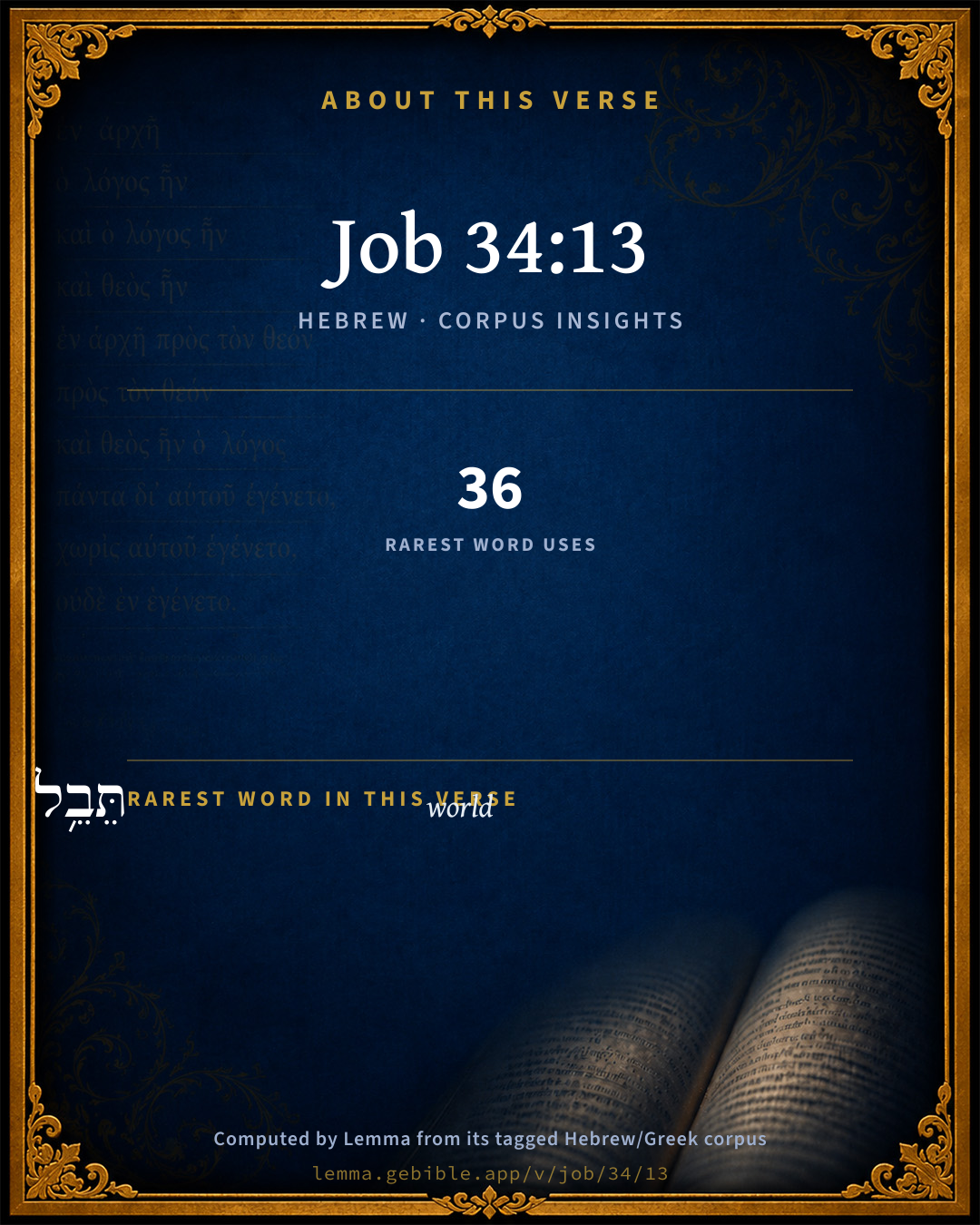
These counts appear in no published source. They are computed here, from the morphology-tagged text and Lemma’s own curated glosses. What Lemma adds →

8
words
7
distinct lemmas
Wisdom
section

Shared distinctive vocabulary

תֵּבֵ֥ל world H8398 occurs in 36 verses of the Hebrew Bible. Also found in:

Grammatical profile

  • 2 verbs
  • 3 nouns
  • 1 preposition
  • 2 particles

Verb forms

  • פָקַ֣ד Qal · Perfect
  • שָׂ֝֗ם Qal · Perfect

Repetition

A word recurs within this verse — often emphatic in Hebrew:

Hebrew & Septuagint length

In English translation the verse runs 17 words from the Hebrew and 15 from the Septuagint (LXX English) — closely comparable.

A rough comparison of the two English renderings, which tokenize alike — not a word-level alignment.

Word counts can differ between the Hebrew and the Greek without any difference in meaning — e.g. the Hebrew direct-object marker אֵת has no separate Greek word, and Greek often adds the article ὁ.

Cross-references

8

Topical passages linked to Job 34:13 in the Treasury of Scripture Knowledge — connected by theme and wording, ordered by reader-vote popularity; previews shown in the World English Bible.

  • 1 Chronicles 29:11 Yours, Yahweh, is the greatness, the power, the glory, the victory, and the majesty: for all that is in the heavens and in the earth is yours. Yours is the kingdom, Yahweh, and you are exalted as head above all.
  • Isaiah 40:13–14 Who has directed the Spirit of Yahweh, or being his counselor has taught him?
  • Romans 11:34–36 "For who has known the mind of the Lord? Or who has been his counselor?"
  • Job 36:23 Who has prescribed his way for him? Or who can say, 'You have committed unrighteousness?'
  • Job 38:4–41 "Where were you when I laid the foundations of the earth? Declare, if you have understanding.
  • Job 40:8–11 Will you even annul my judgment? Will you condemn me, that you may be justified?
  • Proverbs 8:23–30 I was set up from everlasting, from the beginning, Before the earth existed.
  • Daniel 4:35 All the inhabitants of the earth are reputed as nothing; and he does according to his will in the army of heaven, and among the inhabitants of the earth; and none can stay his hand, or tell him, What do you?

Cross-references courtesy of OpenBible.info (CC BY 4.0).

Hebrew and Greek witnesses Masoretic Hebrew ↔ Greek Septuagint

The same verse in the two great witnesses to the Old Testament, shown verse-for-verse.

These are two independent witnesses, not word-aligned to each other, and the Septuagint is shown in lemma (dictionary) form.

Hebrew Job 34:13 Masoretic · Westminster Leningrad Codex

מִֽי פָקַ֣ד עָלָ֣יו אָ֑רְצָה וּמִ֥י שָׂ֝֗ם תֵּבֵ֥ל כֻּלָּֽהּ

Who gave him a charge over the earth? Or who has appointed him over the whole world?

World English Bible · Public Domain

Greek LXX Job 34:13 Septuagint · lemma form

ὅς ποιέω ὁ γῆ τίς δέ εἰμί ὁ ποιέω ὁ ὑπό οὐρανός καί ὁ ἐνεἰμί πᾶς

And who is he that made the whole world under heaven, and all things therein?

LXX2012 (modern English Septuagint) · Public Domain

On this verse, John Gill's Exposition discusses the Septuagint’s reading. Read the note in Commentary ↓

Hebrew: Westminster Leningrad Codex (CC BY 4.0). Greek: Septuagint (public domain); English from LXX2012 (modern English Septuagint) (Public Domain). How the Septuagint differs from the Hebrew →

Commentary

Notes on Job 34:13 from classic Christian and Jewish commentators (each source and its license shown beneath its notes). The classic Christian expositions comment on the surrounding passage and are grouped to its opening verse, so a note may address several verses; the Jewish commentaries on the Tanakh (Rashi and others) are per-verse, so they appear only where the commentator wrote on this verse.

Lemma curates 59 commentaries, every one of them public domain or Creative Commons licensed, each selected and text-cleaned for this edition rather than reprinted as found. About our sources →

Trapp's Complete Commentary

John Trapp

Job 34:13 Who hath given him a charge over the earth? or who hath disposed the whole world?

Ver. 13. Who hath given him a charge over all the earth?] sc. To govern it. Is not he the Maker and Monarch of all men? Who is his superior? and to whom shall he give account? and who shall expostulate with him about injustice? Or, for fear of whom should he warp or writhe? The emperor cannot do right, saith one, because he hath none to overly awe him or question him (Theophil. Inst.). It is said of Trajan, that he neither feared nor hated any man living. What, then, shall we think of him, who is Moderator et Dominator supremus ac solus (Mercer).

Or who hath disposed the whole world?] The habitable world; and especially that habitable part of God’s earth, as man is called, Pro 8:31.

John Trapp, A Commentary or Exposition upon All the Books of the Old and New Testament (1647–1656) — public domain. Text from a community e-Sword module.

The Biblical Illustrator

Joseph S. Exell

Job_34:13

Who hath disposed the whole world.

The disposer of the world

It becomes us to entertain proper apprehensions of Him with whom we have to do.

I. Gods all-disposing agency.

1. God is the disposer of the whole world of nature. What man can produce, man can comprehend. All human workmanship is limited and finite, and capable of improvement. It is otherwise with the works of God. Here nothing is superfluous, nothing wanting, nothing by alteration can be improved. What arrangement there is in all those numerous and immense worlds which God hath created! If we are struck with a single instance of Gods arrangement in the world of nature, how much more should we be impressed with the whole if we were in a proper state of mind, and if God were in all our thoughts.

2. He is the disposer of the whole world of grace. The apostle speaks not only of grace, but of the purpose of grace. There was nothing left unappointed or unarranged. The scheme stretches from eternity to eternity, and in every part of it we see God abounding in all wisdom and prudence.

3. He is the disposer of the whole world of providence; and while He seems to be doing nothing, He is doing all things according to the counsel of His own will. We have many specimens of Gods providence in the Scriptures of truth. Providence has been at work in your history.

II. Practical reflections. Four ways in which the doctrine of the all-disposing energy of God may be improved.

1. In the way of conviction.

2. In the way of adoration.

3. In the way of consolation.

4. Let this subject check our presumption. (William Jay.)

The Biblical Illustrator, edited by Joseph S. Exell (c. 1880s–1900s) — public domain. Text from a community e-Sword module.

Joseph Benson's Commentary

Job 34:13. Who hath given him a charge over the earth? — Over the inhabitants of the earth, to rule them according to his laws, and to give an account to him thereof? Who or where is his superior, that made the world, and then delivered the government of it to God? There is no such person. God himself is the sole Creator, the supreme, absolute Lord of all, and therefore cannot act unjustly; because the Creator and Lord of the world must needs have all possible perfections in himself, and, among others, perfect justice; and because he is of himself all-sufficient, and independent of all other beings, and able to do and procure whatsoever he pleaseth; and therefore as he hath no inclination, so he hath no temptation to any unrighteous action; this being generally the reason of all the unrighteous actions in the world, that the persons who do them either are obliged to do them to gratify some superior who commands them, or else they want or desire something which they cannot justly obtain. For he would be a monster, and not a man, who would take away any thing by injustice or violence which he might have by right. Or who hath disposed the whole world? — “He did not receive the government of the world from any above himself; nor is there any higher being, whose authority he may be thought to dread, and for fear of whom he may be tempted to act unjustly.” — Bishop Patrick. The Hebrew of the former clause, מי פקד עליו ארצה, mi pakad gnalaiv artzah, the phraseology of which is rather peculiar, is rendered by Chappelow, Who enjoined him to create the earth? and by some others, Who on earth can be his overseer? The meaning evidently is, as Dr. Dodd observes from Schultens and Heath, “Who on earth hath authority sufficient to examine into and control his proceedings.”

Joseph Benson's Commentary on the Old and New Testaments (1811–1818) — public domain. Text from a community e-Sword module.

Jamieson, Fausset & Brown

Robert Jamieson, A. R. Fausset & David Brown

If the world were not God's property, as having been made by Him, but committed to His charge by some superior, it might be possible for Him to act unjustly, as He would not thereby be injuring Himself; but as it is, for God to act unjustly would undermine the whole order of the world, and so would injure God's own property (Job 36:23).

disposed--hath founded (Isa 44:7), established the circle of the globe.

Jamieson, Fausset & Brown — Commentary Critical and Explanatory on the Whole Bible (1871) — public domain (CC PDM 1.0). Text via the HelloAO Bible API.

Adam Clarke's Commentary

Verse 13. Who hath given him a charge] Who is it that governs the world? Is it not God? Who disposes of all things in it? Is it not the Almighty, by his just and merciful providence? The government of the world shows the care, the justice, and the mercy of God.

Adam Clarke's Commentary on the Bible (1810–1826) — public domain. Text from a community e-Sword/MySword module.

Ellicott's Commentary for English Readers

(13) Who hath disposed the whole world?—Or, Who hath set the whole world upon Him? i.e., entrusted it to His care; in the other sense it means, “Who but He hath made the whole world, and who, therefore, can have the interest in it which He must have?”

A Bible Commentary for English Readers, edited by Charles John Ellicott (1878–1897) — public domain. Text from a community e-Sword module.

The Cambridge Bible for Schools and Colleges

gen. ed. J. J. S. Perowne

13–15. The first thought of Elihu is that the earth, the world, is not entrusted to God by another; He himself arranged it all as it is; there is therefore no motive to injustice. This is one side of his idea; the other (Job_34:14) is that the fact of the creation and sustaining of all things and creatures by God is proof of unselfish benevolence, for if God thought of Himself and ceased to send forth His spirit, all flesh would perish.

The Oriental thinker was not a pessimist; to his mind life was not an evil but the highest good, and its continuance proof of goodness in God who gave it and continued it. Neither would it occur to such a thinker, when he argued that there was no temptation to injustice in the Creator, that a temptation might be found in His own malevolent nature. A first cause that was evil could not be supposed by any one in the position of the speakers in this Book. Even when Job touches upon such an idea, as in ch. Job_7:17 seq., Job_10:3 seq., it is for the purpose of shewing the inconsistency of malevolence with God’s necessary attributes. Comp. remarks at the end of ch. 10.

The Cambridge Bible for Schools and Colleges (gen. ed. J. J. S. Perowne; Cambridge University Press, 1878–1918) — public domain. Text from a community e-Sword module.

John Gill's Exposition

If he set his heart upon man,.... Not his love and affections; though there are some he does in this sense set his heart on, and whose souls at death he gathers to himself, but with this sense the next verse will not agree; but to destroy him, as Jarchi adds by way of explanation; if he gives his mind to it, is set upon it and resolved to do it, none can hinder him; or sets himself against him in an hostile way, the issue must be entire ruin and destruction to the race of men; but it is plain this is not the case, or otherwise all must have perished long ago: or if he severely marks the ways and works of men, and deals with them according to the strictness of his justice, which yet he might do without any charge of injustice, none could stand before him; but this he does not, so far is he from any injustice, or any appearance of it;

if he gather unto himself his spirit and his breath; not his own spirit and breath, drawing in and retaining that within himself, and withholding the influence of it from his creatures, which the Septuagint version seems to favour; but the spirit and breath of man, which are of God, and which, as he gives, he can gather when he pleases. The spirit or rational soul of man is put in him by the Lord; this at death is separated from the body, yet dies not with it, but is gathered to the Lord: and the breath which he breathes into man, and is in his nostrils, and which, as he gives, he can take away, and then man dies. But in doing this he does no injustice; indeed, should he in anger and resentment rise up and deal thus with men in general, the consequence must be as follows.

John Gill's Exposition of the Whole Bible (1746–1763) — public domain (CC PDM 1.0). Text via the HelloAO Bible API.

Albert Barnes' Notes on the Bible

Who hath given him a charge over the earth? - That is, he is the great original Proprietor and Ruler of all. He has derived his authority to govern from no one; he is under subjection to no one, and he has, therefore, an absolute right to do his own pleasure. Reigning then with absolute and original authority, no one has a right to call in question the equity of what he does. The argument of Elihu here, that God would do right, is derived solely from his independence. If he were a subordinate governor, he would feel less interest in the correct administration of affairs, and might be tempted to commit injuries to gratify the feelings of his superior. As he is, however, supreme and independent, he cannot be tempted to do wrong by any reference to a superior will; as the universe is that which he has made, and which belongs to him, every consideration would lead him to do right to all. He can have no partiality for one more than another; and there can be no one to whom he would desire to do injustice - for who wishes to injure that which belongs to himself? Prof. Lee, however, renders this, “Who hath set a land in order against him?” He supposes that the remark is designed to show the folly of rebelling against God. But the former interpretation seems better to accord with the scope of the argument.

Or who hath disposed the whole world? - Who has arranged the affairs of the universe? The word rendered “world,” usually means the habitable earth, but it is employed here in the sense of the universe, and the idea is, that God has arranged and ordered all things, and that he is the supreme and absolute Sovereign.

Albert Barnes' Notes on the Bible (1834–1885) — public domain. Text from a community e-Sword/MySword module.

Haydock's Catholic Bible Commentary

Earth? If God cannot be unjust, hat he given the administration of the world to some other, who may have been deceived? This will not be asserted. Hebrew, "who hath visited the earth for him?" or, "who hath set him over the earth?" Is he a hired judge, who may be bribed? (Calmet)

George Leo Haydock (1774–1849), Haydock's Catholic Family Bible and Commentary, 1859 edition — public domain. Excludes Psalms (Douay-Rheims chapter numbering differs from Protestant) and Deuterocanonical books (Catholic canon only).

Matthew Poole's English Annotations

Over the earth, i.e. over the inhabitants of the earth, to rule them according to his laws, and to give an account to him of it. Who or where is his superior that made the world, and then delivered the government of it to God? There is no such person. God himself is the sole Creator, the absolute and supreme Lord and Governor, of all the world, and therefore cannot do unjustly. The reason is, partly, because all unrighteousness is a transgression of some law, and God hath no law to bound him but his own nature and will; partly, because the Creator and Lord of the world must needs have all possible perfections in himself, and, amongst others, perfect justice, and must needs be free from all imperfections and obliquities, and therefore from injustice; and partly, because he is of himself all-sufficient, and independent upon all other persons, and able to do and procure whatsoever pleaseth him; and therefore as he hath no inclination, so he hath no temptation, to any unrighteous actions; this being generally the reason of all unrighteous actions in the world, because the persons who do them either are obliged to do it, to gratify some superior authority who commands them to do it, or else do want or desire something which they cannot justly obtain; for he is a monster, and not a man, who will take away any thing by injustice or violence which he may have by right.

Who hath disposed, or committed, to wit, to him, to be governed by him, in the name and for the use and service of his superior Lord, to whom he must give an account.

Matthew Poole's English Annotations on the Holy Bible (1683–1685) — public domain. Text from a community e-Sword/MySword module.

Whedon's Commentary on the Bible

Daniel D. Whedon

13. Who hath given him a charge, etc. — The הis paragogic, not directive. The clause should read, Who hath given the earth in charge to him? Evil-doing can not be imputed to Deity, because of the absoluteness of the divine government. There is none higher than himself, therefore none whose favour God needs to seek. A deputy may be tempted to do wrong to please his superior, but not God; for it was he “who founded, שׂםthe whole world.” Of his own free will he governs his own world. “Shall not the Judge of all the earth do right?” Gen_18:25. Compare Rom_3:5-6.

Daniel D. Whedon (gen. ed.), Commentary on the Old and New Testaments (1874–1909) — public domain. Text from a community e-Sword module.

The Pulpit Commentary

Who hath given him a charge over the earth? The argument seems to be that if God had "received a charge," and were in possession of a mere delegated authority, like the subordinate gods of heathen nations, he might have an interest apart from that of those whom he governs, and so be tempted to be unjust; but as he is the Author of all and the sole Ruler of all, his interest must be bound up with the true interests of his creatures, and cannot clash with them. He can thus never be unjust, since he can have no temptation to be unjust. Or who hath disposed the whole world? rather, Who hath laid upon him the whole world? (see the margin of the Revised Version). Elihu repeats the idea of the previous clause in other words.

The Pulpit Commentary (1880–1919), ed. H.D.M. Spence-Jones & Joseph S. Exell — public domain. Text from a community e-Sword module.

John Wesley's Explanatory Notes

Who - Who or where is his superior that made the world, and, then delivered the government of it to God? God himself is the sole creator, the absolute Lord of all, and therefore cannot do unjustly: because the creator and Lord of the world must needs have all possible perfections in himself, and amongst others, perfect justice. Disposed - Or, committed, to him, to be governed by him, in the name, of his Lord, to whom he must give an account.

John Wesley, Explanatory Notes Upon the Whole Bible (1754–1765) — public domain. Text via the GEBible commentary corpus.

unfoldingWord translationNotes

Door43 World Missions Community

General Information:

Elihu continues speaking.

Who put him in charge over the earth? Who put the whole world under him?

Both of these rhetorical questions have the same meaning and emphasize that no one needed to grant God authority because it was already his. These questions can be written as statements. AT: "No one needed to give permission to God to take responsibility over all the earth. He is the rightful one to rule the world." (See: Parallelism and Rhetorical Question)

If he ever

Elihu is describing a situation that he does not believe would ever happen. (See: Hypothetical Situations)

his spirit and his breath

The "spirit" and "breath" of God are what makes all living things alive. AT: "his spirit and breath which give us life" (See: Assumed Knowledge and Implicit Information)

all flesh

Here all living things are represented by their "flesh." AT: "all living things" (See: Synecdoche)

mankind would return to dust again

This means that all people would die and their bodies would decay and become soil. In the beginning God created man from the dust. AT: "the bodies of mankind would soon become soil again" (See: Assumed Knowledge and Implicit Information)

translationWords

earth

Holy Spirit

flesh

perish

unfoldingWord translationNotes — © Distant Shores Media and the Door43 World Missions Community, licensed CC BY-SA 4.0. Source: git.door43.org/Door43/en_tn.

Rashi

Rabbi Shlomo Yitzchaki (Rashi)

Who gave Him a charge over the earth Who rules over Him, saying, ‘Why did You do so?’ or ‘I did not command You so’? For who gave Him a charge over His dominion, and why should He find pretexts for His creatures? He need not answer one who rules over Him by saying ‘Because of this I harmed him.’

Rashi on the Tanakh — English translations: “The Judaica Press complete Tanach with Rashi, translated by A. J. Rosenberg” (CC BY 4.0); “Pentateuch with Rashi's commentary by M. Rosenbaum and A.M. Silbermann, 1929-1934” (public domain); “The Metsudah Tanach series, Lakewood, N.J” (CC BY 4.0); and “The Book of Joshua, Metsudah Publications, 1997” (CC BY 4.0). Text via Sefaria.

Lesson kit

Teaching starters — assembled from the data on this page, not authored interpretation. Every prompt links to the verse data it draws on. Edit before teaching.

Job, in the Wisdom, opens this verse with 8 words (7 distinct Hebrew lemmas). Its most distinctive word is têbêl (“world”). A historical commentator’s framing appears above. Read the whole chapter for the surrounding context.

Discussion questions

  1. How does “world” (têbêl) shape what this verse is saying?
  2. 1 Samuel 2:8 shares the word «world» with this verse. How do the two illuminate each other?
  3. “who” occurs 2× in this one verse. What is the effect of the repetition?
  4. The translations on this page render this verse differently — a whole-verse word diff, not a word-by-word alignment. What might account for the different wordings?
  5. The verb «פָקַ֣ד» is Qal Perfect. How does its form color the action?
  6. Reading how Trapp's Complete Commentary and The Biblical Illustrator read this verse, where do the two commentators agree and where do they part?

Things to notice

Reading settings

Reading text

Shown beneath each verse's original-language words.

Old Testament
Old Testament edition

Read the OT as the Masoretic Hebrew (MT) or the Greek Septuagint (LXX).

English shown for the Greek Septuagint (in the Hebrew ↔ Greek comparison).

Comparing translations? Open the Compare panel on any verse page to stack up to four side by side.