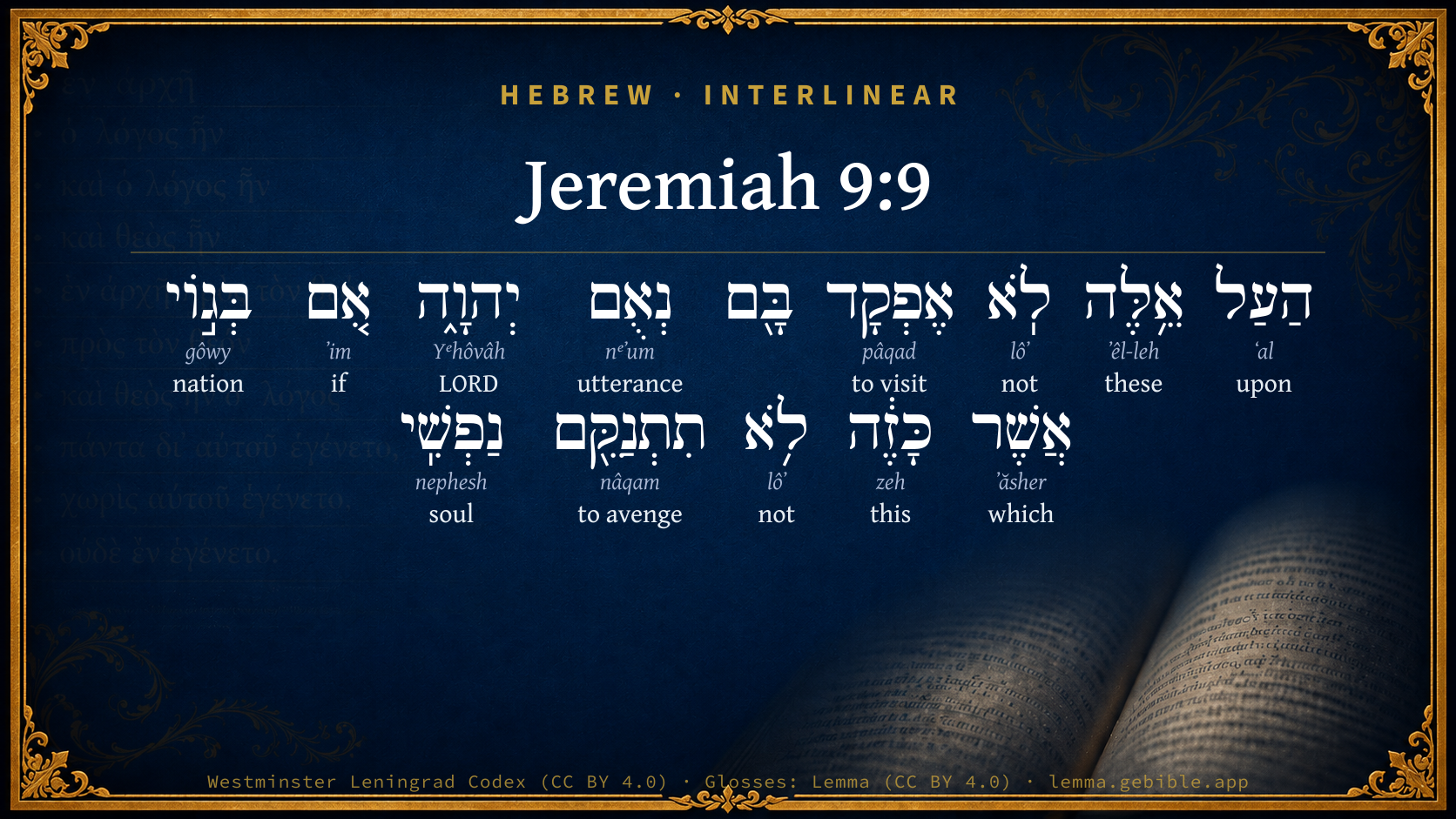
Jeremiah 9:9

Hebrew (Westminster Leningrad Codex) Jeremiah 9:9 appears in the Hebrew Old Testament. The text above is from the Westminster Leningrad Codex. Each word links to its Strong’s number, a concise gloss, and parsing drawn from the Open Scriptures Hebrew Bible morphology. Click any word for its full Brown-Driver-Briggs (BDB) entry.
Download image
Cite this verse

Jeremiah 9:9 (World English Bible). Public Domain. Lemma interlinear Bible study tool, https://lemma.gebible.app/v/jeremiah/9/9.

Show BibTeX & RIS
BibTeX
RIS
English Translation
Shall I not visit them for these things? says Yahweh; shall not my soul be avenged on such a nation as this?
World English Bible · Public Domain
Download a study sheet

One document with this verse’s original text, its word-by-word gloss line, the meaning frame, cross-references with their text, attributed commentary, and full source and license credits — printable, and it pastes into notes with its structure intact.

This verse Autodidact and up

Study sheet (.html) Plain text (.txt)

A passage Seminary Student

Up to 50 verses in one chapter. A passage sheet keeps up to 6 commentary sources and 12 cross-references per verse, in the order this page ranks them, and says so on the sheet whenever that leaves anything out. Ask for a single verse and you get the Autodidact verse sheet above.

Everything on this page stays free to read, with no account — the sheet is a download of what is already on screen, not access to it.

Want to remove ads? Support Godless Engineer
Compare translations 3

The same verse in 3 English versions, stacked beneath the original-language interlinear above. Click any original word for its lexicon entry.

Each is an independent rendering of the whole verse — the interlinear is not word-aligned to these translations.

Highlighted words mark where these versions differ — a whole-verse word diff, not a word-by-word alignment.

  • World English Bible Public Domain
    Shall I not visit them for these things? says Yahweh; shall not my soul be avenged on such a nation as this?
  • King James Version Public Domain
    Shall I not visit them for these things? saith the LORD: shall not my soul be avenged on such a nation as this?
  • unfoldingWord Literal Text CC BY-SA 4.0
    Shall I not punish upon them because of these things”—the declaration of Yahweh— “Shall I not avenge myself on a nation such as this?”

unfoldingWord Literal Text — © unfoldingWord, licensed CC BY-SA 4.0. Word-aligned USFM3 via Door43 (git.door43.org/unfoldingWord/en_ult).

Versions to compare (up to 4)

3 of 4 selected

Show all 18 translations

Every available English version of this verse, each an independent rendering of the whole verse.

  • World English Bible Public Domain
    Shall I not visit them for these things? says Yahweh; shall not my soul be avenged on such a nation as this?
  • Berean Standard Bible Public Domain
    Should I not punish them for these things? declares the LORD. Should I not avenge Myself on such a nation as this?”
  • Majority Standard Bible Public Domain
    Should I not punish them for these things? declares the LORD. Should I not avenge Myself on such a nation as this?”
  • King James Version Public Domain
    Shall I not visit them for these things? saith the LORD: shall not my soul be avenged on such a nation as this?
  • American Standard Version (1901) Public Domain
    Shall I not visit them for these things? saith Jehovah; shall not my soul be avenged on such a nation as this?
  • Revised Version (1885) Public Domain
    Shall I not visit them for these things? saith the LORD: shall not my soul be avenged on such a nation as this?
  • Geneva Bible (1599) Public Domain
    Shal I not visit them for these things, saith the Lord? or shall not my soule be auenged on such a nation as this?
  • Douay-Rheims (1899) Public Domain
    Shall I not visit them for these things, saith the Lord? or shall not my soul be revenged on such a nation?
  • Young's Literal Translation Public Domain
    For these things do not I see after them? An affirmation of Jehovah, Against a nation such as this doth not My soul avenge itself?
  • Literal Standard Version CC BY-SA 4.0
    Do I not see after them for these things?” A declaration of YHWH, “Does My soul not avenge itself against a nation such as this?”
  • Unlocked Literal Bible CC BY-SA 4.0
    Should I not punish them because of these things—this is Yahweh's declaration— and should I not avenge myself on a nation that is like this?
  • unfoldingWord Literal Text CC BY-SA 4.0
    Shall I not punish upon them because of these things”—the declaration of Yahweh— “Shall I not avenge myself on a nation such as this?”
  • Darby Bible Public Domain
    Shall I not visit them for these [things]? saith Jehovah; shall not my soul be avenged on such a nation as this?
  • World Messianic Bible Public Domain
    Shouldn’t I punish them for these things?” says the LORD. “Shouldn’t my soul be avenged on a nation such as this?
  • Webster's Bible Public Domain
    Shall I not visit them for these things? saith the LORD: shall not my soul be avenged on such a nation as this?
  • Free Bible Version CC BY-SA 4.0
    Shouldn't I punish them for all this? declares the Lord. Shouldn't I retaliate for what this nation has done?
  • Bible in Basic English Public Domain
    Am I not to send punishment for these things? says the Lord: will not my soul take payment from such a nation as this?
  • JPS Tanakh (1917) Public Domain
    (9-8) Shall I not punish them for these things? saith the LORD; Shall not My soul be avenged on such a nation as this?

Literal Standard Version (2020), Covenant Press — licensed CC BY-SA 4.0. Text via the HelloAO Bible API (eBible.org). Unlocked Literal Bible (unfoldingWord) — licensed CC BY-SA 4.0. Text via the HelloAO Bible API (eBible.org). unfoldingWord Literal Text — © unfoldingWord, licensed CC BY-SA 4.0. Word-aligned USFM3 via Door43 (git.door43.org/unfoldingWord/en_ult). Free Bible Version, Dr. Jonathan Gallagher — licensed CC BY-SA 4.0. Text via the HelloAO Bible API (eBible.org).

Word by word

More ways to search: Search by grammar → Find every occurrence → Compare this word →

Practice this passage: Drill this verse → Learn its vocabulary →

תִתְנַקֵּ֖ם
nâqam
H5358
“to avenge”
Verb, Hithpael, Imperfect, 3rd Person, Feminine, Singular
Part of Speech
Verb
Stem
Hithpael
Form
Imperfect
Person
3rd Person
Gender
Feminine
Number
Singular
Full BDB Definition

Origin: a primitive root

TWOT: 1413

to avenge, take vengeance, revenge, avenge oneself, be avenged, be punished - (Qal) - to avenge, take vengeance - to entertain revengeful feelings - (Niphal) - to avenge oneself - to suffer vengeance - (Piel) to avenge - (Hophal) to be avenged, vengeance be taken (for blood) - (Hithpael) to avenge oneself
  1. הַעַל ʻal H5921 “upon” Particle, Interrogative + Preposition
  2. אֵ֥לֶּה ʼêl-leh H428 “these” Pronoun, Demonstrative, Common, Plural
  3. לֹֽא lôʼ H3808 “not” Particle, Negative
  4. אֶפְקָד pâqad H6485 “to visit” Verb, Qal, Imperfect, 1st Person, Common, Singular
  5. נְאֻם nᵉʼum H5002 “utterance of” Noun, Common, Masculine, Singular, Construct
  6. יְהוָ֑ה Yᵉhôvâh H3068 “LORD” Noun, Proper
  7. אִ֚ם ʼim H518 “if” Conjunction
  8. בְּג֣וֹי gôwy H1471 “in/at · nation” Preposition + Noun, Common, Masculine, Singular, Absolute
  9. אֲשֶׁר ʼăsher H834 “which” Particle, Relative
  10. כָּזֶ֔ה zeh H2088 “like/as · this” Preposition + Pronoun, Demonstrative, Masculine, Singular
  11. לֹ֥א lôʼ H3808 “not” Particle, Negative
  12. נַפְשִֽׁי nephesh H5315 “soul · my” Noun, Common, Both, Singular, Construct + Suffix, Personal, 1st Person, Common, Singular

About this verse

These counts appear in no published source. They are computed here, from the morphology-tagged text and Lemma’s own curated glosses. What Lemma adds →

14
words
12
distinct lemmas
Prophets
section

Shared distinctive vocabulary

תִתְנַקֵּ֖ם to avenge H5358 occurs in 31 verses of the Hebrew Bible. Also found in:

Grammatical profile

  • 2 verbs
  • 4 nouns
  • 2 pronouns
  • 2 prepositions
  • 1 conjunction
  • 3 particles

Verb forms

  • אֶפְקָד Qal · Imperfect
  • תִתְנַקֵּ֖ם Hithpael · Imperfect

Repetition

A word recurs within this verse — often emphatic in Hebrew:

Cross-references

3

Topical passages linked to Jeremiah 9:9 in the Treasury of Scripture Knowledge — connected by theme and wording, ordered by reader-vote popularity; previews shown in the World English Bible.

  • Jeremiah 5:9 Shall I not visit for these things? says Yahweh; and shall not my soul be avenged on such a nation as this?
  • Jeremiah 5:29 Shall I not visit for these things? says Yahweh; shall not my soul be avenged on such a nation as this?
  • Isaiah 1:24 Therefore the Lord, Yahweh of Hosts, The Mighty One of Israel, says: "Ah, I will get relief from my adversaries, And avenge myself of my enemies;

Cross-references courtesy of OpenBible.info (CC BY 4.0).

Hebrew and Greek witnesses Masoretic Hebrew ↔ Greek Septuagint

The same verse in the two great witnesses to the Old Testament, shown verse-for-verse.

These are two independent witnesses, not word-aligned to each other, and the Septuagint is shown in lemma (dictionary) form.

Hebrew Jeremiah 9:9 Masoretic · Westminster Leningrad Codex

הַעַל אֵ֥לֶּה לֹֽא אֶפְקָד בָּ֖ם נְאֻם יְהוָ֑ה אִ֚ם בְּג֣וֹי אֲשֶׁר כָּזֶ֔ה לֹ֥א תִתְנַקֵּ֖ם נַפְשִֽׁי

Shall I not visit them for these things? says Yahweh; shall not my soul be avenged on such a nation as this?

World English Bible · Public Domain

Greek LXX Structure differs

In the Septuagint, Jeremiah is about an eighth shorter than the Hebrew and arranges its material differently — the Oracles Against the Nations (Hebrew chapters 46–51) appear in the middle of the Greek book, after 25:13. Because the chapter and verse boundaries do not line up, a verse-for-verse comparison with the Hebrew is not shown.

A verse-for-verse comparison isn’t shown here because the chapters and verses don’t line up. Switch to the LXX edition with the MT / LXX toggle above to read the Greek directly.

Hebrew: Westminster Leningrad Codex (CC BY 4.0). Greek: Septuagint (public domain); English from a public-domain English Septuagint. How the Septuagint differs from the Hebrew →

Targum (Aramaic paraphrase)

1

The Targum is the ancient Jewish Aramaic paraphrase of the Hebrew Scriptures — an interpretive translation, not the Hebrew text itself. Onkelos (literal) and Pseudo-Jonathan (expansive) render the Torah, and Jonathan the Prophets. Coverage is partial: where no permissively-licensed English translation exists for a verse, only the Aramaic is shown. This is verse-level text, not a word-by-word alignment to the Hebrew.

  1. Targum Jonathan Prophets (Joshua–Malachi)
    עַל טוּרַיָא אֲנָא מֵרִים קָלֵי וּבְכֵי וּמְצַוָח וְעַל דִירָוַת מַדְבְּרָא אִלְיָא אֲרֵי צַדִיאוּ מִבְּלִי אֱנַשׁ דְעָדֵי וְלָא אִשְׁתְּמַע קַל בְּעִירָא בְּאַרְעֲהוֹן מֵעוֹפָא דִשְׁמַיָא וְעַד בְּעִירָא אִטַלְטָלוּ גְלוֹ:

    (no public-domain English translation for this verse)

    Targum Jonathan — Aramaic: “Mikraot Gedolot” (public domain). English: “Sefaria Community Translation” (CC0 1.0 (public-domain dedication)); “London "Chaldee Paraphrase," 1871” (public domain). Text via Sefaria.

Commentary

Notes on Jeremiah 9:9 from classic Christian and Jewish commentators (each source and its license shown beneath its notes). The classic Christian expositions comment on the surrounding passage and are grouped to its opening verse, so a note may address several verses; the Jewish commentaries on the Tanakh (Rashi and others) are per-verse, so they appear only where the commentator wrote on this verse.

Lemma curates 59 commentaries, every one of them public domain or Creative Commons licensed, each selected and text-cleaned for this edition rather than reprinted as found. About our sources →

Trapp's Complete Commentary

John Trapp

Jer 9:9 Shall I not visit them for these [things]? saith the LORD: shall not my soul be avenged on such a nation as this?

Ver. 9. Shall I not visit them?] See on Jer 5:9.

John Trapp, A Commentary or Exposition upon All the Books of the Old and New Testament (1647–1656) — public domain. Text from a community e-Sword module.

Keil & Delitzsch

C. F. Keil & F. Delitzsch

The land laid waste, and the people scattered amongst the heathen. - Jer 9:9. "For the mountains I take up a weeping and wailing, and for the pastures of the wilderness a lament; for they are burnt up so that no man passeth over them, neither hear they the voice of the flock; the fowls of the heavens and the cattle are fled, are gone. Jer 9:10. And I make Jerusalem heaps, a dwelling of jackals; and the cities of Judah I make a desolation, without an inhabitant. Jer 9:11. Who is the wise man, that he may understand this? and to whom the mouth of Jahveh hath spoken, that he may declare it? Wherefore doth the land come to ruin, is it burnt up like the wilderness, that none passeth through? Jer 9:12. Jahveh said: Because they forsake my law which I set before them, and have not hearkened unto my voice, neither walked therein, Jer 9:13. But went after the stubbornness of their heart, and after the Baals, which their fathers have taught them. Jer 9:14. Therefore thus hath Jahveh of hosts spoken, the God of Israel: Behold, I feed this people with wormwood, and give them water of gall to drink, Jer 9:15. And scatter them among the nations which they knew not, neither they nor their fathers, and send the sword after them, until I have consumed them."

Already in spirit Jeremiah sees God's visitation come upon the land, and in Jer 9:9 and Jer 9:10 he raises a bitter lamentation for the desolation of the country. The mountains and meadows of the steppes or prairies are made so desolate, that neither men nor beasts are to be found there. Mountains and meadows or pastures of the steppes, as contrasted with the cities (Jer 9:10), represent the remoter parts of the country. על is here not local: upon, but causal, concerning = because of, cf. Jer 4:24., as is usual with (נשׂא נהי )קינה; cf. Sa2 1:17; Amo 5:1; Eze 26:17, etc. נצּתוּ, kindled, burnt up, usually of cities (cf. Jer 2:15), here of a tract of country with the sig. be parched by the glowing heat of the sun, as a result of the interruption of agriculture. מדבּר is steppe, prairie, not suitable for tillage, but well fitted for pasturing cattle, as e.g., the wilderness of Judah; cf. Sa1 17:28. With מבּלי, Jer 9:11, cf. Eze 33:28. Not only have the herds disappeared that used to feed there, but the very birds have flown away, because the parched land no longer furnishes food for them; cf. Jer 4:25. To "are fled," which is used most properly of birds, is added: are gone away, departed, in reference to the cattle.

Jer 9:10-13

Jerusalem is to become stone-heaps, where only jackals dwell. תּנּים is jackals (canis aureus), in Isa 13:22 called איּים from their cry; see on Isa. l.c., and Gesen. thes. s. v. מבּלי יושׁב as in Jer 2:15; Jer 4:7. - That such a judgment will pass over Judah every wise man must see well, and every one enlightened by God is to declare it; for universal apostasy from God and His law cannot but bring down punishment. But such wisdom and such spiritual enlightenment is not found in the infatuated people. This is the idea of Jer 9:11-13. The question: Who is the wise man? etc., reminds us of Hos 14:9, and is used with a negative force: unhappily there is none so wise as to see this. "This" is explained by the clause, Wherefore doth the land, etc.: this, i.e., the reason why the land is going to destruction. The second clause, "and to whom," etc., is dependent on the מי, which is to be repeated in thought: and who is he that, etc. Jeremiah has the false prophets here in view, who, if they were really illumined by God, if they had the word of God, could not but declare to the people their corruptness, and the consequences which must flow from it. But since none is so wise...Jeremiah proposes to them the question in Jer 9:11, and in Jer 9:12 tells the answer as given by God Himself. Because they have forsaken my law, etc. נתן לפני, to set before; as in Deu 4:8, so here, of the oral inculcation of the law by the prophets. "Walketh therein" refers to the law. The stubbornness of their heart, as in Jer 3:17; Jer 7:24. After the Baals, Jer 2:23. The relative clause, "which their fathers," etc., refers to both clauses of the verse; אשׁר with a neuter sense: which their fathers have taught them.

Jer 9:14-15

The description of the offence is again followed by the threatening of judgment. To feed with wormwood and give gall to drink is a figure for sore and bitter suffering at the overthrow of the kingdom and in exile. The meaning of the suffix in מאכילם is shown by the apposition: this people. On water of gall see Jer 8:14, and for the use of לענה and ראשׁ together see Deu 29:17. - 'הפיצותים וגו implies a verbal allusion to the words of Deu 28:64 and Deu 28:36, cf. Lev 26:33. With this latter passage the second clause: I send the sword after them, has a close affinity. The purport of it is: I send the sword after the fugitives, to pursue them into foreign lands and slay them; cf. Jer 42:16; Jer 44:27. Thus it is indicated that those who fled into Egypt would be reached by the sword there and slain. This does not stand in contradiction to what is said in Jer 4:27; Jer 5:18, etc., to the effect that God will not make an utter end of them (Graf's opinion). This appears from Jer 44:27, where those that flee to Egypt are threatened with destruction by famine and sword עד כּלּותי או, while Jer 44:28 continues: but they that have escaped the sword shall return. Hence we see that the terms of the threatening do not imply the extirpation of the people to the last man, but only the extirpation of all the godless, of this wicked people.

Keil & Delitzsch — Biblical Commentary on the Old Testament (1861–1891) — public domain (CC PDM 1.0). Text via the HelloAO Bible API. (Old Testament only.)

Jamieson, Fausset & Brown

Robert Jamieson, A. R. Fausset & David Brown

(Jer 5:9, Jer 5:29).

Jamieson, Fausset & Brown — Commentary Critical and Explanatory on the Whole Bible (1871) — public domain (CC PDM 1.0). Text via the HelloAO Bible API.

John Calvin's Commentaries

We have already met with this verse; it will therefore be enough briefly to refer to what it contains. God shews here, that except he denied himself he must necessarily punish the Jews. How so? He takes it as granted that he is the judge of the world: he had said that the Jews were not only become wicked in one thing, but were so given up to all kinds of wickedness, that they wearied themselves; what then was to be done? God would not have acted in a manner worthy of himself, nor preserved consistency, had he not punished such men; for he must have changed his nature, had he not hated such a perverse nation. But he speaks after the manner of men when he mentions vengeance; for we know that no passions belong to God, as it has been often stated: but as he hates wickedness, so he is said to execute vengeance, when he appears as a judge and chastises those by whom he has been provoked to wrath.

John Calvin's Commentaries (1540-1563) — public domain. Text from the Calvin Translation Society English edition (1840s-50s) via the Christian Classics Ethereal Library (ccel.org). Calvin's coverage is partial (roughly two-thirds of the Bible); uncommented books and verses are honest gaps, never fabricated. The 19th-century editor's footnotes and remarks are omitted so the notes are faithfully Calvin's own voice.

Ellicott's Commentary for English Readers

(9) Shall I not visit . . .?—The previous use of the same warning in Jer_5:9; Jer_5:29 gives these words also the emphasis of iteration.

A Bible Commentary for English Readers, edited by Charles John Ellicott (1878–1897) — public domain. Text from a community e-Sword module.

The Cambridge Bible for Schools and Colleges

gen. ed. J. J. S. Perowne

9. Here repeated from ch. Jer_5:9; Jer_5:29.

The Cambridge Bible for Schools and Colleges (gen. ed. J. J. S. Perowne; Cambridge University Press, 1878–1918) — public domain. Text from a community e-Sword module.

John Gill's Exposition

Shall I not visit them for these things? saith the Lord,.... The Targum adds,

"to bring evil upon them.''

Shall not my soul be avenged on such a nation as this? the Targum is,

"or of a people whose works are such, shall I not take vengeance according to my pleasure?''

See Gill on Jer 5:9.

John Gill's Exposition of the Whole Bible (1746–1763) — public domain (CC PDM 1.0). Text via the HelloAO Bible API.

Matthew Poole's English Annotations

See Jer 5:9,29.

Matthew Poole's English Annotations on the Holy Bible (1683–1685) — public domain. Text from a community e-Sword/MySword module.

The Pulpit Commentary

A visitation of God.

I CHASTISEMENT IS A VISITATION OF GOD. The phrase "a visitation of God" has been too much confined to calamitous events. God visits us every hour in gentleness and mercy. Still, it is important to recognize that he also comes in chastisement. He comes, does not simply order, but himself executes chastisement.

1. We should recognize the Divine visitation. Outwardly the trouble may have a human origin. The calamities of the Jews arose out of a Chaldean invasion, but the prophets saw above and behind that invasion a Divine purpose. God was in those armies from Babylon. God is in our troubles.

2. This fact should make us dread to incur chastisement. We cannot resist it, for if God is in it, all his might and majesty are there.

3. This fact should make us submit to the chastisement when it comes as just and good. Its origin is not Satanic, but Divine. If God is in it he must ever be true to his character; his fiercest anger can never break the bounds of what is just and fair; he must always be ready to show mercy when this is possible. (Hab_3:2)

II CHASTISEMENT IS DETERMINED BY THE PERSONAL RELATIONS BETWEEN GOD AND MEN. It is God"s soul being avenged. God"s vengeance is quite unlike ours; it is never cruel or intemperate; it is always governed by justice and consistent with unchanging love. It is, however, more than judicial punishment. It is an action arising out of personal feeling and determined by our personal offences against God. Sin is more than transgression of Law, it is ungrateful rebellion against God; and punishment is more than the cold vindication of Law, it is the result of the provoked anger of God. Such anger is right, for it is not kindness but weakness that allows a father to receive insult from a child unmoved. The greater the love, the greater will be the righteous anger when this is wronged.

III CHASTISEMENT IS NECESSITATED BY THE CONDUCT OF MEN. It is "for such things" and "on such a nation." God does not love vengeance. He does not send punishment as an arbitrary exercise of sovereignty. Therefore our chastisement is virtually in our own hands. Even after meriting it, we alone are to blame if the full force of the blow falls upon us. For God has provided a way of escape, and offers forgiveness to all who repent and submit. Therefore it is foolish for men to complain of their hard lot in falling under the storm of a visitation of God in wrath.

IV THE NECESSITY FOR CHASTISEMENT MAY BE RECOGNIZED BY OUR COMMON INTELLIGENCE. The text is an appeal to reason, a question which unbiased minds could answer only in one way. If chastisement is not seen to be reasonable, it must be either

(1) because the depth of guilt is not felt, or

(2) distorted views of chastisement have been entertained. This will be such as befits the offence.

V THE PERSONAL CHARACTERISTICS OF CHASTISEMENT INVOLVE PERSONAL ELEMENTS IN REDEMPTION. Hence the necessity for a "propitiation." Thus Christ redeems us by becoming a Propitiation for our sins. (1Jn_2:2)

The Pulpit Commentary (1880–1919), ed. H.D.M. Spence-Jones & Joseph S. Exell — public domain. Text from a community e-Sword module.

Rashi

Rabbi Shlomo Yitzchaki (Rashi)

for the mountains i.e., for the destruction of the mountains.

for the dwellings of the wilderness The dwelling of the shepherds in the wilderness. נאות is an expression of a dwelling. Comp. (Psalms 83: 13) “the dwellings (נאות) of God,” also (ibid. 93:5) “to Your house, the dwelling (נאוה) of sanctity.”

they are withered Heb. נצתו. An expression of aridness. Comp. (v. 11) “withered (נצתה).”

have fled and are gone i.e., they are destined to go. For fifty-two years no one passed through Judah; from the exile of Zedekiah until the order of Cyrus, king of Persia, were fifty-two years. An allusion to the matter [is that the numerical value for] “and the beast” (בּהמה) amounts to fifty-two, and the computation is exact, in Tractate Megillah [should read: Yoma 54a].

Rashi on the Tanakh — English translations: “The Judaica Press complete Tanach with Rashi, translated by A. J. Rosenberg” (CC BY 4.0); “Pentateuch with Rashi's commentary by M. Rosenbaum and A.M. Silbermann, 1929-1934” (public domain); “The Metsudah Tanach series, Lakewood, N.J” (CC BY 4.0); and “The Book of Joshua, Metsudah Publications, 1997” (CC BY 4.0). Text via Sefaria.

Lesson kit

Teaching starters — assembled from the data on this page, not authored interpretation. Every prompt links to the verse data it draws on. Edit before teaching.

Jeremiah, in the Prophets, opens this verse with 14 words (12 distinct Hebrew lemmas). Its most distinctive word is nâqam (“to avenge”). A historical commentator’s framing appears above. Read the whole chapter for the surrounding context.

Discussion questions

  1. The word nâqam carries the sense “to avenge.” How does it shape the verse?
  2. How does Genesis 4:15, which shares the word «to avenge», read alongside this verse?
  3. What does the repetition of “not” (2× in this one verse) do in this verse?
  4. The translations on this page render this verse differently — a whole-verse word diff, not a word-by-word alignment. What might account for the different wordings?
  5. «אֶפְקָד» is a Qal Imperfect verb. How does that grammatical form shape the action described?
  6. Compare how Trapp's Complete Commentary and Keil & Delitzsch read this verse. Where do they agree or differ?

Things to notice

Reading settings

Reading text

Shown beneath each verse's original-language words.

Old Testament
Old Testament edition

Read the OT as the Masoretic Hebrew (MT) or the Greek Septuagint (LXX).

English shown for the Greek Septuagint (in the Hebrew ↔ Greek comparison).

Comparing translations? Open the Compare panel on any verse page to stack up to four side by side.