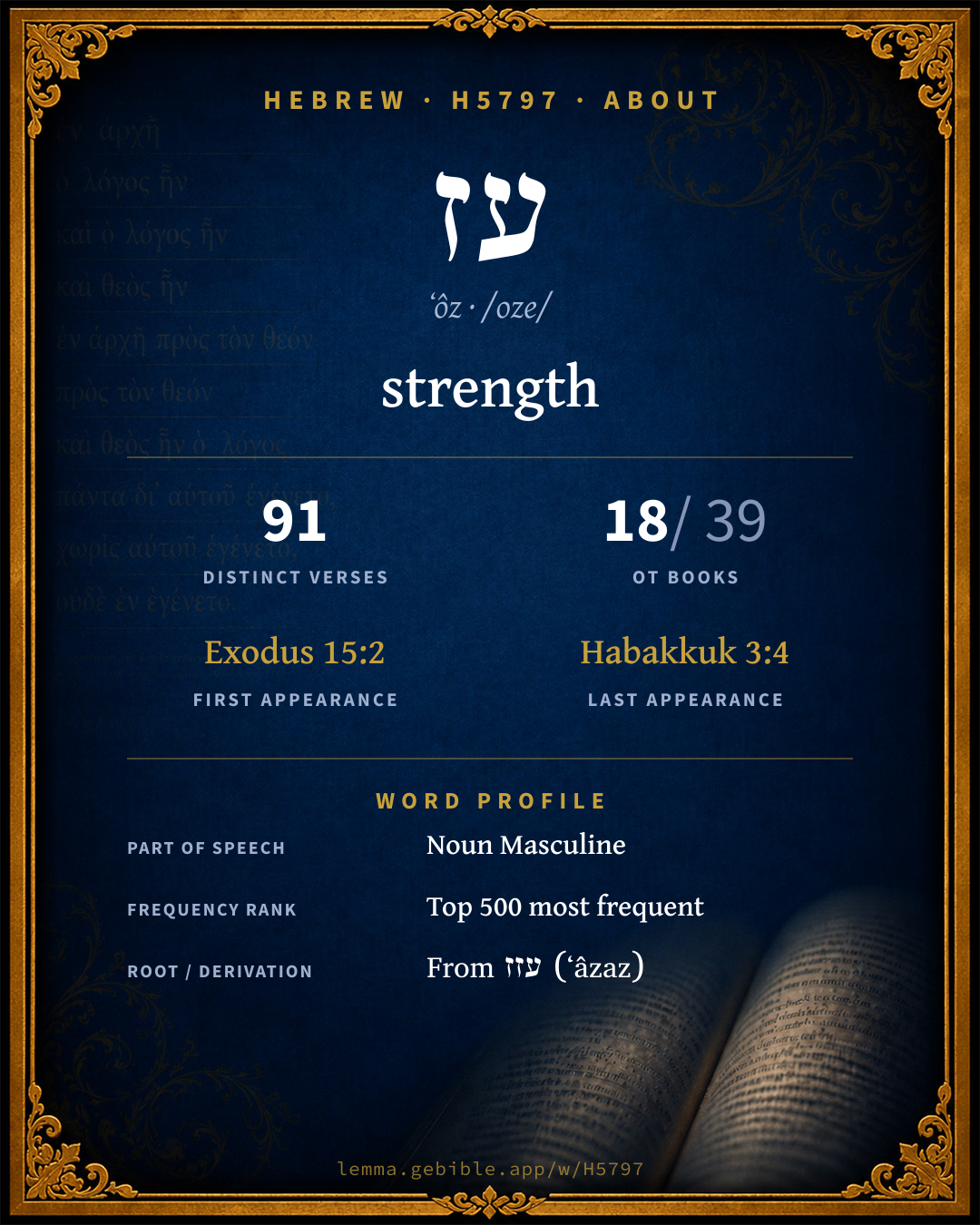
עֹז
strength
‘strength’ is one of 3 main senses fuller range ↓
Full lexicon entry — Brown-Driver-Briggs (BDB)
From Brown-Driver-Briggs (BDB)
Where this word appears
See every Construct-state word in the Hebrew Bible →
Grammar key — what these labels mean
Part of speech
- Noun
- A naming word — a person, place, thing, or idea.
Noun type
- Common
- A common noun — a general class of person, place, or thing (“king,” “city,” “water”), not a specific name.
State
- Absolute
- The independent form of a noun, not bound to a following word.
- Construct
- A noun bound to a following noun in a possessive / “of” relationship (the construct chain).
Gender
- Masculine
- Grammatically masculine.
Number
- Singular
- One.
Grammatical forms
- Noun, Common, Masculine, Singular, Construct 53 times (58%)
- Noun, Common, Masculine, Singular, Absolute 39 times (42%)
Parsed forms decoded from the imported morphology (morphhb / Westminster Leningrad Codex — WLC text public domain, morphhb tagging CC BY 4.0), counted across 92 parsed occurrences — not distinct verses.
Every verse where H5797 appears — 91 distinct verses across 18 books. Click any verse to open its interlinear word-by-word view. Verse text shown in the World English Bible for context — . Each verse’s Hebrew form is shown with its reference; the English is not keyword-highlighted, since the data carries no word-level English alignment. Use “Compare translations” on any verse to read it across multiple English versions. This concordance covers the Hebrew Bible; Septuagint (Greek Old Testament) occurrences are not indexed here.
Exodus 2 verses
- Exodus 15:2 עָזִּ֤/י n c ms cs + sfx pers 1cs Yah is my strength and song, He has become my salvation: This is my God, and I will praise him; My father's God, and I will exalt him.
- Exodus 15:13 בְ/עָזְּ/ךָ֖ prep + n c ms cs + sfx pers 2ms "You, in your loving kindness, have led the people that you have redeemed. You have guided them in your strength to your holy habitation.
Leviticus 1 verse
Judges 2 verses
- Judges 5:21 עֹֽז n c ms The river Kishon swept them away, That ancient river, the river Kishon. My soul, march on with strength.
- Judges 9:51 עֹז֮ n c ms But there was a strong tower within the city, and there fled all the men and women, and all they of the city, and shut themselves in, and got them up to the roof of the tower.
1 Samuel 1 verse
2 Samuel 1 verse
1 Chronicles 4 verses
- 1 Chronicles 13:8 עֹ֑ז n c ms David and all Israel played before God with all their might, even with songs, and with harps, and with psalteries, and with tambourines, and with cymbals, and with trumpets.
- 1 Chronicles 16:11 וְ/עֻזּ֔/וֹ conj + n c ms cs + sfx pers 3ms Seek you Yahweh and his strength; Seek his face forever more.
- 1 Chronicles 16:27 עֹ֥ז n c ms Honor and majesty are before him: Strength and gladness are in his place.
- 1 Chronicles 16:28 וָ/עֹֽז conj + n c ms Ascribe to Yahweh, you relatives of the peoples, Ascribe to Yahweh glory and strength;
2 Chronicles 2 verses
- 2 Chronicles 6:41 עֻזֶּ֑/ךָ n c ms cs + sfx pers 2ms Now therefore arise, Yahweh God, into your resting-place, you, and the ark of your strength: let your priests, Yahweh God, be clothed with salvation, and let your saints rejoice in goodness.
- 2 Chronicles 30:21 עֹ֖ז n c ms The children of Israel who were present at Jerusalem kept the feast of unleavened bread seven days with great gladness; and the Levites and the priests praised Yahweh day by day, [singing] with loud instruments to Yahweh.
Ezra 1 verse
Job 4 verses
- Job 12:16 עֹ֣ז n c ms With him is strength and wisdom; The deceived and the deceiver are his.
- Job 26:2 עֹֽז n c ms "How have you helped him who is without power! How have you saved the arm that has no strength!
- Job 37:6 עֻזּֽ/וֹ n c ms cs + sfx pers 3ms For he says to the snow, 'Fall on the earth;' Likewise to the shower of rain, And to the showers of his mighty rain.
- Job 41:22 עֹ֑ז n c ms In his neck there is strength. Terror dances before him.
Psalms 43 verses
- Psalms 8:2 עֹ֥ז n c ms From the lips of babes and infants you have established strength, Because of your adversaries, that you might silence the enemy and the avenger.
- Psalms 21:1 בְּ/עָזְּ/ךָ֥ prep + n c ms cs + sfx pers 2ms The king rejoices in your strength, Yahweh! How greatly he rejoices in your salvation!
- Psalms 21:13 בְּ/עֻזֶּ֑/ךָ prep + n c ms cs + sfx pers 2ms Be exalted, Yahweh, in your strength, So we will sing and praise your power.
- Psalms 28:7 עֻזִּ֥/י n c ms cs + sfx pers 1cs Yahweh is my strength and my shield. My heart has trusted in him, and I am helped. Therefore my heart greatly rejoices. With my song I will thank him.
- Psalms 28:8 עֹֽז n c ms Yahweh is their strength. He is a stronghold of salvation to his anointed.
- Psalms 29:1 וָ/עֹֽז conj + n c ms Ascribe to Yahweh, you sons of the mighty, Ascribe to Yahweh glory and strength.
- Psalms 29:11 עֹ֭ז n c ms Yahweh will give strength to his people. Yahweh will bless his people with peace.
- Psalms 30:7 עֹ֥ז n c ms You, Yahweh, when you favored me, made my mountain to stand strong. But when you hid your face, I was troubled.
- Psalms 46:1 וָ/עֹ֑ז conj + n c ms God is our refuge and strength, A very present help in trouble.
- Psalms 59:9 עֻ֭זּ/וֹ n c ms cs + sfx pers 3ms Oh, my Strength, I watch for you, For God is my high tower.
- Psalms 59:16 עֻזֶּ/ךָ֮ n c ms cs + sfx pers 2ms But I will sing of your strength. Yes, I will sing aloud of your loving kindness in the morning. For you have been my high tower, A refuge in the day of my distress.
- Psalms 59:17 עֻ֭זִּ/י n c ms cs + sfx pers 1cs To you, my strength, I will sing praises. For God is my high tower, the God of my mercy.
- Psalms 61:3 עֹ֝֗ז n c ms For you have been a refuge for me, A strong tower from the enemy.
- Psalms 62:7 עֻזִּ֥/י n c ms cs + sfx pers 1cs With God is my salvation and my honor. The rock of my strength, and my refuge, is in God.
- Psalms 62:11 עֹ֝֗ז n c ms God has spoken once, Twice I have heard this, That power belongs to God.
- Psalms 63:2 עֻ֝זְּ/ךָ֗ n c ms cs + sfx pers 2ms So I have seen you in the sanctuary, Watching your power and your glory.
- Psalms 66:3 עֻ֝זְּ/ךָ֗ n c ms cs + sfx pers 2ms Tell God, "How awesome are your deeds! Through the greatness of your power, your enemies submit themselves to you.
- Psalms 68:28 עֻ֫זֶּ֥/ךָ n c ms cs + sfx pers 2ms Your God has commanded your strength. Strengthen, God, that which you have done for us.
- Psalms 68:33 עֹֽז n c ms To him who rides on the heaven of heavens, which are of old; Behold, he utters his voice, a mighty voice.
- Psalms 68:34 עֹ֗ז וְ֝/עֻזּ֗/וֹ n c ms conj + n c ms cs + sfx pers 3ms Ascribe strength to God! His excellency is over Israel, His strength is in the skies.
- Psalms 68:35 עֹ֖ז n c ms You are awesome, God, in your sanctuaries. The God of Israel gives strength and power to his people. Praise be to God!
- Psalms 71:7 עֹֽז n c ms I am a marvel to many, But you are my strong refuge.
- Psalms 74:13 בְ/עָזְּ/ךָ֣ prep + n c ms cs + sfx pers 2ms You divided the sea by your strength. You broke the heads of the sea monsters in the waters.
- Psalms 77:14 עֻזֶּֽ/ךָ n c ms cs + sfx pers 2ms You are the God who does wonders. You have made your strength known among the peoples.
- Psalms 78:26 בְּ/עֻזּ֣/וֹ prep + n c ms cs + sfx pers 3ms He caused the east wind to blow in the sky. By his power he guided the south wind.
- Psalms 78:61 עֻזּ֑/וֹ n c ms cs + sfx pers 3ms And delivered his strength into captivity, His glory into the adversary's hand.
- Psalms 81:1 עוּזֵּ֑/נוּ n c ms cs + sfx pers 1cp Sing aloud to God, our strength! Make a joyful shout to the God of Jacob!
- Psalms 84:5 עֽוֹז n c ms Blessed are those whose strength is in you; Who have set their hearts on a pilgrimage.
- Psalms 86:16 עֻזְּ/ךָ֥ n c ms cs + sfx pers 2ms Turn to me, and have mercy on me! Give your strength to your servant. Save the son of your handmaid.
- Psalms 89:10 עֻ֝זְּ/ךָ֗ n c ms cs + sfx pers 2ms You have broken Rahab in pieces, like one of the slain. You have scattered your enemies with your mighty arm.
- Psalms 89:17 עֻזָּ֣/מוֹ n c ms cs + sfx pers 3mp For you are the glory of their strength. In your favor, our horn will be exalted.
- Psalms 90:11 עֹ֣ז n c ms cs Who knows the power of your anger, Your wrath according to the fear that is due to you?
- Psalms 93:1 עֹ֣ז n c ms Yahweh reigns! He is clothed with majesty! Yahweh is armed with strength. The world also is established. It can't be moved.
- Psalms 96:6 עֹ֥ז n c ms Honor and majesty are before him. Strength and beauty are in his sanctuary.
- Psalms 96:7 וָ/עֹֽז conj + n c ms Ascribe to Yahweh, you families of nations, Ascribe to Yahweh glory and strength.
- Psalms 99:4 וְ/עֹ֥ז conj + n c ms cs The King's strength also loves justice. You do establish equity. You execute justice and righteousness in Jacob.
- Psalms 105:4 וְ/עֻזּ֑/וֹ conj + n c ms cs + sfx pers 3ms Seek Yahweh and his strength. Seek his face forever more.
- Psalms 110:2 עֻזְּ/ךָ֗ n c ms cs + sfx pers 2ms Yahweh will send forth the rod of your strength out of Zion. Rule in the midst of your enemies.
- Psalms 118:14 עָזִּ֣/י n c ms cs + sfx pers 1cs Yah is my strength and song. He has become my salvation.
- Psalms 132:8 עֻזֶּֽ/ךָ n c ms cs + sfx pers 2ms Arise, Yahweh, into your resting place; You, and the ark of your strength.
- Psalms 138:3 עֹֽז n c ms In the day that I called, you answered me. You encouraged me with strength in my soul.
- Psalms 140:7 עֹ֣ז n c ms cs Yahweh, the Lord, the strength of my salvation, You have covered my head in the day of battle.
- Psalms 150:1 עֻזּֽ/וֹ n c ms cs + sfx pers 3ms Praise Yah! Praise God in his sanctuary! Praise him in his heavens for his acts of power!
Proverbs 9 verses
- Proverbs 10:15 עֻזּ֑/וֹ n c ms cs + sfx pers 3ms The rich man's wealth is his strong city. The destruction of the poor is their poverty.
- Proverbs 14:26 עֹ֑ז n c ms In the fear of Yahweh is a secure fortress, And he will be a refuge for his children.
- Proverbs 18:10 עֹ֭ז n c ms The name of Yahweh is a strong tower: The righteous run to him, and are safe.
- Proverbs 18:11 עֻזּ֑/וֹ n c ms cs + sfx pers 3ms The rich man's wealth is his strong city, Like an unscalable wall in his own imagination.
- Proverbs 18:19 עֹ֑ז n c ms A brother offended is more difficult than a fortified city; And disputes are like the bars of a castle.
- Proverbs 21:22 עֹ֣ז n c ms cs A wise man scales the city of the mighty, And brings down the strength of its confidence.
- Proverbs 24:5 בַּ/ע֑וֹז prep det + n c ms A wise man has great power; And a knowledgeable man increases strength;
- Proverbs 31:17 בְ/ע֣וֹז prep + n c ms She girds her loins with strength, And makes her arms strong.
- Proverbs 31:25 עֹז n c ms Strength and dignity are her clothing. She laughs at the time to come.
Ecclesiastes 1 verse
Isaiah 6 verses
- Isaiah 12:2 עָזִּ֤/י n c ms cs + sfx pers 1cs Behold, God is my salvation. I will trust, and will not be afraid; for Yah, Yahweh, is my strength and song; and he has become my salvation."
- Isaiah 45:24 וָ/עֹ֑ז conj + n c ms Only in Yahweh, it is said of me, is righteousness and strength; even to him shall men come; and all those who were incensed against him shall be disappointed.
- Isaiah 49:5 עֻזִּֽ/י n c ms cs + sfx pers 1cs Now says Yahweh who formed me from the womb to be his servant, to bring Jacob again to him, and that Israel be gathered to him (for I am honorable in the eyes of Yahweh, and my God is become my strength);
- Isaiah 51:9 עֹז֙ n c ms Awake, awake, put on strength, arm of Yahweh; awake, as in the days of old, the generations of ancient times. Isn't it you who did cut Rahab in pieces, who pierced the monster?
- Isaiah 52:1 עֻזֵּ֖/ךְ n c ms cs + sfx pers 2fs Awake, awake, put on your strength, Zion; put on your beautiful garments, Jerusalem, the holy city: for henceforth there shall no more come into you the uncircumcised and the unclean.
- Isaiah 62:8 עֻזּ֑/וֹ n c ms cs + sfx pers 3ms Yahweh has sworn by his right hand, and by the arm of his strength, Surely I will no more give your grain to be food for your enemies; and foreigners shall not drink your new wine, for which you have labored:
Jeremiah 3 verses
- Jeremiah 16:19 עֻזִּ֧/י n c ms cs + sfx pers 1cs Yahweh, my strength, and my stronghold, and my refuge in the day of affliction, to you shall the nations come from the ends of the earth, and shall say, Our fathers have inherited nothing but lies, [even] vanity and things in which there is no profit.
- Jeremiah 48:17 עֹ֔ז n c ms All you who are round about him, bemoan him, and all you who know his name; say, How is the strong staff broken, the beautiful rod!
- Jeremiah 51:53 עֻזָּ֑/הּ n c ms cs + sfx pers 3fs Though Babylon should mount up to the sky, and though she should fortify the height of her strength, yet from me shall destroyers come to her, says Yahweh.
Ezekiel 8 verses
- Ezekiel 19:11 עֹ֗ז n c ms It had strong rods for the scepters of those who bore rule, and their stature was exalted among the thick boughs, and they were seen in their height with the multitude of their branches.
- Ezekiel 19:12 עֻזָּ֖/הּ n c ms cs + sfx pers 3fs But it was plucked up in fury, it was cast down to the ground, and the east wind dried up its fruit: its strong rods were broken off and withered; the fire consumed them.
- Ezekiel 19:14 עֹ֖ז n c ms Fire is gone out of the rods of its branches, it has devoured its fruit, so that there is in it no strong rod to be a scepter to rule. This is a lamentation, and shall be for a lamentation.
- Ezekiel 24:21 עֻזְּ/כֶ֔ם n c ms cs + sfx pers 2mp Speak to the house of Israel, Thus says the Lord Yahweh: Behold, I will profane my sanctuary, the pride of your power, the desire of your eyes, and that which your soul pities; and your sons and your daughters whom you have left behind shall fall by the sword.
- Ezekiel 26:11 עֻזֵּ֖/ךְ n c ms cs + sfx pers 2fs With the hoofs of his horses shall he tread down all your streets; he shall kill your people with the sword; and the pillars of your strength shall go down to the ground.
- Ezekiel 30:6 עֻזָּ֑/הּ n c ms cs + sfx pers 3fs Thus says Yahweh: They also who uphold Egypt shall fall; and the pride of her power shall come down: from the tower of Seveneh shall they fall in it by the sword, says the Lord Yahweh.
- Ezekiel 30:18 עֻזָּ֑/הּ n c ms cs + sfx pers 3fs At Tehaphnehes also the day shall withdraw itself, when I shall break there the yokes of Egypt, and the pride of her power shall cease in her: as for her, a cloud shall cover her, and her daughters shall go into captivity.
- Ezekiel 33:28 עֻזָּ֑/הּ n c ms cs + sfx pers 3fs I will make the land a desolation and an astonishment; and the pride of her power shall cease; and the mountains of Israel shall be desolate, so that none shall pass through.
Amos 1 verse
Micah 1 verse
Habakkuk 1 verse
About this entry
At a glance — auto-summarized from this page’s data, not written by a person. Every figure links to its source below. This summary describes the numbers; it doesn’t interpret them.
The Hebrew noun עז centers on the idea of “strength.” Its earliest occurrence is Exodus 15:2. The Hebrew Bible uses it across 91 verses — moderately common. Psalms dominates its distribution — 43 of 91 verses. The lexicon spreads it across several senses; see its full sense range. For the data behind this summary, explore the sense tree and the renderings breakdown below.
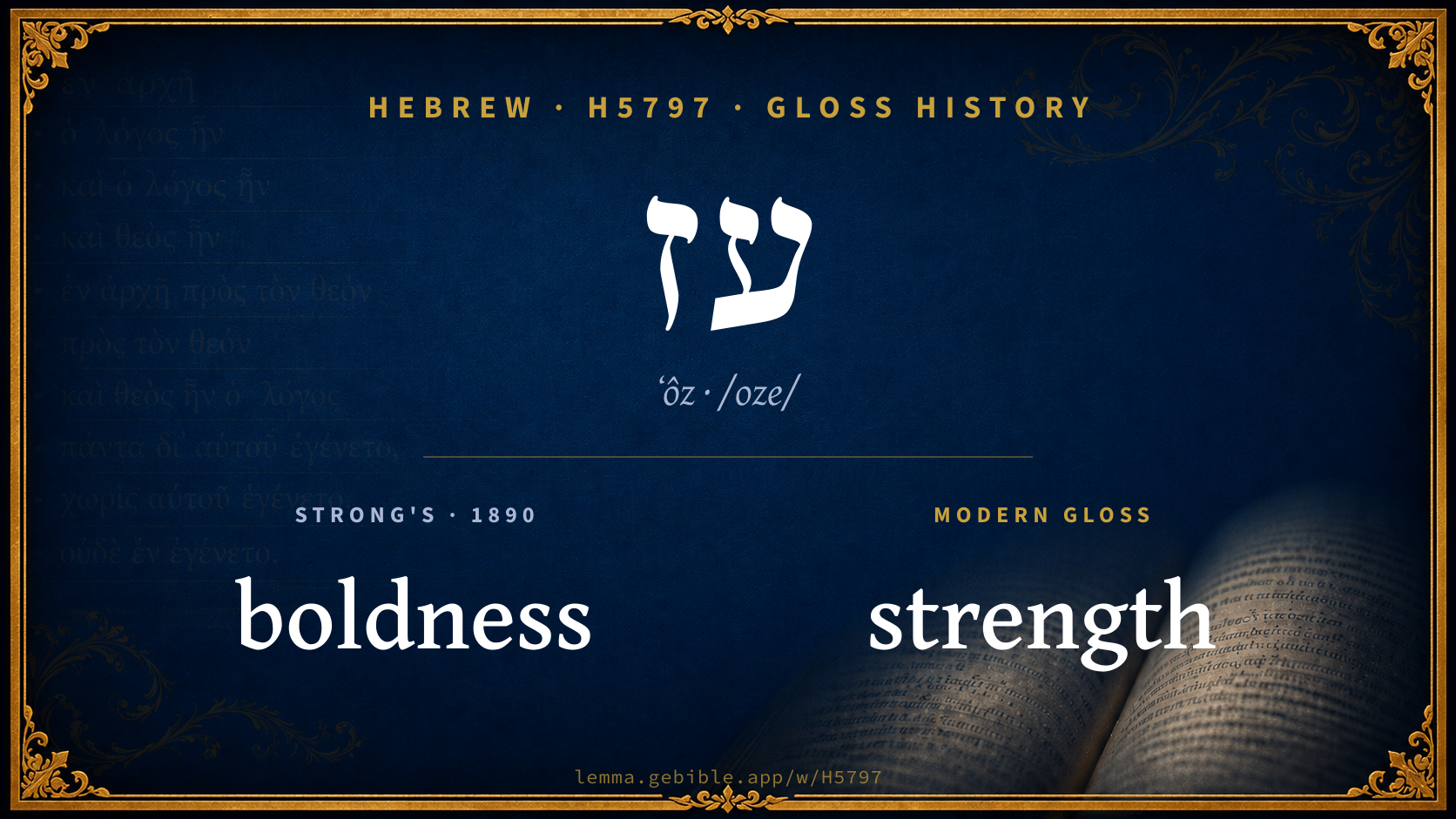
Gloss history
Strong's 1890 vs modern scholarship
About this word
Strong's H5797 catalogs a Hebrew word from the Hebrew Old Testament.
These counts are not copied from any lexicon or concordance. They are computed here, from the morphology-tagged Hebrew Old Testament. What Lemma adds →
- 91
- distinct verses
- The word appears in 91 distinct verses.
- 18 / 39
- OT books
- The word appears in 18 of 39 Old Testament books.
- #450
- by frequency
- Top 500 most frequent Hebrew words (rank 450 of 8,640 Hebrew words by occurrence).
View all 91 occurrences in the concordance →
By section of the Old Testament
By traditional corpus
Conventional, traditional groupings — biblical authorship is debated, so this is a traditional corpus grouping, not an authorship claim. Each share is this word’s portion of its verses in that division of the Hebrew canon. Each figure is a share of the word’s 91 distinct verses.
- Writings (Ketuvim) 64 verses · 70%
- Prophets (Nevi'im) 24 verses · 26%
- Torah (Pentateuch) 3 verses · 3%
How translations render this word
Counts come from each version’s own published word-to-Strong’s tagging or interlinear alignment — an approximate guide to how each version renders this word, not a word-level alignment the data otherwise carries. Because each total is that version’s own tagged count, the per-version totals vary from one another and need not match the appearance or distinct-verse counts above. These counts may also differ from a printed concordance because Lemma counts each distinctly tagged rendering and does not collapse phrase taggings into a single head-word total. This is a fixed set of word-tagged versions (KJV, ASV, BSB, ULT) and does not change with the reading translation you choose elsewhere. Each version’s license is shown beside its name below (and on Sources).
- King James Version: Strength 50×, Power 11×, Strong 5×
- American Standard Version: Strength 42×, Power 13×, Is my strength 4×
- Berean Standard Bible: Strength 41×, Power 10×, Mighty 9×
- unfoldingWord Literal Text: Strength 58×, Power 7×, Strong 7×
King James Version Public Domain
Renders H5797 across 93 tagged occurrences — most commonly:
Plus 19 renderings that appear only once — usually multi-word phrases or single function words the recovered tagging swept in, not distinct renderings.
American Standard Version Public Domain
Renders H5797 across 96 tagged occurrences — most commonly:
Plus 27 renderings that appear only once — usually multi-word phrases or single function words the recovered tagging swept in, not distinct renderings.
Berean Standard Bible Public Domain
Renders H5797 across 91 tagged occurrences — most commonly:
Plus 13 renderings that appear only once — usually multi-word phrases or single function words the recovered tagging swept in, not distinct renderings. Not rendered by a distinct English word in 1 further occurrence.
unfoldingWord Literal Text CC BY-SA 4.0
Renders H5797 across 94 tagged occurrences — most commonly:
Plus 8 renderings that appear only once — usually multi-word phrases or single function words the recovered tagging swept in, not distinct renderings.
12 senses and sub-senses in the full BDB
What do BDB’s symbols mean?
BDB uses these scholarly abbreviations:
| Symbol | Meaning |
|---|---|
| 𝔊 | the Septuagint (the ancient Greek translation, LXX) |
| 𝔙 | the Vulgate (the Latin translation) |
| 𝔖 | the Syriac version (the Peshitta) |
| 𝔗 | the Targum (the Aramaic translation) |
| ψ | the Psalms |
| √ | root (the underlying root or stem) |
| ‖ | parallel passage (a synonymous or contrasted parallel) |
| † | the dagger: every passage where the word occurs is cited |
The 12 senses and sub-senses the full Brown-Driver-Briggs lexicon distinguishes for this word, in lexicon order (not ranked by frequency), with BDB’s own verbatim wording and sub-sense lettering. Shown in Hebrew script with BDB’s own scholarly abbreviations. The condensed entry is in the Lexicon Entry tab. See also the Forms in the corpus table below.
- 1. material and physical, מִגְדַּל־עֹז Ju 9:51, and fig. (of י׳), ψ 61:4 Pr 18:10, מַחֲסִי־עֹז ψ 71:7, cf. עִיר עָז־לָנוּ Is 26:1, קִרְיַת־עֹז Pr 18:19 (sim.), 10:15 = 18:11 (fig.); עֹז טִבְטֶחָ֑ה Pr 21:22 (of a city, read poss. מעוז Toy); צוּר עֻזִּי ψ 62:8 (fig.); מְרוֹם עֻזָּהּ Je 51:53 (of Bab.), מַצְּבוֹת עֻזֵּךְ Ez 26:11 (of Tyre), cf. ψ 30:8 (reading לְהַרְרֵי־עֹז 𝔗 Hup Che Kau We; but no obj. for vb.; Gie in Bae proposes הָעֳמַדְתִּי for הֶעֱמַדְתָּה); רְקִיעַ עֻזּוֹ ψ 150:1 his mighty firmament (De Hup Kau al.; Ki AV RV Che the f. of his power, where his power dwells); בְּכָל־עֹז with all one’s might 2 S 6:14 = 1 Ch 13:8, + 2 Ch 30:21 (where so read, for MT כְּלֵי עֹז, Kau Kit cf. Be Oettli); בְּעוֹז Pr 31:17, 25; abstr. for concr. Ju 5:21 si vera l., but prob. crpt., cf. GFM Bu; of crocodile Jb 41:14; קוֹל עֹז ψ 68:34 a mighty voice; זְרוֹעַ עֻזּוֹ = his mighty arm (fig. of י׳) Is 62:8, cf. 51:9 ψ 89:11 Jb 26:2, גֶּשֶׁם מִטְרוֹת עֻזּוֹ Jb 37:6; מַטֵּה־עֹז, fig. of political power Je 48:17 (‖ מַקֵּל תִּפְאָרָה), Ez 19:11, 12, 14 (vine-branches, in fig.), ψ 110:2. e.g. Judges 9:51
- 2. personal, social, and political:
- a. Am 3:11, גְּאוֹן ע׳ Lv 26:19 (H), Ez 24:21; 30:6, 18; 33:28. e.g. Amos 3:11
- b. bestowed by י׳, 1 S 2:10 (song), ψ 29:11; 68:36; 86:16; 138:3, עוֹז־לוֹ רָ֑ךְ 84:6; 138:3; so (implic.) of Zion Is 52:1. e.g. 1 Samuel 2:10
- c. of י׳ as strength of his servants Mi 5:3; Is 49:5 ψ 81:2; 84:6, also Ex 15:2 (‖ יְשׁוּעָה) = Is 12:2 = ψ 118:14, cf. Is 45:24, עֹז יְשׁוּעָתִי ψ 140:8, תִּפְאֶרֶת עֻזָּמוֹ 89:18; sometimes as their stronghold, for defence Je 16:19 (+ מָעֻזִּי), ψ 28:7 (+ מָגִנִּי), v 8 (‖ מָעוֹז). 46:2 (+ מַחֲסֶה), 59:10 (reading עֻזִּי, v. Comm. and Ginsbmargin; ‖ מִשְׂגַּבִּי), v 18 (‖ id.), cf. Pr 14:26 (‖ מַחְסֶה); v. also sub 1.—Pr 24:5 v. עַז. e.g. Micah 5:3
- 3. might of י׳ (especially ψψ):
- a. as essential attribute Hb 3:4; Jb 12:16 ψ 62:12; 63:3; 68:35; 93:1; 96:6 = 1 Ch 16:27; עֹז מֶלֶךְ ψ 99:4 (title of י׳). e.g. Habakkuk 3:4
- b. theme of ascription in praise ψ 29:1 (c. יָהַב) = 96:7 = 1 Ch 16:28, ψ 59:17 (c. שִׁיר), 68:35 (c. נָתַן). e.g. Psalms 29:1
- c. exerted for his people and against his foes Ex 15:13 (song), ψ 21:2 (‖ יְשוּעָה), v 14; 66:3; 68:29 + v 29 (reading עוֹז for עוּזָּה, v. עזז), 74:13; 77:15; 78:26; 105:4 = 1 Ch 16:11, Ezr 8:22 (+ אַפּוֹ), cf. עֹז אַפֶּ֑ךָ ψ 90:11. e.g. Exodus 15:13
- d. manifested in connex. with the ark, אֲרוֹן עֻזֶּ֑ךָ 2 Ch 6:41 = ψ 132:8, עֹז = ark 78:61. e.g. 2 Chronicles 6:41
- 4. עֹז פָּנָיו = boldness, impudence Ec 8:1, changed by wisdom. De Wild al.; עַז פ׳ he who is impudent 𝔊 Siegf (cf. עזז Hiph.). e.g. Ecclesiastes 8:1
- 5. = stronghold (cf. 2 c): ψ 8:3 out of the mouth of babes … thou hast founded strength, or a stronghold (for thy defence, cf. v b), so Ew De Hup Kau Sch Che Dr, cf. Du; > praise Vrss Bae.—מָעוֹז v. עוז. e.g. Psalms 8:3
Senses from the full Brown-Driver-Briggs lexicon (Brown, Driver, Briggs; Oxford 1906 — public domain), digitized via Sefaria, supplemented by the OpenScriptures HebrewLexicon (CC BY 4.0). Full attribution on Sources.
Word origin
and (rarely) עוֹז n.m. strength, might;—abs. ע׳ Ju 9:51 +, עוֹז ψ 84:6 +, עָז־ Is 26:1, once עָ֑ז Gn 49:3; cstr. עֹז Mi 5:3 +, עָז־ ψ 28:8; sf. עָזִּי Ex 15:2 + 2 times, עֻזִּי ψ 28:7 +; עָזְּךָ 21:2 + 2 times, עֻזְּךָ 66:3 +; sf. 1 pl. עוּזֵנוּ 81:2; 3 mpl. עֻזָּמוֹ 89:18 etc.;—strength, might (usually poet., 44 times ψψ):
— Brown-Driver-Briggs (Oxford 1906, public domain), digitized via Sefaria, supplemented by the OpenScriptures HebrewLexicon (CC BY 4.0). See Sources.
Derived from עזז (ʻâzaz) (H5810) — to be strong.
Jastrow Dictionary
A second Hebrew/Aramaic lexicon for comparison, covering Aramaic and post-biblical (Talmudic, Targumic, Midrashic) usage that the biblical-Hebrew BDB does not. Matched by lemma rather than by Strong’s number, so a lemma may carry more than one Jastrow headword (shown separately below), and the entries cover usage well beyond the Bible.
עוֹז I
- fortitude, strength, majesty. Ber. 6ᵃ התפלין ע׳ הם לישראל T’fillin are a sign of strength to Israel. Ex. R. s. 8 לבושו של הקב"ה ע׳ the garment of the Lord is strength (with ref. to Ps. XCIII, 1). Midr. Till. to Ps. VIII, 3 אין ע׳ אלא תורה וכ׳ ‘strength’ means the Law, as we read (Ps. XXIX, 11) &c.; Mekh. B’shall., Shir., s. 3 אין עָוִּי וכ׳ ‘my strength’ (Ex. XV, 2) means &c. Ber. 16ᵇ תתכסה בעָזְּךָ clothe thyself in thy majesty; a. fr. e.g. Psalms 93:1
עַז
- strong, firm; vehement, rough; (of colors) bright, intense; (of smell and taste) pungent, acrid. Yoma 67ᵇ (expl. עזאזל) שיהא עז וקשה the mountain must be rough and hard (rocky). Yalk. Ps. 852 (ref. to Ps. XCIX, 4) you will find, מי שהוא עז וכ׳ he who is powerful does not care to abide by the law; Midr. Till. to Ps. l. c. ed. Bub. עוז (corr. acc.). Ab. V, 20 הוי עז כנמר וכ׳ be strong (energetic) like a tiger … to do the will of thy Father in heaven; a. fr.—עז פנים insolent, impudent. Ab. l. c.; a. e.—Fem. עַזָּה. Neg. I, 1, a. fr., v. בַּהֶרֶת. Ker. 6ᵃ כדי שתהא ע׳ that it may have a pungent flavor.—Pl. עַזִּים, עַזִּין; עַזּוֹת. Bets. 25ᵇ מפני מה … מפניּ שהם ע׳ why was the Law given to Israel? Because they are impetuous (and the Law was to discipline them). Ib. שלשה ע׳ הן וכ׳ three (creatures) are of a vehement temper, Israel among the nations, the dog among the beasts &c.; a. fr.—Sabb. 30ᵇ; Ber. 16ᵇ עַזֵּי פנים insolent people, v. עַזּוּת. Taan. 7ᵇ; a. e. e.g. Psalms 99:4
עֹז
- , v. עוֹז
עֵז
- c. (b. h.; goat. Bets. 25ᵇ אף עז וכ׳ (among the aggressive creatures, v. עַז) also the goat among the small cattle. Bekh. III, 1 עז בת שנתה וכ׳ that born of a goat in her first year belongs surely to the priest (as first-born); a. fr.—Pl. עִזִּים. Ḥull. 113ᵇ; a. fr.—V. עִיזָּה.
עֵז ²
- ch., v. עִיז
A Dictionary of the Targumim, the Talmud Babli and Yerushalmi, and the Midrashic Literature (Marcus Jastrow; London, Luzac, 1903) — Public Domain. Digitized via Sefaria. Digitized via Sefaria. Full attribution on Sources.
Forms in the corpus
The 53 distinct written forms H5797 takes in the Hebrew Bible, most frequent first — each parse links to that state’s occurrences in the concordance. Hebrew forms include their vowel points and cantillation, so a single lemma takes many written forms.
Same root — word family
Other BDB entries built from the same root as H5797, grouped by Strong’s listed origin. These share a root / origin per the lexicon — not necessarily a shared meaning. Each links to that word’s own entry.
Derives from
Shares the same root
- מעוז mâʻôwz H4581 refuge
- עז ʻaz H5794 strong
- עז ʻêz H5795 female goat
- עזוז ʻĕzûwz H5807 might
- עזוז ʻizzûwz H5808 mighty
Derived from this word
Proper names from this root
People and places named from this root — a name, not an additional meaning of the word.
- עזז ʻÂzâz H5811 Azaz
- עזזיהו ʻĂzazyâhûw H5812 Azaziah
- עזי ʻUzzîy H5813 Uzzi
- עזא ʻUzzâʼ H5798 Uzza
- עזיאל ʻUzzîyʼêl H5816 Uzziel
- עזיה ʻUzzîyâh H5818 Uzziah
Compare all same-root words → Showing 4 of 14 — not the complete family. 6 of the same-root words are proper names (people or places). They share a root, not necessarily a meaning.
Septuagint verse parallels
This word appears in 83 verses that also exist in the Greek Old Testament (Septuagint), out of the 91 Hebrew verses it occurs in. You can read those verses in Greek by switching the Old Testament edition to the Septuagint.
Read these verses in the Septuagint
- Exodus 15:2
- Leviticus 26:19
- Judges 5:21
- 1 Samuel 2:10
- 2 Samuel 6:14
- 1 Chronicles 13:8
- 2 Chronicles 6:41
- Ezra 8:22
- Job 12:16
- Psalms 8:2
- Proverbs 10:15
- Ecclesiastes 8:1
This is a verse-level parallel only — the same verses exist in both the Hebrew and Greek Old Testaments. No word-level Hebrew↔Greek correspondence is claimed: the data carries no such alignment, so no Greek word is shown as this Hebrew word’s translation. Coverage is not total — the Septuagint omits the deuterocanon and renumbers the Psalms, so some Hebrew verses have no direct Greek parallel.