
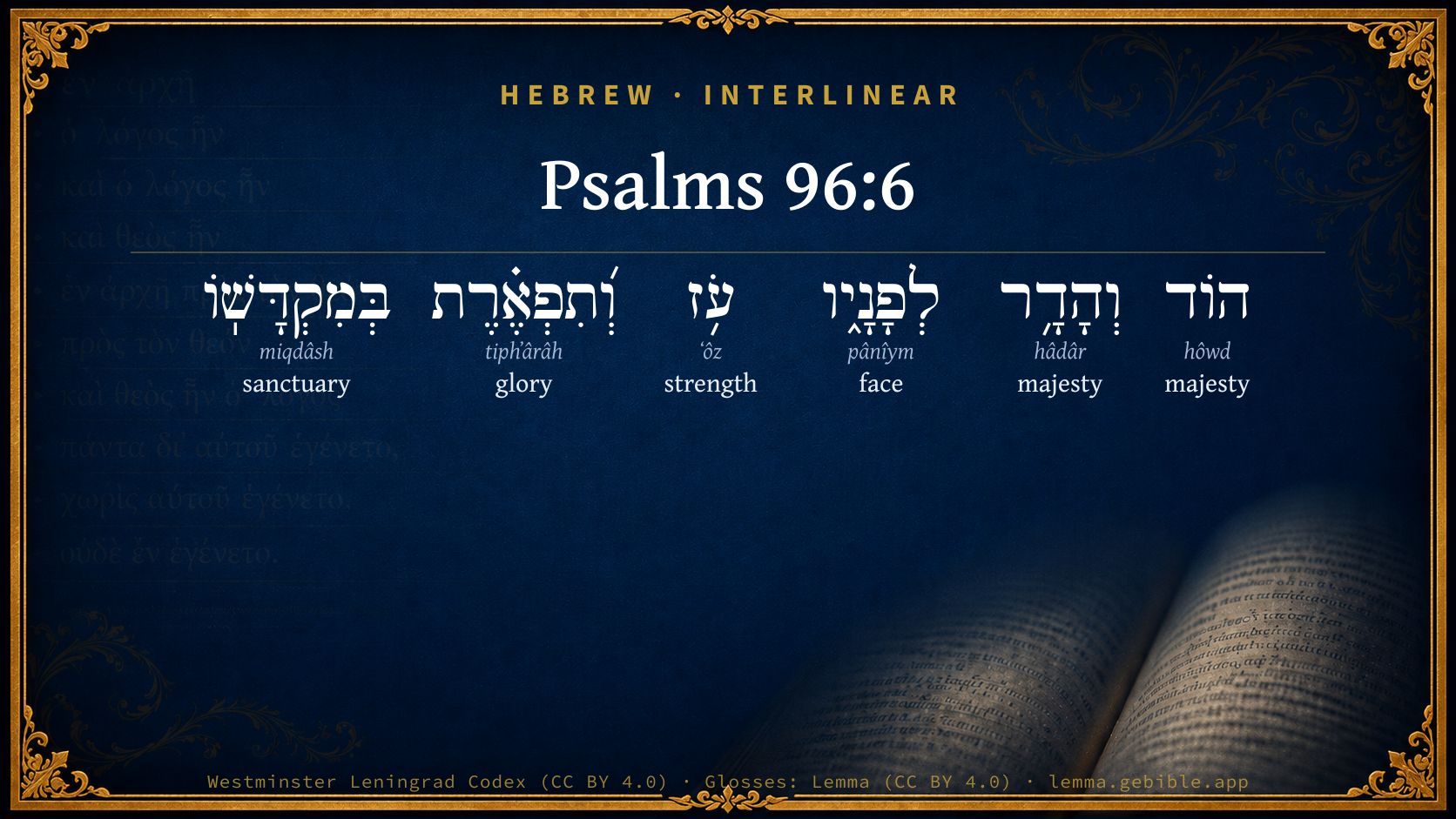
Psalms 96:6

Hebrew (Westminster Leningrad Codex) Psalms 96:6 appears in the Hebrew Old Testament. The text above is from the Westminster Leningrad Codex. Each word links to its Strong’s number, a concise gloss, and parsing drawn from the Open Scriptures Hebrew Bible morphology. Click any word for its full Brown-Driver-Briggs (BDB) entry.
Download image
Cite this verse

Psalms 96:6 (World English Bible). Public Domain. Lemma interlinear Bible study tool, https://lemma.gebible.app/v/psalms/96/6.

Show BibTeX & RIS
BibTeX
RIS
English Translation
Honor and majesty are before him. Strength and beauty are in his sanctuary.
World English Bible · Public Domain
Download a study sheet

One document with this verse’s original text, its word-by-word gloss line, the meaning frame, cross-references with their text, attributed commentary, and full source and license credits — printable, and it pastes into notes with its structure intact.

This verse Autodidact and up

Study sheet (.html) Plain text (.txt)

A passage Seminary Student

Up to 50 verses in one chapter. A passage sheet keeps up to 6 commentary sources and 12 cross-references per verse, in the order this page ranks them, and says so on the sheet whenever that leaves anything out. Ask for a single verse and you get the Autodidact verse sheet above.

Everything on this page stays free to read, with no account — the sheet is a download of what is already on screen, not access to it.

Want to remove ads? Support Godless Engineer
Compare translations 3

The same verse in 3 English versions, stacked beneath the original-language interlinear above. Click any original word for its lexicon entry.

Each is an independent rendering of the whole verse — the interlinear is not word-aligned to these translations.

Highlighted words mark where these versions differ — a whole-verse word diff, not a word-by-word alignment.

  • World English Bible Public Domain
    Honor and majesty are before him. Strength and beauty are in his sanctuary.
  • King James Version Public Domain
    Honour and majesty are before him: strength and beauty are in his sanctuary.
  • unfoldingWord Literal Text CC BY-SA 4.0
    Splendor and majesty to his face. Strength and beauty in his sanctuary.

unfoldingWord Literal Text — © unfoldingWord, licensed CC BY-SA 4.0. Word-aligned USFM3 via Door43 (git.door43.org/unfoldingWord/en_ult).

Versions to compare (up to 4)

3 of 4 selected

Show all 18 translations

Every available English version of this verse, each an independent rendering of the whole verse.

  • World English Bible Public Domain
    Honor and majesty are before him. Strength and beauty are in his sanctuary.
  • Berean Standard Bible Public Domain
    Splendor and majesty are before Him; strength and beauty fill His sanctuary.
  • Majority Standard Bible Public Domain
    Splendor and majesty are before Him; strength and beauty fill His sanctuary.
  • King James Version Public Domain
    Honour and majesty are before him: strength and beauty are in his sanctuary.
  • American Standard Version (1901) Public Domain
    Honor and majesty are before him: Strength and beauty are in his sanctuary.
  • Revised Version (1885) Public Domain
    Honour and majesty are before him: strength and beauty are in his sanctuary.
  • Geneva Bible (1599) Public Domain
    Strength and glory are before him: power and beautie are in his Sanctuarie.
  • Douay-Rheims (1899) Public Domain
    Praise and beauty are before him: holiness and majesty in his sanctuary.
  • Young's Literal Translation Public Domain
    Honour and majesty `are' before Him, Strength and beauty in His sanctuary.
  • Literal Standard Version CC BY-SA 4.0
    Splendor and majesty [are] before Him, || Strength and beauty in His sanctuary.
  • Unlocked Literal Bible CC BY-SA 4.0
    Splendor and majesty are in his presence. Strength and beauty are in his sanctuary.
  • unfoldingWord Literal Text CC BY-SA 4.0
    Splendor and majesty to his face. Strength and beauty in his sanctuary.
  • Darby Bible Public Domain
    Majesty and splendour are before him; strength and beauty are in his sanctuary.
  • World Messianic Bible Public Domain
    Honor and majesty are before him. Strength and beauty are in his sanctuary.
  • Webster's Bible Public Domain
    Honor and majesty are before him: strength and beauty are in his sanctuary.
  • Free Bible Version CC BY-SA 4.0
    Splendor and majesty are his; power and glory are in his sanctuary.
  • Bible in Basic English Public Domain
    Honour and glory are before him: strong and fair is his holy place.
  • JPS Tanakh (1917) Public Domain
    Honour and majesty are before Him; strength and beauty are in His sanctuary.

Literal Standard Version (2020), Covenant Press — licensed CC BY-SA 4.0. Text via the HelloAO Bible API (eBible.org). Unlocked Literal Bible (unfoldingWord) — licensed CC BY-SA 4.0. Text via the HelloAO Bible API (eBible.org). unfoldingWord Literal Text — © unfoldingWord, licensed CC BY-SA 4.0. Word-aligned USFM3 via Door43 (git.door43.org/unfoldingWord/en_ult). Free Bible Version, Dr. Jonathan Gallagher — licensed CC BY-SA 4.0. Text via the HelloAO Bible API (eBible.org).

Word by word

More ways to search: Search by grammar → Find every occurrence → Compare this word →

Practice this passage: Drill this verse → Learn its vocabulary →

About this verse

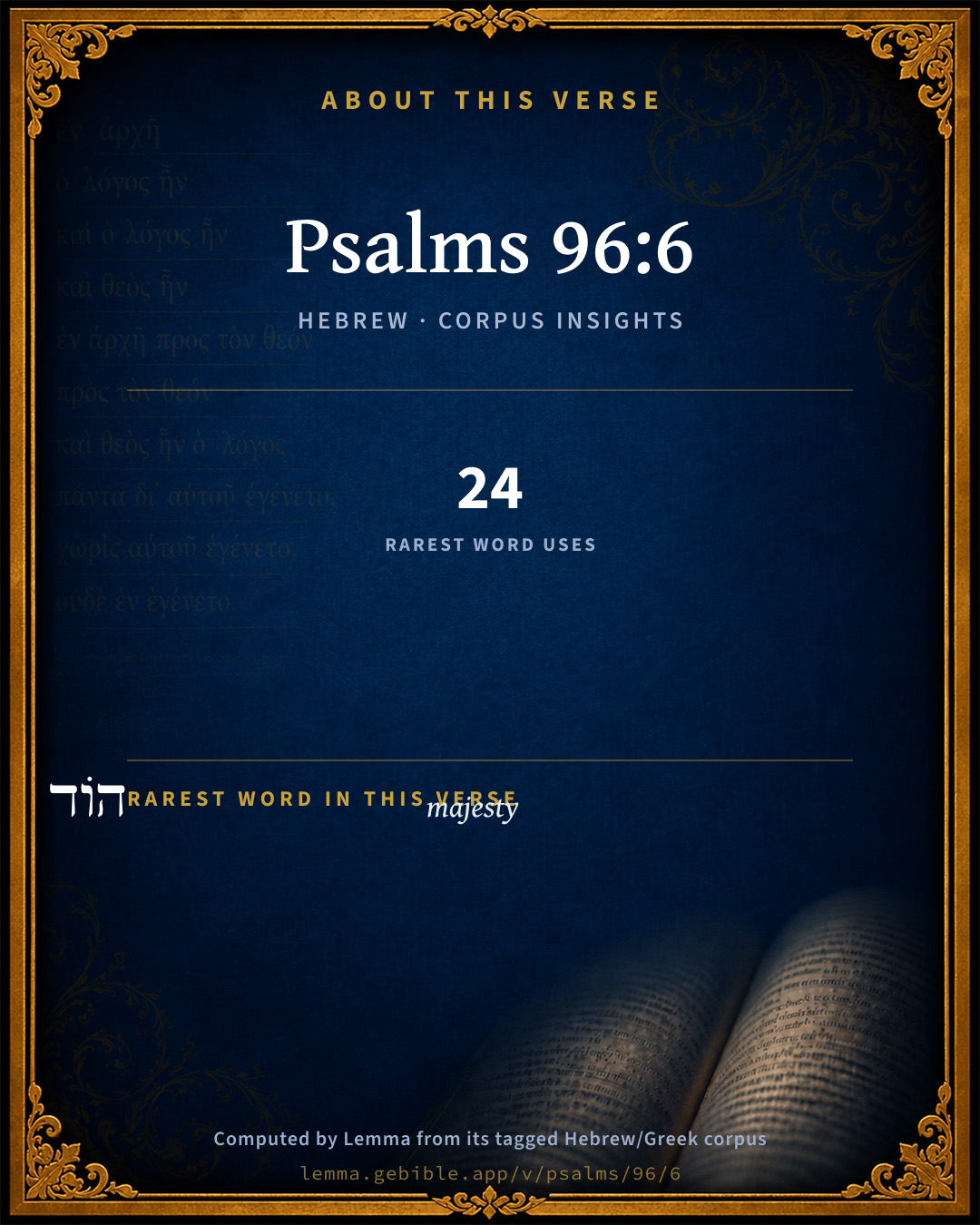
These counts appear in no published source. They are computed here, from the morphology-tagged text and Lemma’s own curated glosses. What Lemma adds →

6
words
6
distinct lemmas
Wisdom
section

Notable vocabulary

The rarest word here is הוֹד majesty H1935 — appearing just 24 times in the whole Hebrew Bible.

Shared distinctive vocabulary

הוֹד majesty H1935 occurs in 24 verses of the Hebrew Bible. Also found in:

Grammatical profile

  • 6 nouns

Hebrew & Septuagint length

In English translation the verse runs 13 words from the Hebrew and 13 from the Septuagint (LXX English) — the same length.

A rough comparison of the two English renderings, which tokenize alike — not a word-level alignment.

Word counts can differ between the Hebrew and the Greek without any difference in meaning — e.g. the Hebrew direct-object marker אֵת has no separate Greek word, and Greek often adds the article ὁ.

Cross-references

12

Topical passages linked to Psalms 96:6 in the Treasury of Scripture Knowledge — connected by theme and wording, ordered by reader-vote popularity; previews shown in the World English Bible.

  • Psalms 63:2–3 So I have seen you in the sanctuary, Watching your power and your glory.
  • 1 Chronicles 16:27 Honor and majesty are before him: Strength and gladness are in his place.
  • Psalms 29:1–2 Ascribe to Yahweh, you sons of the mighty, Ascribe to Yahweh glory and strength.
  • Psalms 93:1 Yahweh reigns! He is clothed with majesty! Yahweh is armed with strength. The world also is established. It can't be moved.
  • Psalms 104:1 Bless Yahweh, my soul. Yahweh, my God, you are very great. You are clothed with honor and majesty.
  • 2 Peter 1:16–17 For we did not follow cunningly devised fables, when we made known to you the power and coming of our Lord Jesus Christ, but we were eyewitnesses of his majesty.
  • Hebrews 1:3 His Son is the radiance of his glory, the very image of his substance, and upholding all things by the word of his power, when he had by himself made purification for our sins, sat down on the right hand of the Majesty on high;
  • Psalms 8:1 Yahweh, our Lord, how majestic is your name in all the earth, Who has set your glory above the heavens!
  • Psalms 19:1 The heavens declare the glory of God. The expanse shows his handiwork.
  • Psalms 27:4 One thing I have asked of Yahweh, that I will seek after, That I may dwell in the house of Yahweh all the days of my life, To see Yahweh's beauty, And to inquire in his temple.
  • Psalms 29:9 Yahweh's voice makes the deer calve, And strips the forests bare. In his temple everything says, "Glory!"
  • Psalms 50:2 Out of Zion, the perfection of beauty, God shines forth.

Cross-references courtesy of OpenBible.info (CC BY 4.0).

Hebrew and Greek witnesses Masoretic Hebrew ↔ Greek Septuagint

The same verse in the two great witnesses to the Old Testament, shown verse-for-verse.

You’re reading Greek Psalm 95 (Hebrew Psalm 96). The Septuagint counts the superscription, so verse numbers can differ from the Hebrew — chapter-level alignment, not verse-by-verse. Numbering follows Rahlfs.

These are two independent witnesses, not word-aligned to each other, and the Septuagint is shown in lemma (dictionary) form.

Hebrew Psalms 96:6 Masoretic · Westminster Leningrad Codex

הוֹד וְהָדָ֥ר לְפָנָ֑יו עֹ֥ז וְ֝תִפְאֶ֗רֶת בְּמִקְדָּשֽׁוֹ

Honor and majesty are before him. Strength and beauty are in his sanctuary.

World English Bible · Public Domain

Greek LXX Greek Psalm 95:6 Septuagint · lemma form

ἐξομολόγησις καί ὡραιότης ἐνώπιον αὐτός ἁγιωσύνη καί μεγαλοπρέπεια ἐν ὁ ἁγίασμα αὐτός

Thanksgiving and beauty are before him: holiness and majesty are in his sanctuary.

LXX2012 (modern English Septuagint) · Public Domain

Hebrew: Westminster Leningrad Codex (CC BY 4.0). Greek: Septuagint (public domain); English from LXX2012 (modern English Septuagint) (Public Domain). How the Septuagint differs from the Hebrew →

Commentary

Notes on Psalms 96:6 from classic Christian and Jewish commentators (each source and its license shown beneath its notes). The classic Christian expositions comment on the surrounding passage and are grouped to its opening verse, so a note may address several verses; the Jewish commentaries on the Tanakh (Rashi and others) are per-verse, so they appear only where the commentator wrote on this verse.

Lemma curates 59 commentaries, every one of them public domain or Creative Commons licensed, each selected and text-cleaned for this edition rather than reprinted as found. About our sources →

Trapp's Complete Commentary

John Trapp

Psa 96:6 Honour and majesty [are] before him: strength and beauty [are] in his sanctuary.

Ver. 6. Honour and majesty are before him] These are his harbingers, and they go often coupled, as Psa 104:1 Psa 111:3 Psa 145:5 Job 40:10, &c. By the former, seemeth to be meant outward port and splendour; by the latter, inward reverence and respect following thereupon.

Strength and beauty are in his sanctuary] God’s glory shineth more in his Church than in all the world besides.

John Trapp, A Commentary or Exposition upon All the Books of the Old and New Testament (1647–1656) — public domain. Text from a community e-Sword module.

The Biblical Illustrator

Joseph S. Exell

Psa_96:6

Strength and beauty are in His sanctuary.

Strength and beauty

Christianity alone has combined the two ideals of the world. Strength and beauty are diverse, but not contradictory. Yet we seldom find them united in the national ideals of ancient or modern times. Thy sons, O Zion! cried one of the Hebrew prophets, against thy sons, O Greece--the nation which stood for moral strength inexorably opposed to the nation whose ruling passion was beauty. To the Hebrew beauty was a secondary and an inconsiderable ideal compared with the strength of moral restraint and attainment. Strength was for men, and beauty perhaps was good enough for women. But the point of our text is that it combines strength and beauty into one harmony of character, which both men and women should seek to acquire.

Not like to like, but like in difference--

Yet in the long years liker must they grow;

The man be more of woman, she of man;

He gain in sweetness and in moral height,

Nor lose the wrestling thews that throw the world;

The mental breadth, nor fail in childward care,

Nor lose the childlike in the larger mind.

Aarons rod was the symbol of authority, the strength of the High Priests office, but Aarons rod it was that budded, and there you have the beauty. Our text, then, points out that there is no character complete which does not possess both strength and beauty. But, more than that, it shows that true strength and beauty are found only in Gods sanctuary--that is, in genuine relationship with God. A very little thought will suffice to satisfy us how closely this corresponds with the facts. For if there is anything which our experience makes clear, it is this: that sins tendency is to weaken, to soften the moral fibre of our natures, and to throw us open to the germs of all spiritual diseases. You all know how sins of sensuality bring their terrible revenge upon the body, and how nature exacts the uttermost farthing. In precisely similar fashion the soul is weakened by the transgression of the laws of moral and spiritual health. To commit any sin is to make oneself less able to resist it in the future. One falsehood leads almost necessarily to more. Where is the boasted strength and liberty of the sinner? Liberty to destroy oneself? Strength enough to take away by an act of moral suicide ones spiritual life? Yes, but no strength to live purely and nobly, no power to aspire, no courage to battle with the incursions of evil; is it not a mockery to say that there is strength in the pursuit of sin? Strength is in Gods sanctuary, for He alone enables men to trample under foot the weakening influences of sin through the grace of our Lord Jesus Christ. What, then, are the nature and value of that strength which is to be found in Christ? What end does it serve and to what attainment does it lead? For one thing, it enables a man to cleave fast to the highest that he knows though all the world deride. No one can doubt how tremendous is the pressure of public opinion in these days, and how strong (one might almost say obstinate) a man must be who is to set himself to resist it. We talk of the pressure of the atmosphere upon the human body, and no doubt it is vast; buy we do not feel it because our frame has been made equal to the strain. For our moral frame, however, we must win the protecting armour of Gods grace, and until we are safely clad in it, the pressure is grievous to be borne. In every line of life there are practices which have grown common and are sanctioned by custom, yet your conscience tells you they are wrong. I do not think, said President Garfield, what others may think or say concerning me, but there is one mans opinion concerning me which I very much value, that is the opinion of James Garfield; others I need not think about. I can get away from them, but I have to be with him all the time . . . It makes a great difference whether he thinks well of me or not. These are noble words, and they show us the sort of strength we need--strength to be faithful to what we know as the best and highest that a man can set up within his soul. From that tribunal we may not escape judgment, and if we are acquitted there our hearts are at peace. The same thing is true of all manner of temptation. We do not escape the snares of the tempter by running away. To these we must offer a constant and pitiless antagonism. There is an old tower on the Continent where in one of the dungeons the walls have graven upon them again and again the word Resist. It is said a Protestant woman was kept in those dark recesses for forty years, and all the time she spent in graving with a piece of iron for all who might come after her that solemn and courageous word. Oh! we need it graven upon our hearts. Strength is in Gods sanctuary--strength for bestowal--and you may have it if you will reach forth your hand. It is useless to say, Be strong, but it is wisdom to say, Be strong in the Lord. And then we should seek strength for the sake of others, so as to impart to them help and encouragement. Briefly, says Ruskin, the constant duty of every man to his fellows is to ascertain his own powers and special gifts, and to strengthen them for the help of others. Our moral strength also is not for ourselves alone. It is intended that by example of words and deeds, by patient endurance and active courage, we should inspire our fellows and make them also strong. The greater your spiritual strength in face of temptation, the braver your courage against all foes of the soul, the more you will help your fellow men to subdue their enemies and to go on from strength to strength. But a character which has strength alone without beauty lacks the perfect round of the Christian ideal. If we would see an instance of such defective character, let us think of the Puritans, who three centuries ago in England stood for righteousness and integrity and the fear of God. But there was little in their lives which could be termed the beauty of holiness. They were upright and they were true; but they had trained themselves to a stern, hard, rugged strength, without polish, without beauty, and without the adornment (though doubtless not without the reality) of love. We see in them the need of those softer and more attractive virtues which fill in the stature of the perfect man. Not only strength, but beauty, is to be found in Gods sanctuary. Nor can true beauty be won save in Him. Just as sin is weakness, so sin is ugliness. It does not always seem so. The siren voices are sweet and their song is fairest music. The form of sin is often beautiful to the eye, and men long to embrace it. But when the sinner clutches it, the lovely form changes to a hideous skeleton that grins and chatters in his face. As George Eliot says of one among her gallery of human characters: He had no idea of a moral repulsion, and could not have believed, if he had been told it, that there may be a resentment and disgust which will gradually make beauty more detestable than ugliness, through exasperation at that outward virtue in which hateful things can flaunt themselves or find a supercilious advantage. Yes, brethren, beauty in its essence is the form of the true and the good, and there is no beauty without goodness. It is a false antagonism to say that one seeks the beautiful rather than the good. There is nothing really beautiful except what is good. The true beautiful, says a modern prophet, differs from the false as heaven does from Vauxhall. Let us, then, get rid of the notion that beauty is not to be sought. Every fresh soul that enters the world instinctively claims a share of the light and joy which this worlds beauty brings; and God forbid that Christians should shut the door upon the beautiful. The instinct, says some one, with truth, even in its lowest forms, is divine. It is the commentary on the text that man shall not live by bread alone. And so far is Christianity from excluding the beautiful from its scheme that it actually recommends the softer and more attractive virtues as no other religion has done. The highest type of Christian character is the most truly beautiful this world has seen. We cannot hear of self-renunciation, or forgiveness, or kindness, or gracious love without exclaiming, How beautiful! And these are the graces which Christ bestows. Strength and beauty, then, make up the perfect character. But where do we find them perfectly combined? Nowhere, save in Jesus Christ. In what wonderful harmony they are blended there! How constantly in His life do we see strength and beauty, in perfect balance and poise, shining forth from His acts and words! In the garden of agony, faced by cruel and murderous men, He stands erect, calmly repeating to His enemies, I have told you that I am He--there is strength; but mark the tender beauty of what follows: If ye seek Me, let these go their way--solicitude for His faint-hearted followers mingling with His fortitude. As one has truly said: The eyes that wept beside the grave of Lazarus were eyes that were like a flame of fire. And so Christian character holds the field, combining the two necessary elements of strength and beauty. That is why Christ appeals to men as well as women. And that is why we cannot but deplore the folly which keeps so many men aloof from active profession of the faith of Christ, because, forsooth, they count it an unmanly thing. Oh! brethren, there is strength as well as beauty in the service of Christ, and nowhere else can you find strength worthy of the name. There is beauty as well as strength, and nowhere else can you find beauty that will last and increase as the years go by. Strength and beauty are in Gods sanctuary; and the sanctuary is the holy place--the place where God and man come nigh, where Gods cleansing and strengthening flow down to men, and where mans service is rendered up to God. (J. Waddell, B.A.)

The sacred union of strength and beauty

I. True of nature as a temple. In nature as a whole,--as one vast cathedral,--and in different scenes, it is as so many aisles and courts and chapels, in it there is strength and beauty. For example, in the forest there is the strength of the gnarled tree, with sinewy and majestic trunk, and the beauty of exquisite foliage and delicate moss and wild flower.

II. True of the Hebrew sanctuaries. In the tabernacle were stout poles and coverings of skin for strength, and finely spun, delicately woven embroidery for beauty. In the temple, what massive and majestic stone for strength! what gleaming of precious and wondrous tapestry for beauty! There were in those sacred structures not only richest harmonies for the ear, but beauties for the eye as well, that so all nature should be toned and tuned to good impressions.

III. True of Christian worship. There may well be Puritan earnestness of spirit, distinctiveness of doctrine, directness of rebuke, fixedness of faith, and at the same time aesthetic refinement of demeanour and tone and thought. Does not worship in the beauty of holiness involve obedience to the precept, Let all things be done decently and in order?

IV. True of Christian character. That is the most perfect sphere of Divine worship; for to Christly men it is infallibly said, Ye are the temple of the Holy Ghost. There must be in such character virtue, the strength of manliness. By which is surely meant honesty, truth, courage, fidelity. But what does St. Peter teach us is to be added to virtue? Clearly, all moral beauty. Our character is to be a sanctuary with solid foundations, but adorned with finely wrought gold; our work is to be a war, but with chivalry. (U. R. Thomas.)

Strength and beauty

Strength and beauty are not always found in company, either in the works of God or of man. The lily is beautiful, but a childs foot may crush it; the gale is mighty, but it is the opposite of loveliness. In the works of man beauty is often allied to the fragile, and strength to the coarse and ungainly. But in the sanctuary of God they meet in undivided perfection.

I. The strength and beauty of attraction. Here is found an attraction mightier than the magnet: it is not a law which acts upon matter, but a life which acts upon mind; a life which enlightens our darkness, quickens the conscience, sways the will, gives hope to the heart, bounding pleasure to the affections.

II. The strength and beauty of an unflinching purpose--to reign, to save, to judge (Psa_96:2; Psa_96:10). This golden chain has never been broken, never been damaged, never been seen, by the enemy. The secret of the Lord is with them that fear Him, etc.

III. The strength and beauty of a perfect organization. It does not grow old; it is a stranger to decay; there is no friction, no loss of power. It is sublimely perfect, and immortal as the years of the Most High.

IV. The strength and beauty of imparted character. The true worshipper comes not only to admire, but to imbibe, be assimilated to the Father; justification is imputed, sanctification is imparted; under the robe of righteousness there must be the holy body, and beneath the manners and bearing of the outward man there must be enshrined, enthroned, the Lord and Saviour of the soul (Psa_100:4). (H. T. Miller.)

Strength and beauty

Had the psalmist set himself to give an inventory, if I may so say, of the things to he found in Gods sanctuary, he would have involved himself in the construction of a very long catalogue. Had he attempted even a somewhat general description, it would have been much the same. For moral impression he does better than either. He passes his eye quickly but reverently round the whole, and feeling that amid all the multiplicity of objects there were two qualities or elements always to be found, sometimes apart, though never far apart, and generally passing into each other and blending together, he seizes upon these as in reality constituting all that was there, and, consequently, all of good that could be anywhere, and thus, with that graphic brevity which is to be found only in Scripture, gives us the whole nature and meaning of religion at a stroke--Strength and beauty are in His sanctuary. The union of strength and beauty in nature is obvious. Some things, indeed, are distinctively strong, and some are distinctively beautiful, but the strongest things are not without beauty, and the most beautiful things are not without strength. Thus order is the all-pervading principle of nature, and as implying security against confusion, collision, and all such things as might lead to these, manifests itself as the very strength of the universe--the invisible cord on which God hangs His material creation. But out of this order comes all the beauty of adaptation, mutual dependence, mutual helpfulness, the succession of seasons--weaving a many-coloured robe for the year--and that felt though hidden harmony which led heathen philosophers to speak of the music of the spheres. So is it also in the sanctuary of home. God setteth us in families, and in these He has a sanctuary, which is as plainly as any other inscribed with the characteristics of strength and beauty. There is the strong arm to work and the loving heart to feel. But the sanctuary here referred to is different from that of nature and of home. It is Gods sanctuary proper--in its first sense, the scene of His worship, of which He has said, I will place salvation in Zion for Israel My glory--Zion, so strong that it cannot be moved--the mountain of the Lords house; and yet Zion, so fair that out of it, as the perfection of beauty, God hath shined. In the further sense, all that belongs to Gods redemption-work is included in it. Take the character and teaching of Him who is its Author and Finisher, Jesus, the Son of God, on whom the execution of the work was laid, and who gave Himself for us that He might redeem us from all iniquity. In Him was the strength of holiness, as a necessity; for He was God, the brightness of the Fathers glory, and the express image of His person. But He was God in human nature and in human relations, and this brought Him within the sphere of human observation, and made His life on the earth the visible image of man in his ideal perfection. The trying and every-varying circumstances in which He was placed served to bring out the strength and beauty alike which were enshrined in this sanctuary of God; for the strength of His purity never passed into hardness, and the beauty of His compassion never sank into weakness. He was both a merciful and a faithful High Priest. This example His people must follow. The spirit of Christ must be their spirit too. The strength of holiness must be conspicuous in them; the strength of obedience even unto death; the strength of a firm and resolute will in the direction of all that is true and just. But this must not be without beauty in their case, any more than it was in His: the beauty of tenderness mingling with their fidelity; the beauty of meekness, gentleness, pity,--knowing, like Him, to have compassion on the ignorant and them that are out of the way. And so also with the services of the sanctuary. In these there must be first, and mainly, the strength of truth, in the reading of the Scriptures and the preaching of the pure and simple Gospel of grace and love. Without this, services are a delusion, clouds without water, carried about of winds, trees whose fruit withereth. And yet they are not to consist entirely in the enunciation of doctrine, but must rise out of that into the beauty of emotional feeling, and find expression in the broken accents of prayer and the uplifted melody of psalms and hymns and songs of praise. In conclusion: this brief sentence might be expanded indefinitely. It passes round and appropriates all that belongs to a religious character and life, and it holds in it many words of counsel and caution. It forbids us to be harsh for the sake of faithfulness, or to be weakly compliant for the sake of tenderness. It takes the two staves of the prophet--Beauty and Bands--and binds them together in the laws and principles of Gods house and service, and in the whole character and life of His people, even as they are bound together in the nature of God Himself, and were so wondrously exemplified at every step by Him who achieved our redemption in all the strength of His immaculate holiness, and in all the beauty of His immeasurable love. (A. L. Simpson, D.D.)

Strength and beauty

It is a common observation that the finest and most impressive effects are often produced by the combination of things that are unlike each other. The painter recognizes this principle when he brings his darkest shadows to heighten the effect of his clearest lights, or contrasts the peaceful life of some humble cottage home with the stately magnificence of the stern mountains that surround it. The architect appeals to the same principle when he crowns his columns with beautiful capitals, and relieves the massive masonry of his walls with delicate tracery and forms of sculptured beauty. In such cases two ideas entirely different from each other are brought together. The massive wall and the marble column suggest the thought of strength; while the delicate carvings and the sculptured friezes appeal to the sense of beauty. The thought which lies deep in the artists mind, and to which he strives to give expression in his work, is that there is a natural alliance between strength and beauty. We see illustrations of this truth in--

I. The works of God. All the strong things in nature are beautiful: all the beautiful things are exhibitions of strength. The dewdrop that glitters on the rose-leaf--we all know the perfection of its beauty; but how little do we understand the mystery of the strength by which that beauty is secured! That little drop of water is composed of elements which are held together by electric forces sufficient to form a flash of lightning that would rend the rocks of the mountain or blast the stoutest oak of the forest. All that mighty thunder of power lies sleeping in the crystal sphere of a tiny dewdrop. Each day is enlarging the sphere of our knowledge of the natural world; and every fresh discovery brings a new gleam of light to kindle up afresh the brilliancy of the illuminated scroll, Strength and beauty are in His sanctuary.

II. The revealed character of God. Strength and beauty are before Him--the strength of an infinite majesty, the thunder of an almighty power, the calm serenity of an eternal righteousness. And these, when seen alone, apart from those other attributes of His nature which are their gracious complement, can bring no peace to the troubled conscience or rest to wearied hearts. They can bring us trembling and awe-stricken into that majestic presence; but they know not the secret of transforming the shrinking terror of the criminal and the slave into the holy reverence and the joyous freedom of the son. Strength and beauty--the beauty of tenderness, the graciousness of Divine condescension, the winning aspects of a love that beareth all things, believeth all things, endureth all things, hopeth all things.

III. The person of Christ.

IV. The various revelations of Divine truth to the world, and the order of their succession. The law precedes the Gospel: and law is to the Gospel as strength to beauty. We speak and think of the severe aspects of the law, its shalt and shalt not, its stern repressions and its calm, passionate sentences. But it had its softer side, its gracious and tender aspects for those who had the heart and the eye to see them. To men like David it was given to rejoice in the thought that the law has its seat in the bosom of the God of Love. The Ritual of Judaism had deeper meanings for the spiritual worshipper, and its law brought him to Christ. The man who had the clearest vision of the strength and majesty of the law was the man who rejoiced most deeply in the everlasting mercy of the Lord. The law had its prefigurement of the Gospel, just as the Gospel had its undying reminiscence of the law.

V. Human character. There is danger in opposite directions. Some Christians are content with the strength, and care little for the beauty, of the Christian life. They are stern in their adhesion to principle, careless of the lesser charities of life, apt to be harsh in their condemnation of error and sin. Every one knows their worth, believes in their honesty, would trust implicitly to their integrity. But they do not win love by their gracious bearing, their kind words, their charitable construction of men and things. They have the strength, but they lack something of the beauty of the Christian character. Others are in danger from the opposite tendency. They would sacrifice something of the severity of perfect uprightness to the graces of life. They must have peace at any price. It is the emotional side of religion that has the chief attraction for them. They are in love with the beauty of religion, but they are not good specimens of its strength and steadfastness. The text has a message for each. Strength and beauty. This is the ideal of a complete Christian character. The one is the framework, the other is the covering, of the man of full spiritual stature. In matters of principle, in the sphere of actions that touch the conscience, remember the call for strength. Be strong in the Lord. But remember the other element, and cultivate the spirit and the practice of the grace of the Lord Jesus Christ. Give wide interpretation to the prayer of the psalmist, Let the beauty of the Lord our God be upon us. (W. Cameron, D.D.)

Strength and beauty

A subject of never-waning interest to the student of comparative religions is she influence upon the character of a nation in its conception of God. It is sometimes asserted, in somewhat too sweeping a fashion, that a people will be as is its idea of God. In qualification of that proposition it has to be said that not all people hold themselves pledged to the imitation of God. Many, indeed, would argue that such a thought is little short of presumptuous folly. Moreover, even when the imitation of God is regarded as mans chief and proper endeavour, the fact remains that a nations character is determined not by certain merely traditional and abstract ideas of Deity, but by the quality of its faith in the reality of God. With these qualifications, it may be generally admitted that the character of every people tends to be influenced by the character of its God or gods. It is impossible to maintain that the old popular mythologies of Greece and Rome had no influence upon the common lives of men. The weaknesses, follies, passions, and vices of the immortals became in the nature of a justification for similar failings and excesses among mortals; and it can never have been easy of belief that what is right in God is wrong in man. No doubt it was a favourable maxim of the Stuart dynasty, Do you not know that I am above the law?; and apologists were wont to maintain in very old times that gods and goddesses could no more than earthly autocrats be subjected to the laws of ordinary human morality. But example tells when the subtlest casuistry fails; and, save where unbelief has relaxed or destroyed the sanctions of religion, the character of the God it worships tends to impress itself upon the character of the worshipping people; and insensibly, if not of settled aspiration, the nation does tend to an imitation of God. We are on surer ground, however, when we turn from that heterogeneous multitude of people we call a nation to a consideration of the individual life. The stronger a mans faith in God, the more will he realize in his own character those qualities which occupy the largest place in his conception of God. The degree of his imitation of God will be proportionate to the intensity of his belief in God. Now, the psalmist, in this lyrical outburst of adoration, professes to have discovered two qualities which are revealed in combination in the character of God, and which, such is the suggestion, He will Himself communicate to devout, worshipful, and aspiring souls. These two qualities are strength and beauty. Neither quality is of itself uncommon; it is their combination that is so rare. Somehow in this world the strong is not usually the beautiful, and the beautiful is not the strong. We think of the beautiful in Nature as the fragile, the delicate, the evanescent. We think of the strong, and with its massive solidity it is difficult to associate any thought of grace and loveliness. But this psalm was a hymn for the Temple; and if it be true, as we suppose, that there are yet remaining many of the glorious pillars which adorned that magnificent structure, it is conceivable that they suggested to the psalmists mind this rare combination of qualities. For these pillars of the Temple were of radiant marble, stately and splendid in themselves, and with the added decoration of capitals nobly carved in all manners of exquisite device. And not the pillars alone, but the whole majestic pile itself, was it not the standing witness to the truth that the God whom it represented to men was at once strong and beautiful? For its durability and solidity was only equalled by its magnificence; the strength of its stone by the beauty of its colouring and the glory of its decoration. The architects of that ancient cathedral seem to have derived their ideas from Nature and to have seen that He who laid the enduring foundations of the earth, decorated the world, He made with the gold of the crocus, the crimson of the field-lily, or the blue of the gentian and the harebell; and they built for Him a lane which, like the world He built for them, was strong and beautiful, massive, but full of delicate colour. As was this temple of their God, so was the God of the Temple--in His Divine Being they felt there must be this glorious combination of strength and beauty. If, then, the religious life be the imitation of God, the man of God will manifest to the world a character in which strength and beauty are found in combination. (C. S. Horne, M.A.)

Strength and beauty

It does not admit of question that not only the Hebrew ideal embraced them both, but the creed of ancient art in its noblest era associated the perfection of beauty with the perfection of strength. The sculptor honoured magnificence and majesty in the human frame; he revealed the beauty that lay in limbs that denoted a sense of power. It is only later on that we begin to see ideals contrasting themselves. One painter worships soft loveliness, and his imagination riots in luxuriance of colouring; but another still upholds the ideal of the majestic, and about his work there is a restraint and even austerity. That is how the ideals of Raphael and Michael Angelo perpetually contrast themselves. And the pre-eminence of the latter is just this: that he never wearies of insisting that strength is inseparable from the highest beauty. (C. S. Horne, M. A.)

The highest beauty is strong, noble magnificent

You remember how Mr. Ruskin enforced the truth in his teaching about architecture. In the rudest forms of building, a strong arch was constructed by laying a huge square stone slab across two huge square upright pillars. When it was complete it had certainly the aspect of durability. Plain it was, and ugly, but surely, said the builder, it could not at any rate be stronger. On the contrary, arches did not become strong until they became beautiful. It was only when the curved line of beauty was discovered that the secret of strength was discovered too . . . Or, again, you will remember how the old pillars of the ancient temples were made thick and square, and squat and ugly. But then came the discovery that you did not detract from strength if you built a more tapering pillar and adorned it with carved capitals, or fluted it from base to summit. There is no antagonism between strength and beauty. This psalmist is in agreement with the thought of the apostle who wrote, I will make thee a pillar in the temple of my God. (C. S. Horne, M. A.)

The supremacy of love in strength and beauty

Without reverence there is no beauty of manhood; nay, and without love, none, none. I know that to-day men praise the strength of will, of energy, and I have no dispraise for that, until it becomes one of the idols of the market-place. Mere strength of will is not by any means always beautiful: it is not seldom hard and brutal. Love is the stronger force when all is said, and love is beautiful. Matthew Arnolds lines contain a haunting truth.

I, too, have longed for trenchant force

And will, like a dividing spear;

Have praised the keen, unscrupulous course

Which knows no doubt, which feels no fear.

But in the world I learnt what there

Thou, too, wilt surely one day prove:

That will, that energy, though rare,

Are yet far, far less rare than love.

(C. S. Horne, M. A.)

The Biblical Illustrator, edited by Joseph S. Exell (c. 1880s–1900s) — public domain. Text from a community e-Sword module.

J. A. Alexander on Psalms

Joseph Addison Alexander

6. (Psa 96:6) Honour and majesty (are) before him, strength and beauty in his holy place. The first combination occurs above, Psa 45:3. Before him, as his constant attendants or forerunners. Beauty, all that is lovely and admirable. See above, on Psa 71:8. His holy place, his earthly residence, regarded as a radiating centre even to the Gentiles; or the place where God reveals himself, whatever it may be.

Joseph Addison Alexander, The Psalms Translated and Explained (1850) — public domain. Text from a community e-Sword module.

Tyndale Open Study Notes

Tyndale Open Resources

96:6 Honor and majesty: The Lord is glorious (96:6; 104:1; 148:13), and so are his works in nature (8:1) and in redemption (111:3; 145:5).

Tyndale Open Study Notes — © Tyndale Open Resources, licensed CC BY-SA 4.0. Text via the HelloAO Bible API.

Geneva Bible (1599)

Geneva Bible translators

God cannot be known, but by his strength and glory, the signs whereof appear in his Sanctuary.

Geneva Bible (1599) marginal notes — public domain. Text via Bolls.life.

Adam Clarke's Commentary

Verse 6. Honour and majesty are before him] Does this refer to the cloud of his glory that preceded the ark in their journeying through the wilderness? The words strength and beauty, and glory and strength, Ps 96:7, are those by which the ark is described, Ps 78:61.

Adam Clarke's Commentary on the Bible (1810–1826) — public domain. Text from a community e-Sword/MySword module.

John Calvin's Commentaries

6 Strength and honor are before him I translate the Hebrew word הוד, hod, by strength, and think those interpreters who render it glory have not duly considered the context. It is evident that the next member of the verse is a repetition, and there it reads, Power and Glory are in his sanctuary. The Psalmist means that we cannot be said to know God if we have not discovered that there is in him an incomparable glory and majesty. He first takes notice of his power and strength, as that in which his glory consists. There, as God is invisible, he directs the thoughts of his people to the sanctuary, which we have already seen to be the symbol of his presence. Such is the weakness of our minds that we rise with difficulty to the contemplation of his glory in the heavens. The Psalmist reminds us that we have no reason to say that his glory is obscure, since there were emblems of his presence in the temple, the sacrifices, and the ark of the covenant. Let us endeavor, when we make mention of God, to conceive of this glory which shines before him — otherwise, if we do not apprehend his power, it is rather a dead than a living God whom we worship.

John Calvin's Commentaries (1540-1563) — public domain. Text from the Calvin Translation Society English edition (1840s-50s) via the Christian Classics Ethereal Library (ccel.org). Calvin's coverage is partial (roughly two-thirds of the Bible); uncommented books and verses are honest gaps, never fabricated. The 19th-century editor's footnotes and remarks are omitted so the notes are faithfully Calvin's own voice.

Ellicott's Commentary for English Readers

(6) Honour . . . The whole universe displays Jehovah’s majesty, but chiefly his sanctuary in Israel, where it is typified by the costly splendour of the building and its rites. So the version of Apollinaris, “Pureness and stately glory fit his shrine.” The chronicler having adopted this psalm as suitable for the occasion when the ark was brought to Zion by David, has substituted “strength and gladness are in his place” possibly because the Temple was not built at that time.

A Bible Commentary for English Readers, edited by Charles John Ellicott (1878–1897) — public domain. Text from a community e-Sword module.

The Cambridge Bible for Schools and Colleges

gen. ed. J. J. S. Perowne

6. The attributes of honour and majesty (Psa_104:1) are perhaps personified, and regarded as attendants standing in God’s Presence. Strength and beauty are terms applied in Psa_78:61 to the Ark, the symbol of His Presence. The sanctuary is not heaven, but the restored Temple, where with the eye of faith the Psalmist sees the glory of Jehovah returning to dwell, although the Ark was no longer there to represent it. Cp. Isa_60:13. 1Ch_16:27 reads “Strength and gladness are in his place,” possibly to adapt the Psalm for the occasion when the Temple did not yet exist.

The Cambridge Bible for Schools and Colleges (gen. ed. J. J. S. Perowne; Cambridge University Press, 1878–1918) — public domain. Text from a community e-Sword module.

John Gill's Exposition

Honour and majesty are before him,.... He being set down at the right hand of the throne of the Majesty in the heavens, and having honour and majesty laid upon him; being arrayed in robes of majesty, crowned with glory and honour, sitting on the same throne of glory with his Father, and having a sceptre of righteousness in his hand, and all the forms and ensigns of royalty and majesty about him; rays of light and glory darting from him; as well as those glorious and bright forms before him; the holy angels continually praising him; which is a much more noble sense than that of Kimchi's, who interprets them of the stars:

strength and beauty are in his sanctuary; the Targum is,

"the house of his sanctuary,''

the temple; the Gospel church, of which the temple or sanctuary was a figure: the strength of Christ is seen here, in the conversion of sinners by his Gospel, which is the rod of his strength, the power of God unto salvation, when it comes not in word only; and by which he also strengthens his people to the more vigorous exercise of grace and discharge of duty; here they go from strength to strength: the "beauty" of Christ is seen here; the King is held in the galleries of Gospel ordinances, and is beheld in his beauty; his people appear here in the beauties of holiness, and as a perfection of beauty, through the righteousness of Christ upon them; and as they observe the order of the Gospel, and do all things decently, and with a good decorum: or else, as Kimchi interprets it, heaven may be meant by the sanctuary, of which the holy place, made with hands, was a figure; here Christ reigns, girded with "strength"; here he rules as the Lord God omnipotent, having all power in heaven, and in earth, and doing according to his will in both; and from hence he shows himself strong on the behalf of his people; here. He, who is beauty itself, fairer than the children of men, dwells; here those beauteous forms of light and glory, the holy angels, are; and here the spirits of just men made perfect, who are without spot or wrinkle, or any such thing, have their abode: in Ch1 16:27, it is,

strength and gladness are in his place; among his people and worshippers there.

John Gill's Exposition of the Whole Bible (1746–1763) — public domain (CC PDM 1.0). Text via the HelloAO Bible API.

Albert Barnes' Notes on the Bible

Honour and majesty are before him - This part of the verse is taken literally from 1Ch 16:27. The meaning is, that that which constitutes honor, glory, majesty, is in his presence, or wherever he is. Whereever he manifests himself, there are the exhibitions of honor and majesty. They are always the accompaniments of his presence.

Strength and beauty are in his sanctuary - This is slightly varied from the parallel passage in 1Ch 16:27. The word rendered “strength” is in both places the same. The word rendered “beauty” here - תפארת tiph'ereth - is in 1Ch 16:27 חדוה chedvâh - “joy or gladness.” The word here rendered “sanctuary” - מקדשׁ miqdâsh - is in 1Ch 16:27 - מקום mâqôm - “place.” These variations are such as to show that the psalm is not a mere extract, but that it was altered of design, and adapted to the occasion on which it was to be employed - confirming the supposition that it may have been used in the re-dedication of the temple after the return from the captivity. The word “sanctuary” refers to the holy place where God dwells; his sacred abode, whether his residence in heaven, or the temple on earth as the place of his earthly habitation. When it is said that “strength” is there, it means that the dwelling-place of God is the source of “power,” or that power emanates from thence; that is, from God himself. When it is said that “beauty” is there, the meaning is, that whatever is suited to charm by loveliness; whatever is a real ornament; whatever makes the world attractive; whatever beautifies and adorns creation, has its home in God; it proceeds from him. It may be added that whatever there is of “power” to reform the world, and convert sinners; whatever there is to turn people from their vicious and abandoned course of life; whatever there is to make the world better and happier, proceeds from the “sanctuary” - the church of God. Whatever there is that truly adorns society, and makes it more lovely and attractive; whatever there is that diffuses a charm over domestic and social life; whatever there is that makes the world more lovely or more desirable to live in - more courteous, more gentle, more humane, more kind, more forgiving - has its home in the “sanctuary,” or emanates from the church of God.

Albert Barnes' Notes on the Bible (1834–1885) — public domain. Text from a community e-Sword/MySword module.

Matthew Poole's English Annotations

Before him, i.e. in his presence, like beams shot out from his face, who is the Sun of righteousness. There is an unconceivable glory and majesty in his countenance, and in the place of his presence.

In his sanctuary; or, in his holy place; where he records his name and affords his presence. There are the manifestations of God’s power and grace, or goodness, and all his perfections.

Matthew Poole's English Annotations on the Holy Bible (1683–1685) — public domain. Text from a community e-Sword/MySword module.

The Treasury of David

Charles H. Spurgeon

Ver. 6. Honour and majesty are before him. Men can but mimic these things; their pompous pageants are but the pretence of greatness. Honour and majesty are with him and with him alone. In the presence of Jehovah real glory and sovereignty abide, as constant attendants.

Strength and beauty are in his sanctuary. In him are combined all that is mighty and lovely, powerful and resplendent. We have seen rugged strength devoid of beauty, we have also seen elegance without strength; the union of the two is greatly to be admired. Do we desire to see the "sublime and beautiful" at one glance? Then we must look to the eternal throne. In the Chronicles we read strength and gladness;and the two renderings do not disagree in sense, for in the highest degree in this instance it is true that "a thing of beauty is a joy for ever." Not in outward show or parade of costly robes does the glory of God consist; such things are tricks of state with which the ignorant are dazzled; holiness, justice, wisdom, grace, these are the splendours of Jehovah's courts, these the jewels and the gold, the regalia, and the pomp of the courts of heaven.

Ver. 6. Beauty... in his sanctuary.

Oh, if so much of beauty doth reveal

Itself in every vein of life and nature,

How beautiful must be the Source itself,

The Ever Bright One! Esaias Tegner, 1782-1847.

Ver. 6. In his sanctuary. That is to say (1) his ark, tabernacle, or temple, as many writers consider. Kimchi, as quoted by Muis, suggests that where joy or beauty is mentioned as being in his temple, it is set in opposition to the perpetual grief of the Philistines when the ark was in their cities. They saw the Lord's strength, but not his beauty. (2) Others refer the word sanctuary to the church of Christ, which, as Munster remarks, is adorned with heavenly ornaments, and was typified by the magnificence of Solomon's temple. Certainly it is in the church that the spiritual power and beauty of the Lord are to be most clearly seen. (3) The passage may refer to heaven, where the divine presence is more peculiarly manifest. C. H. S.

Ver. 6. Honour and majesty are before him.

1. As emanations from him.

2. As excellencies ascribed to him.

3. As characteristics of what is done by him.

4. As marks of all that dwell near him. W. Jackson.

Ver. 6 (latter clause). What we may see in God's sanctuary (strength, and beauty). What we may obtain there, Ps 90:17 (strength and beauty). C. D.

Psalms 96:7*

Charles H. Spurgeon's The Treasury of David (1869–1885) — public domain. Psalms only. Text from a community e-Sword/MySword module.

Whedon's Commentary on the Bible

Daniel D. Whedon

6. Honour and majesty—The Hebrew words denote kingly glory.

Strength and beauty—Two qualities difficult to combine. They are not spoken so much of the architecture of the sanctuary as of the symbolic significance of its structure and furnishments, as “patterns of things in the heavens,” (Heb_9:2; Heb_9:23;) above all, its worship, and the manifestations of God to his devout worshippers. See Psa_63:2

Daniel D. Whedon (gen. ed.), Commentary on the Old and New Testaments (1874–1909) — public domain. Text from a community e-Sword module.

The Pulpit Commentary

Honour and majesty are before him. Another paronomasiahod ve-hadar. Dr. Kay translates, "grandeur and majesty;" Professor Cheyne, "glory and grandeur." Strength and beauty are in his sanctuary. The original phrase used seems to have been, "Strength and gladness are in his place" (1Ch_16:27) terms suiting the simplicity of David"s time. When the psalms came to be used in the temple service, loftier language was more fitting. The whole passage has probable reference to the glory of God as seated between the cherubim in the first temple.

Strength and beauty.

It is supposed that this psalm was composed for the dedication of the temple at Jerusalem; but it existed in the time of David, though it was doubtless used in the service of the second temple. The previous reference of the strength and beauty told of here is to the massive foundations and the solid structure of the temple, such was its strength; and the "beauty" told of the lavish adornments and the varied splendour and richness which characterized all the appointments of the house of the Lord. In very real and literal sense "strength and beauty were in his sanctuary.

I THEY ARE THE DISTINGUISHING MARKS OF ALL GOD"S WORKS. "Jehovah made the heavens so we read in ver. 5; and assuredly they are seen there. And look where we will, it is the same. See the account of the Creation.

II THEE SHOULD BE IN OUR SANCTUARIES TODAY. It is a public dishonouring of God if men are content that the sanctuaries in which they worship should be mean and ill-appointed, as so many of them are, whilst in their own houses no costly expense is spared and no adornment withheld. (see Hag_1:4) On the other hand, the magnificent churches, ministers, abbeys, which still remain in this and other lands, have throughout all the long centuries since they were built borne silent but eloquent testimony to the reverence, love, and devotion towards God which dwelt in the hearts of their builders, and which it was their profound conviction ought to dwell in the hearts of all. Meanness and miserable selfishness often skulk behind the plea of spirituality of worship, and that the heart is all that God desires.

III THEY ARE ESSENTIAL TO THE WELFARE OF ANY CHURCH.

1. Strength must be there. Not necessarily the strength of wealth, or intellect, or social rank, but spiritual strength that strength which springs from a firm and living faith universally and tenaciously held, manifesting itself in conscientious adherence to the truth and unsullied righteousness of life, and nourished by fervent prayer and diligent use of all the means of grace. If such strength be wanting, then the glory of that Church has departed, and her decay and dissolution and degradation are at hand. Ecclesiastical organization and money and property may keep up the scaffolding and outworks of such Church for a while, but ere long they too will fail, and the Church must die. But with such spiritual strength, the gates of hell cannot prevail against it.

2. And there must be beauty also. "The beauty of holiness," in which we are bidden "worship the Lord" (ver. 9). By this we understand that moral and spiritual beauty, such as were pre-eminent in our Lord; that winsomeness and grace, that attractiveness of love and pity and compassionate helpfulness, that beautiful grace of which St. Paul in 1Co 13. has so much to say, that sweet reasonableness and evident sincerity, and that holy peace and joy which union with Christ imparts, such is the beauty, the only real beauty, which should be in the Church of the living God.

IV AND THEY SHOULD CHARACTERIZE THE TEMPLE OF THE SOUL.

1. Strength born of faith and love, which holds the soul true to Christ and causes it to be rooted like the oak, and grounded like the deep foundations of a temple, so that it can never be moved.

2. Then beauty. The superstructure, fair in form and symmetrical, that arrests the attention and awakens the delight of the beholder that holy beauty of Christ-like character, which, with strength also, he is waiting and willing to impart to every faithful soul. S.C.

The Pulpit Commentary (1880–1919), ed. H.D.M. Spence-Jones & Joseph S. Exell — public domain. Text from a community e-Sword module.

John Wesley's Explanatory Notes

Before him - In his presence.

John Wesley, Explanatory Notes Upon the Whole Bible (1754–1765) — public domain. Text via the GEBible commentary corpus.

Lesson kit

Teaching starters — assembled from the data on this page, not authored interpretation. Every prompt links to the verse data it draws on. Edit before teaching.

Psalms, in the Wisdom, opens this verse with 6 words (6 distinct Hebrew lemmas). Its most distinctive word is hôwd (“majesty”). A historical commentator’s framing appears above. Read the whole chapter for the surrounding context.

Discussion questions

  1. The word hôwd carries the sense “majesty.” How does it shape the verse?
  2. How does Numbers 27:20, which shares the word «majesty», read alongside this verse?
  3. These translations render this verse differently. What is at stake in choosing one wording over another?
  4. Compare how Trapp's Complete Commentary and The Biblical Illustrator read this verse. Where do they agree or differ?

Things to notice

Reading settings

Reading text

Shown beneath each verse's original-language words.

Old Testament
Old Testament edition

Read the OT as the Masoretic Hebrew (MT) or the Greek Septuagint (LXX).

English shown for the Greek Septuagint (in the Hebrew ↔ Greek comparison).

Comparing translations? Open the Compare panel on any verse page to stack up to four side by side.