
Psalms 28:8

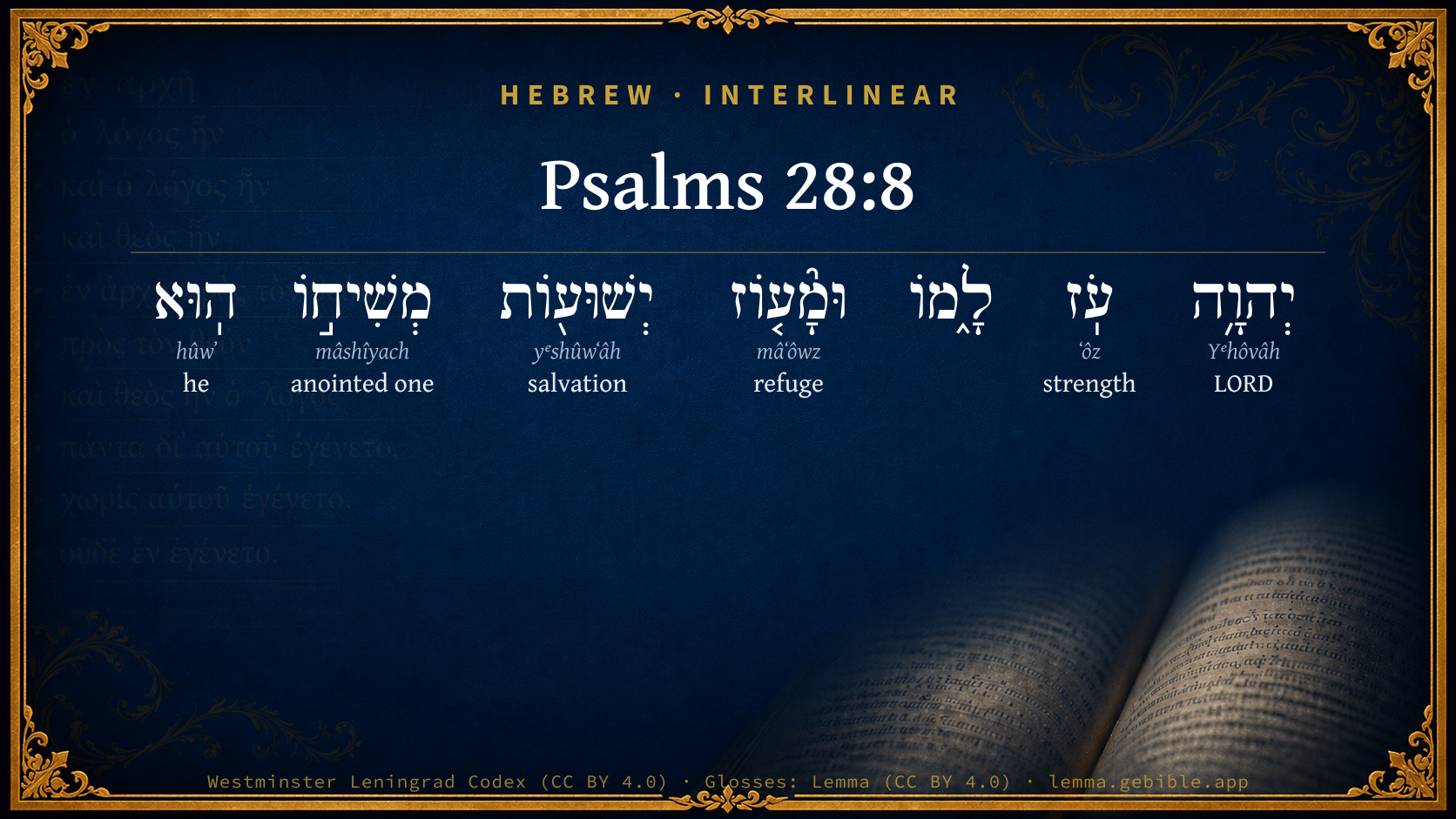
Hebrew (Westminster Leningrad Codex) Psalms 28:8 appears in the Hebrew Old Testament. The text above is from the Westminster Leningrad Codex. Each word links to its Strong’s number, a concise gloss, and parsing drawn from the Open Scriptures Hebrew Bible morphology. Click any word for its full Brown-Driver-Briggs (BDB) entry.
Download image
Cite this verse

Psalms 28:8 (World English Bible). Public Domain. Lemma interlinear Bible study tool, https://lemma.gebible.app/v/psalms/28/8.

Show BibTeX & RIS
BibTeX
RIS
English Translation
Yahweh is their strength. He is a stronghold of salvation to his anointed.
World English Bible · Public Domain
Download a study sheet

One document with this verse’s original text, its word-by-word gloss line, the meaning frame, cross-references with their text, attributed commentary, and full source and license credits — printable, and it pastes into notes with its structure intact.

This verse Autodidact and up

Study sheet (.html) Plain text (.txt)

A passage Seminary Student

Up to 50 verses in one chapter. A passage sheet keeps up to 6 commentary sources and 12 cross-references per verse, in the order this page ranks them, and says so on the sheet whenever that leaves anything out. Ask for a single verse and you get the Autodidact verse sheet above.

Everything on this page stays free to read, with no account — the sheet is a download of what is already on screen, not access to it.

Want to remove ads? Support Godless Engineer
Compare translations 3

The same verse in 3 English versions, stacked beneath the original-language interlinear above. Click any original word for its lexicon entry.

Each is an independent rendering of the whole verse — the interlinear is not word-aligned to these translations.

Highlighted words mark where these versions differ — a whole-verse word diff, not a word-by-word alignment.

  • World English Bible Public Domain
    Yahweh is their strength. He is a stronghold of salvation to his anointed.
  • King James Version Public Domain
    The LORD is their strength, and he is the saving strength of his anointed.
  • unfoldingWord Literal Text CC BY-SA 4.0
    Yahweh is strength for his people, and he is a refuge of help his anointed.

unfoldingWord Literal Text — © unfoldingWord, licensed CC BY-SA 4.0. Word-aligned USFM3 via Door43 (git.door43.org/unfoldingWord/en_ult).

Versions to compare (up to 4)

3 of 4 selected

Show all 18 translations

Every available English version of this verse, each an independent rendering of the whole verse.

  • World English Bible Public Domain
    Yahweh is their strength. He is a stronghold of salvation to his anointed.
  • Berean Standard Bible Public Domain
    The LORD is the strength of His people, a stronghold of salvation for His anointed.
  • Majority Standard Bible Public Domain
    The LORD is the strength of His people, a stronghold of salvation for His anointed.
  • King James Version Public Domain
    The LORD is their strength, and he is the saving strength of his anointed.
  • American Standard Version (1901) Public Domain
    Jehovah is their strength, And he is a stronghold of salvation to his anointed.
  • Revised Version (1885) Public Domain
    The LORD is their strength, and he is a strong hold of salvation to his anointed.
  • Geneva Bible (1599) Public Domain
    The Lord is their strength, and he is the strength of the deliuerances of his anointed.
  • Douay-Rheims (1899) Public Domain
    The Lord is the strength of his people, and the protector of the salvation of his anointed.
  • Young's Literal Translation Public Domain
    Jehovah `is' strength to him, Yea, the strength of the salvation of His anointed `is' He.
  • Literal Standard Version CC BY-SA 4.0
    YHWH [is] strength to him, || Indeed, the strength of the salvation of His anointed [is] He.
  • Unlocked Literal Bible CC BY-SA 4.0
    Yahweh is the strength of his people, and he is the saving refuge of his anointed one.
  • unfoldingWord Literal Text CC BY-SA 4.0
    Yahweh is strength for his people, and he is a refuge of help his anointed.
  • Darby Bible Public Domain
    Jehovah is their strength; and he is the stronghold of salvation to his anointed one.
  • World Messianic Bible Public Domain
    The LORD is their strength. He is a stronghold of salvation to his anointed.
  • Webster's Bible Public Domain
    The LORD is their strength, and he is the saving strength of his anointed.
  • Free Bible Version CC BY-SA 4.0
    The Lord gives strength to his people; he is a safe refuge for the one he has anointed.
  • Bible in Basic English Public Domain
    The Lord is their strength, and a strong place of salvation for his king.
  • JPS Tanakh (1917) Public Domain
    The LORD is a strength unto them; and He is a stronghold of salvation to His anointed.

Literal Standard Version (2020), Covenant Press — licensed CC BY-SA 4.0. Text via the HelloAO Bible API (eBible.org). Unlocked Literal Bible (unfoldingWord) — licensed CC BY-SA 4.0. Text via the HelloAO Bible API (eBible.org). unfoldingWord Literal Text — © unfoldingWord, licensed CC BY-SA 4.0. Word-aligned USFM3 via Door43 (git.door43.org/unfoldingWord/en_ult). Free Bible Version, Dr. Jonathan Gallagher — licensed CC BY-SA 4.0. Text via the HelloAO Bible API (eBible.org).

Word by word

More ways to search: Search by grammar → Find every occurrence → Compare this word →

Practice this passage: Drill this verse → Learn its vocabulary →

וּמָ֘ע֤וֹז
mâʻôwz
H4581
“and · refuge of”
Conjunction + Noun, Common, Masculine, Singular, Construct
Part of Speech
Conjunction + Noun
Type
Common
Gender
Masculine
Number
Singular
State
Construct
Full BDB Definition

Origin: from H5810

TWOT: 1578a

place or means of safety, protection, refuge, stronghold - place of safety, fastness, harbour, stronghold - refuge (of God) (figuratively) - human protection (figuratively)
  1. יְהוָ֥ה Yᵉhôvâh H3068 “LORD” Noun, Proper
  2. עֹֽז ʻôz H5797 “strength” Noun, Common, Masculine, Singular, Absolute
  3. יְשׁוּע֖וֹת yᵉshûwʻâh H3444 “deliverances of” Noun, Common, Feminine, Plural, Construct
  4. מְשִׁיח֣וֹ mâshîyach H4899 “anointed one · his” Noun, Common, Masculine, Singular, Construct + Suffix, Personal, 3rd Person, Masculine, Singular
  5. הֽוּא hûwʼ H1931 “he” Pronoun, Personal, 3rd Person, Masculine, Singular

About this verse

These counts appear in no published source. They are computed here, from the morphology-tagged text and Lemma’s own curated glosses. What Lemma adds →

7
words
6
distinct lemmas
Wisdom
section

Shared distinctive vocabulary

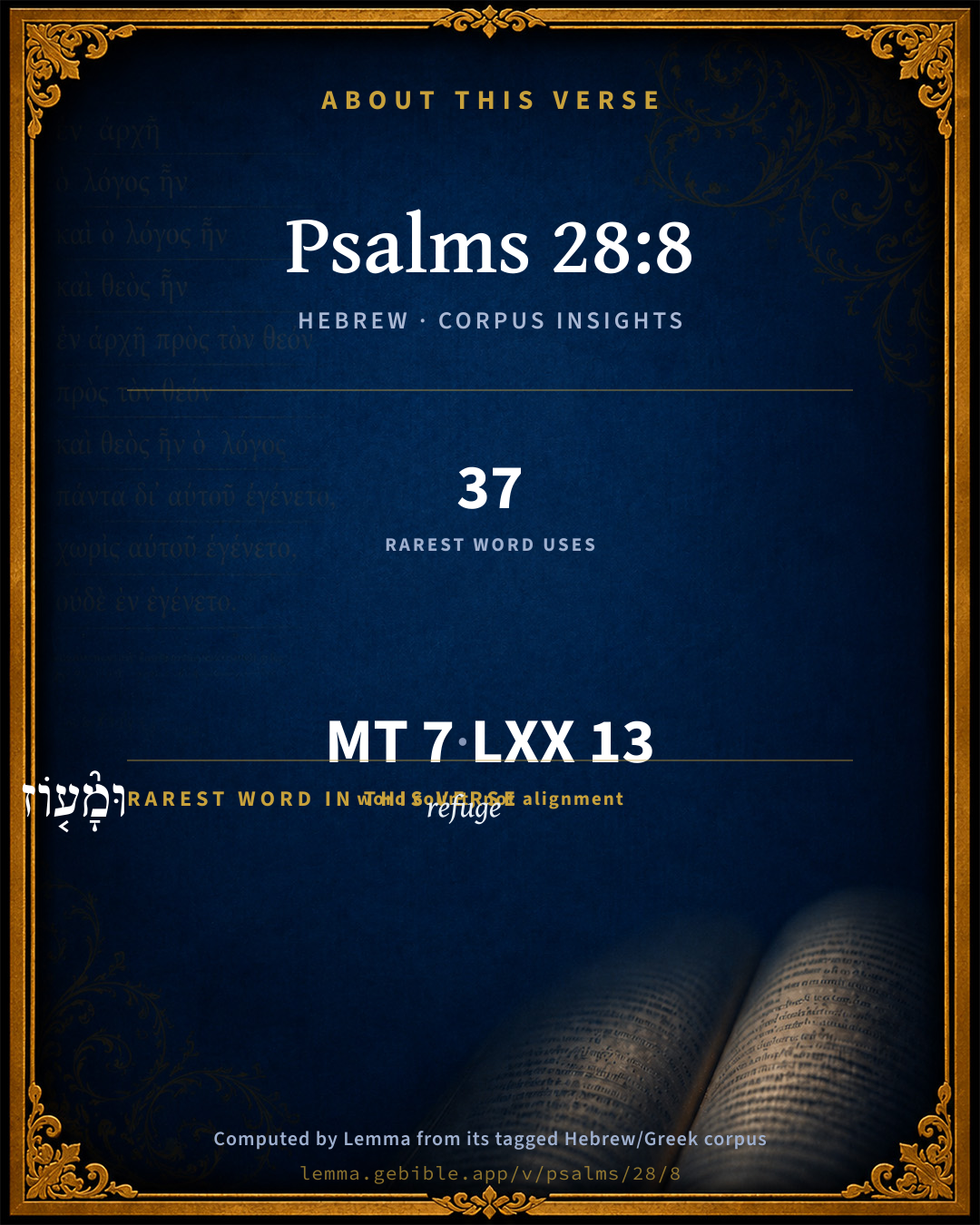
וּמָ֘ע֤וֹז refuge H4581 occurs in 35 verses of the Hebrew Bible. Also found in:

Grammatical profile

  • 5 nouns
  • 1 pronoun
  • 1 preposition

Hebrew & Septuagint length

In English translation the verse runs 13 words from the Hebrew and 15 from the Septuagint (LXX English) — closely comparable.

A rough comparison of the two English renderings, which tokenize alike — not a word-level alignment.

Word counts can differ between the Hebrew and the Greek without any difference in meaning — e.g. the Hebrew direct-object marker אֵת has no separate Greek word, and Greek often adds the article ὁ.

In the original languages it is 7 Hebrew tokens and 13 Greek tokens — but the two are counted differently (Hebrew bundles its prefixes and suffixes into one token; the Greek is in lemma form), so that isn’t a like-for-like length.

Cross-references

5

Topical passages linked to Psalms 28:8 in the Treasury of Scripture Knowledge — connected by theme and wording, ordered by reader-vote popularity; previews shown in the World English Bible.

  • Psalms 20:6 Now I know that Yahweh saves his anointed. He will answer him from his holy heaven, With the saving strength of his right hand.
  • Psalms 140:7 Yahweh, the Lord, the strength of my salvation, You have covered my head in the day of battle.
  • Isaiah 61:1 The Spirit of the Lord Yahweh is on me; because Yahweh has anointed me to preach good news to the humble; he has sent me to bind up the broken-hearted, to proclaim liberty to the captives, and the opening [of the prison] to those who are bound;
  • 1 Samuel 16:13 Then Samuel took the horn of oil, and anointed him in the midst of his brothers: and the Spirit of Yahweh came mightily on David from that day forward. So Samuel rose up, and went to Ramah.
  • Psalms 2:2 The kings of the earth take a stand, And the rulers take counsel together, Against Yahweh, and against his anointed, saying,

Cross-references courtesy of OpenBible.info (CC BY 4.0).

Hebrew and Greek witnesses Masoretic Hebrew ↔ Greek Septuagint

The same verse in the two great witnesses to the Old Testament, shown verse-for-verse.

You’re reading Greek Psalm 27 (Hebrew Psalm 28). The Septuagint counts the superscription, so verse numbers can differ from the Hebrew — chapter-level alignment, not verse-by-verse. Numbering follows Rahlfs.

These are two independent witnesses, not word-aligned to each other, and the Septuagint is shown in lemma (dictionary) form.

Hebrew Psalms 28:8 Masoretic · Westminster Leningrad Codex

יְהוָ֥ה עֹֽז לָ֑מוֹ וּמָ֘ע֤וֹז יְשׁוּע֖וֹת מְשִׁיח֣וֹ הֽוּא

Yahweh is their strength. He is a stronghold of salvation to his anointed.

World English Bible · Public Domain

Greek LXX Greek Psalm 27:8 Septuagint · lemma form

κύριος κραταίωμα ὁ λαός αὐτός καί ὑπερασπιστής ὁ σωτήριον ὁ χριστός αὐτός εἰμί

The Lord is the strength of his people, and the saving defender of his anointed.

LXX2012 (modern English Septuagint) · Public Domain

On this verse, Adam Clarke's Commentary discusses the Septuagint’s reading. Read the note in Commentary ↓

Hebrew: Westminster Leningrad Codex (CC BY 4.0). Greek: Septuagint (public domain); English from LXX2012 (modern English Septuagint) (Public Domain). How the Septuagint differs from the Hebrew →

Commentary

Notes on Psalms 28:8 from classic Christian and Jewish commentators (each source and its license shown beneath its notes). The classic Christian expositions comment on the surrounding passage and are grouped to its opening verse, so a note may address several verses; the Jewish commentaries on the Tanakh (Rashi and others) are per-verse, so they appear only where the commentator wrote on this verse.

Lemma curates 59 commentaries, every one of them public domain or Creative Commons licensed, each selected and text-cleaned for this edition rather than reprinted as found. About our sources →

Trapp's Complete Commentary

John Trapp

Psa 28:8 The LORD [is] their strength, and he [is] the saving strength of his anointed.

Ver. 8. The Lord is their strength] Not mine only, as Psa 28:7, but the strength of all and every one of the holy community, of true Christians, partakers of Christ’s unction, of his Spirit.

John Trapp, A Commentary or Exposition upon All the Books of the Old and New Testament (1647–1656) — public domain. Text from a community e-Sword module.

The Biblical Illustrator

Joseph S. Exell

Psa_28:8

Draw me not away with the wicked.

A prayer against identification with ungodly men

I. the character Of ungodly society.

1. Apostates--gone away from truth, virtue, God.

2. Rebels--wrong in relation to their own nature, society, God.

3. Hypocrites.

II. the attractiveness of ungodly society.

1. In its numerical force. As the little spring from the mountain is drawn to the river, individuals are drawn to the multitude.

2. In its social resources. It has the prizes of fortune and the delights of pleasure at its disposal. All this is attractive. Why should these things be attractive to a good man? Simply, because his goodness is not perfect; remnants of depravity are still in his heart, and these incline him thitherward. To a thoroughly pure soul the power of ungodly society is repulsion, not attraction.

III. the banefulness of ungodly society.

1. Detrimental to the higher interests of human nature. It cannot appease a guilty conscience, or cleanse a polluted heart.

2. Doomed to ruin.

(1) By the moral constitution of the universe.

(2) By the express Word of God, (Homilist.)

Unhook from wicked men

A guards van, attached to some loaded coal trucks, was shunted down an incline towards a siding. On the way, the guard was dismayed to find that the brake in his van was not able to lessen the speed at which they were going. He and his companion mounted the next truck, and tried to let down the brake there, but found that impossible. The guard then proposed to jump off, but his companion thought that that would be certain death. I know what to do! the guard exclaimed, and he seized a huge coal hammer which lay on the truck, went back to the van, and, smashing through the end, lie unhooked the couplings. The van soon stopped, and the two men saw the rest of the train run at great speed into the siding, and the trucks dashed into a shapeless mass. So with bad companions. Unless you throw them off and have nought to do with them they will carry you to the same destruction to which they themselves are hastening.

Psa_28:8

My heart trusted in Him; and I am helped.

The earlier and the later song

There are two actions of the heart--prophecy and memory. In the morning of life I look forward, my heart trusted; in the afternoon I look back, my heart rejoiceth. The morning trust comes before help; it is the prospect of the West seen from the crimson dawn. The afternoon joy follows help: it is the memory of the East seen from the setting sun. My heart is like the migration of the swallows. Every swallow makes its first migration in faith; but at the second its prophecy is turned into a memory. It is no more the heart trusting, but the heart rejoicing. My soul, which of thy migrations is the nobler? Is it the trusting or the rejoicing, the prophecy or the memory, thy journey from East to West, or thy travelling from West to East? The psalmist prefers Shy evening song--the song of memory. It is the swallow after migration. It is a song in spite of storm. It is a praise of life as it is. Faith may sing of the rose behind the thorn; but love sits upon the rose bush and smiles back upon the thorn. Faith journeys from Egypt to seek the promised land; love rests in the promised land, and blesses the journey from Egypt. Faith vows all worship if it shall come without pain to the Fathers house; love reposes in the Fathers house and says: It was good for me to have been afflicted. The song of memory is a song of praise. (G. Matheson, D. D.)

The Biblical Illustrator, edited by Joseph S. Exell (c. 1880s–1900s) — public domain. Text from a community e-Sword module.

Joseph Benson's Commentary

Psa 28:8. The Lord is their strength — That is, the strength of his people, mentioned in the next verse. He is the saving strength — Hebrews ישׁועות מעון, the strength of the preservations, deliverances, or salvations; of his anointed — Of me, whom he hath anointed to be king, and whom therefore he will defend. He signifies that it was by God’s strength alone that his victories, deliverances, and preservations were wrought.

Joseph Benson's Commentary on the Old and New Testaments (1811–1818) — public domain. Text from a community e-Sword module.

J. A. Alexander on Psalms

Joseph Addison Alexander

8. (Psa 28:8) Jehovah (is) strength to them, and a stronghold of salvation (to) his Anointed (is) He. The Psalmist having spoken hitherto not only for him- self but for the people, here insensibly substitutes the third person plural for the first person singular. In the last clause he reverts to himself, but with the use of an expression which discloses his relation to the people, of which he was not only a member but the delegated head, the Anointed of Jehovah. See above, on Psa 2:2. A stronghold. See above on Psa 27:1.—Salvations, full salvation. See above on Psa 18:50 (49). The personal pronoun at the end of the sentence is emphatic, and intended to concentrate the attention upon one great object.

Joseph Addison Alexander, The Psalms Translated and Explained (1850) — public domain. Text from a community e-Sword module.

Geneva Bible (1599)

Geneva Bible translators

Meaning, his soldiers, who were as means, by whom God declared his power.

Geneva Bible (1599) marginal notes — public domain. Text via Bolls.life.

Jamieson, Fausset & Brown

Robert Jamieson, A. R. Fausset & David Brown

The distinction made between the people.

their strength--and the anointed--may indicate Absalom's rebellion as the occasion.

Jamieson, Fausset & Brown — Commentary Critical and Explanatory on the Whole Bible (1871) — public domain (CC PDM 1.0). Text via the HelloAO Bible API.

Adam Clarke's Commentary

Verse 8. The Lord is their strength] Instead of למו lamo, to them, eight MSS. of Kennicott and De Rossi have לעמו leammo, to his people; and this reading is confirmed by the Septuagint, Syriac, Vulgate, AEthiopic, Arabic, and Anglo-Saxon. This makes the passage more precise and intelligible; and of the truth of the reading there can be no reasonable doubt. "The Lord is the strength of his PEOPLE, and the saving strength of his anointed." Both king and people are protected, upheld, and saved by him.

Adam Clarke's Commentary on the Bible (1810–1826) — public domain. Text from a community e-Sword/MySword module.

John Calvin's Commentaries

8. Jehovah is their strength. By way of explanation, he repeats what he had said before, that God had been his strength; namely, because he had blessed his armies. David had indeed employed the hand and labor of men, but to God alone he ascribes the victory. As he knew that whatever help he had obtained from men proceeded from God, and that his prosperous success flowed likewise from his gratuitous favor, he discerned his hand in these means, as palpably as if it had been stretched forth from heaven. And surely it is passing shameful, that human means, which are only the instruments of God’s power, should obscure his glory; although there is no sin more common. It is a manner of speaking which has great weight, when, speaking of his soldiers, he uses only the pronoun their, as if he pointed to them with the finger. The second clause assigns the reason of the other. He declares that himself and his whole army were endued with victorious valor from heaven, because he fought under the standard of God. This is the meaning of the word anointed; for, had not God appointed him king, and freely adopted him, he would not have favored him any more than he did Saul. By this means, in extolling solely the power of God which advanced him to the kingdom, he attributes nothing to his own policy or power. In the meantime, we may learn, that when one is satisfied of the lawfulness of his calling, this doctrine encourages him to entertain good hope with respect to the prosperous issue of his affairs. In particular, it is to be observed, as we have briefly noticed in another place, that the fountain whence all the blessings God bestows upon us flows is, that he hath chosen us in Christ. David employs salvations or deliverances in the plural number, because he had been often and in various ways preserved. The meaning, therefore, is, that from the time when God had anointed him by the hand of Samuel, he never ceased to help him, but delivered him in innumerable ways, until he had accomplished the work of his grace in him.

John Calvin's Commentaries (1540-1563) — public domain. Text from the Calvin Translation Society English edition (1840s-50s) via the Christian Classics Ethereal Library (ccel.org). Calvin's coverage is partial (roughly two-thirds of the Bible); uncommented books and verses are honest gaps, never fabricated. The 19th-century editor's footnotes and remarks are omitted so the notes are faithfully Calvin's own voice.

Ellicott's Commentary for English Readers

(8) Their strength—i.e., the strength of His people, who are throughout in the poet’s thought, even if it is the individual and not the community that speaks. The LXX. and Vulg. read (comp. Psa_29:11) “to his people.”

Saving strength.—Better, stronghold of salvation. (See margin.)

A Bible Commentary for English Readers, edited by Charles John Ellicott (1878–1897) — public domain. Text from a community e-Sword module.

The Cambridge Bible for Schools and Colleges

gen. ed. J. J. S. Perowne

8. their strength] Their must refer to the people. But there is no antecedent for the pronoun, and it is best to follow a few Heb. MSS., the LXX, Vulg., and Syr., in reading, a strength unto his people. Cp. Psa_29:11.

and he is &c.] R.V., and he is a strong hold of salvation to his anointed. Cp. Psa_27:1. Salvation is lit. salvations, great and manifold deliverance. Cp. Psa_18:50; Psa_20:6.

8, 9. Concluding intercession for the people. Cf. Psa_3:8.

The Cambridge Bible for Schools and Colleges (gen. ed. J. J. S. Perowne; Cambridge University Press, 1878–1918) — public domain. Text from a community e-Sword module.

John Gill's Exposition

The Lord is their strength,.... The strength of his people, mentioned in Psa 28:9; not only the strength of David in particular, but of all his people in general; see Psa 37:39;

and he is the saving strength of his anointed; meaning either himself, as before, who was anointed by Samuel king of Israel, and therefore had not invaded and thrust himself into an office he had no call and right unto; or the Messiah, the Lord's Anointed, whom he heard, helped, and strengthened in the day of salvation, and delivered him from the power of death and the grave, and raised him from thence, and gave him glory; see Psa 20:6.

John Gill's Exposition of the Whole Bible (1746–1763) — public domain (CC PDM 1.0). Text via the HelloAO Bible API.

Albert Barnes' Notes on the Bible

The Lord is their strength - Margin, “his strength.” The Hebrew is, “their strength,” or “strength to them.” The allusion is to the people of God. The course of thought seems to be, that the psalmist, having derived in his own case assistance from God, or having found God a strength to him, his mind turns from this fact to the general idea that God was the strength of “all” who were in similar circumstancaes; or that all His people might confide in Him as he had done.

And he is the saving strength - Margin, as in Hebrew, “strength of salvations.” That is, In Him is found the strength which produces salvation. See the notes at Psa 27:1.

Of his anointed - See Psa 2:2, note; Psa 20:6, note. The primary reference here is doubtless to the psalmist himself, as one who had been annointed or set apaart to the kingly office; but the connection shows that he intended to include all the people of God, as those whom He had consecrated or set apart to His service. See 1Pe 2:5, 1Pe 2:9.

Albert Barnes' Notes on the Bible (1834–1885) — public domain. Text from a community e-Sword/MySword module.

Matthew Poole's English Annotations

Their strength, i.e. the strength of his people, mentioned in the next verse; the relative being put before the antecedent, which is left to be gathered out of the following matter, as it is Num 24:17; Psa 87:1. Or, his strength; for the Hebrew affix mo, which commonly is plural, is sometimes taken singularly; of which see my Latin Synopsis here, and on Isa 53:8. And his, i.e. of his anointed, as the next clause explains it. Or the words may be thus rendered, Strength is or belongs to thee Lord. Heb. The Lord, strength is his, or to him. It is a Hebrew pleonasm.

The saving strength, Heb. the strength of the preservations, or deliverances, or victories, or salvations, i.e. he by whose strength alone he hath got these victories, &c.

Of his anointed, i.e. of me, whom he hath anointed to be king, whom therefore he will defend; he speaks of himself in the third person, which is usual in the Hebrew tongue.

Matthew Poole's English Annotations on the Holy Bible (1683–1685) — public domain. Text from a community e-Sword/MySword module.

The Treasury of David

Charles H. Spurgeon

Ver. 8. The Lord is their strength. The heavenly experience of one believer is a pattern of the life of all. To all the militant church, without exception, Jehovah is the same as he was to his servant David, "the least of them shall be as David." They need the same aid and they shall have it, for they are loved with the same love, written in the same book of life, and one with the same anointed Head. And he is the saving strength of his anointed. Here behold king David as the type of our Lord Jesus, our covenant Head, our anointed Prince, through whom all blessings come to us. He has achieved full salvation for us, and we desire saving strength from him, and as we share in the unction which is so largely shed upon him, we expect to partake of his salvation. Glory be unto the God and Father of our Lord Jesus Christ, who has magnified the power of his grace in his only begotten Son, whom he has anointed to be a Prince and a Saviour unto his people.

Ver. 8. The Lord is their strength: not mine only, but the strength of every believer. Notethe saints rejoice in their friends' comforts as well as their own; for as we have not the less benefit by the light of the sun, so neither by the light of God's countenance, for others sharing therein; for we are sure there is enough for all, and enough for each. This is our communion with all saints, that God is their strength and ours; Christ their Lord and ours. 1Co 1:2. He is their strength, the strength of all Israel, because he is the saving strength of his anointed, i.e.,

1. Of David in the type: God in strengthening him that was their king and fought their battles, strengthened the whole kingdom. He calls himself God's anointed, because it was the unction he had received that exposed him to the envy of his enemies, and therefore entitled him to the divine protection. 2. Of Christ, his Anointed, his Messiah, in the antitype. God was his saving strength, qualified him for his undertaking, and carried him through it. Matthew Henry.

Ver. 8. All power given to believers because of their union with Jesus.

Psalms 28:9*

Charles H. Spurgeon's The Treasury of David (1869–1885) — public domain. Psalms only. Text from a community e-Sword/MySword module.

Whedon's Commentary on the Bible

Daniel D. Whedon

8. Their strength—The pronoun, which may be either singular or plural, should be here rendered singular, as it corresponds with anointed (that is, the king) in the parallel line, which should read:—

“Jehovah is his strength,

Even the strength of the salvations of his Anointed is he.”

Daniel D. Whedon (gen. ed.), Commentary on the Old and New Testaments (1874–1909) — public domain. Text from a community e-Sword module.

The Pulpit Commentary

The Lord is their Strength; i.e. the Strength, not of himself alone, but of the whole people. The deliverance will be as much for their sake as for his. And he is the saving strength of his anointed literally, and a Stronghold of salvation to his anointed is HE. The welfare of David and that of the people are bound up together. God strengthens him for their sakes, that he may guide them aright and fight their battles, and give them dominion over their enemies. It was with this object that he chose him out of all Israel, and took him from the sheepfolds, and had him anointed king that he might "feed Jacob his people, and Israel his inheritance". (Psa_78:71)

The Pulpit Commentary (1880–1919), ed. H.D.M. Spence-Jones & Joseph S. Exell — public domain. Text from a community e-Sword module.

Lesson kit

Teaching starters — assembled from the data on this page, not authored interpretation. Every prompt links to the verse data it draws on. Edit before teaching.

Psalms, in the Wisdom, opens this verse with 7 words (6 distinct Hebrew lemmas). Its most distinctive word is mâʻôwz (“refuge”). A historical commentator’s framing appears above. Read the whole chapter for the surrounding context.

Discussion questions

  1. The word mâʻôwz carries the sense “refuge.” How does it shape the verse?
  2. Judges 6:26 shares the word «refuge» with this verse. How do the two illuminate each other?
  3. These translations render this verse differently; the difference is in the English rendering, not the original. What questions does that raise?
  4. Reading how Trapp's Complete Commentary and The Biblical Illustrator read this verse, where do the two commentators agree and where do they part?

Things to notice

Reading settings

Reading text

Shown beneath each verse's original-language words.

Old Testament
Old Testament edition

Read the OT as the Masoretic Hebrew (MT) or the Greek Septuagint (LXX).

English shown for the Greek Septuagint (in the Hebrew ↔ Greek comparison).

Comparing translations? Open the Compare panel on any verse page to stack up to four side by side.