
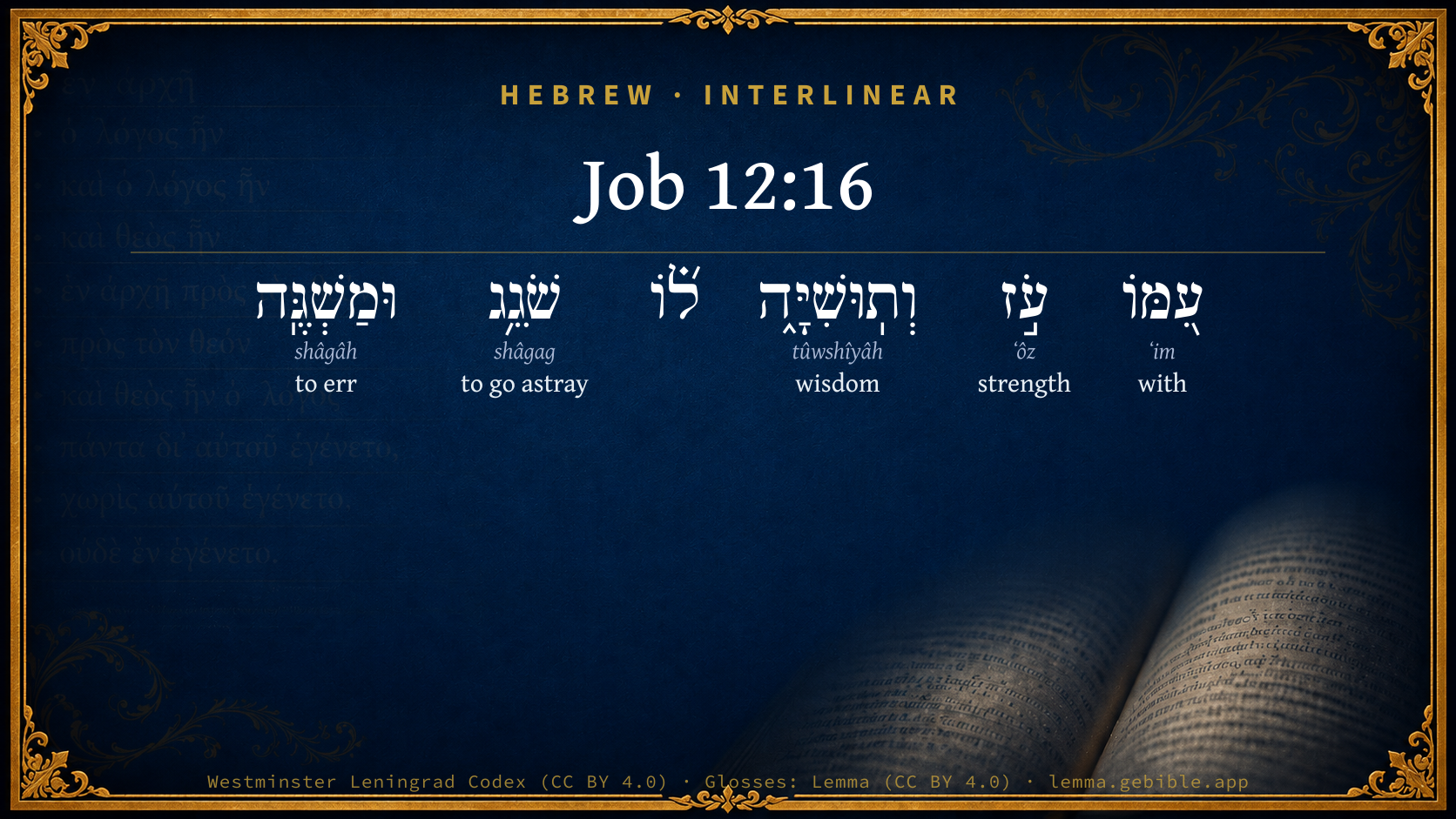
Job 12:16

Hebrew (Westminster Leningrad Codex) Job 12:16 appears in the Hebrew Old Testament. The text above is from the Westminster Leningrad Codex. Each word links to its Strong’s number, a concise gloss, and parsing drawn from the Open Scriptures Hebrew Bible morphology. Click any word for its full Brown-Driver-Briggs (BDB) entry.
Download image
Cite this verse

Job 12:16 (World English Bible). Public Domain. Lemma interlinear Bible study tool, https://lemma.gebible.app/v/job/12/16.

Show BibTeX & RIS
BibTeX
RIS
English Translation
With him is strength and wisdom; The deceived and the deceiver are his.
World English Bible · Public Domain
Download a study sheet

One document with this verse’s original text, its word-by-word gloss line, the meaning frame, cross-references with their text, attributed commentary, and full source and license credits — printable, and it pastes into notes with its structure intact.

This verse Autodidact and up

Study sheet (.html) Plain text (.txt)

A passage Seminary Student

Up to 50 verses in one chapter. A passage sheet keeps up to 6 commentary sources and 12 cross-references per verse, in the order this page ranks them, and says so on the sheet whenever that leaves anything out. Ask for a single verse and you get the Autodidact verse sheet above.

Everything on this page stays free to read, with no account — the sheet is a download of what is already on screen, not access to it.

Want to remove ads? Support Godless Engineer
Compare translations 3

The same verse in 3 English versions, stacked beneath the original-language interlinear above. Click any original word for its lexicon entry.

Each is an independent rendering of the whole verse — the interlinear is not word-aligned to these translations.

Highlighted words mark where these versions differ — a whole-verse word diff, not a word-by-word alignment.

  • World English Bible Public Domain
    With him is strength and wisdom; The deceived and the deceiver are his.
  • King James Version Public Domain
    With him is strength and wisdom: the deceived and the deceiver are his.
  • unfoldingWord Literal Text CC BY-SA 4.0
    With him strength and prudence; to him the one straying and the one causing to stray.

unfoldingWord Literal Text — © unfoldingWord, licensed CC BY-SA 4.0. Word-aligned USFM3 via Door43 (git.door43.org/unfoldingWord/en_ult).

Versions to compare (up to 4)

3 of 4 selected

Show all 18 translations

Every available English version of this verse, each an independent rendering of the whole verse.

  • World English Bible Public Domain
    With him is strength and wisdom; The deceived and the deceiver are his.
  • Berean Standard Bible Public Domain
    True wisdom and power belong to Him. The deceived and the deceiver are His.
  • Majority Standard Bible Public Domain
    True wisdom and power belong to Him. The deceived and the deceiver are His.
  • King James Version Public Domain
    With him is strength and wisdom: the deceived and the deceiver are his.
  • American Standard Version (1901) Public Domain
    With him is strength and wisdom; The deceived and the deceiver are his.
  • Revised Version (1885) Public Domain
    With him is strength and effectual working; the deceived and the deceiver are his.
  • Geneva Bible (1599) Public Domain
    With him is strength and wisedome: hee that is deceiued, and that deceiueth, are his.
  • Douay-Rheims (1899) Public Domain
    With him is strength and wisdom: he knoweth both the deceiver, and him that is deceived.
  • Young's Literal Translation Public Domain
    With Him `are' strength and wisdom, His the deceived and deceiver.
  • Literal Standard Version CC BY-SA 4.0
    With Him [are] strength and wisdom, || His the deceived and deceiver.
  • Unlocked Literal Bible CC BY-SA 4.0
    With him are strength and wisdom; people who are deceived and the deceiver are both in his power.
  • unfoldingWord Literal Text CC BY-SA 4.0
    With him strength and prudence; to him the one straying and the one causing to stray.
  • Darby Bible Public Domain
    With him is strength and effectual knowledge; the deceived and the deceiver are his.
  • World Messianic Bible Public Domain
    With him is strength and wisdom. The deceived and the deceiver are his.
  • Webster's Bible Public Domain
    With him is strength and wisdom: the deceived and the deceiver are his.
  • Free Bible Version CC BY-SA 4.0
    He is mighty and victorious; both deceivers and those deceived are subject to him.
  • Bible in Basic English Public Domain
    With him are strength and wise designs; he who is guided into error, together with his guide, are in his hands;
  • JPS Tanakh (1917) Public Domain
    With Him is strength and sound wisdom; the deceived and the deceiver are His.

Literal Standard Version (2020), Covenant Press — licensed CC BY-SA 4.0. Text via the HelloAO Bible API (eBible.org). Unlocked Literal Bible (unfoldingWord) — licensed CC BY-SA 4.0. Text via the HelloAO Bible API (eBible.org). unfoldingWord Literal Text — © unfoldingWord, licensed CC BY-SA 4.0. Word-aligned USFM3 via Door43 (git.door43.org/unfoldingWord/en_ult). Free Bible Version, Dr. Jonathan Gallagher — licensed CC BY-SA 4.0. Text via the HelloAO Bible API (eBible.org).

Word by word

More ways to search: Search by grammar → Find every occurrence → Compare this word →

Practice this passage: Drill this verse → Learn its vocabulary →

About this verse

These counts appear in no published source. They are computed here, from the morphology-tagged text and Lemma’s own curated glosses. What Lemma adds →

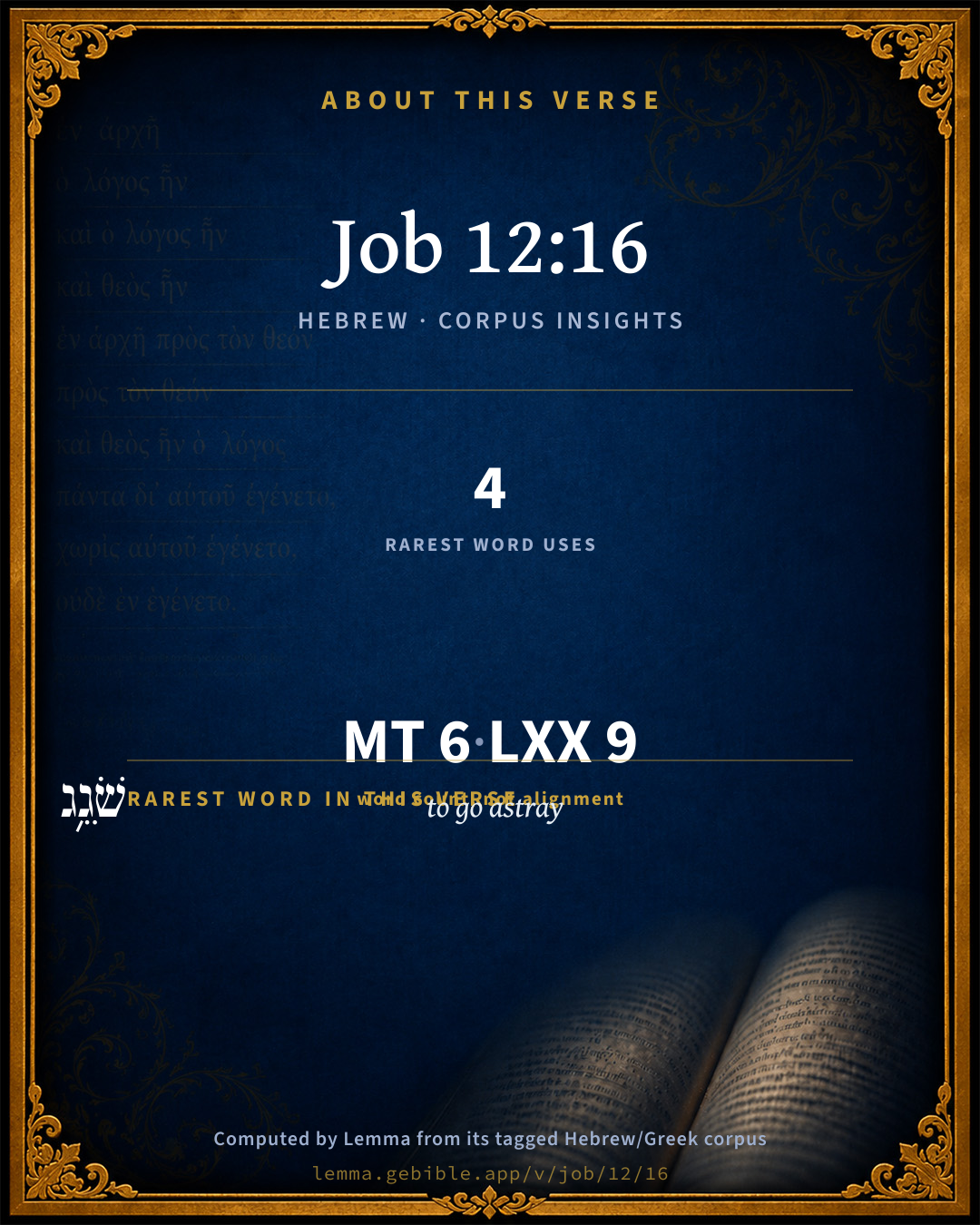
6
words
5
distinct lemmas
Wisdom
section

Notable vocabulary

The rarest word here is שֹׁגֵ֥ג to go astray H7683 — appearing just 4 times in the whole Hebrew Bible.

Shared distinctive vocabulary

שֹׁגֵ֥ג to go astray H7683 occurs in 4 verses of the Hebrew Bible. Also found in:

Grammatical profile

  • 2 verbs
  • 2 nouns
  • 2 prepositions

Verb forms

  • שֹׁגֵ֥ג Qal · Participle Active
  • וּמַשְׁגֶּֽה Hiphil · Participle Active

Hebrew & Septuagint length

In English translation the verse runs 13 words from the Hebrew and 11 from the Septuagint (LXX English) — closely comparable.

A rough comparison of the two English renderings, which tokenize alike — not a word-level alignment.

Word counts can differ between the Hebrew and the Greek without any difference in meaning — e.g. the Hebrew direct-object marker אֵת has no separate Greek word, and Greek often adds the article ὁ.

In the original languages it is 6 Hebrew tokens and 9 Greek tokens — but the two are counted differently (Hebrew bundles its prefixes and suffixes into one token; the Greek is in lemma form), so that isn’t a like-for-like length.

Cross-references

6

Topical passages linked to Job 12:16 in the Treasury of Scripture Knowledge — connected by theme and wording, ordered by reader-vote popularity; previews shown in the World English Bible.

  • 1 Kings 22:22–23 Yahweh said to him, 'How?' He said, 'I will go forth, and will be a lying spirit in the mouth of all his prophets.' He said, 'You shall entice him, and shall prevail also: go forth, and do so.'
  • Job 12:13 "With God is wisdom and might. He has counsel and understanding.
  • Job 13:9 Is it good that he should search you out? Or as one deceives a man, will you deceive him?
  • Ezekiel 14:9 If the prophet be deceived and speak a word, I, Yahweh, have deceived that prophet, and I will stretch out my hand on him, and will destroy him from the midst of my people Israel.
  • Job 13:7 Will you speak unrighteously for God, And talk deceitfully for him?
  • Matthew 6:13 Bring us not into temptation, but deliver us from the evil one. For yours is the Kingdom, the power, and the glory forever. Amen.'

Cross-references courtesy of OpenBible.info (CC BY 4.0).

Hebrew and Greek witnesses Masoretic Hebrew ↔ Greek Septuagint

The same verse in the two great witnesses to the Old Testament, shown verse-for-verse.

These are two independent witnesses, not word-aligned to each other, and the Septuagint is shown in lemma (dictionary) form.

Hebrew Job 12:16 Masoretic · Westminster Leningrad Codex

עִ֭מּוֹ עֹ֣ז וְתֽוּשִׁיָּ֑ה ל֝֗וֹ שֹׁגֵ֥ג וּמַשְׁגֶּֽה

With him is strength and wisdom; The deceived and the deceiver are his.

World English Bible · Public Domain

Greek LXX Job 12:16 Septuagint · lemma form

παρά αὐτός κράτος καί ἰσχύς αὐτός ἐπιστήμη καί σύνεσις

With him are strength and power: he has knowledge and understanding.

LXX2012 (modern English Septuagint) · Public Domain

Hebrew: Westminster Leningrad Codex (CC BY 4.0). Greek: Septuagint (public domain); English from LXX2012 (modern English Septuagint) (Public Domain). How the Septuagint differs from the Hebrew →

Commentary

Notes on Job 12:16 from classic Christian and Jewish commentators (each source and its license shown beneath its notes). The classic Christian expositions comment on the surrounding passage and are grouped to its opening verse, so a note may address several verses; the Jewish commentaries on the Tanakh (Rashi and others) are per-verse, so they appear only where the commentator wrote on this verse.

Lemma curates 59 commentaries, every one of them public domain or Creative Commons licensed, each selected and text-cleaned for this edition rather than reprinted as found. About our sources →

Trapp's Complete Commentary

John Trapp

Job 12:16 With him [is] strength and wisdom: the deceived and the deceiver [are] his.

Ver. 16. With him is strength and wisdom] i.e. Such strength as he exerciseth most wisely, mightily, and righteously. Sic volo, sic iubeo, I wish so, so I command, saith the tyrant, Right or wrong, thus it shall be. Volumus et iubemus, saith that man of sin, We will and command, &c., neither must any one mute or say so much as What dost thou? upon pain of damnation. When Constantius would have Paulinus, Lucifer, and other bishops subscribe against Athanasius, and communicate with the Arians, he yielded to no other reason but this, Quod ego volo, pro canone sit, Do as I bid, or get you into banishment. But God, though he hath all power in his hand, and may do whatsoever he pleaseth, yet with him is strength and equity (so Vatablus rendereth the word Tushijah here used), or the being, substance, and permanence of all creatures (so Munster), which subsist merely by his manutention; or, the rule and certain law of wisdom and judgment, by which wisdom acteth, saith Mercer. So then the Lord, though he make his will a law, yet he cannot do otherwise than well, because nothing but wisdom and equity is in it.

The deceived and the deceiver are his] This Job produceth as a proof of God’s insuperable strength and unsearchable wisdom, that he hath an over ruling hand in the artifices and sleights of men, even the "cunning craftiness" (as the apostle speaketh), Eph 4:14, "whereby they lie in wait to deceive." These he not only and barely permitteth in his just judgment upon the deceived (whether through ignorance or idleness), but disposeth, also, and ordereth both the deceiver and the deceived (whether in spiritual things or civil) to his own righteous ends and holy purposes. See Eze 14:9 1Ki 22:19-20 2Th 2:11 Isa 19:14, and then conclude, with Job, that wisdom and strength are his, who can thus draw light out of darkness, and powerfully order the disorders of the world to his own glory, and the good of his people: "For there must be heresies, that they which are approved may be made manifest," 1Co 11:19. Meanwhile, here is the comfort of every good soul, that none can take them out of the Father’s hands, Joh 10:29, and it is impossible that the elect should be totally and finally deceived, because both the deceived and the deceiver are God’s; by him, and from him, and for him are deceivers and deceived (so Broughton translateth this text). By him, for he suffereth and ordereth them; from him, for he sendeth them; and for him, for they promote his glory and serve his ends. He many times suffereth the tree of the Church to be shaken, that rotten fruit may drop off. There are those who set this sense upon the words; they are both in God’s hands, the deceiver, to have revenge taken upon him, and the deceived, who revengeth not himself, to have his cause righted, as 1Th 4:6; an argument both of God’s wisdom, to find out the deceiver, however subtle; and likewise of his power, in punishing them, however potent.

John Trapp, A Commentary or Exposition upon All the Books of the Old and New Testament (1647–1656) — public domain. Text from a community e-Sword module.

Joseph Benson's Commentary

Job 12:16. With him is strength, &c. — He doth the things mentioned in the foregoing and following verses so powerfully, that no creature can resist him and hinder his operations; and so wisely, that none can prevent him or frustrate his counsels. He had said the same thing before, (Job 12:13,)

but he repeats it here to prepare the way for the following events, which are eminent instances both of his power and wisdom. The deceived and the deceiver are his — Wholly subject to his disposal. He governs the deceiver, and sets bounds to his deceits, how far they shall extend: he also overrules all this to his own glory, and the accomplishment of his righteous designs of trying the good and punishing wicked men, by giving them up to believe lies. Yet God is not the author of any error or sin, but only the wise and holy governor of it.

Joseph Benson's Commentary on the Old and New Testaments (1811–1818) — public domain. Text from a community e-Sword module.

Whedon's Commentary on the Bible

Daniel D. Whedon

b. For the sake of the argument Job acknowledges the divine wisdom and might in the moral world; but at once saddles these attributes with calamities that strike deceived and deceiver alike; as much as to say, Grand descriptions, such as the friends had given of the power and wisdom of God, do not explain the dark mysteries of the divine government, Job_12:16-18.

16. Strength and wisdom — The word translated wisdom (toushiyyah) we have had before. Job_11:6. “Its fundamental signification can only be, true existence, actual being.” — Furst. Dr. Adam Clarke remarks, “God is strength, or power in essence, and an eternal potentiality. With him is every excellence in potentia and in esse. He borrows nothing; he derives nothing. As he is self-existent, so he is self-sufficient.”

The deceived and the deceiver — “A proverb denoting all kinds of sinful men.” — Furst. All are in His power, though allowed at will to disport themselves during the brief day of life. The delay of judgment does not render judgment less certain. Ecc_8:11. Bishop Sherlock thinks that there is an allusion in this passage to the fall of man through the tempter.

Daniel D. Whedon (gen. ed.), Commentary on the Old and New Testaments (1874–1909) — public domain. Text from a community e-Sword module.

Geneva Bible (1599)

Geneva Bible translators

He showeth that there is nothing done in this world without God’s will and ordinance, for else he should not be Almighty.

Geneva Bible (1599) marginal notes — public domain. Text via Bolls.life.

Jamieson, Fausset & Brown

Robert Jamieson, A. R. Fausset & David Brown

(Eze 14:9).

Jamieson, Fausset & Brown — Commentary Critical and Explanatory on the Whole Bible (1871) — public domain (CC PDM 1.0). Text via the HelloAO Bible API.

Adam Clarke's Commentary

Verse 16. With him is strength and wisdom] עז ותושיה oz vethushiyah, strength and sufficiency. Strength or power, springing from an exhaustless and infinite source of potency. In the thirteenth verse it is said, With him is wisdom and strength; but the expressions are not the same, חכמה וגבורה chochmah ugeburah, intelligence and fortitude, or strength in action, the wisdom ever guiding the exertions of power; but here is strength or power in essence, and an eternal potentiality. With him is every excellence, in potentia and in esse. He borrows nothing, he derives nothing. As he is self-existent, so is he self-sufficient. We have had the word tushiyah before. See Clarke on Job 11:6.

The deceived and the deceiver are his.] Some think this refers to the fall; even Satan the deceiver or beguiler, and Adam and Eve, the deceived or beguiled, are his. Satan, as this book shows, cannot act without especial permission; and man, whom the seducer thought to make his own property for ever, is claimed as the peculium or especial property of God, for the seed of the woman was then appointed to bruise the head of the serpent; and Jesus Christ has assumed the nature of man, and thus brought human nature into a state of fellowship with himself. Thus he who sanctifieth and they who are sanctified are all of one, for which cause he is not ashamed to call them brethren; Heb 2:11.

Adam Clarke's Commentary on the Bible (1810–1826) — public domain. Text from a community e-Sword/MySword module.

The Cambridge Bible for Schools and Colleges

gen. ed. J. J. S. Perowne

16. The word “wisdom” in this verse is that in ch. Job_5:12, Job_11:6.

the deceived and the deceiver] lit. he that errs and he that leads into error, he that is ruled and he that rules oppressively. These are distinctions among men; to God both are the same, or both are equally in his hand, cf. Pro_22:2.

The Cambridge Bible for Schools and Colleges (gen. ed. J. J. S. Perowne; Cambridge University Press, 1878–1918) — public domain. Text from a community e-Sword module.

John Gill's Exposition

He leadeth counsellors away spoiled,.... Such who have the greatest share of knowledge and wisdom in civil things, and are capable of giving advice to others, and are very useful in commonwealths, in cities, towns, and neighbourhoods; wherefore it is a judgment on a people when such are removed, Isa 3:3; these God can spoil at once of all their wisdom and knowledge, and render them unfit to give advice and counsel to others; or he can confound their schemes, disappoint their devices, carry their counsel headlong, and make it of none effect, and so spoil them of their ends and views, and of their fame, credit, and reputation:

and maketh the judges fools; men of great parts, abilities, and capacities, whereby they are qualified to sit upon the bench, preside in courts of judicature, and judge in all matters of controversy that come before them; and it is a happiness to a country to have such persons, as it is a judgment to have them removed, see Isa 3:2; yet God can take away the wisdom of such men, deprive them of their natural abilities, and so infatuate them, that they shall not be able to understand a cause, but pass a foolish sentence, to their own shame and disgrace, as well as to the injury of others; see Isa 40:23.

John Gill's Exposition of the Whole Bible (1746–1763) — public domain (CC PDM 1.0). Text via the HelloAO Bible API.

Albert Barnes' Notes on the Bible

The deceived and the deceiver are his - This is designed to teach that all classes of people are under his control. All are dependent on him, and all are subject to him. He has power to keep them, and he can destroy them when he pleases. Dr. Good supposes that Job refers here to himself and his friends who had beguiled him into expressions of impatience and complaint. But it is more probably a general declaration that all classes of people were under the control of God.

Albert Barnes' Notes on the Bible (1834–1885) — public domain. Text from a community e-Sword/MySword module.

Matthew Poole's English Annotations

He doth the things here mentioned in the foregoing and succeeding verses, and that both powerfully, so as no creature can resist and hinder him, and wisely, so as none can prevent and overreach him. The same thing he had said before, Job 12:13, but he repeats it here to prepare the way for the following events, which are eminent instances both of his power and wisdom.

Are his, i.e. from or by him, and wholly subject to his disposal. That one man deceiveth another, and that the other is deceived by him, either in Divine or civil and worldly things, (which seem to be principally intended here, by comparing the following verses,) this is from God, and by the conduct of his wise and powerful providence. God giveth to the deceiver more wit, and knowledge, and art, and withal opportunity, and all favourable circumstances for his deceit. He also gives less understanding to the deceived, and withdraws from him, either wholly or in part, that common light of discretion which is his free gift; and he may justly give, or take away, as he pleaseth, and leaves him to his own ignorance and error, pride and self-conceit, and to all those prejudices, passions, and lusts which commonly corrupt men’s minds, and to the power and crafts of Satan, that grand deceiver. He governs the deceiver, and sets bounds to his deceits, to whom, and when, and how far they shall extend; as is manifest from Deu 13:1; 1Ki 22:20; Isa 19:14; Eze 14:9; Mat 24:24; 2Th 2:11; Rev 20:3,8. He also overrules all this to his own glory, and the accomplishment of his righteous designs of trying the good, and punishing wicked men, by giving them up to believe lies. Yet God is not the cause or author of any error or sin, but only the wise and holy governor and disposer of it.

Matthew Poole's English Annotations on the Holy Bible (1683–1685) — public domain. Text from a community e-Sword/MySword module.

The Pulpit Commentary

With him is strength and wisdom; rather (as in the Revised Version), with him is strength and effectual working. God has not only the wisdom to design the course of events (ver. 13), but the power and ability to carry out all that he designs. The deceived and the deceiver are his. Not only does God rule the course of external nature, but also the doings of men. "Shall there be evil in a city, and shall not he have done it?" (Amo_3:6) He allows some to deceive, and others to be deceived. Moral evil is thus under his control, and, in a certain sense, may be celled his doing. But it behoves men, when they approach such great mysteries, to be very cautious and wary in their speech. Job touches with somewhat too bold a hand the deepest problems of the universe.

Vers. 16, 17, 22. Instances of the overruling wisdom of God.

I THE DECEIVER AND THE DECEIVED ARE HIS. (Ver. 16) He can cause the spirit of the faithless prophet to be a lying spirit, (1Ki 22) to be deceived in his oracles, and incur destruction. (Eze_14:9)

II So THE JUDGES ARE MADE FOOLS. (Ver. 17) In short, God hath made from time to time the wisdom of this world foolishness, (1Co 1) that no flesh might glory in his presence.

III HE BRINGS NEW DISCOVERIES OF TRUTH TO LIGHT. (Ver. 22) This is the revelation of God in history, and its page is full of illustrations. The calling of Abraham; the raising up of Moses; the deliverance of Israel; the elevation of David, the "rod out of his stem the lowly Messiah; the progress of the gospel and triumph over the wisdom of Greece and pride of Rome; the beginnings of the Reformation, are but a few of the salient points in this providential history of the world.

The whole description is fitted to teach:

(1) Humility in the sense of the feebleness of our power, the inferiority of our knowledge in presence of the power and wisdom of God.

(2) Reverence in the study of history and the observation of nature.

(3) Watchful and confident expectation of changes in the course of providence, by which iniquity will be overturned, the rule of falsehood be brought to an end, and the Divine kingdom be advanced in the world. J.

The Pulpit Commentary (1880–1919), ed. H.D.M. Spence-Jones & Joseph S. Exell — public domain. Text from a community e-Sword module.

John Wesley's Explanatory Notes

With him - The same thing he had said before, ver. 13, but he repeats it here to prepare the way for the following events, which are eminent instances, both of his power and wisdom. Are his - Wholly subject to his disposal. He governs the deceiver and sets bounds to his deceits, how far they shall extend; he also over-rules all this to his own glory, and the accomplishment of his righteous designs of trying the good, and punishing wicked men, by giving them up to believe lies. Yet God is not the author of any error or sin, but only the wise and holy governor of it.

John Wesley, Explanatory Notes Upon the Whole Bible (1754–1765) — public domain. Text via the GEBible commentary corpus.

unfoldingWord translationNotes

Door43 World Missions Community

With him are strength and wisdom

The abstract nouns "strength" and "wisdom" can be expressed with the words "strong" and "wise." AT: "God is strong and wise" (See: Abstract Nouns)

people who are deceived and the deceiver are both in his power

Being in God's power represents God ruling over them. AT: "people who believe a lie and people who lie to others are both in his power" or "God rules over both people who believe lies and people who lie to others"

He leads counselors away barefoot

Leading counselors away barefoot represents taking away their wisdom and authority. (See: Metaphor)

in sorrow

The abstract noun "sorrow" can be expressed with the words "sad" or "grieve" AT: "and they feel very sad" or "and they grieve" (See: Abstract Nouns)

he turns judges into fools

"he makes judges become foolish"

He takes off the chain of authority from kings

Possible meanings are that 1) this is a metonym for causing kings to no longer have authority. AT: "He takes away the authority of kings" or 2) this is a metonym for setting people free from the chains that kings have put on them. AT: "He takes off the bonds that kings have put on people" (See: Metonymy)

he wraps a cloth about their waists

This cloth is probably what a slave wears. To put these cloths on kings represents making the kings slaves. AT: "he makes kings wear the clothing of slaves" or "he makes them slaves" (See: Metonymy)

translationWords

wise

deceive

power

advice

judge, judges

fool

authority

king

unfoldingWord translationNotes — © Distant Shores Media and the Door43 World Missions Community, licensed CC BY-SA 4.0. Source: git.door43.org/Door43/en_tn.

Rashi

Rabbi Shlomo Yitzchaki (Rashi)

His are the misled The man who is misled.

and the misleader The Adversary, who misleads.

Rashi on the Tanakh — English translations: “The Judaica Press complete Tanach with Rashi, translated by A. J. Rosenberg” (CC BY 4.0); “Pentateuch with Rashi's commentary by M. Rosenbaum and A.M. Silbermann, 1929-1934” (public domain); “The Metsudah Tanach series, Lakewood, N.J” (CC BY 4.0); and “The Book of Joshua, Metsudah Publications, 1997” (CC BY 4.0). Text via Sefaria.

Lesson kit

Teaching starters — assembled from the data on this page, not authored interpretation. Every prompt links to the verse data it draws on. Edit before teaching.

Job, in the Wisdom, opens this verse with 6 words (5 distinct Hebrew lemmas). Its most distinctive word is shâgag (“to go astray”). A historical commentator’s framing appears above. Read the whole chapter for the surrounding context.

Discussion questions

  1. How does “to go astray” (shâgag) shape what this verse is saying?
  2. How does Leviticus 5:18, which shares the word «to go astray», read alongside this verse?
  3. The translations on this page render this verse differently — a whole-verse word diff, not a word-by-word alignment. What might account for the different wordings?
  4. «שֹׁגֵ֥ג» is a Qal Participle Active verb. How does that grammatical form shape the action described?
  5. Compare how Trapp's Complete Commentary and Joseph Benson's Commentary read this verse. Where do they agree or differ?

Things to notice

Reading settings

Reading text

Shown beneath each verse's original-language words.

Old Testament
Old Testament edition

Read the OT as the Masoretic Hebrew (MT) or the Greek Septuagint (LXX).

English shown for the Greek Septuagint (in the Hebrew ↔ Greek comparison).

Comparing translations? Open the Compare panel on any verse page to stack up to four side by side.