
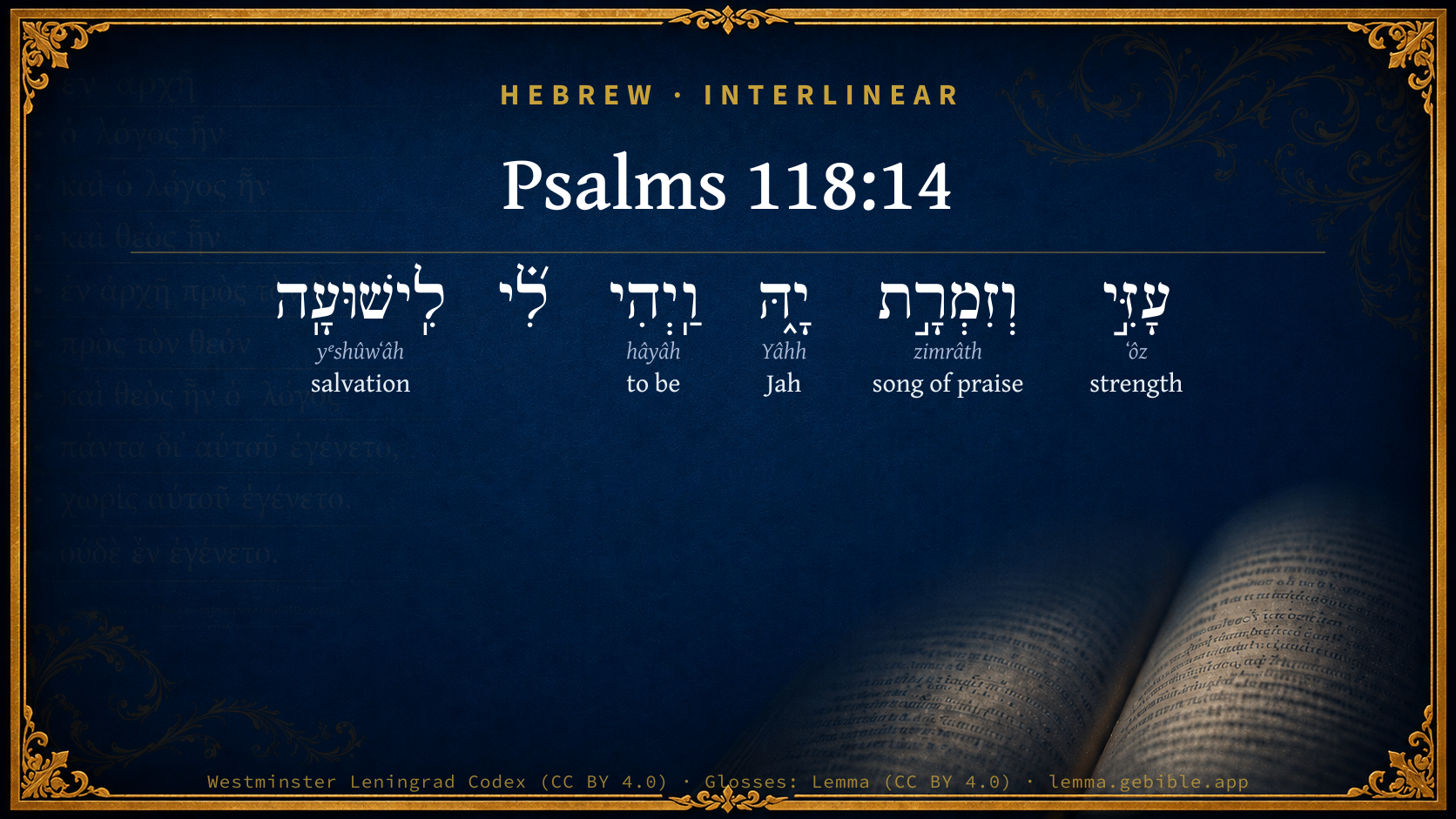
Psalms 118:14

Hebrew (Westminster Leningrad Codex) Psalms 118:14 appears in the Hebrew Old Testament. The text above is from the Westminster Leningrad Codex. Each word links to its Strong’s number, a concise gloss, and parsing drawn from the Open Scriptures Hebrew Bible morphology. Click any word for its full Brown-Driver-Briggs (BDB) entry.
Download image
Cite this verse

Psalms 118:14 (World English Bible). Public Domain. Lemma interlinear Bible study tool, https://lemma.gebible.app/v/psalms/118/14.

Show BibTeX & RIS
BibTeX
RIS
English Translation
Yah is my strength and song. He has become my salvation.
World English Bible · Public Domain
Download a study sheet

One document with this verse’s original text, its word-by-word gloss line, the meaning frame, cross-references with their text, attributed commentary, and full source and license credits — printable, and it pastes into notes with its structure intact.

This verse Autodidact and up

Study sheet (.html) Plain text (.txt)

A passage Seminary Student

Up to 50 verses in one chapter. A passage sheet keeps up to 6 commentary sources and 12 cross-references per verse, in the order this page ranks them, and says so on the sheet whenever that leaves anything out. Ask for a single verse and you get the Autodidact verse sheet above.

Everything on this page stays free to read, with no account — the sheet is a download of what is already on screen, not access to it.

Want to remove ads? Support Godless Engineer
Compare translations 3

The same verse in 3 English versions, stacked beneath the original-language interlinear above. Click any original word for its lexicon entry.

Each is an independent rendering of the whole verse — the interlinear is not word-aligned to these translations.

Highlighted words mark where these versions differ — a whole-verse word diff, not a word-by-word alignment.

  • World English Bible Public Domain
    Yah is my strength and song. He has become my salvation.
  • King James Version Public Domain
    The LORD is my strength and song, and is become my salvation.
  • unfoldingWord Literal Text CC BY-SA 4.0
    Yah my strength and song, and he is to me for salvation.

unfoldingWord Literal Text — © unfoldingWord, licensed CC BY-SA 4.0. Word-aligned USFM3 via Door43 (git.door43.org/unfoldingWord/en_ult).

Versions to compare (up to 4)

3 of 4 selected

Show all 18 translations

Every available English version of this verse, each an independent rendering of the whole verse.

  • World English Bible Public Domain
    Yah is my strength and song. He has become my salvation.
  • Berean Standard Bible Public Domain
    The LORD is my strength and my song, and He has become my salvation.
  • Majority Standard Bible Public Domain
    The LORD is my strength and my song, and He has become my salvation.
  • King James Version Public Domain
    The LORD is my strength and song, and is become my salvation.
  • American Standard Version (1901) Public Domain
    Jehovah is my strength and song; And he is become my salvation.
  • Revised Version (1885) Public Domain
    The LORD is my strength and song; and he is become my salvation.
  • Geneva Bible (1599) Public Domain
    The Lord is my strength and song: for he hath beene my deliuerance.
  • Douay-Rheims (1899) Public Domain
    The Lord is my strength and my praise: and he is become my salvation.
  • Young's Literal Translation Public Domain
    My strength and song `is' Jah, And He is to me for salvation.
  • Literal Standard Version CC BY-SA 4.0
    YAH is my strength and song, || And He is to me for salvation.
  • Unlocked Literal Bible CC BY-SA 4.0
    Yahweh is my strength and joy, and he is the one who rescues me.
  • unfoldingWord Literal Text CC BY-SA 4.0
    Yah my strength and song, and he is to me for salvation.
  • Darby Bible Public Domain
    My strength and song is Jah, and he is become my salvation.
  • World Messianic Bible Public Domain
    The LORD is my strength and song. He has become my salvation [yeshu`ah].
  • Webster's Bible Public Domain
    The LORD is my strength and song, and is become my salvation.
  • Free Bible Version CC BY-SA 4.0
    The Lord is my strength, and the one I sing about. He is the one who saves me.
  • Bible in Basic English Public Domain
    The Lord is my strength and my song; he has become my salvation.
  • JPS Tanakh (1917) Public Domain
    The LORD is my strength and song; and He is become my salvation.

Literal Standard Version (2020), Covenant Press — licensed CC BY-SA 4.0. Text via the HelloAO Bible API (eBible.org). Unlocked Literal Bible (unfoldingWord) — licensed CC BY-SA 4.0. Text via the HelloAO Bible API (eBible.org). unfoldingWord Literal Text — © unfoldingWord, licensed CC BY-SA 4.0. Word-aligned USFM3 via Door43 (git.door43.org/unfoldingWord/en_ult). Free Bible Version, Dr. Jonathan Gallagher — licensed CC BY-SA 4.0. Text via the HelloAO Bible API (eBible.org).

Word by word

More ways to search: Search by grammar → Find every occurrence → Compare this word →

Practice this passage: Drill this verse → Learn its vocabulary →

About this verse

These counts appear in no published source. They are computed here, from the morphology-tagged text and Lemma’s own curated glosses. What Lemma adds →

6
words
5
distinct lemmas
Wisdom
section

Notable vocabulary

The rarest word here is וְזִמְרָ֣ת song of praise H2176 — appearing just 3 times in the whole Hebrew Bible.

Shared distinctive vocabulary

וְזִמְרָ֣ת song of praise H2176 occurs in 3 verses of the Hebrew Bible. Also found in:

Grammatical profile

  • 1 verb
  • 4 nouns
  • 1 preposition

Verb forms

  • וַֽיְהִי Qal · Sequential Imperfect

Hebrew & Septuagint length

In English translation the verse runs 11 words from the Hebrew and 13 from the Septuagint (LXX English) — closely comparable.

A rough comparison of the two English renderings, which tokenize alike — not a word-level alignment.

Word counts can differ between the Hebrew and the Greek without any difference in meaning — e.g. the Hebrew direct-object marker אֵת has no separate Greek word, and Greek often adds the article ὁ.

Cross-references

7

Topical passages linked to Psalms 118:14 in the Treasury of Scripture Knowledge — connected by theme and wording, ordered by reader-vote popularity; previews shown in the World English Bible.

  • Isaiah 12:2 Behold, God is my salvation. I will trust, and will not be afraid; for Yah, Yahweh, is my strength and song; and he has become my salvation."
  • Psalms 18:2 Yahweh is my rock, my fortress, and my deliverer; My God, my rock, in whom I take refuge; My shield, and the horn of my salvation, my high tower.
  • Exodus 15:2–6 Yah is my strength and song, He has become my salvation: This is my God, and I will praise him; My father's God, and I will exalt him.
  • Psalms 27:1 Yahweh is my light and my salvation. Whom shall I fear? Yahweh is the strength of my life. Of whom shall I be afraid?
  • Matthew 1:21–23 She shall bring forth a son. You shall call his name Jesus, for it is he who shall save his people from their sins."
  • Isaiah 45:17 [But] Israel shall be saved by Yahweh with an everlasting salvation: you shall not be disappointed nor confounded world without end.
  • Isaiah 45:22–25 Look to me, and be you saved, all the ends of the earth; for I am God, and there is none else.

Cross-references courtesy of OpenBible.info (CC BY 4.0).

Hebrew and Greek witnesses Masoretic Hebrew ↔ Greek Septuagint

The same verse in the two great witnesses to the Old Testament, shown verse-for-verse.

You’re reading Greek Psalm 117 (Hebrew Psalm 118). The Septuagint counts the superscription, so verse numbers can differ from the Hebrew — chapter-level alignment, not verse-by-verse. Numbering follows Rahlfs.

These are two independent witnesses, not word-aligned to each other, and the Septuagint is shown in lemma (dictionary) form.

Hebrew Psalms 118:14 Masoretic · Westminster Leningrad Codex

עָזִּ֣י וְזִמְרָ֣ת יָ֑הּ וַֽיְהִי לִ֝֗י לִֽישׁוּעָֽה

Yah is my strength and song. He has become my salvation.

World English Bible · Public Domain

Greek LXX Greek Psalm 117:14 Septuagint · lemma form

ἰσχύς ἐγώ καί ὕμνησις ἐγώ ὁ κύριος καί γίγνομαι ἐγώ εἰς σωτηρία

The Lord is my strength and my song, and is become my salvation.

LXX2012 (modern English Septuagint) · Public Domain

Hebrew: Westminster Leningrad Codex (CC BY 4.0). Greek: Septuagint (public domain); English from LXX2012 (modern English Septuagint) (Public Domain). How the Septuagint differs from the Hebrew →

Commentary

Notes on Psalms 118:14 from classic Christian and Jewish commentators (each source and its license shown beneath its notes). The classic Christian expositions comment on the surrounding passage and are grouped to its opening verse, so a note may address several verses; the Jewish commentaries on the Tanakh (Rashi and others) are per-verse, so they appear only where the commentator wrote on this verse.

Lemma curates 59 commentaries, every one of them public domain or Creative Commons licensed, each selected and text-cleaned for this edition rather than reprinted as found. About our sources →

Trapp's Complete Commentary

John Trapp

Psa 118:14 The LORD [is] my strength and song, and is become my salvation.

Ver. 14. The Lord is my strength and song] i.e. The matter of my song, and mean of my joy. Trust in God shall once triumph.

John Trapp, A Commentary or Exposition upon All the Books of the Old and New Testament (1647–1656) — public domain. Text from a community e-Sword module.

The Biblical Illustrator

Joseph S. Exell

Psa_118:14-18

The Lord is my strength and song, and is become my salvation.

God and man

I. How God should be realized by every man. What should He be to every many

1. He should be his strength. All the strength we have, physical, intellectual, and moral is from God; nay, more, is Gods. Conscious dependence upon His strength is the foundation of piety. Hold thou me up, and I shall be saved.

2. He should be his song; that is, his joy. The source of all his joy and spring of his delights. We should rejoice in God as our Father.

3. He should be his salvation. He saves from misery by saving from sin.

II. How God is enjoyed by the righteous. Who is the righteous man? The man who is right in himself and right in relation to God and the universe.

1. Such a man has rejoicing. Being justified, or made right by faith; he has peace that passeth all understanding. Religion is happiness wherever it exists.

2. Such a man has salvation. A righteous man is saved--saved from sin, and to be saved from sin, is to be saved from all evils of all kinds.

III. How God appears in His procedure.

1. Courageous (verse 16). He moves on in the execution of His eternal purposes with absolute fearlessness. Of what can He be afraid, whose will can at any moment create or destroy universes?

2. Glorious. The right hand of the Lord is exalted. That is, praised, hououred, adored. Who that studies His works, whether the minute or the vast can fail to exalt and adore the right hand of the Lord? 3.Restorative (verses 17, 18). (Homilist.)

Christ is our song

I. In what sense Christ is a believers song.

1. He is the main object of hope and trust (Isa_12:2).

2. He is the main subject of praise and thanksgiving (2Co_9:15).

3. He is the main matter of joy and rejoicing (Psa_137:6; Psa_43:4). Three things are necessary.

(1) An interest in Him as our Saviour.

(2) The knowledge of that interest.

(3) Suitable walking.

II. What of Christ especially is a believers song? True believers sing, and ought to sing--

1. Of what Jesus Christ is in Himself as to His personal excellences and perfections.

2. Of what He is to us. He is our foundation, our food, our root, our raiment; and should we not sing of these?

3. Of what He hath done, and is doing, and will yet do, for us.

(1) He hath taken our nature upon Him, and in our nature suffered and died; He hath washed us from our sins in His own blood; called us with a holy calling; begun a good work.

(2) Is He not ever living to make intercession for us? Is He not guiding and guarding us, enlightening and comforting us, every day?

(3) He will perform the good work that He hath begun; He will come again and fetch us to Himself, that where He is there we may be also. Can ye name any other to sing of, that hath done the like for you?

III. What are the properties of this song?

1. He is the angels song (Job_38:7; Luk_2:13-14).

2. He is the most ancient song; the song of the ancients. They sung of Him as one to come, for they saw Him, though it was but as through the lattices, or as through a glass darkly.

3. He is the new song. Wherever ye read of a new song in Scripture, it points at Him (Psa_33:3; Psa_96:1; Psa_98:1; Psa_149:1). He is the New Testament song. Ever since His coming in the flesh all His saints have been singing of Him, as of one already come; rejoicing in Him, and showing forth His praises. As fast, as they have been made new creatures they have learned this new song.

4. He is their night song (Psa_42:8; Job_35:10).

(1) In the night season, when others are sleeping, true believers are rejoicing in God their Redeemer, and solacing themselves in Him (Psa_149:5; Son_1:13; Act_16:1-40.) Paul and Silas sang at midnight.

(2) In the night of sorrow and affliction. To be able to sing then, when everything looks sad and sorrowful round about us, is a great matter; as David (1Sa_30:6)

5. He is their song all the week, and their song on the Sabbath. We are bid to rejoice in the Lord always, every day, and they that have an interest in Christ, and know it, do so; but especially on Sabbath days (Psa_118:24). Sabbath days are set apart on purpose.

6. He is their song while they live, and their song when they die. While they live, in all the turns of their lives (Psa_146:2). And in a special manner when they come to die; upon sick-beds, and death-beds. As it is said of the swan, that she sings sweetest when dying, so it is with many of Gods people. At the death of Mr. John Janeway, one present said he never was in a room where God in Christ had more praises than there at that time.

7. He is their song in the world, and will he their song to eternity. What is the great employment of heaven, and what will it be for ever and ever, but to lift up God-redeemer (Rev_5:9-13). Jesus Christ is to be our everlasting song (Isa_35:10). It is good to be found doing that, now that we would be glad to be found doing hereafter--world without end.

IV. Application.

1. This may serve for an examining sign, or mark of trial, whereby to know what we are as to our spiritual state and condition. We are bid to try ourselves (2Co_13:5). What, is Jesus Christ to us? What think we of Him? Hath He ever been our song? Do we rejoice in Him?

2. Here is a word of reproof to the true believers among us, that do not make Christ their song, that are in Him, but do not rejoice in Him; however, not with evenness and constancy, not in that measure and degree, that they should and ought. Thou shouldst chide thyself for it (Psa_43:5).

(1) It grieves the Spirit of God.

(2) It blemishes the ways of God; makes thee a stumbling-block to them that are without, like the evil spies.

(3) It is weakening to thyself. The more Christ is our song the more is our strength (Neh_8:10). Then search out the cause.

3. Exhortation, to all that call themselves believers. Make Christ your song, week days and Sabbath days.

(1) He is worthy that you should.

(2) The gain of it will be thy own, in present comfort, in eternal recompense. (Philip Henry.)

Making God our song

Instead of waiting until you get sick and worn out before you speak the praise of Christ, while your heart is happiest, and your step is lightest, and your fortune smiles, and your pathway blossoms, and the overarching heavens drop upon you their benediction, speak the praises of Jesus. The old Greek orators, when they saw their audiences inattentive and slumbering, had one word with which they would rouse them up to the greatest enthusiasm. In the midst of their orations they would stop and cry out: Marathon! and the peoples enthusiasm would be unbounded. My hearers, though you may have been borne down with sin, and though trouble, and trial, and temptation may have come upon you, and you feel to-night hardly like looking up, methinks there is one grand, royal, imperial, word that ought to rouse, your soul to infinite rejoicing, and that word is Jesus. (T. De Witt Talmage.)

The Biblical Illustrator, edited by Joseph S. Exell (c. 1880s–1900s) — public domain. Text from a community e-Sword module.

J. A. Alexander on Psalms

Joseph Addison Alexander

14. (Psa 118:14) My strength and song (is) Jah, and he has become my salvation. These words are from Exo 15:2. The first clause is also borrowed by Isaiah (Isa 12:2). My strength and song, my protection or deliverer, and as such the object of my praise. Become my salvation, literally has been to me for salvation, a stranger though synonymous expression for my saviour.

Joseph Addison Alexander, The Psalms Translated and Explained (1850) — public domain. Text from a community e-Sword module.

Tyndale Open Study Notes

Tyndale Open Resources

118:14-18 The psalmist celebrates the victory of the Lord’s strong right arm, which kept him from death.

Tyndale Open Study Notes — © Tyndale Open Resources, licensed CC BY-SA 4.0. Text via the HelloAO Bible API.

Geneva Bible (1599)

Geneva Bible translators

In that he was delivered, it came not of himself, nor of the power of man, but only of God’s favor, therefore he will praise him.

Geneva Bible (1599) marginal notes — public domain. Text via Bolls.life.

Ellicott's Commentary for English Readers

(14) Thou hast.—Better, Thou didst thrust and thrust at me. This sudden change of person and challenge of the foes themselves is very dramatic.

A Bible Commentary for English Readers, edited by Charles John Ellicott (1878–1897) — public domain. Text from a community e-Sword module.

The Cambridge Bible for Schools and Colleges

gen. ed. J. J. S. Perowne

14. The words, taken from the Song of Moses (Exo_15:2; cp. Isa_12:2) recall the memory of Israel’s greatest deliverance, and imply that He Who brought them out of Egypt is still their Deliverer.

The Cambridge Bible for Schools and Colleges (gen. ed. J. J. S. Perowne; Cambridge University Press, 1878–1918) — public domain. Text from a community e-Sword module.

John Gill's Exposition

The right hand of the Lord is exalted,.... Lifted up, very eminent and conspicuous, easily to be observed in the instances before given, and become great and glorious in power; see Exo 15:6. The power of God is superior to all enemies; and is beyond conception and expression; and is able to do for his people above all they are able to ask or think;

the right hand of the Lord doth valiantly: or "acts powerfully". This is repeated for the confirmation of it, and to show how much the righteous were affected with it, and how desirous they were of glorifying of it; "the right hand of the Lord", being three times mentioned, may have respect to the three divine Persons in the Godhead, whose right hand or power is the same: and as the right hand of the Father has done powerfully in the instances given, so the right hand of the Son has worked mightily in vanquishing all enemies, sin, Satan, death, and the world; in obtaining the salvation of his people, and in raising himself from the dead: and so the right hand of the Holy Spirit has wrought powerfully on Christ, on whom he rested as the Spirit of might, and through whom Christ offered himself to God, and by whom he was raised from the dead; and also in the conversion of sinners, and in helping, assisting, strengthening, and protecting the saints.

John Gill's Exposition of the Whole Bible (1746–1763) — public domain (CC PDM 1.0). Text via the HelloAO Bible API.

Albert Barnes' Notes on the Bible

The Lord is my strength and song - He is the source of strength to me; and he is the subject of my praise. There is no ground of praise in myself for anything that I have done, but all is due to him.

And is become my salvation - He has saved me. I live because he preserved me. So we shall be saved in heaven solely because he saves us, and there, more than can be possible here, we shall say, “God is our strength and our song, and is become our salvation.”

Albert Barnes' Notes on the Bible (1834–1885) — public domain. Text from a community e-Sword/MySword module.

Matthew Poole's English Annotations

My strength and song; the author of my strength, and therefore the just object of my song and praise. My salvation, i.e. my Saviour.

Matthew Poole's English Annotations on the Holy Bible (1683–1685) — public domain. Text from a community e-Sword/MySword module.

The Treasury of David

Charles H. Spurgeon

Ver. 14. The LORD my strength and song, my strength while I was in the conflict, my song now that it is ended; my strength against the strong, and my song over their defeat. He is far from boasting of his own valour; he ascribes his victory to its real source, he has no song concerning his own exploits, but all his peans are unto Jehovah Victor, the Lord whose right hand and holy arm had given him the victory.

And is become my salvation. The poet warrior knew that he was saved, and he not only ascribed that salvation unto God, but he declared God himself to be his salvation. It is an all comprehending expression, signifying that from beginning to end, in the whole and in the details of it, he owed his deliverance entirely to the Lord. Thus can all the Lord's redeemed say, "Salvation is of the Lord." We cannot endure any doctrine which puts the drown upon the wrong head and defrauds the glorious King of his revenue of praise. Jehovah has done it all; yea; in Christ Jesus he is all, and therefore in our praises let him alone be extolled. It is a happy circumstance for us when we can praise God as alike our strength, song, and salvation; for God sometimes gives a secret strength to his people, and yet they question their own salvation, and cannot, therefore, sing of it. Many are, no doubt, truly saved, but at times they have so little strength, that they are ready to faint, and therefore they cannot sing: when strength is imparted and salvation is realised then the song is clear and full.

Ver. 14. The LORD is my strength and song, and as become my salvation. "My strength, "that I am able to resist my enemies; "my salvation, "that I am delivered from my enemies; "my song, "that I may joyfully praise him and sing of him after I am delivered. William Nicholson, 1662.

Ver. 14. Good songs, good promises, good proverbs, good doctrines are none the worse for age. What was sung just after the passage of the Red Sea, is here sung by the prophet, and shall be sung to the end of the world by the saints of the Most High. William S. Plumer.

Ver. 14. And is become my salvation. Not that he hath become anything which he was not before, but because his people, when they believed on him, became what they were not before, and then he began to be salvation unto them when turned towards him, which he was not to them when turned away from himself. Augustine.

Ver. 14.

1. Strength under affliction.

2. Song in hope of deliverance.

3. Salvation, or actual escape out of trial.

Psalms 118:15*

Charles H. Spurgeon's The Treasury of David (1869–1885) — public domain. Psalms only. Text from a community e-Sword/MySword module.

Whedon's Commentary on the Bible

Daniel D. Whedon

14. The Lord is my strength—Borrowed from the song at the Red Sea.

Exo_15:2

Daniel D. Whedon (gen. ed.), Commentary on the Old and New Testaments (1874–1909) — public domain. Text from a community e-Sword module.

The Pulpit Commentary

The Lord is my strength and my song, and is become my salvation. The deliverance was such that no words but those of the Song of Moses (Exo_15:2) could fitly celebrate it.

The Pulpit Commentary (1880–1919), ed. H.D.M. Spence-Jones & Joseph S. Exell — public domain. Text from a community e-Sword module.

John Wesley's Explanatory Notes

Salvation - My saviour.

John Wesley, Explanatory Notes Upon the Whole Bible (1754–1765) — public domain. Text via the GEBible commentary corpus.

Rashi

Rabbi Shlomo Yitzchaki (Rashi)

The might and the cutting power of God was my salvation Heb. עזי וזמרת, the might of the Holy One, blessed be He, was my salvation. עזי has a superfluous “yud” because we do not [usually] find עזי vowelized with a short “kamatz” instead of a “shuruk,” except in three places, where it is next to וזמרת, and perforce is attached to the word denoting the name of God. You cannot explain it as “my praise.” Do not wonder about ויהי לי, that he did not say היה לי לישועה, for there are many like these in Scripture, [e.g.] (Exod. 9:21): “And whoever did not pay attention...left (ויעזב) his slaves, etc.” He should have written עַזָב.

Rashi on the Tanakh — English translations: “The Judaica Press complete Tanach with Rashi, translated by A. J. Rosenberg” (CC BY 4.0); “Pentateuch with Rashi's commentary by M. Rosenbaum and A.M. Silbermann, 1929-1934” (public domain); “The Metsudah Tanach series, Lakewood, N.J” (CC BY 4.0); and “The Book of Joshua, Metsudah Publications, 1997” (CC BY 4.0). Text via Sefaria.

Lesson kit

Teaching starters — assembled from the data on this page, not authored interpretation. Every prompt links to the verse data it draws on. Edit before teaching.

Psalms, in the Wisdom, opens this verse with 6 words (5 distinct Hebrew lemmas). Its most distinctive word is zimrâth (“song of praise”). A historical commentator’s framing appears above. Read the whole chapter for the surrounding context.

Discussion questions

  1. How does “song of praise” (zimrâth) shape what this verse is saying?
  2. How does Exodus 15:2, which shares the word «song of praise», read alongside this verse?
  3. The translations on this page render this verse differently — a whole-verse word diff, not a word-by-word alignment. What might account for the different wordings?
  4. «וַֽיְהִי» is a Qal Sequential Imperfect verb. How does that grammatical form shape the action described?
  5. Compare how Trapp's Complete Commentary and The Biblical Illustrator read this verse. Where do they agree or differ?

Things to notice

Reading settings

Reading text

Shown beneath each verse's original-language words.

Old Testament
Old Testament edition

Read the OT as the Masoretic Hebrew (MT) or the Greek Septuagint (LXX).

English shown for the Greek Septuagint (in the Hebrew ↔ Greek comparison).

Comparing translations? Open the Compare panel on any verse page to stack up to four side by side.