Psalms 30:7

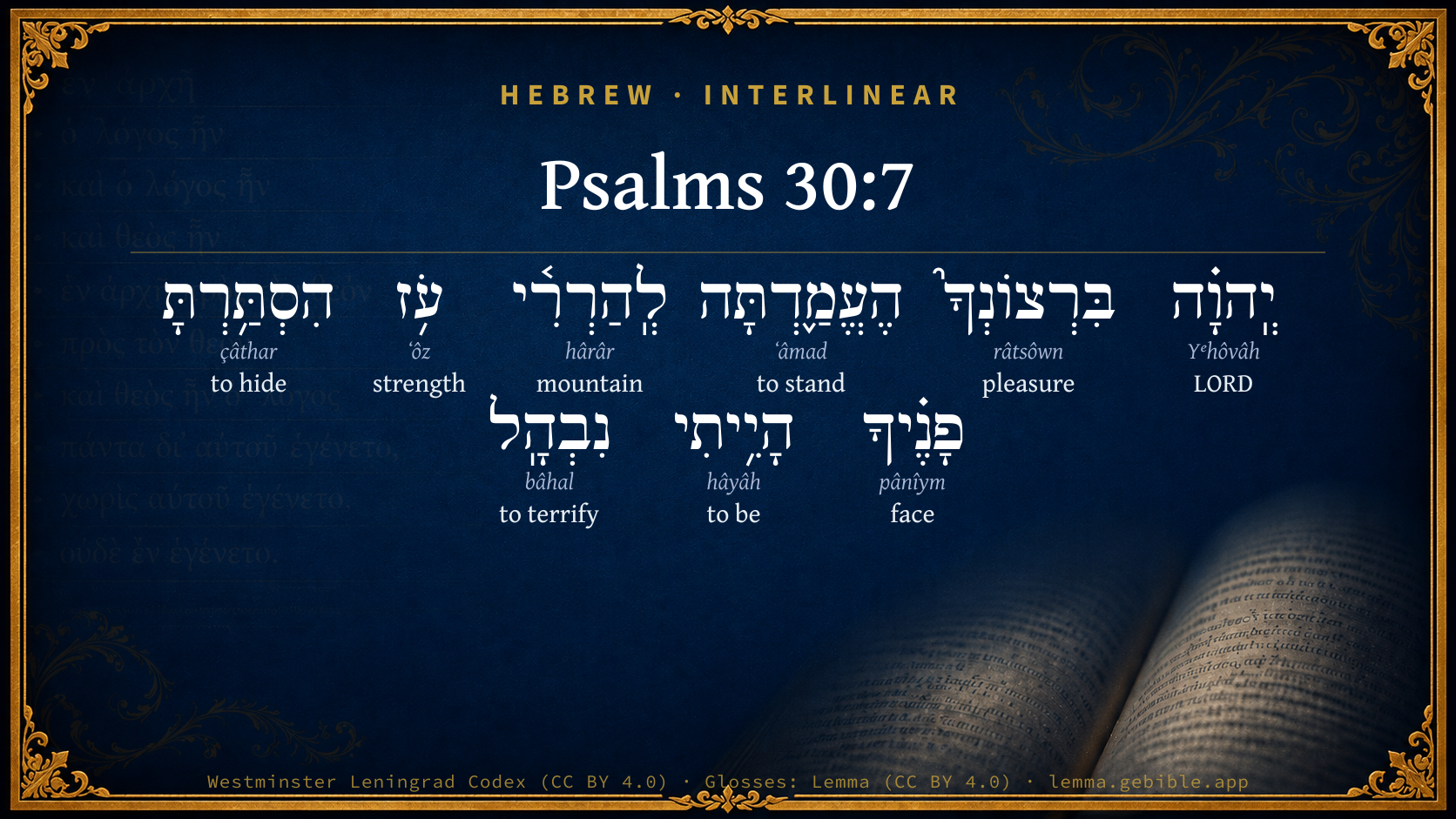
Hebrew (Westminster Leningrad Codex) Psalms 30:7 appears in the Hebrew Old Testament. The text above is from the Westminster Leningrad Codex. Each word links to its Strong’s number, a concise gloss, and parsing drawn from the Open Scriptures Hebrew Bible morphology. Click any word for its full Brown-Driver-Briggs (BDB) entry.
Download image
Cite this verse

Psalms 30:7 (World English Bible). Public Domain. Lemma interlinear Bible study tool, https://lemma.gebible.app/v/psalms/30/7.

Show BibTeX & RIS
BibTeX
RIS
English Translation
You, Yahweh, when you favored me, made my mountain to stand strong. But when you hid your face, I was troubled.
World English Bible · Public Domain
Download a study sheet

One document with this verse’s original text, its word-by-word gloss line, the meaning frame, cross-references with their text, attributed commentary, and full source and license credits — printable, and it pastes into notes with its structure intact.

This verse Autodidact and up

Study sheet (.html) Plain text (.txt)

A passage Seminary Student

Up to 50 verses in one chapter. A passage sheet keeps up to 6 commentary sources and 12 cross-references per verse, in the order this page ranks them, and says so on the sheet whenever that leaves anything out. Ask for a single verse and you get the Autodidact verse sheet above.

Everything on this page stays free to read, with no account — the sheet is a download of what is already on screen, not access to it.

Want to remove ads? Support Godless Engineer
Compare translations 3

The same verse in 3 English versions, stacked beneath the original-language interlinear above. Click any original word for its lexicon entry.

Each is an independent rendering of the whole verse — the interlinear is not word-aligned to these translations.

Highlighted words mark where these versions differ — a whole-verse word diff, not a word-by-word alignment.

  • World English Bible Public Domain
    You, Yahweh, when you favored me, made my mountain to stand strong. But when you hid your face, I was troubled.
  • King James Version Public Domain
    LORD, by thy favour thou hast made my mountain to stand strong: thou didst hide thy face, and I was troubled.
  • unfoldingWord Literal Text CC BY-SA 4.0
    Yahweh, by your favor you have made my mountain stand strong; you hid your face, I was dismayed.

unfoldingWord Literal Text — © unfoldingWord, licensed CC BY-SA 4.0. Word-aligned USFM3 via Door43 (git.door43.org/unfoldingWord/en_ult).

Versions to compare (up to 4)

3 of 4 selected

Show all 18 translations

Every available English version of this verse, each an independent rendering of the whole verse.

  • World English Bible Public Domain
    You, Yahweh, when you favored me, made my mountain to stand strong. But when you hid your face, I was troubled.
  • Berean Standard Bible Public Domain
    O LORD, You favored me; You made my mountain stand strong. When You hid Your face, I was dismayed.
  • Majority Standard Bible Public Domain
    O LORD, You favored me; You made my mountain stand strong. When You hid Your face, I was dismayed.
  • King James Version Public Domain
    LORD, by thy favour thou hast made my mountain to stand strong: thou didst hide thy face, and I was troubled.
  • American Standard Version (1901) Public Domain
    Thou, Jehovah, of thy favor hadst made my mountain to stand strong: Thou didst hide thy face; I was troubled.
  • Revised Version (1885) Public Domain
    Thou, LORD, of thy favour hadst made my mountain to stand strong: thou didst hide thy face; I was troubled.
  • Geneva Bible (1599) Public Domain
    For thou Lord of thy goodnes hadest made my mountaine to stande strong: but thou didest hide thy face, and I was troubled.
  • Douay-Rheims (1899) Public Domain
    And in my abundance I said: I shall never be moved.
  • Young's Literal Translation Public Domain
    O Jehovah, in Thy good pleasure, Thou hast caused strength to remain for my mountain,' Thou hast hidden Thy face -- I have been troubled.
  • Literal Standard Version CC BY-SA 4.0
    O YHWH, in Your good pleasure, || You have caused strength to remain for my mountain,” || You have hidden Your face—I have been troubled.
  • Unlocked Literal Bible CC BY-SA 4.0
    Yahweh, by your favor you established me as a strong mountain; but when you hid your face, I was troubled.
  • unfoldingWord Literal Text CC BY-SA 4.0
    Yahweh, by your favor you have made my mountain stand strong; you hid your face, I was dismayed.
  • Darby Bible Public Domain
    Jehovah, by thy favour thou hadst made my mountain to stand strong: thou didst hide thy face; I was troubled.
  • World Messianic Bible Public Domain
    You, LORD, when you favored me, made my mountain stand strong; but when you hid your face, I was troubled.
  • Webster's Bible Public Domain
    \\30:6\\And in my prosperity I said, I shall never be moved.
  • Free Bible Version CC BY-SA 4.0
    Lord, when you showed me your favor I stood as strong as a mountain; when you turned away from me I was terrified.
  • Bible in Basic English Public Domain
    Lord, by your grace you have kept my mountain strong: when your face was turned from me I was troubled.
  • JPS Tanakh (1917) Public Domain
    (30-8) Thou hadst established, O LORD, in Thy favour my mountain as a stronghold — Thou didst hide Thy face; I was affrighted.

Literal Standard Version (2020), Covenant Press — licensed CC BY-SA 4.0. Text via the HelloAO Bible API (eBible.org). Unlocked Literal Bible (unfoldingWord) — licensed CC BY-SA 4.0. Text via the HelloAO Bible API (eBible.org). unfoldingWord Literal Text — © unfoldingWord, licensed CC BY-SA 4.0. Word-aligned USFM3 via Door43 (git.door43.org/unfoldingWord/en_ult). Free Bible Version, Dr. Jonathan Gallagher — licensed CC BY-SA 4.0. Text via the HelloAO Bible API (eBible.org).

Word by word

More ways to search: Search by grammar → Find every occurrence → Compare this word →

Practice this passage: Drill this verse → Learn its vocabulary →

לְֽהַרְרִ֫י
hârâr
H2042
“to/for · mountain · my”
Preposition + Noun, Common, Masculine, Singular, Construct + Suffix, Personal, 1st Person, Common, Singular
Part of Speech
Preposition + Noun
Type
Common
Gender
Masculine
Number
Singular
State
Construct
Full BDB Definition

Origin: from an unused root meaning to loom up

TWOT: 517

mountain, hill, hill country, mount
  1. יְֽהוָ֗ה Yᵉhôvâh H3068 “LORD” Noun, Proper
  2. בִּרְצוֹנְךָ֮ râtsôwn H7522 “in/at · pleasure · your” Preposition + Noun, Common, Masculine, Singular, Construct + Suffix, Personal, 2nd Person, Masculine, Singular
  3. הֶעֱמַ֪דְתָּה ʻâmad H5975 “to stand” Verb, Hiphil, Perfect, 2nd Person, Masculine, Singular
  4. עֹ֥ז ʻôz H5797 “strength” Noun, Common, Masculine, Singular, Absolute
  5. הִסְתַּ֥רְתָּ çâthar H5641 “to hide” Verb, Hiphil, Perfect, 2nd Person, Masculine, Singular
  6. פָנֶ֗יךָ pânîym H6440 “face(s) · your” Noun, Common, Both, Plural, Construct + Suffix, Personal, 2nd Person, Masculine, Singular
  7. הָיִ֥יתִי hâyâh H1961 “to be” Verb, Qal, Perfect, 1st Person, Common, Singular
  8. נִבְהָֽל bâhal H926 “terrifying” Verb, Niphal, Participle Active, Masculine, Singular, Absolute

About this verse

These counts appear in no published source. They are computed here, from the morphology-tagged text and Lemma’s own curated glosses. What Lemma adds →

9
words
9
distinct lemmas
Wisdom
section

Notable vocabulary

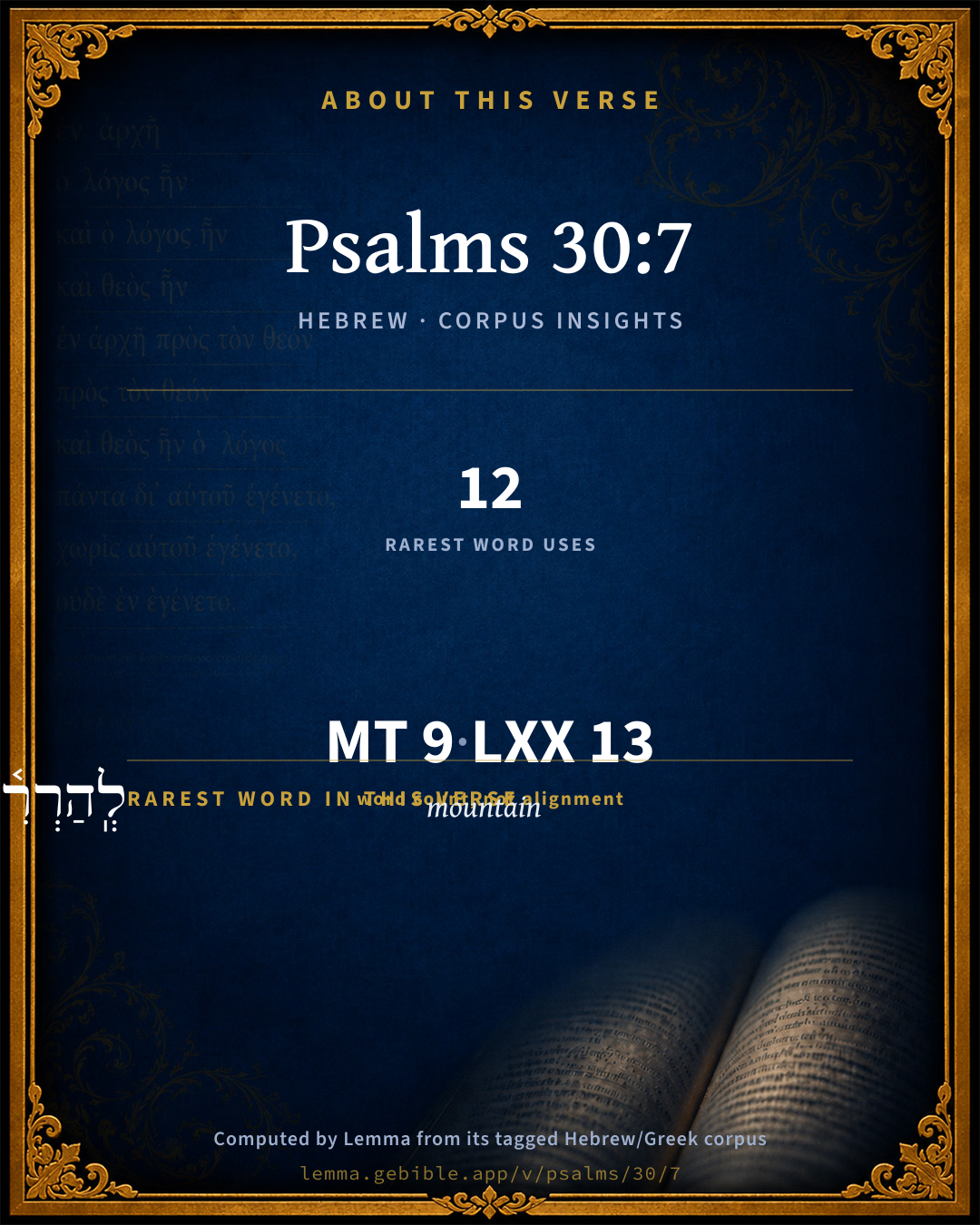
The rarest word here is לְֽהַרְרִ֫י mountain H2042 — appearing just 12 times in the whole Hebrew Bible.

Shared distinctive vocabulary

לְֽהַרְרִ֫י mountain H2042 occurs in 12 verses of the Hebrew Bible. Also found in:

Grammatical profile

  • 4 verbs
  • 5 nouns

Verb forms

  • הֶעֱמַ֪דְתָּה Hiphil · Perfect
  • הִסְתַּ֥רְתָּ Hiphil · Perfect
  • הָיִ֥יתִי Qal · Perfect
  • נִבְהָֽל Niphal · Participle Active

Hebrew & Septuagint length

In English translation the verse runs 21 words from the Hebrew and 24 from the Septuagint (LXX English) — closely comparable.

A rough comparison of the two English renderings, which tokenize alike — not a word-level alignment.

Word counts can differ between the Hebrew and the Greek without any difference in meaning — e.g. the Hebrew direct-object marker אֵת has no separate Greek word, and Greek often adds the article ὁ.

In the original languages it is 9 Hebrew tokens and 13 Greek tokens — but the two are counted differently (Hebrew bundles its prefixes and suffixes into one token; the Greek is in lemma form), so that isn’t a like-for-like length.

Cross-references

16

Topical passages linked to Psalms 30:7 in the Treasury of Scripture Knowledge — connected by theme and wording, ordered by reader-vote popularity; previews shown in the World English Bible.

  • Psalms 104:29 You hide your face: they are troubled; You take away their breath: they die, and return to the dust.
  • Psalms 143:7 Hurry to answer me, Yahweh. My spirit fails. Don't hide your face from me, So that I don't become like those who go down into the pit.
  • Psalms 30:5 For his anger is but for a moment; His favor is for a lifetime. Weeping may stay for the night, But joy comes in the morning.
  • Deuteronomy 31:17 Then my anger shall be kindled against them in that day, and I will forsake them, and I will hide my face from them, and they shall be devoured, and many evils and troubles shall come on them; so that they will say in that day, Haven't these evils come on us because our God is not among us?
  • 1 Chronicles 17:26–27 Now, Yahweh, you are God, and have promised this good thing to your servant:
  • Job 10:12 You have granted me life and loving kindness. Your visitation has preserved my spirit.
  • Psalms 5:12 For you will bless the righteous. Yahweh, you will surround him with favor as with a shield.
  • Psalms 40:2 He brought me up also out of a horrible pit, Out of the miry clay. He set my feet on a rock, And gave me a firm place to stand.
  • Psalms 89:17 For you are the glory of their strength. In your favor, our horn will be exalted.
  • Isaiah 38:17 Behold, [it was] for [my] peace [that] I had great bitterness: But you have in love to my soul delivered it from the pit of corruption; For you have cast all my sins behind your back.
  • Job 30:26–31 When I looked for good, then evil came; When I waited for light, there came darkness.
  • Psalms 10:1 Why do you stand far off, Yahweh? Why do you hide yourself in times of trouble?
  • Psalms 13:1–2 How long, Yahweh? Will you forget me forever? How long will you hide your face from me?
  • Psalms 18:35–36 You have also given me the shield of your salvation. Your right hand sustains me. Your gentleness has made me great.
  • Psalms 44:3 For they didn't get the land in possession by their own sword, Neither did their own arm save them; But your right hand, and your arm, and the light of your face, Because you were favorable to them.
  • Psalms 102:10 Because of your indignation and your wrath, For you have taken me up, and thrown me away.

Cross-references courtesy of OpenBible.info (CC BY 4.0).

Hebrew and Greek witnesses Masoretic Hebrew ↔ Greek Septuagint

The same verse in the two great witnesses to the Old Testament, shown verse-for-verse.

You’re reading Greek Psalm 29 (Hebrew Psalm 30). The Septuagint counts the superscription, so verse numbers can differ from the Hebrew — chapter-level alignment, not verse-by-verse. Numbering follows Rahlfs.

These are two independent witnesses, not word-aligned to each other, and the Septuagint is shown in lemma (dictionary) form.

Hebrew Psalms 30:7 Masoretic · Westminster Leningrad Codex

יְֽהוָ֗ה בִּרְצוֹנְךָ֮ הֶעֱמַ֪דְתָּה לְֽהַרְרִ֫י עֹ֥ז הִסְתַּ֥רְתָּ פָנֶ֗יךָ הָיִ֥יתִי נִבְהָֽל

You, Yahweh, when you favored me, made my mountain to stand strong. But when you hid your face, I was troubled.

World English Bible · Public Domain

Greek LXX Greek Psalm 29:7 Septuagint · lemma form

ἐγώ δέ εἶπον ἐν ὁ εὐθηνία ἐγώ οὐ μή σαλεύω εἰς ὁ αἰών

O Lord, in your good pleasure you did add strength to my beauty: but you did turn away your face, and I was troubled.

LXX2012 (modern English Septuagint) · Public Domain

On this verse, Ellicott's Commentary for English Readers discusses the Septuagint’s reading. Read the note in Commentary ↓

Hebrew: Westminster Leningrad Codex (CC BY 4.0). Greek: Septuagint (public domain); English from LXX2012 (modern English Septuagint) (Public Domain). How the Septuagint differs from the Hebrew →

Commentary

Notes on Psalms 30:7 from classic Christian and Jewish commentators (each source and its license shown beneath its notes). The classic Christian expositions comment on the surrounding passage and are grouped to its opening verse, so a note may address several verses; the Jewish commentaries on the Tanakh (Rashi and others) are per-verse, so they appear only where the commentator wrote on this verse.

Lemma curates 59 commentaries, every one of them public domain or Creative Commons licensed, each selected and text-cleaned for this edition rather than reprinted as found. About our sources →

Trapp's Complete Commentary

John Trapp

Psa 30:7 LORD, by thy favour thou hast made my mountain to stand strong: thou didst hide thy face, [and] I was troubled.

Ver. 7. Lord, by thy favour thou hast made my mountain, &c]. Yea, but there is no mountain so strong that may not be moved, if not removed with an earthquake. Is it not as easy with God to blast an oak as trample a mushroom? And what though God in his favour had settled strength to David’s mountain? what though he had constituted and established it sure as Mount Zion (for there was David’s arx, et aula regia) which cannot be removed, but abideth for ever? Psa 125:1; yet, by a turn of his countenance only, God can soon dissweeten all in his enjoyments, and plunge him into a deplorable condition.

Thou didst hide thy face, and I was troubled] i.e. Thou didst suspend the actual influence and communication of thy grace (the Chaldee calleth it Shechinah, the divine presence), and I was all death. The life of some creatures consisteth in the end; so doth that of the saints in the light of God’s countenance. And as in an eclipse of the sun there is a drooping in the whole face of nature, so when God hideth his face the good soul laboureth and languisheth. And as none look at the sun but when it is in the eclipse, so neither prize we God’s loving countenance till we have lost it.

John Trapp, A Commentary or Exposition upon All the Books of the Old and New Testament (1647–1656) — public domain. Text from a community e-Sword module.

The Biblical Illustrator

Joseph S. Exell

Psa_30:7

Thou didst hide Thy face, and I was troubled.

The withdrawal of the Divine presence

Of all the sources of sorrow to which a good man is exposed here, there is none whose waters are so bitter, nor whose grief is so poignant, as the withdrawal of the Divine presence. But there is one practical benefit to be derived from it; it affords additional evidence of our real state before God. If we can endure the absence of Gods favourable presence from our souls without sorrow, our love to Him cannot be genuine.

I. the extent of this withdrawal. We speak not of His withdrawal from the unconverted--but from the real child of God.

1. It does not include the withdrawal of His loving-kindness. Indeed, the very act of withdrawal is prompted by love.

2. It does not include the withdrawal of the real presence and indwelling of the Holy Spirit. The Spirit may not reflect the shining of Gods love upon the believers soul, and yet He may, at the same time, so work in his heart, as to make his faith lively; his desires strong; his conscience tender; and his life fruitful.

3. This withdrawal may be experienced indifferent degrees by different Christians, and by the same Christians at different times and under different circumstances. With some it is only a cloudy day; with others it is twilight, neither dark nor light; with some the Sun of Righteousness is overcast, with others He appears to be totally eclipsed.

II. when God may be said to hide his face.

1. When He does not interpose on their behalf, and though He sees them in trouble does not step forward to their relief.

2. When He removes from His people the symbols of His presence--the ordinances and sacraments of religion.

3. When His people do not prize the means of grace, and when their profiting does not appear.

4. When He denies His people access to Himself, and breaks off communion with them.

III. the reasons of this hiding.

1. When Christians commit gross sins, and bring a disgrace upon religion, then God hides His face from them, to show to them His displeasure, and to show to the world that the falls and sins of professors are not to be attributed to, neither to be charged upon, his religion.

2. When Christians become earthly-minded, and begin to prefer possessions, delights, and engagements of the world to Jesus and His great salvation, then God hides His face from them.

3. When Christians grow formal, cold, and lifeless in their religious duties, then God frequently hides His face from them. It is the lively, active, zealous, spiritual worshipper, with whom God has engaged to dwell.

4. When Christians neglect the great medium of access to God, the Lord Jesus Christ, then Jehovah resents the insult offered to His Son by hiding His face.

IV. the spirit to be exercised in these seasons of desertion. I was troubled. This implies:

1. That we are truly sensible of our loss, of our sin, and of the fearful consequences that must inevitably follow a continuance of this state of things.

2. That we recognize the presence of God as the only permanent source of comfort and happiness.

3. That we exert all the powers and faculties of our souls to recover the presence and favour of God. For this purpose we should use all the appointed means of grace. In all duties and ordinances our souls should follow hard after Him, and pursue Him closely from one ordinance to another till we find Him.

V. why Christians are thus troubled at the hiding of his face,

1. Because of the blessings they have lost.

2. Because of the positive evils that always attend this withdrawal of Gods favourable presence from the soul.

(1) Spiritual darkness.

(2) Spiritual deadness and insensibility.

(3) Failure in all spiritual duties.

(4) Barrenness of soul.

(5) Exposure to dangers and temptations.

(6) A dread of Gods displeasure.

(7) The fear of final rejection.

(8) Melancholy thought of death and judgment.

VI. practical lessons and cautions.

1. How few are true believers.

2. How awful is the condition of unconverted men.

3. How awful is the state of the backslider.

4. How happy are the people of God. (W. Gregory.)

The Biblical Illustrator, edited by Joseph S. Exell (c. 1880s–1900s) — public domain. Text from a community e-Sword module.

J. A. Alexander on Psalms

Joseph Addison Alexander

8. (Psa 30:7). Jehovah, in thy favour thou didst establish to my mountain strength; thou didst hide thy face, I was confounded. It was only through God's mercy that his power was established.—Thou didst confirm strength (literally, make it stand) to my mountain, a common figure for royal power, and especially for that of the theocracy, the central point of which was mount Zion. See 2Sa 5:9; 2Sa 5:12, Neh 3:15, Mic 4:8, Isa 2:3. The idea of personal prosperity in general, though not expressed directly, is suggested by the special case of David's official eminence. —Thou didst hide thy face, withdraw the tokens of thy presence and thy favour. See above, on Psa 13:2 (1). —I was confounded, agitated, terrified, perplexed. See above, on Psa 6:3-4 (2, 3), and compare Psa 2:5. The common version, troubled, is too weak.

Joseph Addison Alexander, The Psalms Translated and Explained (1850) — public domain. Text from a community e-Sword module.

Geneva Bible (1599)

Geneva Bible translators

After that thou hast withdrawn thine help, I felt my misery.

I thought thou hadst established me in Zion most surely.

Geneva Bible (1599) marginal notes — public domain. Text via Bolls.life.

Jamieson, Fausset & Brown

Robert Jamieson, A. R. Fausset & David Brown

troubled--confounded with fear (Psa 2:5).

Jamieson, Fausset & Brown — Commentary Critical and Explanatory on the Whole Bible (1871) — public domain (CC PDM 1.0). Text via the HelloAO Bible API.

Adam Clarke's Commentary

Verse 7. Thou didst hide thy face] Thou didst show thyself displeased with me for my pride and forgetfulness of thee: and then I found how vainly I had trusted in an arm of flesh.

Adam Clarke's Commentary on the Bible (1810–1826) — public domain. Text from a community e-Sword/MySword module.

John Calvin's Commentaries

7. O Jehovah! of thy good pleasure. This verse describes the difference which exists between the confidence which is founded upon the word of God and the carnal security which springs from presumption. True believers, when they rely upon God, are not on that account neglectful of prayer. On the contrary, looking carefully at the multitude of dangers by which they are beset, and the manifold instances of human frailty which pass before their eyes, they take warning from them, and pour out their hearts before God. The prophet now failed in duty as to this matter; because, by anchoring himself on his present wealth and tranquillity, or spreading his sails to the prosperous winds, he depended not on the free favor of God in such a manner as to be ready at any time to resign into his hands the blessings which he had bestowed upon him. The contrast should be observed between that confidence of stability which arises from the absence of trouble, and that which rests upon the gracious favor of God. When David says that strength was established to his mountain, some interpreters expound it of mount Zion. Others understand by it a stronghold or fortified tower, because in old time fortresses were usually built upon mountains and lofty places. I understand the word metaphorically to signify a solid support, and therefore readily admit that the prophet alludes to mount Zion. David thus blames his own folly, because he considered not, as he ought to have done, that there was no stability in the nest which he had formed for himself, but in God’s good will alone.

Thou hast hidden thy face. Here he confesses, that, after he was deprived of God’s gifts, this served to purge his mind as it were by medicine from the disease of perverse confidence. A marvellous and incredible method surely, that God, by hiding his face, and as it were bringing on darkness, should open the eyes of his servant, who saw nothing in the broad light of prosperity. But thus it is necessary that we be violently shaken, in order to drive away the delusions which both stifle our faith and hinder our prayers, and which absolutely stupify us with a soothing infatuation. And if David had need of such a remedy, let us not presume that we are endued with so good a state of heart as to render it unprofitable for us to be in want, in order to remove from us this carnal confidence, which is as it were diseased repletion which would otherwise suffocate us. We have, therefore, no reason to wonder, though God often hides his face from us, when the sight of it, even when it shines serenely upon us, makes us so wretchedly blind.

John Calvin's Commentaries (1540-1563) — public domain. Text from the Calvin Translation Society English edition (1840s-50s) via the Christian Classics Ethereal Library (ccel.org). Calvin's coverage is partial (roughly two-thirds of the Bible); uncommented books and verses are honest gaps, never fabricated. The 19th-century editor's footnotes and remarks are omitted so the notes are faithfully Calvin's own voice.

Ellicott's Commentary for English Readers

(7) Lord, by thy favour—i.e., and all the while thou (not my own strength) hadst made me secure. The margin gives the literal rendering, but the reading varies between the text “to my mountain,” “to my honour” (LXX., Vulg., and Syriac), and “on mountains,” the last involving the supply of the pronoun “me.” The sense, however, is the same, and is obvious. The mountain of strength, perhaps mountain fortress, is an image of secure retreat. Doubtless Mount Zion was in the poet’s thought.

Thou didst . . .—The fluctuation of feeling is well shown by the rapid succession of clauses without any connecting conjunctions.

A Bible Commentary for English Readers, edited by Charles John Ellicott (1878–1897) — public domain. Text from a community e-Sword module.

The Cambridge Bible for Schools and Colleges

gen. ed. J. J. S. Perowne

7. R.V., Thou, Lord, of thy favour hadst made my mountain to stand strong; lit. hadst established strength for my mountain. Zion, strong by position and art, may be thought of, partly in itself, partly as an emblem of the Davidic kingdom. Fortress and kingdom alike derived their real strength from Jehovah. Cp. 1Ki_15:4; 2Ch_9:8. But the reading is doubtful. The LXX, Vulg., and Syr. represent, hadst established strength for my majesty. The Targum, which rarely departs from the Massoretic Text, gives hadst made me stand upon strong mountains; a figure for security. Cp. Psa_18:33; Psa_27:5.

thou didst hide thy face] Withdrawing the light of thy favour. Then I was troubled (omit and which A.V. inserts): a strong word, expressing the confusion and helplessness of terror, as in Psa_6:2-3; Psa_6:10 (A.V. vexed); Psa_104:29.

The Cambridge Bible for Schools and Colleges (gen. ed. J. J. S. Perowne; Cambridge University Press, 1878–1918) — public domain. Text from a community e-Sword module.

John Gill's Exposition

Lord, by thy favour thou hast made my mountain to stand strong,.... The psalmist found himself mistaken, and acknowledges it; that as it was not owing to his own merit that he enjoyed the prosperity that he did, so neither was the continuance of it owing to his goodness, power, and strength, but to the free grace and favour of God; as the church of God is compared to a mountain, and the several individuals of believers are like to Mount Zion, so the soul of a child of God may be called his mountain, which is made strong by the Lord as to its state in Christ, being set on him, the Rock of ages, and sure foundation, where it is safe and secure; and as to its grace, whenever it is in any strong exercise, which is altogether owing to the favour of God, and continues as long as he pleases;

thou didst hide thy face, and I was troubled; the Lord may hide his face from his people, and yet their state be safe; their mountain stands strong in that respect; yet this generally produces a change of frames; it gives trouble, and faith and hope become feeble and languid in their acts and exercises; this shows the changeableness of frames, that they are not to be depended upon; that they are entirely owing to the pleasure of God, and that rejoicing only should be in him: very likely some regard is had to the affair of Absalom's rebellion, which came unawares, unthought of, when David was in the greatest prosperity and security.

John Gill's Exposition of the Whole Bible (1746–1763) — public domain (CC PDM 1.0). Text via the HelloAO Bible API.

Albert Barnes' Notes on the Bible

Lord, by thy favor thou hast made my mountain to stand strong - Margin: “settled strength for my mountain.” This refers, I apprehend, to his former state of mind; to his confidence in that which constituted his prosperity as referred to in the previous verse; to his feeling, in that state, that everything pertaining to himself was safe; to his freedom from any apprehension that there would be any change. The word “mountain” seems to be used as denoting that on which he relied as his security or strength, as the mountain, or the inaccessible hills, constituted a refuge and security in times of danger. See Psa 18:1-2, Psa 18:33; Psa 27:5. It does not refer to Mount Moriah, or Mount Zion, as some have supposed, for the passage relates to a former period of his life when these were not in his possession; but he speaks of himself as having, through the favor of God, put himself into a strong position - a position where he feared no enemy and no change; where he thought himself entirely secure - the state of “prosperity” to which he had referred in the previous verse. In that state, however, God showed him that there was no real security but in his favor: security not in what a man can draw around himself, but in the favor of God alone.

Thou didst hide thy face - That is, at the time when I was so confident, and when I thought my mountain stood so strong, and that I was so secure. Then I was shown how insecure and uncertain was all that I relied on, and how absolutely, after all that I had done, I was dependent for safety on God. To “hide the face” is synonymous in the sacred writings with the withdrawing of favor, or with displeasure. See the notes at Psa 13:1. Compare Psa 104:29.

And I was troubled - I was confounded, perplexed, agitated, terrified. I was thrown into sudden fear, for all that I had so confidently relied on, all that I thought was so firm, was suddenly swept away. We do not know what this was in the case of the psalmist. It may have been the strength of his own fortifications; it may have been the number and discipline of his army; it may have been his own conscious power and skill as a warrior; it may have been his wealth; it may have been his bodily health - in reference to any of which he may have felt as if none of these things could fail. When that on which he so confidently relied was swept away, he was agitated, troubled, anxious. The same thing may occur now, and often does occur, whenpeople rely on their own strength; their health; their wealth. Suddenly any of these may be swept away; suddenly they are often swept away, to teach such men - even good men - their dependence on God, and to show them how vain is every other refuge.

Albert Barnes' Notes on the Bible (1834–1885) — public domain. Text from a community e-Sword/MySword module.

Matthew Poole's English Annotations

Thou hast made my mountain to stand strong; thou hast so firmly settled me in my kingdom; which he calls his

mountain, partly because kingdoms are usually called mountains in prophetical writings, as Psa 46:3,4; Isa 2:2; Jer 51:25; Dan 2:34,35,44,45; and partly with respect to Mount Zion, where he built his royal palace, the dedication whereof is mentioned in the title of the Psalm.

Thou didst hide thy face, i.e. withdraw thy favour and help, and I was quickly brought into such distresses of body, and anxiety of mind, that I saw the vanity of all my carnal confidences.

Matthew Poole's English Annotations on the Holy Bible (1683–1685) — public domain. Text from a community e-Sword/MySword module.

The Treasury of David

Charles H. Spurgeon

Ver. 7. Lord, by thy favour thou hast made my mountain to stand strong. He ascribed his prosperity to the Lord's favourso far good, it is well to own the hand of the Lord in all our stability and wealth. But observe that the good in a good man is not unmingled good, for this was alloyed with carnal security. His state he compares to a mountain, a molehill would have been nearerwe never think too little of ourselves. He boasted that his mountain stood strong, and yet he had before, in Psalm 29, spoken of Sirion and Lebanon as moving like young unicorns. Was David's state more firm than Lebanon? Ah, vain conceit, too common to us all! How soon the bubble bursts when God's people get conceit into their heads, and fancy that they are to enjoy immutability beneath the stars, and constancy upon this whirling orb. How touchingly and teachingly God corrected his servant's mistake: Thou didst hide thy face, and I was troubled. There was no need to come to blows, a hidden face was enough. This proves, first, that David was a genuine saint, for no hiding of God's face on earth would trouble a sinner; and, secondly, that the joy of the saint is dependent upon the presence of his Lord. No mountain, however firm, can yield us rest when our communion with God is broken, and his face is concealed. However, in such a case, it is well to be troubled. The next best thing to basking in the light of God's countenance, is to be thoroughly unhappy when that bliss is denied us.

"Lord, let me weep for nought for sin!

And after none but thee!

And then I wouldO that I might,

A constant weeper be!"

Ver. 7. It is rare to receive much of this world, and not as the prodigal to go afar off; it is hard to keep close to God in prosperity, when we have much of this world to live upon and content ourselves with; to live upon God, and make him our content and stay, as if we had no other life nor livelihood but in him; we are very apt in such a case to contract a carnal frame, let go our hold of God, discustom ourselves to the exercise of faith, abate and estrange our affections from God. See how it was with David: "I said, I shall never be moved, thou hast made my mountain so strong." I solaced myself on these outward accommodations, as if I needed no other support, strength, or content, and there were no fear of a change; no care now to make God my constant joy and stay, and reckon upon God only for my portion, and that I must follow him with a cross, and be conformed to my Saviour, in being crucified to the world. What comes of this? Thou didst hide thy face, and I was troubled; namely, because he had too much indulged a life of sense. Children that are held up by their nurses' hand, and mind not to feel their feet and ground when the nurses let them go, they fall, as if they had no feet or ground to stand upon. Or thus: we are like children, who, playing in the golden sunshine, and following their sport, stray so far from their father's house, that night coming upon them ere they are aware, they are as it were lost, and full of fears, not knowing how to recover home. The world steals away our hearts from God, gives so few opportunities for the exercise of the life of faith, and such advantages to a life of sense, wears off the sense of our dependence on God, and need thereof, so that when we are put to it by affliction, we are ready to miscarry ere we can recover our weapon or hold. Faith is our cordial Ps 27:13; now if it be not at hand (as in health, when we have no need of it, it use to be) we may faint ere we recover the use of it. Elias Pledger's Sermon in "The Morning Exercises, "1677.

Ver. 7. Thou didst hide thy face, and I was troubled. What soul can be deserted and not be afflicted? Certainly his absence cannot but be lamented with greatest grief, whose presence the soul prizes above all earthly joy; when the evidence of salvation is obscured, the light of God's countenance darkened, the comforts of the Spirit detained, then the heavens appear not so clear, the promises taste not so sweet, the ordinances prove not so lively, yea, the clouds which hang over the soul gather blackness, doubts arise, fears overflow, terrors increase, troubles enlarge, and the soul becomes languishingly afflicted, even with all variety of disquietments. Robert Mossom.

Ver. 7. Thou didst hide thy face, and I was troubled. A believer puts on the sackcloth of contrition, for having put off the garment of perfection. As the sugar loaf is dissolved, and weeps itself way, when dipped in wine; so do our hearts melt under a sense of divine love. William Secker.

Ver. 7. (last clause). No verse can more plainly teach us that glorious and comforting truth on which the medieval writers especially love to dwell, that it is the looking, or not looking, of God upon his creature, that forms the happiness or the misery of that creature; that those secret springs of joy which sometimes seem to rise up of themselves, and with which a stranger intermeddleth not, are nothing but God's direct and immediate looking on us; while the sorrow for which we cannot assign any especial causecall it melancholy, or low spirits, or by whatever other nameis nothing but his turning away his face from us. John Mason Neale.

Ver. 7 (last clause). Is spiritual desertion and the hiding of God's face matter of affliction, and casting down to believers? Yes, yes; it quails their hearts, nothing can comfort them. Thou didst hide thy face, and I was troubled. Outward afflictions do but break the skin, this touches the quick; they like rain fall only upon the tiles, this soaks into the house; but Christ brings to believers substantial matter of consolation against the troubles of desertion; he himself was deserted of God for a time, that they might not be deserted for ever. John Flavel.

Ver. 7. (last clause). If God be thy portion, then there is no loss in all the world that lies so hard and so heavy upon thee as the loss of thy God. There is no loss under heaven that doth so affect and afflict a man that hath God for his portion, as the loss of his God. David met with many a loss, but no loss made so sad and so great a breach upon his spirit as the loss of the face of God, the loss of the favour of God: "In my prosperity I said, I shall never be moved. Lord, by thy favour thou hast made my mountain to stand strong: thou didst hide thy face, and I was troubled." The Hebrew word (lhn) bahal signifies to be greatly troubled, to be sorely terrified, as you may see in that 1Sa 28:21. "And the woman came unto Saul, and saw that he was sore troubled." Here is the same Hebrew word bahal. Saul was so terrified, affrighted, and disanimated with the dreadful news that the devil in Samuel's likeness told him, that his very vital spirits so failed him, that he fell into a deadly swoon. And it was even so with David upon God's hiding of his face. David was like a withered flower that had lost its sap, life, and vigour, when God had wrapped himself up in a cloud. The life of some creatures lieth in the light and warmth of the sun; and so doth the life of the saints lie in the light and warmth of God's countenance. And, as in an eclipse of the sun, there is a drooping in the whole frame of nature, so when God hides his face, gracious souls cannot but droop and languish, and bow down themselves before him. Many insensible creatures, some by opening and shutting, as marigolds and tulips, others by bowing and inclining the head, as the solsequy (the early name of the sunflower) and mallow flowers, are so sensible of the presence and absence of the sun, that there seems to be such a sympathy between the sun and them, that if the sun be gone or clouded, they wrap up themselves or hang down their heads, as being unwilling to be seen by any eye but his that fills them: and just thus it was with David when God had his face in a cloud. Thomas Brooks.

Ver. 7. (first clause). Carnal security; its causes, dangers, and cures.

Ver. 7. (last clause). The gracious bemoanings of a soul in spiritual darkness.

Psalms 30:8*

Charles H. Spurgeon's The Treasury of David (1869–1885) — public domain. Psalms only. Text from a community e-Sword/MySword module.

Whedon's Commentary on the Bible

Daniel D. Whedon

7. By thy favour thou hast made, etc.—The judgment of God upon the nation, in sweeping away 70,000 people in two days and threatening the king’s life, taught him that his mountain or government—Calvin: “solid support”—that on which he firmly trusted—was made strong only by divine favour, not by the multitude of his hosts nor his great skill in war. Thus when we listen not to milder methods, God by judgments teaches us our entire dependence on himself. In this verse David “contrasts his former self-confidence, in which he thought himself to be immovable, with the Godward trust he has now gained in the school of affliction.”—Delitzsch.

Troubled—In the greatest trepidation, terror, and perplexity, as the word denotes. So weak are kings without the favour of God.

Daniel D. Whedon (gen. ed.), Commentary on the Old and New Testaments (1874–1909) — public domain. Text from a community e-Sword module.

The Pulpit Commentary

Lord, by thy favour thou hast (rather, hadst) made my mountain to stand strong. It was thy favour which had given me the "prosperity" whereby I was exalted, and which I thought rooted in myself which had made Zion strong, and enabled me to triumph over my enemies. But, lo! suddenly all was changedThou didst hide thy face, and I was troubled. God turned his face away, declared himself angry with his servant, (1Ch_21:7-12) and sent the dreadful plague which in a single day destroyed seventy thousand lives. Then David, feeling that God"s face was indeed turned from him, "was troubled."

The Pulpit Commentary (1880–1919), ed. H.D.M. Spence-Jones & Joseph S. Exell — public domain. Text from a community e-Sword module.

John Wesley's Explanatory Notes

Mountain - My kingdom: kingdoms are usually called mountains in prophetical writings.

John Wesley, Explanatory Notes Upon the Whole Bible (1754–1765) — public domain. Text via the GEBible commentary corpus.

Rashi

Rabbi Shlomo Yitzchaki (Rashi)

And I said in my tranquility In my tranquility, I thought that I would never falter. However, the matter is not in my power, but in the power of the Holy One, blessed be He. With His will, He set up my mountain, my greatness to be [my] mightbut when He hid His countenance from me, I was immediately frightened.

Rashi on the Tanakh — English translations: “The Judaica Press complete Tanach with Rashi, translated by A. J. Rosenberg” (CC BY 4.0); “Pentateuch with Rashi's commentary by M. Rosenbaum and A.M. Silbermann, 1929-1934” (public domain); “The Metsudah Tanach series, Lakewood, N.J” (CC BY 4.0); and “The Book of Joshua, Metsudah Publications, 1997” (CC BY 4.0). Text via Sefaria.

Lesson kit

Teaching starters — assembled from the data on this page, not authored interpretation. Every prompt links to the verse data it draws on. Edit before teaching.

Psalms, in the Wisdom, opens this verse with 9 words (9 distinct Hebrew lemmas). Its most distinctive word is hârâr (“mountain”). A historical commentator’s framing appears above. Read the whole chapter for the surrounding context.

Discussion questions

  1. What does “mountain” (hârâr) contribute to the verse as a whole?
  2. Numbers 23:7 shares the word «mountain» with this verse. How do the two illuminate each other?
  3. These translations render this verse differently. What is at stake in choosing one wording over another?
  4. The verb «הֶעֱמַ֪דְתָּה» is Hiphil Perfect. How does its form color the action?
  5. Reading how Trapp's Complete Commentary and The Biblical Illustrator read this verse, where do the two commentators agree and where do they part?

Things to notice

Reading settings

Reading text

Shown beneath each verse's original-language words.

Old Testament
Old Testament edition

Read the OT as the Masoretic Hebrew (MT) or the Greek Septuagint (LXX).

English shown for the Greek Septuagint (in the Hebrew ↔ Greek comparison).

Comparing translations? Open the Compare panel on any verse page to stack up to four side by side.