
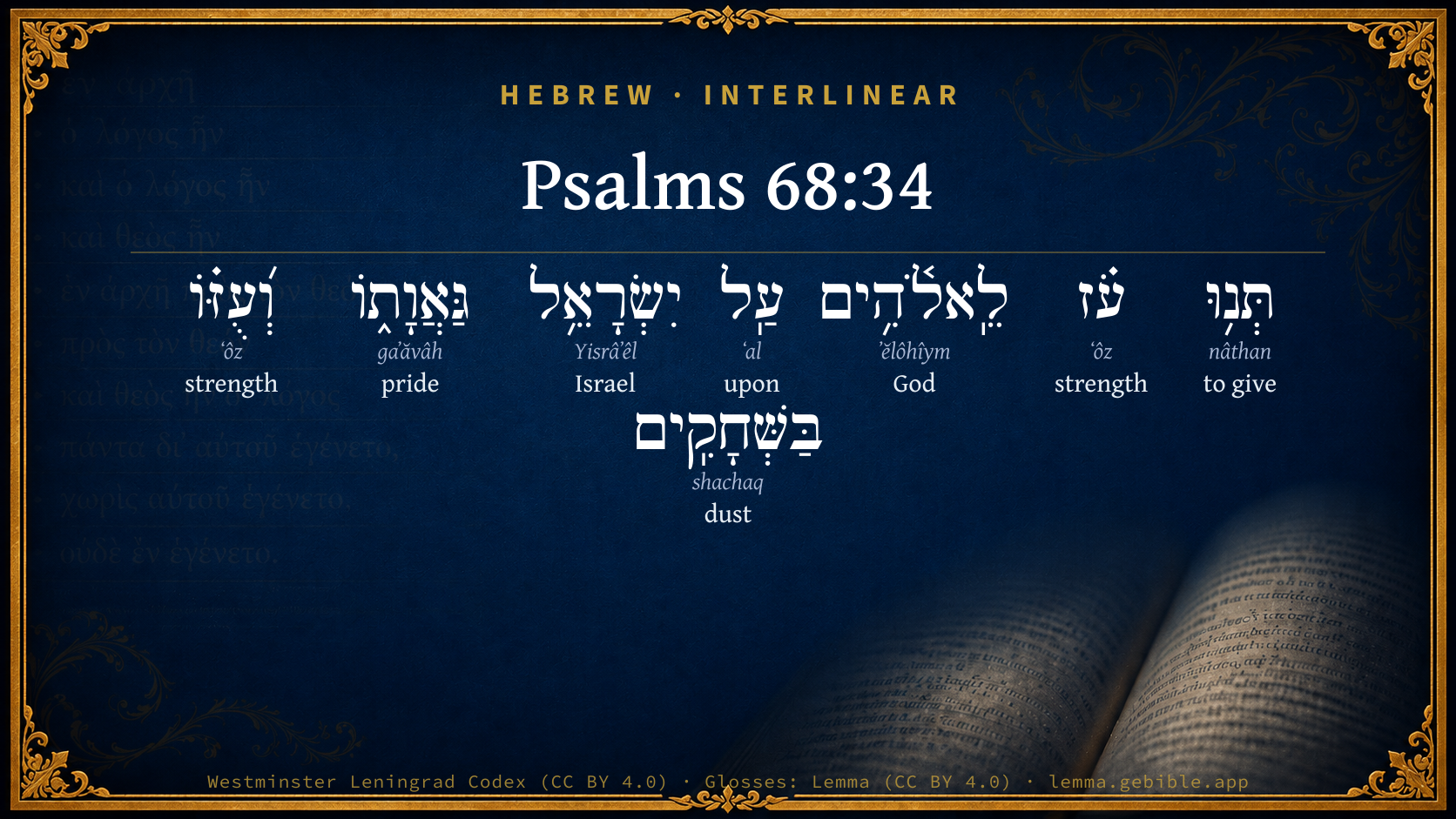
Psalms 68:34

Hebrew (Westminster Leningrad Codex) Psalms 68:34 appears in the Hebrew Old Testament. The text above is from the Westminster Leningrad Codex. Each word links to its Strong’s number, a concise gloss, and parsing drawn from the Open Scriptures Hebrew Bible morphology. Click any word for its full Brown-Driver-Briggs (BDB) entry.
Download image
Cite this verse

Psalms 68:34 (World English Bible). Public Domain. Lemma interlinear Bible study tool, https://lemma.gebible.app/v/psalms/68/34.

Show BibTeX & RIS
BibTeX
RIS
English Translation
Ascribe strength to God! His excellency is over Israel, His strength is in the skies.
World English Bible · Public Domain
Download a study sheet

One document with this verse’s original text, its word-by-word gloss line, the meaning frame, cross-references with their text, attributed commentary, and full source and license credits — printable, and it pastes into notes with its structure intact.

This verse Autodidact and up

Study sheet (.html) Plain text (.txt)

A passage Seminary Student

Up to 50 verses in one chapter. A passage sheet keeps up to 6 commentary sources and 12 cross-references per verse, in the order this page ranks them, and says so on the sheet whenever that leaves anything out. Ask for a single verse and you get the Autodidact verse sheet above.

Everything on this page stays free to read, with no account — the sheet is a download of what is already on screen, not access to it.

Want to remove ads? Support Godless Engineer
Compare translations 3

The same verse in 3 English versions, stacked beneath the original-language interlinear above. Click any original word for its lexicon entry.

Each is an independent rendering of the whole verse — the interlinear is not word-aligned to these translations.

Highlighted words mark where these versions differ — a whole-verse word diff, not a word-by-word alignment.

  • World English Bible Public Domain
    Ascribe strength to God! His excellency is over Israel, His strength is in the skies.
  • King James Version Public Domain
    Ascribe ye strength unto God: his excellency is over Israel, and his strength is in the clouds.
  • unfoldingWord Literal Text CC BY-SA 4.0
    Ascribe strength to God; his majesty over Israel, and his strength in the clouds.

unfoldingWord Literal Text — © unfoldingWord, licensed CC BY-SA 4.0. Word-aligned USFM3 via Door43 (git.door43.org/unfoldingWord/en_ult).

Versions to compare (up to 4)

3 of 4 selected

Show all 18 translations

Every available English version of this verse, each an independent rendering of the whole verse.

  • World English Bible Public Domain
    Ascribe strength to God! His excellency is over Israel, His strength is in the skies.
  • Berean Standard Bible Public Domain
    Ascribe the power to God, whose majesty is over Israel, whose strength is in the skies.
  • Majority Standard Bible Public Domain
    Ascribe the power to God, whose majesty is over Israel, whose strength is in the skies.
  • King James Version Public Domain
    Ascribe ye strength unto God: his excellency is over Israel, and his strength is in the clouds.
  • American Standard Version (1901) Public Domain
    Ascribe ye strength unto God: His excellency is over Israel, And his strength is in the skies.
  • Revised Version (1885) Public Domain
    Ascribe ye strength unto God: his excellency is over Israel, and his strength is in the skies.
  • Geneva Bible (1599) Public Domain
    Ascribe the power to God: for his maiestie is vpon Israel, and his strength is in the cloudes.
  • Douay-Rheims (1899) Public Domain
    who mounteth above the heaven of heavens, to the east. Behold he will give to his voice the voice of power:
  • Young's Literal Translation Public Domain
    Ascribe ye strength to God, Over Israel `is' His excellency, and His strength in the clouds.
  • Literal Standard Version CC BY-SA 4.0
    Ascribe strength to God, || His excellence [is] over Israel, and His strength in the clouds.
  • Unlocked Literal Bible CC BY-SA 4.0
    Ascribe strength to God; his majesty is over Israel, and his strength is in the skies.
  • unfoldingWord Literal Text CC BY-SA 4.0
    Ascribe strength to God; his majesty over Israel, and his strength in the clouds.
  • Darby Bible Public Domain
    Ascribe ye strength unto God: his excellency is over Israel, and his strength is in the clouds.
  • World Messianic Bible Public Domain
    Ascribe strength to God! His excellency is over Israel, his strength is in the skies.
  • Webster's Bible Public Domain
    \\68:33\\To him that rideth upon the heavens of heavens, which were of old; lo, he doth send out his voice, and that a mighty voice.
  • Free Bible Version CC BY-SA 4.0
    Let everyone know of God's power: how his majesty extends over Israel, how his strength is revealed in the heavens.
  • Bible in Basic English Public Domain
    Make clear that strength is God's: he is lifted up over Israel, and his power is in the clouds.
  • JPS Tanakh (1917) Public Domain
    (68-35) Ascribe ye strength unto God; His majesty is over Israel, and His strength is in the skies.

Literal Standard Version (2020), Covenant Press — licensed CC BY-SA 4.0. Text via the HelloAO Bible API (eBible.org). Unlocked Literal Bible (unfoldingWord) — licensed CC BY-SA 4.0. Text via the HelloAO Bible API (eBible.org). unfoldingWord Literal Text — © unfoldingWord, licensed CC BY-SA 4.0. Word-aligned USFM3 via Door43 (git.door43.org/unfoldingWord/en_ult). Free Bible Version, Dr. Jonathan Gallagher — licensed CC BY-SA 4.0. Text via the HelloAO Bible API (eBible.org).

Word by word

More ways to search: Search by grammar → Find every occurrence → Compare this word →

Practice this passage: Drill this verse → Learn its vocabulary →

About this verse

These counts appear in no published source. They are computed here, from the morphology-tagged text and Lemma’s own curated glosses. What Lemma adds →

8
words
7
distinct lemmas
Wisdom
section

Notable vocabulary

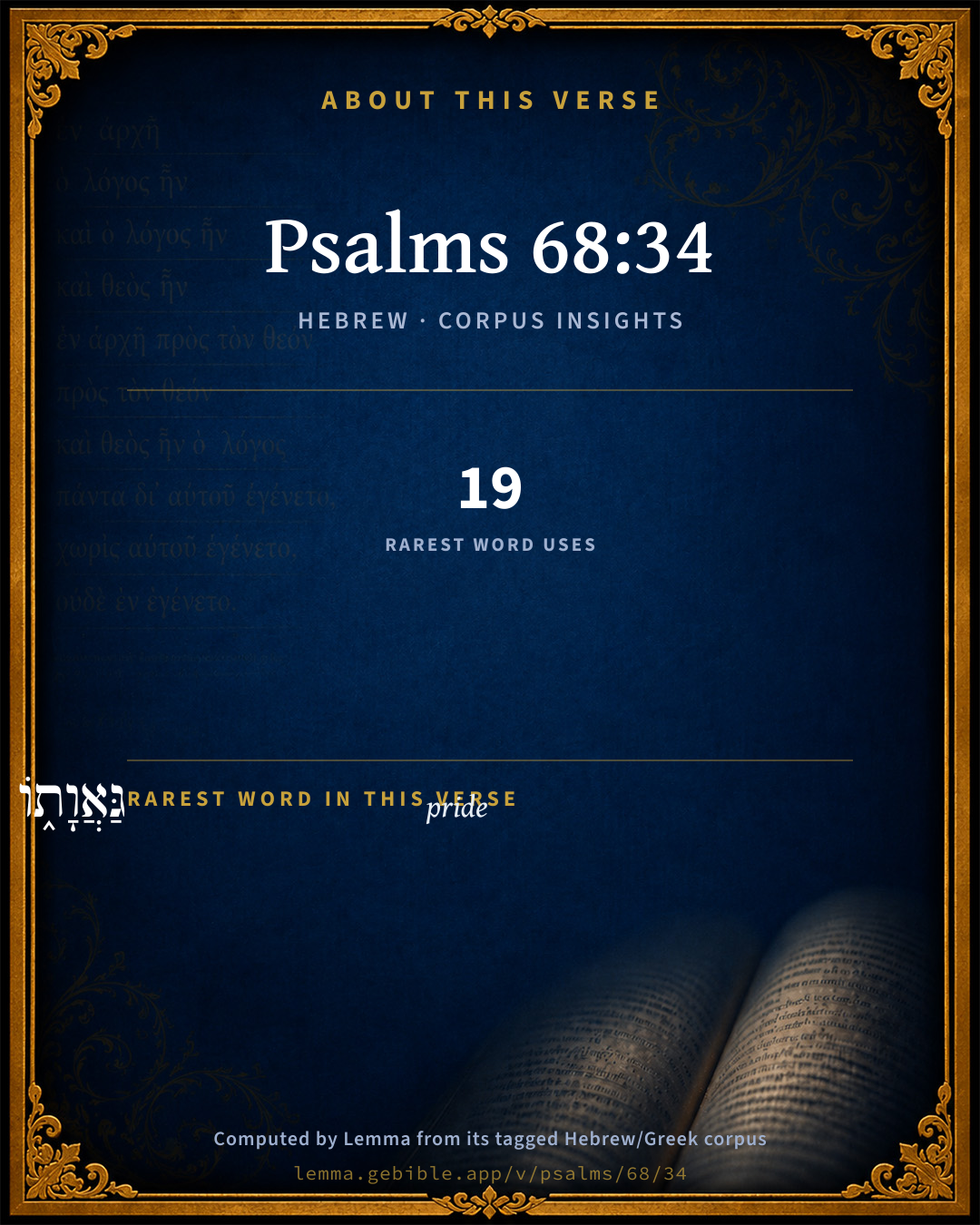
The rarest word here is גַּאֲוָת֑וֹ pride H1346 — appearing just 19 times in the whole Hebrew Bible.

Shared distinctive vocabulary

גַּאֲוָת֑וֹ pride H1346 occurs in 19 verses of the Hebrew Bible. Also found in:

Grammatical profile

  • 1 verb
  • 6 nouns
  • 1 preposition

Verb forms

  • תְּנ֥וּ Qal · Imperative

Repetition

A word recurs within this verse — often emphatic in Hebrew:

  • עֹ֗ז strength H5797 ×2

Hebrew & Septuagint length

In English translation the verse runs 15 words from the Hebrew and 17 from the Septuagint (LXX English) — closely comparable.

A rough comparison of the two English renderings, which tokenize alike — not a word-level alignment.

Word counts can differ between the Hebrew and the Greek without any difference in meaning — e.g. the Hebrew direct-object marker אֵת has no separate Greek word, and Greek often adds the article ὁ.

Cross-references

7

Topical passages linked to Psalms 68:34 in the Treasury of Scripture Knowledge — connected by theme and wording, ordered by reader-vote popularity; previews shown in the World English Bible.

  • 1 Chronicles 16:28–29 Ascribe to Yahweh, you relatives of the peoples, Ascribe to Yahweh glory and strength;
  • 2 Peter 1:17 For he received from God the Father honor and glory, when the voice came to him from the Majestic Glory, "This is my beloved Son, in whom I am well pleased."
  • Revelation 19:6 I heard something like the voice of a great multitude, and like the voice of many waters, and like the voice of mighty thunders, saying, "Hallelujah! For the Lord our God, the Almighty, reigns!
  • Psalms 150:1 Praise Yah! Praise God in his sanctuary! Praise him in his heavens for his acts of power!
  • Deuteronomy 33:26 There is none like God, Jeshurun, Who rides on the heavens for your help, In his excellency on the skies.
  • Psalms 29:1–2 Ascribe to Yahweh, you sons of the mighty, Ascribe to Yahweh glory and strength.
  • Psalms 96:6–8 Honor and majesty are before him. Strength and beauty are in his sanctuary.

Cross-references courtesy of OpenBible.info (CC BY 4.0).

Hebrew and Greek witnesses Masoretic Hebrew ↔ Greek Septuagint

The same verse in the two great witnesses to the Old Testament, shown verse-for-verse.

You’re reading Greek Psalm 67 (Hebrew Psalm 68). The Septuagint counts the superscription, so verse numbers can differ from the Hebrew — chapter-level alignment, not verse-by-verse. Numbering follows Rahlfs.

These are two independent witnesses, not word-aligned to each other, and the Septuagint is shown in lemma (dictionary) form.

Hebrew Psalms 68:34 Masoretic · Westminster Leningrad Codex

תְּנ֥וּ עֹ֗ז לֵֽאלֹ֫הִ֥ים עַֽל יִשְׂרָאֵ֥ל גַּאֲוָת֑וֹ וְ֝עֻזּ֗וֹ בַּשְּׁחָקִֽים

Ascribe strength to God! His excellency is over Israel, His strength is in the skies.

World English Bible · Public Domain

Greek LXX Greek Psalm 67:34 Septuagint · lemma form

ψάλω ὁ θεός ὁ ἐπιβαίνω ἐπί ὁ οὐρανός ὁ οὐρανός κατά ἀνατολή ἰδού δίδωμι ἐν ὁ φωνή αὐτός φωνή δύναμις

Give you⌃ glory to God: his excellency is over Israel, and his power is in the clouds.

LXX2012 (modern English Septuagint) · Public Domain

Hebrew: Westminster Leningrad Codex (CC BY 4.0). Greek: Septuagint (public domain); English from LXX2012 (modern English Septuagint) (Public Domain). How the Septuagint differs from the Hebrew →

Commentary

Notes on Psalms 68:34 from classic Christian and Jewish commentators (each source and its license shown beneath its notes). The classic Christian expositions comment on the surrounding passage and are grouped to its opening verse, so a note may address several verses; the Jewish commentaries on the Tanakh (Rashi and others) are per-verse, so they appear only where the commentator wrote on this verse.

Lemma curates 59 commentaries, every one of them public domain or Creative Commons licensed, each selected and text-cleaned for this edition rather than reprinted as found. About our sources →

Trapp's Complete Commentary

John Trapp

Psa 68:34 Ascribe ye strength unto God: his excellency [is] over Israel, and his strength [is] in the clouds.

Ver. 34. Ascribe ye strength unto God] The high thunderer, υψιβρεμετης (Altitonans); acknowledge your own nothingness, submit to his government.

His excellency is over Israel, and his strength, &c.] i.e. His glory shineth no less in Israel than the thunder roareth in the clouds.

John Trapp, A Commentary or Exposition upon All the Books of the Old and New Testament (1647–1656) — public domain. Text from a community e-Sword module.

Joseph Benson's Commentary

Psa 68:34. Ascribe ye strength unto God — Acknowledge that he is mighty, and able to do whatsoever he pleaseth for his people, or against his or their enemies. His excellency is over Israel — His excellent power and goodness; Hebrew, גאותו, gaavatho, his highness, or majesty; this dwells among them, and is employed for them, as occasion requires. He is indeed the universal Lord of the whole heaven and earth, but in a special and excellent manner he is the God of Israel, and his kingdom is particularly exalted over them. He hath taken them for his peculiar inheritance; and by them alone he is adored and worshipped as the universal Creator, the supreme Lord of heaven and earth. His strength is in the clouds — Hebrew, בשׁחקים, in the heavens, or skies. He hath two dwellings and thrones, the one in his church and among his people, and the other in heaven, and in both these he manifests his power; redeeming, preserving, and sanctifying the former, and directing and governing the mighty orbs of the latter in all their motions, and from thence upholding and influencing the whole universe, animate and inanimate, rational and spiritual, and sending forth both the thunder of his power, and the great and small rain of his strength.

Joseph Benson's Commentary on the Old and New Testaments (1811–1818) — public domain. Text from a community e-Sword module.

J. A. Alexander on Psalms

Joseph Addison Alexander

35. (Psa 68:34). Give strength to God! Over Israel (is) his majesty, and his strength in the clouds. To give, in such connections, is of course to ascribe. See above, on Psa 29:1-2. The remainder of the verse contains the ground of this injunction. God is entitled to the praise of power, because his greatness is displayed in the protection which he extends over Israel. As the sanctuary was above Jerusalem, so God was above the chosen people, their chief and their protector. See above, on Psa 68:29. At the same time his power is displayed throughout the universe, especially those extra-ordinary dispensations, in which he appears to speak from heaven or the clouds. See above, on Psa 26:5.

Joseph Addison Alexander, The Psalms Translated and Explained (1850) — public domain. Text from a community e-Sword module.

Tyndale Open Study Notes

Tyndale Open Resources

68:34 When the Lord demonstrates his power, majesty, and strength against the nations, he strengthens his people (see 96:4-6).

Tyndale Open Study Notes — © Tyndale Open Resources, licensed CC BY-SA 4.0. Text via the HelloAO Bible API.

Adam Clarke's Commentary

Verse 34. His strength is in the clouds.] This refers to the bursting, rattling, and pounding of thunder and lightning; for all nations have observed that this is an irresistible agent; and even the most enlightened have looked on it as an especial manifestation of the power and sovereignty of God.

Adam Clarke's Commentary on the Bible (1810–1826) — public domain. Text from a community e-Sword/MySword module.

John Calvin's Commentaries

34. Give strength unto God over Israel The expression is in allusion to the sentence which went before, and in which God was said to send forth a strong or mighty voice. Not that, properly speaking, we can give anything to Him, but, disposed as we are to withhold that honor which is his due, David subjoins to what he had said of his thundering with a mighty voice, an injunction that we should, on our part, be ready to sound forth his praises. To guard the Gentile nations against those false ideas upon religion in which they were accustomed to indulge, he brings them back to the doctrine of the Law, in which God had specially revealed himself, and intimates that, if they would not lose themselves in error, they must advance by necessary steps from the creation and government of the world, to that doctrine in which God had condescended to make a familiar revelation of himself to men. So much is included when God is spoken of here as the God of Israel But he does not satisfy himself with enjoining them to celebrate the power of God with praises of the voice. He exhorts them to the exercise of faith, for in reality we cannot better ascribe strength unto God, than by reposing in his protection as all-sufficient. Thus, after having said that his strength is in the clouds; he adds, that he is terrible out of his holy places, by which is meant, that he exerts a power in his temple which is sufficient to confound his enemies. Some understand heaven and earth to be the holy places intended, but this does not agree with the context, for it is immediately added, that the God of Israel would give strength unto his people. It is evident, therefore, that the Psalmist speaks of God’s protection of his Church. The plural number is used in speaking of the sanctuary, here as in other places, because the tabernacle was divided into three parts. He points, in short, to the ark of the covenant, as that which the believing people of God should recognize as a symbol of confidence, remembering the promise, “I will dwell in the midst of you,” and thus resting with security under the wings of the Divine protection, and confidently calling upon his name. Any right which Israel might have in distinction from others to trust in the guardianship of God, rested entirely upon that covenant of free grace by which they had been chosen to be God’s peculiar heritage. Let it be remembered, however, that God continues to exert in behalf of his Church still these terrible displays of his power of which the Psalmist speaks.

John Calvin's Commentaries (1540-1563) — public domain. Text from the Calvin Translation Society English edition (1840s-50s) via the Christian Classics Ethereal Library (ccel.org). Calvin's coverage is partial (roughly two-thirds of the Bible); uncommented books and verses are honest gaps, never fabricated. The 19th-century editor's footnotes and remarks are omitted so the notes are faithfully Calvin's own voice.

The Cambridge Bible for Schools and Colleges

gen. ed. J. J. S. Perowne

34. Ascribe &c.] Lit. as in Psa_29:1, give. Acknowledge by the tribute of your praises the power which is His and which He exercises in the world.

His excellency, or majesty, is over Israel to protect and bless, and his strength is in the skies, supreme not on earth alone, but throughout the universe. This and the last verse are based upon Deu_32:26,

“There is none like God (El), O Jeshurun,

Who rideth upon the heavens as thy help,

And in his excellency on the skies.”

The Cambridge Bible for Schools and Colleges (gen. ed. J. J. S. Perowne; Cambridge University Press, 1878–1918) — public domain. Text from a community e-Sword module.

John Gill's Exposition

Ascribe ye strength unto God,.... The Messiah; by asserting him to be the mighty God, even the Almighty; by attributing works of strength and power to him: such as the creation of all things; upholding all things in their being; the redemption and preservation of his people; the resurrection of the dead, &c. by applying to him, and exercising faith on him for spiritual strength, and giving him the glory of it: so the Targum,

"give the glory of strength to God.''

Moreover, this may be understood of ascribing dominion and power to him by the kingdoms of the earth, who are here addressed, when they shall be converted to him; and who, upon this enlargement of his kingdom, will be congratulated by his people, for taking to himself his great power and reigning, Rev 11:15;

his excellency is over Israel; the spiritual Israel, such who are Israelites indeed. Over these his glorious Majesty in his kingdom rules; they are subject to him, and acknowledge him for their King; and among them is his Shechinah, or divine Presence. Or over Israel, literally understood; when they shall, as at this time the prophecy refers to, be all called, converted, and saved: they shall seek the Lord their God, and David their King, and he shall be Prince over them;

and his strength is in the clouds; which are round about him, the chariots in which he rides, and in which he shows his strength; by sending forth from thence the rain of his strength, the terrible lightning and thunder. In these he went up to heaven, and in these he will come again to judgment. They may be mystically understood of the ministers of the Gospel, especially in the latter day, who may be compared to clouds for their numbers, they will then be many; for their swiftness in moving to and fro, and spreading the Gospel; and for their being full of the doctrines of grace, comparable to rain; see Isa 5:6. And the Lord's strength will be seen in them, who will greatly strengthen them to do their work; his strength will be made perfect in their weakness; the excellency of the power attending their ministrations, to the large conversion of sinners, will appear to be of God, and not of man.

John Gill's Exposition of the Whole Bible (1746–1763) — public domain (CC PDM 1.0). Text via the HelloAO Bible API.

Albert Barnes' Notes on the Bible

Ascribe ye strength unto God - literally, “give.” That is, Acknowledge him as a God of power. Recognise his omnipotence in your worship. See the notes at Psa 29:1.

His excellency is over Israel - His majesty; his glory; his protecting care. The idea is, that his glorious character - his majesty - was manifested particularly in his protection of his people.

And his strength is in the clouds - Margin, “heavens.” The Hebrew word rather means “clouds.” The idea is, that while his character as Protector was evinced particularly in his care of his people, his “power” was particularly seen in the clouds - the storm - the thunder - the lightning. Thus, all the manifestations of his character, alike in nature, and toward his people, are adapted to produce a deep and solemn impression in regard to his majesty and glory, or to lay the just foundation of praise.

Albert Barnes' Notes on the Bible (1834–1885) — public domain. Text from a community e-Sword/MySword module.

Matthew Poole's English Annotations

Ascribe ye strength unto God; acknowledge that he is mighty and able to do whatsoever he pleaseth for his people, or against his and their enemies.

His excellency; his excellent power and goodness.

Is over Israel; dwells among them, and is employed for them, as occasion requires. He is indeed the universal Lord of the whole heaven and earth, but in a special and excellent manner he is the God of Israel.

In the clouds; or, in the heavens, He hath two dwellings and thrones, the one in his church and people, and the other in heaven. See Isa 57:15.

Matthew Poole's English Annotations on the Holy Bible (1683–1685) — public domain. Text from a community e-Sword/MySword module.

The Treasury of David

Charles H. Spurgeon

Ver. 34. Ascribe ye strength unto God. When even his voice rends the rocks and uproots the cedars, what cannot his hand do? His finger shakes the earth; who can conceive the power of his arm? Let us never by our doubts or our daring defiances appear to deny power unto God; on the contrary, by yielding to him and trusting in him, let our hearts acknowledge his might. When we are reconciled to God, his omnipotence is an attribute of which we sing with delight.

His excellency is over Israel. The favoured nation is protracted by his majesty; his greatness is to them goodness, his glory is their defence.

And his strength is in the clouds. He does not confine his power to the sons of men, but makes it like a canopy to cover the skies. Rain, snow, hail, and tempest are his artillery; he rules all nature with awe inspiring majesty. Nothing is so high as to be above him, or too low to be beneath him; praise him, then, in the highest.

Ver. 34. His strength is in the clouds. This refers to the phenomena of thunder and lightning; for all nations have observed that the electric fluid is an irresistible agent--destroying life, tearing towers and castles to pieces, rending the strongest oaks, and cleaving the most solid rocks; and the most enlightened nations have justly considered it as an especial manifestation of the power and sovereignty of God. W. Greenfield, in Comprehensive Bible.

None.

Psalms 68:35*

Charles H. Spurgeon's The Treasury of David (1869–1885) — public domain. Psalms only. Text from a community e-Sword/MySword module.

The Pulpit Commentary

Ascribe ye strength unto God; or, "might," "power that which makes him Shaddai, "the Almighty." His excellency is over Israel; or, "his majesty" (Kay). And his strength is in the clouds. Not in earth only, but in heaven also.

The Pulpit Commentary (1880–1919), ed. H.D.M. Spence-Jones & Joseph S. Exell — public domain. Text from a community e-Sword module.

John Wesley's Explanatory Notes

Ascribe - Acknowledge that he is able to do whatsoever he pleaseth. Excellency - His excellent power and goodness. Is over - Dwells among them. He is indeed the universal Lord, but in a special manner, he is the God of Israel.

John Wesley, Explanatory Notes Upon the Whole Bible (1754–1765) — public domain. Text via the GEBible commentary corpus.

unfoldingWord translationNotes

Door43 World Missions Community

Ascribe strength to God

"Ascribe" means to give credit to someone. AT: "Strength belongs to God"

his strength is in the skies

The abstract noun "strength" can be stated as "powerful." AT: "in the skies he also shows that he is powerful" (See: Abstract Nouns)

God, you are fearsome in your holy place

Here the author speaks directly to God. (See: Apostrophe)

strength and power

These two words mean basically these same thing. They emphasize how much strength God provides to his people. (See: Doublet)

translationWords

strength

majesty

Israel

heaven

fear

holy place

power

bless

unfoldingWord translationNotes — © Distant Shores Media and the Door43 World Missions Community, licensed CC BY-SA 4.0. Source: git.door43.org/Door43/en_tn.

Rashi

Rabbi Shlomo Yitzchaki (Rashi)

behold He gives forth Heb. יתן, behold He gives.

Rashi on the Tanakh — English translations: “The Judaica Press complete Tanach with Rashi, translated by A. J. Rosenberg” (CC BY 4.0); “Pentateuch with Rashi's commentary by M. Rosenbaum and A.M. Silbermann, 1929-1934” (public domain); “The Metsudah Tanach series, Lakewood, N.J” (CC BY 4.0); and “The Book of Joshua, Metsudah Publications, 1997” (CC BY 4.0). Text via Sefaria.

Lesson kit

Teaching starters — assembled from the data on this page, not authored interpretation. Every prompt links to the verse data it draws on. Edit before teaching.

Psalms, in the Wisdom, opens this verse with 8 words (7 distinct Hebrew lemmas). Its most distinctive word is gaʼăvâh (“pride”). A historical commentator’s framing appears above. Read the whole chapter for the surrounding context.

Discussion questions

  1. The word gaʼăvâh carries the sense “pride.” How does it shape the verse?
  2. How does Deuteronomy 33:26, which shares the word «pride», read alongside this verse?
  3. What does the repetition of “strength” (2× in this one verse) do in this verse?
  4. These translations render this verse differently; the difference is in the English rendering, not the original. What questions does that raise?
  5. «תְּנ֥וּ» is a Qal Imperative verb. How does that grammatical form shape the action described?
  6. Compare how Trapp's Complete Commentary and Joseph Benson's Commentary read this verse. Where do they agree or differ?

Things to notice

  • These translations choose different wording for 4 words in this verse.
  • “strength” occurs 2× in this single verse.
  • 7 distinct Hebrew lemmas span 8 words in this verse.

Reading settings

Reading text

Shown beneath each verse's original-language words.

Old Testament
Old Testament edition

Read the OT as the Masoretic Hebrew (MT) or the Greek Septuagint (LXX).

English shown for the Greek Septuagint (in the Hebrew ↔ Greek comparison).

Comparing translations? Open the Compare panel on any verse page to stack up to four side by side.