
Psalms 138:3

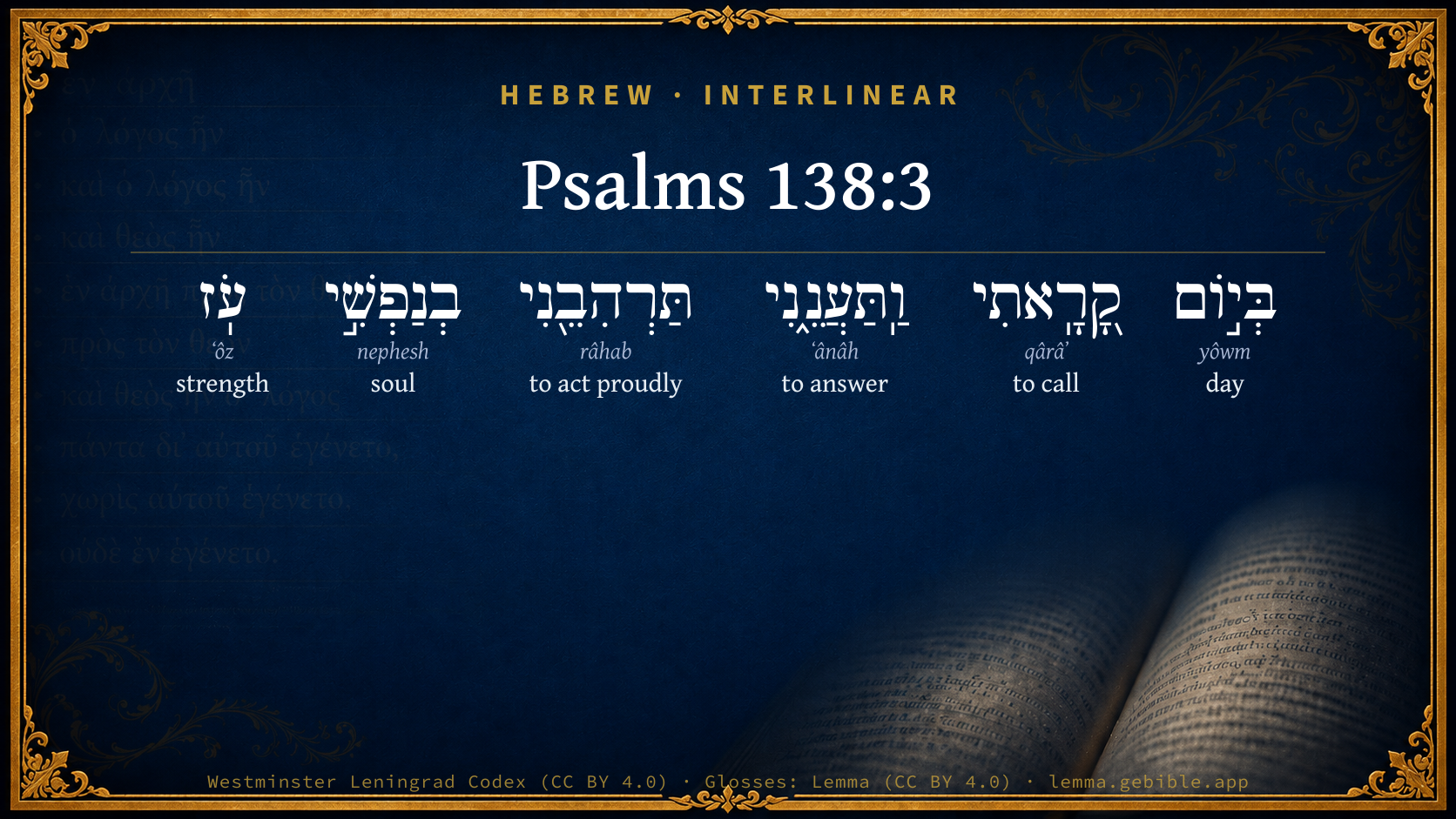
Hebrew (Westminster Leningrad Codex) Psalms 138:3 appears in the Hebrew Old Testament. The text above is from the Westminster Leningrad Codex. Each word links to its Strong’s number, a concise gloss, and parsing drawn from the Open Scriptures Hebrew Bible morphology. Click any word for its full Brown-Driver-Briggs (BDB) entry.
Download image
Cite this verse

Psalms 138:3 (World English Bible). Public Domain. Lemma interlinear Bible study tool, https://lemma.gebible.app/v/psalms/138/3.

Show BibTeX & RIS
BibTeX
RIS
English Translation
In the day that I called, you answered me. You encouraged me with strength in my soul.
World English Bible · Public Domain
Highlights
  • 1 first appearance in the Hebrew Bible
Full analysis ↓
Download a study sheet

One document with this verse’s original text, its word-by-word gloss line, the meaning frame, cross-references with their text, attributed commentary, and full source and license credits — printable, and it pastes into notes with its structure intact.

This verse Autodidact and up

Study sheet (.html) Plain text (.txt)

A passage Seminary Student

Up to 50 verses in one chapter. A passage sheet keeps up to 6 commentary sources and 12 cross-references per verse, in the order this page ranks them, and says so on the sheet whenever that leaves anything out. Ask for a single verse and you get the Autodidact verse sheet above.

Everything on this page stays free to read, with no account — the sheet is a download of what is already on screen, not access to it.

Want to remove ads? Support Godless Engineer
Compare translations 3

The same verse in 3 English versions, stacked beneath the original-language interlinear above. Click any original word for its lexicon entry.

Each is an independent rendering of the whole verse — the interlinear is not word-aligned to these translations.

Highlighted words mark where these versions differ — a whole-verse word diff, not a word-by-word alignment.

  • World English Bible Public Domain
    In the day that I called, you answered me. You encouraged me with strength in my soul.
  • King James Version Public Domain
    In the day when I cried thou answeredst me, and strengthenedst me with strength in my soul.
  • unfoldingWord Literal Text CC BY-SA 4.0
    On the day that I called and you answered me, you emboldened my soul power.

unfoldingWord Literal Text — © unfoldingWord, licensed CC BY-SA 4.0. Word-aligned USFM3 via Door43 (git.door43.org/unfoldingWord/en_ult).

Versions to compare (up to 4)

3 of 4 selected

Show all 18 translations

Every available English version of this verse, each an independent rendering of the whole verse.

  • World English Bible Public Domain
    In the day that I called, you answered me. You encouraged me with strength in my soul.
  • Berean Standard Bible Public Domain
    On the day I called, You answered me; You emboldened me and strengthened my soul.
  • Majority Standard Bible Public Domain
    On the day I called, You answered me; You emboldened me and strengthened my soul.
  • King James Version Public Domain
    In the day when I cried thou answeredst me, and strengthenedst me with strength in my soul.
  • American Standard Version (1901) Public Domain
    In the day that I called thou answeredst me, Thou didst encourage me with strength in my soul.
  • Revised Version (1885) Public Domain
    In the day that I called thou answeredst me, thou didst encourage me with strength in my soul.
  • Geneva Bible (1599) Public Domain
    When I called, then thou heardest me, and hast encreased strength in my soule.
  • Douay-Rheims (1899) Public Domain
    For there they that led us into captivity required of us the words of songs. And they that carried us away, said: Sing ye to us a hymn of the songs of Sion.
  • Young's Literal Translation Public Domain
    In the day I called, when Thou dost answer me, Thou dost strengthen me in my soul `with' strength.
  • Literal Standard Version CC BY-SA 4.0
    In the day I called, when You answer me, || You strengthen me in my soul [with] strength.
  • Unlocked Literal Bible CC BY-SA 4.0
    On the day that I called you, you answered me; you made me bold and strengthened my soul.
  • unfoldingWord Literal Text CC BY-SA 4.0
    On the day that I called and you answered me, you emboldened my soul power.
  • Darby Bible Public Domain
    In the day when I called thou answeredst me; thou didst encourage me with strength in my soul.
  • World Messianic Bible Public Domain
    In the day that I called, you answered me. You encouraged me with strength in my soul.
  • Webster's Bible Public Domain
    In the day when I cried thou didst answer me, and strengthen me with strength in my soul.
  • Free Bible Version CC BY-SA 4.0
    On the day I cried out to you for help, you answered me. You encouraged me and made me strong.
  • Bible in Basic English Public Domain
    When my cry came to your ears you gave me an answer, and made me great with strength in my soul.
  • JPS Tanakh (1917) Public Domain
    In the day that I called, Thou didst answer me; Thou didst encourage me in my soul with strength.

Literal Standard Version (2020), Covenant Press — licensed CC BY-SA 4.0. Text via the HelloAO Bible API (eBible.org). Unlocked Literal Bible (unfoldingWord) — licensed CC BY-SA 4.0. Text via the HelloAO Bible API (eBible.org). unfoldingWord Literal Text — © unfoldingWord, licensed CC BY-SA 4.0. Word-aligned USFM3 via Door43 (git.door43.org/unfoldingWord/en_ult). Free Bible Version, Dr. Jonathan Gallagher — licensed CC BY-SA 4.0. Text via the HelloAO Bible API (eBible.org).

Word by word

More ways to search: Search by grammar → Find every occurrence → Compare this word →

Practice this passage: Drill this verse → Learn its vocabulary →

תַּרְהִבֵ֖נִי
râhab
H7292
“to act proudly · me”
Verb, Hiphil, Imperfect, 2nd Person, Masculine, Singular + Suffix, Personal, 1st Person, Common, Singular
Part of Speech
Verb
Stem
Hiphil
Form
Imperfect
Person
2nd Person
Gender
Masculine
Number
Singular
Full BDB Definition

Origin: a primitive root

TWOT: 2125

to behave proudly, act stormily or boisterously or arrogantly - (Qal) to act insolently, storm against, beset, importune - (Hiphil) to disturb, alarm, awe, confuse, make bold or proud
  1. בְּי֣וֹם yôwm H3117 “in/at · day” Preposition + Noun, Common, Masculine, Singular, Absolute
  2. קָ֭רָֽאתִי qârâʼ H7121 “to call” Verb, Qal, Perfect, 1st Person, Common, Singular
  3. וַֽתַּעֲנֵ֑נִי ʻânâh H6030 “and · to answer · me” Conjunction + Verb, Qal, Sequential Imperfect, 2nd Person, Masculine, Singular + Suffix, Personal, 1st Person, Common, Singular
  4. בְנַפְשִׁ֣י nephesh H5315 “in/at · soul · my” Preposition + Noun, Common, Both, Singular, Construct + Suffix, Personal, 1st Person, Common, Singular
  5. עֹֽז ʻôz H5797 “strength” Noun, Common, Masculine, Singular, Absolute

About this verse

These counts appear in no published source. They are computed here, from the morphology-tagged text and Lemma’s own curated glosses. What Lemma adds →

6
words
6
distinct lemmas
Wisdom
section

Notable vocabulary

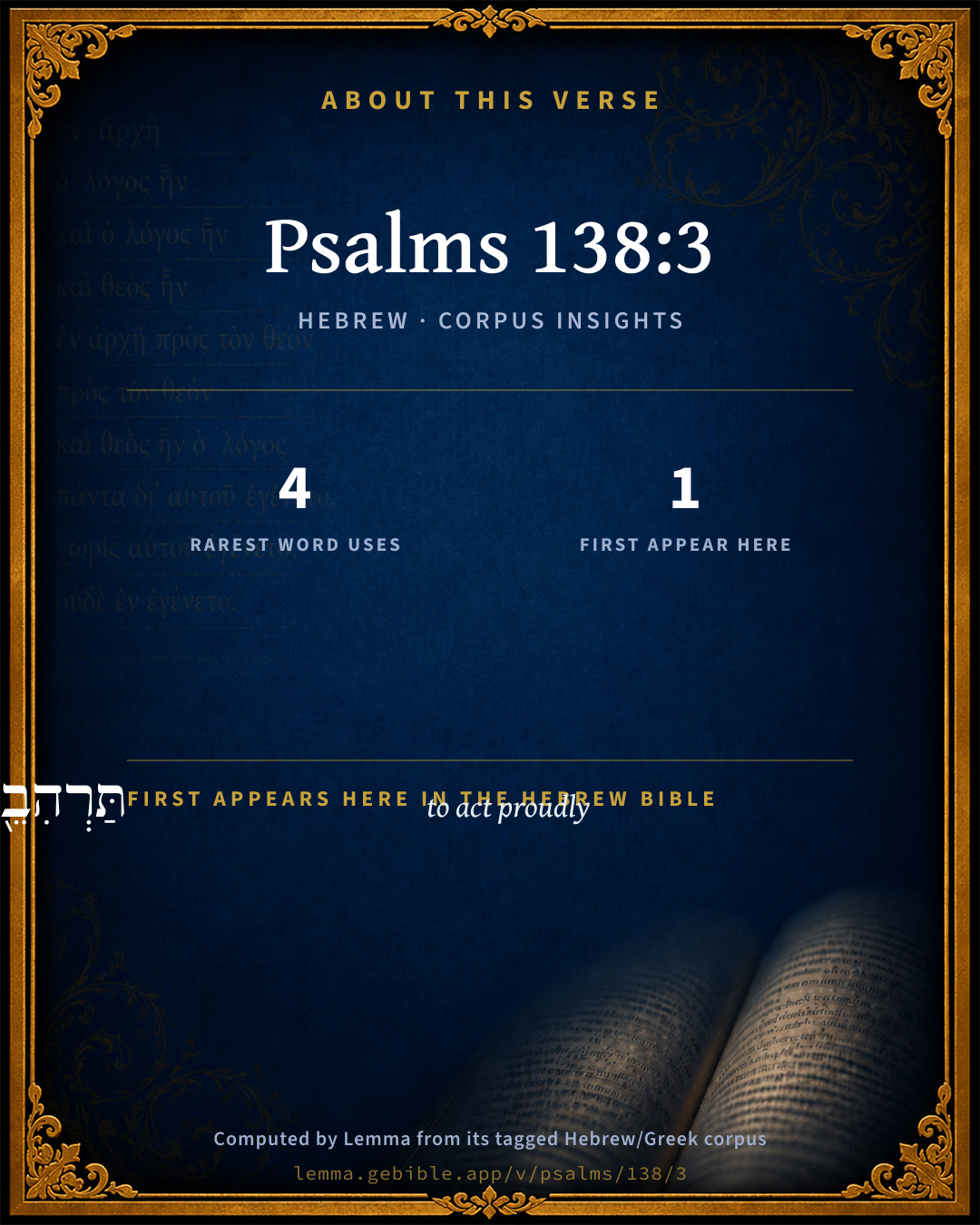
The rarest word here is תַּרְהִבֵ֖נִי to act proudly H7292 — appearing just 4 times in the whole Hebrew Bible.

First appearance in Scripture

This word makes its first canonical appearance in the Hebrew Bible here:

  • תַּרְהִבֵ֖נִי to act proudly H7292

Shared distinctive vocabulary

תַּרְהִבֵ֖נִי to act proudly H7292 occurs in 4 verses of the Hebrew Bible. Also found in:

Grammatical profile

  • 3 verbs
  • 3 nouns

Verb forms

  • קָ֭רָֽאתִי Qal · Perfect
  • וַֽתַּעֲנֵ֑נִי Qal · Sequential Imperfect
  • תַּרְהִבֵ֖נִי Hiphil · Imperfect

Hebrew & Septuagint length

In English translation the verse runs 17 words from the Hebrew and 22 from the Septuagint (LXX English) — closely comparable.

A rough comparison of the two English renderings, which tokenize alike — not a word-level alignment.

Word counts can differ between the Hebrew and the Greek without any difference in meaning — e.g. the Hebrew direct-object marker אֵת has no separate Greek word, and Greek often adds the article ὁ.

Cross-references

18

Topical passages linked to Psalms 138:3 in the Treasury of Scripture Knowledge — connected by theme and wording, ordered by reader-vote popularity; previews shown in the World English Bible.

  • 1 Peter 5:10 But may the God of all grace, who called you to his eternal glory by Christ Jesus, after you have suffered a little while, perfect, establish, strengthen, and settle you.
  • Psalms 18:6 In my distress I called on Yahweh, And cried to my God. He heard my voice out of his temple, My cry before him came into his ears.
  • Psalms 34:4–6 I sought Yahweh, and he answered me, And delivered me from all my fears.
  • Isaiah 40:29–31 He gives power to the faint; and to him who has no might he increases strength.
  • Zechariah 10:12 I will strengthen them in Yahweh; And they will walk up and down in his name," says Yahweh.
  • Philippians 4:13 I can do all things through Christ, who strengthens me.
  • Isaiah 12:2 Behold, God is my salvation. I will trust, and will not be afraid; for Yah, Yahweh, is my strength and song; and he has become my salvation."
  • Psalms 27:14 Wait for Yahweh. Be strong, and let your heart take courage. Yes, wait for Yahweh.
  • Isaiah 41:10 Don't you be afraid, for I am with you; don't be dismayed, for I am your God; I will strengthen you; yes, I will help you; yes, I will uphold you with the right hand of my righteousness.
  • Psalms 29:11 Yahweh will give strength to his people. Yahweh will bless his people with peace.
  • Ephesians 6:10 Finally, be strong in the Lord, and in the strength of his might.
  • Colossians 1:11 strengthened with all power, according to the might of his glory, for all endurance and perseverance with joy;
  • 2 Corinthians 12:8–10 Concerning this thing, I begged the Lord three times that it might depart from me.
  • Ephesians 3:16 that he would grant you, according to the riches of his glory, that you may be strengthened with power through his Spirit in the inward man;
  • Psalms 28:7 Yahweh is my strength and my shield. My heart has trusted in him, and I am helped. Therefore my heart greatly rejoices. With my song I will thank him.
  • Psalms 63:8 My soul stays close to you. Your right hand holds me up.
  • Psalms 77:1–2 My cry goes to God! Indeed, I cry to God for help, And for him to listen to me.
  • Isaiah 65:24 It shall happen that, before they call, I will answer; and while they are yet speaking, I will hear.

Cross-references courtesy of OpenBible.info (CC BY 4.0).

Hebrew and Greek witnesses Masoretic Hebrew ↔ Greek Septuagint

The same verse in the two great witnesses to the Old Testament, shown verse-for-verse.

You’re reading Greek Psalm 137 (Hebrew Psalm 138). The Septuagint counts the superscription, so verse numbers can differ from the Hebrew — chapter-level alignment, not verse-by-verse. Numbering follows Rahlfs.

These are two independent witnesses, not word-aligned to each other, and the Septuagint is shown in lemma (dictionary) form.

Hebrew Psalms 138:3 Masoretic · Westminster Leningrad Codex

בְּי֣וֹם קָ֭רָֽאתִי וַֽתַּעֲנֵ֑נִי תַּרְהִבֵ֖נִי בְנַפְשִׁ֣י עֹֽז

In the day that I called, you answered me. You encouraged me with strength in my soul.

World English Bible · Public Domain

Greek LXX Greek Psalm 137:3 Septuagint · lemma form

ἐν ὅς ἄν ἡμέρα ἐπικαλέω σύ ταχύς ἐπιἀκούω ἐγώ πολυωρέω ἐγώ ἐν ψυχή ἐγώ ἐν δύναμις

In whatever day I shall call upon you, hear me speedily; you shall abundantly provide me with your power in my soul.

LXX2012 (modern English Septuagint) · Public Domain

Hebrew: Westminster Leningrad Codex (CC BY 4.0). Greek: Septuagint (public domain); English from LXX2012 (modern English Septuagint) (Public Domain). How the Septuagint differs from the Hebrew →

Commentary

Notes on Psalms 138:3 from classic Christian and Jewish commentators (each source and its license shown beneath its notes). The classic Christian expositions comment on the surrounding passage and are grouped to its opening verse, so a note may address several verses; the Jewish commentaries on the Tanakh (Rashi and others) are per-verse, so they appear only where the commentator wrote on this verse.

Lemma curates 59 commentaries, every one of them public domain or Creative Commons licensed, each selected and text-cleaned for this edition rather than reprinted as found. About our sources →

Trapp's Complete Commentary

John Trapp

Psa 138:3 In the day when I cried thou answeredst me, [and] strengthenedst me [with] strength in my soul.

Ver. 3. In the day when I cried, &c.] This he worthily celebrateth as a singular favour, a badge of grace, Psa 66:18, and pledge of glory, Act 2:21.

And strengthenedst me with strength in my soul] With strength in the inward man, Eph 3:16; Eph 3:20, with spiriual mettle, with supporting grace; keeping head above water. My body is weak, my soul is well, said that dying saint. I am as full of comfort as heart can hold, said a certain martyr. The apostle speaketh of the new supplies of the Spirit of Jesus Christ, επιχορηγεω, Php 1:19; the joy of the Lord is strengthening, Neh 8:10.

John Trapp, A Commentary or Exposition upon All the Books of the Old and New Testament (1647–1656) — public domain. Text from a community e-Sword module.

The Biblical Illustrator

Joseph S. Exell

Psa_138:3

In the day when I cried Thou answeredst me, and strengthenedst me.

Successful prayer

I. The cry.

1. A deep sense of need.

2. A feeling sense of inability.

3. Earnestness of supplication.

4. Confidence in God.

II. Its successful issue.

1. God heard his cry.

2. He answered it.

3. Immediately.

4. Imparting strength to his soul.

(1) To work.

(2) To resist enemies.

(3) To suffer.

(4) To be firm and persevering.

III. Application.

1. Learn the saints remedy in trouble--to cry unto the Lord, etc.

2. The importance of soul-strength. When obtained, exercise it, etc.

3. The efficacy of fervent prayer. God will hear and bless, etc.

4. The duty of recounting Gods gracious answers to our supplications. (J. Burns, D. D.)

The Biblical Illustrator, edited by Joseph S. Exell (c. 1880s–1900s) — public domain. Text from a community e-Sword module.

Joseph Benson's Commentary

Psa 138:3. In the day when I cried thou answeredst me — Didst give me to understand that my prayer was accepted, and should have a gracious return in due time; and strengthenedst me, in my soul — This clause limits and explains the former, and shows in what way God answered him so speedily, namely, not by giving him the very thing which he desired in that very instant, but by giving him inward support and patience, to wait God’s time, and to bear all his troubles cheerfully in the mean time, which was a singular mercy, and, indeed, greater than the actual donation of any temporal blessing. Observe, reader, if God give us strength in our souls, to bear the burdens, resist the temptations, and to do the duties, of an afflicted state; if he strengthen us to rely on him by faith, to maintain the peace of our own minds, and to wait with patience for the issue, we must own that he hath answered us, and are bound to be thankful.

Joseph Benson's Commentary on the Old and New Testaments (1811–1818) — public domain. Text from a community e-Sword module.

J. A. Alexander on Psalms

Joseph Addison Alexander

3. (Psa 138:3) In the day I called and thou didst answer me, thou makest me brave in my soul (with) strength. This may be connected with what goes before, thou didst magnify thy word in the day when I called, etc. The promise in 2 Samuel 7 was an answer to his prayer for a perpetual succession. See above, on Psa 21:2; Psa 21:4; Psa 61:5. The common version of the last clause (strengthenedst me with strength in my soul), contains a paronomasia not in the original, where the verb and noun have not even a letter in common. The verb is by some translated made me proud, i.e. elated me, not with a vain or selfish pride, but with a lofty and exhilarating hope. In my soul, as opposed to a mere outward influence. Strength, i.e. strength of faith and confidence in God.

Joseph Addison Alexander, The Psalms Translated and Explained (1850) — public domain. Text from a community e-Sword module.

Geneva Bible (1599)

Geneva Bible translators

Thou hast strengthened me against mine outward and inward enemies.

Geneva Bible (1599) marginal notes — public domain. Text via Bolls.life.

Adam Clarke's Commentary

Verse 3. With strength in my soul.] Thou hast endued my soul with many graces, blessings, and heavenly qualities.

Adam Clarke's Commentary on the Bible (1810–1826) — public domain. Text from a community e-Sword/MySword module.

John Calvin's Commentaries

3. In the day when I cried to thee, etc. Frequently God prevents our prayers, and surprises us, as it were, sleeping: but commonly he stirs us up to prayer by the influence of his Spirit, and this to illustrate his goodness the more by our finding that he crowns our prayers with success. David well infers that his escape front danger could not have been merely fortuitous, as it plainly appeared that God had answered him. This then is one thing noticeable, that our prayers more nearly discover his goodness to us. Some supply a copulative in the second part of the verse — Thou hast increased me, and in my soul is strength. But this is not called for, since the words read well enough as they stand, whether we render the passage as I have done above, or translate it, Thou hast multiplied, or increased, me with strength in my soul. The sense, is, That from a weak and afflicted state he had received fresh strength to his spirit Or some may, perhaps, prefer resolving it thus: Thou hast multiplied — that is, blest me, whence strength in my soul.

John Calvin's Commentaries (1540-1563) — public domain. Text from the Calvin Translation Society English edition (1840s-50s) via the Christian Classics Ethereal Library (ccel.org). Calvin's coverage is partial (roughly two-thirds of the Bible); uncommented books and verses are honest gaps, never fabricated. The 19th-century editor's footnotes and remarks are omitted so the notes are faithfully Calvin's own voice.

Ellicott's Commentary for English Readers

(3) Strengthenedst me with strength.—Or, encouragest me strongly. (See Note to Son_6:5, where the same Hebrew form occurs.)

In my soul.—Or, at my desire.

A Bible Commentary for English Readers, edited by Charles John Ellicott (1878–1897) — public domain. Text from a community e-Sword module.

The Cambridge Bible for Schools and Colleges

gen. ed. J. J. S. Perowne

3. and strengthenedst me] R.V. thou didst encourage me, giving me a proud consciousness of strength; a bold use of the word, which elsewhere denotes pride in a bad sense.

The Cambridge Bible for Schools and Colleges (gen. ed. J. J. S. Perowne; Cambridge University Press, 1878–1918) — public domain. Text from a community e-Sword module.

John Gill's Exposition

In the day when I cried thou answeredst me,.... When in distress through Saul's persecution, he cried to the Lord, and he immediately answered him, and delivered him out of his troubles; and such immediate answers of prayer are to be remembered with thankfulness: see Psa 18:6;

and strengthenedst me with strength in my soul; put him good heart and spirit, when before ready to faint; strengthened his heart and grace in it, particularly faith, and drew it forth into lively act and exercise so that he sunk not under the weight of affliction and trouble, but was filled with courage to withstand his enemies, and with strength to do the will and work of God; this is to be understood of inward spiritual strength; see Eph 3:16.

John Gill's Exposition of the Whole Bible (1746–1763) — public domain (CC PDM 1.0). Text via the HelloAO Bible API.

Albert Barnes' Notes on the Bible

In the day when I cried - Referring to some former period of his life when he was in trouble.

Thou answeredst me - In the very day when I called, thou gavest me the answer: that is, immediately.

And strengthenedst me with strength in my soul - literally, “Thou didst embolden - or, didst make me courageous with strength.” Thou didst enable me to meet danger, and to overcome fear. It would seem probable that this was on some occasion when he was in danger from his enemies.

Albert Barnes' Notes on the Bible (1834–1885) — public domain. Text from a community e-Sword/MySword module.

Matthew Poole's English Annotations

The last clause limits and explains the former, how God answered him so speedily, not by giving him the thing which he desired in that very instant, but by giving him inward support and patience to wait God’s time, and to bear all his troubles cheerfully in the mean time, which was a singular mercy, and indeed greater than the actual donation of any temporal blessing.

Matthew Poole's English Annotations on the Holy Bible (1683–1685) — public domain. Text from a community e-Sword/MySword module.

The Treasury of David

Charles H. Spurgeon

Ver. 3. In the day when I cried thou answerest me. No proof is so convincing as that of experience. No man doubts the power of prayer after he has received an answer of peace to his supplication. It is the distinguishing mark of the true and living God that he hears the pleadings of his people, and answers them; the gods hear not and answer not, but Jehovah's memorial is"the God that heareth prayer." There was some special day in which David cried more vehemently than usual; he was weak, wounded, worried, and his heart was wearied; then like a child he "cried", cried unto his Father. It was a bitter, earnest, eager prayer, as natural and as plaintive as the cry of a babe. The Lord answered it, but what answer can there be to a cry? to a mere inarticulate wail of grief? Our heavenly Father is able to interpret tears, and cries, and he replies to their inner sense in such a way as fully meets the case. The answer came in the same day as the cry ascended: so speedily does prayer rise to heaven, so quickly does mercy return to earth. The statement of this sentence is one which all believers can make, and as they can substantiate it with many facts, they ought boldly to publish it, for it is greatly to God's glory. Well might the Psalmist say, "I will worship" when he felt bound to say "thou answeredst me." Well might he glory before the idols and their worshippers when he had answers to prayer to look back upon. This also is our defence against modern heresies: we cannot forsake the Lord, for he has heard our prayers.

And strengthenedst me with strength in my soul. This was a true answer to his prayer. If the burden was not removed, yet strength was given wherewith to bear it, and this is an equally effective method of help. It may not be best for us that the trial should come to an end; it may be far more to our advantage that by its pressure we should learn patience. Sweet are the uses of adversity, and our prudent Father in heaven will not deprive us of those benefits. Strength imparted to the soul is an inestimable boon; it means courage, fortitude, assurance, heroism. By his word and Spirit the Lord can make the trembler brave, the sick whole, the weary bright. This soul might will continue: the man having been strengthened for one emergency remains vigorous for life, and is prepared for all future labours and sufferings; unless, indeed, he throw away his force by unbelief, or pride, or some other sin. When God strengthens, none can weaken. Then is our soul strong indeed when the Lord infuses might into us.

Ver. 3. In the day when I cried, etc. God granted him a speedy answer; for it was in the very day that he cried that he was heard: and it was a spiritual answer; he was strengthened with strength in his soul. Would you have soul strength for the work you have in view? Then cry unto him who is the "strength of Israel" for it; for "he giveth power to the faint, and he increaseth strength to them that have no might." Ebenezer Erskine.

Ver. 3. In the day when I cried thou answeredst me, etc. That part of an army which is upon action in the field is sure to have their pay, if their masters have any money in their purse, or care of them; yea, sometimes when their fellows left in their quarters are made to wait. I am sure there is more gold and silver (spiritual joy, I mean, and comfort) to be found in Christ's camp, among his suffering ones, than their brethren at home in peace and prosperity ordinarily can show. What are the promises but vessels of cordial wine, turned on purpose against a groaning hour, when God usually broacheth them! "Call upon me", saith God, "in the day of trouble." Ps 50:15. And may we not do so in the day of peace? Yes; but he would have us most bold with him in the day of trouble. None find such quick despatch at the throne of grace as suffering saints. "In the day that I cried", saith David, "thou answeredst me, and strengthenedst me with strength in my soul." He was now in a strait, and God comes in haste to him. Though we may keep a well friend waiting should he send for us, yet we will give a sick friend leave to call us up at midnight. In such extremities we usually go with the messenger that comes for us; and so doth God with the prayer. Peter knocked at their gate, who were assembled to seek God for him, almost as soon as their prayer knocked at heaven gate in his behalf. And truly it is no more than needs, if we consider the temptations of our afflicted condition; we are prone then to be suspicious that our best friends forget us, and to think every stay a delay, and neglect of us; therefore God chooseth to show himself most kind at such a time. "As the sufferings of Christ abound in us, so our consolation also aboundeth by Christ": 2Co 1:5. As man laid on trouble, so Christ laid in consolation: both tides rose and fell together; when it was spring tide with him in affliction, it was so with him in his joy. We relieve the poor as their need increaseth; so Christ comforts his people as their troubles multiply. And now, Christian, tell me, doth not thy dear Lord deserve a ready spirit in thee to meet any suffering with, for, or from him, who gives his sweetest comforts where his people are put to bear their saddest sorrows? Well may the servant do his work cheerfully when his master is so careful of him as with his own hands to bring him his breakfast into the fields. The Christian stays not till he comes to heaven for all his comfort. There indeed shall be the full supper, but there is a breakfast, Christian, of previous joys, more or less, which Christ brings to thee into the field, to be eaten on the place where you endure your hardship. William Gurnall.

Ver. 3. Thou answeredst me, and strengthenedst me with strength in my soul. It is one gracious way of answering our prayers when God doth bestow upon us spiritual strength in our souls; if he do not give the things we desire, yet if he gives us strength in our souls, he graciously answers our prayers. What is this spiritual strength? I answer, it is a work of the Spirit of God, enabling a man to do and suffer what God would have him without fainting or backsliding. James Nalton.

Ver. 3. Thou strengthenedst me with strength in my soul. Other masters cut out work for their servants, but do not help them in their work; but our Master in heaven doth not only give us work, but strength. God bids us serve him, and he will enable us to serve him, Eze 36:27: "I will cause you to walk in my statutes." The Lord doth not only fit work for us, but fits us for our work; with his command he gives power. Thomas Watson.

Ver. 3. Thou makest me brave in my soul (with) strength. The common version of this clause ("strengthenedst me with strength in my soul") contains a paronomasia not in the original, where the verb and noun have not even a letter in common. The verb is by some translated made me proud, i.e., elated me, not with a vain or selfish pride, but with a lofty and exhilarating hope. Joseph Addison Alexander.

Ver. 3.

1. Prayer answered in the day.

2. Prayer answered by giving strength for the day. See 2Co 12:8-9.

A.G.B.

Ver. 3.

1. Answers to prayer should be noted and acknowledged: "Thou answeredst me."

2. Speedy answers should have special praise: "In the when I cried, thou", etc.

3. A strengthened soul is sometimes the best answer to prayer: "Strengthened me with strength."

J.F.

Ver. 3. Remarkable answer to prayer.

1. The prayer: feeble, earnest, sorrowful, inarticulate.

2. The answer: prompt, divine, effectual, certain.

3. The praise deserved by such grace. See preceding verses.

Ver. 3.

1. A special day.

2. A specific form of prayer: "I cried."

3. A special method of response.

W.W.

Psalms 138:4*

Charles H. Spurgeon's The Treasury of David (1869–1885) — public domain. Psalms only. Text from a community e-Sword/MySword module.

Whedon's Commentary on the Bible

Daniel D. Whedon

3. Strengthenedst—Literally, Thou hast caused me to rise up.

With strength in my soul—A more clear, direct profession of spiritual strength supernaturally bestowed could not be given in the words of any language. More amplified, but not more unequivocal, is the expression of Paul, “Strengthened with might by his Spirit in the inner man.” Eph_3:16

Daniel D. Whedon (gen. ed.), Commentary on the Old and New Testaments (1874–1909) — public domain. Text from a community e-Sword module.

The Pulpit Commentary

In the day when I cried thou answeredst me. Thy answer came to my prayer almost as soon as it was out of my mouth. And strengthenedst me with strength in my soul. The promptness of thy answer gave my soul fresh strength.

Recognized answer to prayer.

"In the day that I called thou answeredst me; thou didst encourage me with strength in my soul." Here prayer had evidently been offered for some special thing; what it was we are not told, nor does it greatly matter. Our attention is fixed on the fact that the answer came at once, and was recognized as the answer. We have ways in which we expect answers to come; and because they do not come in the expected ways, we fail to recognize them as answers at all. But it cannot be becoming for us to fix conditions to the prayers we offer. There can be no "making terms" with God.

I THE ANSWER IN THIS CASE WAS IMMEDIATE. "In the day when I called." We need not press the word "day." It is but equivalent to "at the very time." Compare the experience of Daniel, (Dan_9:21) and that of our Divine Lord. (Joh_12:27, Joh_12:28) It is true that there is sometimes delay in the answer to our prayer; but, in that case, delay is the answer. The fact is that the answer is always immediate; and of this we can be sure, because the attention is always immediate. Illustrate by the orderliness of the business man, who sees to everything at once. Serious injury is done to Christian life by suggesting that God is very likely to delay, He is much more likely to answer at once.

II THE ANSWER IN THIS CASE WAS NOT A SHAPING OF CIRCUMSTANCES. It often was in the Old Testament days; and this is strikingly illustrated in the prayer of Abraham"s servant (Genesis 24). The higher truth comes into view in the New Testament. St. Paul prays for a change of circumstances the removal of the "thorn in the flesh." The answer did not change his conditions.

III THE ANSWER IN THIS CASE WAS A DIVINE INWARD STRENGTHENING. "Thou didst encourage me with strength in my soul." To St. Paul the answer was, "My grace is sufficient for thee." The cry of genuine and heartfelt prayer is the expression of conscious weakness. It is, therefore, really a cry for strength. And the best answer is strength. But that is not what we seem to ask for, or think we ask for, and so we mistake the answer.

IV THE ANSWER, IN THIS CASE, INVOLVED MASTERY OF CIRCUMSTANCES BY THE STRENGTHENED SOUL. Strength received in Gethsemane prayer-time enabled our Lord to endure Calvary; and so the triumph of the cross was the answer to his prayer, though it came as inward strengthening. What we should watch for is the immediate answer to our prayer for soul-strengthening, Answers in cur circumstances may be left to follow. R.T.

The provision of inward strength.

"And strengthenedst me with strength in my soul." Whether this precisely renders the thought of the psalmist may be doubtful. It certainly presents a suggestive thought to us. The statement is certainly true of God"s ways with us. His best blessings come to the inward, spiritual self to the true individuality, the real us. The various rendering is, "Thou madest me proud;" the Revised Version gives, "Thou didst encourage me with strength in my soul;" the Prayer-book Version has, "and enduedst me with much strength." God does, as he may see fitting, make provision for the needs of our life, by altering and mastering our circumstances. But if he does not work for us in this way, we may be quite sure that he will "strengthen us with strength in our soul;" answering us as he did St. Paul, saying, "My grace is sufficient for thee." Inward strength to bear is a far higher provision than any mere mastery of the ills and troubles of life. In recalling sorrows, for the bearing of which we had inward peace, because our mind was stayed on God, we are conscious of recalling the noblest times of our past experience, and the times when we were most truly master of our circumstances. The Patriarch Job mastered Sabaeans, and Chaldeans, and lightnings, and the four winds, and a tempting wife, and Satan himself, by being soul-strong, and able to say, "Shall we receive good at the hand of God, and shall we not receive evil?" We are accustomed to say that a man is not utterly lost until he has lost heart. But if God supplies inward strength, we never shall lose heart, and so never shall be lost. God is prepared ever to make a man"s soul triumphant over his circumstances. He may be very poor; God can make his soul very rich. He may be very full of troubles; God can make his soul quiet and calm with Divine peace; God can comfort him with the support of "the everlasting arms." Outwardly a man may be tossed about, worn, wearied, wounded, almost broken; yet inwardly he may be kept in perfect peace; he may be "strong in the Lord, and in the power of his might. R.T.

The Pulpit Commentary (1880–1919), ed. H.D.M. Spence-Jones & Joseph S. Exell — public domain. Text from a community e-Sword module.

Keil & Delitzsch

C. F. Keil & F. Delitzsch

There are two things for which the poet gives thanks to God: He has answered him in the days of trouble connected with his persecution by Saul and in all distresses; and by raising him to the throne, and granting him victory upon victory, and promising him the everlasting possession of the throne, He has filled him with a proud courage, so that lofty feeling has taken up its abode in his soul, which was formerly fearful about help. Just as רהב signifies impetuosity, vehemence, and then also a monster, so הרהיב signifies both to break in upon one violently and overpowerlingly (Sol 6:5; cf. Syriac arheb, Arabic arhaba, to terrify), and to make any one courageous, bold, and confident of victory. בּנפשׁי עז forms a corollary to the verb that is marked by Mugrash or Dech: so that in my soul there was עז, i.e., power, viz., a consciousness of power (cf. Jdg 5:21). The thanksgiving, which he, the king of the promise, offers to God on account of this, will be transmitted to all the kings of the earth when they shall hear (שׁמעוּ in the sense of a fut. exactum) the words of His mouth, i.e., the divine אמרה, and they shall sing of (שׁיר with בּ, like דּבּר בּ in Psa 87:3, שׂיח בּ in Psa 105:2 and frequently, הלּל בּ in Psa 44:9, הזכּיר בּ in Psa 20:8, and the like) the ways of the God of the history of salvation, they shall sing that great is the glory of Jahve. Psa 138:6 tells us by what means He has so super-gloriously manifested Himself in His leadings of David. He has shown Himself to be the Exalted One who is His all-embracing rule does not leave the lowly (cf. David's confessions in Psa 131:1; Sa2 6:22) unnoticed (Psa 113:6), but on the contrary makes him the especial object of His regard; and on the other hand even from afar (cf. Psa 139:2) He sees through (ידע as in Psa 94:11; Jer 29:23) the lofty one who thinks himself unobserved and conducts himself as if he were answerable to no higher being (Psa 10:4). In correct texts וגבה has Mugrash, and ממרחק Mercha. The form of the fut. Kal יידע is formed after the analogy of the Hiphil forms ייליל in Isa 16:7, and frequently, and ייטיב in Job 24:21; probably the word is intended to be all the more emphatic, inasmuch as the first radical, which disappears in ידע, is thus in a certain measure restored.

(Note: The Greek imperfects with the double (syllabic and temporal) augment, as ἑώρων, ἀνέῳγον, are similar. Chajuǵ also regards the first Jod in these forms as the preformative and the second as the radical, whereas Abulwald, Gramm. ch. xxvi. p. 170, explains the first as a prosthesis and the second as the preformative. According to the view of others, e.g., of Kimchi, יידע might be fut. Hiph. weakened from יהדע (יהידיע), which, apart from the unsuitable meaning, assumes a change of consonants that is all the more inadmissible as ידע itself springs from ודע. Nor is it to be supposed that יידע is modified from יידע (Luzzatto, 197), because it is nowhere written יידע.)

Keil & Delitzsch — Biblical Commentary on the Old Testament (1861–1891) — public domain (CC PDM 1.0). Text via the HelloAO Bible API. (Old Testament only.)

unfoldingWord translationNotes

Door43 World Missions Community

your mouth

This expression stands for God himself. AT: "you" (See: Synecdoche)

translationWords

call

courage

soul

king

earth

unfoldingWord translationNotes — © Distant Shores Media and the Door43 World Missions Community, licensed CC BY-SA 4.0. Source: git.door43.org/Door43/en_tn.

Lesson kit

Teaching starters — assembled from the data on this page, not authored interpretation. Every prompt links to the verse data it draws on. Edit before teaching.

Psalms, in the Wisdom, opens this verse with 6 words (6 distinct Hebrew lemmas). Its most distinctive word is râhab (“to act proudly”). A historical commentator’s framing appears above. Read the whole chapter for the surrounding context.

Discussion questions

  1. The word râhab carries the sense “to act proudly.” How does it shape the verse?
  2. This is the first place “to act proudly” appears in Scripture (first appears here). What does its debut here establish?
  3. How does Proverbs 6:3, which shares the word «to act proudly», read alongside this verse?
  4. These translations render this verse differently; the difference is in the English rendering, not the original. What questions does that raise?
  5. «קָ֭רָֽאתִי» is a Qal Perfect verb. How does that grammatical form shape the action described?
  6. Compare how Trapp's Complete Commentary and The Biblical Illustrator read this verse. Where do they agree or differ?

Things to notice

Reading settings

Reading text

Shown beneath each verse's original-language words.

Old Testament
Old Testament edition

Read the OT as the Masoretic Hebrew (MT) or the Greek Septuagint (LXX).

English shown for the Greek Septuagint (in the Hebrew ↔ Greek comparison).

Comparing translations? Open the Compare panel on any verse page to stack up to four side by side.