
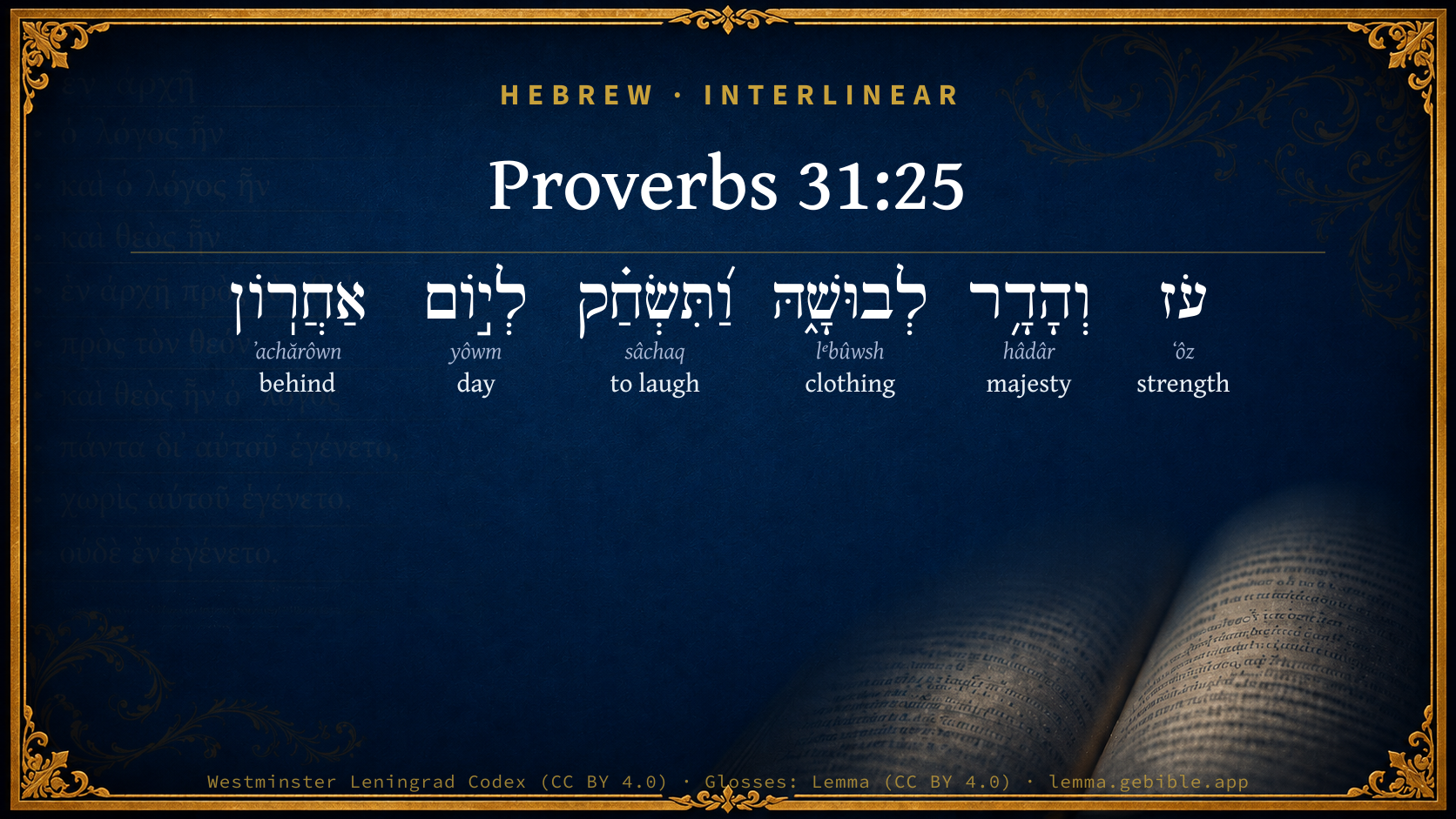
Proverbs 31:25

Hebrew (Westminster Leningrad Codex) Proverbs 31:25 appears in the Hebrew Old Testament. The text above is from the Westminster Leningrad Codex. Each word links to its Strong’s number, a concise gloss, and parsing drawn from the Open Scriptures Hebrew Bible morphology. Click any word for its full Brown-Driver-Briggs (BDB) entry.
Download image
Cite this verse

Proverbs 31:25 (World English Bible). Public Domain. Lemma interlinear Bible study tool, https://lemma.gebible.app/v/proverbs/31/25.

Show BibTeX & RIS
BibTeX
RIS
English Translation
Strength and dignity are her clothing. She laughs at the time to come.
World English Bible · Public Domain
Download a study sheet

One document with this verse’s original text, its word-by-word gloss line, the meaning frame, cross-references with their text, attributed commentary, and full source and license credits — printable, and it pastes into notes with its structure intact.

This verse Autodidact and up

Study sheet (.html) Plain text (.txt)

A passage Seminary Student

Up to 50 verses in one chapter. A passage sheet keeps up to 6 commentary sources and 12 cross-references per verse, in the order this page ranks them, and says so on the sheet whenever that leaves anything out. Ask for a single verse and you get the Autodidact verse sheet above.

Everything on this page stays free to read, with no account — the sheet is a download of what is already on screen, not access to it.

Want to remove ads? Support Godless Engineer
Compare translations 3

The same verse in 3 English versions, stacked beneath the original-language interlinear above. Click any original word for its lexicon entry.

Each is an independent rendering of the whole verse — the interlinear is not word-aligned to these translations.

Highlighted words mark where these versions differ — a whole-verse word diff, not a word-by-word alignment.

  • World English Bible Public Domain
    Strength and dignity are her clothing. She laughs at the time to come.
  • King James Version Public Domain
    Strength and honour are her clothing; and she shall rejoice in time to come.
  • unfoldingWord Literal Text CC BY-SA 4.0
    Strength and splendor her clothing, and she laughs at a future day.

unfoldingWord Literal Text — © unfoldingWord, licensed CC BY-SA 4.0. Word-aligned USFM3 via Door43 (git.door43.org/unfoldingWord/en_ult).

Versions to compare (up to 4)

3 of 4 selected

Show all 18 translations

Every available English version of this verse, each an independent rendering of the whole verse.

  • World English Bible Public Domain
    Strength and dignity are her clothing. She laughs at the time to come.
  • Berean Standard Bible Public Domain
    Strength and honor are her clothing, and she can laugh at the days to come.
  • Majority Standard Bible Public Domain
    Strength and honor are her clothing, and she can laugh at the days to come.
  • King James Version Public Domain
    Strength and honour are her clothing; and she shall rejoice in time to come.
  • American Standard Version (1901) Public Domain
    Strength and dignity are her clothing; And she laugheth at the time to come.
  • Revised Version (1885) Public Domain
    Strength and dignity are her clothing; and she laugheth at the time to come.
  • Geneva Bible (1599) Public Domain
    Strength and honour is her clothing, and in the latter day she shall reioyce.
  • Douay-Rheims (1899) Public Domain
    Strength and beauty are her clothing, and she shall laugh in the latter day.
  • Young's Literal Translation Public Domain
    Strength and honour `are' her clothing, And she rejoiceth at a latter day.
  • Literal Standard Version CC BY-SA 4.0
    Strength and honor [are] her clothing, || And she rejoices at a latter day.
  • Unlocked Literal Bible CC BY-SA 4.0
    She is clothed with strength and honor, and she laughs at the time to come.
  • unfoldingWord Literal Text CC BY-SA 4.0
    Strength and splendor her clothing, and she laughs at a future day.
  • Darby Bible Public Domain
    Strength and dignity are her clothing, and she laugheth [at] the coming day.
  • World Messianic Bible Public Domain
    Strength and dignity are her clothing. She laughs at the time to come.
  • Webster's Bible Public Domain
    Strength and honor are her clothing; and she shall rejoice in time to come.
  • Free Bible Version CC BY-SA 4.0
    She's clothed with strength and dignity, and she is happy about the future.
  • Bible in Basic English Public Domain
    Strength and self-respect are her clothing; she is facing the future with a smile.
  • JPS Tanakh (1917) Public Domain
    Strength and dignity are her clothing; and she laugheth at the time to come.

Literal Standard Version (2020), Covenant Press — licensed CC BY-SA 4.0. Text via the HelloAO Bible API (eBible.org). Unlocked Literal Bible (unfoldingWord) — licensed CC BY-SA 4.0. Text via the HelloAO Bible API (eBible.org). unfoldingWord Literal Text — © unfoldingWord, licensed CC BY-SA 4.0. Word-aligned USFM3 via Door43 (git.door43.org/unfoldingWord/en_ult). Free Bible Version, Dr. Jonathan Gallagher — licensed CC BY-SA 4.0. Text via the HelloAO Bible API (eBible.org).

Word by word

More ways to search: Search by grammar → Find every occurrence → Compare this word →

Practice this passage: Drill this verse → Learn its vocabulary →

About this verse

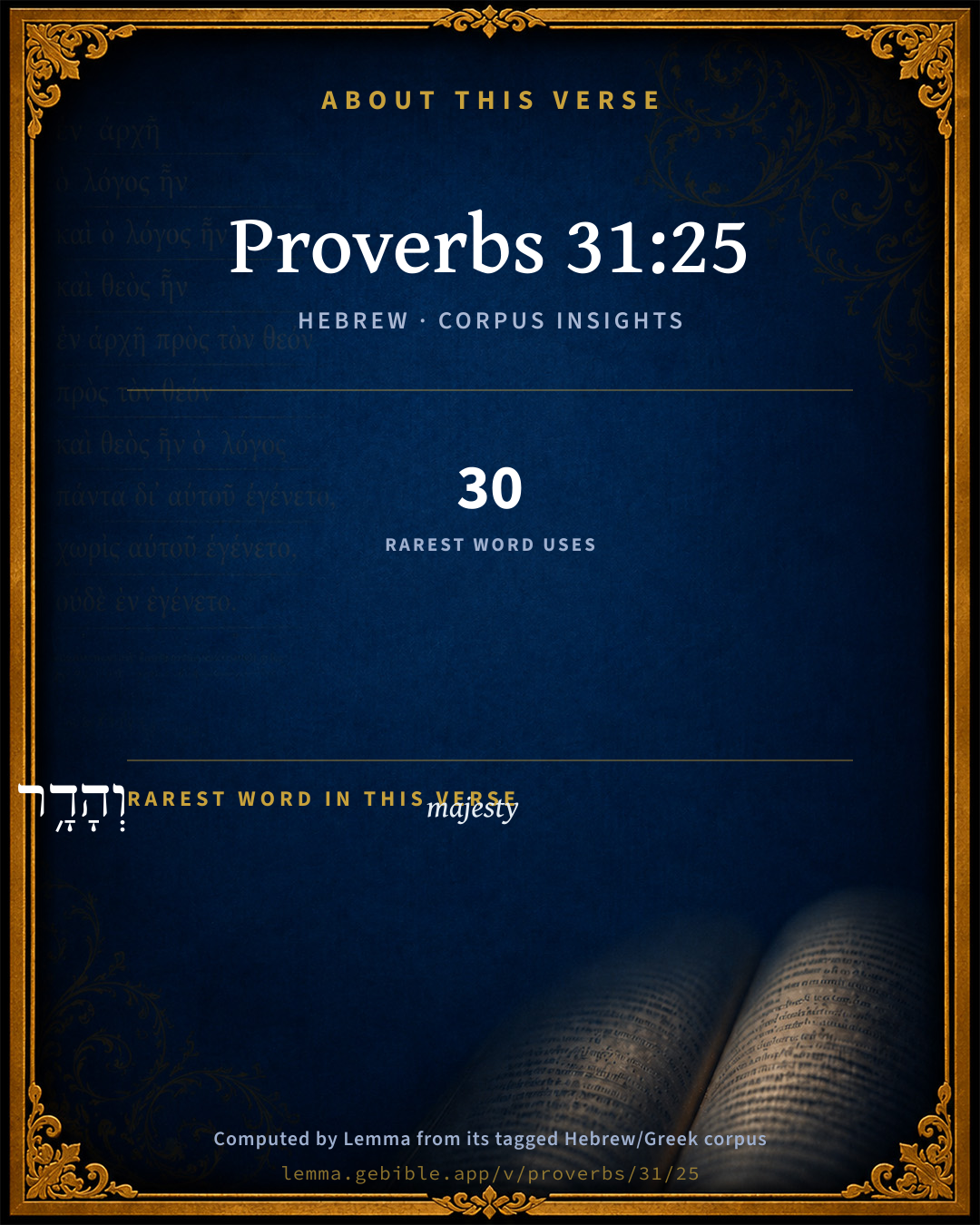
These counts appear in no published source. They are computed here, from the morphology-tagged text and Lemma’s own curated glosses. What Lemma adds →

6
words
6
distinct lemmas
Wisdom
section

Shared distinctive vocabulary

וְהָדָ֥ר majesty H1926 occurs in 29 verses of the Hebrew Bible. Also found in:

Grammatical profile

  • 1 verb
  • 4 nouns
  • 1 adjective

Verb forms

  • וַ֝תִּשְׂחַ֗ק Qal · Sequential Imperfect

Hebrew & Septuagint length

In English translation the verse runs 13 words from the Hebrew and 12 from the Septuagint (LXX English) — closely comparable.

A rough comparison of the two English renderings, which tokenize alike — not a word-level alignment.

Word counts can differ between the Hebrew and the Greek without any difference in meaning — e.g. the Hebrew direct-object marker אֵת has no separate Greek word, and Greek often adds the article ὁ.

Cross-references

12

Topical passages linked to Proverbs 31:25 in the Treasury of Scripture Knowledge — connected by theme and wording, ordered by reader-vote popularity; previews shown in the World English Bible.

  • Job 40:10 "Now deck yourself with excellency and dignity. Array yourself with honor and majesty.
  • Romans 13:14 But put on the Lord Jesus Christ, and make no provision for the flesh, for its lusts.
  • Isaiah 61:10 I will greatly rejoice in Yahweh, my soul shall be joyful in my God; for he has clothed me with the garments of salvation, he has covered me with the robe of righteousness, as a bridegroom decks himself with a garland, and as a bride adorns herself with her jewels.
  • Job 29:14 I put on righteousness, and it clothed me. My justice was as a robe and a diadem.
  • Ephesians 4:24 and put on the new man, who in the likeness of God has been created in righteousness and holiness of truth.
  • 1 Timothy 2:10 but (which becomes women professing godliness) with good works.
  • 1 Peter 5:5–6 Likewise, you younger ones, be subject to the elder. Yes, all of you gird yourselves with humility, to subject yourselves to one another; for "God resists the proud, but gives grace to the humble."
  • Psalms 97:11–12 Light is sown for the righteous, And gladness for the upright in heart.
  • Psalms 132:9 Let your priest be clothed with righteousness. Let your saints shout for joy!"
  • Psalms 132:16 Her priests I will also clothe with salvation. Her saints will shout aloud for joy.
  • Isaiah 65:13–14 Therefore thus says the Lord Yahweh, Behold, my servants shall eat, but you shall be hungry; behold, my servants shall drink, but you shall be thirsty; behold, my servants shall rejoice, but you shall be disappointed;
  • Matthew 25:20–21 He who received the five talents came and brought another five talents, saying, 'Lord, you delivered to me five talents. Behold, I have gained another five talents besides them.'

Cross-references courtesy of OpenBible.info (CC BY 4.0).

Hebrew and Greek witnesses Masoretic Hebrew ↔ Greek Septuagint

The same verse in the two great witnesses to the Old Testament, shown verse-for-verse.

These are two independent witnesses, not word-aligned to each other, and the Septuagint is shown in lemma (dictionary) form.

Hebrew Proverbs 31:25 Masoretic · Westminster Leningrad Codex

עֹז וְהָדָ֥ר לְבוּשָׁ֑הּ וַ֝תִּשְׂחַ֗ק לְי֣וֹם אַחֲרֽוֹן

Strength and dignity are her clothing. She laughs at the time to come.

World English Bible · Public Domain

Greek LXX Proverbs 31:25 Septuagint · lemma form

στόμα αὐτός δια ἀναοἴγω προσεχόντως καί ἐννόμως καί τάξις στέλλω ὁ γλῶσσα αὐτός

She puts on strength and honor; and rejoices in the last days.

LXX2012 (modern English Septuagint) · Public Domain

On this verse, The Pulpit Commentary discusses the Septuagint’s reading. Read the note in Commentary ↓

Hebrew: Westminster Leningrad Codex (CC BY 4.0). Greek: Septuagint (public domain); English from LXX2012 (modern English Septuagint) (Public Domain). How the Septuagint differs from the Hebrew →

Commentary

Notes on Proverbs 31:25 from classic Christian and Jewish commentators (each source and its license shown beneath its notes). The classic Christian expositions comment on the surrounding passage and are grouped to its opening verse, so a note may address several verses; the Jewish commentaries on the Tanakh (Rashi and others) are per-verse, so they appear only where the commentator wrote on this verse.

Lemma curates 59 commentaries, every one of them public domain or Creative Commons licensed, each selected and text-cleaned for this edition rather than reprinted as found. About our sources →

Trapp's Complete Commentary

John Trapp

Pro 31:25 Strength and honour [are] her clothing; and she shall rejoice in time to come.

Ver. 25. Strength and honour are her clothing.] See Pro 31:22. She is not of those, quae fulgent monilibus, sordent moribus, that are well habited but ill mannered. No; she is inwardly decked with spiritual attire, such as rendereth her glorious in the eyes of God and angels. "The joy of the Lord is her strength," so that she laugheth at the time to come. This "daughter of Sarah, so long as she doth well," and hath the euge a good conscience, "is not afraid with any amazement," as women are apt to be. {1Pe 3:6} Gaudebat Crispina cum tenebatur, cure audiebatur, cum damnabatur, cam dacebutur. {a} So did Mistress Anne Askew, Alice Driver, and many other gracious women that suffered for the truth in Queen Mary’s days. Strength and honour were their clothing, and they rejoiced at the time to come: they went as merry to die as to dine, and cheered up one another with this, that although they had but a bitter breakfast, yet they should sup with Christ in joy.

{a} Aug. in Ps. cxxxvii.

John Trapp, A Commentary or Exposition upon All the Books of the Old and New Testament (1647–1656) — public domain. Text from a community e-Sword module.

Tyndale Open Study Notes

Tyndale Open Resources

31:25-27 The noble wife’s character exemplifies wisdom. She is coolheaded as she faces future uncertainties. She gives advice in a winsome way.

Tyndale Open Study Notes — © Tyndale Open Resources, licensed CC BY-SA 4.0. Text via the HelloAO Bible API.

Geneva Bible (1599)

Geneva Bible translators

After that he had spoken of the apparel of the body, he now declareth the apparel of the spirit.

Geneva Bible (1599) marginal notes — public domain. Text via Bolls.life.

Jamieson, Fausset & Brown

Robert Jamieson, A. R. Fausset & David Brown

Strength and honour--Strong and beautiful is her clothing; or, figuratively, for moral character, vigorous and honorable.

shall rejoice . . . come--in confidence of certain maintenance.

Jamieson, Fausset & Brown — Commentary Critical and Explanatory on the Whole Bible (1871) — public domain (CC PDM 1.0). Text via the HelloAO Bible API.

Adam Clarke's Commentary

Verse 25. Strength and honour are her clothing]

16. All the articles manufactured by herself or under her care have a double perfection:

1). They are strong.

2) They are elegant; Strength and honour are her clothing; and on account of this she shall rejoice in time to come; she shall never have occasion to blush for any thing she has made, for any thing she or hers have worn, or for any thing she has sold. Besides, she has so conducted herself that she has reason to expect that the hand of the Lord shall be still with her, and shall keep her from evil that it may not grieve her.

Adam Clarke's Commentary on the Bible (1810–1826) — public domain. Text from a community e-Sword/MySword module.

Ellicott's Commentary for English Readers

(25) Strength and honour are her clothing.—She never parts with them; they serve her, like clothing, for protection and ornament. (Comp. Psa_104:1.)

And she shall rejoice in time to come.—Rather, smiles at the coming day; does not fear the future.

A Bible Commentary for English Readers, edited by Charles John Ellicott (1878–1897) — public domain. Text from a community e-Sword module.

The Cambridge Bible for Schools and Colleges

gen. ed. J. J. S. Perowne

25. she shall rejoice in] Rather: she laugheth at, i.e. so far from regarding it with apprehension, she can look forward to it with joyful confidence. Comp. “He laugheth at the rushing of the javelin,” in the description of Leviathan, Job_41:29.

The Cambridge Bible for Schools and Colleges (gen. ed. J. J. S. Perowne; Cambridge University Press, 1878–1918) — public domain. Text from a community e-Sword module.

John Gill's Exposition

Strength and honour are her clothing,.... Strength, not of body, but of mind. The church is clothed with strength, as her Lord, head, and husband, is said to be, Psa 93:1; and which she has from him; for though she is the weaker vessel, and weak in herself, yet is strong in him; and is able to bear and do all things, with a fortitude of mind to withstand every enemy, and persevere in well doing: and she is clothed with "honour"; with honourable garments, suitable to her rank and dignity; in cloth of gold, in raiment of needlework; with the garments of salvation, and the robe of righteousness;

and she shall rejoice in time to come; Aben Ezra interprets it of old age, or of the world to come; and Jarchi and Gersom of the day of death: having fulness of food and clothing, she is not afraid of want in old age, or in any time of distress that may come; and having a good name, laughs at death, and departs in peace; so these interpreters. The church of Christ fears no want at any time, nor need any of her members; they have a clothing that never waxes old, a righteousness that will answer for them in a time to come; their bread is given, and their waters are sure; they shall want no good thing; all their need is supplied from Christ; they have hope in their death, and rejoice then and sing, "O death, where is thy sting?" Co1 15:55; they will have confidence in the day of judgment, and not be ashamed; shall come to Zion with everlasting joy; and shall rejoice with Christ, angels and saints, to all eternity.

John Gill's Exposition of the Whole Bible (1746–1763) — public domain (CC PDM 1.0). Text via the HelloAO Bible API.

Albert Barnes' Notes on the Bible

Shall rejoice in time to come - Better, rejoiceth over the time to come; i. e., looks forward to the future, not with anxious care, but with confident gladness.

Albert Barnes' Notes on the Bible (1834–1885) — public domain. Text from a community e-Sword/MySword module.

Haydock's Catholic Bible Commentary

Clothing: it is very beautiful, or wisdom and virtue surround her. --- Day. She fears not death, (Calmet) or future distress of hunger, &c. (Jansenius)

George Leo Haydock (1774–1849), Haydock's Catholic Family Bible and Commentary, 1859 edition — public domain. Excludes Psalms (Douay-Rheims chapter numbering differs from Protestant) and Deuterocanonical books (Catholic canon only).

Matthew Poole's English Annotations

Strength; not strength of body, which is no ornament of that sex, save only as she preserves her health and strength by sobriety and exercise, which other men waste by intemperance and idleness; but strength of mind, magnanimity, courage, resolution, activity.

Honour; either,

1. Her prudent, and pious, and amiable behaviour, in which true honour principally consists. Or,

2. That good name and honourable esteem which she hath gained amongst all that know her by her virtuous disposition and carnage.

Her clothing; these, and not her rich garments mentioned before, are her great ornament and glory.

She shall rejoice in thee to come: the sense is either,

1. In her old age she reaps the comfort and benefit of her youthful labours, Or rather,

2. She lives in constant tranquillity of mind, and a confident and cheerful expectation of all future events, how calamitous soever, partly because she hath laid in provisions for a rainy day, and chiefly because she hath the comfortable remembrance of a well-spent life, and, which follows thereupon, a just confidence in God’s gracious providence and promises made to such persons.

Matthew Poole's English Annotations on the Holy Bible (1683–1685) — public domain. Text from a community e-Sword/MySword module.

Whedon's Commentary on the Bible

Daniel D. Whedon

25. Strength and honour — Or, beauty; (the abstract for the concrete;) her clothing is strong and beautiful, both that which she wears and that which she sells; and, therefore, she has no depressing solicitude for the future.

Shall rejoice in time to come — Rather, rejoices, or is cheerful for the future; literally, she laughs at the after day. Fearing God and working righteousness, pursuing a lucrative business and blessed of Providence, she is cheerful in view of the future.

Daniel D. Whedon (gen. ed.), Commentary on the Old and New Testaments (1874–1909) — public domain. Text from a community e-Sword module.

The Pulpit Commentary

AYIN. Strength and honour are her clothing (ver. 17); iscu euprepeian , Septuagint. She is invested with a moral force and dignity which arm her against care and worry; the power of a righteous purpose and strong will reveals itself in her carriage and demeanour. And thus equipped, she shall rejoice in time to come; or, she laugheth (Job_5:22 Job_39:7) at the future. (Isa_30:8) She is not disquieted by any fear of what may happen, knowing in whom she trusts, and having done her duty to the utmost of her ability. The Greek and Latin versions seem to take the expression as referring to the day of death; thus the Vulgate, Ridebit in die novissimo; Septuagint, "She rejoices in the last days (en hmeraiv escataiv ). But it is best interpreted as above. The true servant of God is not afraid of any evil tidings, his heart being fixed, trusting in the Lord. (Psa_112:7)

The Pulpit Commentary (1880–1919), ed. H.D.M. Spence-Jones & Joseph S. Exell — public domain. Text from a community e-Sword module.

John Wesley's Explanatory Notes

Strength - Strength of mind, magnanimity, courage, activity. Her clothing - Her ornament and glory. Rejoice - She lives in constant tranquillity of mind, from a just confidence in God's gracious providence.

John Wesley, Explanatory Notes Upon the Whole Bible (1754–1765) — public domain. Text via the GEBible commentary corpus.

Keil & Delitzsch

C. F. Keil & F. Delitzsch

The description is now more inward:

25 ע Strength and honour is her clothing;

Thus she laugheth at the future day.

She is clothed with עז, strength, i.e., power over the changes of temporal circumstances, which easily shatter and bring to ruin a household resting on less solid foundations; clothed with הדר, glory, i.e., elevation above that which is low, little, common, a state in which they remain who propose to themselves no high aim after which they strive with all their might: in other words, her raiment is just pride, true dignity, with which she looks confidently into the future, and is armed against all sorrow and care. The connection of ideas, עז והדר (defectively written, on the contrary, at Psa 84:6, Masora, and only there written plene, and with Munach), instead of the frequent הוד והדר, occurs only here. The expression 25b is like Job 39:7, wherefore Hitzig rightly compares Job 24:14 to 25a. יום אחרון, distinguished from אחרית, and incorrectly interpreted (Rashi) of the day of death, is, as at Isa 30:8, the future, here that which one at a later period may enter upon.

Keil & Delitzsch — Biblical Commentary on the Old Testament (1861–1891) — public domain (CC PDM 1.0). Text via the HelloAO Bible API. (Old Testament only.)

Rashi

Rabbi Shlomo Yitzchaki (Rashi)

at the last day On the day of her death, she departs with a good name.

and she laughs all her life about the day of her death, that it should be honored with a good name.

Rashi on the Tanakh — English translations: “The Judaica Press complete Tanach with Rashi, translated by A. J. Rosenberg” (CC BY 4.0); “Pentateuch with Rashi's commentary by M. Rosenbaum and A.M. Silbermann, 1929-1934” (public domain); “The Metsudah Tanach series, Lakewood, N.J” (CC BY 4.0); and “The Book of Joshua, Metsudah Publications, 1997” (CC BY 4.0). Text via Sefaria.

Lesson kit

Teaching starters — assembled from the data on this page, not authored interpretation. Every prompt links to the verse data it draws on. Edit before teaching.

Proverbs, in the Wisdom, opens this verse with 6 words (6 distinct Hebrew lemmas). Its most distinctive word is hâdâr (“majesty”). A historical commentator’s framing appears above. Read the whole chapter for the surrounding context.

Discussion questions

  1. How does “majesty” (hâdâr) shape what this verse is saying?
  2. Leviticus 23:40 shares the word «majesty» with this verse. How do the two illuminate each other?
  3. These translations render this verse differently. What is at stake in choosing one wording over another?
  4. The verb «וַ֝תִּשְׂחַ֗ק» is Qal Sequential Imperfect. How does its form color the action?
  5. Reading how Trapp's Complete Commentary and Tyndale Open Study Notes read this verse, where do the two commentators agree and where do they part?

Things to notice

Reading settings

Reading text

Shown beneath each verse's original-language words.

Old Testament
Old Testament edition

Read the OT as the Masoretic Hebrew (MT) or the Greek Septuagint (LXX).

English shown for the Greek Septuagint (in the Hebrew ↔ Greek comparison).

Comparing translations? Open the Compare panel on any verse page to stack up to four side by side.