Jeremiah 48:17

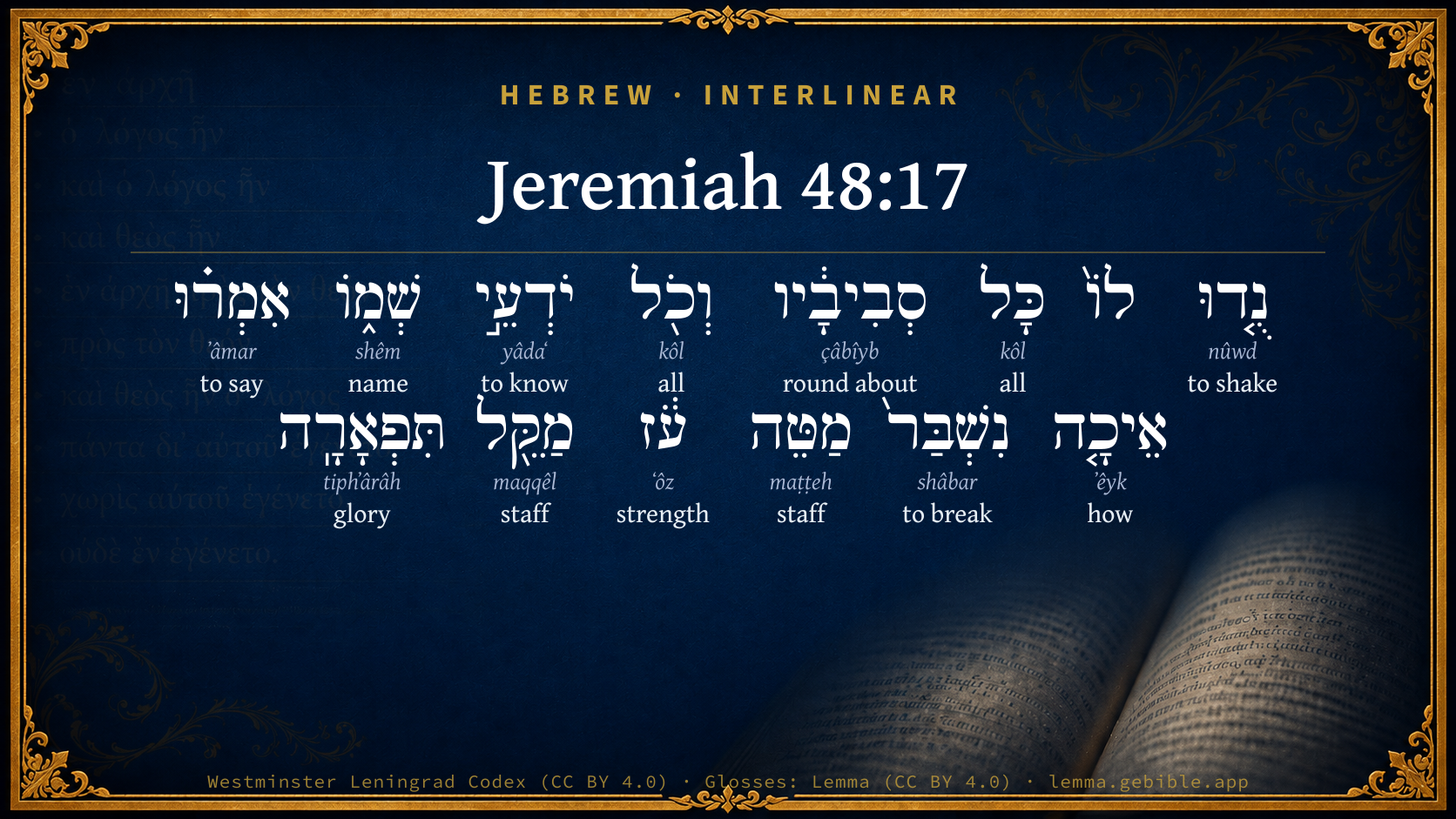
Hebrew (Westminster Leningrad Codex) Jeremiah 48:17 appears in the Hebrew Old Testament. The text above is from the Westminster Leningrad Codex. Each word links to its Strong’s number, a concise gloss, and parsing drawn from the Open Scriptures Hebrew Bible morphology. Click any word for its full Brown-Driver-Briggs (BDB) entry.
Download image
Cite this verse

Jeremiah 48:17 (World English Bible). Public Domain. Lemma interlinear Bible study tool, https://lemma.gebible.app/v/jeremiah/48/17.

Show BibTeX & RIS
BibTeX
RIS
English Translation
All you who are round about him, bemoan him, and all you who know his name; say, How is the strong staff broken, the beautiful rod!
World English Bible · Public Domain
Download a study sheet

One document with this verse’s original text, its word-by-word gloss line, the meaning frame, cross-references with their text, attributed commentary, and full source and license credits — printable, and it pastes into notes with its structure intact.

This verse Autodidact and up

Study sheet (.html) Plain text (.txt)

A passage Seminary Student

Up to 50 verses in one chapter. A passage sheet keeps up to 6 commentary sources and 12 cross-references per verse, in the order this page ranks them, and says so on the sheet whenever that leaves anything out. Ask for a single verse and you get the Autodidact verse sheet above.

Everything on this page stays free to read, with no account — the sheet is a download of what is already on screen, not access to it.

Want to remove ads? Support Godless Engineer
Compare translations 3

The same verse in 3 English versions, stacked beneath the original-language interlinear above. Click any original word for its lexicon entry.

Each is an independent rendering of the whole verse — the interlinear is not word-aligned to these translations.

Highlighted words mark where these versions differ — a whole-verse word diff, not a word-by-word alignment.

  • World English Bible Public Domain
    All you who are round about him, bemoan him, and all you who know his name; say, How is the strong staff broken, the beautiful rod!
  • King James Version Public Domain
    All ye that are about him, bemoan him; and all ye that know his name, say, How is the strong staff broken, and the beautiful rod!
  • unfoldingWord Literal Text CC BY-SA 4.0
    All you who are around Moab, wail; and all you who know its fame, shout this, ‘Woe, the strong staff, the honored rod, has been broken.’

unfoldingWord Literal Text — © unfoldingWord, licensed CC BY-SA 4.0. Word-aligned USFM3 via Door43 (git.door43.org/unfoldingWord/en_ult).

Versions to compare (up to 4)

3 of 4 selected

Show all 18 translations

Every available English version of this verse, each an independent rendering of the whole verse.

  • World English Bible Public Domain
    All you who are round about him, bemoan him, and all you who know his name; say, How is the strong staff broken, the beautiful rod!
  • Berean Standard Bible Public Domain
    Mourn for him, all you who surround him, everyone who knows his name; tell how the mighty scepter is shattered—the glorious staff!
  • Majority Standard Bible Public Domain
    Mourn for him, all you who surround him, everyone who knows his name; tell how the mighty scepter is shattered—the glorious staff!
  • King James Version Public Domain
    All ye that are about him, bemoan him; and all ye that know his name, say, How is the strong staff broken, and the beautiful rod!
  • American Standard Version (1901) Public Domain
    All ye that are round about him, bemoan him, and all ye that know his name; say, How is the strong staff broken, the beautiful rod!
  • Revised Version (1885) Public Domain
    All ye that are round about him, bemoan him, and all ye that know his name; say, How is the strong staff broken, the beautiful rod!
  • Geneva Bible (1599) Public Domain
    All ye that are about him, mourne for him, and all ye that knowe his name, say, Howe is the strong staffe broken, and the beautifull rod!
  • Douay-Rheims (1899) Public Domain
    Comfort him, all you that are round about him, and all you that know his name, say: How is the strong staff broken, the beautiful rod?
  • Young's Literal Translation Public Domain
    Bemoan for him, all ye round about him, And all knowing his name, say ye: How hath it been broken, the staff of strength, The rod of beauty.
  • Literal Standard Version CC BY-SA 4.0
    Bemoan for him, all you around him, || And all knowing his name, say, || How it has been broken, the staff of strength, || The rod of beauty!
  • Unlocked Literal Bible CC BY-SA 4.0
    All you who are around Moab, wail; and all you who know its fame, shout this, 'Woe, the strong staff, the honored rod, has been broken.'
  • unfoldingWord Literal Text CC BY-SA 4.0
    All you who are around Moab, wail; and all you who know its fame, shout this, ‘Woe, the strong staff, the honored rod, has been broken.’
  • Darby Bible Public Domain
    All ye that are about him, bemoan him; and all ye that know his name, say, How is the strong staff broken, the beautiful rod!
  • World Messianic Bible Public Domain
    All you who are around him, bemoan him; and all you who know his name, say, ‘How the strong staff is broken, the beautiful rod!’
  • Webster's Bible Public Domain
    All ye that are about him bemoan him; and all ye that know his name, say, How is the strong staff broken, and the beautiful rod!
  • Free Bible Version CC BY-SA 4.0
    Mourn for them, all you surrounding nations, everyone who knows them! Let others know how the great scepter has been smashed, the rod that once proudly ruled!
  • Bible in Basic English Public Domain
    All you who are round about him, give signs of grief for him, and all you who have knowledge of his name, say, How is the strong rod broken, even the beautiful branch!
  • JPS Tanakh (1917) Public Domain
    Bemoan him, all ye that are round about him, and all ye that know his name; say: 'How is the strong staff broken, the beautiful rod!'

Literal Standard Version (2020), Covenant Press — licensed CC BY-SA 4.0. Text via the HelloAO Bible API (eBible.org). Unlocked Literal Bible (unfoldingWord) — licensed CC BY-SA 4.0. Text via the HelloAO Bible API (eBible.org). unfoldingWord Literal Text — © unfoldingWord, licensed CC BY-SA 4.0. Word-aligned USFM3 via Door43 (git.door43.org/unfoldingWord/en_ult). Free Bible Version, Dr. Jonathan Gallagher — licensed CC BY-SA 4.0. Text via the HelloAO Bible API (eBible.org).

Word by word

More ways to search: Search by grammar → Find every occurrence → Compare this word →

Practice this passage: Drill this verse → Learn its vocabulary →

מַקֵּ֖ל
maqqêl
H4731
“staff of”
Noun, Common, Masculine, Singular, Construct
Part of Speech
Noun
Type
Common
Gender
Masculine
Number
Singular
State
Construct
Full BDB Definition

Origin: from an unused root meaning apparently to germinate

TWOT: 1236

rod, staff - rod, stick - staff (in travel) - wand (of diviner)
  1. נֻ֤דוּ nûwd H5110 “shake” Verb, Qal, Imperative, 2nd Person, Masculine, Plural
  2. כָּל kôl H3605 “all of” Noun, Common, Masculine, Singular, Construct
  3. סְבִיבָ֔יו çâbîyb H5439 “surroundings · his” Noun, Common, Both, Plural, Construct + Suffix, Personal, 3rd Person, Masculine, Singular
  4. וְכֹ֖ל kôl H3605 “and · all of” Conjunction + Noun, Common, Masculine, Singular, Construct
  5. יֹדְעֵ֣י yâdaʻ H3045 “knowing” Verb, Qal, Participle Active, Masculine, Plural, Construct
  6. שְׁמ֑וֹ shêm H8034 “name · his” Noun, Common, Masculine, Singular, Construct + Suffix, Personal, 3rd Person, Masculine, Singular
  7. אִמְר֗וּ ʼâmar H559 “say” Verb, Qal, Imperative, 2nd Person, Masculine, Plural
  8. אֵיכָ֤ה ʼêyk H349 “how” Particle, Interrogative
  9. נִשְׁבַּר֙ shâbar H7665 “to break” Verb, Niphal, Perfect, 3rd Person, Masculine, Singular
  10. מַטֵּה maṭṭeh H4294 “staff of” Noun, Common, Masculine, Singular, Construct
  11. עֹ֔ז ʻôz H5797 “strength” Noun, Common, Masculine, Singular, Absolute
  12. תִּפְאָרָֽה tiphʼârâh H8597 “glory” Noun, Common, Feminine, Singular, Absolute

About this verse

These counts appear in no published source. They are computed here, from the morphology-tagged text and Lemma’s own curated glosses. What Lemma adds →

14
words
12
distinct lemmas
Prophets
section

Notable vocabulary

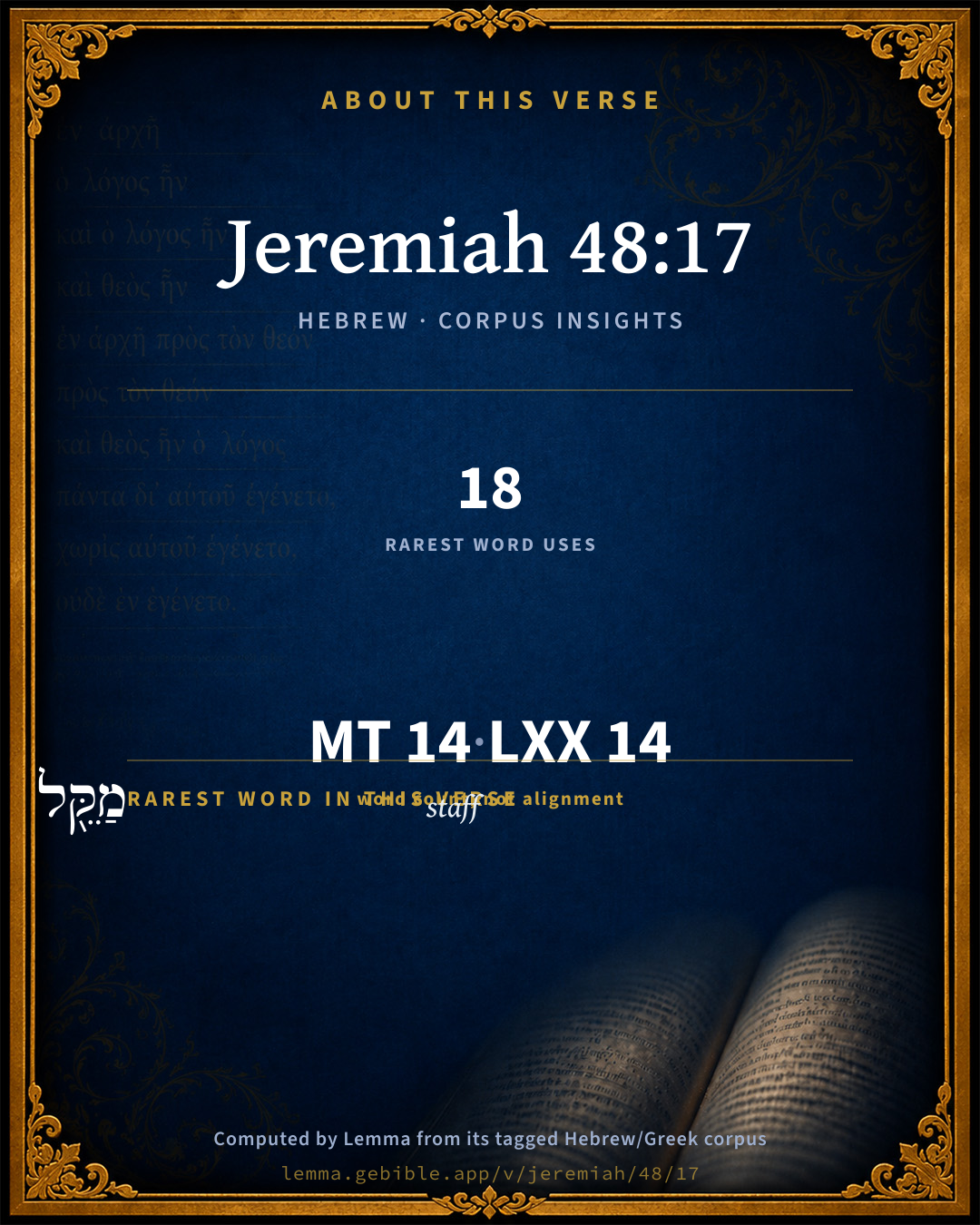
The rarest word here is מַקֵּ֖ל staff H4731 — appearing just 18 times in the whole Hebrew Bible.

Shared distinctive vocabulary

מַקֵּ֖ל staff H4731 occurs in 16 verses of the Hebrew Bible. Also found in:

Grammatical profile

  • 4 verbs
  • 8 nouns
  • 1 preposition
  • 1 particle

Verb forms

  • נֻ֤דוּ Qal · Imperative
  • יֹדְעֵ֣י Qal · Participle Active
  • אִמְר֗וּ Qal · Imperative
  • נִשְׁבַּר֙ Niphal · Perfect

Repetition

A word recurs within this verse — often emphatic in Hebrew:

Hebrew & Septuagint length

In the original languages it is 14 Hebrew tokens and 14 Greek tokens — but the two are counted differently (Hebrew bundles its prefixes and suffixes into one token; the Greek is in lemma form), so that isn’t a like-for-like length.

Cross-references

10

Topical passages linked to Jeremiah 48:17 in the Treasury of Scripture Knowledge — connected by theme and wording, ordered by reader-vote popularity; previews shown in the World English Bible.

  • Isaiah 9:4 For the yoke of his burden, and the staff of his shoulder, the rod of his oppressor, you have broken as in the day of Midian.
  • Isaiah 10:5 Ho Assyrian, the rod of my anger, the staff in whose hand is my indignation!
  • Isaiah 14:4–5 that you shall take up this parable against the king of Babylon, and say, How has the oppressor ceased! the golden city ceased!
  • Isaiah 16:8 For the fields of Heshbon languish, [and] the vine of Sibmah; the lords of the nations have broken down the choice branches of it, which reached even to Jazer, which wandered into the wilderness; its shoots were spread abroad, they passed over the sea.
  • Jeremiah 9:17–20 Thus says Yahweh of Hosts, Consider you, and call for the mourning women, that they may come; and send for the skillful women, that they may come:
  • Jeremiah 48:31–33 Therefore will I wail for Moab; yes, I will cry out for all Moab: for the men of Kir Heres shall they mourn.
  • Jeremiah 48:39 How is it broken down! [how] do they wail! how has Moab turned the back with shame! so shall Moab become a derision and a terror to all who are round about him.
  • Ezekiel 19:11–14 It had strong rods for the scepters of those who bore rule, and their stature was exalted among the thick boughs, and they were seen in their height with the multitude of their branches.
  • Zechariah 11:10–14 I took my staff Favor, and cut it apart, that I might break my covenant that I had made with all the peoples.
  • Revelation 18:14–20 The fruits which your soul lusted after have been lost to you, and all things that were dainty and sumptuous have perished from you, and you will find them no more at all.

Cross-references courtesy of OpenBible.info (CC BY 4.0).

Hebrew and Greek witnesses Masoretic Hebrew ↔ Greek Septuagint

The same verse in the two great witnesses to the Old Testament, shown verse-for-verse.

These are two independent witnesses, not word-aligned to each other, and the Septuagint is shown in lemma (dictionary) form.

Hebrew Jeremiah 48:17 Masoretic · Westminster Leningrad Codex

נֻ֤דוּ לוֹ֙ כָּל סְבִיבָ֔יו וְכֹ֖ל יֹדְעֵ֣י שְׁמ֑וֹ אִמְר֗וּ אֵיכָ֤ה נִשְׁבַּר֙ מַטֵּה עֹ֔ז מַקֵּ֖ל תִּפְאָרָֽה

All you who are round about him, bemoan him, and all you who know his name; say, How is the strong staff broken, the beautiful rod!

World English Bible · Public Domain

Greek LXX Structure differs

In the Septuagint, Jeremiah is about an eighth shorter than the Hebrew and arranges its material differently — the Oracles Against the Nations (Hebrew chapters 46–51) appear in the middle of the Greek book, after 25:13. Because the chapter and verse boundaries do not line up, a verse-for-verse comparison with the Hebrew is not shown.

A verse-for-verse comparison isn’t shown here because the chapters and verses don’t line up. Switch to the LXX edition with the MT / LXX toggle above to read the Greek directly.

Hebrew: Westminster Leningrad Codex (CC BY 4.0). Greek: Septuagint (public domain); English from a public-domain English Septuagint. How the Septuagint differs from the Hebrew →

Targum (Aramaic paraphrase)

1

The Targum is the ancient Jewish Aramaic paraphrase of the Hebrew Scriptures — an interpretive translation, not the Hebrew text itself. Onkelos (literal) and Pseudo-Jonathan (expansive) render the Torah, and Jonathan the Prophets. Coverage is partial: where no permissively-licensed English translation exists for a verse, only the Aramaic is shown. This is verse-level text, not a word-by-word alignment to the Hebrew.

  1. Targum Jonathan Prophets (Joshua–Malachi)
    דְווֹ עֲלוֹהִי כָּל סַחֲרָנוֹהִי וְכָל יָדְעֵי שְׁמֵיהּ אֲמָרוּ אֵיכְדֵין אִתְּבַר מְלַךְ מַבְאִישׁ שִׁלְטוֹן מָעִיק:

    (no public-domain English translation for this verse)

    Targum Jonathan — Aramaic: “Mikraot Gedolot” (public domain). English: “Sefaria Community Translation” (CC0 1.0 (public-domain dedication)); “London "Chaldee Paraphrase," 1871” (public domain). Text via Sefaria.

Commentary

Notes on Jeremiah 48:17 from classic Christian and Jewish commentators (each source and its license shown beneath its notes). The classic Christian expositions comment on the surrounding passage and are grouped to its opening verse, so a note may address several verses; the Jewish commentaries on the Tanakh (Rashi and others) are per-verse, so they appear only where the commentator wrote on this verse.

Lemma curates 59 commentaries, every one of them public domain or Creative Commons licensed, each selected and text-cleaned for this edition rather than reprinted as found. About our sources →

Trapp's Complete Commentary

John Trapp

Jer 48:17 All ye that are about him, bemoan him; and all ye that know his name, say, How is the strong staff broken, [and] the beautiful rod!

Ver. 17. All ye that are about him, bemoan him.] And that ye may not want a form, say ye, How is the strong staff broken!

John Trapp, A Commentary or Exposition upon All the Books of the Old and New Testament (1647–1656) — public domain. Text from a community e-Sword module.

The Biblical Illustrator

Joseph S. Exell

Jer_48:17

How is the strong staff broken.

The strong staff and the beautiful rod

I. The purposes of our Heavenly Father in great bereavements.

1. To teach us that we should not misplace our trust.

2. To convince us of our sins and to sever us from them.

3. To teach us His own independence of the instruments He employs.

4. To remind us of the sovereignty of God.

5. To exhibit His wise and watchful providence.

II. The duties to which we are, and such scenes, specially called.

1. We are to exercise submission.

2. That we should profit by the example of those who have died in the Lord.

3. That we should cease from man and put our trust in God. (W. R. Williams.)

The Biblical Illustrator, edited by Joseph S. Exell (c. 1880s–1900s) — public domain. Text from a community e-Sword module.

Geneva Bible (1599)

Geneva Bible translators

How are they destroyed that put their trust in their strength and riches?

Geneva Bible (1599) marginal notes — public domain. Text via Bolls.life.

Jamieson, Fausset & Brown

Robert Jamieson, A. R. Fausset & David Brown

bemoan--Not that Moab deserves pity, but this mode of expression pictures more vividly the grievousness of Moab's calamities.

all ye that know his name--those at a greater distance whom the fame of Moab's "name" had reached, as distinguished from those "about him," that is, near.

strong staff . . . rod--Moab is so called as striking terror into and oppressing other peoples (Isa 9:4; Isa 14:4-5); also because of its dignity and power (Psa 110:2; Zac 11:7).

Jamieson, Fausset & Brown — Commentary Critical and Explanatory on the Whole Bible (1871) — public domain (CC PDM 1.0). Text via the HelloAO Bible API.

Adam Clarke's Commentary

Verse 17. How is the strong staff broken] The sceptre. The sovereignty of Moab is destroyed.

Adam Clarke's Commentary on the Bible (1810–1826) — public domain. Text from a community e-Sword/MySword module.

John Calvin's Commentaries

The Prophet seems indeed to exhort all neighbors to sympathy; but we have stated for what purpose he did this; for it was not his object to show that the Moabites deserved pity, so that their neighbors ought to have condoled with them in their calamities: but by this figurative mode of speaking he exaggerated the grievousness of the evils which were soon to happen to the Moabites; as though he had said, “This judgment of God will be so dreadful as to make all their neighbors to tremble; all who had previously known the state of the people of Moab, will be smitten with such terror as will make them to groan and mourn with them.” In short, the Prophet had nothing else in view than to show that God’s vengeance on the Moabites would not be less severe and dreadful than it had been on the ten tribes, and what it would be on the tribe of Judah.

Say ye, he says, how is the staff broken? He introduces here all their neighbors as astonished with wonder; for the same purpose are other things mentioned, even to show that the calamity of Moab would be deemed a prodigy, for the people thought them unassailable, and no one had ever dared to attempt anything against their land. This, then, was the reason why the Prophet here asks as one astonished, even in the person of all nations, How has it happened that the staff is broken? and the beautiful rod? These are metaphorical words, which refer to the royal dignity and the condition of the whole people. It follows —

John Calvin's Commentaries (1540-1563) — public domain. Text from the Calvin Translation Society English edition (1840s-50s) via the Christian Classics Ethereal Library (ccel.org). Calvin's coverage is partial (roughly two-thirds of the Bible); uncommented books and verses are honest gaps, never fabricated. The 19th-century editor's footnotes and remarks are omitted so the notes are faithfully Calvin's own voice.

The Cambridge Bible for Schools and Colleges

gen. ed. J. J. S. Perowne

17. For the use of “How” introducing a lament, cp. Lam_1:1; Lam_2:1; Lam_4:1.

the strong staff (mg. sceptre) … the beautiful rod] For these expressions, as implying national glory and power over others, cp. Psa_110:2; Isa_14:29; Eze_19:11-12; Eze_19:14.

The Cambridge Bible for Schools and Colleges (gen. ed. J. J. S. Perowne; Cambridge University Press, 1878–1918) — public domain. Text from a community e-Sword module.

John Gill's Exposition

Thou daughter that dost inhabit Dibon,.... A city in Moab; See Gill on Isa 15:2. The Targum is,

"O kingdom of the congregation of Dibon;''

but this was not a kingdom of itself, though a principal city in the kingdom of Moab:

come down from thy glory, and sit in thirst; in a dry and thirsty land; in want of all the necessaries of life; in captivity; who before abounded with all good things, inhabiting a well watered and fruitful soil; see Isa 15:9; but now called to quit all their former glory and happiness, their fulness and felicity, and submit to the greatest straits and difficulties:

for the spoiler of Moab shall come upon thee, and he shall destroy thy strong holds; the king of Babylon and his army, who spoiled the other cities of Moab; he should come against this also, and take it, and demolish its fortifications, by reason of which it thought itself secure; but these should not be able to protect it.

John Gill's Exposition of the Whole Bible (1746–1763) — public domain (CC PDM 1.0). Text via the HelloAO Bible API.

Albert Barnes' Notes on the Bible

The lamentation over Moab uttered by those “round about him,” i. e., the neighboring nations, and those “that know his name,” nations more remote, who know little more than that, there is such a people, takes the form of an elegy. The metaphorical expressions, “staff of strength,” and “rod” or “scepter of beauty,” indicate the union of power and splendor in the Moabite kingdom.

Albert Barnes' Notes on the Bible (1834–1885) — public domain. Text from a community e-Sword/MySword module.

Haydock's Catholic Bible Commentary

His name, as particular friends, Exodus xxxiii. 12, 17. People in the East had a secret name, which they disclosed to very few, to prevent incantations. --- Rod. This nation was exceedingly vain, ver. 29.

George Leo Haydock (1774–1849), Haydock's Catholic Family Bible and Commentary, 1859 edition — public domain. Excludes Psalms (Douay-Rheims chapter numbering differs from Protestant) and Deuterocanonical books (Catholic canon only).

Matthew Poole's English Annotations

All ye that are about him, bemoan him: the prophet having spoken of Moab’s calamity as already come upon him, or at least very near, calls to his friends to come and condole with him, as is usually done in case of some calamity befallen to a friend.

All ye that know his name, say, How is the strong staff broken, and the beautiful rod! All ye that know how terrible Moab hath been to others, and how famous for mighty and strong men, say, How is this potent nation, and this people that hath been such a rod against others, or hath ruled over so many others, broken! for both a staff and a rod are as well ensigns of power and government, as instruments to punish offenders.

Matthew Poole's English Annotations on the Holy Bible (1683–1685) — public domain. Text from a community e-Sword/MySword module.

Whedon's Commentary on the Bible

Daniel D. Whedon

PARTICULARS OF MOAB’S RUIN, Jer_48:16-25.

17. Strong staff… beautiful rod — The power and the splendour of Moab have departed.

Daniel D. Whedon (gen. ed.), Commentary on the Old and New Testaments (1874–1909) — public domain. Text from a community e-Sword module.

The Pulpit Commentary

Vers. 17-25. How lamentable that such a glorious sceptre should be broken! But there is no remedy. Even Dibon, that highly honoured town, is disgraced. There is no hiding the sad fate of the Moabites; the crowds of fugitives sufficiently proclaim it. Judgment has been passed upon all the cities of Moab, a long roll of whose names is recited.

All ye that are about him; i.e. the neighbouring nations. (see on Jer_46:14) The invitation to condolence is not ironical, but in the deepest spirit of human sympathy, as in the parallel prophecy in Isaiah. (see on Isa_15:5) The strong staff; i.e. the sceptre as an image of royal authority. (comp. Eze_19:11-14) Rod; as in Psa_110:2.

The Pulpit Commentary (1880–1919), ed. H.D.M. Spence-Jones & Joseph S. Exell — public domain. Text from a community e-Sword module.

John Wesley's Explanatory Notes

Staff - A staff and a rod are as well, ensigns of power and government, as instruments to punish offenders.

John Wesley, Explanatory Notes Upon the Whole Bible (1754–1765) — public domain. Text via the GEBible commentary corpus.

Rashi

Rabbi Shlomo Yitzchaki (Rashi)

Lament for them Heb. נדו, an expression of lamentation. Cf. “and do not lament (תָּנוּד) for him.”

Rashi on the Tanakh — English translations: “The Judaica Press complete Tanach with Rashi, translated by A. J. Rosenberg” (CC BY 4.0); “Pentateuch with Rashi's commentary by M. Rosenbaum and A.M. Silbermann, 1929-1934” (public domain); “The Metsudah Tanach series, Lakewood, N.J” (CC BY 4.0); and “The Book of Joshua, Metsudah Publications, 1997” (CC BY 4.0). Text via Sefaria.

Lesson kit

Teaching starters — assembled from the data on this page, not authored interpretation. Every prompt links to the verse data it draws on. Edit before teaching.

Jeremiah, in the Prophets, opens this verse with 14 words (12 distinct Hebrew lemmas). Its most distinctive word is maqqêl (“staff”). A historical commentator’s framing appears above. Read the whole chapter for the surrounding context.

Discussion questions

  1. What does “staff” (maqqêl) contribute to the verse as a whole?
  2. How does Genesis 30:37, which shares the word «staff», read alongside this verse?
  3. What does the repetition of “all” (2× in this one verse) do in this verse?
  4. These translations render this verse differently; the difference is in the English rendering, not the original. What questions does that raise?
  5. «נֻ֤דוּ» is a Qal Imperative verb. How does that grammatical form shape the action described?
  6. Compare how Trapp's Complete Commentary and The Biblical Illustrator read this verse. Where do they agree or differ?

Things to notice

Reading settings

Reading text

Shown beneath each verse's original-language words.

Old Testament
Old Testament edition

Read the OT as the Masoretic Hebrew (MT) or the Greek Septuagint (LXX).

English shown for the Greek Septuagint (in the Hebrew ↔ Greek comparison).

Comparing translations? Open the Compare panel on any verse page to stack up to four side by side.