
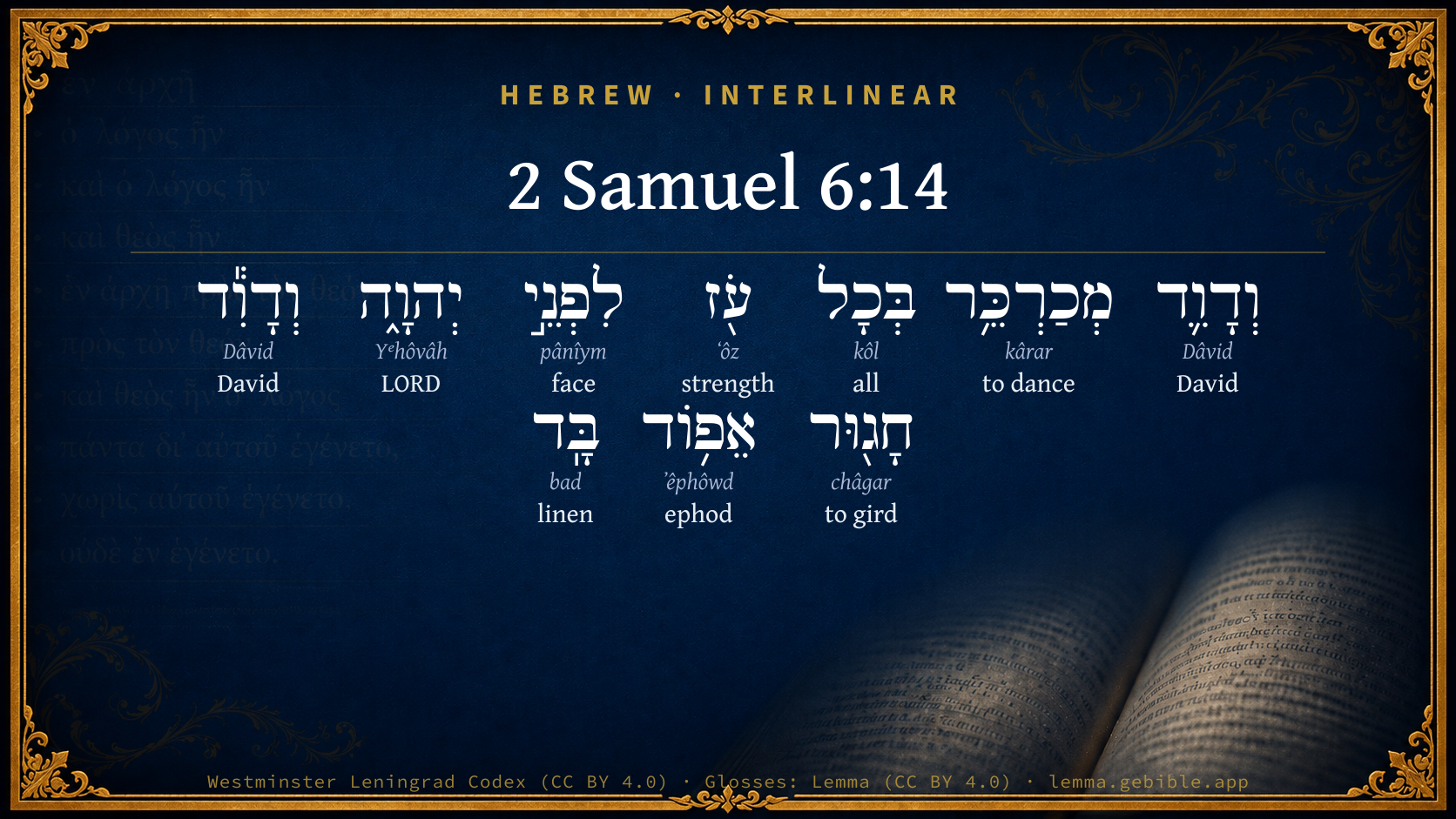
2 Samuel 6:14

Hebrew (Westminster Leningrad Codex) 2 Samuel 6:14 appears in the Hebrew Old Testament. The text above is from the Westminster Leningrad Codex. Each word links to its Strong’s number, a concise gloss, and parsing drawn from the Open Scriptures Hebrew Bible morphology. Click any word for its full Brown-Driver-Briggs (BDB) entry.
Download image
Cite this verse

2 Samuel 6:14 (World English Bible). Public Domain. Lemma interlinear Bible study tool, https://lemma.gebible.app/v/2-samuel/6/14.

Show BibTeX & RIS
BibTeX
RIS
English Translation
David danced before Yahweh with all his might; and David was girded with a linen ephod.
World English Bible · Public Domain
Highlights
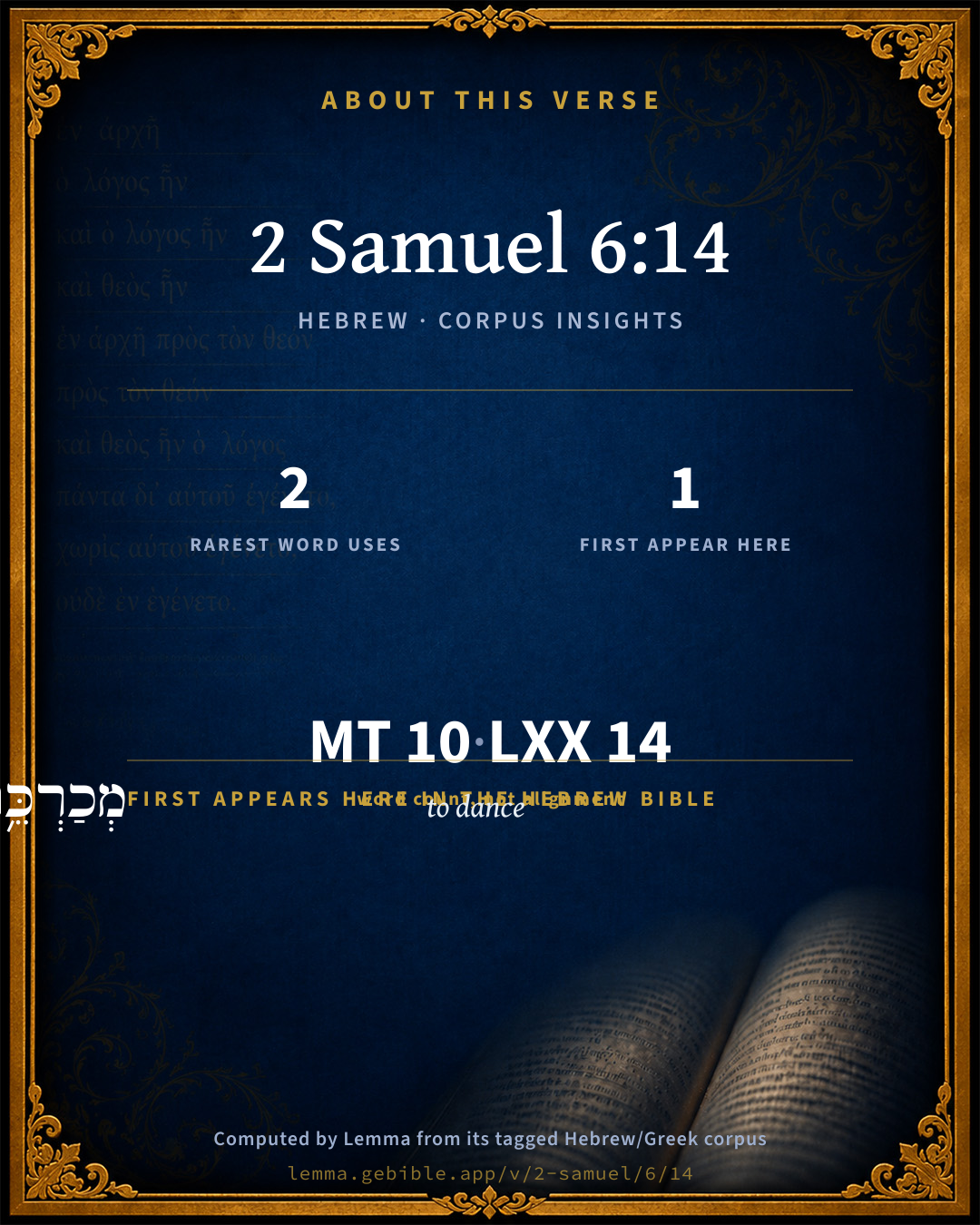
  • 1 first appearance in the Hebrew Bible
Full analysis ↓
Download a study sheet

One document with this verse’s original text, its word-by-word gloss line, the meaning frame, cross-references with their text, attributed commentary, and full source and license credits — printable, and it pastes into notes with its structure intact.

This verse Autodidact and up

Study sheet (.html) Plain text (.txt)

A passage Seminary Student

Up to 50 verses in one chapter. A passage sheet keeps up to 6 commentary sources and 12 cross-references per verse, in the order this page ranks them, and says so on the sheet whenever that leaves anything out. Ask for a single verse and you get the Autodidact verse sheet above.

Everything on this page stays free to read, with no account — the sheet is a download of what is already on screen, not access to it.

Want to remove ads? Support Godless Engineer
Compare translations 3

The same verse in 3 English versions, stacked beneath the original-language interlinear above. Click any original word for its lexicon entry.

Each is an independent rendering of the whole verse — the interlinear is not word-aligned to these translations.

Highlighted words mark where these versions differ — a whole-verse word diff, not a word-by-word alignment.

  • World English Bible Public Domain
    David danced before Yahweh with all his might; and David was girded with a linen ephod.
  • King James Version Public Domain
    And David danced before the LORD with all his might; and David was girded with a linen ephod.
  • unfoldingWord Literal Text CC BY-SA 4.0
    And David danced to the face of Yahweh with all of strength. And David was girded an ephod of linen.

unfoldingWord Literal Text — © unfoldingWord, licensed CC BY-SA 4.0. Word-aligned USFM3 via Door43 (git.door43.org/unfoldingWord/en_ult).

Versions to compare (up to 4)

3 of 4 selected

Show all 18 translations

Every available English version of this verse, each an independent rendering of the whole verse.

  • World English Bible Public Domain
    David danced before Yahweh with all his might; and David was girded with a linen ephod.
  • Berean Standard Bible Public Domain
    And David, wearing a linen ephod, danced with all his might before the LORD,
  • Majority Standard Bible Public Domain
    And David, wearing a linen ephod, danced with all his might before the LORD,
  • King James Version Public Domain
    And David danced before the LORD with all his might; and David was girded with a linen ephod.
  • American Standard Version (1901) Public Domain
    And David danced before Jehovah with all his might; and David was girded with a linen ephod.
  • Revised Version (1885) Public Domain
    And David danced before the LORD with all his might; and David was girded with a linen ephod.
  • Geneva Bible (1599) Public Domain
    And Dauid danced before the Lord with al his might, and was girded with a linnen Ephod.
  • Douay-Rheims (1899) Public Domain
    And David danced with all his might before the Lord: and David was girded with a linen ephod.
  • Young's Literal Translation Public Domain
    And David is dancing with all strength before Jehovah, and David is girded with a linen ephod,
  • Literal Standard Version CC BY-SA 4.0
    And David is dancing with all [his] strength before YHWH, and David is girded with a linen ephod,
  • Unlocked Literal Bible CC BY-SA 4.0
    David danced before Yahweh with all his might; he was wearing only a linen ephod.
  • unfoldingWord Literal Text CC BY-SA 4.0
    And David danced to the face of Yahweh with all of strength. And David was girded an ephod of linen.
  • Darby Bible Public Domain
    And David danced before Jehovah with all his might; and David was girded with a linen ephod.
  • World Messianic Bible Public Domain
    David danced before the LORD with all his might; and David was clothed in a linen ephod.
  • Webster's Bible Public Domain
    And David danced before the LORD with all his might; and David was girded with a linen ephod.
  • Free Bible Version CC BY-SA 4.0
    Wearing a priest's ephod, David danced as hard as he could before the Lord
  • Bible in Basic English Public Domain
    And David, clothed in a linen ephod, was dancing before the Lord with all his strength.
  • JPS Tanakh (1917) Public Domain
    And David danced before the LORD with all his might; and David was girded with a linen ephod.

Literal Standard Version (2020), Covenant Press — licensed CC BY-SA 4.0. Text via the HelloAO Bible API (eBible.org). Unlocked Literal Bible (unfoldingWord) — licensed CC BY-SA 4.0. Text via the HelloAO Bible API (eBible.org). unfoldingWord Literal Text — © unfoldingWord, licensed CC BY-SA 4.0. Word-aligned USFM3 via Door43 (git.door43.org/unfoldingWord/en_ult). Free Bible Version, Dr. Jonathan Gallagher — licensed CC BY-SA 4.0. Text via the HelloAO Bible API (eBible.org).

Word by word

More ways to search: Search by grammar → Find every occurrence → Compare this word →

Practice this passage: Drill this verse → Learn its vocabulary →

About this verse

These counts appear in no published source. They are computed here, from the morphology-tagged text and Lemma’s own curated glosses. What Lemma adds →

10
words
9
distinct lemmas
Historical
section

Notable vocabulary

The rarest word here is מְכַרְכֵּ֥ר to dance H3769 — appearing just 2 times in the whole Hebrew Bible.

First appearance in Scripture

This word makes its first canonical appearance in the Hebrew Bible here:

  • מְכַרְכֵּ֥ר to dance H3769

Shared distinctive vocabulary

מְכַרְכֵּ֥ר to dance H3769 occurs in 2 verses of the Hebrew Bible. Also found in:

Grammatical profile

  • 2 verbs
  • 8 nouns

Verb forms

  • מְכַרְכֵּ֥ר Pilpel · Participle Active
  • חָג֖וּר Qal · Participle Passive

Repetition

A word recurs within this verse — often emphatic in Hebrew:

  • וְדָוִ֛ד David H1732 ×2

Hebrew & Septuagint length

In English translation the verse runs 16 words from the Hebrew and 18 from the Septuagint (LXX English) — closely comparable.

A rough comparison of the two English renderings, which tokenize alike — not a word-level alignment.

Word counts can differ between the Hebrew and the Greek without any difference in meaning — e.g. the Hebrew direct-object marker אֵת has no separate Greek word, and Greek often adds the article ὁ.

In the original languages it is 10 Hebrew tokens and 14 Greek tokens — but the two are counted differently (Hebrew bundles its prefixes and suffixes into one token; the Greek is in lemma form), so that isn’t a like-for-like length.

Cross-references

15

Topical passages linked to 2 Samuel 6:14 in the Treasury of Scripture Knowledge — connected by theme and wording, ordered by reader-vote popularity; previews shown in the World English Bible.

  • 1 Samuel 2:18 But Samuel ministered before Yahweh, being a child, girded with a linen ephod.
  • Exodus 15:20 Miriam the prophetess, the sister of Aaron, took a tambourine in her hand; and all the women went out after her with tambourines and with dances.
  • Judges 11:34 Jephthah came to Mizpah to his house; and, behold, his daughter came out to meet him with tambourines and with dances: and she was his only child; besides her he had neither son nor daughter.
  • Psalms 149:3 Let them praise his name in the dance! Let them sing praises to him with tambourine and harp!
  • Psalms 150:4 Praise him with tambourine and dancing! Praise him with stringed instruments and flute!
  • 1 Samuel 2:28 and did I choose him out of all the tribes of Israel to be my priest, to go up to my altar, to burn incense, to wear an ephod before me? and did I give to the house of your father all the offerings of the children of Israel made by fire?
  • Psalms 30:11 You have turned my mourning into dancing for me. You have removed my sackcloth, and clothed me with gladness,
  • Colossians 3:23 And whatever you do, work heartily, as for the Lord, and not for men,
  • Exodus 19:6 and you shall be to me a kingdom of priests, and a holy nation.' These are the words which you shall speak to the children of Israel."
  • Deuteronomy 6:5 and you shall love Yahweh your God with all your heart, and with all your soul, and with all your might.
  • Judges 21:21 and see, and, behold, if the daughters of Shiloh come out to dance in the dances, then come you out of the vineyards, and catch you every man his wife of the daughters of Shiloh, and go to the land of Benjamin.
  • 1 Samuel 22:18 The king said to Doeg, Turn you, and fall on the priests. Doeg the Edomite turned, and he fell on the priests, and he killed on that day eighty-five persons who wore a linen ephod.
  • 1 Chronicles 15:27 David was clothed with a robe of fine linen, and all the Levites who bore the ark, and the singers, and Chenaniah the master of the song [with] the singers: and David had on him an ephod of linen.
  • Ecclesiastes 9:10 Whatever your hand finds to do, do it with your might; for there is no work, nor device, nor knowledge, nor wisdom, in Sheol, where you are going.
  • Luke 15:25 "Now his elder son was in the field. As he came near to the house, he heard music and dancing.

Cross-references courtesy of OpenBible.info (CC BY 4.0).

Hebrew and Greek witnesses Masoretic Hebrew ↔ Greek Septuagint

The same verse in the two great witnesses to the Old Testament, shown verse-for-verse.

These are two independent witnesses, not word-aligned to each other, and the Septuagint is shown in lemma (dictionary) form.

Hebrew 2 Samuel 6:14 Masoretic · Westminster Leningrad Codex

וְדָוִ֛ד מְכַרְכֵּ֥ר בְּכָל עֹ֖ז לִפְנֵ֣י יְהוָ֑ה וְדָוִ֕ד חָג֖וּר אֵפ֥וֹד בָּֽד

David danced before Yahweh with all his might; and David was girded with a linen ephod.

World English Bible · Public Domain

Greek LXX 2 Samuel 6:14 Septuagint · lemma form

καί δαυίδ ἀνακρούω ἐν ὄργανον ἁρμόζω ἐνώπιον κύριος καί ὁ δαυίδ ἐνδύω στολή ἔξαλλος

And David sounded with well-tuned instruments before the Lord, and David was clothed with a fine long robe.

LXX2012 (modern English Septuagint) · Public Domain

On this verse, John Gill's Exposition discusses the Septuagint’s reading. Read the note in Commentary ↓

Hebrew: Westminster Leningrad Codex (CC BY 4.0). Greek: Septuagint (public domain); English from LXX2012 (modern English Septuagint) (Public Domain). How the Septuagint differs from the Hebrew →

Targum (Aramaic paraphrase)

1

The Targum is the ancient Jewish Aramaic paraphrase of the Hebrew Scriptures — an interpretive translation, not the Hebrew text itself. Onkelos (literal) and Pseudo-Jonathan (expansive) render the Torah, and Jonathan the Prophets. Coverage is partial: where no permissively-licensed English translation exists for a verse, only the Aramaic is shown. This is verse-level text, not a word-by-word alignment to the Hebrew.

  1. Targum Jonathan Prophets (Joshua–Malachi)
    וְדָוִד מְשַׁבַּח בְּכָל תְּקוֹף קֳדָם יְיָ וְדָוִד אֲסִיר כַּרְדוּט דְבוּץ:

    (no public-domain English translation for this verse)

    Targum Jonathan — Aramaic: “Mikraot Gedolot” (public domain). English: “Sefaria Community Translation” (CC0 1.0 (public-domain dedication)); “London "Chaldee Paraphrase," 1871” (public domain). Text via Sefaria.

Commentary

Notes on 2 Samuel 6:14 from classic Christian and Jewish commentators (each source and its license shown beneath its notes). The classic Christian expositions comment on the surrounding passage and are grouped to its opening verse, so a note may address several verses; the Jewish commentaries on the Tanakh (Rashi and others) are per-verse, so they appear only where the commentator wrote on this verse.

Lemma curates 59 commentaries, every one of them public domain or Creative Commons licensed, each selected and text-cleaned for this edition rather than reprinted as found. About our sources →

Trapp's Complete Commentary

John Trapp

2Sa 6:14 And David danced before the LORD with all [his] might; and David [was] girded with a linen ephod.

Ver. 14. And David danced before the Lord with all his might.] Lustily indeed, yet not lightly and vainly, as Caligula and Nero sometimes did on an open theatre; nor yet superstitiously, as the Salii, those Roman priests, did in honour of their god Mars, and as the Romanists do at this day in Spain and elsewhere before their breaden god, when he is carried in procession: but by a grave motion of his body, in a holy and sober manner and measure, as was usual with the ancients in some cases, to express thereby their spiritual jollity and ravishments of rejoicing.

And David was girded with a linen ephod.] Laying aside his royal habit; he put on a linen garment, not unlike that of the priests, to show his devotion. We read of Charles V, that at his solemn inaguration at Bononia he did put on a linen vesture, to please the Papal society, as if he were consecrated one of their priests. This was much in an emperor, but the less to be wondered at, since afterwards he sent his schoolmaster, Adrian, to Rome, to negotiate for him for the Popedom: thinking thereby to sway much, if he could get both the swords. David had no such aim when upon his silken robe he put this linen ephod, {1Ch 15:27} which, being girt to him, kept his other garments close from flying abroad when he danced. {a}

{a} Osiander on 1 Chron. xv.

John Trapp, A Commentary or Exposition upon All the Books of the Old and New Testament (1647–1656) — public domain. Text from a community e-Sword module.

The Biblical Illustrator

Joseph S. Exell

2Sa_6:14-15

And David danced before the Lord.

Religious uses of music and dancing

The nations of the East have ever combined the dance as well as music with their most solemn religious ceremonies. There is nothing frivolous or trifling in the manner in which Orientals strive by the rhythmical movements and gestures of the body to express joy and praise. Just as our music might be divided into sacred, martial, and operatic (including in the latter all lighter melodies), so there are still among the Mohammedans three very distinct classes of dance, corresponding to these three divisions. From the various allusions to the dance in Holy Scripture, we may reasonably believe that their dances as well as their music have come down with little change from their Jewish predecessors. Of the third class of dance, performed exclusively by women, we need say nothing. Such was the dancing of the daughter of Herodias before Herod; such are the exhibitions of the dancing girls of Egypt, or the Nautch girls of India--all of them an abomination to the Lord. In the East the sexes always danced separately; nor was it otherwise when David led the triumphal procession before the ark. The men preceded with a leaping step, swaying to the sound of the music; then followed the musicians, and after them the damsels dancing by themselves. I had an opportunity of seeing such a religious dance in 1881, when Arabi Pasha led the procession with the sacred carpet, for the Kaaba of Mecca, out of Cairo on its way to the prophets shrine. This is one of the greatest ceremonies of Mohammedanism; and the carpet, the gift of the khalif, is renewed only at intervals of several years. It was borne aloft on camels, and surrounded by troops; but in front was a vast crowd of ulemas and dervishes, with the chief muftis at their head, leaping, bounding, swaying their arms, and whirling round in time to the din of drums, trumpets, and cymbals which followed them. (H. B. Tristram, D. D.)

The Biblical Illustrator, edited by Joseph S. Exell (c. 1880s–1900s) — public domain. Text from a community e-Sword module.

Tyndale Open Study Notes

Tyndale Open Resources

6:14 priestly garment: This word (Hebrew ’epod, “ephod”) is associated with an Akkadian word, epattu, meaning “a costly garment.” Richly ornamented with gold, this garment was used for robing statues of gods. Because priests and (sometimes) kings were considered sacred persons, they traditionally used garments of this type (see 1 Sam 2:18, 28; 14:3; 22:18; 23:6, 9).

Tyndale Open Study Notes — © Tyndale Open Resources, licensed CC BY-SA 4.0. Text via the HelloAO Bible API.

Geneva Bible (1599)

Geneva Bible translators

With a garment like to the Priest’s garment.

Geneva Bible (1599) marginal notes — public domain. Text via Bolls.life.

Jamieson, Fausset & Brown

Robert Jamieson, A. R. Fausset & David Brown

David danced before the Lord--The Hebrews, like other ancient people, had their sacred dances, which were performed on their solemn anniversaries and other great occasions of commemorating some special token of the divine goodness and favor.

with all his might--intimating violent efforts of leaping, and divested of his royal mantle (in a state of undress), conduct apparently unsuitable to the gravity of age or the dignity of a king. But it was unquestionably done as an act of religious homage, his attitudes and dress being symbolic, as they have always been in Oriental countries, of penitence, joy, thankfulness, and devotion. [See on Ch1 15:27.]

Jamieson, Fausset & Brown — Commentary Critical and Explanatory on the Whole Bible (1871) — public domain (CC PDM 1.0). Text via the HelloAO Bible API.

Adam Clarke's Commentary

Verse 14. And David danced before the Lord] Dancing is a religious ceremony among the Hindoos, and they consider it an act of devotion to their idols. It is evident that David considered it in the same light. What connection dancing can have with devotion I cannot tell. This I know, that unpremeditated and involuntary skipping may be the effect of sudden mental elation.

Adam Clarke's Commentary on the Bible (1810–1826) — public domain. Text from a community e-Sword/MySword module.

Ellicott's Commentary for English Readers

(14) David danced.—The religious dances on occasions of great national blessing were usually performed by women only (Exo_15:20-21; Jdg_11:34; 1Sa_18:6). The king, by now taking part in them himself, marked his strong sense of the importance of the occasion, and his readiness to do his utmost in God’s honour.

Girded with a linen ephod.—This is usually spoken of as if David were arrayed in a distinctively priestly dress; but it is remarkable that the ephod was not prescribed as a part of the priestly dress—the ephod of the high-priest (Exo_25:7, &c.) being quite a different thing—and was worn by others, as Samuel (1Sa_2:18). The wearing of the ephod, however, is spoken of in 1Sa_22:18 as characteristic of the priests, and in Jdg_8:27; Jdg_17:5; Jdg_18:14-20, it is connected with idolatrous worship. It is also to be noted that the high priest’s ephod (Exo_28:6; Exo_28:8, &c.) was made of shesh, while the garments of the ordinary priests, as well as the ephods of Samuel and David, were of bad. The explanation seems to be that the ephod of bad was simply a garment worn by any one engaged in a religious service, and it is used in 1Sa_22:18 to describe the priests, because such service constituted their ordinary life. It was not, therefore, a peculiarly priestly dress, though naturally more worn by them than by any one else.

A Bible Commentary for English Readers, edited by Charles John Ellicott (1878–1897) — public domain. Text from a community e-Sword module.

The Cambridge Bible for Schools and Colleges

gen. ed. J. J. S. Perowne

14. David danced] The dances which were the usual expression of rejoicing on occasions of national thanksgiving (Exo_15:20-21; Jdg_11:34) and religious festivals (Psa_149:3; Psa_150:4) were generally performed by women only. David’s enthusiasm did not fear to transgress the limits of conventional propriety.

before the Lord] For the Ark was the symbol of Jehovah’s presence.

a linen ephod] David laid aside his royal robes and appeared in the distinctive dress of a priest. As the head and representative of “a kingdom of priests” (Exo_19:6), the king possessed a priestly character; and David on this occasion exercised priestly functions in directing the sacrifices, even if he did not offer them himself (2Sa_6:17-18), and in blessing the people (2Sa_6:18). See Introd. ch. VII. p. 43.

The Cambridge Bible for Schools and Colleges (gen. ed. J. J. S. Perowne; Cambridge University Press, 1878–1918) — public domain. Text from a community e-Sword module.

John Gill's Exposition

So David and all the house of Israel brought up the ark of the Lord,.... The elders of Israel, and the captains over thousands, Ch1 15:25; besides the common people; there might be as large a number with him now as before:

with shouting, and with the sound of the trumpet; with the shouts of the people in common, and with blowing of trumpets by those who were appointed for that purpose, and with other instruments of music, see Ch1 15:27; Josephus says (r), that seven choirs went before the priests bearing the ark, as the king commanded, he himself playing on the harp; so the Septuagint version.

(r) Antiqu. l. 7. c. 4. sect. 2.

John Gill's Exposition of the Whole Bible (1746–1763) — public domain (CC PDM 1.0). Text via the HelloAO Bible API.

Albert Barnes' Notes on the Bible

Danced - The Hebrew word is found only here and in 2Sa 6:16. It means “to dance in a circle,” hence, simply to dance. The parallel passage in 1Ch 15:27 gives a widely different sense.

Albert Barnes' Notes on the Bible (1834–1885) — public domain. Text from a community e-Sword/MySword module.

Haydock's Catholic Bible Commentary

Ephod which ordinarily was the habit of priests. But no law restrained others from using it, (Calmet) particularly on sacred occasions; as we often see laics in a surplice, when they have to sing Church music, &c. (Menochius) --- David had also on a cloak of byssus; (Paralipomenon) and still Michol speaks as if he had been uncovered; because in this solemn ceremony, he was inspired to divest himself of his royal robes, and to act with a degree of enthusiasm; (Haydock) which would not have been otherwise becoming in a king. David is considered by some of the fathers as a figure of the priests of the new law; as he ate the loaves of proposition, was dressed like priests, &c. Sacerdos scitus erat David. (1 Iræn. iv.; St. Ambrose v. in Luc. vi.) (Calmet)

George Leo Haydock (1774–1849), Haydock's Catholic Family Bible and Commentary, 1859 edition — public domain. Excludes Psalms (Douay-Rheims chapter numbering differs from Protestant) and Deuterocanonical books (Catholic canon only).

Matthew Poole's English Annotations

David danced before the Lord, to express his inward joy and thankfulness to God by his outward carriage, according to the manner of these times. See Exo 15:20; Jdg 11:34; 21:21; 1Sa 18:6; Psa 149:3.

A linen ephod; the usual habit of the priests and Levites in their sacred ministrations, yet sometimes worn by others, as it was by the young child Samuel, 1Sa 2:18, before he was come to those years in which the Levites were allowed to minister; and so hereby David, who laid by his royal robes, and put on this robe, to signify and declare, that although he was king of Israel, yet he willingly owned himself to be the Lord’s minister and servant.

Matthew Poole's English Annotations on the Holy Bible (1683–1685) — public domain. Text from a community e-Sword/MySword module.

Whedon's Commentary on the Bible

Daniel D. Whedon

14. Danced before the Lord — From the most ancient times, both among the Jews and other nations, dancing formed a part of the ceremonies of religious processions and festivals, but the performers were usually a band of females. Exo_15:20; Jdg_11:34; Jdg_21:21; 1Sa_18:6. When persons of different sexes engaged, they seem always to have kept in separate companies, and never to have danced promiscuously.

Girded with a linen ephod — See on 1Sa_2:18. The ephod was worn by David on this occasion, probably, for the purpose of showing special respect and reverence for the ark of God.

Daniel D. Whedon (gen. ed.), Commentary on the Old and New Testaments (1874–1909) — public domain. Text from a community e-Sword module.

The Pulpit Commentary

And David danced. The word used means the springing round in half circles to the sound of music. Conder has given a very interesting account of the dancing of the Malawiyeh, which consisted in turning round in whole circles, resting on the heel of the left foot ("Herb and Moab," p. 65, etc.). As David danced with all his might, he was evidently strongly excited with religious fervour. We have the expression of his feelings in the psalm composed for this occasion; (1Ch_16:7-36) subsequently it seems to have been rearranged for the temple service, as it is broken up into Psalm 96. and 105:1-15. Dancing was usually the office of the women (Exo_15:20; Jud_1:11:35; 1Sa_18:6) but men may also have often taken part in it, as Michal"s objection was that it was unbefitting a king. David was girded with a linen ephod. David wore this as a tightly fitting garment, which left him free to exert himself in the dance. So far from the use of it being an assumption of the priestly office, it was regarded by Michal as an act of humiliation, as it was a dress worn even by a child when admitted to service in a priest"s family. (1Sa_2:18) Probably David did mean to rank himself for the time among the inferior servitors of the ark. He might have claimed more. In the theocracy he was the representative of Jehovah, and his anointing was a solemn consecration to a religious office. To have burned incense or offered sacrifice would have been to invade the priestly office, an office parallel to "the administration of the Word and the sacraments," denied, in the Thirty-Seventh Article of the Church of England, to princes. To wear the garb of a servitor was to do honour both to Jehovah and to his priests.

The Pulpit Commentary (1880–1919), ed. H.D.M. Spence-Jones & Joseph S. Exell — public domain. Text from a community e-Sword module.

John Wesley's Explanatory Notes

Danced - To express his thankfulness to God by his outward carriage, according to the manner of those times. Linen ephod - The usual habit of the priests and Levites, in their sacred ministrations yet sometimes worn by others, as it was by the young child Samuel; and so David, who laid by his royal robes, and put on this robe to declare, that although he was king of Israel, yet he willingly owned himself to be the Lord's minister and servant.

John Wesley, Explanatory Notes Upon the Whole Bible (1754–1765) — public domain. Text via the GEBible commentary corpus.

Keil & Delitzsch

C. F. Keil & F. Delitzsch

"And David danced with all his might before the Lord (i.e., before the ark), and was girded with a white ephod (shoulder-dress)." Dancing, as an expression of holy enthusiasm, was a customary thing from time immemorial: we meet with it as early as at the festival of thanksgiving at the Red Sea (Exo 15:20); but there, and also at subsequent celebrations of the different victories gained by the Israelites, none but women are described as taking part in it (Jdg 11:34; Jdg 21:19; Sa1 18:6). The white ephod was, strictly speaking, a priestly costume, although in the law it is not prescribed as the dress to be worn by them when performing their official duties, but rather as the dress which denoted the priestly character of the wearer (see at Sa1 22:18); and for this reason it was worn by David in connection with these festivities in honour of the Lord, as the head of the priestly nation of Israel (see at Sa1 2:18). In Sa2 6:15 it is still further related, that David and all the house (nation) of Israel brought up the ark of the Lord with jubilee and trumpet-blast. תּרוּעה is used here to signify the song of jubilee and the joyous shouting of the people. In the Chronicles (Ch1 15:28) the musical instruments played on the occasion are also severally mentioned.

Keil & Delitzsch — Biblical Commentary on the Old Testament (1861–1891) — public domain (CC PDM 1.0). Text via the HelloAO Bible API. (Old Testament only.)

unfoldingWord translationNotes

Door43 World Missions Community

David danced before Yahweh with all his might

Dancing here is a form of joyfully worshiping Yahweh.

linen

a cloth made from fibers of the flax plant

all the house of Israel

Here "house" represents the people of Israel. AT: "all the other Israelites with him" (See: Metonymy)

translationWords

might

ephod

house

Israel

trumpet

unfoldingWord translationNotes — © Distant Shores Media and the Door43 World Missions Community, licensed CC BY-SA 4.0. Source: git.door43.org/Door43/en_tn.

Rashi

Rabbi Shlomo Yitzchaki (Rashi)

Danced. Danced.

Linen robe. A linen robe, Foursaint in O.F. Yonasan translated, robe as Yonasan also translated "the robes of Tomor, the sister of Avsholom," robes (Further, 13:18)

Rashi on the Tanakh — English translations: “The Judaica Press complete Tanach with Rashi, translated by A. J. Rosenberg” (CC BY 4.0); “Pentateuch with Rashi's commentary by M. Rosenbaum and A.M. Silbermann, 1929-1934” (public domain); “The Metsudah Tanach series, Lakewood, N.J” (CC BY 4.0); and “The Book of Joshua, Metsudah Publications, 1997” (CC BY 4.0). Text via Sefaria.

Lesson kit

Teaching starters — assembled from the data on this page, not authored interpretation. Every prompt links to the verse data it draws on. Edit before teaching.

2 Samuel, in the Historical, opens this verse with 10 words (9 distinct Hebrew lemmas). Its most distinctive word is kârar (“to dance”). A historical commentator’s framing appears above. Read the whole chapter for the surrounding context.

Discussion questions

  1. What does “to dance” (kârar) contribute to the verse as a whole?
  2. The word “to dance” first appears here in Scripture. What is being introduced at this debut?
  3. 2 Samuel 6:16 shares the word «to dance» with this verse. How do the two illuminate each other?
  4. “David” occurs 2× in this one verse. What is the effect of the repetition?
  5. The translations on this page render this verse differently — a whole-verse word diff, not a word-by-word alignment. What might account for the different wordings?
  6. The verb «מְכַרְכֵּ֥ר» is Pilpel Participle Active. How does its form color the action?
  7. Reading how Trapp's Complete Commentary and The Biblical Illustrator read this verse, where do the two commentators agree and where do they part?

Things to notice

Reading settings

Reading text

Shown beneath each verse's original-language words.

Old Testament
Old Testament edition

Read the OT as the Masoretic Hebrew (MT) or the Greek Septuagint (LXX).

English shown for the Greek Septuagint (in the Hebrew ↔ Greek comparison).

Comparing translations? Open the Compare panel on any verse page to stack up to four side by side.