
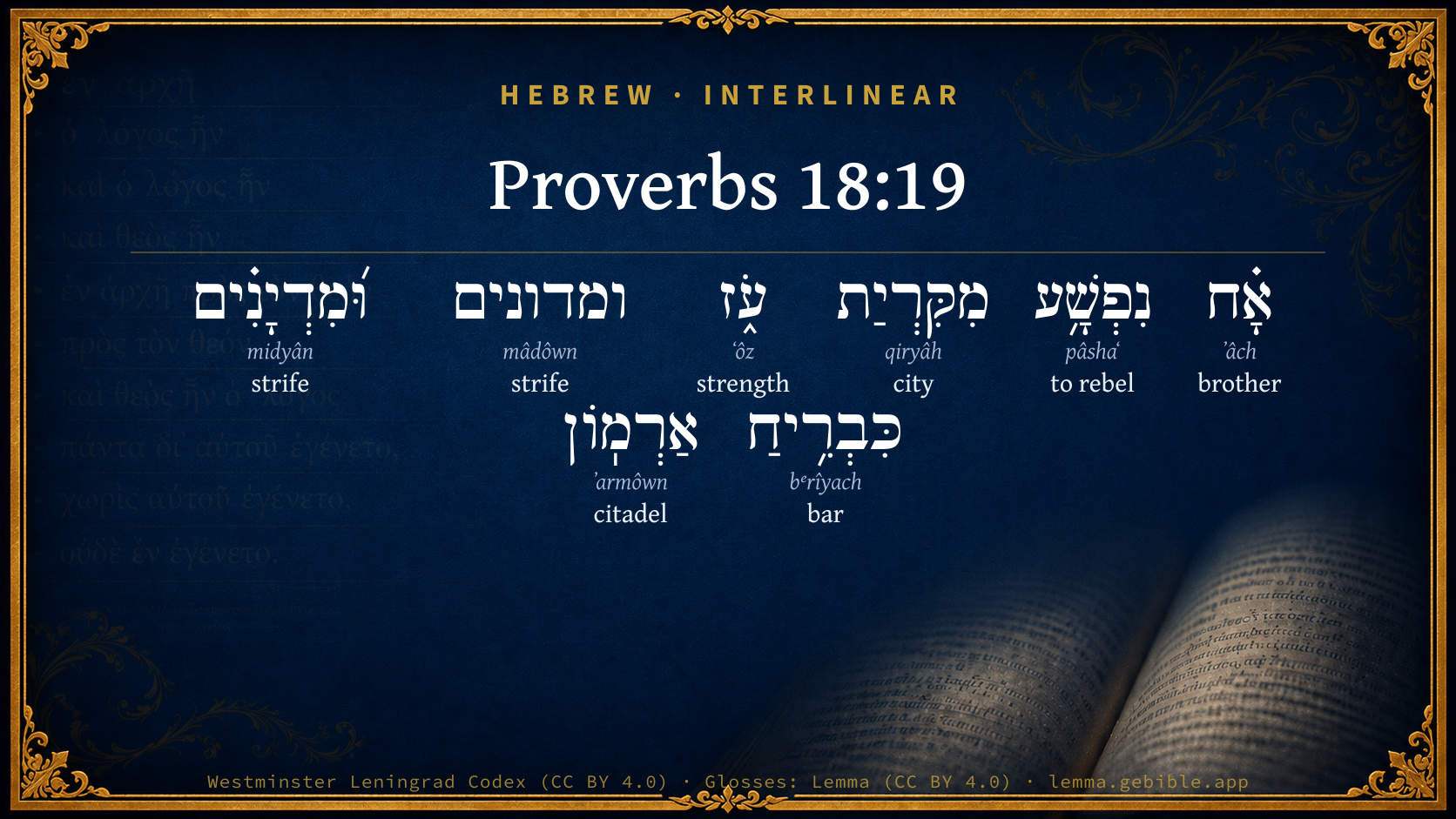
Proverbs 18:19

Hebrew (Westminster Leningrad Codex) Proverbs 18:19 appears in the Hebrew Old Testament. The text above is from the Westminster Leningrad Codex. Each word links to its Strong’s number, a concise gloss, and parsing drawn from the Open Scriptures Hebrew Bible morphology. Click any word for its full Brown-Driver-Briggs (BDB) entry.
Download image
Cite this verse

Proverbs 18:19 (World English Bible). Public Domain. Lemma interlinear Bible study tool, https://lemma.gebible.app/v/proverbs/18/19.

Show BibTeX & RIS
BibTeX
RIS
English Translation
A brother offended is more difficult than a fortified city; And disputes are like the bars of a castle.
World English Bible · Public Domain
Download a study sheet

One document with this verse’s original text, its word-by-word gloss line, the meaning frame, cross-references with their text, attributed commentary, and full source and license credits — printable, and it pastes into notes with its structure intact.

This verse Autodidact and up

Study sheet (.html) Plain text (.txt)

A passage Seminary Student

Up to 50 verses in one chapter. A passage sheet keeps up to 6 commentary sources and 12 cross-references per verse, in the order this page ranks them, and says so on the sheet whenever that leaves anything out. Ask for a single verse and you get the Autodidact verse sheet above.

Everything on this page stays free to read, with no account — the sheet is a download of what is already on screen, not access to it.

Want to remove ads? Support Godless Engineer
Compare translations 3

The same verse in 3 English versions, stacked beneath the original-language interlinear above. Click any original word for its lexicon entry.

Each is an independent rendering of the whole verse — the interlinear is not word-aligned to these translations.

Highlighted words mark where these versions differ — a whole-verse word diff, not a word-by-word alignment.

  • World English Bible Public Domain
    A brother offended is more difficult than a fortified city; And disputes are like the bars of a castle.
  • King James Version Public Domain
    A brother offended is harder to be won than a strong city: and their contentions are like the bars of a castle.
  • unfoldingWord Literal Text CC BY-SA 4.0
    A brother offended more than a city of strength, and quarrels like the gate bar of a fortress.

unfoldingWord Literal Text — © unfoldingWord, licensed CC BY-SA 4.0. Word-aligned USFM3 via Door43 (git.door43.org/unfoldingWord/en_ult).

Versions to compare (up to 4)

3 of 4 selected

Show all 18 translations

Every available English version of this verse, each an independent rendering of the whole verse.

  • World English Bible Public Domain
    A brother offended is more difficult than a fortified city; And disputes are like the bars of a castle.
  • Berean Standard Bible Public Domain
    An offended brother is harder to win than a fortified city, and disputes are like the bars of a castle.
  • Majority Standard Bible Public Domain
    An offended brother is harder to win than a fortified city, and disputes are like the bars of a castle.
  • King James Version Public Domain
    A brother offended is harder to be won than a strong city: and their contentions are like the bars of a castle.
  • American Standard Version (1901) Public Domain
    A brother offended `is harder to be won' than a strong city; And `such' contentions are like the bars of a castle.
  • Revised Version (1885) Public Domain
    A brother offended is harder to be won than a strong city: and such contentions are like the bars of a castle.
  • Geneva Bible (1599) Public Domain
    A brother offended is harder to winne then a strong citie, and their contentions are like the barre of a palace.
  • Douay-Rheims (1899) Public Domain
    A brother that is helped by his brother, is like a strong city: and judgments are like the bars of cities.
  • Young's Literal Translation Public Domain
    A brother transgressed against is as a strong city, And contentions as the bar of a palace.
  • Literal Standard Version CC BY-SA 4.0
    A brother transgressed against is as a strong city, || And contentions as the bar of a palace.
  • Unlocked Literal Bible CC BY-SA 4.0
    An offended brother is harder to be won than a strong city, and quarreling is like the bars of a castle.
  • unfoldingWord Literal Text CC BY-SA 4.0
    A brother offended more than a city of strength, and quarrels like the gate bar of a fortress.
  • Darby Bible Public Domain
    A brother offended is [harder to be won] than a strong city; and contentions are as the bars of a palace.
  • World Messianic Bible Public Domain
    A brother offended is more difficult than a fortified city. Disputes are like the bars of a fortress.
  • Webster's Bible Public Domain
    A brother offended is harder to be won than a strong city: and their contentions are like the bars of a castle.
  • Free Bible Version CC BY-SA 4.0
    A brother you've offended is harder to win back than a fortified town. Arguments keep people apart like bars on the doors of a fortress.
  • Bible in Basic English Public Domain
    A brother wounded is like a strong town, and violent acts are like a locked tower.
  • JPS Tanakh (1917) Public Domain
    A brother offended is harder to be won than a strong city; and their contentions are like the bars of a castle.

Literal Standard Version (2020), Covenant Press — licensed CC BY-SA 4.0. Text via the HelloAO Bible API (eBible.org). Unlocked Literal Bible (unfoldingWord) — licensed CC BY-SA 4.0. Text via the HelloAO Bible API (eBible.org). unfoldingWord Literal Text — © unfoldingWord, licensed CC BY-SA 4.0. Word-aligned USFM3 via Door43 (git.door43.org/unfoldingWord/en_ult). Free Bible Version, Dr. Jonathan Gallagher — licensed CC BY-SA 4.0. Text via the HelloAO Bible API (eBible.org).

Word by word

More ways to search: Search by grammar → Find every occurrence → Compare this word →

Practice this passage: Drill this verse → Learn its vocabulary →

About this verse

These counts appear in no published source. They are computed here, from the morphology-tagged text and Lemma’s own curated glosses. What Lemma adds →

8
words
8
distinct lemmas
Wisdom
section

Notable vocabulary

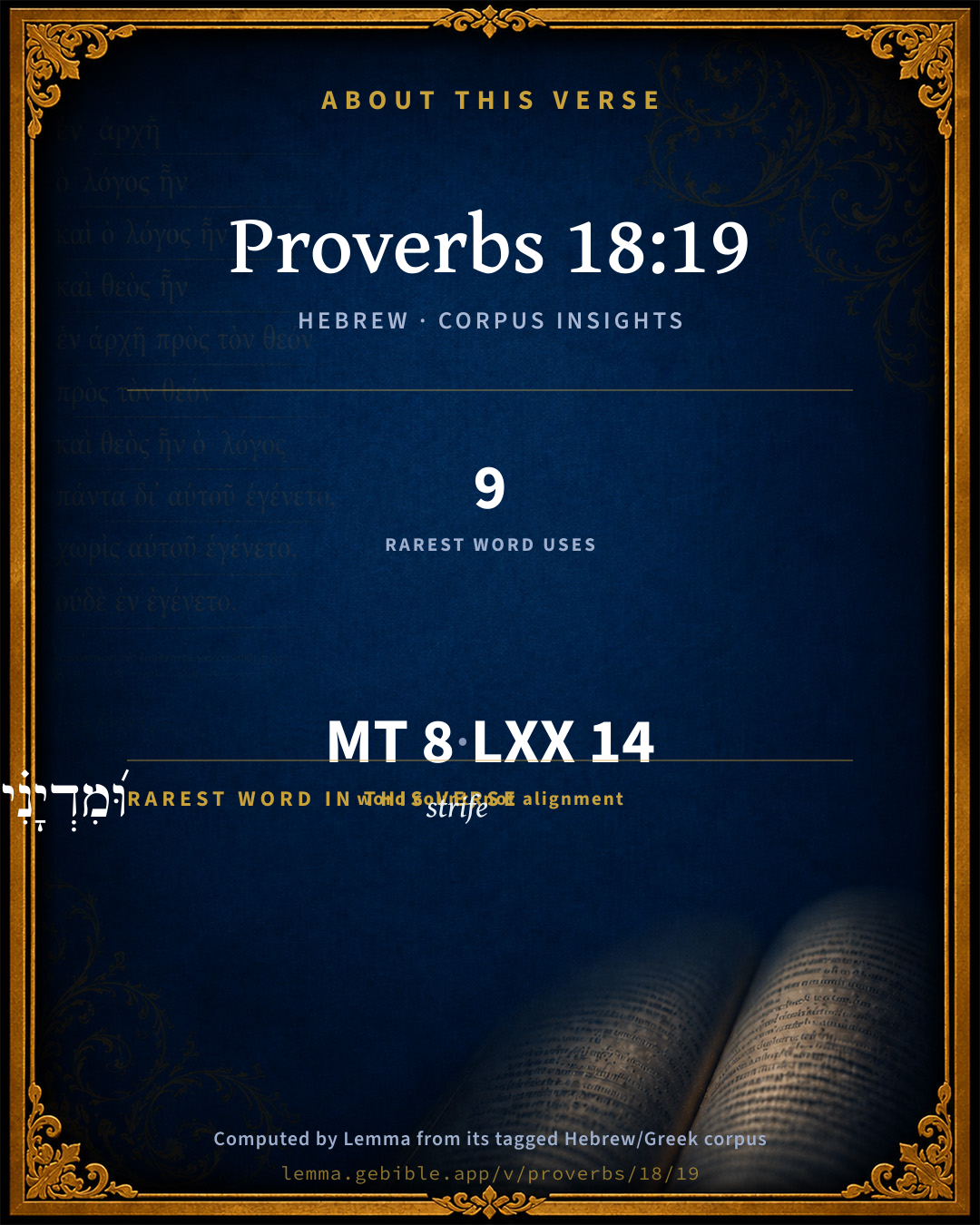
The rarest word here is וּ֝מִדְיָנִ֗ים strife H4079 — appearing just 9 times in the whole Hebrew Bible.

Shared distinctive vocabulary

וּ֝מִדְיָנִ֗ים strife H4079 occurs in 9 verses of the Hebrew Bible. Also found in:

Grammatical profile

  • 1 verb
  • 7 nouns

Verb forms

  • נִפְשָׁ֥ע Niphal · Participle Active

Hebrew & Septuagint length

In English translation the verse runs 19 words from the Hebrew and 21 from the Septuagint (LXX English) — closely comparable.

A rough comparison of the two English renderings, which tokenize alike — not a word-level alignment.

Word counts can differ between the Hebrew and the Greek without any difference in meaning — e.g. the Hebrew direct-object marker אֵת has no separate Greek word, and Greek often adds the article ὁ.

In the original languages it is 8 Hebrew tokens and 14 Greek tokens — but the two are counted differently (Hebrew bundles its prefixes and suffixes into one token; the Greek is in lemma form), so that isn’t a like-for-like length.

Cross-references

14

Topical passages linked to Proverbs 18:19 in the Treasury of Scripture Knowledge — connected by theme and wording, ordered by reader-vote popularity; previews shown in the World English Bible.

  • Proverbs 16:32 One who is slow to anger is better than the mighty; One who rules his spirit, than he who takes a city.
  • Acts 15:39 Then the contention grew so sharp that they separated from each other. Barnabas took Mark with him, and sailed away to Cyprus,
  • Proverbs 6:19 A false witness who utters lies, And he who sows discord among brothers.
  • Genesis 37:3–5 Now Israel loved Joseph more than all his children, because he was the son of his old age, and he made him a coat of many colors.
  • 1 Kings 12:16 When all Israel saw that the king didn't listen to them, the people answered the king, saying, What portion have we in David? neither have we inheritance in the son of Jesse: to your tents, Israel: now see to your own house, David. So Israel departed to their tents.
  • Genesis 4:5–8 but he didn't respect Cain and his offering. Cain was very angry, and the expression on his face fell.
  • Genesis 27:41–45 Esau hated Jacob because of the blessing with which his father blessed him. Esau said in his heart, "The days of mourning for my father are at hand. Then I will kill my brother Jacob."
  • Genesis 32:6–11 The messengers returned to Jacob, saying, "We came to your brother Esau. Not only that, but he comes to meet you, and four hundred men with him."
  • Genesis 37:18–27 They saw him afar off, and before he came near to them, they conspired against him to kill him.
  • 2 Samuel 13:22 Absalom spoke to Amnon neither good nor bad; for Absalom hated Amnon, because he had forced his sister Tamar.
  • 2 Samuel 13:28 Absalom commanded his servants, saying, Mark you now, when Amnon's heart is merry with wine; and when I tell you, Smite Amnon, then kill him; don't be afraid; haven't I commanded you? be courageous, and be valiant.
  • 1 Kings 2:23–25 Then king Solomon swore by Yahweh, saying, God do so to me, and more also, if Adonijah has not spoken this word against his own life.
  • 2 Chronicles 13:17 Abijah and his people killed them with a great slaughter: so there fell down slain of Israel five hundred thousand chosen men.
  • Genesis 37:11 His brothers envied him; but his father kept this saying in mind.

Cross-references courtesy of OpenBible.info (CC BY 4.0).

Hebrew and Greek witnesses Masoretic Hebrew ↔ Greek Septuagint

The same verse in the two great witnesses to the Old Testament, shown verse-for-verse.

These are two independent witnesses, not word-aligned to each other, and the Septuagint is shown in lemma (dictionary) form.

Hebrew Proverbs 18:19 Masoretic · Westminster Leningrad Codex

אָ֗ח נִפְשָׁ֥ע מִקִּרְיַת עֹ֑ז ומדונים וּ֝מִדְיָנִ֗ים כִּבְרִ֥יחַ אַרְמֽוֹן

A brother offended is more difficult than a fortified city; And disputes are like the bars of a castle.

World English Bible · Public Domain

Greek LXX Proverbs 18:19 Septuagint · lemma form

ἀδελφός ὑπό ἀδελφός βοηθέω ὡς πόλις ὀχυρός καί ὑψηλός ἰσχύω δέ ὥσπερ θεμελιόω βασίλειον

A brother helped by a brother is as a strong and high city; and is as strong as a well-founded palace.

LXX2012 (modern English Septuagint) · Public Domain

On this verse, Joseph Benson's Commentary discusses the Septuagint’s reading. Read the note in Commentary ↓

Hebrew: Westminster Leningrad Codex (CC BY 4.0). Greek: Septuagint (public domain); English from LXX2012 (modern English Septuagint) (Public Domain). How the Septuagint differs from the Hebrew →

Commentary

Notes on Proverbs 18:19 from classic Christian and Jewish commentators (each source and its license shown beneath its notes). The classic Christian expositions comment on the surrounding passage and are grouped to its opening verse, so a note may address several verses; the Jewish commentaries on the Tanakh (Rashi and others) are per-verse, so they appear only where the commentator wrote on this verse.

Lemma curates 59 commentaries, every one of them public domain or Creative Commons licensed, each selected and text-cleaned for this edition rather than reprinted as found. About our sources →

Trapp's Complete Commentary

John Trapp

Pro 18:19 A brother offended [is harder to be won] than a strong city: and [their] contentions [are] like the bars of a castle.

Ver. 19. A brother offended is harder to be won, &c.] Whether it be a brother by race, place, or grace; Corruptio optimi pessima: those oft that loved most dearly, if once the devil cast his club between them, they hate most deadly. See this exemplified in Cain and Abel, Esau and Jacob, Polynices and Eteocles, Romulus and Remus, Caracalla and Geta, the two sons of Severus the Emperor, Robert and Rufus, the sons of William the Conqueror, the civil dissensions between the houses of York and Lancaster, wherein were slain eighty princes of the blood royal, {a} the dissensions between England and Scotland, which consumed more Christian blood, wrought more spoil and destruction, and continued longer than ever quarrel we read of did between any two people of the world. As for brethren by profession, and that of the true religion too, among Protestants, you shall meet with many divisions, and those prosecuted with a great deal of bitterness. Nullum bellum citius exardescit, nullum deflagrat tardius quam Theologicum. {b} No war breaks out sooner, or lasts longer, than that among divines, or as that about the sacrament; a sacrament of love, a communion, and yet the occasion, by accident, of much dissension. This made holy Strigelius weary of his life. Cupio ex hac vita migrare ob duas causas, saith he. For two causes chiefly do I desire to depart out of this world; First, That I may enjoy the sweet sight of the Son of God, and the Church above; Next, Ut liberer ab immanibus et implicabilibus odiis Theologorum, that I may be delivered from the cruel and implacable hatreds of dissenting divines. {c} There is a most sad story of those that fled to Frankfort hence in Queen Mary’s time; yet among them there were such grievous breaches, that they sought the lives one of another; great care therefore must be taken that brethren break not friendship: or if they do, that they reunite in peace again as soon as is possible.

{a} Dan, 192.

{b} Bucholcer.

{c} Melch. Adam, in Vita.

John Trapp, A Commentary or Exposition upon All the Books of the Old and New Testament (1647–1656) — public domain. Text from a community e-Sword module.

The Biblical Illustrator

Joseph S. Exell

Pro_18:19

A brother offended is harder to be won than a strong city.

Physical power and moral power

In the early life of men and communities, the power most admired is physical power. Those who can conquer in the material world are the heroes of the young. Later, men think more of intellectual achievements. The greatest in the schools is the greatest in the world. In the maturest stage of life we are content with less conspicuous feats; for we see that the less may be greater. We deem it greater to conquer in the realm of moral life than in the field of nature or the area of intellect. The conqueror in the field of battle may be great, but the conqueror of the hearts of men is greater. A brother offended may be harder to win than the bars of a castle, but so much the nobler is the victory. To win men is a nobler achievement than the defeat of mens bodies or the confounding of their minds. (Bp. Boyd Carpenter.)

Discords among brethren

No discords are like those of brethren; the nearer the union, the greater the separation upon a breach; for natural ties being stronger than artificial, when they are once broken, they are hardly made up again, as seams when they are ripped may be sown again; but rents in the whole cloth are not so easily remedied. (H. G. Salter.)

The Biblical Illustrator, edited by Joseph S. Exell (c. 1880s–1900s) — public domain. Text from a community e-Sword module.

Joseph Benson's Commentary

Pro 18:19. A brother offended — Namely, by his brother’s unkindness or injury; is harder to be won — Or, is stronger and more impregnable; than a strong city — Which is hardly to be conquered. And their contentions are like the bars of a castle — Which are very strong, and not to be broken, as being made of iron or brass: see 1Ki 4:13; Isa 45:2. The truth of this assertion is confirmed by the testimony of several learned men who affirm the same thing; and the reason of it is evident, because the nearness of the relation greatly heightens the provocation, and love abused frequently turns to extreme hatred. “There are no contentions,” says Bishop Patrick, in his paraphrase on this verse, “so sharp and obstinate as those among brethren; who grow so refractory when they have transgressed against each other, that it is easier to take a strong city, or to break the bars of a castle, than it is to compose their differences, and remove all the obstructions that lie in the way of their hearty reconciliation.” The LXX., but on what authority does not appear, render this, Αδελφος υπο αδελφου βοηθουμενος, &c., A brother assisted by a brother is powerful, as a strong and high city, and as a well-founded kingdom. And Bochart, following the Vulgate, renders the verse, “As a fortified city is a brother assisted by a brother, and they who mutually love one another are like the bars of a castle.” But certainly neither of these readings is consistent with the Hebrew text, which is literally and faithfully translated in our English Bible.

Joseph Benson's Commentary on the Old and New Testaments (1811–1818) — public domain. Text from a community e-Sword module.

The Preacher's Complete Homiletical Commentary

Joseph S. Exell (gen. ed.)

CRITICAL NOTES.—

Pro_18:19. “Is harder to be won;” these words are not in the original, but have been inserted to supply the sense. Some translators read “a brother offended resisteth more than a strong city.” Miller reads, “When a brother is revolted away, it is from a city of strength.”

MAIN HOMILETICS OF Pro_18:19

CASTLE BARS

The state of things treated in this verse reveals most conclusively that man has fallen. Contention between any men is a plain proof that there is some flaw in human nature, that the relations of human creatures are not what they ought to be. If the disputants are men of the same nation, their contention seems more unnatural than if they belonged to different races, but when sons of the same father—men brought up at the knees of the same mother, are found in a state of enmity, we have a very strong proof that the race is not what its head was when he came fresh from the hand of his Creator. Such enmity Solomon compares to the bars of a castle—

I. Because it is hard to break through. The bars that guard the outlet of a fortress are strong, and when the iron crowbar is applied to them with a view of making an entrance, the weapon finds itself resisted by a substance as unyielding as its own. The bars strike against each other, but neither being more brittle than its antagonist, no progress is made. It is no ordinary difference that makes a ground of quarrel between brothers; there are so many ties to be broken and so many motives of self-interest to bind them, that the enmity must be deep to separate them at first, and being deep and strong, it is not easily broken down.

II. Because it is the only thing that separates them. Friends who dearly love each other and are one in spirit sometimes find nothing between them but a few bars—the iron grating of a dungeon may be all that keeps them apart. But although it is only that, it is a very real and terrible barrier. And a dispute between brethren is like iron bars, dividing those who ought to be one more truly and sadly than any prison door could separate them. They may be dwelling under the same roof, and so have every opportunity of enjoying each other’s society and gladdening each other’s life. But contention builds around each one a more impregnable barrier than the highest walls of the strongest fortress.

III. That to subdue such enmity requires more wisdom and skill than to take a city. There are several methods by which a city may be won. It may be taken by superior physical force, it may be surprised and captured, or its inhabitants may be starved into a surrender. But it is not so easy to capture a human heart—an angry brother must be subdued by different means, and by weapons which require more skilful handling. No physical force can break down enmity of heart—even God cannot reconcile men unto Himself by His physical omnipotence, but wins them by love. And this is the only power which can win “a brother offended.” If he has been in the wrong we must approach him with a free forgiveness, and if the wrong has been on our side we must approach with submission and acknowledgment of our fault.

OUTLINES AND SUGGESTIVE COMMENTS

“When a brother is revolted away, it is from a city of strength; and contentions are like the bars of a citadel.” The whole meaning is, that one “brother” “revolted away” from another, is “revolted from a city of strength,” that being what one is to all the rest. In other words, brothers are a shelter to brothers, and quarrels lock up that resort.… Notice, that a brother is not only a commoner defence, but a “citadel;” and a “bar” to that keep shuts a man out of his best earthly dependence. It is a fine adage, even for this world … but when applied to our Great Brother, and to our God and King, it is one of the noblest of inspired texts. He who offends our Brother Prince shuts a high tower (Psa_18:2). He who quarrels with our Surety snaps to the lock of a citadel; and then, alas, it shall be, just as the wild rush of embittered enemies should have roused him to enter in.—Miller.

The sweeter the wine the sharper the vinegar; accordingly, the greater the love implanted by nature, the more bitter the hate where this love is violated.—Zeltner.

The matter of fact is here stated—and there are natural enough reasons to account for it. More is justly expected from a brother than from a stranger—more of affection, gratitude, kindly treatment, fidelity, and trustworthiness. When such expectations are disappointed, the wound in the spirit is proportionately deeper, and more difficult of healing—the breach wider, and harder of being made up. Besides, the slower a person is to take offence—the longer he forbears—the more he forgives—the more difficult it is fairly to overcome the yearnings of affection, and break the bonds of brotherhood—the more inveterate may the spirit of resentment be; the more sullen and distant the alienation, when it is actually produced.—Wardlaw.

Whether it be a brother by race, place, or grace; those oft that loved most dearly, if once the devil cast his club between them, hate most deadly.… As for brethren by profession, and that of the true religion too, among Protestants, you shall meet with many divisions, and those prosecuted with a great deal of bitterness. No war breaks out sooner, or lasts longer, than that among divines, or that about a sacrament; a sacrament of love, a communion, and yet the occasion, by accident, of much dissension.—Trapp.

The original word here used is a brother revolting or departing by disloyalty; or else a brother offended by disloyal departing. For such ought to be the command of love between brethren, that he that breaks it is a disloyal rebel unto it. And surely they had need to be firmly tied, because, being divided, they are so hardly joined. For as that which being whole is most strongly united, being broken is farthest from being made whole; and as a stick of hard wax, being broken, may more easily be conjoined than a stick of hard wood, so are the divisions of brethren more hardly composed than the contentions of others.—Jermin.

The Preacher's Complete Homiletical Commentary (gen. ed. Joseph S. Exell; Funk & Wagnalls, c. 1892) — public domain (pre-1929). A full-Bible homiletical/sermon-outline anthology covering 65 of 66 books (2 John is absent from the source module). Text from a community e-Sword module.

Geneva Bible (1599)

Geneva Bible translators

Which for the strength thereof will not bow nor yield.

Geneva Bible (1599) marginal notes — public domain. Text via Bolls.life.

Matthew Henry's Commentary

Note, 1. Great care must be taken to prevent quarrels among relations, and those that are under special obligation to each other, not only because they are most unnatural and unbecoming, but because between such things are commonly taken most unkindly, and resentments are apt to be carried too far. Wisdom and grace would indeed make it most easy to us to forgive our relations and friends if they offend us, but corruption makes it most difficult to forgive them; let us therefore take heed of disobliging a brother, or one that has been as a brother; ingratitude is very provoking. 2. Great pains must be taken to compromise matters in variance between relations, with all speed, because it is a work of so much difficulty, and consequently the more honourable if it be done. Esau was a brother offended, and seemed harder to be won than a strong city, yet by a work of God upon his heart, in answer to Jacob's prayer, he was won.

Matthew Henry's Commentary on the Whole Bible (1708–1710) — public domain (CC PDM 1.0). Text via the HelloAO Bible API.

Jamieson, Fausset & Brown

Robert Jamieson, A. R. Fausset & David Brown

No feuds so difficult of adjustment as those of relatives; hence great care should be used to avoid them.

Jamieson, Fausset & Brown — Commentary Critical and Explanatory on the Whole Bible (1871) — public domain (CC PDM 1.0). Text via the HelloAO Bible API.

Adam Clarke's Commentary

Verse 19. A brother offended is harder to be won than a strong city] Almost all the versions agree in the following reading: "A brother assisted by a brother, is like a fortified city; and their decisions are like the bars of a city." Coverdale is both plain and terse: "The unitie of brethren is stronger then a castell, and they that holde together are like the barre of a palace." The fable of the dying father, his sons, and the bundle of faggots, illustrates this proverb. Unity among brethren makes them invincible; small things grow great by concord. If we take the words according to the common version, we see them express what, alas! we know to be too generally true: that when brothers fall out, it is with extreme difficulty that they can be reconciled. And fraternal enmities are generally strong and inveterate.

Adam Clarke's Commentary on the Bible (1810–1826) — public domain. Text from a community e-Sword/MySword module.

Ellicott's Commentary for English Readers

(19) A brother offended.—Or rather, wronged.

Their contentions.—Of such as have once been friends, “are like the bars of a castle,” or palace, forming an almost impassable barrier to reconciliation. The bitterness of quarrels between friends is proverbial.

A Bible Commentary for English Readers, edited by Charles John Ellicott (1878–1897) — public domain. Text from a community e-Sword module.

The Cambridge Bible for Schools and Colleges

gen. ed. J. J. S. Perowne

19. offended] or injured, R.V. marg.

like the bars of a castle] forming an impassable barrier to reconciliation.

The Cambridge Bible for Schools and Colleges (gen. ed. J. J. S. Perowne; Cambridge University Press, 1878–1918) — public domain. Text from a community e-Sword module.

John Gill's Exposition

A brother offended is harder to be won than a strong city,.... A fortified city may sooner be taken by an enemy, than one brother offended can be reconciled to another; their resentments against each other are keener than against another person that has offended them; and their love being turned into hatred, it is more bitter; and it is more difficult to compose differences between brethren than between enemies; wherefore such should take care that they fall not out by the way: this is true of brethren in a natural sense; as the cases of Abel and Cain, Jacob and Esau, Joseph and his brethren, Amnon and Absalom, and others, show; and of brethren in a spiritual sense, as Paul and Barnabas, Luther and Calvin, and others;

and their contentions are like the bars of a castle: which cannot be easily broken or cut asunder: so contentions, especially those among brethren, are with great difficulty made to cease, and their differences composed; they will stand it out against one another as long as a strong city, or a barred castle, against an enemy.

John Gill's Exposition of the Whole Bible (1746–1763) — public domain (CC PDM 1.0). Text via the HelloAO Bible API.

Albert Barnes' Notes on the Bible

The meaning of the first clause is obtained in the King James Version by the insertion of the words in italics, and it seems on the whole to be the best. The Septuagint and Vulgate give an entirely different rendering, based, apparently, upon a different text.

Albert Barnes' Notes on the Bible (1834–1885) — public domain. Text from a community e-Sword/MySword module.

Haydock's Catholic Bible Commentary

Judgments of many are more deserving of credit. Hebrew, "a brother offended, is like a strong place, and their quarrels," &c. The are not easily reconciled. Civil wars are most terrible. (Calmet)

George Leo Haydock (1774–1849), Haydock's Catholic Family Bible and Commentary, 1859 edition — public domain. Excludes Psalms (Douay-Rheims chapter numbering differs from Protestant) and Deuterocanonical books (Catholic canon only).

Matthew Poole's English Annotations

Offended, to wit, by his brother’s unkindness or injury.

Is harder to be won; or, is stronger, which is sufficiently understood by the mention of a strong city, to which he is compared; such ellipses being frequent in the Hebrew, as hath been noted before.

Than a strong city; which is hardly to be conquered.

Like the bars of a castle; which are very strong, and not to be broken, and make the castle strong, and hardly to be won. The truth of this assertion is confirmed by the testimony of Aristotle and other learned authors, who affirm the same fixing; and the reason of it is evident, because the nearness of the relation greatly heightens the provocation, and love abused frequently turns to extreme hatred.

Matthew Poole's English Annotations on the Holy Bible (1683–1685) — public domain. Text from a community e-Sword/MySword module.

Whedon's Commentary on the Bible

Daniel D. Whedon

19. A brother offended — Estranged, because of some real or supposed wrong done him.

Harder… than a strong city — Some versions and critics give a different reading of this proverb, thus: “A brother assisted by a brother is like a fortified city, and their decisions like the bars of a castle.”

Coverdale thus: “The unity of brethren is stronger than a castle, and they that hold together are like the bars of a palace.” These readings are not in accordance with the present Hebrew text, but are supported by the Septuagint, Vulgate, etc.

Daniel D. Whedon (gen. ed.), Commentary on the Old and New Testaments (1874–1909) — public domain. Text from a community e-Sword module.

The Pulpit Commentary

A brother offended is harder to be won than a strong city. Something must be supplied on which the comparative notion min, "than," depends. So we may understand "resists more," or something similar. A brother or a once close friend, when injured or deceived, becomes a potent and irreconcilable enemy. The idea of the preceding verses is carried on, and the primary thought is still concerning lawsuits and matters brought before a judge. This is shown in the second clause by the use of the word "contentions" (midyanim). And their contentions are like the bars of a castle. They close the door against reconciliation, shut the heart against all feeling of tenderness. True it is, Calepoi polemoi adelfwn (Eurip., "Fragm."). And again, "Iph. Aul.," 376 Deinotoisi gignesqai logouv Macav y otan pot empeswsin eiv erin ..

Aristotle also writes thus ("De Republ.," 7:7): "If men receive no return from those to whom they have shown kindness, they deem themselves, not only defrauded of due gratitude, but actually injured. Whence it is said, "Bitter are the quarrels of friends;" and, "Those who love beyond measure also hate beyond measure. An English maxim gloomily decides, "Friendship once injured is forever lost." Pliny ("Hist. Nat.," 37:4), "Ut adamas, si frangi contingat malleis, in minutissimas dissidit crustas, adeo ut vix oculis cerni queant: ita arctissima necessitudo, si quando contingat dirimi, in summam vertitur simultatem, et ex arctissimis foederibus, si semel rumpantur, maxima nascuntur dissidia." Ecc_6:9, "There is a friend, who being turned to enmity will also discover thy disgraceful strife," i.e. will disclose the quarrel which according to his representation will redound to thy discredit. The Vulgate and Septuagint have followed a different reading from that of the present Hebrew text: "Brother aided by brother is like a strong and high city, and he is powerful as a well founded palace," Septuagint. The last clause is rendered in the Vulgate. Et judicia quasi vectes urbium; where judicia means "lawsuits," legal disputes; these bar out friendship. The first member of the sentence in the Greek and Latin recalls Ecc_4:9, etc., "Two are better than one; because they have a good reward for their labour," etc. St. Chrysostom, commenting on Eph_4:3 ("Hem.," 9.), writes, "A glorious bond is this; with this bond let us bind ourselves together alike to one another and to God. This is a bond that bruises not, nor cramps the hands it binds, but it leaves them free, and gives them ample play and greater energy than those which are at liberty. The strong, if he be bound to the weak, will support him, and not suffer him to perish; and if again he be tied to the indolent, he will rather rouse and animate. "Brother helped by brother," it is said, "is as a strong city." This chain no distance of place can interrupt, neither heaven, nor earth, nor death, nor anything else, but it is more powerful and stronger than all things.

Brethren at strife.

The reference in the text is to

I A DIFFICULTY EVERYWHERE ACKNOWLEDGED. It seems to have been universally felt that a "brother offended" is very hard indeed "to be won." It is more easy to effect a reconciliation between strangers than between those united by ties of blood. Hence a family feud is usually a very long as well as a very sad one. This does not seem to be a local or a national peculiarity. What Solomon wrote in his land and age might be written by any English or continental moralist today. It is human.

II ITS EXPLANATION.

1. It is an aggravated difficulty, inasmuch as the bitterness aroused is more intense. For always in proportion to the fulness of our love is the greatness of our wrath. Anger is love reversed. Whom we love the most we are in danger of disliking the most; it is against his own wife that the madman first turns his hand. And how should we love another with all the affection we feel for the companion of our childhood and our youth, the sharer of our joys and sufferings from the very cradle and under the parental roof?

2. We shrink with greatest sensitiveness from humbling ourselves before our kindred. Reconciliation usually means apology, and apology means a measure of humiliation. And we do not like to humble our hearts before one with whom we have had and may have so much to do.

3. We are inclined to "stand upon the order of our going;" each thinks the other should make the first move; the younger thinks the elder should because he is the elder, and the elder the younger because he is the younger.

4. We are apt to resent interposition as interference; to any peacemaker who would intervene we are inclined to say, "Do not intrude into our family secrets.

III OUR DUTY IN VIEW OF THIS FACT. It is clearly this:

1. To avoid all serious differences with our near kindred;

(1) to heal at once the first small breach that may occur, for while a rupture may be beyond remedy, a small difference is easily healed;

(2) to consider that almost any sacrifice of money, or of position, or of goods is worth making to retain the love of the children of our own parents, the playmates of our childhood and our youth.

2. To make a determined effort, after earnest thought and prayer, to master the difficulty we find in our heart, and make the first overture to the offended brother. Be shall we win a really noble victory over ourselves; so shall we gain the warm approval of the Prince of peace. C.

The Pulpit Commentary (1880–1919), ed. H.D.M. Spence-Jones & Joseph S. Exell — public domain. Text from a community e-Sword module.

Bridges on Proverbs

Charles Bridges

Adverting to the ceasing of contentions, how affecting is this case of special difficulty! A brother — not an enemy — is harder to be won than a strong city; as if the nearer the relation, the wider the breach.†1 The thread, once snapped, is not easily joined. ’What a view does it give us of our corruption, that the natural love implanted in us should degenerate into Satanic hatred!’†2 Such was the contention of Cain with Abel; of Joseph’s brethren with himself;†3 of Absolom and Amnon;†4 the civil wars between Benjamin and his brethren;†5 in later times between Judah and Israel;†6 in our own country, the long-continued and ruinous contentions between the Houses of York and Lancaster. Cities in olden times were strongly fortified with bars of iron against a siege. (See Isa 45:2 .) What a long siege did Esau’s strong city stand, before it was won by the power of love, and the bars of his castle opened their avenues for conciliation!†7

Nowhere is concord so important as in the Church. Never can she prosper, except she maintain the form of Jerusalem — "a city compact together." (Psa 122:3 .) Begotten as we are by the same word, living on the same food, animated by the same life, ought we not, with all our lesser differences, to hold "the unity of the Spirit"?†8 If ties so close cannot unite us; at least let our common welfare, and common danger, quench this unholy fire; just as the fear of the enemy without, might allay mutual misunderstanding within. But how painfully did the contentions between Luther and Calvin (not to mention others of more recent date in the Church) shew the fearful difficulty of winning a brother offended!

Yet the extreme difficulty does not diminish the obligation. Let it not therefore paralyze the effort. Nothing can be more plain and decisive than the Gospel rule. Yet so repugnant is it to flesh and blood, to all nature’s pride, feelings, and high notions, that we cry with the disciples of old — "Lord, increase our faith." (Luk 17:5 .) Call in this only principle, that can constrain the heart; and the Christian victory is ensured. Grace reigns triumphant.

Footnotes:

†1 ’Acerrima firma proximorum odia sunt.’ — Tacitus.

†2 Geier in loco.

†3 Gen 37:3-5, Gen 37:18-27 .

†4 2Sa 13:22 .

†5 Jdg 20:1-48.

†6 2Ch 13:16-17 .

†7 Gen 27:41-45; Gen 33:5-11 . The rooted enmity of the nation seems to render doubtful the cordiality of the reconciliation. See Num 20:14-21 . Eze 35:5 . Oba 1:10-14 .

†8 Two reasons made a godly and learned man (Strigelius) long to leave the world. ’1. That I might enjoy the sweet sight of the Son of God and the Church of God. 2. That I may be delivered from the cruel and implacable hatred of Theologians.’ Melchior Adam in vita. Chroysostom gives this rule — ’Have but one enemy — the devil. With him never be reconciled; with thy brother never fall out.’

Charles Bridges, An Exposition of the Book of Proverbs (1846) — public domain. Text from a community e-Sword module.

Kretzmann's Popular Commentary

Paul E. Kretzmann

v. 19. A brother offended is harder to be won than a strong city, or if he has been estranged by some deliberate offense, by a breach of faith, he will look upon every attempt at adjustment with suspicion; and their contentions are like the bars of a castle, quarrels between former friends are the most stubborn obstructions to a reconciliation.

Paul E. Kretzmann, Popular Commentary of the Bible (1921–1924) — public domain. Text from a community e-Sword module.

unfoldingWord translationNotes

Door43 World Missions Community

An offended brother is harder to be won than a strong city

This speaks of the difficulty of making peace with a brother you have offended by comparing it to the difficulty of winning a war against a strong city. AT: "If you offend your brother, finding a way to have peace with him again may be harder than waging a battle to win a city" (See: Metaphor)

quarreling is like the bars of a castle

This speaks of the difficulty of resolving quarreling by comparing it to the difficulty of breaking down the bars of a castle. AT: "resolving quarreling is as difficult as breaking down the bars of a castle" (See: Simile)

castle

a fortified palace

From the fruit of his mouth one's stomach is filled; with the harvest of his lips he is satisfied

These two lines have the same meaning and are used together to emphasize what is said. They can be combined. AT: "A person is satisfied by the results of the good things that he says" (See: Parallelism)

the fruit of his mouth

This speaks of the good things that a person says as if they were fruit that came from his mouth. AT: "his wise speech" or "his good words" (See: Metaphor)

one's stomach is filled

This speaks of a person being satisfied or content by the result of what they have said as if they had eaten and become satisfied" AT: "a person is satisfied" (See: Metaphor)

the harvest of his lips

This speaks of the good things that a person says as if they were fruit that is harvested. AT: "his wise speech" or "his good words" (See: Metonymy)

he is satisfied

"he is pleased"

translationWords

brother

fruit

harvest

unfoldingWord translationNotes — © Distant Shores Media and the Door43 World Missions Community, licensed CC BY-SA 4.0. Source: git.door43.org/Door43/en_tn.

Rashi

Rabbi Shlomo Yitzchaki (Rashi)

A rebellious brother...of a strong city There is a brother who rebels against his brother and loses a strong city, e.g. Lot against Abraham and Esau against Jacob.

and the quarrels are like the bolt of a castle The quarrel between them separates them forever, like a bolt with which they lock the gates of a castle, so that no one should enter it.

Rashi on the Tanakh — English translations: “The Judaica Press complete Tanach with Rashi, translated by A. J. Rosenberg” (CC BY 4.0); “Pentateuch with Rashi's commentary by M. Rosenbaum and A.M. Silbermann, 1929-1934” (public domain); “The Metsudah Tanach series, Lakewood, N.J” (CC BY 4.0); and “The Book of Joshua, Metsudah Publications, 1997” (CC BY 4.0). Text via Sefaria.

Lesson kit

Teaching starters — assembled from the data on this page, not authored interpretation. Every prompt links to the verse data it draws on. Edit before teaching.

Proverbs, in the Wisdom, opens this verse with 8 words (8 distinct Hebrew lemmas). Its most distinctive word is midyân (“strife”). A historical commentator’s framing appears above. Read the whole chapter for the surrounding context.

Discussion questions

  1. The word midyân carries the sense “strife.” How does it shape the verse?
  2. Proverbs 18:18 shares the word «strife» with this verse. How do the two illuminate each other?
  3. The translations on this page render this verse differently — a whole-verse word diff, not a word-by-word alignment. What might account for the different wordings?
  4. The verb «נִפְשָׁ֥ע» is Niphal Participle Active. How does its form color the action?
  5. Reading how Trapp's Complete Commentary and The Biblical Illustrator read this verse, where do the two commentators agree and where do they part?

Things to notice

Reading settings

Reading text

Shown beneath each verse's original-language words.

Old Testament
Old Testament edition

Read the OT as the Masoretic Hebrew (MT) or the Greek Septuagint (LXX).

English shown for the Greek Septuagint (in the Hebrew ↔ Greek comparison).

Comparing translations? Open the Compare panel on any verse page to stack up to four side by side.