
1 Chronicles 13:8

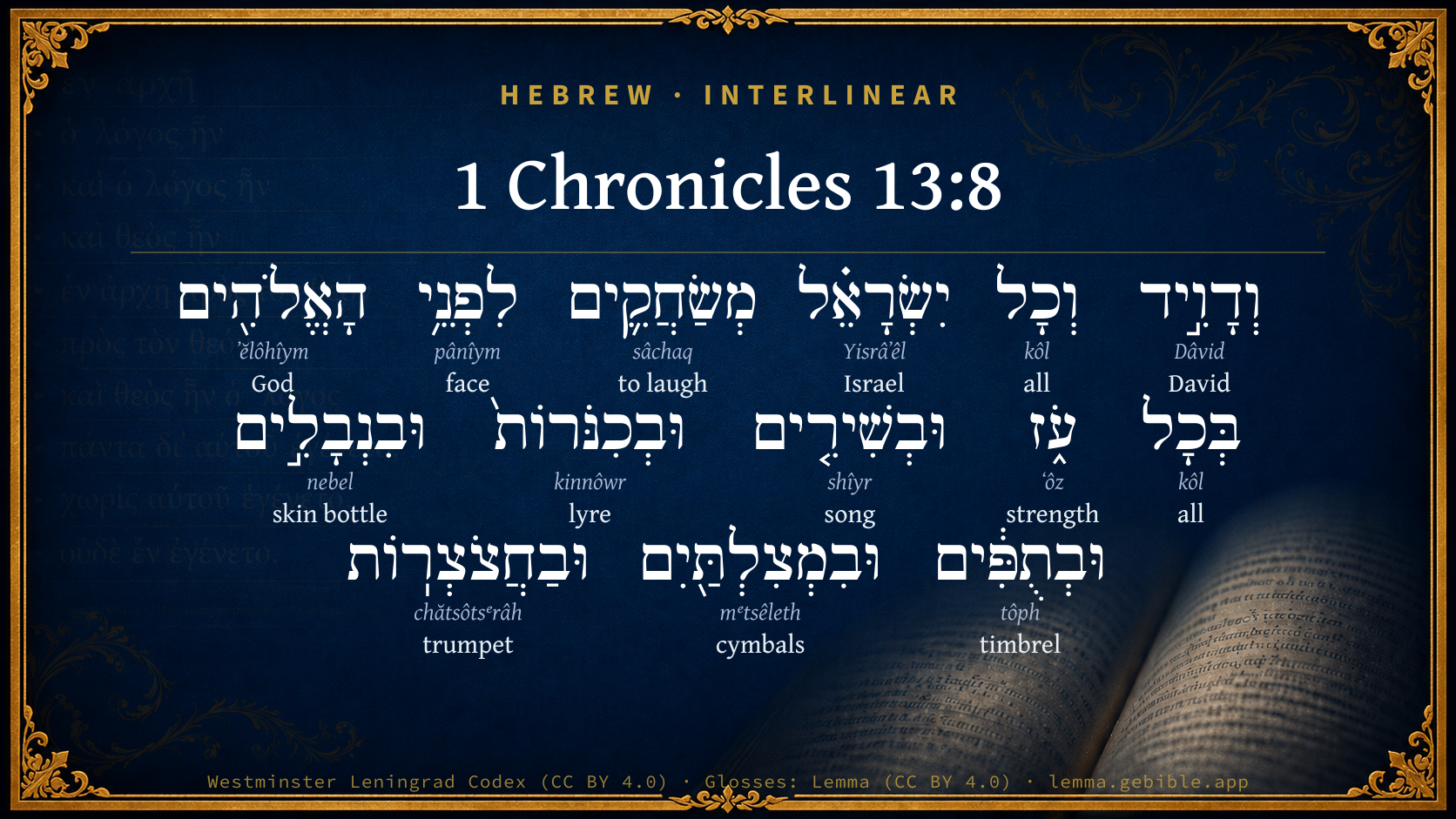
Hebrew (Westminster Leningrad Codex) 1 Chronicles 13:8 appears in the Hebrew Old Testament. The text above is from the Westminster Leningrad Codex. Each word links to its Strong’s number, a concise gloss, and parsing drawn from the Open Scriptures Hebrew Bible morphology. Click any word for its full Brown-Driver-Briggs (BDB) entry.
Download image
Cite this verse

1 Chronicles 13:8 (World English Bible). Public Domain. Lemma interlinear Bible study tool, https://lemma.gebible.app/v/1-chronicles/13/8.

Show BibTeX & RIS
BibTeX
RIS
English Translation
David and all Israel played before God with all their might, even with songs, and with harps, and with psalteries, and with tambourines, and with cymbals, and with trumpets.
World English Bible · Public Domain
Highlights
  • 1 first appearance in the Hebrew Bible
Full analysis ↓
Download a study sheet

One document with this verse’s original text, its word-by-word gloss line, the meaning frame, cross-references with their text, attributed commentary, and full source and license credits — printable, and it pastes into notes with its structure intact.

This verse Autodidact and up

Study sheet (.html) Plain text (.txt)

A passage Seminary Student

Up to 50 verses in one chapter. A passage sheet keeps up to 6 commentary sources and 12 cross-references per verse, in the order this page ranks them, and says so on the sheet whenever that leaves anything out. Ask for a single verse and you get the Autodidact verse sheet above.

Everything on this page stays free to read, with no account — the sheet is a download of what is already on screen, not access to it.

Want to remove ads? Support Godless Engineer
Compare translations 3

The same verse in 3 English versions, stacked beneath the original-language interlinear above. Click any original word for its lexicon entry.

Each is an independent rendering of the whole verse — the interlinear is not word-aligned to these translations.

Highlighted words mark where these versions differ — a whole-verse word diff, not a word-by-word alignment.

  • World English Bible Public Domain
    David and all Israel played before God with all their might, even with songs, and with harps, and with psalteries, and with tambourines, and with cymbals, and with trumpets.
  • King James Version Public Domain
    And David and all Israel played before God with all their might, and with singing, and with harps, and with psalteries, and with timbrels, and with cymbals, and with trumpets.
  • unfoldingWord Literal Text CC BY-SA 4.0
    And David and all of Israel were rejoicing to the face of God with all might and with songs and with harps and with lyres and with tambourines and with cymbals and with trumpets.

unfoldingWord Literal Text — © unfoldingWord, licensed CC BY-SA 4.0. Word-aligned USFM3 via Door43 (git.door43.org/unfoldingWord/en_ult).

Versions to compare (up to 4)

3 of 4 selected

Show all 18 translations

Every available English version of this verse, each an independent rendering of the whole verse.

  • World English Bible Public Domain
    David and all Israel played before God with all their might, even with songs, and with harps, and with psalteries, and with tambourines, and with cymbals, and with trumpets.
  • Berean Standard Bible Public Domain
    David and all the Israelites were celebrating before God with all their might, with songs and on harps and lyres, with tambourines, cymbals, and trumpets.
  • Majority Standard Bible Public Domain
    David and all the Israelites were celebrating before God with all their might, with songs and on harps and lyres, with tambourines, cymbals, and trumpets.
  • King James Version Public Domain
    And David and all Israel played before God with all their might, and with singing, and with harps, and with psalteries, and with timbrels, and with cymbals, and with trumpets.
  • American Standard Version (1901) Public Domain
    And David and all Israel played before God with all their might, even with songs, and with harps, and with psalteries, and with timbrels, and with cymbals, and with trumpets.
  • Revised Version (1885) Public Domain
    And David and all Israel played before God with all their might: even with songs, and with harps, and with psalteries, and with timbrels, and with cymbals, and with trumpets.
  • Geneva Bible (1599) Public Domain
    And Dauid and all Israel played before God with all their might, both with songes and with harpes, and with violes, and with timbrels and with cymbales and with trumpets.
  • Douay-Rheims (1899) Public Domain
    And David and all Israel played before God with all their might with hymns, and with harps, and with psalteries, and timbrels, and cymbals, and trumpets,
  • Young's Literal Translation Public Domain
    and David and all Israel are playing before God, with all strength, and with songs, and with harps, and with psalteries, and with timbrels, and with cymbals, and with trumpets.
  • Literal Standard Version CC BY-SA 4.0
    and David and all Israel are playing before God, with all strength, and with songs, and with harps, and with psalteries, and with timbrels, and with cymbals, and with trumpets.
  • Unlocked Literal Bible CC BY-SA 4.0
    David and all Israel were celebrating before God with all their might. They were singing with stringed instruments, tambourines, cymbals, and trumpets.
  • unfoldingWord Literal Text CC BY-SA 4.0
    And David and all of Israel were rejoicing to the face of God with all might and with songs and with harps and with lyres and with tambourines and with cymbals and with trumpets.
  • Darby Bible Public Domain
    And David and all Israel played before God with all their might, and with singing, and with harps, and with lutes, and with tambours, and with cymbals, and with trumpets.
  • World Messianic Bible Public Domain
    David and all Israel played before God with all their might, even with songs, with harps, with stringed instruments, with tambourines, with cymbals, and with shofars.
  • Webster's Bible Public Domain
    And David and all Israel played before God with all their might, and with singing, and with harps, and with psalteries, and with timbrels, and with cymbals, and with trumpets.
  • Free Bible Version CC BY-SA 4.0
    David and all of Israel were celebrating before the Lord as loudly as possible, singing songs and playing music on lyres, harps, tambourines, cymbals, and trumpets.
  • Bible in Basic English Public Domain
    Then David and all Israel made melody before God with all their strength, with songs and corded instruments of music, and with brass instruments and horns.
  • JPS Tanakh (1917) Public Domain
    And David and all Israel played before God with all their might; even with songs, and with harps, and with psalteries, and with timbrels, and with cymbals, and with trumpets.

Literal Standard Version (2020), Covenant Press — licensed CC BY-SA 4.0. Text via the HelloAO Bible API (eBible.org). Unlocked Literal Bible (unfoldingWord) — licensed CC BY-SA 4.0. Text via the HelloAO Bible API (eBible.org). unfoldingWord Literal Text — © unfoldingWord, licensed CC BY-SA 4.0. Word-aligned USFM3 via Door43 (git.door43.org/unfoldingWord/en_ult). Free Bible Version, Dr. Jonathan Gallagher — licensed CC BY-SA 4.0. Text via the HelloAO Bible API (eBible.org).

Word by word

More ways to search: Search by grammar → Find every occurrence → Compare this word →

Practice this passage: Drill this verse → Learn its vocabulary →

וּבִמְצִלְתַּ֖יִם
mᵉtsêleth
H4700
“and · in/at · cymbals”
Conjunction + Preposition + Noun, Common, Feminine, Dual, Absolute
Part of Speech
Conjunction + Preposition + Noun
Type
Common
Gender
Feminine
Number
Dual
State
Absolute
Full BDB Definition

Origin: from H6750

TWOT: 1919f

cymbals
  1. וְדָוִ֣יד Dâvid H1732 “and · David” Conjunction + Noun, Proper
  2. וְכָל kôl H3605 “and · all of” Conjunction + Noun, Common, Masculine, Singular, Construct
  3. יִשְׂרָאֵ֗ל Yisrâʼêl H3478 “Israel” Noun, Proper
  4. מְשַׂחֲקִ֛ים sâchaq H7832 “laughing” Verb, Piel, Participle Active, Masculine, Plural, Absolute
  5. לִפְנֵ֥י pânîym H6440 “to/for · face(s) of” Preposition + Noun, Common, Both, Plural, Construct
  6. הָאֱלֹהִ֖ים ʼĕlôhîym H430 “the · God(s)” Particle, Definite Article + Noun, Common, Masculine, Plural, Absolute
  7. בְּכָל kôl H3605 “in/at · all of” Preposition + Noun, Common, Masculine, Singular, Construct
  8. עֹ֑ז ʻôz H5797 “strength” Noun, Common, Masculine, Singular, Absolute
  9. וּבְשִׁירִ֤ים shîyr H7892 “and · in/at · songs” Conjunction + Preposition + Noun, Common, Both, Plural, Absolute
  10. וּבְכִנֹּרוֹת֙ kinnôwr H3658 “and · in/at · lyres” Conjunction + Preposition + Noun, Common, Masculine, Plural, Absolute
  11. וּבִנְבָלִ֣ים nebel H5035 “and · in/at · skin bottles” Conjunction + Preposition + Noun, Common, Masculine, Plural, Absolute
  12. וּבְתֻפִּ֔ים tôph H8596 “and · in/at · timbrels” Conjunction + Preposition + Noun, Common, Masculine, Plural, Absolute
  13. וּבַחֲצֹצְרֽוֹת chătsôtsᵉrâh H2689 “and · in/at · trumpets” Conjunction + Preposition + Noun, Common, Feminine, Plural, Absolute

About this verse

These counts appear in no published source. They are computed here, from the morphology-tagged text and Lemma’s own curated glosses. What Lemma adds →

14
words
13
distinct lemmas
Historical
section

Notable vocabulary

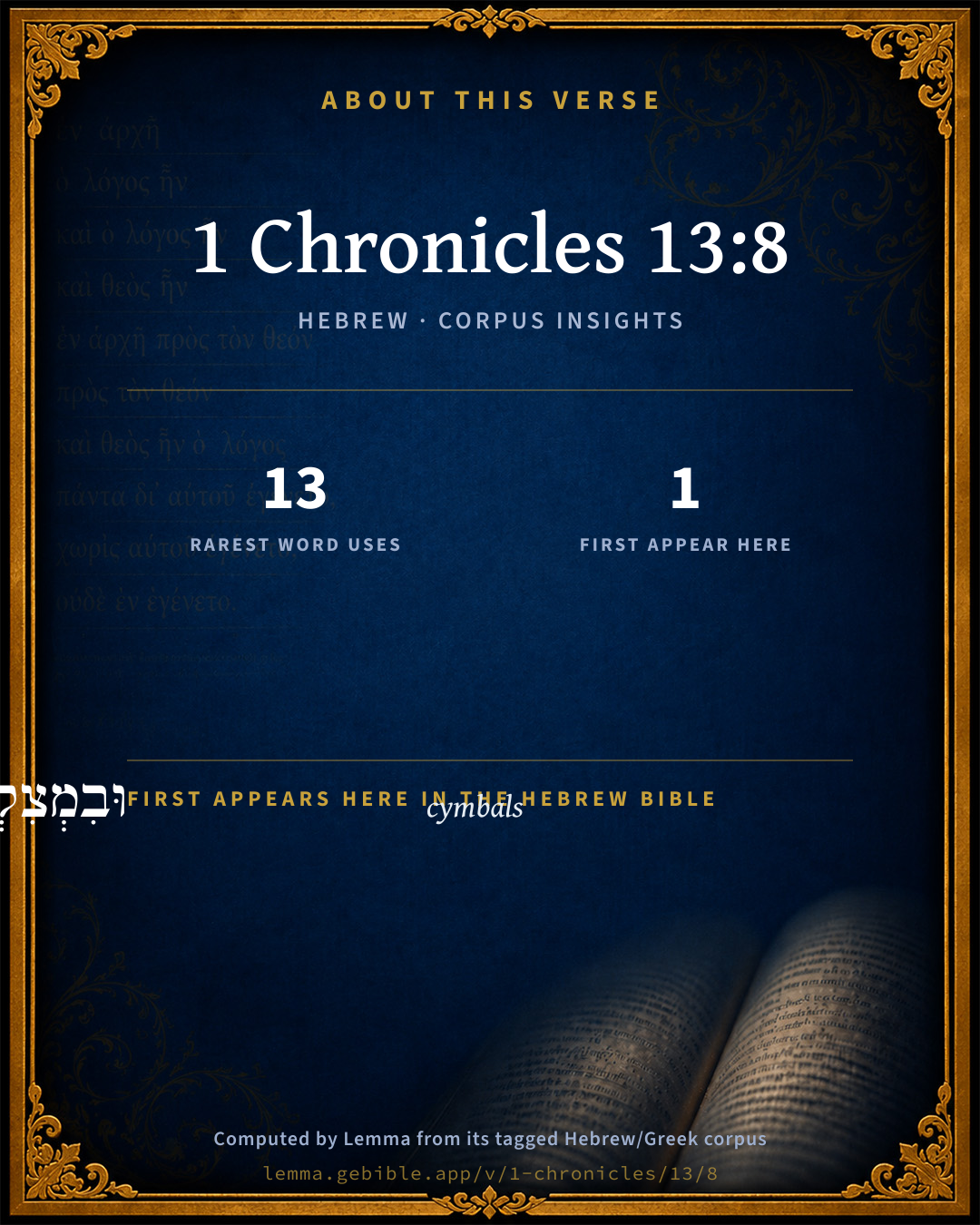
The rarest word here is וּבִמְצִלְתַּ֖יִם cymbals H4700 — appearing just 13 times in the whole Hebrew Bible.

First appearance in Scripture

This word makes its first canonical appearance in the Hebrew Bible here:

  • וּבִמְצִלְתַּ֖יִם cymbals H4700

Shared distinctive vocabulary

וּבִמְצִלְתַּ֖יִם cymbals H4700 occurs in 13 verses of the Hebrew Bible. Also found in:

Grammatical profile

  • 1 verb
  • 13 nouns

Verb forms

  • מְשַׂחֲקִ֛ים Piel · Participle Active

Repetition

A word recurs within this verse — often emphatic in Hebrew:

  • וְכָל all H3605 ×2

Hebrew & Septuagint length

In English translation the verse runs 29 words from the Hebrew and 33 from the Septuagint (LXX English) — closely comparable.

A rough comparison of the two English renderings, which tokenize alike — not a word-level alignment.

Word counts can differ between the Hebrew and the Greek without any difference in meaning — e.g. the Hebrew direct-object marker אֵת has no separate Greek word, and Greek often adds the article ὁ.

Cross-references

15

Topical passages linked to 1 Chronicles 13:8 in the Treasury of Scripture Knowledge — connected by theme and wording, ordered by reader-vote popularity; previews shown in the World English Bible.

  • 2 Samuel 6:5–23 David and all the house of Israel played before Yahweh with all manner of [instruments made of] fir-wood, and with harps, and with psalteries, and with tambourines, and with castanets, and with cymbals.
  • Psalms 150:3–5 Praise him with the sounding of the trumpet! Praise him with harp and lyre!
  • 1 Samuel 10:5 After that you shall come to the hill of God, where is the garrison of the Philistines: and it shall happen, when you are come there to the city, that you shall meet a band of prophets coming down from the high place with a psaltery, and a tambourine, and a pipe, and a harp, before them; and they will be prophesying:
  • 2 Kings 3:15 But now bring me a minstrel. It happened, when the minstrel played, that the hand of Yahweh came on him.
  • 1 Chronicles 15:10–24 of the sons of Uzziel, Amminadab the chief, and his brothers one hundred twelve.
  • 1 Chronicles 15:28 Thus all Israel brought up the ark of the covenant of Yahweh with shouting, and with sound of the cornet, and with trumpets, and with cymbals, sounding aloud with psalteries and harps.
  • 1 Chronicles 16:5 Asaph the chief, and second to him Zechariah, Jeiel, and Shemiramoth, and Jehiel, and Mattithiah, and Eliab, and Benaiah, and Obed-edom, and Jeiel, with psalteries and with harps; and Asaph with cymbals, sounding aloud;
  • 1 Chronicles 16:42 and with them Heman and Jeduthun [with] trumpets and cymbals for those that should sound aloud, and [with] instruments for the songs of God; and the sons of Jeduthun to be at the gate.
  • 1 Chronicles 23:5 and four thousand were doorkeepers; and four thousand praised Yahweh with the instruments which I made, [said David], for giving praise.
  • 1 Chronicles 25:1–6 Moreover, David and the captains of the host set apart for the service certain of the sons of Asaph, and of Heman, and of Jeduthun, who should prophesy with harps, with psalteries, and with cymbals: and the number of those who did the work according to their service was:
  • Psalms 47:5 God has gone up with a shout, Yahweh with the sound of a trumpet.
  • Psalms 68:25–27 The singers went before, the minstrels followed after, In the midst of the ladies playing with tambourines,
  • Daniel 3:5–7 that whenever you hear the sound of the horn, flute, zither, lyre, harp, pipe, and all kinds of music, you fall down and worship the golden image that Nebuchadnezzar the king has set up;
  • Amos 5:23 Take away from me the noise of your songs! I will not listen to the music of your harps.
  • Amos 6:5 Who strum on the strings of a harp; Who invent for themselves instruments of music, like David;

Cross-references courtesy of OpenBible.info (CC BY 4.0).

Hebrew and Greek witnesses Masoretic Hebrew ↔ Greek Septuagint

The same verse in the two great witnesses to the Old Testament, shown verse-for-verse.

These are two independent witnesses, not word-aligned to each other, and the Septuagint is shown in lemma (dictionary) form.

Hebrew 1 Chronicles 13:8 Masoretic · Westminster Leningrad Codex

וְדָוִ֣יד וְכָל יִשְׂרָאֵ֗ל מְשַׂחֲקִ֛ים לִפְנֵ֥י הָאֱלֹהִ֖ים בְּכָל עֹ֑ז וּבְשִׁירִ֤ים וּבְכִנֹּרוֹת֙ וּבִנְבָלִ֣ים וּבְתֻפִּ֔ים וּבִמְצִלְתַּ֖יִם וּבַחֲצֹצְרֽוֹת

David and all Israel played before God with all their might, even with songs, and with harps, and with psalteries, and with tambourines, and with cymbals, and with trumpets.

World English Bible · Public Domain

Greek LXX 1 Chronicles 13:8 Septuagint · lemma form

καί δαυίδ καί πᾶς ἰσραήλ παίζω ἐναντίον ὁ θεός ἐν πᾶς δύναμις καί ἐν ψαλτῳδός καί ἐν κινύρα καί ἐν νάβλα ἐν τύμπανον καί ἐν κύμβαλον καί ἐν σάλπιγξ

And David and all Israel were playing before the Lord with all their might, and that together with singers, and with harps, and with lutes, with timbrels, and with cymbals, and with trumpets.

LXX2012 (modern English Septuagint) · Public Domain

On this verse, Ellicott's Commentary for English Readers discusses the Septuagint’s reading. Read the note in Commentary ↓

Hebrew: Westminster Leningrad Codex (CC BY 4.0). Greek: Septuagint (public domain); English from LXX2012 (modern English Septuagint) (Public Domain). How the Septuagint differs from the Hebrew →

Commentary

Notes on 1 Chronicles 13:8 from classic Christian and Jewish commentators (each source and its license shown beneath its notes). The classic Christian expositions comment on the surrounding passage and are grouped to its opening verse, so a note may address several verses; the Jewish commentaries on the Tanakh (Rashi and others) are per-verse, so they appear only where the commentator wrote on this verse.

Lemma curates 59 commentaries, every one of them public domain or Creative Commons licensed, each selected and text-cleaned for this edition rather than reprinted as found. About our sources →

Trapp's Complete Commentary

John Trapp

1Ch 13:8 And David and all Israel played before God with all [their] might, and with singing, and with harps, and with psalteries, and with timbrels, and with cymbals, and with trumpets.

Ver. 8. David and all Israel played.] How should we rejoice in the gospel now restored! O nos ingratos!

And with singing.] Psallunt et saliunt. All this is no warrant for those Popish pompous processions and superstitous will-worships.

John Trapp, A Commentary or Exposition upon All the Books of the Old and New Testament (1647–1656) — public domain. Text from a community e-Sword module.

Geneva Bible (1599)

Geneva Bible translators

That is, before the Ark, where God showed himself: so that the sign is taken for the thing signified, which is common to all sacraments both in the old and new Testament.

Geneva Bible (1599) marginal notes — public domain. Text via Bolls.life.

Ellicott's Commentary for English Readers

(8) Played.—Were dancing (to music).

With all their might, and with singing.—So LXX. and Syriac. Samuel has “with all woods of cypresses;” a strange expression, probably due to confusion of similar letters, and transposition. The LXX. there has “in strength.”

Cymbals and trumpets.—Samuel (Hebrew) has sistrums (a kind of rattle) and cymbals. The former word only occurs there. The Chronicle has a later term for cymbals (meçiltayim for çilçeþlîm).

A Bible Commentary for English Readers, edited by Charles John Ellicott (1878–1897) — public domain. Text from a community e-Sword module.

The Cambridge Bible for Schools and Colleges

gen. ed. J. J. S. Perowne

8. played] The Heb. word means to sport, to dance (cp. 1Ch_15:29).

with all their might, and with singing] A better reading than that of 2Sa_6:5, with all manner of instruments made of fir wood.

and with singing] R.V. even with songs.

psalteries] The instrument here meant (Heb. nçbhel) “is generally identified at the present day with an instrument called the santir still in use among the Arabs. This consists of a long box with a flat bottom covered with a somewhat convex sounding-board over which the strings are stretched.” (Nowack, Hebräische Arckäologie, I. 275.) The “harp” (Heb. kinnôr) was a simpler instrument, a lyre rather than a true harp.

For a full discussion of nçbhel and kinnôr see Driver, Amos, p. 234.

The Cambridge Bible for Schools and Colleges (gen. ed. J. J. S. Perowne; Cambridge University Press, 1878–1918) — public domain. Text from a community e-Sword module.

The Pulpit Commentary

Let us bring again the ark. It had been removed from Shiloh (Jos_18:1) at the instance of "the elders of Israel" to their camp, when they were hard pressed and smitten by the Philistines; (1Sa_4:1-4) there it was taken by the Philistines, (1Sa_4:11, 1Sa_4:22) and hurried from Ashdod to Ekron and on to Bethshemesh. (1Sa 5:l, 1Sa_5:5, 1Sa_5:8, 10 6:9-13) For we inquired not at it in the days of Saul. The allusion may be considered delicately worded, but an inexpressible pathos and unmeasured condemnation must be imagined as clinging to this sentence, illustrated further by 1Sa_7:2 1Sa_28:6, 1Sa_28:15, 1Sa_28:16; 1Ch_10:14. Played before God. The Hebrew word is the Piel of qjc, the root of which, from the simplest meaning of "to laugh" (and with the two appropriate prepositions used for laughing with an expression of derision or contempt), through the two further meanings of "sporting" and jesting," passes to the signification of dancing" (1Sa_18:7; Jer_31:4) Its deepest idea seems to be "to make merry," and to savour of the very same ambiguity attaching to that idiom with ourselves. The parallel of this passage exhibits "before the Lord." With all their might. See the evident mistake of the parallel ("on all manner of instruments made of firwood," literally, with all firwoods) through similarity of the Hebrew characters. Cymbals and trumpets. Of the five names of musical instruments, the same in number in both passages, the first three are the same in the Hebrew, but these last two are different words, twOrxxOj here for A variation of this particular kind again indicates with some decisiveness the different character and the number of the sources from which the writers of the Books of Samuel and those of Chronicles took.

Holy mirth.

To some minds the two ideas, holiness and mirth, do not seem to harmonize. Whether because goodness is sometimes associated with austerity, and religious observances with dulness, or because mirth is sometimes associated with sensual indulgence and profanity; the fact is that to many minds there appears a mutual repugnance between the two.

I WE HAVE HERE A SUITABLE AND INSPIRITING OCCASION OF HOLY MIRTH. General rejoicing should not take place only when temporal deliverances or material prosperity have been experienced. When God shows his mercy towards a people, in conferring upon them spiritual privileges, then should they show forth his praise, and make a joyful noise unto the Lord.

II THE UNION OF ALL CLASSES IN HOLY MIRTH. King, priests, and people rejoiced together, and if all orders and ranks are alike indebted to God"s goodness, all should alike join in his service and praise. Widespread is the beneficence of the heavenly Father; let all the children give thanks, and be joyful before the Lord the King.

III HOLY MIRTH FINDS AN APPROPRIATE EXPRESSION IN CONJOINED AND CORDIAL SERVICES OF MUSIC AND SONG.

Such utterance of mirth is natural, is in accordance with the constitution God our Maker has given us. It is scriptural, for both under the old covenant and the new, vocal praise was practised by the saints of God. It is acceptable: "With such sacrifices God is well pleased." It is an anticipation of heaven, where the praises of the redeeming God are universal and perpetual.

LESSONS.

1. Discourage a severe, morose piety.

2. Let songs of rejoicing abound in Christian homes and Churches.

3. Let the young be trained to associate happiness with religion to take pleasure in "the service of song in the house of the Lord.

T.

The joy of religion.

The natural and fitting expression of the kingly and national gladness in the restoration of the sacred ark was, "Playing before God with all their might, and with singing, and with harps, and with psalteries, and with timbrels, and with cymbals, and with trumpets." The three kinds of musical instruments are here indicated those producing sound by wind, by the vibration of strings, and by the clanging together of metals. For a picturesque realization of the scene brought before us in this verse, see Stanley"s "Jewish Church," vol. 2:74-76. The mission of music and song is to find expression for man"s gladness and joy. It is as natural to sing as to laugh. Man has wonderfully developed the faculties of music and song, and now it is one of our chief modes of expressing human emotions, and of relieving them by expression. It is as truly one of the great forces for exciting and stirring emotion, as is well shown when it is necessary to raise the martial spirit of a nation. Dr. Horace Bushnell has a very striking paper on "Religious Music," in his volume "Work and Play," in which he opens out and illustrates these two points: "The very wonderful fact that God has hidden powers of music in things without life; and that when they are used, in right distinctions or properties of sound, they discourse what we know what meets, interprets, and works our feeling, as living and spiritualcreatures." "How carefully this (musical) part of the worship was ordered in the temple service of Israel is known to every reader of the ancient Scriptures; how exactly also the chorus of singers and of players on instruments were arranged, one to answer to another in the deep wail of grief or penitence, the soft response of love, the lively sweep of festive gladness, or all to flow together in choral multitudes of praise, that might even shake the rock of Zion itself." "And if any one wishes to know what power there may be in music, as an instrument of reliction, let him ask what effect the songs of this one singer (David) have had, melted into men"s hearts, age after age, by music, and made in that manner to be their consecrated and customary expressions of worship.

I THE REASONABLENESS OF JOY IN RELIGION. We feel the reasonableness of the songs and joy of Israel when redeemed from Egyptian bondage and delivered from their raging foes. Much more is joy and song right and natural as our response for redemption from penalty, and deliverance from evil. It can only be a distorted religion that fits with melancholy. "The joy of the Lord is our strength;" and with "joy we draw water from the wells of salvation." Illustrate from the Old Testament point of view: David and the prophets give high examples. Illustrate from the New Testament point of view: apostles tell us if we are merry, we should sing psalms;" "Speaking to one another in psalms and hymns and spiritual songs." Modern religious life makes music and song essential features, and these do much towards preserving a healthy tone in our piety. This may be applied to private devotion; it is greatly aided by hymn and song. It is the most attractive feature of public worship.

II THE HELPFULNESS OF SONG IN EXPRESSING RELIGIOUS JOY. What could David have done else, or so well, in uttering his overcharged feelings? Music at once soothes and gives adequate expression. A man can put his very heart into a song, and ease and quiet his intense emotions by so doing. Estimate the influence of song: it

(1) uplifts;

(2) brightens;

(3) aids feeling;

(4) comforts.

Illustrate by the incidents and influences connected with Paul Gerhardt s hymns. Then we should fully recognize the importance of the gifts of song and music which have been granted to the Church, and see that these are duly consecrated and cultivated. Religious joy cannot be always maintained, and yet true hearts may even find "songs in the night and in the prison. R.T.

The Pulpit Commentary (1880–1919), ed. H.D.M. Spence-Jones & Joseph S. Exell — public domain. Text from a community e-Sword module.

Rashi

Rabbi Shlomo Yitzchaki (Rashi)

with all [their] might Here it is written: בְּכָל עֹז, with all strength, and in II Samuel (6:5): “בְּכָל עֲצֵי, with all wood.” The meaning is: with all manner of wooden musical instruments, and here the meaning is: with all powerful musical instruments.

and with songs and with harps and with psalteries and with timbrels All of these are musical instruments, but cymbals (מְצִלְתַּיִם) were not a musical instrument, and their function was only to make sounds, like the instrument called the kettle drum, Pauken in German, which is struck with sticks to make sounds. This is implied further (15: 25): “and with resounding cymbals,” and it is written (ibid. verse 19): “And the singers: Heman, Asaph, and Ethan, with copper cymbals to resound.” And it is written further below (25:6): “with song in the House of the Lord, with cymbals, etc.,” and because of this, they are called מְצִלְתַּיִם. Similarly (Deut. 28:42): “... the locusts (הַצְּלָצַל) will inherit.” This is a species of locust that makes a sound, as it is written in the prophecy of Joel (2:5) about the locusts: “Like the sound of chariots on the mountaintops, they will leap, etc.”

Rashi on the Tanakh — English translations: “The Judaica Press complete Tanach with Rashi, translated by A. J. Rosenberg” (CC BY 4.0); “Pentateuch with Rashi's commentary by M. Rosenbaum and A.M. Silbermann, 1929-1934” (public domain); “The Metsudah Tanach series, Lakewood, N.J” (CC BY 4.0); and “The Book of Joshua, Metsudah Publications, 1997” (CC BY 4.0). Text via Sefaria.

Lesson kit

Teaching starters — assembled from the data on this page, not authored interpretation. Every prompt links to the verse data it draws on. Edit before teaching.

1 Chronicles, in the Historical, opens this verse with 14 words (13 distinct Hebrew lemmas). Its most distinctive word is mᵉtsêleth (“cymbals”). A historical commentator’s framing appears above. Read the whole chapter for the surrounding context.

Discussion questions

  1. How does “cymbals” (mᵉtsêleth) shape what this verse is saying?
  2. This is the first place “cymbals” appears in Scripture (first appears here). What does its debut here establish?
  3. How does 1 Chronicles 15:16, which shares the word «cymbals», read alongside this verse?
  4. What does the repetition of “all” (2× in this one verse) do in this verse?
  5. These translations render this verse differently. What is at stake in choosing one wording over another?
  6. «מְשַׂחֲקִ֛ים» is a Piel Participle Active verb. How does that grammatical form shape the action described?
  7. Compare how Trapp's Complete Commentary and Geneva Bible (1599) read this verse. Where do they agree or differ?

Things to notice

  • 1 word makes its first canonical appearance in Scripture here.
  • These translations choose different wording for 11 words in this verse.
  • “all” occurs 2× in this single verse.
  • 13 distinct Hebrew lemmas span 14 words in this verse.

Reading settings

Reading text

Shown beneath each verse's original-language words.

Old Testament
Old Testament edition

Read the OT as the Masoretic Hebrew (MT) or the Greek Septuagint (LXX).

English shown for the Greek Septuagint (in the Hebrew ↔ Greek comparison).

Comparing translations? Open the Compare panel on any verse page to stack up to four side by side.