
Proverbs 14:26

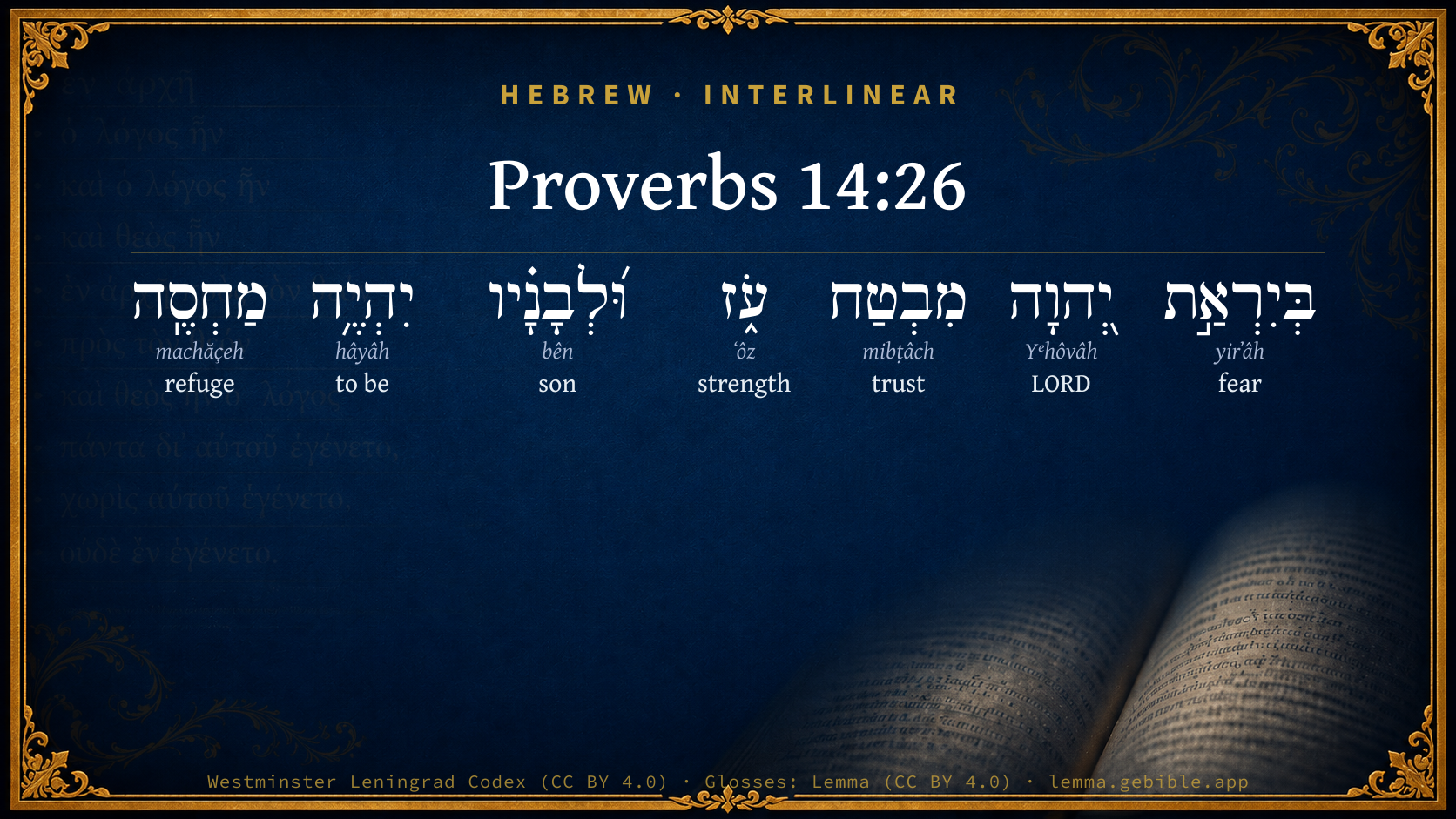
Hebrew (Westminster Leningrad Codex) Proverbs 14:26 appears in the Hebrew Old Testament. The text above is from the Westminster Leningrad Codex. Each word links to its Strong’s number, a concise gloss, and parsing drawn from the Open Scriptures Hebrew Bible morphology. Click any word for its full Brown-Driver-Briggs (BDB) entry.
Download image
Cite this verse

Proverbs 14:26 (World English Bible). Public Domain. Lemma interlinear Bible study tool, https://lemma.gebible.app/v/proverbs/14/26.

Show BibTeX & RIS
BibTeX
RIS
English Translation
In the fear of Yahweh is a secure fortress, And he will be a refuge for his children.
World English Bible · Public Domain
Download a study sheet

One document with this verse’s original text, its word-by-word gloss line, the meaning frame, cross-references with their text, attributed commentary, and full source and license credits — printable, and it pastes into notes with its structure intact.

This verse Autodidact and up

Study sheet (.html) Plain text (.txt)

A passage Seminary Student

Up to 50 verses in one chapter. A passage sheet keeps up to 6 commentary sources and 12 cross-references per verse, in the order this page ranks them, and says so on the sheet whenever that leaves anything out. Ask for a single verse and you get the Autodidact verse sheet above.

Everything on this page stays free to read, with no account — the sheet is a download of what is already on screen, not access to it.

Want to remove ads? Support Godless Engineer
Compare translations 3

The same verse in 3 English versions, stacked beneath the original-language interlinear above. Click any original word for its lexicon entry.

Each is an independent rendering of the whole verse — the interlinear is not word-aligned to these translations.

Highlighted words mark where these versions differ — a whole-verse word diff, not a word-by-word alignment.

  • World English Bible Public Domain
    In the fear of Yahweh is a secure fortress, And he will be a refuge for his children.
  • King James Version Public Domain
    In the fear of the LORD is strong confidence: and his children shall have a place of refuge.
  • unfoldingWord Literal Text CC BY-SA 4.0
    In the fear of Yahweh strong confidence, and for his sons he will be a refuge.

unfoldingWord Literal Text — © unfoldingWord, licensed CC BY-SA 4.0. Word-aligned USFM3 via Door43 (git.door43.org/unfoldingWord/en_ult).

Versions to compare (up to 4)

3 of 4 selected

Show all 18 translations

Every available English version of this verse, each an independent rendering of the whole verse.

  • World English Bible Public Domain
    In the fear of Yahweh is a secure fortress, And he will be a refuge for his children.
  • Berean Standard Bible Public Domain
    He who fears the LORD is secure in confidence, and his children shall have a place of refuge.
  • Majority Standard Bible Public Domain
    He who fears the LORD is secure in confidence, and his children shall have a place of refuge.
  • King James Version Public Domain
    In the fear of the LORD is strong confidence: and his children shall have a place of refuge.
  • American Standard Version (1901) Public Domain
    In the fear of Jehovah is strong confidence; And his children shall have a place of refuge.
  • Revised Version (1885) Public Domain
    In the fear of the LORD is strong confidence: and his children shall have a place of refuge.
  • Geneva Bible (1599) Public Domain
    In the feare of the Lord is an assured strength, and his children shall haue hope.
  • Douay-Rheims (1899) Public Domain
    In the fear of the Lord is confidence of strength, and there shall be hope for his children.
  • Young's Literal Translation Public Domain
    In the fear of Jehovah `is' strong confidence, And to His sons there is a refuge.
  • Literal Standard Version CC BY-SA 4.0
    Strong confidence [is] in the fear of YHWH, || And there is a refuge to His sons.
  • Unlocked Literal Bible CC BY-SA 4.0
    When someone fears Yahweh, he also has much confidence in him; these things will be like a strong place of protection for this man's children.
  • unfoldingWord Literal Text CC BY-SA 4.0
    In the fear of Yahweh strong confidence, and for his sons he will be a refuge.
  • Darby Bible Public Domain
    In the fear of Jehovah is strong confidence, and his children shall have a place of refuge.
  • World Messianic Bible Public Domain
    In the fear of the LORD is a secure fortress, and he will be a refuge for his children.
  • Webster's Bible Public Domain
    In the fear of the LORD is strong confidence: and his children shall have a place of refuge.
  • Free Bible Version CC BY-SA 4.0
    People who honor the Lord are completely safe; he will protect their children.
  • Bible in Basic English Public Domain
    For him in whose heart is the fear of the Lord there is strong hope: and his children will have a safe place.
  • JPS Tanakh (1917) Public Domain
    In the fear of the LORD a man hath strong confidence; and his children shall have a place of refuge.

Literal Standard Version (2020), Covenant Press — licensed CC BY-SA 4.0. Text via the HelloAO Bible API (eBible.org). Unlocked Literal Bible (unfoldingWord) — licensed CC BY-SA 4.0. Text via the HelloAO Bible API (eBible.org). unfoldingWord Literal Text — © unfoldingWord, licensed CC BY-SA 4.0. Word-aligned USFM3 via Door43 (git.door43.org/unfoldingWord/en_ult). Free Bible Version, Dr. Jonathan Gallagher — licensed CC BY-SA 4.0. Text via the HelloAO Bible API (eBible.org).

Word by word

More ways to search: Search by grammar → Find every occurrence → Compare this word →

Practice this passage: Drill this verse → Learn its vocabulary →

About this verse

These counts appear in no published source. They are computed here, from the morphology-tagged text and Lemma’s own curated glosses. What Lemma adds →

7
words
7
distinct lemmas
Wisdom
section

Notable vocabulary

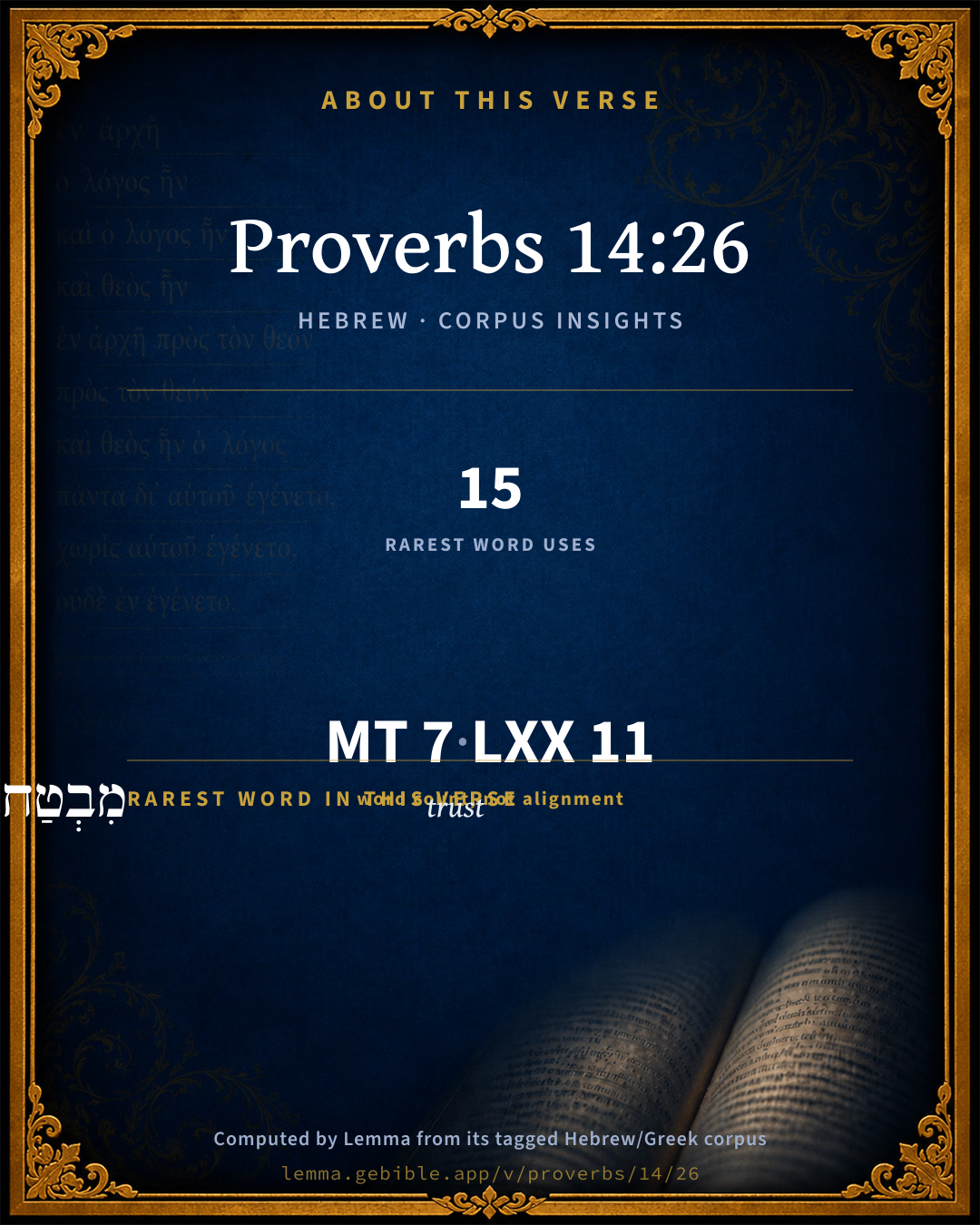
The rarest word here is מִבְטַח trust H4009 — appearing just 15 times in the whole Hebrew Bible.

Shared distinctive vocabulary

מִבְטַח trust H4009 occurs in 15 verses of the Hebrew Bible. Also found in:

Grammatical profile

  • 1 verb
  • 6 nouns

Verb forms

  • יִהְיֶ֥ה Qal · Imperfect

Hebrew & Septuagint length

In English translation the verse runs 18 words from the Hebrew and 16 from the Septuagint (LXX English) — closely comparable.

A rough comparison of the two English renderings, which tokenize alike — not a word-level alignment.

Word counts can differ between the Hebrew and the Greek without any difference in meaning — e.g. the Hebrew direct-object marker אֵת has no separate Greek word, and Greek often adds the article ὁ.

In the original languages it is 7 Hebrew tokens and 11 Greek tokens — but the two are counted differently (Hebrew bundles its prefixes and suffixes into one token; the Greek is in lemma form), so that isn’t a like-for-like length.

Cross-references

17

Topical passages linked to Proverbs 14:26 in the Treasury of Scripture Knowledge — connected by theme and wording, ordered by reader-vote popularity; previews shown in the World English Bible.

  • Proverbs 19:23 The fear of Yahweh leads to life, then contentment; He rests and will not be touched by trouble.
  • Jeremiah 32:39–40 and I will give them one heart and one way, that they may fear me forever, for the good of them, and of their children after them:
  • Psalms 115:13–14 He will bless those who fear Yahweh, Both small and great.
  • Proverbs 18:10 The name of Yahweh is a strong tower: The righteous run to him, and are safe.
  • Proverbs 3:7–8 Don't be wise in your own eyes. Fear Yahweh, and depart from evil.
  • Psalms 34:7–11 The angel of Yahweh encamps round about those who fear him, And delivers them.
  • Psalms 112:1 Praise Yah! Blessed is the man who fears Yahweh, Who delights greatly in his commandments.
  • Malachi 3:16–18 Then those who feared Yahweh spoke one with another; and Yahweh listened, and heard, and a book of memory was written before him, for those who feared Yahweh, and who honored his name.
  • Malachi 4:2 But to you who fear my name shall the sun of righteousness arise with healing in its wings. You will go out, and leap like calves of the stall.
  • Isaiah 33:6 There shall be stability in your times, abundance of salvation, wisdom, and knowledge: the fear of Yahweh is your treasure.
  • Acts 9:31 So the assemblies throughout all Judea and Galilee and Samaria had peace, and were built up. They were multiplied, walking in the fear of the Lord and in the comfort of the Holy Spirit.
  • Psalms 112:6–8 For he will never be shaken. The righteous will be remembered forever.
  • Proverbs 3:25–26 Don't be afraid of sudden fear, Neither of the desolation of the wicked, when it comes:
  • Ecclesiastes 7:18 It is good that you should take hold of this. Yes, also from that don't withdraw your hand; for he who fears God will come forth from them all.
  • Genesis 31:42 Unless the God of my father, the God of Abraham, and the fear of Isaac, had been with me, surely now you would have sent me away empty. God has seen my affliction and the labor of my hands, and rebuked you last night."
  • Isaiah 26:20–21 Come, my people, enter you into your chambers, and shut your doors about you: hide yourself for a little moment, until the indignation be past.
  • Jeremiah 15:11 Yahweh said, Most assuredly I will strengthen you for good; most assuredly I will cause the enemy to make supplication to you in the time of evil and in the time of affliction.

Cross-references courtesy of OpenBible.info (CC BY 4.0).

Hebrew and Greek witnesses Masoretic Hebrew ↔ Greek Septuagint

The same verse in the two great witnesses to the Old Testament, shown verse-for-verse.

These are two independent witnesses, not word-aligned to each other, and the Septuagint is shown in lemma (dictionary) form.

Hebrew Proverbs 14:26 Masoretic · Westminster Leningrad Codex

בְּיִרְאַ֣ת יְ֭הוָה מִבְטַח עֹ֑ז וּ֝לְבָנָ֗יו יִהְיֶ֥ה מַחְסֶֽה

In the fear of Yahweh is a secure fortress, And he will be a refuge for his children.

World English Bible · Public Domain

Greek LXX Proverbs 14:26 Septuagint · lemma form

ἐν φόβος κύριος ἐλπίς ἰσχύς ὁ δέ τέκνον αὐτός καταλείπω ἔρεισμα

In the fear of the Lord is strong confidence: and he leaves his children a support.

LXX2012 (modern English Septuagint) · Public Domain

On this verse, The Pulpit Commentary discusses the Septuagint’s reading. Read the note in Commentary ↓

Hebrew: Westminster Leningrad Codex (CC BY 4.0). Greek: Septuagint (public domain); English from LXX2012 (modern English Septuagint) (Public Domain). How the Septuagint differs from the Hebrew →

Commentary

Notes on Proverbs 14:26 from classic Christian and Jewish commentators (each source and its license shown beneath its notes). The classic Christian expositions comment on the surrounding passage and are grouped to its opening verse, so a note may address several verses; the Jewish commentaries on the Tanakh (Rashi and others) are per-verse, so they appear only where the commentator wrote on this verse.

Lemma curates 59 commentaries, every one of them public domain or Creative Commons licensed, each selected and text-cleaned for this edition rather than reprinted as found. About our sources →

Trapp's Complete Commentary

John Trapp

Pro 14:26 In the fear of the LORD [is] strong confidence: and his children shall have a place of refuge.

Ver. 26. In the fear of the Lord is strong confidence.] The reverential fear of God is monimenturn, munimentum, ornamentum. The wise man had said, in Pro 14:24, "The crown of the wise are their riches," and in Pro 18:11, he will tell us that "the rich man’s wealth is his strong city." Now, lest any should hereby be brought to think of riches more highly than is meet, he gives us to know that wealth, severed from the fear of God, can neither adorn us nor secure us. Great is the confidence of a good conscience. "Our God whom we serve is able to deliver us, and he will deliver us out of thine hand." {Dan 3:17} Hezekiah pulled down the brazen serpent, for he "trusted in God." {2Ki 18:5} At ego rem divinam facio, - But I am sacrificing, said Numa, when they told him the enemy was at hand. Non sic Deos coluimus, aut sic vivimus ut illi nos vincerent, said the Emperor Antoninus. We are bold to believe that God will deal better with us than so.

And his children have a place of refuge], i.e., God’s children run to his name and are safe. Or, The children of him who fears God. For God will bless those who fear him, "both small and great." {Psa 115:13} If I can but once find the fear of God in those about me, said reverend Claviger, satis habeo, satisque mihi, meae uxori, fillis, et filiabus prospexi, {a} I shall have enough for myself, wife, and children; they will be all cared for.

{a} Seluecer.

John Trapp, A Commentary or Exposition upon All the Books of the Old and New Testament (1647–1656) — public domain. Text from a community e-Sword module.

The Biblical Illustrator

Joseph S. Exell

Pro_14:26

In the fear of the Lord is strong confidence: and His children shall have a place of refuge.

Godly fear and its goodly consequence

Has it never surprised you that there should be such sentences as these in the Book of inspiration--secular proverbs interspersed with spiritual proverbs--the secular and the spiritual all put together without any division or classification. The hard and fast line which is made to divide the secular from the religious is fraught with innumerable injuries.

I. What is this fear of the Lord? Fear stands for true godliness. It is a short way of expressing real faith, hope, love, holiness of living, and every grace. There is a something more tender, more touching, more real about fear than there is about some peoples faith, which faith may very readily verge upon presumption. But in speaking of fear we must always discriminate. There is a fear with which a Christian has nothing to do. What is the fear that a well-ordered, well-disciplined, beloved child has of his own father?

1. He has an awe of him which arises out of admiration of his character.

2. He is sure to be very deferential in his fathers presence.

3. He fears at any time to intrude upon his fathers prerogative.

4. He dreads everything which might cause his fathers displeasure.

II. Wherein is the confidence of godly fear seen? The history of men that have feared God may enlighten us on this matter, e.g., Job, Habakkuk. The confidence will not only appear in time of trouble, it will appear also in acts of obedience. The same confidence will develop itself when persecution is involved, and when we have to bear witness to the truth.

III. Whereupon is this confidence built? They that fear God know God to be infinitely loving to them, to be immutable and unchangeable, to be unsearchingly wise and omnipotently strong on their behalf; they know that an atonement has been made for their sins, and that the Spirit of God dwells in them.

IV. How this confidence and this fear are favoured of God. The promise is, His children shall have a place of refuge. Those who fear God and have confidence in Him are His children. There is a heaven lying asleep within those words, His children. For the place of refuge finds illustration in Noah, Lot, Israel, Ruth, Elijah, Christians at Pella, etc. Moses Stuart says the text means that the children of those who fear God shall have a place of refuge. And there are many precious texts that speak thus of our children. (C. H. Spurgeon.)

Godliness, safety, and life

I. That godliness is safety. The fear of the Lord is strong confidence. The godly are safe. God is their Refuge and Strength. They will not fear though the earth be removed. We make three remarks about this refuge.

1. It is a provision against immense dangers.

2. It admits of the greatest freedom of action. A prison is a refuge as well as a fortress. But all in this refuge have ample scope for action. The sphere is as infinite as God.

3. It is accessible at all times and for all persons. Its gates are open day and night.

II. That godliness is life. The fear of the Lord is a fountain of life. Godliness is a fountain of happiness--salubrious, abundant, perennial. (D. Thomas, D.D.)

Strong confidence

Fear prevents confidence, and sometimes destroys confidence; but the fear of the Lord produces confidence. The text does not say that all godly persons have confidence; some have not, because the body is weak or there is some morbid feeling ruling the heart which should not control the emotions and the affections. Godliness, where it has full play and free scope, will invariably produce confidence. All the confidence of godly persons is not a direct fruit of piety. Some confidence comes from constitutional conditions. It is a matter of temperament.

I. Real godliness involves confidence towards God. Because in such a case as this reconciliation with God is complete. Not necessarily the realisation of reconciliation and the fruits and effects of it. If reconciliation in the case of those who fear the Lord be complete, confidence cannot but be restored by such reconciliation. There springs up between them that fear the Lord and God, that which may be called filial friendship; and in this there is strong confidence, Further, the intercourse of the godly with heaven is perfectly unfettered. And there is, in the case of those who fear the Lord, happy dependence; such as that of the babe upon its mother. We are not always to be asking God for an explanation of His doings, we are to trust Him. There is motherhood as truly as fatherhood in God.

II. Real godliness produces confidence towards men. Not impudence; not boldness of the evil kind; but that confidence which is perfectly consistent with deep humility, and which works together with that spirit which is ever ready to put honour on another. Do not mistake this confidence towards men. This confidence is the confidence of conscious uprightness. As in the case of Job. But it is not the self-conceit which says, Stand by, I am holier than thou.

III. The confidence which real godliness awakens is adapted to all circumstances. In danger it becomes boldness. In duty and work it becomes conscious power. The godly man is not a fatalist.

IV. A confidence which abides to the end. It goes with a man to the uttermost, it carries him right through. It endures because the principles out of which it is established endure. Faith endures. Hope endures. This confidence will be strong enough to do all the work which you, in this world of sin and sorrow, may require from it. Then do not be content without strong confidence. And endeavour to promote this confidence, especially among weak and timid Christians. (S. Martin, M.A.)

Fear a confidence

Fear is confidence; the words sound strangely. They are strange indeed, but true. To fear God aright is to be delivered from all fear. His salvation is nigh them that fear Him. To have such a neighbour is strong consolation to a human spirit in this howling wilderness. The fear which brings a sinner submissive and trustful to the sacrifice and righteousness of the Substitute is itself a confidence. The great and terrible God becomes the dwelling-rock of the fugitive. (W. Arnot.)

The fear of the Lord and its advantages

Religion, in the life of a man who regularly lives to God, always appears in an aspect uninteresting and unlovely to the irreligious. And so they speak of it. It is needful, therefore, that religion should be honoured.

I. The habit which the text exhibits. The fear of the Lord. Fear, in its most comprehensive and general definition, is that emotion arising from the prospect of danger, either real or imaginary. In spiritual things it has a twofold character.

1. Slavish fear, or mere dread of Jehovah in His character as Judge. This fear must not be put in the place of religion.

2. Filial fear. Analogous to the emotion properly exercised by children towards parents; it is exercised by all those who have undergone a redemption from slavish fear and a renovation of heart by the influence of the Divine Spirit. It arises from a deep and humble reverence of the Divine perfections and from a practical desire to walk in obedience to the Divine commandments. It is principally included in the direction of all the affections towards Jehovah and the exhibition of practical religion in the life and conversation. The filial fear of the Lord is by no means inconsistent with the love cf the Lord.

II. The advantages which this mental habit always and invariably secures. The fear of God excludes all other fear, and he who has it has a sanctuary in which his soul shall abide in security, and safety, and peace, while looking beyond the scenes of this present life for the perfect enjoyment of interminable and imperishable felicity. Notice three facts embodied in the principle.

1. The fear of the Lord removes the terrors of conscience. Conscience is the judge of a mans mind with regard to a mans own actions. An accusing conscience is one that sets before the spirit of a man the array of his crimes. The fear of the Lord prevents the accusations of conscience and brings the soul into a state of peace.

2. The fear of the Lord removes also the terrors of temporal chastisement. But the chastening of God is always for our profit; and in connection with the profit arising from chastisement there are peculiar comforts.

3. The fear of the Lord removes the terrors of death and of futurity. He who has God for his friend must look, not only without fear, but with hope and joy, to the last moment of dissolution, and his entrance into the mysteries of the awful world of futurity. (James Parsons.)

The advantages of religious principle

The fear of the Lord is here put for all gracious principles, producing gracious practices.

1. Where this reigns it produces a holy security and serenity of mind.

2. It entails a blessing on posterity.

3. It is an overflowing and everflowing spring of comfort and joy. It is a fountain of life, yielding constant pleasure and satisfaction to the soul.

4. It is a sovereign antidote against sin and temptation. Those that have a true relish of the pleasures of serious godliness will not be allured by the baits of sin to swallow its hook; they know where they can obtain better things than any it can pretend to offer. (Matthew Henry.)

The childrens place of refuge

(to children):--What is a place of refuge? In the Isle of Man there is a tower in the sea which is known as the Tower of Refuge. Just under the waters is a cruel rock, and many a boat has been struck upon it and lost, so the wife of one of the governors has had this tower built, and sailors and fishermen, instead of a dangerous rock, find shelter, a dry room, and something to eat and drink. Who is it in the text who are to have a place of refuge? Not the fathers, not the mothers, but His children. But who are Gods children? Every child that comes into the world is Gods child. But it is possible for a little boy or girl to be one of Gods children and not know it. If you will give your heart to the Lord God, if you will love Him, you will find out that you are one of Gods children. God is often grieved because His boys and girls do not know Him. God is your Father, and He likes to know that you know Him. Now, boys and girls have their troubles. We big people sometimes forget that when little people have little cares they are just as hard for them to bear. If you have troubles you want a place of refuge into which you can escape. The place of refuge for you is the heart of Jesus. If you ask Jesus to let you come He will let you come, and you will know Jesus if you get into His heart. The heart of Jesus is a great heart--it is large enough to take us all in, boys and girls and men and women. And now is the very best time for you to come and find your place of refuge in the heart of Jesus. Remember that your place of refuge is always close to you. Jesus is always willing to hear and willing to answer you. (W. J. Woods, B.A.)

The Biblical Illustrator, edited by Joseph S. Exell (c. 1880s–1900s) — public domain. Text from a community e-Sword module.

The Preacher's Complete Homiletical Commentary

Joseph S. Exell (gen. ed.)

MAIN HOMILETICS OF Pro_14:26

A SURE REFUGE

I. What is to be found in the fear of the Lord? “Strong confidence.” The confidence is in the divine character, and is based upon a knowledge of it, in contrast to a false security which has its foundation in ignorance. There is a reverence of one being for another which is the outcome of ignorance, but this cannot generate that strong confidence which can be a sheet anchor to the human soul. The old Romans, in the early days of their history, had a reverence for their divinities, but it was a reverence of ignorance, it was a reverence for unrealities, and could never yield them that confidence which all men in all ages need to comfort them in trial and inspire them with hope in the mysteries of human life. There are men now who are quite ignorant of the Divine character and yet seem to possess great confidence that all will be well with them—that God, in fact, will not do what He has said He will do in relation to them. But this confidence is also false; it is based, not upon fear of the Lord, arising out of acquaintance with Him, but upon want of knowledge, and consequently upon disregard of His claims. But the strong confidence of our text is the fruit of a reverence which has its foundation in acquaintance with the holiness of the Divine Father, which is the outcome of a knowledge of His laws, of His threatenings, and of His promises. It is the confidence which a child reposes in a good parent, because it knows from experience—from an every-day contemplation of that parent’s life—what good grounds it has to reverence and to trust him. This confidence is strong enough to inspire the soul with courage to face the difficulties of human life and to vanquish them. Confidence in a fellow-creature is often inspiration. A soldier’s confidence in his general, a seaman’s confidence in his captain, inspires to the performance of deeds of heroism. And confidence in the living God, in that King who can do no wrong, in that leader who can make no mistake, has been the inspiration of millions of men and women in all ages and under all circumstances. It has been found strong enough to enable them to be heroes through a long life of poverty, of ignominy, of sickness, and it has sustained all in the hour of death, and many in the death of martyrdom. By the strength born of this “strong confidence,” they have “subdued kingdoms, wrought righteousness, obtained promises, stopped the mouths of lions, quenched the violence of fire,” etc. (Heb_11:33-38).

II. This confidence gives men God for a refuge.

1. He is a present refuge from conscious guilt. This is a need which every man feels as soon as his conscience is awakened as surely as the man-slayer felt his want of a stronghold of defence from the avenger of blood. The God against whom man has sinned becomes, when His character is understood, the object of hope for pardon. The sinner can only “flee from God, by fleeing to God.”

2. He is a present refuge from all foes, whether spiritual or human. “Who is he that will harm you, if ye be followers of that which is good?” (1Pe_3:13) is a question which can never be answered. It is impossible that the children of God can ever be without a resource in whatever peril of soul, body, or estate they find themselves, for—“If God be for us, who can be against us?” (Rom_8:31.)

ILLUSTRATION

The Rev. J. W. Fletcher had a profligate nephew, who was dismissed from his post as an officer in the Sardinian army. One day, by presenting a pistol to his uncle, General de Gons, he extorted from him a draft for 500 crowns. With this he called on Mr. Fletcher, and, as he exhibited it with exultation, Mr. F. took it, folded it up and put it into his pocket, saying: “It strikes me, young man, that you have possessed yourself of this note by some indirect method; and in honesty I cannot return it but with my brother’s knowledge and approbation.” Instantly the pistol was at his breast, and he was told, as he valued his life, to return the draft. “My life,” replied Mr. Fletcher, “is secure in the protection of the Almighty power who guards it.” This led the nephew to remark that his uncle De Gons was more afraid of death. “Afraid of death!” rejoined Mr. Fletcher, “do you think I have been twenty-five years the minister of the Lord of life to be afraid of death now? No, sir, thanks be to God who giveth me the victory! It is for you to fear death who have every reason to fear it. You are a gamester and a cheat, yet call yourself a gentleman.… Look, there, sir, look there! See the broad eye of Heaven is fixed upon us. Tremble in the presence of your Maker, who can in a moment kill your body, and for ever punish your soul in hell.” The youth was disarmed, and the interview ended in his uncle praying with him, and promising to give him a hundred crowns to relieve his immediate necessities.—From “The Proverbs Illustrated.”

OUTLINES AND SUGGESTIVE COMMENTS

Fear is anything but a refuge in itself. But as faith was imputed to the patriarch for righteousness (Rom_4:22), so this need not cloud Christ’s merit. Christ has so saved us that fear becomes our hope. He who has experienced “fear” has gone into a retreat; nothing can dislodge him from it. If the lost tremble, let them learn to fear; for by fear they become children of God, and as children of God they have an eternal refuge.—Miller.

Fear hath torment (1Jn_4:18; Act_24:25). It is the trembling of the slave (Rom_8:15); the dread of wrath, not of sin. There is no confidence here. It is pure selfishness. It ends in self. There is no homage to God. But the true fear of God is a holy, happy, reverential principle (see Psa_112:1; Psa_33:18; Psa_147:11); not that which love “casts out” (1Jn_4:18), but which love brings in. We fear, because we love. We fear, yet we are not afraid (Psa_112:1-7). The holiest and humblest is the most fixed and trusting heart. The fear of man produces faintness (Jon_1:3; Gall. Pro_2:12). The fear of the Lord—such is the Christian paradox—emboldens. Its childlike spirit shuts out all terrors of conscience, all forebodings of eternity. Abraham sacrificed his son in the fear of the Lord; yet fully confident “that God was able to raise him up from the dead” (Gen_22:12, with Heb_11:17-19).—Bridges.

What confidence shall be strong, if this is not strong? He confides in that which is all infinite:—the truth, the love, the wisdom, the power of his covenant God! Whatever the love of God has induced Him graciously to promise, no power or combination of powers in existence can stay from being done.—Wardlaw.

It does not mean that the fear of God is something on which one can rely, but that it has (Pro_22:19; Jer_17:7) an inheritance which is enduring, unwavering, and not disappointing in God, who is the object of fear; for it is not faith, nor anything else subjective, which is the rock that bears us, but this rock is the object that faith lays hold of (Cf. Isa_28:16).—Delitzsch.

Gregory, writing upon those words in Job_4:6, “Is not this thy fear, thy confidence?” etc., saith that although Eliphaz did wrongfully reprove Job, yet he doth rightly set down the order of the virtues, when he joineth fortitude to fear, For in the way of God we must begin with fear that we may come to fortitude. For as in the course of the world boldness breedeth courage, so in the way of God it breedeth weakness, and as in the course of the world fear begetteth weakness, so in the way of God it bringeth forth confidence.—Jermin.

The fear which brings a sinner submissive and trustful to the sacrifice and righteousness of the Substitute is itself a confidence.… Those who went early to the sepulchre and looked into the empty grave where the Lord lay, departed from the place with “fear and great joy.” A human soul made at first in God’s image has great capacities still. In that large place fear and great joy can dwell together.… The filial fear of the children may be known by this, that it takes in beside itself a great joy, and the two brethren dwell together in unity.… “His children shall have a place of refuge.” They “are kept by the power of God.” … There are two keepings very diverse from each other, and yet alike in this, that both employ as their instruments strong walls and barred gates. Great harm accrues from confounding them, and therefore the distinction should be kept clear. Gates and bars may be closed around you for the purpose of keeping you in, or of keeping your enemy out. The one is a prison, the other a fortress. In construction and appearance the two edifices are in many respects similar. The walls are in both cases high and the bars strong. In both it is essential that the guards should be watchful and trusty. But they differ in this: the prison is constructed with a view to prevent escape from within, the fortress to defy assault from without. In their design and use they are exact contraries. The one makes sure the bondage, the other the liberty of its inmates. In both cases it is a keep, and in both the keep is strong—the one to keep the prisoner in, the other to keep the enemy out. The fear of the Lord to those who are within, and have tasted of His grace, is the strong confidence of a fortress to defend them from every foe; to those who look at it from without, it often seems a frowning prison that will close away the sunlight from all who go within its portals, and waste young life away in mouldy dungeons. Mistakes are common on this point, and mistakes are disastrous.… Though the refuge is provided, and the gate standing open, and the invitation free, poor wanderers stand shivering without because a suspicion clings to the guilty conscience, that the “strong tower” offered as a safe dwelling place will turn out to be a place of confinement from genial society and human joys.—Arnot.

FOR HOMILETICS ON Pro_14:27 SEE ON THE PRECEDING VERSE AND ON CHAPTER Pro_13:14 PAGE

OUTLINES AND SUGGESTIVE COMMENTS

Pro_14:26-27. The whole system of religion is expressed in the fear of God. A religion which makes this fear the principle of action implicitly condemns all self-confidence and presumptous security, enjoins a constant state of vigilance and caution, a perpetual distrust of our own hearts, a full conviction of our natural weakness, and an earnest solicitude for Divine assistance. It keeps men always attentive to the motives and consequences of actions; always unsatisfied with present attainments; always wishing to advance and always afraid of falling away. The blessings it brings in its train are—

1. Security. “Strong confidence.” “Place of refuge.” “Great is the confidence of a good conscience.” “Our God whom we serve is able to deliver us, and He will deliver us” (Dan_3:17). “None of these things move me” (Act_20:24). When they told Numa that the enemy was at the gates, he simply answered, “But I am sacrificing.” When Antonius was threatened, he replied, “We have not so worshipped, neither have we so lived, that we should fear their conquering us” (Trapp). If such was the confidence of heathens, what should be that of Christians? God’s children “know in whom they have believed” (2Ti_1:12).

2. Consolation. “A fountain of life.” So called from the constancy of its supply. A confluence of blessings, grace here and glory hereafter—present and future—upper and nether springs. David combines both when he says, “Thou shalt guide me with Thy counsel and afterward receive me to glory” (Psa_73:24). He refers to the future when he says, “Oh, how peat is Thy goodness, which Thou hast laid up for them that fear Thee, which Thou hast wrought for them that trust in Thee before the sons of men!” (Psa_31:19). Here he speaks not only of what God has laid up, but of what He has laid out—not only of what he has in prospect, but of what he has in experience.

3. Deliverance from dangerous temptations. “To depart from the snares of death.” “The way of this world is like the Vale of Siddim (Gen_14:10), treacherous and slippery and full of snares” (Trapp). But he that fears the Lord has many safeguards. “The integrity of the upright shall guide them” (chap. Pro_11:3).—S. Thodey.

Pro_14:27. “The law of the wise” is “the fear of the Lord,” for of both the same things are predicted (chap. Pro_13:14).—Fausset.

Not only does Christian confidence open a cover from the guilt, but it roots out the power of sin. For among the countless throngs of the redeemed, not one finds a cover from condemnation, who is not renovated into spiritual life. Bridges.

The fear of the Lord teacheth wisdom, and wisdom teacheth that an evil feared is much the sooner avoided, and that it is a great safety of life to fear death. Wherefore St. Cyprian saith, “Be ye fearful, that ye may be without fear; fear the Lord, that ye may not fear death.” For the same fountain doth not send forth bitter waters and sweet; life and death do not issue from the same spring.—Jermin.

The Preacher's Complete Homiletical Commentary (gen. ed. Joseph S. Exell; Funk & Wagnalls, c. 1892) — public domain (pre-1929). A full-Bible homiletical/sermon-outline anthology covering 65 of 66 books (2 John is absent from the source module). Text from a community e-Sword module.

Matthew Henry's Commentary

In these two verses we are invited and encouraged to live in the fear of God by the advantages which attend a religious life. The fear of the Lord is here put for all gracious principles, producing gracious practices. 1. Where this reigns it produces a holy security and serenity of mind. There is in it a strong confidence; it enables a man still to hold fast both his purity and his peace, whatever happens, and gives him boldness before God and the world. I know that I shall be justified - None of these things move me; such is the language of this confidence. 2. It entails a blessing upon posterity. The children of those that by faith make God their confidence shall be encouraged by the promise that God will be a God to believers and to their seed to flee to him as their refuge, and they shall find shelter in him. The children of religious parents often do the better for their parents' instructions and example and fare the better for their faith and prayers. "Our fathers trusted in thee, therefore we will." 3. It is an over-flowing ever-flowing spring of comfort and joy; it is a fountain of life, yielding constant pleasure and satisfaction to the soul, joys that are pure and fresh, are life to the soul, and quench its thirst, and can never be drawn dry; it is a well of living water, that is springing up to, and is the earnest of, eternal life. 4. It is a sovereign antidote against sin and temptation. Those that have a true relish of the pleasures of serious godliness will not be allured by the baits of sin to swallow its hook; they know where to obtain better things than any it can pretend to offer, and therefore it is easy to them to depart from the snares of death and to keep their foot from being taken in them.

Matthew Henry's Commentary on the Whole Bible (1708–1710) — public domain (CC PDM 1.0). Text via the HelloAO Bible API.

Jamieson, Fausset & Brown

Robert Jamieson, A. R. Fausset & David Brown

The blessings of piety descend to children (Pro 13:22; Pro 20:7; Exo 20:6).

Jamieson, Fausset & Brown — Commentary Critical and Explanatory on the Whole Bible (1871) — public domain (CC PDM 1.0). Text via the HelloAO Bible API.

Adam Clarke's Commentary

Verse 26. In the fear of the Lord is strong confidence] From this, and from genuine Christian experience, we find that the fear of God is highly consistent with the strongest confidence in his mercy and goodness.

Adam Clarke's Commentary on the Bible (1810–1826) — public domain. Text from a community e-Sword/MySword module.

Ellicott's Commentary for English Readers

(26) His children.—Either, the children of the man who fears the Lord, as the blessing of Abraham (Gen_17:7-8) and David (Jer_33:20-21) descended to their children; or the pronoun may refer to God’s children, i.e., those who look up to Him as a father, an expression which occurs in the Old Testament (e g., Psa_73:15), but is brought forward more prominently in the New Testament.

A Bible Commentary for English Readers, edited by Charles John Ellicott (1878–1897) — public domain. Text from a community e-Sword module.

The Cambridge Bible for Schools and Colleges

gen. ed. J. J. S. Perowne

26. his] i.e. the Lord’s. Ewald and others render, to his children (who feareth Jehovah) he (Jehovah) will be &c. Comp. R.V. marg.: the children of him that hath it (sc. the fear of the Lord) shall have, &c.

The Cambridge Bible for Schools and Colleges (gen. ed. J. J. S. Perowne; Cambridge University Press, 1878–1918) — public domain. Text from a community e-Sword module.

John Gill's Exposition

In the fear of the Lord is strong confidence,.... Such who fear the Lord may be confident that he has a love to them, a delight in them; that his eye is upon them, and his heart towards them; and will communicate every needful good to them, and protect and defend them: or the Lord himself that is feared, who is the object of fear, called the fear of Isaac, Gen 31:42; he is a strong tower, a place of defence to those that fear him and trust in him, Pro 18:10;

and his children shall have a place of refuge; the children of God, as those that fear him are; the Lord is a place of refuge to them, from the avenger of blood, from the vindictive justice of God; from the storm and tempest of divine wrath, and from the curses of a righteous law; as well as from the rage and persecutions of men.

John Gill's Exposition of the Whole Bible (1746–1763) — public domain (CC PDM 1.0). Text via the HelloAO Bible API.

Albert Barnes' Notes on the Bible

His children - Probably, the children whom the Lord adopts, and who are true to their adoption.

Albert Barnes' Notes on the Bible (1834–1885) — public domain. Text from a community e-Sword/MySword module.

Matthew Poole's English Annotations

Strong confidence; a sure ground of confidence; or a strong refuge, as the next clause explains it.

His children; either,

1. God’s children. Or,

2. The children of them that fear God, who are sufficiently understood out of the former clause.

Matthew Poole's English Annotations on the Holy Bible (1683–1685) — public domain. Text from a community e-Sword/MySword module.

Whedon's Commentary on the Bible

Daniel D. Whedon

26. His children — The pronoun may be referred either to “the Lord,” or to the man who fears the Lord. Some critics prefer the former and others the latter. There is nothing absolutely to determine whether it means the children of Jehovah or the children of the worshipper. Miller renders: “And to his children” — that is, to the children of Jehovah — “it becomes a place of refuge.”

Daniel D. Whedon (gen. ed.), Commentary on the Old and New Testaments (1874–1909) — public domain. Text from a community e-Sword module.

The Pulpit Commentary

In the fear of the Lord is strong confidence. The fear of God casts out all fear of man, all despairing anticipations of possible evil, and makes the believer confident and bold. St. Gregory ("Moral.," 5:33), "As in the way of the world fear gives rise to weakness, so in the way of God fear produces strength. In truth, our mind so much the more valorously sets at naught all the terrors of temporal vicissitudes, the more thoroughly that it submits itself in fear to the Author of those same temporal things. And being stablished in the fear of the Lord, it encounters nothing without it to fill it with alarm, in that whereas it is united to the Creator of all things by a righteous fear, it is by a certain powerful influence raised high above them all." Comp. Psa_27:1 and St. Paul"s words, "If God be for us, who can be against us?". (Rom_8:31) Septuagint, "In the fear of the Lord is hope of strength." And his children shall have a place of refuge. (Psa_46:1) There is an ambiguity as to whose children are meant. The LXX renders, "And to his children he will leave a support." Thus many refer the pronoun to the Lord named in the first clause God"s children, those who love and trust him, and look up to him as a Father, an expression used more specially in the New Testament than in the Old. But see Psa_73:15, and passages (e.g. Hos_11:1) where God calls Israel his son, a type of all who are brought unto him by adoption and grace. Others, again, refer the pronoun to "the fear of the Lord," "its children," which would be quite in conformity with Hebrew idiom; as we have "sons of wisdom," "children of obedience," equivalent to "wise," "obedient," etc. But most modern commentators explain it of the children of the God-fearing man, comparing Exo_20:6 and Psa_103:17. Such a one shall confer lasting benefits upon his posterity. (Pro_13:22 Pro_20:7) So God blessed the descendants of Abraham and David; so he shows mercy unto thousands i.e. the thousandth generation of them that love him and keep his commandments. (see Gen_17:7, etc.; Exo_34:7 1Ki_11:12, etc.; Jer_33:20, etc.)

The Pulpit Commentary (1880–1919), ed. H.D.M. Spence-Jones & Joseph S. Exell — public domain. Text from a community e-Sword module.

Keil & Delitzsch

C. F. Keil & F. Delitzsch

26 In the fear of Jahve lies a strong ground of confidence,

And the children of such an one have a refuge.

The so-called בּ essentiae stands here, as at Psa 68:5; Psa 55:19; Isa 26:4, before the subject idea; the clause: in the fear of God exists, i.e., it is and proves itself, as a strong ground of confidence, does not mean that the fear of God is something in which one can rely (Hitzig), but that it has (Pro 22:19; Jer 17:7, and here) an inheritance which is enduring, unwavering, and not disappointing in God, who is the object of fear; for it is not faith, nor anything else subjective, which is the rock that bears us, but this Rock is the object which faith lays hold of (cf. Isa 28:16). Is now the וּלבניו to be referred, with Ewald and Zckler, to 'ה? It is possible, as we have discussed at Gen 6:1.; but in view of parallels such as Pro 20:7, it is not probable. He who fears God entails in the Abrahamic way (Gen 18:19) the fear of God on his children, and in this precious paternal inheritance they have a מחסה (not מחסה, and therefore to be written with Masoretic exactness מחסּה), a fortress or place of protection, a refuge in every time of need (cf. Psa 71:5-7). Accordingly, ולבניו refers back to the 'ירא ה, to be understood from 'ביראת ה (lxx, Luther, and all the Jewish interpreters), which we find not so doubtful as to regard on this account the explanation after Psa 73:15, cf. Deu 14:1, as necessary, although we grant that such an introduction of the N.T. generalization and deepening of the idea of sonship is to be expected from the Chokma.

Keil & Delitzsch — Biblical Commentary on the Old Testament (1861–1891) — public domain (CC PDM 1.0). Text via the HelloAO Bible API. (Old Testament only.)

Bridges on Proverbs

Charles Bridges

"Fear hath torment." (1Jn 4:18 . Act 24:25 .) It is the trembling of the slave (Rom 8:15 ); the dread of wrath, not of sin. There is no confidence here. It is pure selfishness. It ends in self. There is no homage to God. But the true fear of God is a holy, happy (See Psa 112:1 ; Psa 22:18 ; Psa 147:11 ), reverential principle; not that which "love casts out" (1Jn 4:18 ), but which love brings in. It is reverence tempered with love. We fear, because we love. We "fear his goodness" (Hos 3:5 . Psa 130:4 ) no less then his justice; not because we doubt his love, but because we are assured of it.(Heb 12:28 . 1Pe 1:17-18 .) We fear, yet we are not afraid. (Psa 112:1, Psa 112:7 .) The holiest and humblest is the most fixed and trusting heart. The fear of man produces faintness. (Pro 29:25 . Jon 1:3 . Gal 2:12 .) The fear of the LORD — such is the Christian paradox — emboldens. Its child-like spirit shuts out all terrors of conscience, all forebodings of eternity. Confidence — strong confidence — issues out of it. Abraham sacrificed his son in the fear of God; yet fully confident, "that God was able to raise him up from the dead." (Gen 22:12, with Heb 11:17-19 .) The fear of God led the Babylonish captives with unshaken confidence into the fiery furnace. (Dan 3:16-18 .) And thus does the child of God, while walking in godly fear, rejoice in confidence, even in the most frowning dispensation.†1 His covenant privilege covers him;†2 "and that wicked one toucheth him not."†3

And how happy is the change wrought on our profession! Before, as criminals, we fled from God — now, as his children, we "flee to him — to hide us." (Gen 3:8, with Psa 143:9 .) The atonement, which has "made and end of sin;" the righteousness, which hath brought in the sunshine of favor; the intercession which maintains our standing of acceptance — this is our ground of confidence, strong as death, stronger than hell. (Rom 8:31-39 .) Yes — if heaven and earth shake, God hath ordained and secured, that his children shall have a place of refuge, such as they need, and when they need (Psa 46:1 ; Psa 48:3 . Isa 32:2 ); when the enemy is most strongly assaulting (Psa 56:1-4 . Isa 25:4 ); at the last extremity, when every other refuge shall have been swept away. (Isa 28:16-17 .) Oh! does not every act of faith strengthen our confidence, and realize more sensibly the peaceful security of our refuge? (Pro 1:33 ; Pro 18:10 . Isa 32:18-19 .) But remember — nothing short of a full application of the atonement can establish our confidence, and deliver us from slavish fear and uncertainty.

Footnotes:

†1 Job 1:1, with Job 13:15 . Mic 7:7-9 . Heb 3:16-19 .

†2 Jer 32:40.

†3 1Jn 5:18 . Compare Pro 3:21-26 ; Pro 19:23 .

Charles Bridges, An Exposition of the Book of Proverbs (1846) — public domain. Text from a community e-Sword module.

Scofield Reference Notes

C. I. Scofield

fear

Also; Pro 15:16, (See Scofield "Psa 19:9").

The Scofield Reference Bible (1917 edition), notes by C. I. Scofield — public domain. Text from a community e-Sword module.

Kretzmann's Popular Commentary

Paul E. Kretzmann

v. 26. In the fear of the Lord is strong confidence, it gives a strong security, a safe reliance; and his children shall have a place of refuge, for since they follow the upright conduct of their parents, the Lord protects them in like manner.

Paul E. Kretzmann, Popular Commentary of the Bible (1921–1924) — public domain. Text from a community e-Sword module.

unfoldingWord translationNotes

Door43 World Missions Community

fountain of life

A "fountain" is a bountiful source of water and represents here the source of life. AT: "source of life" (See: Metaphor)

from the snares of death

A "snare" is a sort of trap used to hunt animals and represents something tricky and dangerous that will kill. AT: "from the trap that will kill" (See: Metaphor)

translationWords

fear

confidence

children

fountain

life

turn

die

unfoldingWord translationNotes — © Distant Shores Media and the Door43 World Missions Community, licensed CC BY-SA 4.0. Source: git.door43.org/Door43/en_tn.

Rashi

Rabbi Shlomo Yitzchaki (Rashi)

In the fear of the Lord is a strong promise It is stated concerning Abraham (Gen. 22:12): “Now I know that you are a God-fearing man,” and He promised him: “For I will bless, you, etc.”

and he will be... for his sons He.

a shelter For they will take shelter and hide in the shadow of his merit.

Rashi on the Tanakh — English translations: “The Judaica Press complete Tanach with Rashi, translated by A. J. Rosenberg” (CC BY 4.0); “Pentateuch with Rashi's commentary by M. Rosenbaum and A.M. Silbermann, 1929-1934” (public domain); “The Metsudah Tanach series, Lakewood, N.J” (CC BY 4.0); and “The Book of Joshua, Metsudah Publications, 1997” (CC BY 4.0). Text via Sefaria.

Lesson kit

Teaching starters — assembled from the data on this page, not authored interpretation. Every prompt links to the verse data it draws on. Edit before teaching.

Proverbs, in the Wisdom, opens this verse with 7 words (7 distinct Hebrew lemmas). Its most distinctive word is mibṭâch (“trust”). A historical commentator’s framing appears above. Read the whole chapter for the surrounding context.

Discussion questions

  1. What does “trust” (mibṭâch) contribute to the verse as a whole?
  2. Job 8:14 shares the word «trust» with this verse. How do the two illuminate each other?
  3. The translations on this page render this verse differently — a whole-verse word diff, not a word-by-word alignment. What might account for the different wordings?
  4. The verb «יִהְיֶ֥ה» is Qal Imperfect. How does its form color the action?
  5. Reading how Trapp's Complete Commentary and The Biblical Illustrator read this verse, where do the two commentators agree and where do they part?

Things to notice

Reading settings

Reading text

Shown beneath each verse's original-language words.

Old Testament
Old Testament edition

Read the OT as the Masoretic Hebrew (MT) or the Greek Septuagint (LXX).

English shown for the Greek Septuagint (in the Hebrew ↔ Greek comparison).

Comparing translations? Open the Compare panel on any verse page to stack up to four side by side.