
Proverbs 31:17

Hebrew (Westminster Leningrad Codex) Proverbs 31:17 appears in the Hebrew Old Testament. The text above is from the Westminster Leningrad Codex. Each word links to its Strong’s number, a concise gloss, and parsing drawn from the Open Scriptures Hebrew Bible morphology. Click any word for its full Brown-Driver-Briggs (BDB) entry.
Download image
Cite this verse

Proverbs 31:17 (World English Bible). Public Domain. Lemma interlinear Bible study tool, https://lemma.gebible.app/v/proverbs/31/17.

Show BibTeX & RIS
BibTeX
RIS
English Translation
She girds her loins with strength, And makes her arms strong.
World English Bible · Public Domain
Download a study sheet

One document with this verse’s original text, its word-by-word gloss line, the meaning frame, cross-references with their text, attributed commentary, and full source and license credits — printable, and it pastes into notes with its structure intact.

This verse Autodidact and up

Study sheet (.html) Plain text (.txt)

A passage Seminary Student

Up to 50 verses in one chapter. A passage sheet keeps up to 6 commentary sources and 12 cross-references per verse, in the order this page ranks them, and says so on the sheet whenever that leaves anything out. Ask for a single verse and you get the Autodidact verse sheet above.

Everything on this page stays free to read, with no account — the sheet is a download of what is already on screen, not access to it.

Want to remove ads? Support Godless Engineer
Compare translations 3

The same verse in 3 English versions, stacked beneath the original-language interlinear above. Click any original word for its lexicon entry.

Each is an independent rendering of the whole verse — the interlinear is not word-aligned to these translations.

Highlighted words mark where these versions differ — a whole-verse word diff, not a word-by-word alignment.

  • World English Bible Public Domain
    She girds her loins with strength, And makes her arms strong.
  • King James Version Public Domain
    She girdeth her loins with strength, and strengtheneth her arms.
  • unfoldingWord Literal Text CC BY-SA 4.0
    She girds her loins with strength, and she strengthens her arms.

unfoldingWord Literal Text — © unfoldingWord, licensed CC BY-SA 4.0. Word-aligned USFM3 via Door43 (git.door43.org/unfoldingWord/en_ult).

Versions to compare (up to 4)

3 of 4 selected

Show all 18 translations

Every available English version of this verse, each an independent rendering of the whole verse.

  • World English Bible Public Domain
    She girds her loins with strength, And makes her arms strong.
  • Berean Standard Bible Public Domain
    She girds herself with strength and shows that her arms are strong.
  • Majority Standard Bible Public Domain
    She girds herself with strength and shows that her arms are strong.
  • King James Version Public Domain
    She girdeth her loins with strength, and strengtheneth her arms.
  • American Standard Version (1901) Public Domain
    She girdeth her loins with strength, And maketh strong her arms.
  • Revised Version (1885) Public Domain
    She girdeth her loins with strength, and maketh strong her arms.
  • Geneva Bible (1599) Public Domain
    She girdeth her loynes with strength, and strengtheneth her armes.
  • Douay-Rheims (1899) Public Domain
    She hath girded her loins with strength, and hath strengthened her arm.
  • Young's Literal Translation Public Domain
    She hath girded with might her loins, And doth strengthen her arms.
  • Literal Standard Version CC BY-SA 4.0
    She has girded her loins with might, || And strengthens her arms.
  • Unlocked Literal Bible CC BY-SA 4.0
    She dresses herself with strength and makes her arms strong.
  • unfoldingWord Literal Text CC BY-SA 4.0
    She girds her loins with strength, and she strengthens her arms.
  • Darby Bible Public Domain
    She girdeth her loins with strength, and maketh strong her arms.
  • World Messianic Bible Public Domain
    She arms her waist with strength, and makes her arms strong.
  • Webster's Bible Public Domain
    She girdeth her loins with strength, and strengtheneth her arms.
  • Free Bible Version CC BY-SA 4.0
    She's keen to get ready, and works hard with her strong arms.
  • Bible in Basic English Public Domain
    She puts a band of strength round her, and makes her arms strong.
  • JPS Tanakh (1917) Public Domain
    She girdeth her loins with strength, and maketh strong her arms.

Literal Standard Version (2020), Covenant Press — licensed CC BY-SA 4.0. Text via the HelloAO Bible API (eBible.org). Unlocked Literal Bible (unfoldingWord) — licensed CC BY-SA 4.0. Text via the HelloAO Bible API (eBible.org). unfoldingWord Literal Text — © unfoldingWord, licensed CC BY-SA 4.0. Word-aligned USFM3 via Door43 (git.door43.org/unfoldingWord/en_ult). Free Bible Version, Dr. Jonathan Gallagher — licensed CC BY-SA 4.0. Text via the HelloAO Bible API (eBible.org).

Word by word

More ways to search: Search by grammar → Find every occurrence → Compare this word →

Practice this passage: Drill this verse → Learn its vocabulary →

וַ֝תְּאַמֵּ֗ץ
ʼâmats
H553
“and · to be strong”
Conjunction + Verb, Piel, Sequential Imperfect, 3rd Person, Feminine, Singular
Part of Speech
Conjunction + Verb
Stem
Piel
Form
Sequential Imperfect
Person
3rd Person
Gender
Feminine
Number
Singular
Full BDB Definition

Origin: a primitive root

TWOT: 117

to be strong, alert, courageous, brave, stout, bold, solid, hard - (Qal) to be strong, brave, bold - (Piel) to strengthen, secure (for oneself), harden (heart), make firm, make obstinate, assure - (Hithpael) to be determined, to make oneself alert, strengthen oneself, confirm oneself, persist in, prove superior to - (Hiphil) to exhibit strength, be strong, feel strong
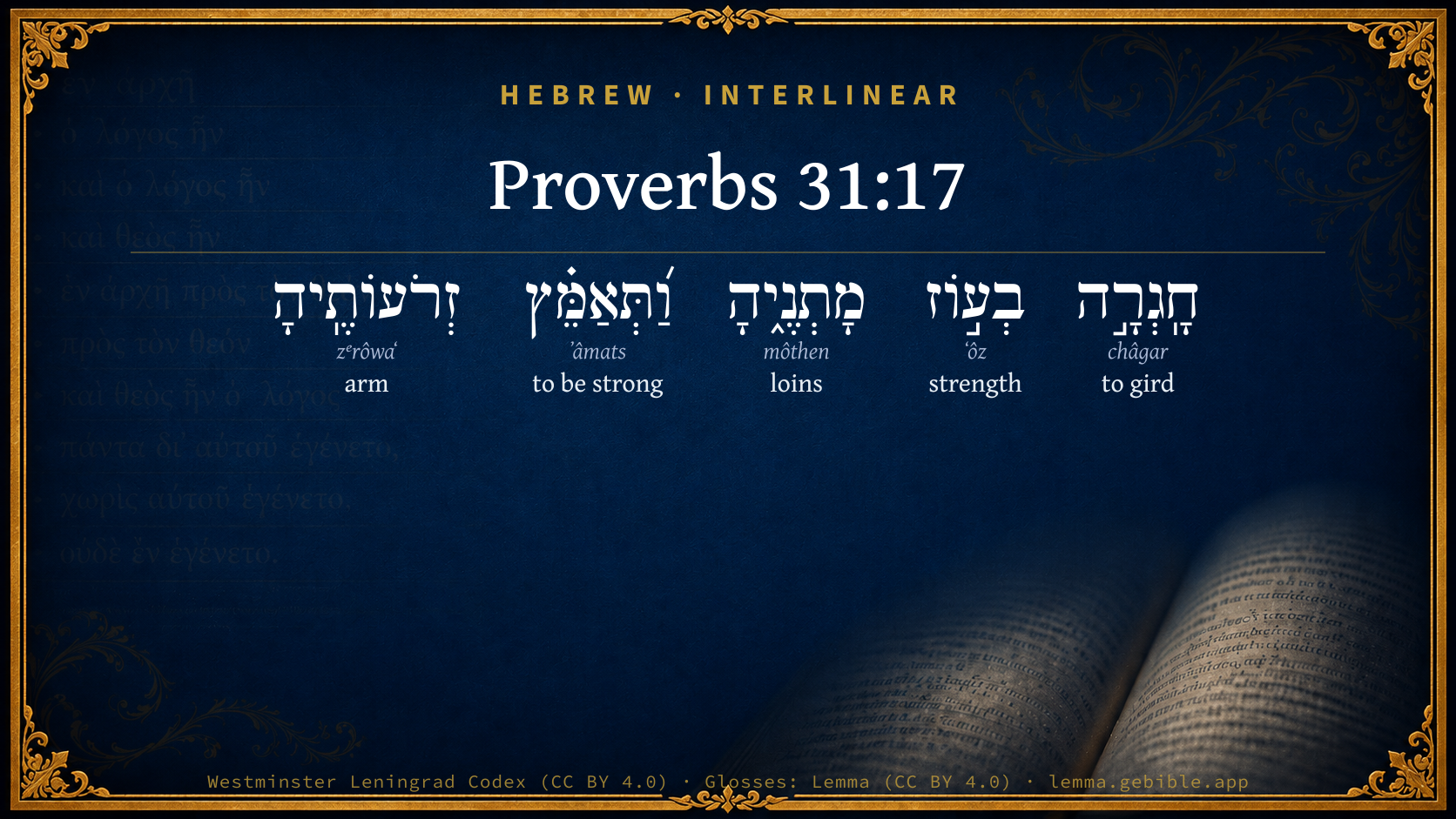
  1. חָֽגְרָ֣ה châgar H2296 “to gird” Verb, Qal, Perfect, 3rd Person, Feminine, Singular
  2. בְע֣וֹז ʻôz H5797 “in/at · strength” Preposition + Noun, Common, Masculine, Singular, Absolute
  3. מָתְנֶ֑יהָ môthen H4975 “loins · her” Noun, Common, Masculine, Dual, Construct + Suffix, Personal, 3rd Person, Feminine, Singular
  4. זְרֹעוֹתֶֽיהָ zᵉrôwaʻ H2220 “arms · her” Noun, Common, Both, Plural, Construct + Suffix, Personal, 3rd Person, Feminine, Singular

About this verse

These counts appear in no published source. They are computed here, from the morphology-tagged text and Lemma’s own curated glosses. What Lemma adds →

5
words
5
distinct lemmas
Wisdom
section

Shared distinctive vocabulary

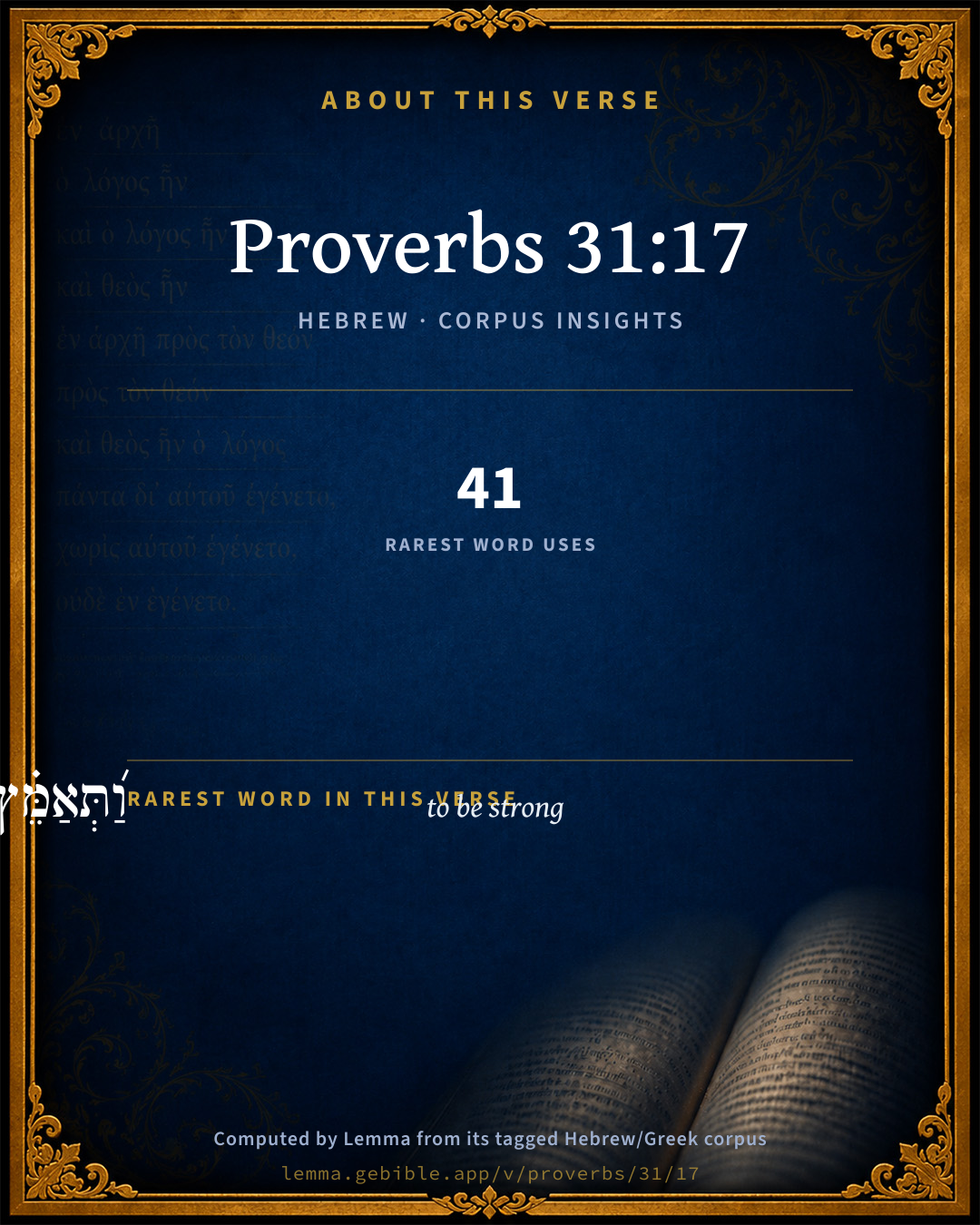
וַ֝תְּאַמֵּ֗ץ to be strong H553 occurs in 41 verses of the Hebrew Bible. Also found in:

Grammatical profile

  • 2 verbs
  • 3 nouns

Verb forms

  • חָֽגְרָ֣ה Qal · Perfect
  • וַ֝תְּאַמֵּ֗ץ Piel · Sequential Imperfect

Hebrew & Septuagint length

In English translation the verse runs 11 words from the Hebrew and 11 from the Septuagint (LXX English) — the same length.

A rough comparison of the two English renderings, which tokenize alike — not a word-level alignment.

Word counts can differ between the Hebrew and the Greek without any difference in meaning — e.g. the Hebrew direct-object marker אֵת has no separate Greek word, and Greek often adds the article ὁ.

Cross-references

10

Topical passages linked to Proverbs 31:17 in the Treasury of Scripture Knowledge — connected by theme and wording, ordered by reader-vote popularity; previews shown in the World English Bible.

  • Job 38:3 Brace yourself like a man, For I will question you, then you answer me!
  • Ephesians 6:10 Finally, be strong in the Lord, and in the strength of his might.
  • 1 Peter 1:13 Therefore, prepare your minds for action, be sober and set your hope fully on the grace that will be brought to you at the revelation of Jesus Christ--
  • 1 Kings 18:46 and the hand of Yahweh was on Elijah; and he girded up his loins, and ran before Ahab to the entrance of Jezreel.
  • Luke 12:35 "Let your loins be girded and your lamps burning.
  • Ephesians 6:14 Stand therefore, having the utility belt of truth buckled around your waist, and having put on the breastplate of righteousness,
  • 2 Kings 4:29 Then he said to Gehazi, Gird up your loins, and take my staff in your hand, and go your way: if you meet any man, Don't greet him; and if anyone greets you, don't answer him again: and lay my staff on the face of the child.
  • Isaiah 44:12 The smith [makes] an axe, and works in the coals, and fashions it with hammers, and works it with his strong arm: yes, he is hungry, and his strength fails; he drinks no water, and is faint.
  • Genesis 49:24 But his bow abode in strength, The arms of his hands were made strong, By the hands of the Mighty One of Jacob, (From there is the shepherd, the stone of Israel),
  • Hosea 7:15 Though I have taught and strengthened their arms, Yet they plot evil against me.

Cross-references courtesy of OpenBible.info (CC BY 4.0).

Hebrew and Greek witnesses Masoretic Hebrew ↔ Greek Septuagint

The same verse in the two great witnesses to the Old Testament, shown verse-for-verse.

These are two independent witnesses, not word-aligned to each other, and the Septuagint is shown in lemma (dictionary) form.

Hebrew Proverbs 31:17 Masoretic · Westminster Leningrad Codex

חָֽגְרָ֣ה בְע֣וֹז מָתְנֶ֑יהָ וַ֝תְּאַמֵּ֗ץ זְרֹעוֹתֶֽיהָ

She girds her loins with strength, And makes her arms strong.

World English Bible · Public Domain

Greek LXX Proverbs 31:17 Septuagint · lemma form

ἀναζώννυμι ἰσχυρῶς ὁ ὀσφύς αὐτός ἐρείδω ὁ βραχίων αὐτός εἰς ἔργον

She strongly girds her loins, and strengthens her arms for work.

LXX2012 (modern English Septuagint) · Public Domain

Hebrew: Westminster Leningrad Codex (CC BY 4.0). Greek: Septuagint (public domain); English from LXX2012 (modern English Septuagint) (Public Domain). How the Septuagint differs from the Hebrew →

Commentary

Notes on Proverbs 31:17 from classic Christian and Jewish commentators (each source and its license shown beneath its notes). The classic Christian expositions comment on the surrounding passage and are grouped to its opening verse, so a note may address several verses; the Jewish commentaries on the Tanakh (Rashi and others) are per-verse, so they appear only where the commentator wrote on this verse.

Lemma curates 59 commentaries, every one of them public domain or Creative Commons licensed, each selected and text-cleaned for this edition rather than reprinted as found. About our sources →

Trapp's Complete Commentary

John Trapp

Pro 31:17 She girdeth her loins with strength, and strengtheneth her arms.

Ver. 17. She girdeth her loins with strength.] She flies about her work, and sets on it with a courage. We have read of women in whom, besides their sex, there was nothing woman-like or weak; such were Semiramis, Zenobia, Blandina, that brave Hungarian woman, who, in an assault at the siege of Buda, thrusting in among the soldiers upon the top of the fort, with a great scythe in her hand, at one blow struck off two of the Turks’ heads as they were climbing up the rampier. {a} The like is reported of Marulla, a maid of Lemnos, who, seeing her father slain in the gates of the city by the Turks, which hoped to have surprised it, took up the weapons that lay by him, and, like a fierce Amazon, notably revenged his death. {b}

{a} Turkish History, fol. 741.

{b} Ibid., 413.

John Trapp, A Commentary or Exposition upon All the Books of the Old and New Testament (1647–1656) — public domain. Text from a community e-Sword module.

Joseph Benson's Commentary

Pro 31:17-18. She girdeth her loins with strength — She uses great diligence and expedition in her employment; for which end, men in those times used to gird up their long and loose garments about their loins. And strengtheneth her arms — Puts forth her utmost strength in her business. She perceiveth that her merchandise is good — She finds great comfort and good success in her labours. Her candle goeth not out by night — Which is not to be taken strictly, but only signifies her unwearied care and industry.

Joseph Benson's Commentary on the Old and New Testaments (1811–1818) — public domain. Text from a community e-Sword module.

Jamieson, Fausset & Brown

Robert Jamieson, A. R. Fausset & David Brown

To energy she adds a watchfulness in bargains, and a protracted and painful industry. The last clause may figuratively denote that her prosperity (compare Pro 24:20) is not short lived.

Jamieson, Fausset & Brown — Commentary Critical and Explanatory on the Whole Bible (1871) — public domain (CC PDM 1.0). Text via the HelloAO Bible API.

Adam Clarke's Commentary

Verse 17. She girdeth her loins with strength]

7. She takes care of her own health and strength, not only by means of useful labour, but by healthy exercise. She avoids what might enervate her body, or soften her mind-she is ever active, and girt ready for every necessary exercise. Her loins are firm, and her arms strong.

Adam Clarke's Commentary on the Bible (1810–1826) — public domain. Text from a community e-Sword/MySword module.

John Gill's Exposition

She girdeth her loins with strength,.... Showing her readiness to every good work; and with what cheerfulness, spirit, and resolution, she set about it, and with what dispatch and expedition she performed it: the allusion is to the girding and tucking up of long garments, wore in the eastern countries, when any work was set about in earnest, which required dispatch; see Luk 17:8; the strength of creatures being in their loins, Job 40:16; the loins are sometimes put for strength, as in Plautus (r); and the sense is much the same with what follows;

and strengtheneth her arms; does all she finds to do with all her might and main, as the church does; not in her own strength, but in the strength of Christ; to whom she seeks for it, and in whose strength she goes forth about her business; by whom the arms of her hands are made strong, even by the mighty God of Jacob; and because she thus applies to him for it, she is said to do it herself, Gen 49:24; here she plays the man, and acts the manly part, Co1 16:13.

(r) "Lumbos defractos velim", Stichus, Act. 2. Sc. 1. v. 37.

John Gill's Exposition of the Whole Bible (1746–1763) — public domain (CC PDM 1.0). Text via the HelloAO Bible API.

Haydock's Catholic Bible Commentary

Arm; working, and making others obey.

George Leo Haydock (1774–1849), Haydock's Catholic Family Bible and Commentary, 1859 edition — public domain. Excludes Psalms (Douay-Rheims chapter numbering differs from Protestant) and Deuterocanonical books (Catholic canon only).

Matthew Poole's English Annotations

She girdeth her loins with strength; she useth great diligence and expedition in her employment; for which end men in those times used to gird up their long and loose garments about their loins.

Strengtheneth her arms; putteth forth her utmost strength in her business.

Matthew Poole's English Annotations on the Holy Bible (1683–1685) — public domain. Text from a community e-Sword/MySword module.

Whedon's Commentary on the Bible

Daniel D. Whedon

17. She girdeth her loins with strength — The Orientals wear loose flowing robes, which need to be girded close to the body, or tucked up, when they engage in any active employment. The figure denotes her activity and energy. “She walks about.” says Patrick, “with great expedition, tucking up her garments that she may be fit for motion anywhere, and not minding clothes more than her business, nor neglecting it for fear of spoiling them; but prefers strength in her arms, acquired by labour, before the ornaments wherewith they are wont to be adorned.”

Daniel D. Whedon (gen. ed.), Commentary on the Old and New Testaments (1874–1909) — public domain. Text from a community e-Sword module.

The Pulpit Commentary

KHETH. She girdeth her loins with strength (ver. 25). This seems at first sight a strange assertion to make concerning one of the weaker sex; but the phrase is metaphorically expressive of the energy and force with which she prepares herself for her work. Strength and vigour are, as it were, the girdle which she binds round her waist to enable her to conduct her operations with case and freedom. So we have a similar metaphor boldly applied to God: (Psa_93:1) "The Lord reigneth, he is apparelled with majesty; the Lord is apparelled, he hath girded himself with strength". (cf. Job_38:3) Strengtheneth her arms. By daily exercise she makes her arms firm and strong, and capable of great and continued exertion.

The Pulpit Commentary (1880–1919), ed. H.D.M. Spence-Jones & Joseph S. Exell — public domain. Text from a community e-Sword module.

John Wesley's Explanatory Notes

Girdeth - She uses great diligence and expedition in her employment; for which end, men in those times used to gird up their long and loose garments about their loins. Strengtheneth - Puts forth her utmost strength in her business.

John Wesley, Explanatory Notes Upon the Whole Bible (1754–1765) — public domain. Text via the GEBible commentary corpus.

Keil & Delitzsch

C. F. Keil & F. Delitzsch

The poet has this augmented household wealth in his eye, for he continues:

17 ח She girdeth her loins with strength,

And moveth vigorously her arms.

Strength is as the girdle which she wraps around her body (Psa 93:1). We write חגרה בעוז; both words have Munach, and the ב of בעוז is aspirated. Thus girded with strength, out of this fulness of strength she makes firm or steels her arms (cf. Psa 89:22). The produce of the field and vineyard extend far beyond the necessity of her house; thus a great portion is brought to sale, and the gain thence arising stimulates the industry and the diligence of the unwearied woman.

Keil & Delitzsch — Biblical Commentary on the Old Testament (1861–1891) — public domain (CC PDM 1.0). Text via the HelloAO Bible API. (Old Testament only.)

Lesson kit

Teaching starters — assembled from the data on this page, not authored interpretation. Every prompt links to the verse data it draws on. Edit before teaching.

Proverbs, in the Wisdom, opens this verse with 5 words (5 distinct Hebrew lemmas). Its most distinctive word is ʼâmats (“to be strong”). A historical commentator’s framing appears above. Read the whole chapter for the surrounding context.

Discussion questions

  1. How does “to be strong” (ʼâmats) shape what this verse is saying?
  2. How does Genesis 25:23, which shares the word «to be strong», read alongside this verse?
  3. These translations render this verse differently; the difference is in the English rendering, not the original. What questions does that raise?
  4. «חָֽגְרָ֣ה» is a Qal Perfect verb. How does that grammatical form shape the action described?
  5. Compare how Trapp's Complete Commentary and Joseph Benson's Commentary read this verse. Where do they agree or differ?

Things to notice

Reading settings

Reading text

Shown beneath each verse's original-language words.

Old Testament
Old Testament edition

Read the OT as the Masoretic Hebrew (MT) or the Greek Septuagint (LXX).

English shown for the Greek Septuagint (in the Hebrew ↔ Greek comparison).

Comparing translations? Open the Compare panel on any verse page to stack up to four side by side.