
Psalms 62:7

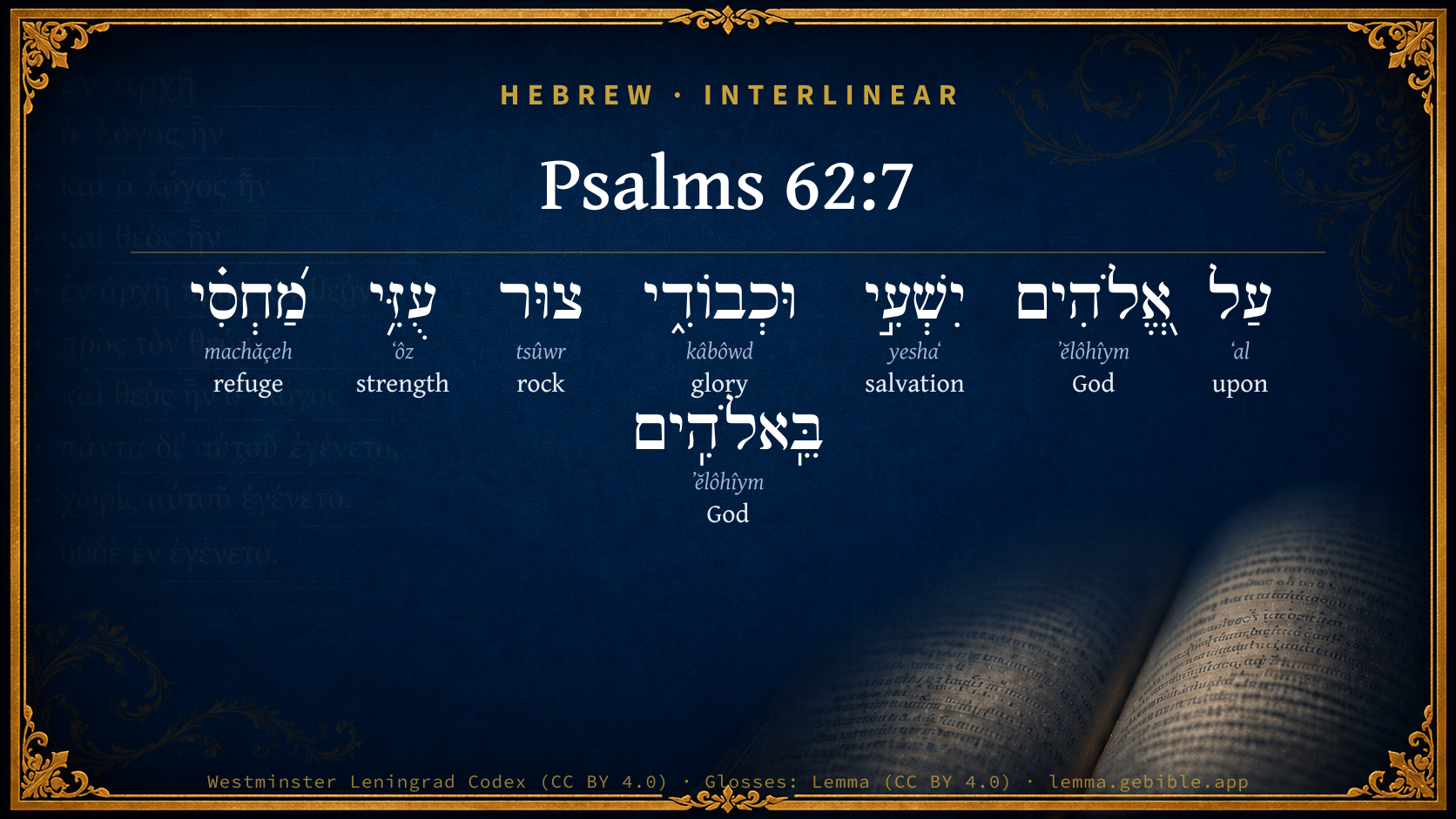
Hebrew (Westminster Leningrad Codex) Psalms 62:7 appears in the Hebrew Old Testament. The text above is from the Westminster Leningrad Codex. Each word links to its Strong’s number, a concise gloss, and parsing drawn from the Open Scriptures Hebrew Bible morphology. Click any word for its full Brown-Driver-Briggs (BDB) entry.
Download image
Cite this verse

Psalms 62:7 (World English Bible). Public Domain. Lemma interlinear Bible study tool, https://lemma.gebible.app/v/psalms/62/7.

Show BibTeX & RIS
BibTeX
RIS
English Translation
With God is my salvation and my honor. The rock of my strength, and my refuge, is in God.
World English Bible · Public Domain
Download a study sheet

One document with this verse’s original text, its word-by-word gloss line, the meaning frame, cross-references with their text, attributed commentary, and full source and license credits — printable, and it pastes into notes with its structure intact.

This verse Autodidact and up

Study sheet (.html) Plain text (.txt)

A passage Seminary Student

Up to 50 verses in one chapter. A passage sheet keeps up to 6 commentary sources and 12 cross-references per verse, in the order this page ranks them, and says so on the sheet whenever that leaves anything out. Ask for a single verse and you get the Autodidact verse sheet above.

Everything on this page stays free to read, with no account — the sheet is a download of what is already on screen, not access to it.

Want to remove ads? Support Godless Engineer
Compare translations 3

The same verse in 3 English versions, stacked beneath the original-language interlinear above. Click any original word for its lexicon entry.

Each is an independent rendering of the whole verse — the interlinear is not word-aligned to these translations.

Highlighted words mark where these versions differ — a whole-verse word diff, not a word-by-word alignment.

  • World English Bible Public Domain
    With God is my salvation and my honor. The rock of my strength, and my refuge, is in God.
  • King James Version Public Domain
    In God is my salvation and my glory: the rock of my strength, and my refuge, is in God.
  • unfoldingWord Literal Text CC BY-SA 4.0
    In God my salvation and my glory; the rock of my strength, my refuge, in God.

unfoldingWord Literal Text — © unfoldingWord, licensed CC BY-SA 4.0. Word-aligned USFM3 via Door43 (git.door43.org/unfoldingWord/en_ult).

Versions to compare (up to 4)

3 of 4 selected

Show all 18 translations

Every available English version of this verse, each an independent rendering of the whole verse.

  • World English Bible Public Domain
    With God is my salvation and my honor. The rock of my strength, and my refuge, is in God.
  • Berean Standard Bible Public Domain
    My salvation and my honor rest on God, my strong rock; my refuge is in God.
  • Majority Standard Bible Public Domain
    My salvation and my honor rest on God, my strong rock; my refuge is in God.
  • King James Version Public Domain
    In God is my salvation and my glory: the rock of my strength, and my refuge, is in God.
  • American Standard Version (1901) Public Domain
    With God is my salvation and my glory: The rock of my strength, and my refuge, is in God.
  • Revised Version (1885) Public Domain
    With God is my salvation and my glory: the rock of my strength, and my refuge, is in God.
  • Geneva Bible (1599) Public Domain
    In God is my saluation and my glory, the rocke of my strength: in God is my trust.
  • Douay-Rheims (1899) Public Domain
    For he is my God and my saviour: he is my helper, I shall not be moved.
  • Young's Literal Translation Public Domain
    On God `is' my salvation, and my honour, The rock of my strength, my refuge `is' in God.
  • Literal Standard Version CC BY-SA 4.0
    On God [is] my salvation, and my glory, || The rock of my strength, my refuge [is] in God.
  • Unlocked Literal Bible CC BY-SA 4.0
    With God is my salvation and my glory; the rock of my strength and my refuge are in God.
  • unfoldingWord Literal Text CC BY-SA 4.0
    In God my salvation and my glory; the rock of my strength, my refuge, in God.
  • Darby Bible Public Domain
    With God is my salvation and my glory; the rock of my strength, my refuge is in God.
  • World Messianic Bible Public Domain
    My salvation and my honor is with God. The rock of my strength, and my refuge, is in God.
  • Webster's Bible Public Domain
    \\62:6\\He only is my rock and my salvation: he is my defense; I shall not be moved.
  • Free Bible Version CC BY-SA 4.0
    My salvation and my success come from God alone; God is my security and my protection.
  • Bible in Basic English Public Domain
    In God is my salvation, and my glory; the Rock of my strength, and my safe place.
  • JPS Tanakh (1917) Public Domain
    (62-8) Upon God resteth my salvation and my glory; the rock of my strength, and my refuge, is in God.

Literal Standard Version (2020), Covenant Press — licensed CC BY-SA 4.0. Text via the HelloAO Bible API (eBible.org). Unlocked Literal Bible (unfoldingWord) — licensed CC BY-SA 4.0. Text via the HelloAO Bible API (eBible.org). unfoldingWord Literal Text — © unfoldingWord, licensed CC BY-SA 4.0. Word-aligned USFM3 via Door43 (git.door43.org/unfoldingWord/en_ult). Free Bible Version, Dr. Jonathan Gallagher — licensed CC BY-SA 4.0. Text via the HelloAO Bible API (eBible.org).

Word by word

More ways to search: Search by grammar → Find every occurrence → Compare this word →

Practice this passage: Drill this verse → Learn its vocabulary →

About this verse

These counts appear in no published source. They are computed here, from the morphology-tagged text and Lemma’s own curated glosses. What Lemma adds →

8
words
7
distinct lemmas
Wisdom
section

Notable vocabulary

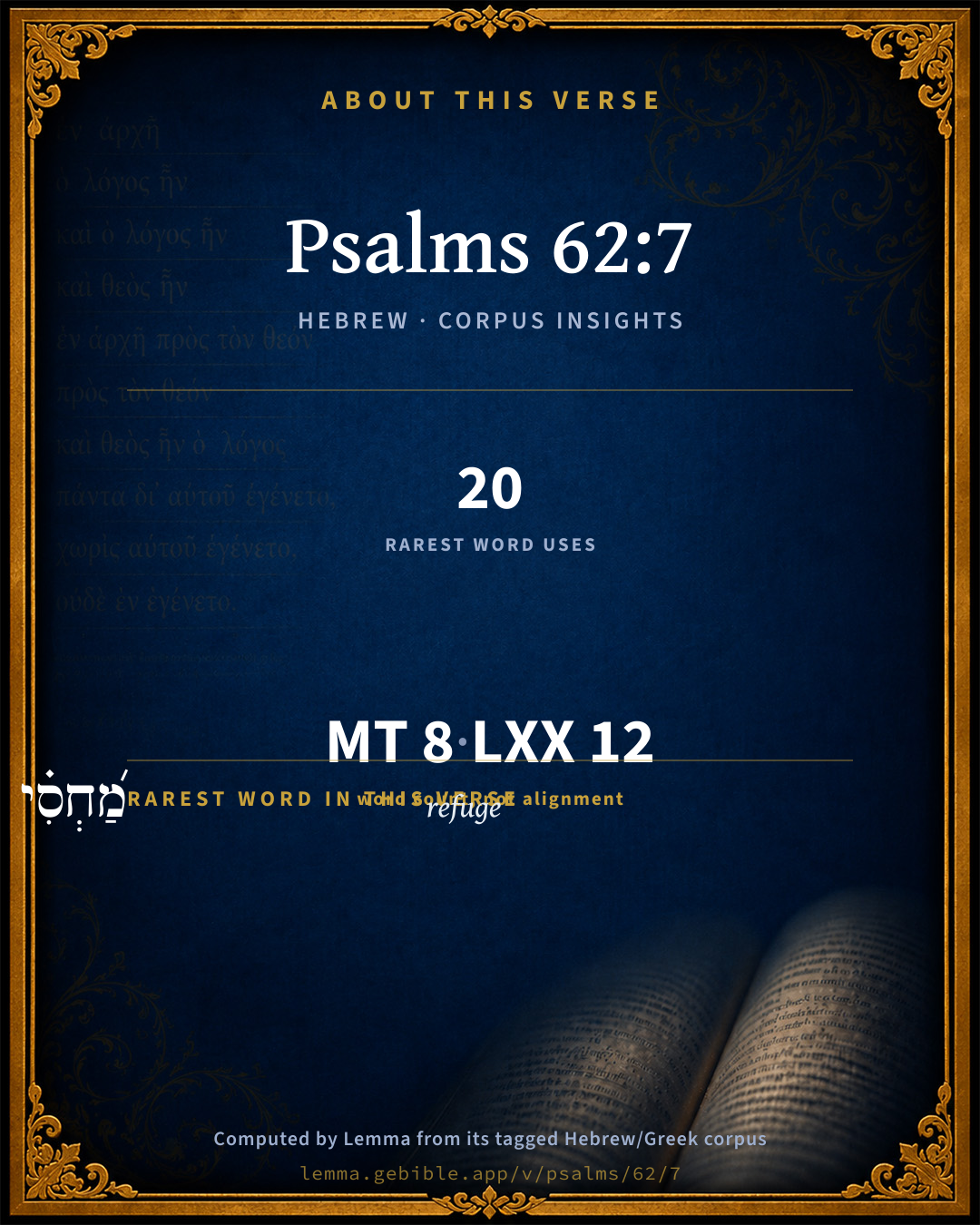
The rarest word here is מַ֝חְסִ֗י refuge H4268 — appearing just 20 times in the whole Hebrew Bible.

Shared distinctive vocabulary

מַ֝חְסִ֗י refuge H4268 occurs in 20 verses of the Hebrew Bible. Also found in:

Grammatical profile

  • 7 nouns
  • 1 preposition

Repetition

A word recurs within this verse — often emphatic in Hebrew:

  • אֱ֭לֹהִים God H430 ×2

Hebrew & Septuagint length

In English translation the verse runs 19 words from the Hebrew and 21 from the Septuagint (LXX English) — closely comparable.

A rough comparison of the two English renderings, which tokenize alike — not a word-level alignment.

Word counts can differ between the Hebrew and the Greek without any difference in meaning — e.g. the Hebrew direct-object marker אֵת has no separate Greek word, and Greek often adds the article ὁ.

In the original languages it is 8 Hebrew tokens and 12 Greek tokens — but the two are counted differently (Hebrew bundles its prefixes and suffixes into one token; the Greek is in lemma form), so that isn’t a like-for-like length.

Cross-references

14

Topical passages linked to Psalms 62:7 in the Treasury of Scripture Knowledge — connected by theme and wording, ordered by reader-vote popularity; previews shown in the World English Bible.

  • Psalms 3:3 But you, Yahweh, are a shield around me, My glory, and the one who lifts up my head.
  • Isaiah 26:4 Trust in Yahweh forever; for in Yah, Yahweh, is an everlasting Rock.
  • Psalms 94:22 But Yahweh has been my high tower, My God, the rock of my refuge.
  • Psalms 18:2 Yahweh is my rock, my fortress, and my deliverer; My God, my rock, in whom I take refuge; My shield, and the horn of my salvation, my high tower.
  • Psalms 95:1 Oh come, let's sing to Yahweh. Let's shout aloud to the rock of our salvation!
  • Jeremiah 3:23 Truly in vain is [the help that is looked for] from the hills, the tumult on the mountains: truly in Yahweh our God is the salvation of Israel.
  • Psalms 46:1 God is our refuge and strength, A very present help in trouble.
  • Jeremiah 9:23–24 Thus says Yahweh, Don't let the wise man glory in his wisdom, neither let the mighty man glory in his might, don't let the rich man glory in his riches;
  • Psalms 18:46 Yahweh lives; and blessed be my rock. Exalted be the God of my salvation,
  • Psalms 85:9 Surely his salvation is near those who fear him, That glory may dwell in our land.
  • Galatians 6:14 But far be it from me to boast, except in the cross of our Lord Jesus Christ, through which the world has been crucified to me, and I to the world.
  • Psalms 4:2 You sons of men, how long shall my glory be turned into dishonor? Will you love vanity, and seek after falsehood? Selah.
  • Isaiah 45:25 In Yahweh shall all the seed of Israel be justified, and shall glory.
  • 1 Corinthians 1:30–31 But of him, you are in Christ Jesus, who was made to us wisdom from God, and righteousness and sanctification, and redemption:

Cross-references courtesy of OpenBible.info (CC BY 4.0).

Hebrew and Greek witnesses Masoretic Hebrew ↔ Greek Septuagint

The same verse in the two great witnesses to the Old Testament, shown verse-for-verse.

You’re reading Greek Psalm 61 (Hebrew Psalm 62). The Septuagint counts the superscription, so verse numbers can differ from the Hebrew — chapter-level alignment, not verse-by-verse. Numbering follows Rahlfs.

These are two independent witnesses, not word-aligned to each other, and the Septuagint is shown in lemma (dictionary) form.

Hebrew Psalms 62:7 Masoretic · Westminster Leningrad Codex

עַל אֱ֭לֹהִים יִשְׁעִ֣י וּכְבוֹדִ֑י צוּר עֻזִּ֥י מַ֝חְסִ֗י בֵּֽאלֹהִֽים

With God is my salvation and my honor. The rock of my strength, and my refuge, is in God.

World English Bible · Public Domain

Greek LXX Greek Psalm 61:7 Septuagint · lemma form

ὅτι αὐτός θεός ἐγώ καί σωτήρ ἐγώ ἀντιλήμπτωρ ἐγώ οὐ μή μεταναστεύω

In God is my salvation and my glory: he is the God of my help, and my hope is in God.

LXX2012 (modern English Septuagint) · Public Domain

Hebrew: Westminster Leningrad Codex (CC BY 4.0). Greek: Septuagint (public domain); English from LXX2012 (modern English Septuagint) (Public Domain). How the Septuagint differs from the Hebrew →

Commentary

Notes on Psalms 62:7 from classic Christian and Jewish commentators (each source and its license shown beneath its notes). The classic Christian expositions comment on the surrounding passage and are grouped to its opening verse, so a note may address several verses; the Jewish commentaries on the Tanakh (Rashi and others) are per-verse, so they appear only where the commentator wrote on this verse.

Lemma curates 59 commentaries, every one of them public domain or Creative Commons licensed, each selected and text-cleaned for this edition rather than reprinted as found. About our sources →

Trapp's Complete Commentary

John Trapp

Psa 62:7 In God [is] my salvation and my glory: the rock of my strength, [and] my refuge, [is] in God.

Ver. 7. In God is my salvation and my glory, &c.] By these many adjuncts and attributions David helpeth his faith, and quelleth the commotions of his headstrong affections. See Psa 18:2.

John Trapp, A Commentary or Exposition upon All the Books of the Old and New Testament (1647–1656) — public domain. Text from a community e-Sword module.

J. A. Alexander on Psalms

Joseph Addison Alexander

8. (Psa 62:7). Upon God (i.e. dependent, founded on him) is my salvation, and my honour (both official and personal); the rock of my strength (my strong rock, or the basis upon which my own strength rests); my hiding-place (my refuge) is in God. It is in his presence, favour, and protection, that I hide myself from all my enemies and all my dangers. See above, on Psa 7:10; Psa 61:3.

Joseph Addison Alexander, The Psalms Translated and Explained (1850) — public domain. Text from a community e-Sword module.

Geneva Bible (1599)

Geneva Bible translators

These vehement and often repetitions were necessary to strengthen his faith against the horrible assault of Satan.

Geneva Bible (1599) marginal notes — public domain. Text via Bolls.life.

Jamieson, Fausset & Brown

Robert Jamieson, A. R. Fausset & David Brown

rock of my strength--or strongest support (Psa 7:10; Psa 61:3).

Jamieson, Fausset & Brown — Commentary Critical and Explanatory on the Whole Bible (1871) — public domain (CC PDM 1.0). Text via the HelloAO Bible API.

Adam Clarke's Commentary

Verse 7. In God is my salvation] עי אלהים al Elohim, "Upon God is my salvation;" he has taken it upon himself. And my glory - the preservation of my state, and the safety of my kingdom.

Adam Clarke's Commentary on the Bible (1810–1826) — public domain. Text from a community e-Sword/MySword module.

John Calvin's Commentaries

7. In God is my salvation One expression is here heaped upon another and this apparently because he wished to rein that infirmity of disposition which makes us so prone to slide into wrong exercise. We may throw out a passing and occasional acknowledgement, that our only help is to be found in God, and yet shortly display our distrust in him by busying ourselves in all directions to supplement what we consider defective in his aid. The various terms which he employs to express the sufficiency of God as a deliverer, may thus be considered as so many arguments to constancy, or so many checks which he would apply to the waywardness of the carnal heart, ever disposed to depend for support upon others rather than God. Such is the manner in which he animates his own spirit; and next, we find him addressing himself to others, calling upon them to enter upon the same conflict, and reap the same victory and triumph. By the people, there seems little doubt that he means the Jews. The Gentiles being yet unvisited by the true religion and divine revelation, it was only in Judea that God could be the object of trust and religious invocation; and it would appear, that by distinguishing the chosen people of the Lord from the surrounding heathen, he insinuates how disgraceful it would be in them not to devote themselves entirely to God, being, as they were, the children of Abraham, favored with the discovery of his grace, and specially taken under his divine protection. The expression, at all times, means both in prosperity and adversity, intimating the blameworthiness of those who waver and succumb under every variation in their outward circumstances. God tries his children with afflictions, but here they are taught by David to abide them with constancy and courage. The hypocrites, who are loud in their praises of God so long as prosperity shines upon their head, while their heart fails them upon the first approach of trial, dishonor his name by placing a most injurious limitation to his power. We are bound to put honor upon his name by remembering, in our greatest extremities, that to Him belong the issues of death. And as we are all too apt at such times to shut up our affliction in our own breast — a circumstance which can only aggravate the trouble and imbitter the mind against God, David could not have suggested a better expedient than that of disburdening our cares to him, and thus, as it were, pouring out our hearts before him. It is always found, that when the heart is pressed under a load of distress, there is no freedom in prayer. Under trying circumstances, we must comfort ourselves by reflecting that God will extend relief, provided we just freely roll them over upon his consideration. What the Psalmist advises is all the more necessary, considering the mischievous tendency which we have naturally to keep our troubles pent up in our breasts till they drive us to despair. Usually, indeed, men show much anxiety and ingenuity in seeking to escape from the troubles which may happen to press upon them; but so long as they shun coming into the presence of God, they only involve themselves in a labyrinth of difficulties. Not to insist farther upon the words, David is here to be considered as exposing that diseased but deeply-rooted principle in our nature, which leads us to hide our griefs, and ruminate upon them, instead of relieving ourselves at once by pouring out our prayers and complaints before God. The consequence is, that we are distracted more and more with our distresses, and merge into a state of hopeless despondency. In the close of the verse, he says, in reference to the people generally, what he had said of himself individually, that their safety was to be found only under the divine protection.

John Calvin's Commentaries (1540-1563) — public domain. Text from the Calvin Translation Society English edition (1840s-50s) via the Christian Classics Ethereal Library (ccel.org). Calvin's coverage is partial (roughly two-thirds of the Bible); uncommented books and verses are honest gaps, never fabricated. The 19th-century editor's footnotes and remarks are omitted so the notes are faithfully Calvin's own voice.

Ellicott's Commentary for English Readers

(7) In God.—Literally, upon God, as in Psa_7:10.

A Bible Commentary for English Readers, edited by Charles John Ellicott (1878–1897) — public domain. Text from a community e-Sword module.

The Cambridge Bible for Schools and Colleges

gen. ed. J. J. S. Perowne

7. In God] R.V., With God, lit, upon God (cp. Psa_7:10, note). It rests with God to deliver him and defend his honour;—his personal reputation and (if the speaker is David) his royal dignity. See Psa_4:2, note.

is in God] Or, consists in God, is God (Psa_62:6; Psa_62:8). Cp. Isa_26:4.

The Cambridge Bible for Schools and Colleges (gen. ed. J. J. S. Perowne; Cambridge University Press, 1878–1918) — public domain. Text from a community e-Sword module.

John Gill's Exposition

In God is my salvation,.... Or "upon God" (h); he that is God over all has took it upon him to save me; he is the author of salvation to me; and it is in him safe and secure, and I shall be saved in him with an everlasting salvation:

and my glory; the author of all his temporal glory, honour, and dignity; and of all his spiritual glory, which lay in the righteousness of Christ put upon him, and in the grace of God wrought in him; and of the eternal glory he was waiting for; and besides, God was the object of his glorying, of whom he boasted, and in whom he gloried; see Psa 3:3;

the rock of my strength, and my refuge, is in God; not only his strength, as well as his righteousness and refuge; but the firmness and security of his strength were in God, who is the Rock of ages, in whom is everlasting strength.

(h) "super Deo", Montanus, Gejerus, Michaelis; "super Deum", Vatablus, Cocceius.

John Gill's Exposition of the Whole Bible (1746–1763) — public domain (CC PDM 1.0). Text via the HelloAO Bible API.

Albert Barnes' Notes on the Bible

In God is my salvation - See Psa 62:1. That is, his salvation, his safety, his anticipated deliverance, was to come only from God.

And my glory - That in which I glory or boast; the source of all in me that is glorious or honorable. he gloried that there was such a God; he gloried that He was his God.

The rock of my strength - The strong rock; the refuge that cannot be successfully assailed; where I shall feel strong and secure. See the notes at Psa 18:2.

My refuge - That to which I may flee for safety. See the notes at Psa 46:1.

Albert Barnes' Notes on the Bible (1834–1885) — public domain. Text from a community e-Sword/MySword module.

Matthew Poole's English Annotations

In God, Heb. upon or with God. It depends upon him and his favour and help.

My glory; either,

1. The manner of my glorying. Or,

2. That honour which I either have or hope for.

Matthew Poole's English Annotations on the Holy Bible (1683–1685) — public domain. Text from a community e-Sword/MySword module.

The Treasury of David

Charles H. Spurgeon

Ver. 7. In God is my salvation and my glory. Wherein should we glory but in him who saves us? Our honour may well be left with him who secures our souls. To find all in God, and to glory that it is so, is one of the sure marks of an enlightened soul.

The rock of my strength, and my refuge, is in God. He multiplies titles, for he would render much honour to the Lord, whom he had tried, and proved to be a faithful God under so many aspects. Ignorance needs but few words, but when experience brings a wealth of knowledge, we need varied expressions to serve as coffers for our treasure. God who is our rock when we flee for shelter, is also our strong rock when we stand firm and defy the foe; he is to be praised under both characters. Observe how the psalmist brands his own initials upon every name which he rejoicingly gives to his God-- my expectation, my rock, my salvation, my glory, my strength, my refuge; he is not content to know that the Lord is all these things; he acts faith towards him, and lays claim to him under every character. What are the mines of Peru or Golconda to me if I have no inheritance in them? It is the word my which puts the honey into the comb. If our experience has not yet enabled us to realise the Lord under any of these consoling titles, we must seek grace that we may yet be partakers of their sweetness. The bees in some way or other penetrate the flowers and collect their juices; it must be hard for them to enter the closed cups and mouthless bags of some of the favourites of the garden, yet the honey gatherers find or make a passage; and in this they are our instructors, for into each delightful name, character, and office of our covenant God our persevering faith must find an entrance, and from each it must draw delight.

Ver. 7. (first clause). On the shields of the Greeks, Neptune was depicted; on the shields of the Trojans, Minerva; because in them they put their confidence, and in their protection deemed themselves secure... Now, Christ is the insignia of our shields. Often does David say, God is his protector. The Hebrew is magen; that is, shield, buckler, as Ps 18:2, 30. Thomas Le Blanc.

Ver. 7. There are several names of God given in this verse, that so every soul may take with him that name which may minister most comfort to him. Let him that is pursued by any particular temptation, invest God, as God is a refuge, a sanctuary; let him that is buffeted with Satan, battered with his own concupiscence receive God, as God is his defence and target; let him that is shaked with perplexities in his understanding, or scruples in his conscience, lay hold on God, as God is his rock and his anchor; let him that hath any diffident jealousy and suspicion of the free and full mercy of God, apprehend God, as God is his salvation; and let him that walks in the ingloriousness and contempt of the world, contemplate God, as God is glory. Any of these notions is enough to any man; but God is all these, and all else, that all souls can think, to every man. Abraham Wright.

None.

Psalms 62:8*

Charles H. Spurgeon's The Treasury of David (1869–1885) — public domain. Psalms only. Text from a community e-Sword/MySword module.

The Pulpit Commentary

In God is my salvation and my glory. The last phrase is new. The psalmist feels that the God who saves him, at the same.time sheds on him glory and honour. The Rock of my strength, and my Refuge, is in God. (comp. Psa_9:9 Psa_57:2 Psa_94:22, etc.)

The Pulpit Commentary (1880–1919), ed. H.D.M. Spence-Jones & Joseph S. Exell — public domain. Text from a community e-Sword module.

unfoldingWord translationNotes

Door43 World Missions Community

the rock of my strength and my refuge are in God

The writer speaks of God as if he were a rock that keeps one safe from his enemies. He also speaks of God as if he were a shelter that provides protection. AT: "God always gives me strength and protection" (See: Metaphor)

pour out your heart

This refers to telling God your inner feelings as if you were pouring out a liquid. AT: "give your deepest concerns to God" (See: Idiom)

refuge for us

The word "us" refers to David and the people he is speaking to. (See: Inclusive "We")

translationWords

save

glory

strength

refuge

trust

heart

unfoldingWord translationNotes — © Distant Shores Media and the Door43 World Missions Community, licensed CC BY-SA 4.0. Source: git.door43.org/Door43/en_tn.

Lesson kit

Teaching starters — assembled from the data on this page, not authored interpretation. Every prompt links to the verse data it draws on. Edit before teaching.

Psalms, in the Wisdom, opens this verse with 8 words (7 distinct Hebrew lemmas). Its most distinctive word is machăçeh (“refuge”). A historical commentator’s framing appears above. Read the whole chapter for the surrounding context.

Discussion questions

  1. The word machăçeh carries the sense “refuge.” How does it shape the verse?
  2. How does Job 24:8, which shares the word «refuge», read alongside this verse?
  3. What does the repetition of “God” (2× in this one verse) do in this verse?
  4. These translations render this verse differently. What is at stake in choosing one wording over another?
  5. Compare how Trapp's Complete Commentary and J. A. Alexander on Psalms read this verse. Where do they agree or differ?

Things to notice

Reading settings

Reading text

Shown beneath each verse's original-language words.

Old Testament
Old Testament edition

Read the OT as the Masoretic Hebrew (MT) or the Greek Septuagint (LXX).

English shown for the Greek Septuagint (in the Hebrew ↔ Greek comparison).

Comparing translations? Open the Compare panel on any verse page to stack up to four side by side.