Job 37:6

Hebrew (Westminster Leningrad Codex) Job 37:6 appears in the Hebrew Old Testament. The text above is from the Westminster Leningrad Codex. Each word links to its Strong’s number, a concise gloss, and parsing drawn from the Open Scriptures Hebrew Bible morphology. Click any word for its full Brown-Driver-Briggs (BDB) entry.
Download image
Cite this verse

Job 37:6 (World English Bible). Public Domain. Lemma interlinear Bible study tool, https://lemma.gebible.app/v/job/37/6.

Show BibTeX & RIS
BibTeX
RIS
English Translation
For he says to the snow, 'Fall on the earth;' Likewise to the shower of rain, And to the showers of his mighty rain.
World English Bible · Public Domain
Download a study sheet

One document with this verse’s original text, its word-by-word gloss line, the meaning frame, cross-references with their text, attributed commentary, and full source and license credits — printable, and it pastes into notes with its structure intact.

This verse Autodidact and up

Study sheet (.html) Plain text (.txt)

A passage Seminary Student

Up to 50 verses in one chapter. A passage sheet keeps up to 6 commentary sources and 12 cross-references per verse, in the order this page ranks them, and says so on the sheet whenever that leaves anything out. Ask for a single verse and you get the Autodidact verse sheet above.

Everything on this page stays free to read, with no account — the sheet is a download of what is already on screen, not access to it.

Want to remove ads? Support Godless Engineer
Compare translations 3

The same verse in 3 English versions, stacked beneath the original-language interlinear above. Click any original word for its lexicon entry.

Each is an independent rendering of the whole verse — the interlinear is not word-aligned to these translations.

Highlighted words mark where these versions differ — a whole-verse word diff, not a word-by-word alignment.

  • World English Bible Public Domain
    For he says to the snow, 'Fall on the earth;' Likewise to the shower of rain, And to the showers of his mighty rain.
  • King James Version Public Domain
    For he saith to the snow, Be thou on the earth; likewise to the small rain, and to the great rain of his strength.
  • unfoldingWord Literal Text CC BY-SA 4.0
    For he says to the snow, ‘Be the earth,’ and the shower of rain, the shower of rains, ‘Strength!’

unfoldingWord Literal Text — © unfoldingWord, licensed CC BY-SA 4.0. Word-aligned USFM3 via Door43 (git.door43.org/unfoldingWord/en_ult).

Versions to compare (up to 4)

3 of 4 selected

Show all 18 translations

Every available English version of this verse, each an independent rendering of the whole verse.

  • World English Bible Public Domain
    For he says to the snow, 'Fall on the earth;' Likewise to the shower of rain, And to the showers of his mighty rain.
  • Berean Standard Bible Public Domain
    For He says to the snow, ‘Fall on the earth,’ and to the gentle rain, ‘Pour out a mighty downpour.’
  • Majority Standard Bible Public Domain
    For He says to the snow, ‘Fall on the earth,’ and to the gentle rain, ‘Pour out a mighty downpour.’
  • King James Version Public Domain
    For he saith to the snow, Be thou on the earth; likewise to the small rain, and to the great rain of his strength.
  • American Standard Version (1901) Public Domain
    For he saith to the snow, Fall thou on the earth; Likewise to the shower of rain, And to the showers of his mighty rain.
  • Revised Version (1885) Public Domain
    For he saith to the snow, Fall thou on the earth; likewise to the shower of rain, and to the showers of his mighty rain.
  • Geneva Bible (1599) Public Domain
    For he sayth to the snowe, Be thou vpon the earth: likewise to the small rayne and to the great rayne of his power.
  • Douay-Rheims (1899) Public Domain
    He commandeth the snow to go down upon the earth, and the winter rain, and the shower of his strength.
  • Young's Literal Translation Public Domain
    For to snow He saith, `Be `on' the earth.' And the small rain and great rain of His power.
  • Literal Standard Version CC BY-SA 4.0
    For He says to snow: Be [on] the earth. And the small rain and great rain of His power.
  • Unlocked Literal Bible CC BY-SA 4.0
    For he says to the snow, 'Fall on the earth'; likewise to the rain shower, 'Become a great shower of rain.'
  • unfoldingWord Literal Text CC BY-SA 4.0
    For he says to the snow, ‘Be the earth,’ and the shower of rain, the shower of rains, ‘Strength!’
  • Darby Bible Public Domain
    For he saith to the snow, Fall on the earth! and to the pouring rain, even the pouring rains of his might.
  • World Messianic Bible Public Domain
    For he says to the snow, ‘Fall on the earth,’ likewise to the shower of rain, and to the showers of his mighty rain.
  • Webster's Bible Public Domain
    For he saith to the snow, Be thou on the earth; likewise to the small rain, and to the great rain of his strength.
  • Free Bible Version CC BY-SA 4.0
    He tells the snow to fall and the rain to pour down on the earth.
  • Bible in Basic English Public Domain
    For he says to the snow, Make the earth wet; and to the rain-storm, Come down.
  • JPS Tanakh (1917) Public Domain
    For He saith to the snow: 'Fall thou on the earth'; likewise to the shower of rain, and to the showers of His mighty rain.

Literal Standard Version (2020), Covenant Press — licensed CC BY-SA 4.0. Text via the HelloAO Bible API (eBible.org). Unlocked Literal Bible (unfoldingWord) — licensed CC BY-SA 4.0. Text via the HelloAO Bible API (eBible.org). unfoldingWord Literal Text — © unfoldingWord, licensed CC BY-SA 4.0. Word-aligned USFM3 via Door43 (git.door43.org/unfoldingWord/en_ult). Free Bible Version, Dr. Jonathan Gallagher — licensed CC BY-SA 4.0. Text via the HelloAO Bible API (eBible.org).

Word by word

More ways to search: Search by grammar → Find every occurrence → Compare this word →

Practice this passage: Drill this verse → Learn its vocabulary →

הֱוֵ֫א
hâvâʼ
H1933
“be”
Verb, Qal, Imperative, 2nd Person, Masculine, Singular
Part of Speech
Verb
Stem
Qal
Form
Imperative
Person
2nd Person
Gender
Masculine
Number
Singular
Full BDB Definition

Origin: a primitive root [compare H183 , H1961 ]

TWOT: 484 , 491

Qal) - to fall - to be, become, exist, happen
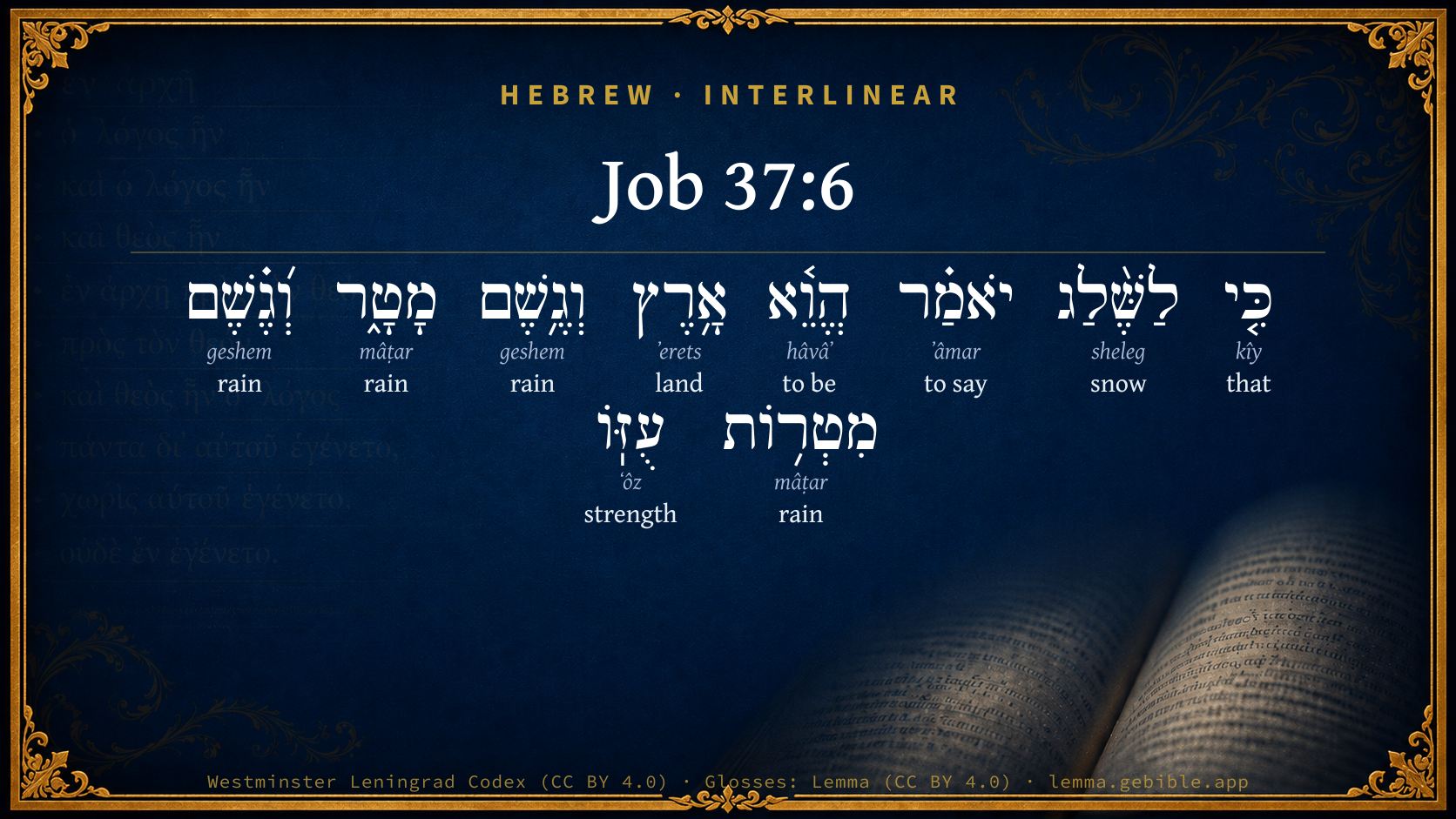
  1. כִּ֤י kîy H3588 “that” Conjunction
  2. לַשֶּׁ֨לַג sheleg H7950 “to/for the · snow” Preposition, Determined + Noun, Common, Masculine, Singular, Absolute
  3. יֹאמַ֗ר ʼâmar H559 “to say” Verb, Qal, Imperfect, 3rd Person, Masculine, Singular
  4. אָ֥רֶץ ʼerets H776 “land” Noun, Common, Both, Singular, Absolute
  5. וְגֶ֥שֶׁם geshem H1653 “and · rain of” Conjunction + Noun, Common, Masculine, Singular, Construct
  6. מָטָ֑ר mâṭar H4306 “rain” Noun, Common, Masculine, Singular, Absolute
  7. וְ֝גֶ֗שֶׁם geshem H1653 “and · rain of” Conjunction + Noun, Common, Masculine, Singular, Construct
  8. מִטְר֥וֹת mâṭar H4306 “rains of” Noun, Common, Masculine, Plural, Construct
  9. עֻזּֽוֹ ʻôz H5797 “strength · his” Noun, Common, Masculine, Singular, Construct + Suffix, Personal, 3rd Person, Masculine, Singular

About this verse

These counts appear in no published source. They are computed here, from the morphology-tagged text and Lemma’s own curated glosses. What Lemma adds →

10
words
8
distinct lemmas
Wisdom
section

Notable vocabulary

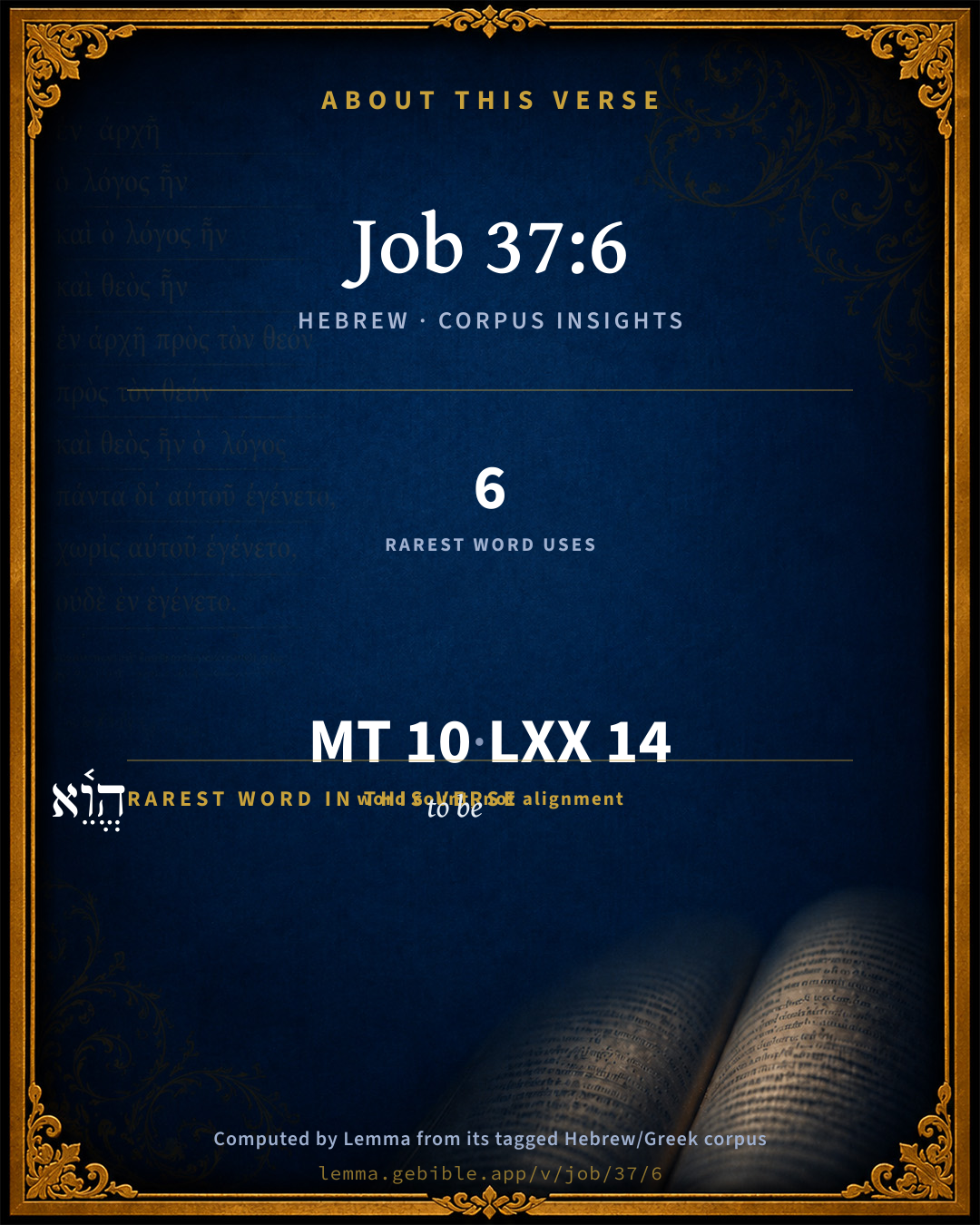
The rarest word here is הֱוֵ֫א to be H1933 — appearing just 6 times in the whole Hebrew Bible.

Shared distinctive vocabulary

הֱוֵ֫א to be H1933 occurs in 6 verses of the Hebrew Bible. Also found in:

Grammatical profile

  • 2 verbs
  • 7 nouns
  • 1 conjunction

Verb forms

  • יֹאמַ֗ר Qal · Imperfect
  • הֱוֵ֫א Qal · Imperative

Repetition

Words recur within this verse — often emphatic in Hebrew:

  • וְגֶ֥שֶׁם rain H1653 ×2
  • מָטָ֑ר rain H4306 ×2

Hebrew & Septuagint length

In English translation the verse runs 24 words from the Hebrew and 21 from the Septuagint (LXX English) — closely comparable.

A rough comparison of the two English renderings, which tokenize alike — not a word-level alignment.

Word counts can differ between the Hebrew and the Greek without any difference in meaning — e.g. the Hebrew direct-object marker אֵת has no separate Greek word, and Greek often adds the article ὁ.

In the original languages it is 10 Hebrew tokens and 14 Greek tokens — but the two are counted differently (Hebrew bundles its prefixes and suffixes into one token; the Greek is in lemma form), so that isn’t a like-for-like length.

Cross-references

12

Topical passages linked to Job 37:6 in the Treasury of Scripture Knowledge — connected by theme and wording, ordered by reader-vote popularity; previews shown in the World English Bible.

  • Job 36:27 For he draws up the drops of water, Which distill in rain from his vapor,
  • Job 38:22 Have you entered the treasuries of the snow, Or have you seen the treasures of the hail,
  • Psalms 147:16–18 He gives snow like wool, And scatters frost like ashes.
  • Ezekiel 13:13 Therefore thus says the Lord Yahweh: I will even tear it with a stormy wind in my wrath; and there shall be an overflowing shower in my anger, and great hailstones in wrath to consume it.
  • Genesis 7:10–12 It happened after the seven days, that the waters of the flood came on the earth.
  • Ezra 10:9 Then all the men of Judah and Benjamin gathered themselves together to Jerusalem within the three days; it was the ninth month, on the twentieth [day] of the month: and all the people sat in the broad place before the house of God, trembling because of this matter, and for the great rain.
  • Ezra 10:13 But the people are many, and it is a time of much rain, and we are not able to stand outside: neither is this a work of one day or two; for we have greatly transgressed in this matter.
  • Psalms 148:8 Lightning and hail, snow and clouds; Stormy wind, fulfilling his word;
  • Proverbs 28:3 A needy man who oppresses the poor Is like a driving rain which leaves no crops.
  • Ezekiel 13:11 tell those who daub it with whitewash, that it shall fall: there shall be an overflowing shower; and you, great hailstones, shall fall; and a stormy wind shall tear it.
  • Amos 9:6 It is he who builds his chambers in the heavens, and has founded his vault on the earth; he who calls for the waters of the sea, and pours them out on the surface of the earth; Yahweh is his name.
  • Matthew 7:25–27 The rain came down, the floods came, and the winds blew, and beat on that house; and it didn't fall, for it was founded on the rock.

Cross-references courtesy of OpenBible.info (CC BY 4.0).

Hebrew and Greek witnesses Masoretic Hebrew ↔ Greek Septuagint

The same verse in the two great witnesses to the Old Testament, shown verse-for-verse.

These are two independent witnesses, not word-aligned to each other, and the Septuagint is shown in lemma (dictionary) form.

Hebrew Job 37:6 Masoretic · Westminster Leningrad Codex

כִּ֤י לַשֶּׁ֨לַג יֹאמַ֗ר הֱוֵ֫א אָ֥רֶץ וְגֶ֥שֶׁם מָטָ֑ר וְ֝גֶ֗שֶׁם מִטְר֥וֹת עֻזּֽוֹ

For he says to the snow, 'Fall on the earth;' Likewise to the shower of rain, And to the showers of his mighty rain.

World English Bible · Public Domain

Greek LXX Job 37:6 Septuagint · lemma form

συντάσσω χιών γίγνομαι ἐπί ὁ γῆ καί χειμών ὑετός καί χειμών ὑετός δυναστεία αὐτός

commanding the snow, Be you upon the earth, and the stormy rain, and the storm of the showers of his might.

LXX2012 (modern English Septuagint) · Public Domain

On this verse, Matthew Henry's Commentary discusses the Septuagint’s reading. Read the note in Commentary ↓

Hebrew: Westminster Leningrad Codex (CC BY 4.0). Greek: Septuagint (public domain); English from LXX2012 (modern English Septuagint) (Public Domain). How the Septuagint differs from the Hebrew →

Commentary

Notes on Job 37:6 from classic Christian and Jewish commentators (each source and its license shown beneath its notes). The classic Christian expositions comment on the surrounding passage and are grouped to its opening verse, so a note may address several verses; the Jewish commentaries on the Tanakh (Rashi and others) are per-verse, so they appear only where the commentator wrote on this verse.

Lemma curates 59 commentaries, every one of them public domain or Creative Commons licensed, each selected and text-cleaned for this edition rather than reprinted as found. About our sources →

Matthew Henry's Commentary

The changes and extremities of the weather, wet or dry, hot or cold, are the subject of a great deal of our common talk and observation; but how seldom do we think and speak of these things, as Elihu does here, with an awful regard to God the director of them, who shows his power and serves the purposes of his providence by them! We must take notice of the glory of God, not only in the thunder and lightning, but in the more common revolutions of the weather, which are not so terrible and which make less noise. As,

I. In the snow and rain, Job 37:6. Thunder and lightning happen usually in the summer, but here he takes notice of the winter-weather. Then he saith to the snow, Be thou on the earth; he commissions it, he commands it, he appoints it, where it shall light and how long it shall lie. He speaks, and it is done: as in the creation of the world, Let there be light, so in the works of common providence, Snow, be thou on the earth. Saying and doing are not two things with God, though they are with us. When he speaks the word the small rain distils and the great rain pours down as he pleases - the winter-rain (so the Septuagint), for in those countries, when the winter was past, the rain was over and gone, Sol 2:11. The distinction in the Hebrew between the small rain and the great rain is this, that the former is called a shower of rain, the latter of rains, many showers in one; but all are the showers of his strength: the power of God is to be observed as much in the small rain that soaks into the earth as in the great rain that batters on the house-top and washes away all before it. Note, The providence of God is to be acknowledged, both by husbandmen in the fields and travellers upon the road, in every shower of rain, whether it does them a kindness of a diskindness. It is sin and folly to contend with God's providence in the weather; if he send the snow or rain, can we hinder them? Or shall we be angry at them? It is as absurd to quarrel with any other disposal of Providence concerning ourselves or ours. The effect of the extremity of the winter-weather is that it obliges both men and beasts to retire, making it uncomfortable and unsafe for them to go abroad. 1. Men retire to their houses from their labours in the field, and keep within doors (Job 37:7): He seals up the hand of every man. In frost and snow, husbandmen cannot follow their business, nor some tradesmen, nor travellers, when the weather is extreme. The plough is laid by, the shipping laid up, nothing is to be done, nothing to be got, that men, being taken off from their own work, may know his work, and contemplate that, and give him the glory of that, and, by the consideration of that work of his in the weather which seals up their hands, be led to celebrate his other great and marvellous works. Note, When we are, upon any account, disabled from following our worldly business, and taken off from it, we should spend our time rather in the exercises of piety and devotion (in acquainting ourselves with the works of God and praising him in them) than in foolish idle sports and recreations. When our hands are sealed up our hearts should be thus opened, and the less we have at any time to do in the world the more we should thereby be driven to our Bibles and our knees. 2. The beasts also retire to their dens and remain in their close places, Job 37:8. It is meant of the wild beasts, which, being wild, must seek a shelter for themselves, to which by instinct they are directed, while the tame beasts, which are serviceable to man, are housed and protected by his care, as Exo 9:20. The ass has no den but his master's crib, and thither he goes, not only to be safe and warm, but to be fed. Nature directs all creatures to shelter themselves from a storm; and shall man alone be unprovided with an ark?

II. In the winds, which blow from different quarters and produce different effects (Job 37:9): Out of the hidden place (so it may be read) comes the whirlwind; it turns round, and so it is hard to say from which point it comes but it comes from the secret chamber, as the word signifies, which I am not so willing to understand of the south, because he says here (Job 37:17) that the wind out of the south is so far from being a whirlwind that it is a warming, quieting, wind. But at this time, perhaps, Elihu saw a whirlwind-cloud coming out of the south and making towards them, out of which the Lord spoke soon after, Job 38:1. Or, if turbulent winds which bring showers come out of the south, cold and drying blasts come out of the north to scatter the vapours and clear the air of them.

III. In the frost, Job 37:10. See the cause of it: It is given by the breath of God, that is, by the word of his power and the command of his will; or, as some understand it, by the wind, which is the breath of God, as the thunder is his voice; it is caused by the cold freezing wind out of the north. See the effect of it: The breadth of the waters is straitened, that is, the waters that had spread themselves, and flowed with liberty, are congealed, benumbed, arrested, bound up in crystal fetters. This is such an instance of the power of God as, if it were not common, would be next to a miracle.

IV. In the clouds, the womb where all these watery meteors are conceived, of which he had spoken, Job 36:28. Three sorts of clouds he here speaks of: - 1. Close, black, thick clouds, pregnant with showers; and these with watering he wearies (Job 37:11), that is, they spend themselves, and are exhausted by the rain into which they melt and are dissolved, pouring out water till they are weary and can pour out no more. See what pains, as I may say, the creatures, even those above us, take to serve man: the clouds water the earth till they are weary; they spend and are spent for our benefit, which shames and condemns us for the little good we do in our places, though it would be to our own advantage, for he that watereth shall be watered also himself. 2. Bright thin clouds, clouds without water; and these he scattereth; they are dispersed of themselves, and not dissolved into rain, but what becomes of them we know not. The bright cloud, in the evening, when the sky is red, is scattered, and proves an earnest of a fair day, Mat 16:2. 3. Flying clouds, which do not dissolve, as the thick cloud, into a close rain, but are carried upon the wings of the wind from place to place, dropping showers as they go; and these are said to be turned round about by his counsels, Job 37:12. The common people say that the rain is determined by the planets, which is as bad divinity as it is philosophy, for it is guided and governed by the counsel of God, which extends even to those things that seem most casual and minute, that they may do whatsoever he commands them; for the stormy winds, and the clouds that are driven by them, fulfil his word; and by this means he causes it to rain upon one city and not upon another, Amo 4:7, Amo 4:8. Thus his will is done upon the face of the world in the earth, that is, among the children of men, to whom God has an eye in all these things, of whom it is said that he made them to dwell on the face of the earth, Act 17:26. The inferior creatures, being incapable of doing moral actions, are incapable of receiving rewards and punishments: but, among the children of men, God causes the rain to come, either for the correction of his land or for a mercy to it, Job 37:13. (1.) Rain sometimes turns into a judgment. It is a scourge to a sinful land; as once it was for the destruction of the whole world, so it is now often for the correction or discipline of some parts of it, by hindering seedness and harvest, raising the waters, and damaging the fruits. Some have said that our nation has received much more prejudice by the excess of rain than by the want of it. (2.) At other times it is a blessing. It is for his land, that this may be made fruitful; and, besides that which is just necessary, he gives for mercy, to fatten it and make it more fruitful. See what a necessary dependence we have upon God, when the very same thing, according to the proportion in which it is given, may be either a great judgment or a great mercy, and without God we cannot have either a shower or a fair gleam.

Matthew Henry's Commentary on the Whole Bible (1708–1710) — public domain (CC PDM 1.0). Text via the HelloAO Bible API.

Trapp's Complete Commentary

John Trapp

Job 37:6 For he saith to the snow, Be thou [on] the earth; likewise to the small rain, and to the great rain of his strength.

Ver. 6. For he saith to the snow, Be thou on the earth] He commandeth it, and it is done; for together with his word there goeth forth a power. Dixisse Dei, est fecisse. Psa 147:1-20, God giveth snow like wool. Many wonders there are in snow; as that it should be made in the lowest part of the air, and not above where it is coldest; that it should snow upon the earth, but never upon the sea, as Pliny saith; that snow should lie continually, not only upon the Alps, but upon Mount Aetna, where fire flames out; that no snow falleth in Egypt; but in Tartary, a hot country, sometimes it snoweth in the heat of summer; that it serves for a cover to preserve the earth’s heat, though itself be cold; that being white, it should sometimes bring forth red worms, &c.

Likewise to the small rain, and to the great rain of his strength] Not a drop of rain, whether it come leisurely or hastily, but falleth by a divine decree, Job 28:26, {See Trapp on "Job 28:26"} The Chaldee paraphrast understandeth here the summer and winter rains. God showeth his strength in a thing so weak and diffluent of itself, that thereby he may overturn and break in pieces the proudest of men’s spirits; for whom also, if they repent not, he hath a more terrible rain, Psa 11:6, overflowing with fire and brimstone, Eze 38:22

John Trapp, A Commentary or Exposition upon All the Books of the Old and New Testament (1647–1656) — public domain. Text from a community e-Sword module.

Joseph Benson's Commentary

Job 37:6-8. He saith to the snow, Be thou on the earth — By his powerful will the snow is formed in the air, and falls upon the earth where and when he sees fit. And the great rain of his strength — Those storms of rain which come with great force and irresistible violence. He sealeth up the hand of every man — By these great snows and rains he drives men out of the fields, and seals or binds up their hands from their work, confining them to, and, in a manner, shutting them up in their houses. Or, ביד, bejad, by his hand, or power, (that is, by those powerful works of his hands here mentioned,) he sealeth, or shutteth up, or keepeth close, every man, namely, in his house, as the wild beasts in their dens, Job 37:8. That all men may know his work — That men, being hindered from their own ordinary labour, and perfectly at leisure, may apply themselves to a serious consideration of these and other great and glorious works of God. Then — In great rains or deep snows; the beasts go into dens — For shelter and comfort, and are compelled to continue therein.

Joseph Benson's Commentary on the Old and New Testaments (1811–1818) — public domain. Text from a community e-Sword module.

Whedon's Commentary on the Bible

Daniel D. Whedon

Strophe e. — The thunder-storm suggests to the mind of Elihu other meteorological phenomena of nature, such as snow, rains, wind, ice, and in general the reign of winter, which, by scaling up the face of nature, furnishes man abundant opportunity for reflection, Job_37:6-10.

6. Be thou — As in the Septuagint; or, Fall thou, according to some critics, which, as Conant says, “very poorly expresses the gentle falling of the snow.” As respects sublimity, the passage reminds us of the divine fiat that called light into being. Gen_1:3. The uncounted flakes of snow, in crystallized beauty, and pure as the light of the day, no less express the merciful thought of God than, as Elihu intimates, his ever-recurring creative act. E.H. Palmer, when in Idumaea, encountered a heavy storm of snow, which soon rendered the mountain paths impassable, and subjected the party to extreme discomfort. (Desert of the Exodus, p. 444.)

Small rain — Rather, a gush of rain, such as follows a clap of thunder. So copious is the Hebrew language, that it has no less than seven different words for rain. The view of Hirtzel and Dillmann, that there is a reference here to the early and latter rain, is not sustained.

Daniel D. Whedon (gen. ed.), Commentary on the Old and New Testaments (1874–1909) — public domain. Text from a community e-Sword module.

Keil & Delitzsch

C. F. Keil & F. Delitzsch

6 For He saith to the snow: Fall towards the earth,

And to the rain-shower

And the showers of His mighty rain.

7 He putteth a seal on the hand of every man,

That all men may come to a knowledge of His creative work.

8 The wild beast creepeth into a hiding-place,

And in its resting-place it remaineth.

9 Out of the remote part cometh the whirlwind,

And cold from the cloud-sweepers.

10 From the breath of God cometh ice,

And the breadth of the waters is straitened.

Like אבי, Job 34:36, and פּשׁ, Job 35:15, הוא, Job 37:6 (is falsely translated "be earthwards" by lxx, Targ., and Syr.), also belongs to the most striking Arabisms of the Elihu section: it signifies delabere (Jer. ut descendat), a signification which the Arab. hawâ does not gain from the radical signification placed first in Gesenius-Dietrich's Handwrterbuch, to breathe, blow, but from the radical signification, to gape, yawn, by means of the development of the meaning which also decides in favour of the primary notion of the Hebr. הוּה, according to which, what was said on Job 6:2; Job 30:13 is to be corrected.

(Note: Arab. hawâ is originally χαίνειν, to gape, yawn, hiare, e.g., hawat et-ta‛natu, the stab gapes (imperf. tahwı̂, inf. huwı̂jun), "when it opens its mouth" - the Turkish Kamus adds, to complete the picture: like a tulip. Thence next hâwijatun, χαίνουσα χαῖνον, i.e., χᾶσμα = hûwatun, uhwı̂jatun, huwâatun, mahwâtun, a cleft, yawning deep, chasm, abyss, βάραθρον, vorago; hawı̂jatun and hauhâtun (a reduplicated form), especially a very deep pit or well. But these same words, hâwijatun, hûwatun, uhwı̂jatun, mahwâtun, also signify, like the usual Arab. hawa'â'un, the χάσμα between heaven and earth, i.e., the wide, empty space, the same as 'gauwun. The wider significations, or rather applications and references of hawâ: air set in motion, a current of air, wind, weather, are all secondary, and related to that primary signification as samâ, rain-clouds, rain, grass produced by the rain, to the prim. signification height, heaven, vid., Mehren, Rhetorik d. Araber, S. 107, Z. 14ff. This hawâ, however, also signifies in general: a broad, empty space, and by transferring the notion of "empty" to mind and heart, as the reduplicated forms hûhatun and hauhâtun: devoid of understanding and devoid of courage, e.g., Koran xiv. 44: wa-af'i-datuhum hawâun, where Bedhw first explains hawâ directly by chalâ, emptiness, empty space, i.e., as he adds, châlijetun ‛an el-fahm, as one says of one without mind and courage qalbuhu hawâun. Thence also hauwun, emptiness, a hole, i.e., in a wall or roof, a dormar-window (kauwe, kûwe), but also with the genit. of a person or thing: their hole, i.e., the space left empty by them, the side not taken up by them, e.g., qa‛ada fi hauwihi, he set himself beside him. From the signification to be empty then comes (1) hawat el-mar'atu, i.e., vacua fuit mulier = orba oiberis, as χήρα, vidua, properly empty, French vide; (2) hawâ er-ragulu, i.e., vacuus, inanis factus est vir = exanimatus (comp. Arab. frg, he became empty, euphemistic for he died).

From this variously applied primary signification is developed the generally known and usual Arab. hawâ, loose and free, without being held or holding to anything one's self, to pass away, fly, swing, etc., libere ferri, labi, in general in every direction, as the wind, or what is driven hither and thither by the wind, especially however from above downwards, labi, delabi, cadere, deorsum ruere. From this point, like many similar, the word first passes into the signification of sound (as certainly also שׁאה, שא): as anything falling has a full noise, and so on, δουπεῖν, rumorem, fragorem edere (fragor from frangi), hence hawat udhnuhu jawı̂jan of a singing in the ears.

Finally, the mental Arab. hawan (perf. hawija, imperf. jahwâ with the acc.), animo ad or in aliquid ferri, is attached to the notion of passing and falling through space (though by no means to hiare, or the supposed meaning "to breathe, blow"). It is used both emotionally of desire, lust, appetites, passions, and strong love, and intellectually of free opinions or assertions springing from mere self-willed preference, caprices of the understanding. - Fl.)

The ל of לשּׁלג influences Job 37:6 also. The Hebr. name for rain, גּשׁם (cogn. with Chald. גשׁם, Arab. gism, a body), denotes the rain collectively. The expression Job 37:6 is exceeded in Job 37:6, where מטרות does not signify rain-drops (Ew.), but, like the Arab. amtr, rain-showers. The wonders of nature during the rough season (חרף, סתיו, Sol 2:11), between the autumnal and vernal equinoxes, are meant; the rains after the autumnal equinox (the early rain), which begin the season, and the rains before the vernal equinox (the late rain, Zac 10:1), which close it, with the falls of snow between, which frequently produce great desolation, especially the proper winter with its frosty winds and heavy showers, when the business of the husbandmen as of the nomads is brought to a stand-still, and every one retreats to his house or seeks a sheltering corner.

This is the meaning of Job 37:7 : He sealeth up (חתם בּ as Job 33:16) the hand of all men that they cannot, viz., on account of the cold out of doors, be opened for work, that all people of His work (i.e., thanking Him for their origin as His handiwork, Job 34:19) may come to the perception (of Him who doeth all things). The expression is remarkable, and by the insertion of a m may be as easily cleared up as Job 33:17 : לדעת כּל־אנשׁים מעשׂהוּ, in order that each and every one may acknowledge His work; after which even Jer. translates: ut noverint singuli opera sua. The conjecture אנשׁים עשׂהוּ (Schultens junior, Reiske, Hirz.) is inferior to the former (Olsh.) by its awkward synecdoche num. The fut. consec. in Job 37:8 continues the description of what happens in consequence of the cold rainy season; the expression calls to mind Psa 104:22, as Job 34:14. does Psa 104:29. The winter is also the time of the stormy and raw winds. In Job 37:9 Elihu means the storms which come across from the great wide desert, Job 1:19, therefore the south (Isa 21:1; Zac 9:14), or rather south-east winds (Hos 13:15), increasing in violence to storms. החדר (properly the surrounded, enclosed space, never the storehouse, - so that Psa 135:7 should be compared, - but adytum, penetrale, as Arab. chidr, e.g., in Vita Timuri ii. 904: after the removal of the superincumbent earth, they drew away sitr chidrihâ, the curtain of its innermost part, i.e., uncovered its lowest depth) is here the innermost part of the south (south-east), - comp. Job 9:9 חדרי תימן, and Job 23:9 יעטף ימין (so far as יעטף there signifies si operiat se), - especially of the great desert lying to the south (south-east), according to which ארץ חדרך, Zac 9:1, is translated by the Targ. דרומא ארעא. In opposition to the south-east wind, מזרים, Job 37:9, seems to mean the north winds; in and of itself, however, the word signifies the scattering or driving, as also in the Koran the winds are called the scatterers, dhârijât, Sur. li. 1.

(Note: This dhârijât is also differently explained; but the first explanation in Beidhwi (ii. 183, Fleischer's edition) is, "the winds which scatter (blow away) the dust and other things.")

In מזרים, Reiske, without any ground for it, traces the Arab. mirzam (a name of two stars, from which north wind, rain, and cold are derived); the Targ. also has one of the constellations in view: מכּוּת מזרים (from the window, i.e., the window of the vault of heaven, of the mezarim); Aq., Theod. ἀπὸ μαζούρ (= מזרות, Job 38:32); lxx ἀπὸ δὲ τῶν ἀκρωτηρίων, we know not wherefore. Concerning מנּשׁמת־אל (with causal מן) with reference to the wind, vid., on Job 4:15. יתּן, it gives, i.e., comes to light, is used as in Gen 38:28; Pro 13:10. The idea of מוּצק (not fusum from יצק, but coarctatum from צוּק) cannot be doubtful in connection with the antithesis of רחב, comp. Job 36:16, the idea is like Job 38:30 (comp. Mutenebbi: "the flood is bound by bands of ice"); the בּ of בּמוּצק is, as Job 36:32, the Beth essentiae, used far more extensively in Hebr. than in Arab. as an exponent of the predicate: the breadth of the water is (becomes) straitened (forcibly drawn together).

Keil & Delitzsch — Biblical Commentary on the Old Testament (1861–1891) — public domain (CC PDM 1.0). Text via the HelloAO Bible API. (Old Testament only.)

Geneva Bible (1599)

Geneva Bible translators

So that neither small rain, nor great, snow nor anything else cometh without God’s appointment.

Geneva Bible (1599) marginal notes — public domain. Text via Bolls.life.

Jamieson, Fausset & Brown

Robert Jamieson, A. R. Fausset & David Brown

Be--more forcible than "fall," as UMBREIT translates Gen 1:3.

to the small rain, &c.--He saith, Be on the earth. The shower increasing from "small" to "great," is expressed by the plural "showers" (Margin), following the singular "shower." Winter rain (Sol 2:11).

Jamieson, Fausset & Brown — Commentary Critical and Explanatory on the Whole Bible (1871) — public domain (CC PDM 1.0). Text via the HelloAO Bible API.

Adam Clarke's Commentary

Verse 6. For he saith to the snow, Be thou on the earth] SNOW is generally defined, "A well-known meteor, formed by the freezing of the vapours in the atmosphere." We may consider the formation of snow thus: - A cloud of vapours being condensed into drops, these drops, becoming too heavy to be suspended in the atmosphere, descend; and, meeting with a cold region of the air, they are frozen, each drop shooting into several points. These still continuing their descent, and meeting with some intermitting gales of a warmer air, are a little thawed, blunted, and again, by falling into colder air, frozen into clusters, or so entangled with each other as to fall down in what we call flakes.

Snow differs from hail and hoar-frost in being crystallized: this appears on examining a flake of snow with a magnifying glass; when the whole of it will appear to be composed of fine spicula or points diverging like rays from a centre. I have often observed the particles of snow to be of a regular figure, for the most part beautiful stars of six points as clear and transparent as ice. On each of these points are other collateral points, set at the same angles as the main points themselves, though some are irregular, the points broken, and some are formed of the fragments of other regular stars. I have observed snow to fall sometimes entirely in the form of separate regular six-pointed stars, without either clusters or flakes, and each so large as to be the eighth of an inch in diameter.

The lightness of snow is owing to the excess of its surface, when compared with the matter contained under it.

Its whiteness is owing to the small particles into which it is divided: for take ice, opaque almost to blackness, and pound it fine, and it becomes as white as snow.

The immediate cause of the formation of snow is not well understood: it has been attributed to electricity; and hail is supposed to owe its more compact form to a more intense electricity, which unites the particles of hail more closely than the moderate electricity does those of snow. But rain, snow, hail, frost, ice, c., have all one common origin they are formed out of the vapours which have been exhaled by heat from the surface of the waters.

Snow, in northern countries, is an especial blessing of Providence; for, by covering the earth, it prevents corn and other vegetables from being destroyed by the intense cold of the air in the winter months; and especially preserves them from cold piercing winds. It is not a fact that it possesses in itself any fertilizing quality, such as nitrous salts, according to vulgar opinion: its whole use is covering the vegetables from intense cold, and thus preventing the natural heat of the earth from escaping, so that the intense cold cannot freeze the juices in the tender tubes of vegetables, which would rupture those tubes, and so destroy the plant.

Mr. Good alters the punctuation of this verse, and translates thus: -

Behold, he saith to the snow, BE!

On earth then falleth it.

To the rain,-and it falleth:

The rains of his might.

By the small rain, we may understand drizzling showers: by the rain of his strength, sudden thunder storms, when the rain descends in torrents: or violent rain from dissipating water-spouts.

Adam Clarke's Commentary on the Bible (1810–1826) — public domain. Text from a community e-Sword/MySword module.

Ellicott's Commentary for English Readers

(6) For he saith to the snow.—All the operations of nature obey the behest of God—the snow, the gentle showers, the drenching downpour. By means of these He sealeth up the hand of every man, obstructing and impeding their works and movements, so that all the men whom He has made may know it or know Him. This is the plain meaning, which the Authorised Version gives somewhat less clearly. Men may learn from these things that they and their works are under the control of God. They are not the entirely free agents they suppose.

A Bible Commentary for English Readers, edited by Charles John Ellicott (1878–1897) — public domain. Text from a community e-Sword module.

The Cambridge Bible for Schools and Colleges

gen. ed. J. J. S. Perowne

6. The verse reads as a whole,

For he saith to the snow, Fall thou on the earth;

Likewise to the showers of rain,

Even to the showers of his mighty rains.

The reference in the second and third clauses is probably to the heavy rainfall of the winter season.

6–10. Another wonder of God’s power, snow and frost.

The Cambridge Bible for Schools and Colleges (gen. ed. J. J. S. Perowne; Cambridge University Press, 1878–1918) — public domain. Text from a community e-Sword module.

John Gill's Exposition

For he saith to the snow, be thou on the earth,.... In the original it is, be thou earth: hence one of the Rabbins formed a notion, that the earth was created from snow under the throne of glory, which is justly censured by Maimonides (f); for there is a defect of the letter as in Ch2 34:30; as Aben Ezra observes; and therefore rightly supplied by us, on the earth. This is one of the great and incomprehensible things of God. What is the cause of it, how it is generated, what gives it its exceeding whiteness and its form, we rather guess at than certainly know; and there are some things relative to it not easy to be accounted for: as that it should be generated in the lower region of the air, so near us, and yet be so cold; and be so cold in its own nature, yet be like a blanket warming to the earth; and that being so cold, it should fall in hot countries, as in many parts of Africa, as Leo Africanus asserts (g); and though so easily melted, yet lies continually upon the top of a burning mountain, Mount Etna, as observed by Pineda and others. God has his treasures of it, and he brings it forth from thence; it is at his command, it goes at a word speaking; it is one of the things that fulfil his word, Psa 148:8. And if what Pliny (h) says is true, that snow never falls upon the high seas or main ocean, the expression here is, with great exactness and propriety, be thou on the earth. However, this is certain, that to the earth only it is useful, warming, refreshing, and fructifying; it has a wonderful virtue in it to fatten the earth. Olaus Magnus (i) reports, that in the northern countries, where it falls in great plenty, the fields are more fruitful than any others, and sooner put forth their fruits and increase than other fields prepared and cultivated with the greatest labour and diligence: and that they are often obliged to drive off the cattle from them, lest they should eat too much and burst, the fields and meadows becoming so luxurious by it; and frequently they mow off the tops of herbs and grass with their scythes, to prevent their growing too thick. The word of God, as for its purity, so for its warming, refreshing, and fructifying nature, is compared unto it, Isa 55:10;

likewise to the small rain, and to the great rain of his strength: that is, God says to these as to the snow, be upon the earth; and they presently are, whether lesser or larger showers: the lesser or more gentle, according to Seneca (k), fall in, the winter, and the larger in spring; the former when the north wind blows, the latter when the south; but whenever they come, they fall by the direction of God, and at his command. He and he only gives rain, the vanities of the Gentiles cannot; and these are sent to water and refresh the earth, and make it fruitful; for which reason also the word of God is compared thereunto, Deu 32:12. The Targum is,

"to the rain after rain in summer, to ripen the fruits; and to the rain after the rain, to cause the grass to bud in winter in his strength.''

So a shower of rain in the singular number signifies rain that falls in summer; and a shower of rain in the plural what falls in winter.

(f) Moreh Nevochim, par. 2. c. 26. (g) Descriptio Africae, l. 1. c. 27, 28. l. 2. c. 27, 46, 69. (h) Nat. Hist. l. 2. c. 103. (i) De Ritu Gent. Septentr. l. 19. c. 15. (k) Nat. Quaest. l. 4. c. 4.

John Gill's Exposition of the Whole Bible (1746–1763) — public domain (CC PDM 1.0). Text via the HelloAO Bible API.

Albert Barnes' Notes on the Bible

For he saith to the snow - That is, the snow is produced by the command of God, and is a proof of his wisdom and greatness. The idea is, that; the formation of snow was an illustration of the wisdom of God, and should teach people to regard him with reverence. It is not to be supposed that the laws by which snow is formed in the atmosphere were understood in the time of Elihu. The fact that it seemed to be the effect of the immediate creation of God, was the principal idea in the mind of Elihu in illustrating his wisdom. But it is not less fitted to excite our admiration of his wisdom now that the laws by which it is produced are better understood; and in fact the knowledge of those laws is adapted to elevate our conceptions of the wisdom and majesty of Him who formed them. The investigations and discoveries of science do not diminish the proofs of the Creator’s wisdom and greatness. but every new discovery tends to change blind admiration to intelligent devotion; to transform wonder to praise. On the formation of snow, see the notes at Job 38:22.

Be thou on the earth - There is a strong resemblance between this passage and the sublime command in Gen 1:3, “And God said, Let there be light, and there was light.” Each of them is expressive of the creative power of God, and of the ease with which he accomplishes his purposes.

Likewise to the small rain - Margin, “and to the shower of rain, and to the showers of rain of his strength.” The word which is used here in the Hebrew (גשׁם geshem), means “rain” in general, and the phrase “small rain” ( גשׁם ( מטר mâṭâr geshem), seems to be used to denote the “rain” simply, without reference to its violence, or to its being copious. The following phrase, “the great rain of his strength” (עזוּ מטרות גשׁם geshem mâṭârôt ‛ôzû) refers to the rain when it has increased to a copious shower. The idea before the mind of Elihu seems to have been that of a shower, as it commences and increases until it pours down torrents, and the meaning is, that alike in the one case and the other, the rain was under the command of God, and obeyed his will. The whole description here is that which pertains to winter, and Elihu refers doubtless to the copious rains which fell at that season of the year.

Albert Barnes' Notes on the Bible (1834–1885) — public domain. Text from a community e-Sword/MySword module.

Matthew Poole's English Annotations

By his powerful word and will the snow is made in the air, and falls upon the earth where and when he seeth fit.

The great rain of his strength, i.e. those great storms or showers of rain which come with great force and irresistible violence.

Matthew Poole's English Annotations on the Holy Bible (1683–1685) — public domain. Text from a community e-Sword/MySword module.

The Pulpit Commentary

For he saith to the snow, Be thou on the earth. The phenomenon of snow is always full of marvel to an Oriental. It comes before him so seldom; it is in itself so strange; it involves things so inexplicable as the sudden solidification of a liquid, crystallization, a marked expansion of bulk, and the sudden assumption by what was colourless of a definite and dazzling colour. In Arabia and the countries bordering on Palestine snow very seldom falls; but in Palestine itself the mountain ranges of Lebanon and Hermon are never without it; and in the region occupied by Job and his friends then is reason to believe that ice and snow were not altogether infrequent. (see Job_6:16, and the comment ad loc) Likewise to the small rain; or, to the light shower of rain spring rain," as the Chaldee paraphrase explains it. And to the great rain of his strength; or, "the heavy winter rain," according to the same authority. The former and the latter rain the rain of winter, and the rain of spring are often mentioned by the sacred writers. (see Deu_11:14 Jer_5:24 Hos 6:3Jo Hos_2:23 Zec_10:1 Jam_5:7) God gave both, ordinarily, in due course.

The Pulpit Commentary (1880–1919), ed. H.D.M. Spence-Jones & Joseph S. Exell — public domain. Text from a community e-Sword module.

John Wesley's Explanatory Notes

Strength - Those storms of rain which come with great force and irresistible violence.

John Wesley, Explanatory Notes Upon the Whole Bible (1754–1765) — public domain. Text via the GEBible commentary corpus.

Rashi

Rabbi Shlomo Yitzchaki (Rashi)

For He says to the snow through these voices.

‘Be upon the earth’; likewise to the shower of rain and to the showers of His mighty rain That is to say that it comes from the four directions.

Rashi on the Tanakh — English translations: “The Judaica Press complete Tanach with Rashi, translated by A. J. Rosenberg” (CC BY 4.0); “Pentateuch with Rashi's commentary by M. Rosenbaum and A.M. Silbermann, 1929-1934” (public domain); “The Metsudah Tanach series, Lakewood, N.J” (CC BY 4.0); and “The Book of Joshua, Metsudah Publications, 1997” (CC BY 4.0). Text via Sefaria.

Lesson kit

Teaching starters — assembled from the data on this page, not authored interpretation. Every prompt links to the verse data it draws on. Edit before teaching.

Job, in the Wisdom, opens this verse with 10 words (8 distinct Hebrew lemmas). Its most distinctive word is hâvâʼ (“to be”). A historical commentator’s framing appears above. Read the whole chapter for the surrounding context.

Discussion questions

  1. The word hâvâʼ carries the sense “to be.” How does it shape the verse?
  2. How does Genesis 27:29, which shares the word «to be», read alongside this verse?
  3. What does the repetition of “rain” (2× in this one verse) do in this verse?
  4. The translations on this page render this verse differently — a whole-verse word diff, not a word-by-word alignment. What might account for the different wordings?
  5. «יֹאמַ֗ר» is a Qal Imperfect verb. How does that grammatical form shape the action described?
  6. Compare how Matthew Henry's Commentary and Trapp's Complete Commentary read this verse. Where do they agree or differ?

Things to notice

Reading settings

Reading text

Shown beneath each verse's original-language words.

Old Testament
Old Testament edition

Read the OT as the Masoretic Hebrew (MT) or the Greek Septuagint (LXX).

English shown for the Greek Septuagint (in the Hebrew ↔ Greek comparison).

Comparing translations? Open the Compare panel on any verse page to stack up to four side by side.