
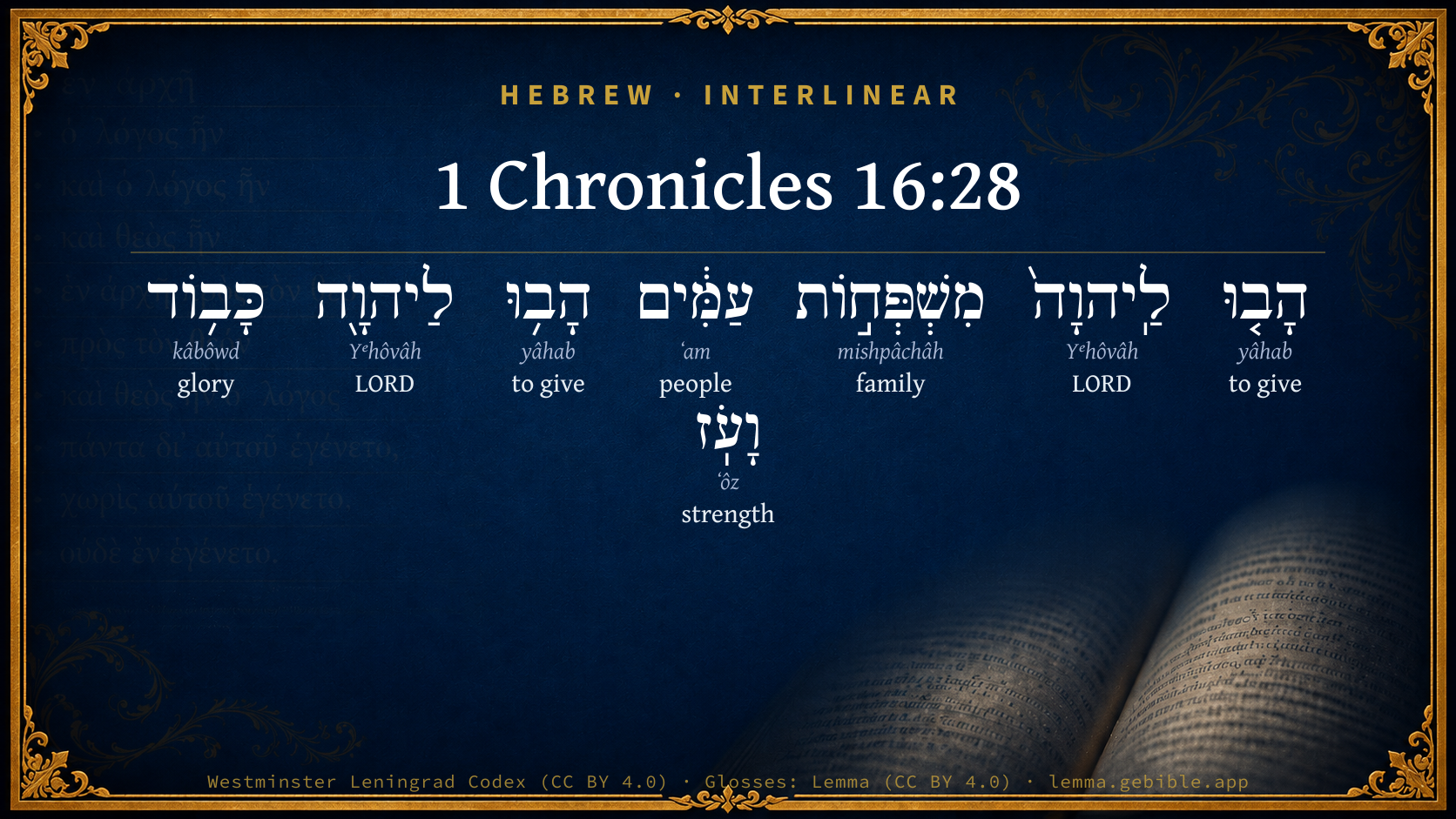
1 Chronicles 16:28

Hebrew (Westminster Leningrad Codex) 1 Chronicles 16:28 appears in the Hebrew Old Testament. The text above is from the Westminster Leningrad Codex. Each word links to its Strong’s number, a concise gloss, and parsing drawn from the Open Scriptures Hebrew Bible morphology. Click any word for its full Brown-Driver-Briggs (BDB) entry.
Download image
Cite this verse

1 Chronicles 16:28 (World English Bible). Public Domain. Lemma interlinear Bible study tool, https://lemma.gebible.app/v/1-chronicles/16/28.

Show BibTeX & RIS
BibTeX
RIS
English Translation
Ascribe to Yahweh, you relatives of the peoples, Ascribe to Yahweh glory and strength;
World English Bible · Public Domain
Download a study sheet

One document with this verse’s original text, its word-by-word gloss line, the meaning frame, cross-references with their text, attributed commentary, and full source and license credits — printable, and it pastes into notes with its structure intact.

This verse Autodidact and up

Study sheet (.html) Plain text (.txt)

A passage Seminary Student

Up to 50 verses in one chapter. A passage sheet keeps up to 6 commentary sources and 12 cross-references per verse, in the order this page ranks them, and says so on the sheet whenever that leaves anything out. Ask for a single verse and you get the Autodidact verse sheet above.

Everything on this page stays free to read, with no account — the sheet is a download of what is already on screen, not access to it.

Want to remove ads? Support Godless Engineer
Compare translations 3

The same verse in 3 English versions, stacked beneath the original-language interlinear above. Click any original word for its lexicon entry.

Each is an independent rendering of the whole verse — the interlinear is not word-aligned to these translations.

Highlighted words mark where these versions differ — a whole-verse word diff, not a word-by-word alignment.

  • World English Bible Public Domain
    Ascribe to Yahweh, you relatives of the peoples, Ascribe to Yahweh glory and strength;
  • King James Version Public Domain
    Give unto the LORD, ye kindred of the people, give unto the LORD glory and strength.
  • unfoldingWord Literal Text CC BY-SA 4.0
    Ascribe to Yahweh, clans of the peoples, ascribe to Yahweh glory and strength!

unfoldingWord Literal Text — © unfoldingWord, licensed CC BY-SA 4.0. Word-aligned USFM3 via Door43 (git.door43.org/unfoldingWord/en_ult).

Versions to compare (up to 4)

3 of 4 selected

Show all 18 translations

Every available English version of this verse, each an independent rendering of the whole verse.

  • World English Bible Public Domain
    Ascribe to Yahweh, you relatives of the peoples, Ascribe to Yahweh glory and strength;
  • Berean Standard Bible Public Domain
    Ascribe to the LORD, O families of the nations, ascribe to the LORD glory and strength.
  • Majority Standard Bible Public Domain
    Ascribe to the LORD, O families of the nations, ascribe to the LORD glory and strength.
  • King James Version Public Domain
    Give unto the LORD, ye kindred of the people, give unto the LORD glory and strength.
  • American Standard Version (1901) Public Domain
    Ascribe unto Jehovah, ye kindreds of the peoples, Ascribe unto Jehovah glory and strength;
  • Revised Version (1885) Public Domain
    Give unto the LORD, ye kindreds of the peoples, give unto the LORD glory and strength.
  • Geneva Bible (1599) Public Domain
    Giue vnto the Lord, ye families of the people: giue vnto the Lord glory and power.
  • Douay-Rheims (1899) Public Domain
    Bring ye to the Lord, O ye families of the nations: bring ye to the Lord glory and empire.
  • Young's Literal Translation Public Domain
    Ascribe to Jehovah, ye families of peoples, Ascribe to Jehovah honour and strength.
  • Literal Standard Version CC BY-SA 4.0
    Ascribe to YHWH, you families of peoples, || Ascribe to YHWH glory and strength.
  • Unlocked Literal Bible CC BY-SA 4.0
    Ascribe to Yahweh, you clans of peoples, ascribe to Yahweh glory and strength!
  • unfoldingWord Literal Text CC BY-SA 4.0
    Ascribe to Yahweh, clans of the peoples, ascribe to Yahweh glory and strength!
  • Darby Bible Public Domain
    Give unto Jehovah, ye families of peoples, Give unto Jehovah glory and strength!
  • World Messianic Bible Public Domain
    Ascribe to the LORD, you families of the peoples, ascribe to the LORD glory and strength!
  • Webster's Bible Public Domain
    Give to the LORD, ye kindreds of the people, give to the LORD glory and strength.
  • Free Bible Version CC BY-SA 4.0
    Give the Lord credit, nations of the world, credit him with glory and strength.
  • Bible in Basic English Public Domain
    Give to the Lord, O you families of the peoples, give to the Lord glory and strength.
  • JPS Tanakh (1917) Public Domain
    Ascribe unto the LORD, ye kindreds of the peoples, ascribe unto the LORD glory and strength.

Literal Standard Version (2020), Covenant Press — licensed CC BY-SA 4.0. Text via the HelloAO Bible API (eBible.org). Unlocked Literal Bible (unfoldingWord) — licensed CC BY-SA 4.0. Text via the HelloAO Bible API (eBible.org). unfoldingWord Literal Text — © unfoldingWord, licensed CC BY-SA 4.0. Word-aligned USFM3 via Door43 (git.door43.org/unfoldingWord/en_ult). Free Bible Version, Dr. Jonathan Gallagher — licensed CC BY-SA 4.0. Text via the HelloAO Bible API (eBible.org).

Word by word

More ways to search: Search by grammar → Find every occurrence → Compare this word →

Practice this passage: Drill this verse → Learn its vocabulary →

About this verse

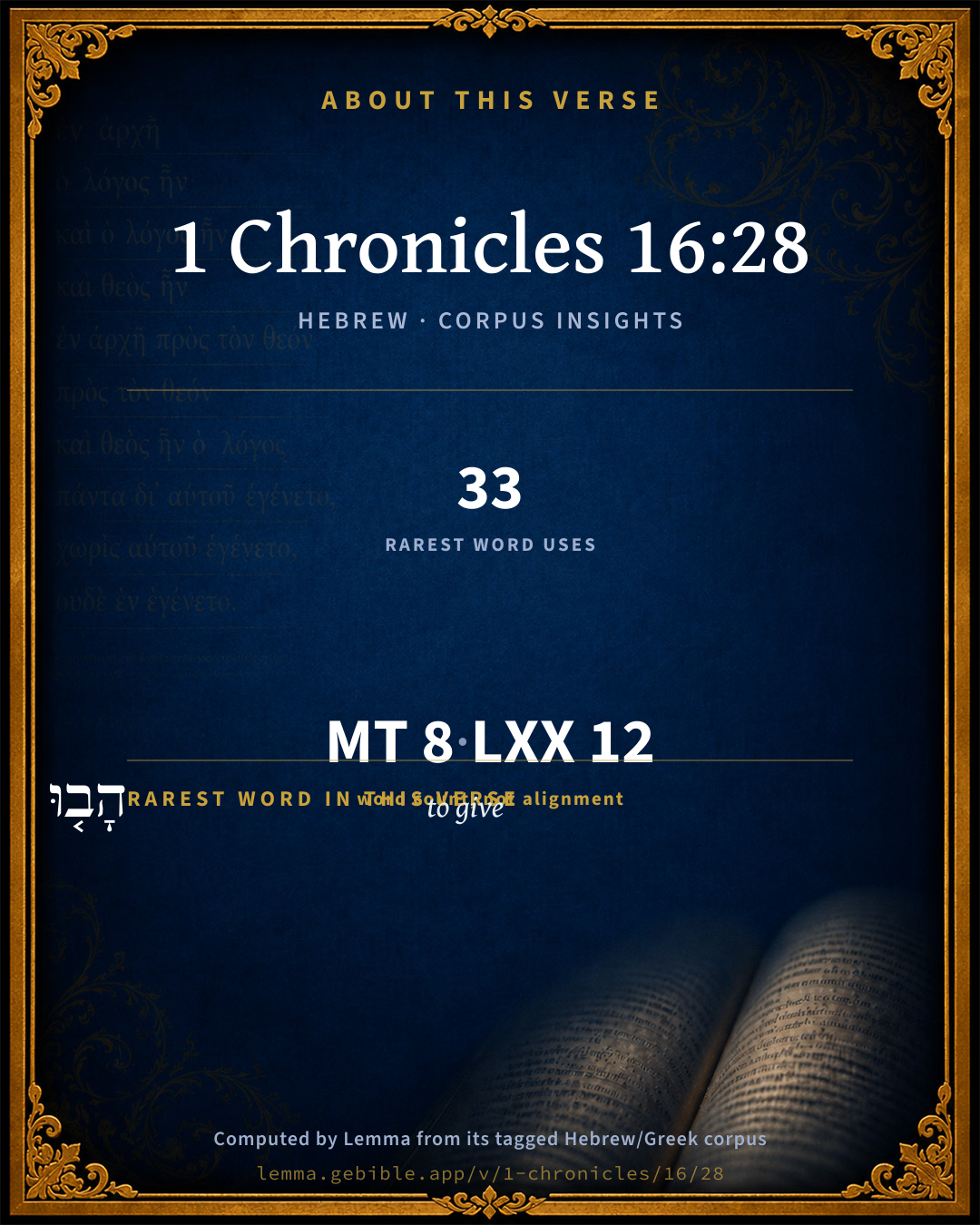
These counts appear in no published source. They are computed here, from the morphology-tagged text and Lemma’s own curated glosses. What Lemma adds →

8
words
6
distinct lemmas
Historical
section

Shared distinctive vocabulary

הָב֤וּ to give H3051 occurs in 29 verses of the Hebrew Bible. Also found in:

Grammatical profile

  • 2 verbs
  • 6 nouns

Verb forms

  • הָב֤וּ Qal · Imperative
  • הָב֥וּ Qal · Imperative

Repetition

Words recur within this verse — often emphatic in Hebrew:

  • הָב֤וּ to give H3051 ×2
  • לַֽיהוָה֙ LORD H3068 ×2

Hebrew & Septuagint length

In English translation the verse runs 14 words from the Hebrew and 16 from the Septuagint (LXX English) — closely comparable.

A rough comparison of the two English renderings, which tokenize alike — not a word-level alignment.

Word counts can differ between the Hebrew and the Greek without any difference in meaning — e.g. the Hebrew direct-object marker אֵת has no separate Greek word, and Greek often adds the article ὁ.

In the original languages it is 8 Hebrew tokens and 12 Greek tokens — but the two are counted differently (Hebrew bundles its prefixes and suffixes into one token; the Greek is in lemma form), so that isn’t a like-for-like length.

Cross-references

16

Topical passages linked to 1 Chronicles 16:28 in the Treasury of Scripture Knowledge — connected by theme and wording, ordered by reader-vote popularity; previews shown in the World English Bible.

  • 1 Corinthians 15:10 But by the grace of God I am what I am. His grace which was bestowed on me was not futile, but I worked more than all of them; yet not I, but the grace of God which was with me.
  • Philippians 4:13 I can do all things through Christ, who strengthens me.
  • Psalms 100:1–2 Shout for joy to Yahweh, all you lands!
  • 2 Corinthians 12:9–10 He has said to me, "My grace is sufficient for you, for my power is made perfect in weakness." Most gladly therefore I will rather glory in my weaknesses, that the power of Christ may rest on me.
  • Ephesians 1:17–19 that the God of our Lord Jesus Christ, the Father of glory, may give to you a spirit of wisdom and revelation in the knowledge of him;
  • Psalms 29:1–2 Ascribe to Yahweh, you sons of the mighty, Ascribe to Yahweh glory and strength.
  • Psalms 66:1–2 Make a joyful shout to God, all the earth!
  • Psalms 68:34 Ascribe strength to God! His excellency is over Israel, His strength is in the skies.
  • Psalms 115:1–2 Not to us, Yahweh, not to us, But to your name give glory, For your loving kindness, and for your truth's sake.
  • 1 Chronicles 29:10–14 Therefore David blessed Yahweh before all the assembly; and David said, You are blessed, Yahweh, the God of Israel our father, forever and ever.
  • Psalms 86:8–10 There is no one like you among the gods, Lord, Nor any deeds like your deeds.
  • Ephesians 1:6 to the praise of the glory of his grace, by which he freely bestowed favor on us in the Beloved,
  • Psalms 98:4 Make a joyful noise to Yahweh, all the earth! Burst out and sing for joy, yes, sing praises!
  • Isaiah 11:10 It shall happen in that day, that the root of Jesse, who stands for an ensign of the peoples, to him shall the nations seek; and his resting-place shall be glorious.
  • Psalms 67:4 Oh let the nations be glad and sing for joy, For you will judge the peoples with equity, And govern the nations on earth. Selah.
  • Psalms 67:7 God will bless us. All the ends of the earth shall fear him.

Cross-references courtesy of OpenBible.info (CC BY 4.0).

Hebrew and Greek witnesses Masoretic Hebrew ↔ Greek Septuagint

The same verse in the two great witnesses to the Old Testament, shown verse-for-verse.

These are two independent witnesses, not word-aligned to each other, and the Septuagint is shown in lemma (dictionary) form.

Hebrew 1 Chronicles 16:28 Masoretic · Westminster Leningrad Codex

הָב֤וּ לַֽיהוָה֙ מִשְׁפְּח֣וֹת עַמִּ֔ים הָב֥וּ לַיהוָ֖ה כָּב֥וֹד וָעֹֽז

Ascribe to Yahweh, you relatives of the peoples, Ascribe to Yahweh glory and strength;

World English Bible · Public Domain

Greek LXX 1 Chronicles 16:28 Septuagint · lemma form

δίδωμι ὁ κύριος πατριά ὁ ἔθνος δίδωμι ὁ κύριος δόξα καί ἰσχύς

Give to the Lord, you⌃ families of the nations, give to the Lord glory and strength.

LXX2012 (modern English Septuagint) · Public Domain

Hebrew: Westminster Leningrad Codex (CC BY 4.0). Greek: Septuagint (public domain); English from LXX2012 (modern English Septuagint) (Public Domain). How the Septuagint differs from the Hebrew →

Commentary

Notes on 1 Chronicles 16:28 from classic Christian and Jewish commentators (each source and its license shown beneath its notes). The classic Christian expositions comment on the surrounding passage and are grouped to its opening verse, so a note may address several verses; the Jewish commentaries on the Tanakh (Rashi and others) are per-verse, so they appear only where the commentator wrote on this verse.

Lemma curates 59 commentaries, every one of them public domain or Creative Commons licensed, each selected and text-cleaned for this edition rather than reprinted as found. About our sources →

The Biblical Illustrator

Joseph S. Exell

1Ch_16:28-29

Give unto the Lord the glory due unto His name.

The claims of God to the worship and homage of His creatures

I. God is entitled to and claims the homage of His creatures.

II. These claims are made upon us, his intelligent creatures.

III. The worship and homage required elevates the man who pays it. (J. Robinson.)

The glory which is due to Jehovah

The whole preceptive part of the Bible is contained in this one command. Every being has a right and may justly claim to be regarded and treated by all who know him in a manner suitable to the nature and character which he possesses to the relations and offices which he sustains, and to the works which he performs. Consider what is due to Jehovah.

I. An account of His nature. He is God alone. He deserves something which is due to no other being in the universe--religious worship and adoration.

II. On account of the character he possesses. It is absolutely perfect. There is something in His character suited to excite every proper affection of which the human soul is capable.

III. On account of the relations and offices which He sustains.

1. Creator.

2. Preserver.

These imply that God must necessarily be the universal Teacher, Master, Sovereign, and Judge.

IV. On account of the works which He has performed. Conclusion:

1. How reasonable are Gods requisitions! He merely requires the payment of a great debt.

2. How immeasurably great, then, is the debt which our world has contracted, and under the burden of which it now groans. (E. Payson, D. D.)

The claims of the Supreme Being to the worship and homage of His creatures

These claims are founded--

I. On our relation to God as His creatures.

II. On the manifestations of the Divine excellence visible in the universe around us.

III. In the constitution and susceptibilities of our minds. Worship is not only fit and proper as an act of the mind, but one to which it is naturally prone.

IV. On a consideration of what is most conducive to the well-being of men. The very act itself elevates the mind; it reminds us of our true position as the creatures and the servants of God. Conclusion:

1. These acts of worship divide the world into two great classes--those that fear God and those that fear Him not.

2. That as the public worship of God is one most important means of proclaiming the great facts of His existence and government, it demands the special and constant attention of all that fear God.

3. That as worship and homage are the requirements and the just rights of the Supreme Being, and as they are intimately connected with our well-being in this life and that which is to come, it is a serious and important inquiry how we may be able to present it most acceptably. (J. Robinson.)

Bring an offering.--

Hearing and worshipping

I. What do we come to Church for? Not merely to get but to give. Not to take only but to offer. Not to hear simply, but to worship: bring an offering, worship the Lord.

II. What is the offering the bringing of which constitutes worship? It is the offering of ourselves. Spirit, soul, body, substance. Conclusion:

1. This true explanation of the object of our meeting in Gods house gives the clearest condemnation of those who absent themselves. I can read my Bible at home might be an answer if we be but hearers; none if we be worshippers.

2. How great is the honour of being allowed to honour God--as worshippers!

3. Our direct worship shall be the smoke of the incense; but our whole life shall be, as it were, a compound of sweet spices. (J. R. Vernon, M. A.)

The beauty of holiness

The religion of the gospel of Christ is the beauty of holiness, as it concerns--

I. Its author.

II. Its plan.

III. Its fruits. (Legh Richardson.)

The Biblical Illustrator, edited by Joseph S. Exell (c. 1880s–1900s) — public domain. Text from a community e-Sword module.

The Cambridge Bible for Schools and Colleges

gen. ed. J. J. S. Perowne

28. of the people] R.V. of the peoples. An expectation that the Gentiles will turn to the worship of the true God is expressed not rarely in the Psalms; cp. Psa_22:27; Psa_68:31-32.

The Cambridge Bible for Schools and Colleges (gen. ed. J. J. S. Perowne; Cambridge University Press, 1878–1918) — public domain. Text from a community e-Sword module.

unfoldingWord translationNotes

Door43 World Missions Community

Ascribe to Yahweh

"Give praise to Yahweh" or "Praise Yahweh"

ascribe to Yahweh glory and strength

The abstract nouns "glory" and "strength" can be stated as adjectives. AT: "praise Yahweh because he is glorious and strong" (See: Abstract Nouns)

Ascribe to Yahweh the glory his name deserves

The abstract noun "glory" can be stated as a verb or adjective. AT: "Glorify Yahweh just as his name deserves" or "Proclaim that Yahweh is glorious just as his name deserves" (See: Abstract Nouns)

his name deserves

Here "his name" refers to the person of God. AT: "due to him" or "he deserves" or "he is worthy to receive" (See: Metonymy)

Bow down to Yahweh

The implied information is that the people were to bow down in worship. AT: "Bow down to worship Yahweh" (See: Assumed Knowledge and Implicit Information and Symbolic Action)

in the splendor of holiness

The abstract nouns "splendor" and "holiness" can be translated as adjectives. AT: "because he is gloriously beautiful and holy" (See: Abstract Nouns)

translationWords

clan

people group

name

sacrifice

bow

holy

splendor

unfoldingWord translationNotes — © Distant Shores Media and the Door43 World Missions Community, licensed CC BY-SA 4.0. Source: git.door43.org/Door43/en_tn.

Rashi

Rabbi Shlomo Yitzchaki (Rashi)

Ascribe to the Lord, [you] families of peoples And what should they ascribe to Him? And he explains: glory and might.

Rashi on the Tanakh — English translations: “The Judaica Press complete Tanach with Rashi, translated by A. J. Rosenberg” (CC BY 4.0); “Pentateuch with Rashi's commentary by M. Rosenbaum and A.M. Silbermann, 1929-1934” (public domain); “The Metsudah Tanach series, Lakewood, N.J” (CC BY 4.0); and “The Book of Joshua, Metsudah Publications, 1997” (CC BY 4.0). Text via Sefaria.

Lesson kit

Teaching starters — assembled from the data on this page, not authored interpretation. Every prompt links to the verse data it draws on. Edit before teaching.

1 Chronicles, in the Historical, opens this verse with 8 words (6 distinct Hebrew lemmas). Its most distinctive word is yâhab (“to give”). A historical commentator’s framing appears above. Read the whole chapter for the surrounding context.

Discussion questions

  1. The word yâhab carries the sense “to give.” How does it shape the verse?
  2. Genesis 11:3 shares the word «to give» with this verse. How do the two illuminate each other?
  3. “to give” occurs 2× in this one verse. What is the effect of the repetition?
  4. These translations render this verse differently. What is at stake in choosing one wording over another?
  5. The verb «הָב֤וּ» is Qal Imperative. How does its form color the action?
  6. Reading how The Biblical Illustrator and The Cambridge Bible for Schools and Colleges read this verse, where do the two commentators agree and where do they part?

Things to notice

Reading settings

Reading text

Shown beneath each verse's original-language words.

Old Testament
Old Testament edition

Read the OT as the Masoretic Hebrew (MT) or the Greek Septuagint (LXX).

English shown for the Greek Septuagint (in the Hebrew ↔ Greek comparison).

Comparing translations? Open the Compare panel on any verse page to stack up to four side by side.