
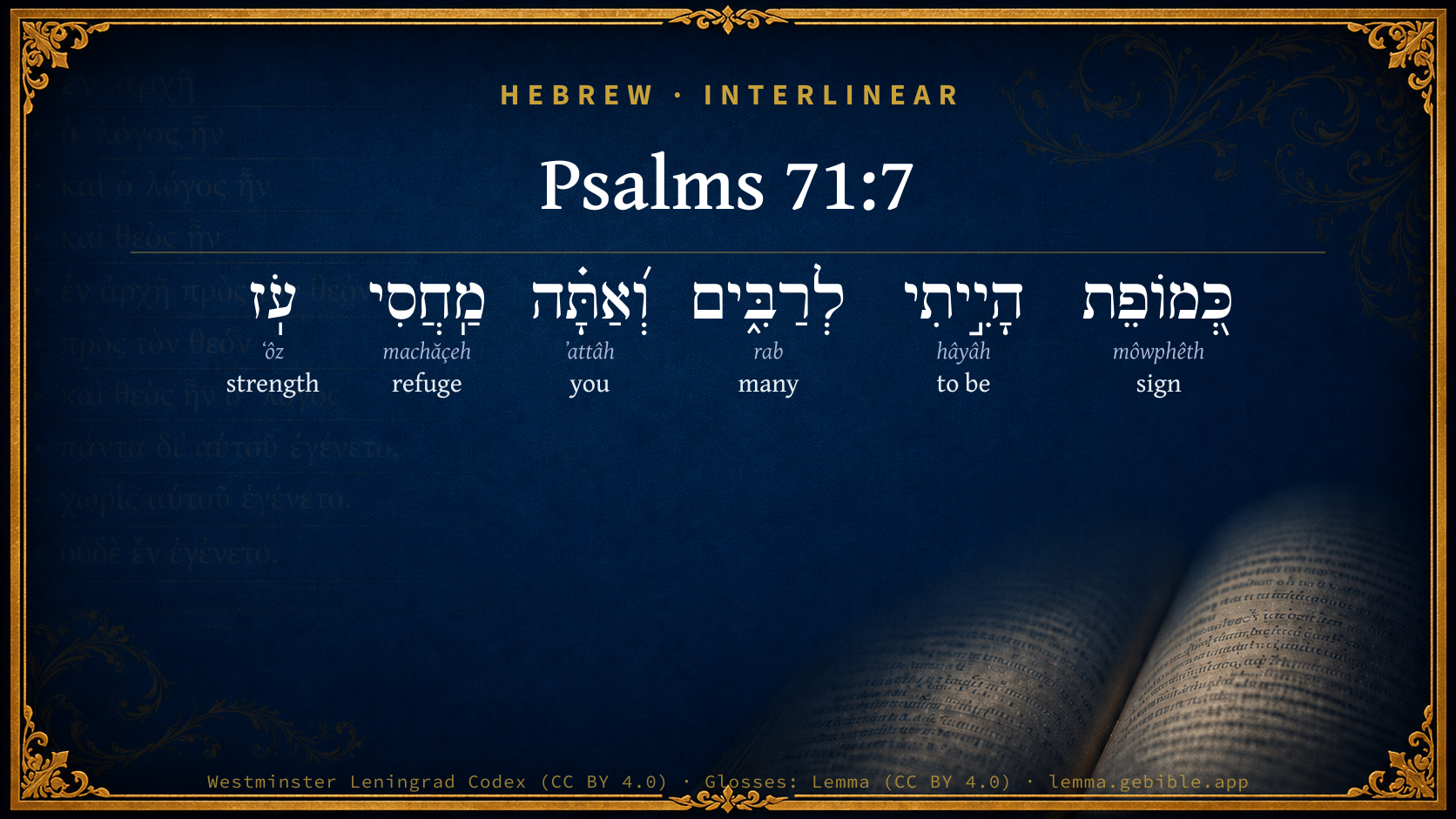
Psalms 71:7

Hebrew (Westminster Leningrad Codex) Psalms 71:7 appears in the Hebrew Old Testament. The text above is from the Westminster Leningrad Codex. Each word links to its Strong’s number, a concise gloss, and parsing drawn from the Open Scriptures Hebrew Bible morphology. Click any word for its full Brown-Driver-Briggs (BDB) entry.
Download image
Cite this verse

Psalms 71:7 (World English Bible). Public Domain. Lemma interlinear Bible study tool, https://lemma.gebible.app/v/psalms/71/7.

Show BibTeX & RIS
BibTeX
RIS
English Translation
I am a marvel to many, But you are my strong refuge.
World English Bible · Public Domain
Download a study sheet

One document with this verse’s original text, its word-by-word gloss line, the meaning frame, cross-references with their text, attributed commentary, and full source and license credits — printable, and it pastes into notes with its structure intact.

This verse Autodidact and up

Study sheet (.html) Plain text (.txt)

A passage Seminary Student

Up to 50 verses in one chapter. A passage sheet keeps up to 6 commentary sources and 12 cross-references per verse, in the order this page ranks them, and says so on the sheet whenever that leaves anything out. Ask for a single verse and you get the Autodidact verse sheet above.

Everything on this page stays free to read, with no account — the sheet is a download of what is already on screen, not access to it.

Want to remove ads? Support Godless Engineer
Compare translations 3

The same verse in 3 English versions, stacked beneath the original-language interlinear above. Click any original word for its lexicon entry.

Each is an independent rendering of the whole verse — the interlinear is not word-aligned to these translations.

Highlighted words mark where these versions differ — a whole-verse word diff, not a word-by-word alignment.

  • World English Bible Public Domain
    I am a marvel to many, But you are my strong refuge.
  • King James Version Public Domain
    I am as a wonder unto many; but thou art my strong refuge.
  • unfoldingWord Literal Text CC BY-SA 4.0
    I have become like a wonder to many, but you my refuge of strength.

unfoldingWord Literal Text — © unfoldingWord, licensed CC BY-SA 4.0. Word-aligned USFM3 via Door43 (git.door43.org/unfoldingWord/en_ult).

Versions to compare (up to 4)

3 of 4 selected

Show all 18 translations

Every available English version of this verse, each an independent rendering of the whole verse.

  • World English Bible Public Domain
    I am a marvel to many, But you are my strong refuge.
  • Berean Standard Bible Public Domain
    I have become a portent to many, but You are my strong refuge.
  • Majority Standard Bible Public Domain
    I have become a portent to many, but You are my strong refuge.
  • King James Version Public Domain
    I am as a wonder unto many; but thou art my strong refuge.
  • American Standard Version (1901) Public Domain
    I am as a wonder unto many; But thou art my strong refuge.
  • Revised Version (1885) Public Domain
    I am as a wonder unto many; but thou art my strong refuge.
  • Geneva Bible (1599) Public Domain
    I am become as it were a monster vnto many: but thou art my sure trust.
  • Douay-Rheims (1899) Public Domain
    I run become unto many as a wonder, but thou art a strong helper.
  • Young's Literal Translation Public Domain
    As a wonder I have been to many, And Thou `art' my strong refuge.
  • Literal Standard Version CC BY-SA 4.0
    I have been as a wonder to many, || And You [are] my strong refuge.
  • Unlocked Literal Bible CC BY-SA 4.0
    I am an example to many people; you are my strong refuge.
  • unfoldingWord Literal Text CC BY-SA 4.0
    I have become like a wonder to many, but you my refuge of strength.
  • Darby Bible Public Domain
    I have been as a wonder unto many; but thou art my strong refuge.
  • World Messianic Bible Public Domain
    I am a marvel to many, but you are my strong refuge.
  • Webster's Bible Public Domain
    I am as a wonder to many; but thou art my strong refuge.
  • Free Bible Version CC BY-SA 4.0
    My life has been like a miracle to many people, for you have been my powerful protector.
  • Bible in Basic English Public Domain
    I am a wonder to all; but you are my strong tower.
  • JPS Tanakh (1917) Public Domain
    I am as a wonder unto many; but Thou art my strong refuge.

Literal Standard Version (2020), Covenant Press — licensed CC BY-SA 4.0. Text via the HelloAO Bible API (eBible.org). Unlocked Literal Bible (unfoldingWord) — licensed CC BY-SA 4.0. Text via the HelloAO Bible API (eBible.org). unfoldingWord Literal Text — © unfoldingWord, licensed CC BY-SA 4.0. Word-aligned USFM3 via Door43 (git.door43.org/unfoldingWord/en_ult). Free Bible Version, Dr. Jonathan Gallagher — licensed CC BY-SA 4.0. Text via the HelloAO Bible API (eBible.org).

Word by word

More ways to search: Search by grammar → Find every occurrence → Compare this word →

Practice this passage: Drill this verse → Learn its vocabulary →

About this verse

These counts appear in no published source. They are computed here, from the morphology-tagged text and Lemma’s own curated glosses. What Lemma adds →

6
words
6
distinct lemmas
Wisdom
section

Notable vocabulary

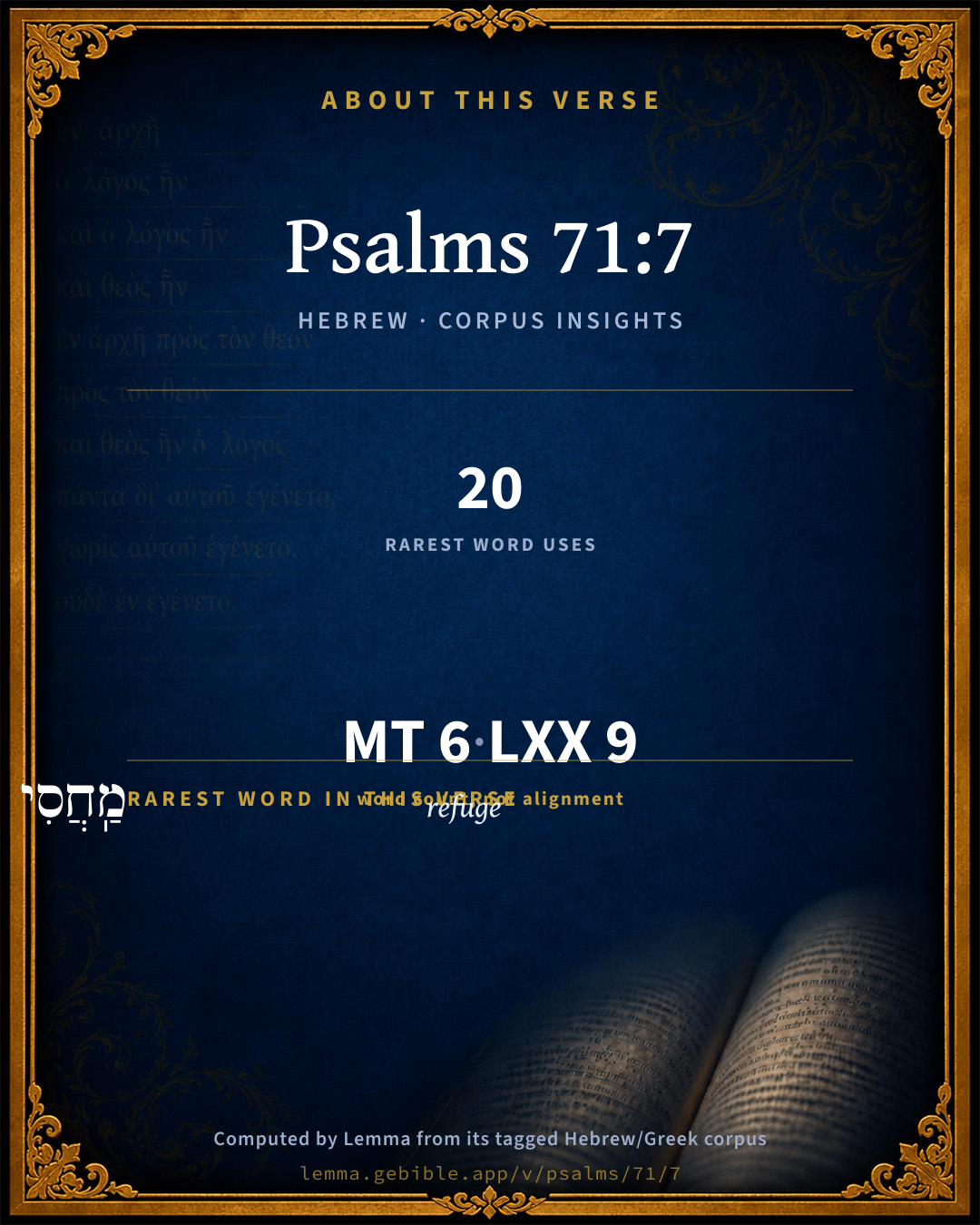
The rarest word here is מַֽחֲסִי refuge H4268 — appearing just 20 times in the whole Hebrew Bible.

Shared distinctive vocabulary

מַֽחֲסִי refuge H4268 occurs in 20 verses of the Hebrew Bible. Also found in:

Grammatical profile

  • 1 verb
  • 3 nouns
  • 1 adjective
  • 1 pronoun

Verb forms

  • הָיִ֣יתִי Qal · Perfect

Hebrew & Septuagint length

In English translation the verse runs 12 words from the Hebrew and 16 from the Septuagint (LXX English) — closely comparable.

A rough comparison of the two English renderings, which tokenize alike — not a word-level alignment.

Word counts can differ between the Hebrew and the Greek without any difference in meaning — e.g. the Hebrew direct-object marker אֵת has no separate Greek word, and Greek often adds the article ὁ.

In the original languages it is 6 Hebrew tokens and 9 Greek tokens — but the two are counted differently (Hebrew bundles its prefixes and suffixes into one token; the Greek is in lemma form), so that isn’t a like-for-like length.

Cross-references

11

Topical passages linked to Psalms 71:7 in the Treasury of Scripture Knowledge — connected by theme and wording, ordered by reader-vote popularity; previews shown in the World English Bible.

  • Isaiah 8:18 Behold, I and the children whom Yahweh has given me are for signs and for wonders in Israel from Yahweh of Hosts, who dwells in Mount Zion.
  • Psalms 62:7 With God is my salvation and my honor. The rock of my strength, and my refuge, is in God.
  • Acts 4:13 Now when they saw the boldness of Peter and John, and had perceived that they were unlearned and ignorant men, they marveled. They recognized that they had been with Jesus.
  • 1 Corinthians 4:9 For, I think that God has displayed us, the apostles, last of all, like men sentenced to death. For we are made a spectacle to the world, both to angels and men.
  • Jeremiah 16:19 Yahweh, my strength, and my stronghold, and my refuge in the day of affliction, to you shall the nations come from the ends of the earth, and shall say, Our fathers have inherited nothing but lies, [even] vanity and things in which there is no profit.
  • 2 Corinthians 6:8–10 by glory and dishonor, by evil report and good report; as deceivers, and yet true;
  • Psalms 61:3 For you have been a refuge for me, A strong tower from the enemy.
  • Zechariah 3:6 The angel of Yahweh protested to Joshua, saying,
  • Luke 2:34 and Simeon blessed them, and said to Mary, his mother, "Behold, this child is set for the falling and the rising of many in Israel, and for a sign which is spoken against.
  • 2 Corinthians 4:8–12 We are pressed on every side, yet not crushed; perplexed, yet not to despair;
  • Psalms 142:4–5 Look on my right, and see; For there is no one who is concerned for me. Refuge has fled from me. No one cares for my soul.

Cross-references courtesy of OpenBible.info (CC BY 4.0).

Hebrew and Greek witnesses Masoretic Hebrew ↔ Greek Septuagint

The same verse in the two great witnesses to the Old Testament, shown verse-for-verse.

You’re reading Greek Psalm 70 (Hebrew Psalm 71). The Septuagint counts the superscription, so verse numbers can differ from the Hebrew — chapter-level alignment, not verse-by-verse. Numbering follows Rahlfs.

These are two independent witnesses, not word-aligned to each other, and the Septuagint is shown in lemma (dictionary) form.

Hebrew Psalms 71:7 Masoretic · Westminster Leningrad Codex

כְּ֭מוֹפֵת הָיִ֣יתִי לְרַבִּ֑ים וְ֝אַתָּ֗ה מַֽחֲסִי עֹֽז

I am a marvel to many, But you are my strong refuge.

World English Bible · Public Domain

Greek LXX Greek Psalm 70:7 Septuagint · lemma form

ὡσεί τέρας γίγνομαι ὁ πολύς καί σύ βοηθός κραταιός

I am become as it were a wonder to many: but you are my strong helper.

LXX2012 (modern English Septuagint) · Public Domain

Hebrew: Westminster Leningrad Codex (CC BY 4.0). Greek: Septuagint (public domain); English from LXX2012 (modern English Septuagint) (Public Domain). How the Septuagint differs from the Hebrew →

Commentary

Notes on Psalms 71:7 from classic Christian and Jewish commentators (each source and its license shown beneath its notes). The classic Christian expositions comment on the surrounding passage and are grouped to its opening verse, so a note may address several verses; the Jewish commentaries on the Tanakh (Rashi and others) are per-verse, so they appear only where the commentator wrote on this verse.

Lemma curates 59 commentaries, every one of them public domain or Creative Commons licensed, each selected and text-cleaned for this edition rather than reprinted as found. About our sources →

Trapp's Complete Commentary

John Trapp

Psa 71:7 I am as a wonder unto many; but thou [art] my strong refuge.

Ver. 7. I am a wonder unto many] Or, unto the great ones, a monster to the mighty, quia credo quod non video, as Austin glosseth, because I believe what I yet see not, viz. that this storm shall blow over, and I be resettled in my throne.

John Trapp, A Commentary or Exposition upon All the Books of the Old and New Testament (1647–1656) — public domain. Text from a community e-Sword module.

The Biblical Illustrator

Joseph S. Exell

Psa_71:7

I am as a wonder unto many; but Thou art my strong refuge.

A wonder unto many

Consider the text, with reference to David, to Christ, and to the Christian. (John Cawood, M. A.)

The Biblical Illustrator, edited by Joseph S. Exell (c. 1880s–1900s) — public domain. Text from a community e-Sword module.

Joseph Benson's Commentary

Psa 71:7. I am a wonder to many — Hebrew, כמופת, chemopeth, as a prodigy, or monster, that is, as a frightful spectacle, which they are afraid to come near. Green renders it, as a gazing-stock to the multitude. This David was, on account of his many and sore calamities, and perhaps, also, because of his firm trust in God amidst them all; as if he had said, Every one waits to see what will be the issue of such extraordinary troubles as I have fallen into, and such extraordinary confidence as I profess to have in God. But thou art my sure refuge — But, although men desert me, and look with suspicion and contempt on me, God is a sure refuge for me. “David, banished from his kingdom,” says Dr. Horne, “was regarded as a wonder, or prodigy of wretchedness; Christ, in his state of humiliation upon earth, was a sign everywhere spoken against, as Simeon foretold he would be, Luk 2:34. The Christian, who lives by faith, who quits possession for reversion, and who chooses to suffer with his Saviour here, that he may reign with him hereafter, appears to the men of the world as a monster of folly and enthusiasm. But God is the strong refuge of all such.”

Joseph Benson's Commentary on the Old and New Testaments (1811–1818) — public domain. Text from a community e-Sword module.

J. A. Alexander on Psalms

Joseph Addison Alexander

Psa 71:7. As a prodigy, or wonder, an object of contemptuous astonishment, was I, or have I been to many, on account of my extraordinary sufferings; but thou art my refuge of strength, my strong refuge, at once my protector and my hiding place. With the first clause compare Deu 28:46, Isa. 53:14, 1Co 4:9.

Joseph Addison Alexander, The Psalms Translated and Explained (1850) — public domain. Text from a community e-Sword module.

Geneva Bible (1599)

Geneva Bible translators

All the world wondereth at me because of my miseries: as well they in authority as the common people, yet being assured of thy favor, I remained steadfast.

Geneva Bible (1599) marginal notes — public domain. Text via Bolls.life.

Adam Clarke's Commentary

Verse 7. I am as a wonder unto many] I am כמופת kemopheth, "as a portent," or "type:" I am a typical person; and many of the things that happen to me are to be considered in reference to him of whom I am a type. But he may mean I am a continual prodigy. My low estate, my slaying the lion and the bear, conquering the Philistine, escaping the fury of Saul, and being raised to the throne of Israel, are all so many wonders of thy providence, and effects of thy power and grace.

Adam Clarke's Commentary on the Bible (1810–1826) — public domain. Text from a community e-Sword/MySword module.

John Calvin's Commentaries

7. I have been as a prodigy to the great ones. He now makes a transition to the language of complaint, declaring that he was held in almost universal abhorrence by reason of the great calamities with which he was afflicted. There is an apparent, although only an apparent, discrepancy between these two statements; first, that he had always been crowned with the benefits of God; and, secondly, that he was accounted as a prodigy on account of his great afflictions; but we may draw from thence the very profitable doctrine, that he was not so overwhelmed by his calamities, heavy though they were, as to be insensible to the goodness of God which he had experienced. Although, therefore, he saw that he was an object of detestation, yet the remembrance of the blessings which God had conferred upon him, could not be extinguished by the deepest shades of darkness which surrounded him, but served as a lamp in his heart to direct his faith. By the term prodigy is expressed no ordinary calamity. Had he not been afflicted in a strange and unusual manner, those to whom the miserable condition of mankind was not unknown would not have shrunk from him with such horror, and regarded him as so repulsive a spectacle. It was, therefore, a higher and more commendable proof of his constancy, that his spirit was neither broken nor enfeebled with sham but reposed in God with the stronger confidence, the more he was cast off by the world. The sentence is to be explained adversatively, implying that, although men abhorred him as a monster, yet, by leaning upon God, he continued in despite of all this unmoved. If it should be thought preferable to translate the word רבים, rabbim, which I have rendered great ones, by the word many, the sense will be, That David’s afflictions were generally known, and had acquired great notoriety, as if he had been brought forth upon a stage and exposed to the view of the whole people. But in my opinion it will be more suitable to understand the word of great men, or the nobles. There is no heart so strong and impervious to outward influences as not to be deeply pierced when those who are considered to excel in wisdom and judgment, and who are invested with authority, treat a suffering and an afflicted man with such indignity, that they shrink with horror from him, as if he were a monster. In the next verse, as if he had obtained the desire of his heart, he expresses it to be his resolution to yield a grateful acknowledgement to God. To encourage himself to hope with the greater confidence for a happy issue to his present troubles, he promises loudly to celebrate the praises of God, and to do this not only on one occasion, but to persevere in the exercise without intermission.

John Calvin's Commentaries (1540-1563) — public domain. Text from the Calvin Translation Society English edition (1840s-50s) via the Christian Classics Ethereal Library (ccel.org). Calvin's coverage is partial (roughly two-thirds of the Bible); uncommented books and verses are honest gaps, never fabricated. The 19th-century editor's footnotes and remarks are omitted so the notes are faithfully Calvin's own voice.

Ellicott's Commentary for English Readers

(7) A wonder—i.e., not a miracle of preservation, but a monster. Though men point at him as something to be avoided or mocked, God is his refuge.

A Bible Commentary for English Readers, edited by Charles John Ellicott (1878–1897) — public domain. Text from a community e-Sword module.

The Cambridge Bible for Schools and Colleges

gen. ed. J. J. S. Perowne

7. I am &c.] Or, I have been as a wonder. Many of those who saw my sufferings regarded me as a typical example of divine chastisement, but my faith has remained unshaken throughout. Cp. Isa_52:14; and Deu_28:46, where the punishment of Israel for its sins is spoken of as “a sign and a wonder.” In a somewhat different sense Ezekiel was a ‘wonder’ to his contemporaries (Eze_12:6; Eze_12:11; Eze_24:24; Eze_24:27). The explanation ‘I have been a sign and example of God’s protecting care’ is less natural. ‘Monster’ in P.B.V. is an archaism for ‘portent,’ or, ‘prodigy,’ from Lat. monstrum.

my strong refuge] Cp. Psa_71:1, and Jer_17:17, R.V.

The Cambridge Bible for Schools and Colleges (gen. ed. J. J. S. Perowne; Cambridge University Press, 1878–1918) — public domain. Text from a community e-Sword module.

John Gill's Exposition

I am as a wonder unto many,.... To the multitude, to the populace, or "to the great" (u) and mighty; and indeed to both: which respects not his wonderful preservation from the womb, he had before observed; nor his being in a wonderful manner raised to the throne of Israel; nor the wonderful things and amazing exploits done by him, and victories he obtained; nor the wonderful instances of divine grace and goodness to him; but rather the forlorn and distressed state and condition he was now in, being obliged to quit his palace, and flee from the face of his son, accompanied only with a few of his servants; and so was a shocking sight, a spectacle, as the apostle says of himself, to others, to the world, to angels, and to men, Co1 4:9; so the Messiah and his children are said to be set for signs and wonders, Isa 8:18; and Joshua and his fellows to be men wondered at, Zac 3:8; as the saints are by themselves, that they should partake of such favours; and by the angels, that they should be the objects of electing, redeeming, calling, adopting, justifying, and pardoning grace; and by the world, that they should choose to suffer affliction and reproach for Christ, bear it with so much patience, and be supported, and thrive under it; see Co2 6:8;

but thou art my strong refuge; or "my refuge of strength" (w); his refuge and strength, as in Psa 46:1; his refuge, to which he betook himself, when refuge failed him, and no man cared for him, and which he found to be a strong one, and in it safety.

(u) "multis vel magnis", Piscator; so Ainsworth. (w) "refugium meum roboris", Gejerus.

John Gill's Exposition of the Whole Bible (1746–1763) — public domain (CC PDM 1.0). Text via the HelloAO Bible API.

Albert Barnes' Notes on the Bible

I am as a wonder unto many - The word here rendered “wonder” - מופת môphêth - means properly a miracle, a prodigy; then things that are suited to excite wonder or admiration; then, a sign, a token. See the notes at Isa 8:18. The meaning here is, that the course of things in regard to him - the divine dealings toward him - had been such as to excite attention; to strike the mind as something unusual, and out of the common course, in the same way that miracles do. This might be either from the number and the character of the calamities which had come upon him; or from the narrow escapes which he had had from death; or from the frequency of the divine intervention in his behalf; or from the abundant mercies which had been manifested toward him. The connection makes it probable that he refers to the unusual number of afflictions which had come upon him, and the frequency of the divine interpositions in his behalf when there was no other refuge, and no other hope.

But thou art my strong refuge - See the notes at Psa 18:2. That is, God had been his Protector, his hiding-place.

Albert Barnes' Notes on the Bible (1834–1885) — public domain. Text from a community e-Sword/MySword module.

Matthew Poole's English Annotations

A wonder, or prodigy; either,

1. Of mercy, for the wonderful protections and deliverances which God hath given me. Or rather,

2. Of judgment, for my many and sore calamities, as appears from the next words. They wondered both at the calamities themselves which befell me; which were great, and various, and strange; and that they should befall me, one who have made it the chief care and business of my life to please, and serve, and glorify God; and one whom God hath owned in so eminent a degree, and crowned with such a constant succession of blessings and deliverances from time to time. That such a man should be forsaken by so gracious a God; and persecuted even to death by his own son, whom he had so tenderly loved; and deserted by the body of his own people, who had generally expressed so great an opinion of him and affection to him, and had so many obligations to him, and such singular benefits by his wise, and just, and pious government; this was indeed cause of wonder.

But thou art my strong refuge; but although men desert me, and look askew at me, God is a sure refuge to me.

Matthew Poole's English Annotations on the Holy Bible (1683–1685) — public domain. Text from a community e-Sword/MySword module.

The Treasury of David

Charles H. Spurgeon

Ver. 7. I am as a wonder unto many. "To thousand eyes a mark and gaze am I." The saints are men wondered at; often their dark side is gloomy even to amazement, while their bright side is glorious even to astonishment. The believer is a riddle, an enigma puzzling the unspiritual; he is a monster warring with those delights of the flesh, which are the all in all of other men; he is a prodigy, unaccountable to the judgments of ungodly men; a wonder gazed at, feared, and, by and by, contemptuously derided. Few understand us, many are surprised at us.

But thou art my strong refuge. Here is the answer to our riddle. If we are strong, it is in God; if we are safe, our refuge shelters us; if we are calm, our soul hath found her stay in God. When faith is understood, and the grounds of her confidence seen, the believer is no longer a wonder; but the marvel is that so much unbelief remains among the sons of men.

Ver. 7. I am as a wonder unto many. The Hebrew word translated wonder, would, perhaps, be better expressed by portent. It denotes anything uncommon and wonderful, and admits a double meaning. Some interpreters are of opinion, that it is here taken in the most favourable sense, and that the psalmist represents himself as considered, by the many, as a prodigy of God's goodness. But the whole tenor of the Psalm is against this meaning; which is not badly expressed by Green: "I am become a gazing stock to the multitude." Alexander Geddes. 1737-1802.

Ver. 7. I am as a wonder unto many etc. On several accounts a converted man may be an object of surprise among his contemporaries. This may arise from the circumstance of his conversion dating at a late period of his life, when his long continuance in a state of impenitence seemed to render it almost certain that he would persist in it to the last. It is, indeed, a wonder to see any human being's course entirely altered at a late period, and to observe him afterwards moving in a totally different direction, influenced by different principals. Or, to take the instance of another convert, the character he is enabled to sustain, founded upon his great change, is in such marked and continued contrast to his former habits of life as to render it difficult to recognise in the Christian of today the sinner of yesterday. "Is Saul also among the prophets?" Or, in yet another example, the means divinely employed to effect result, as to place the result itself under suspicion and doubt. Every godly man, like Ananias of old, may hesitate to admit into his society the persecutor or the profligate of unhappy notoriety, except upon clearly discerning that he has become a new creature in Christ Jesus, and that old evil habits have passed away. At the same time, his former ungodly associates are mortified at his renunciation of fellowship with them, and are malicious enough to promulgate false reports concerning his character and motives. "They think it strange, "says the apostle, "that ye run not with them to the same excess of riot, speaking evil of you." Yet to such a convert his God is a sun and shield--a shield from the shafts of cruel slander, and a refuge to him from all storms of persecution. In all similar cases the language of the psalmist becomes particularly appropriate: I am as a wonder unto many; but thou art my strong refuge. John Leifchild.

Ver. 7. A wonder. The Messiah did not attract the admiring gaze of mankind. He did arrest attention; he did excite wonder; but it was not the wonder of admiration. A few whose eyes God had opened, saw, indeed, in some measure, the real grandeur that was amid all this apparent meanness. They "beheld his glory--the glory as of the only begotten of the Father; "a glory that bedimmed all created lustre. But the great body of those who beheld him were, "astonished" at him. His external appearance, especially when contrasted with his claim to be the Messiah, shocked them. The Galilean peasant--the Nazarene carpenter--the son of Joseph, claiming God for his own Father, --declaring himself the "bread of life, "and "the light of the world, "and asserting that the destinies of eternity hung on the reception or rejection of him and his message; all this excited a mingled emotion of amazement and indignation, scorn and horror, in the bosom of the great majority of his countrymen. He was a wonder, a prodigy unto many. A mixture of pity and contempt, disgust and wonder, seems to have stirred the stern bosom of the Roman governor, when he brought him out wearing the robe of mock royalty and the torturing crown, and exclaimed, "Behold the man." Even his friends were confounded, though their astonishment bore a different character. The closing scene, notwithstanding what appear to us very plain forewarnings, appears to have come on them like a thunderbolt. They were overwhelmed with amazement, as well as sorrow. What blank astonishment sat on their countenances when he made the announcement, "Verily I say unto you, one of you shall betray me!" How must their amazement have risen at the successive scenes of Gethsemane, and the hall of the high priest, and the court of Pilate, till at last they saw him, in whom they trusted that he should redeem Israel, nailed to a cross like a felonious slave--execrated of man, and deserted of God! Then their amazement reached its consummation: they were "astonished at him." John Brown, in "The Sufferings and Glories of the Messiah."

Ver. 7. (first clause). may be accommodated to,

I. The Saviour.

II. The Saint. He is a wonder in reference to

(1) What he once was;

(2) What he now is;

(3) What he will hereafter be.

III. The sinner is "a wonder unto many; "a wonder to

three worlds: to

(1) angels;

(2) saints;

(3) devils and lost souls. Warwell Fenn. 1830.

Ver. 7. Consider the text, with reference to David, to Christ, and to the Christian.

I. With reference to David.

1. David was a wonder as a man.

2. As a king.

3. As a servant of God. II. With respect to Christ.

1. Christ was a wonder in his person.

2. In his life.

3. In his miracles.

4. In his teaching.

5. In his sufferings.

6. In his ascension and mediatorial glory. III. With regard to the Christian.

1. The Christian is a wonder to himself.

2. To the world.

3. To wicked spirits.

4. To the angels in heaven. John Cawood. 1830.

Psalms 71:8*

Charles H. Spurgeon's The Treasury of David (1869–1885) — public domain. Psalms only. Text from a community e-Sword/MySword module.

Whedon's Commentary on the Bible

Daniel D. Whedon

7. I am as a wonder unto many— “As a prodigy or wonder, an object of contemptuous astonishment was I, or have I been, to many, on account of my extraordinary sufferings.”—Alexander. But מופת is often used in the sense sign, symbol, or token, indicating the divine will or purpose, as in Eze_12:11, “Say, I am your sign: like as I have done, so shall it be done unto them;” and Eze_24:24, “Thus Ezekiel is unto you a sign: according to all that he hath done shall ye do.” This sense is quite common. So, in the text, the psalmist was a sign or token to many, illustrating by his high example what God will do with the righteous and the wicked, and the principles on which he will reward or punish men. Thus, in all ages, individual experience has been used as illustrative of the settled methods of divine grace and judgment for the admonition and encouragement of others, Isa_8:18; Zec_3:8, where “men wondered at,” should be “men of a sign.” David seemed conscious of this public relation of his personal and official life.

Daniel D. Whedon (gen. ed.), Commentary on the Old and New Testaments (1874–1909) — public domain. Text from a community e-Sword module.

The Pulpit Commentary

I am as a wonder unto many; or, as a portent, a prodigy something montrous. Some explain, "as an object of God"s singular favour from his youth" (Kay, Cheyne); others, "as a marvellous example of God"s punishments" (Schultens, Hengstenberg, Professor Alexander, Canon Cook). The latter explanation is supported by Deu_28:46, and, on the whole, seems preferable. But thou art my strong Refuge (see above, ver. 3, ad fin.).

The Pulpit Commentary (1880–1919), ed. H.D.M. Spence-Jones & Joseph S. Exell — public domain. Text from a community e-Sword module.

John Wesley's Explanatory Notes

A wonder - For my many and sore calamities.

John Wesley, Explanatory Notes Upon the Whole Bible (1754–1765) — public domain. Text via the GEBible commentary corpus.

Keil & Delitzsch

C. F. Keil & F. Delitzsch

Brought safely through dangers of every kind, he is become כּמופת, as a wonder, a miracle (Arabic aft from afata, cognate afaka, הפך, to bend, distort: a turning round, that which is turned round or wrenched, i.e., that which is contrary to what is usual and looked for) to many, who gaze upon him as such with astonishment (Psa 40:4). It is his God, however, to whom, as hitherto so also in time to come, he will look to be thus wonderfully preserved: מחסי־עז, as in Sa2 22:33. עז is a genitive, and the suffix is thrown back (vid., supra, p 171) in order that what God is to, and does for, the poet may be brought forward more clearly and independently [lit. unalloyed]. Psa 71:8 tells us what it is that he firmly expects on the ground of what he possesses in God. And on this very ground arises the prayer of Psa 71:9 also: Cast me not away (viz., from Thy presence, Psa 51:13; Jer 7:15, and frequently) in the time (לעת, as in Gen 8:11) of old age - he is therefore already an old man (זקן), though only just at the beginning of the זקנה. He supplicates favour for the present and for the time still to come: now that my vital powers are failing, forsake me not! Thus he prays because he, who has been often wondrously delivered, is even now threatened by foes. Psa 71:11, introduced by means of Psa 71:10, tells us what their thoughts of him are, and what they purpose doing. לי, Psa 71:10, does not belong to אויבי, as it dies not in Psa 27:2 also, and elsewhere. The ל is that of relation or of reference, as in Psa 41:6. The unnecessary לאמר betrays a poet of the later period; cf. Psa 105:11; Psa 119:82 (where it was less superfluous), and on the contrary, Psa 83:5. The later poet also reveals himself in Psa 71:12, which is an echo of very similar prayers of David in Psa 22:12, Psa 22:20 (Psa 40:14, cf. Psa 70:2), Psa 35:22; Psa 38:22. The Davidic style is to be discerned here throughout in other points also. In place of הישׁה the Ker substitutes חוּשׁה, which is the form exclusively found elsewhere.

Keil & Delitzsch — Biblical Commentary on the Old Testament (1861–1891) — public domain (CC PDM 1.0). Text via the HelloAO Bible API. (Old Testament only.)

Rashi

Rabbi Shlomo Yitzchaki (Rashi)

I was as an example for the multitude Many saw my troubles and worried lest an example of my trouble befall them; lest I be an example for them: “just as happened to this one, so will happen to us.” As the matter is said (Ezek. 24:24): “and Ezekiel will be an example to you.”

Rashi on the Tanakh — English translations: “The Judaica Press complete Tanach with Rashi, translated by A. J. Rosenberg” (CC BY 4.0); “Pentateuch with Rashi's commentary by M. Rosenbaum and A.M. Silbermann, 1929-1934” (public domain); “The Metsudah Tanach series, Lakewood, N.J” (CC BY 4.0); and “The Book of Joshua, Metsudah Publications, 1997” (CC BY 4.0). Text via Sefaria.

Lesson kit

Teaching starters — assembled from the data on this page, not authored interpretation. Every prompt links to the verse data it draws on. Edit before teaching.

Psalms, in the Wisdom, opens this verse with 6 words (6 distinct Hebrew lemmas). Its most distinctive word is machăçeh (“refuge”). A historical commentator’s framing appears above. Read the whole chapter for the surrounding context.

Discussion questions

  1. What does “refuge” (machăçeh) contribute to the verse as a whole?
  2. How does Job 24:8, which shares the word «refuge», read alongside this verse?
  3. These translations render this verse differently; the difference is in the English rendering, not the original. What questions does that raise?
  4. «הָיִ֣יתִי» is a Qal Perfect verb. How does that grammatical form shape the action described?
  5. Compare how Trapp's Complete Commentary and The Biblical Illustrator read this verse. Where do they agree or differ?

Things to notice

Reading settings

Reading text

Shown beneath each verse's original-language words.

Old Testament
Old Testament edition

Read the OT as the Masoretic Hebrew (MT) or the Greek Septuagint (LXX).

English shown for the Greek Septuagint (in the Hebrew ↔ Greek comparison).

Comparing translations? Open the Compare panel on any verse page to stack up to four side by side.