
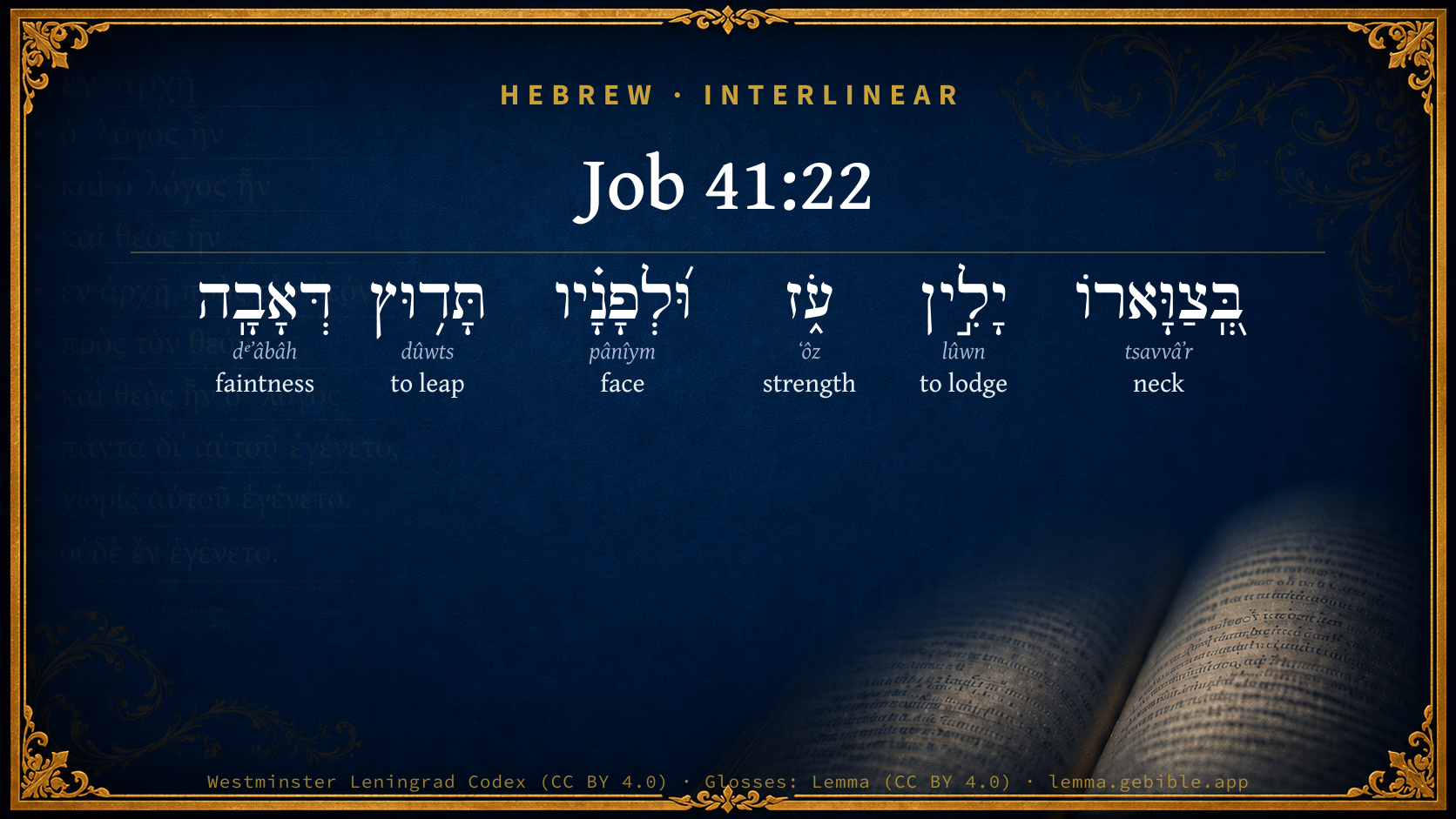
Job 41:22

Hebrew (Westminster Leningrad Codex) Job 41:22 appears in the Hebrew Old Testament. The text above is from the Westminster Leningrad Codex. Each word links to its Strong’s number, a concise gloss, and parsing drawn from the Open Scriptures Hebrew Bible morphology. Click any word for its full Brown-Driver-Briggs (BDB) entry.
Download image
Cite this verse

Job 41:22 (World English Bible). Public Domain. Lemma interlinear Bible study tool, https://lemma.gebible.app/v/job/41/22.

Show BibTeX & RIS
BibTeX
RIS
English Translation
In his neck there is strength. Terror dances before him.
World English Bible · Public Domain
Highlights Full analysis ↓
Download a study sheet

One document with this verse’s original text, its word-by-word gloss line, the meaning frame, cross-references with their text, attributed commentary, and full source and license credits — printable, and it pastes into notes with its structure intact.

This verse Autodidact and up

Study sheet (.html) Plain text (.txt)

A passage Seminary Student

Up to 50 verses in one chapter. A passage sheet keeps up to 6 commentary sources and 12 cross-references per verse, in the order this page ranks them, and says so on the sheet whenever that leaves anything out. Ask for a single verse and you get the Autodidact verse sheet above.

Everything on this page stays free to read, with no account — the sheet is a download of what is already on screen, not access to it.

Want to remove ads? Support Godless Engineer
Compare translations 3

The same verse in 3 English versions, stacked beneath the original-language interlinear above. Click any original word for its lexicon entry.

Each is an independent rendering of the whole verse — the interlinear is not word-aligned to these translations.

Highlighted words mark where these versions differ — a whole-verse word diff, not a word-by-word alignment.

  • World English Bible Public Domain
    In his neck there is strength. Terror dances before him.
  • King James Version Public Domain
    In his neck remaineth strength, and sorrow is turned into joy before him.
  • unfoldingWord Literal Text CC BY-SA 4.0
    Strength lodges in its neck, and fear leaps up to its face.

unfoldingWord Literal Text — © unfoldingWord, licensed CC BY-SA 4.0. Word-aligned USFM3 via Door43 (git.door43.org/unfoldingWord/en_ult).

Versions to compare (up to 4)

3 of 4 selected

Show all 18 translations

Every available English version of this verse, each an independent rendering of the whole verse.

  • World English Bible Public Domain
    In his neck there is strength. Terror dances before him.
  • Berean Standard Bible Public Domain
    Strength resides in his neck, and dismay leaps before him.
  • Majority Standard Bible Public Domain
    Strength resides in his neck, and dismay leaps before him.
  • King James Version Public Domain
    In his neck remaineth strength, and sorrow is turned into joy before him.
  • American Standard Version (1901) Public Domain
    In his neck abideth strength, And terror danceth before him.
  • Revised Version (1885) Public Domain
    In his neck abideth strength, and terror danceth before him.
  • Geneva Bible (1599) Public Domain
    He maketh the depth to boyle like a pot, and maketh the sea like a pot of oyntment.
  • Douay-Rheims (1899) Public Domain
    He shall make the deep sea to boil like a pot, and shall make it as when ointments boil.
  • Young's Literal Translation Public Domain
    In his neck lodge doth strength, And before him doth grief exult.
  • Literal Standard Version CC BY-SA 4.0
    Strength lodges in his neck, || And grief exults before him.
  • Unlocked Literal Bible CC BY-SA 4.0
    In his neck is strength, and terror dances in front of him.
  • unfoldingWord Literal Text CC BY-SA 4.0
    Strength lodges in its neck, and fear leaps up to its face.
  • Darby Bible Public Domain
    In his neck lodgeth strength, and terror danceth before him.
  • World Messianic Bible Public Domain
    There is strength in his neck. Terror dances before him.
  • Webster's Bible Public Domain
    \\41:31\\He maketh the deep to boil like a pot: he maketh the sea like a pot of ointment.
  • Free Bible Version CC BY-SA 4.0
    Its neck is powerful, and all who face him shake with terror.
  • Bible in Basic English Public Domain
    The deep is boiling like a pot of spices, and the sea like a perfume-vessel.
  • JPS Tanakh (1917) Public Domain
    (41-14) In his neck abideth strength, and dismay danceth before him.

Literal Standard Version (2020), Covenant Press — licensed CC BY-SA 4.0. Text via the HelloAO Bible API (eBible.org). Unlocked Literal Bible (unfoldingWord) — licensed CC BY-SA 4.0. Text via the HelloAO Bible API (eBible.org). unfoldingWord Literal Text — © unfoldingWord, licensed CC BY-SA 4.0. Word-aligned USFM3 via Door43 (git.door43.org/unfoldingWord/en_ult). Free Bible Version, Dr. Jonathan Gallagher — licensed CC BY-SA 4.0. Text via the HelloAO Bible API (eBible.org).

Word by word

More ways to search: Search by grammar → Find every occurrence → Compare this word →

Practice this passage: Drill this verse → Learn its vocabulary →

About this verse

These counts appear in no published source. They are computed here, from the morphology-tagged text and Lemma’s own curated glosses. What Lemma adds →

6
words
6
distinct lemmas
Wisdom
section

Notable vocabulary

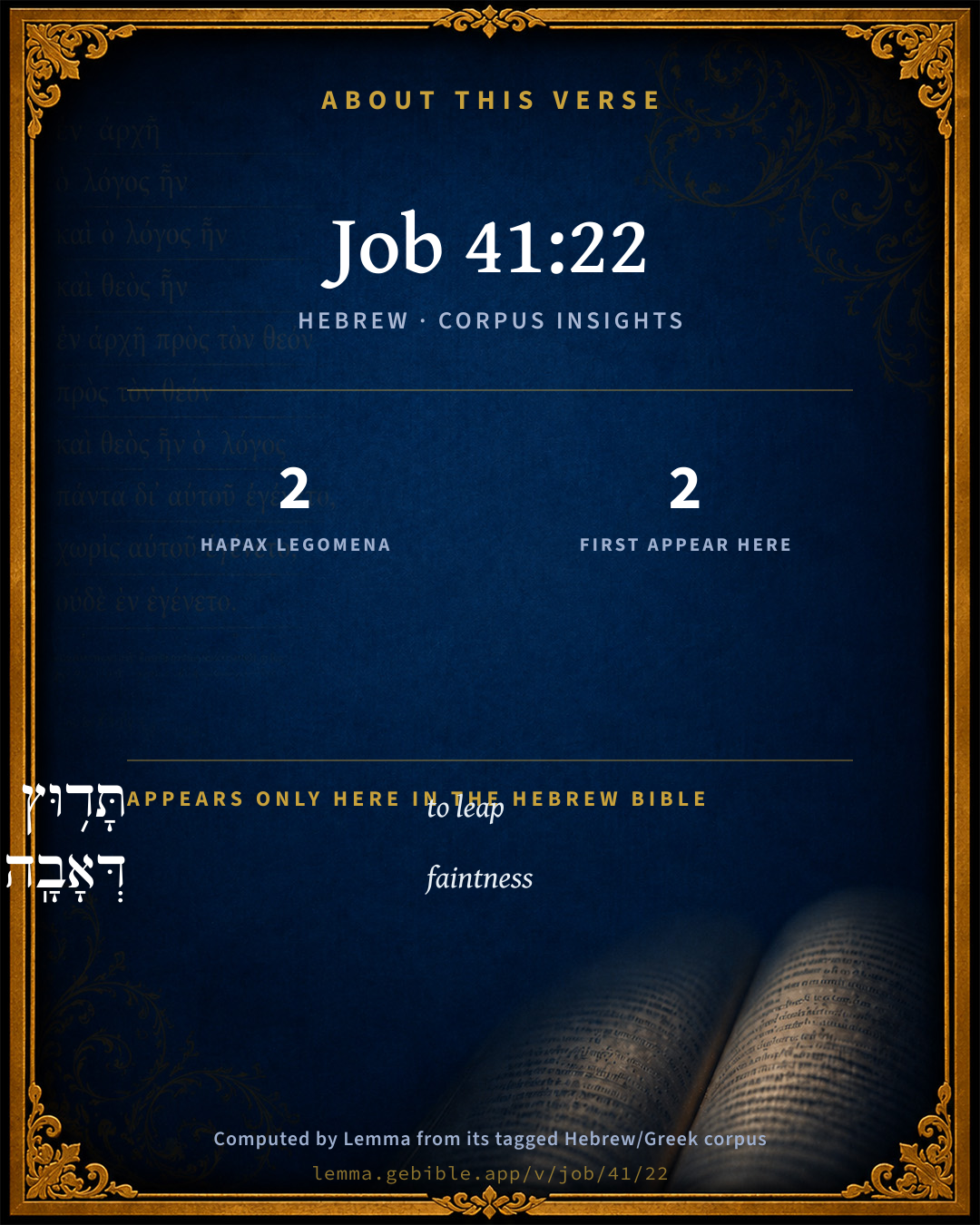
2 hapax legomena — words that appear only here in the entire Hebrew Bible:

  • תָּד֥וּץ to leap H1750
  • דְּאָבָֽה faintness H1670

First appearance in Scripture

These words make their first canonical appearance in the Hebrew Bible here:

  • תָּד֥וּץ to leap H1750
  • דְּאָבָֽה faintness H1670

Shared distinctive vocabulary

בְּֽ֭צַוָּארוֹ neck H6677 occurs in 38 verses of the Hebrew Bible. Also found in:

Grammatical profile

  • 2 verbs
  • 4 nouns

Verb forms

  • יָלִ֣ין Qal · Imperfect
  • תָּד֥וּץ Qal · Imperfect

Hebrew & Septuagint length

In English translation the verse runs 10 words from the Hebrew and 19 from the Septuagint (LXX English) — the Septuagint runs noticeably longer here. See the side-by-side →

A rough comparison of the two English renderings, which tokenize alike — not a word-level alignment.

Word counts can differ between the Hebrew and the Greek without any difference in meaning — e.g. the Hebrew direct-object marker אֵת has no separate Greek word, and Greek often adds the article ὁ.

Cross-references

4

Topical passages linked to Job 41:22 in the Treasury of Scripture Knowledge — connected by theme and wording, ordered by reader-vote popularity; previews shown in the World English Bible.

  • Job 39:19 "Have you given the horse might? Have you clothed his neck with a quivering mane?
  • Job 40:16 Look now, his strength is in his loins, His force is in the muscles of his belly.
  • Hosea 13:14 I will ransom them from the power of Sheol. I will redeem them from death! Death, where are your plagues? Sheol, where is your destruction? Compassion will be hidden from my eyes.
  • 1 Corinthians 15:55–57 "Death, where is your sting? Hades, where is your victory?"

Cross-references courtesy of OpenBible.info (CC BY 4.0).

Hebrew and Greek witnesses Masoretic Hebrew ↔ Greek Septuagint

The same verse in the two great witnesses to the Old Testament, shown verse-for-verse.

Here the Septuagint runs noticeably longer than the Hebrew — LXX2012 (modern English Septuagint) 19 words vs World English Bible 10. A rough length comparison of the two English translations, not a word-level alignment — read both below.

These are two independent witnesses, not word-aligned to each other, and the Septuagint is shown in lemma (dictionary) form.

Hebrew Job 41:22 Masoretic · Westminster Leningrad Codex

בְּֽ֭צַוָּארוֹ יָלִ֣ין עֹ֑ז וּ֝לְפָנָ֗יו תָּד֥וּץ דְּאָבָֽה

In his neck there is strength. Terror dances before him.

World English Bible · Public Domain

Greek LXX Job 41:22 Septuagint · lemma form

ὁ στρωμνή αὐτός ὀβελίσκος ὀξύς πᾶς δέ χρυσός θάλασσα ὑπό αὐτός ὥσπερ πηλός ἀμύθητος

He makes the deep boil like a brazen caldron; and he regards the sea as a pot of ointment,

LXX2012 (modern English Septuagint) · Public Domain

On this verse, Haydock's Catholic Bible Commentary discusses the Septuagint’s reading. Read the note in Commentary ↓

Hebrew: Westminster Leningrad Codex (CC BY 4.0). Greek: Septuagint (public domain); English from LXX2012 (modern English Septuagint) (Public Domain). How the Septuagint differs from the Hebrew →

Commentary

Notes on Job 41:22 from classic Christian and Jewish commentators (each source and its license shown beneath its notes). The classic Christian expositions comment on the surrounding passage and are grouped to its opening verse, so a note may address several verses; the Jewish commentaries on the Tanakh (Rashi and others) are per-verse, so they appear only where the commentator wrote on this verse.

Lemma curates 59 commentaries, every one of them public domain or Creative Commons licensed, each selected and text-cleaned for this edition rather than reprinted as found. About our sources →

Trapp's Complete Commentary

John Trapp

Job 41:22 In his neck remaineth strength, and sorrow is turned into joy before him.

Ver. 22. In his neck remaineth strength] Aristotle saith, that among fishes the dolphin, whale, and such as breathe, have necks proportionate to their bodies. The word rendered remaineth is in the Hebrew lodgeth, or abideth all night; so spoken, saith one, because the whale, as also the dolphin, sleepeth with his head erected above water.

And sorrow is turned into joy before him] i.e. He knows no sorrows, he fears no hurt, but always rejoiceth, bearing himself bold upon his strength, God having made him to sport in the sea, Psa 104:26. Others read it, And before him danceth fear ( Pavor et Pallor, Tullus Hostilius’s two gods); men dance, or start for fear.

John Trapp, A Commentary or Exposition upon All the Books of the Old and New Testament (1647–1656) — public domain. Text from a community e-Sword module.

Joseph Benson's Commentary

Job 41:22-24. In his neck remaineth strength, &c. — Houbigant’s translation of this is excellent; Strength has its dwelling (so ילין עז, jalin gnoz, literally signifies) on his neck — His head and body are firmly joined together, and therefore what may be called his neck is exceeding strong. This is equally applicable to the whale and the crocodile, neither of which has any more neck than other fishes have. And sorrow is turned into joy before him — The approach of any enemy, which usually causeth fear and sorrow in others, fills him with joy, as being desirous of nothing more than fighting. Or, as the Hebrew may be rendered, sorrow rejoices, or dances, or triumphs, &c., that is, is prevalent and victorious; and quickly invades and conquers all those men, or other creatures, which are in his way. Sorrow is his companion, or harbinger, which attends upon him wheresoever he goes. So anger and fear are said by the poets to accompany the god of war into the battle. Houbigant translates the clause, Before him marches destruction; he makes terrible work wherever he comes. The flakes of his flesh are joined together — Or, the parts of his flesh which stick out, or hang loose, and are ready to fall from other fishes, or creatures. The word flesh is sometimes used of fishes also, as Lev 11:11; 1Co 15:39. They cannot be moved — Without difficulty, namely, out of their place, or from the other members of the body. His heart is as hard as a stone — His courage is invincible; he is void of fear for himself, and of compassion for others, which is often termed, hardness of heart. As hard as a piece of the nether millstone — Which being to bear the weight of the upper, ought to be the harder and stronger of the two. On these last three verses also, Dr. Young’s paraphrase is worthy of the reader’s attention:

“Strength on his ample shoulder sits in state;

His well-join’d limbs are dreadfully complete;

His flakes of solid flesh are slow to part;

As steel his nerves, as adamant his heart.”

Joseph Benson's Commentary on the Old and New Testaments (1811–1818) — public domain. Text from a community e-Sword module.

Geneva Bible (1599)

Geneva Bible translators

Either he maketh the sea to seem as it boiled by his wallowing, or else he spouteth water in such abundance as it would seem that the sea boiled.

Geneva Bible (1599) marginal notes — public domain. Text via Bolls.life.

Jamieson, Fausset & Brown

Robert Jamieson, A. R. Fausset & David Brown

remaineth--abideth permanently. His chief strength is in the neck.

sorrow--anxiety or dismay personified.

is turned into joy--rather, "danceth," "exulteth"; wherever he goes, he spreads terror "before him."

Jamieson, Fausset & Brown — Commentary Critical and Explanatory on the Whole Bible (1871) — public domain (CC PDM 1.0). Text via the HelloAO Bible API.

Adam Clarke's Commentary

Verse 22. In his neck remaineth strength] Literally, "strength has its dwelling in his neck." The neck is the seat of strength of most animals; but the head and shoulders must be here meant, as the crocodile has no neck, being shaped nearly like a lizard.

And sorrow is turned into joy before him.] ולפניו תדוץ דאבה ulephanaiv taduts deabah; "And destruction exulteth before him." This is as fine an image as can well be conceived. It is in the true spirit of poetry, the legitimate offspring of the genie createur. Our translation is simply insignificant.

Adam Clarke's Commentary on the Bible (1810–1826) — public domain. Text from a community e-Sword/MySword module.

Ellicott's Commentary for English Readers

(22) Sorrow is turned into joy before him.—Literally, and before him danceth fear, or pining sorrow exulteth before him. A marvellous personification of the terror which goes with him wherever he goes.

A Bible Commentary for English Readers, edited by Charles John Ellicott (1878–1897) — public domain. Text from a community e-Sword module.

The Cambridge Bible for Schools and Colleges

gen. ed. J. J. S. Perowne

22. The verse means,

In his neck dwelleth strength,

And terror leapeth up before him.

His neck is the dwelling-place, the home of strength; and wherever he appears terror leaps up. The prosaic meaning in the last words is that in the presence of Leviathan every thing starts up affrighted and seeks escape.

22–24. His strength and hardness of muscle.

The Cambridge Bible for Schools and Colleges (gen. ed. J. J. S. Perowne; Cambridge University Press, 1878–1918) — public domain. Text from a community e-Sword module.

John Gill's Exposition

The flakes of his flesh are joined together,.... The muscles of his hefty are not flaccid and flabby, but solid and firmly compacted;

they are firm in themselves; they cannot be moved; that is, not very easily, not without a large sharp cutting knife, and that used with much strength.

John Gill's Exposition of the Whole Bible (1746–1763) — public domain (CC PDM 1.0). Text via the HelloAO Bible API.

Albert Barnes' Notes on the Bible

In his neck remaineth strength - That is, strength is “permanently residing” there. It is not assumed for the moment, but his neck is so constructed as to be the abode of strength. The word here rendered “remaineth” (ילין yālı̂yn), means properly to pass the night; then to abide or dwell; and there is a designed contrast here with what is said of “sorrow” in this verse. This description of strength residing in the neck, agrees well with the crocodile; see the figure of the animal on p. 255. It is not easy, however, to see how this is applicable to the whale, as Prof. Lee supposes. The whale is endowed, indeed, with great strength, as Prof. Lee has shown, but that strength is manifested mainly by the stroke of the tail.

And sorrow is turned into joy before him - Margin, “rejoiceth.” The proper meaning of the word used here (תדוץ tādûts) is “to dance, to leap, to skip;” and the sense is, that “terror dances before him.” It does not refer to the motion of the animal, as if he were brisk and rapid. but it is a poetic expression, as if terror played or pranced along wherever he came. Strength “resided” in his neck, but his approach made terror and alarm play before him wherever he went; that is, produced terror and dread. In his neck is permanent, calm strength; before him, everything trembles and is agitated. The beauty of the passage lies in this contrast between the strength and firmness which repose calmly in the neck of the animal, and the consternation which he everywhere produces, causing all to tremble as he approaches. Bochart has well illustrated this from the Classical writers.

Albert Barnes' Notes on the Bible (1834–1885) — public domain. Text from a community e-Sword/MySword module.

Haydock's Catholic Bible Commentary

When. Hebrew, "a pot of ointment." This boils out very much. (Calmet) --- The flesh of the crocodile has also the smell of musk; (Bochart) and Peter Martyr asserts, that Columbus found some in America, which plunged into the water, and left behind them the odour of musk or castor. When they are wounded, they give the same perfume to the sea, or rather to the waters, where they abide. The Hebrews style all deep rives and lakes, seas. (Calmet) --- Crocodiles were kept in the lake Mœris, being adored and honoured as gods. (Herodotus ii. 69.) --- Septuagint, "He deems the sea as a vase of ointment; (23) and the Tartarus of the abyss, like a prisoner." Theodotion adds, "He hath considered the abyss as a walk."

George Leo Haydock (1774–1849), Haydock's Catholic Family Bible and Commentary, 1859 edition — public domain. Excludes Psalms (Douay-Rheims chapter numbering differs from Protestant) and Deuterocanonical books (Catholic canon only).

Matthew Poole's English Annotations

His neck is exceeding strong. This is meant either

1. Of the whale, who though he hath no neck no more than other fishes have, yet he hath a part in some sort answerable to it, where the head and body are joined together. Or,

2. Of the crocodile, whom Aristotle, (who made it his business to search out the several natures and parts of all living creatures, and had all the helps and advantages which he desired to find them out,) and Scaliger, and others affirm to have a neck, though some deny it.

Sorrow is turned into joy before him, i.e. the approach of any enemy, which usually causeth fear and sorrow in others, fills him with joy, as being desirous of nothing more than fighting. Or, sorrow rejoiceth, or danceth, or triumpheth, &c., i.e. is prevalent and victorious, and quickly invades and conquers all those men, or other creatures, which are in his way. Sorrow is his companion or harbinger, which attends upon him wheresoever he goes. This may be a poetical expression, like that of the poets, when they bring in anger and fear going along with or before Mars into the battle.

Matthew Poole's English Annotations on the Holy Bible (1683–1685) — public domain. Text from a community e-Sword/MySword module.

Whedon's Commentary on the Bible

Daniel D. Whedon

22. Remaineth — Literally, pass the night, same as in Job_19:4. A literal rendering brings out the personification: —

In his neck lodgeth strength;

Before him runneth terror.

His neck at night is the resting place of strength; terror is his avant-courier by day; “terror bounds before him.” — Renan.

Is turned into joy before him — The Septuagint gives better sense, as it more correctly interprets the original — runs before him. The word דוצ, douts, means “to jump,” “to leap,” and in the Targum is used for “rejoicing,” “leaping for joy:” a sense our translators have entered in the margin. The Arabic name for the Sphinx is “father of terror.”

Daniel D. Whedon (gen. ed.), Commentary on the Old and New Testaments (1874–1909) — public domain. Text from a community e-Sword module.

The Pulpit Commentary

In his neck remaineth strength. It has been well remarked that the whale has no neck, or at any rate none that is visible, while the crocodile has one that is of great strength, and that naturally attracts observation. "Le cou assez marque," says the "Dictionnaire des Sciences" (l.s.c.). It is nearly of the same diameter with the head at the point of junction, and where it adjoins the body is still larger. And sorrow is turned into joy before him; rather, and terror rid"seth before him (see the Revised Version). Whithersoever he proceeds, he causes terror; people tremble, take to flight, and disappear.

The Pulpit Commentary (1880–1919), ed. H.D.M. Spence-Jones & Joseph S. Exell — public domain. Text from a community e-Sword module.

John Wesley's Explanatory Notes

And sorrow - Sorrow is his companion and harbinger, which attends upon him wheresoever he goes. So anger and fear are said by the poets to accompany the God of war.

John Wesley, Explanatory Notes Upon the Whole Bible (1754–1765) — public domain. Text via the GEBible commentary corpus.

Keil & Delitzsch

C. F. Keil & F. Delitzsch

22 Great strength resteth upon his neck,

And despair danceth hence before him.

23 The flanks of his flesh are thickly set,

Fitting tightly to him, immoveable.

24 His heart is firm like stone,

And firm like the nether millstone.

25 The mighty are afraid of his rising up;

From alarm they miss their aim.

Overpowering strength lodges on its neck, i.e., has its abiding place there, and before it despair, prop. melting away, dissolution (דּאבה from דּאב, Arab. ḏ'b = דּוּב Hiph., Arab. ḍ'b II, to bring into a loose condition, synon. חמס), dances hence, i.e., spring up and away (ידוּץ, Arab. jadisu, to run away), i.e., it spreads before it a despondency which produces terror, and deprives of strength. Even the pendulous fleshy parts (מפּלי), especially of its belly, hang close together, דבקוּ, i.e., they are not flabby, but fit to it, like a metal casting, without moving, for the skin is very thick and covered with thick scales; and because the digestive apparatus of the animal occupies but little space, and the scales of the back are continued towards the belly, the tender parts appear smaller, narrower, and closer together than in other animals. יצוּק here is not, as Job 27:2; Job 29:6, the fut. of צוּק, but the part. of יצק, as also Job 41:24: its heart is firm and obdurate, as though it were of cast brass, hard as stone, and in fact as the nether millstone (פלח from פלח, falacha, to split, crush in pieces), which, because it has to bear the weight and friction of the upper, must be particularly hard. It is not intended of actual stone-like hardness, but only of its indomitable spirit and great tenacity of life: the activity of its heart is not so easily disturbed, and even fatal wounds do not so quickly bring it to a stand. משּׂמו from שׂת = שׂאת = שׂאת), primary form שׂאתּ, is better understood in the active sense: afraid of its rising, than the passive: of its exaltedness. אילים (according to another reading אלים) is not, with Ew., to be derived from איל (Arab. ı̂jal), a ram; but אילים Exo 15:15; Eze 17:13 (comp. גּירים Ch2 2:16, נירי Sa2 22:29), אלים Eze 31:11; Eze 32:21, and אוּלים Cheth. Kg2 24:15, are only alternating forms and modes of writing of the participial adject., derived from אוּל (איל) first of all in the primary form awil (as גּר = gawir). The signif. assigned to the verb אול: to be thick = fleshy, which is said then to go over into the signif. to be stupid and strong (Ges. Handwrterb.), rests upon a misconception: âla is said of fluids "to become thick," because they are condensed, since they go back, i.e., sink in or settle (Ges. correctly in Thes.: notio crassitiei a retrocendendo). The verb âla, ja'ûlu, unites in itself the significations to go backward, to be forward, and to rule; the last two: anteriorem and superiorem esse, probably belong together, and אל signifies, therefore, a possessor of power, who is before and over others. התחטּא, Job 41:25, has the signif., which does not otherwise occur, to miss the mark (from חטא, Arab. chaṭiya, to miss, opp. Arab. ṣâb, to hit the mark), viz., (which is most natural where אילים is the subject spoken of) since they had designed the slaughter and capture of the monster. שׁברים is intended subjectively, as תּבירא = פּחד Exo 15:16, Targ. II, and also as the Arab. thubûr, employed more in reference to the mind, can be used of pain.

Keil & Delitzsch — Biblical Commentary on the Old Testament (1861–1891) — public domain (CC PDM 1.0). Text via the HelloAO Bible API. (Old Testament only.)

unfoldingWord translationNotes

Door43 World Missions Community

his ... him

The words "his" and "him" refer to Leviathan.

terror dances in front of him

The abstract noun "terror" can be translated as the verb "be afraid." AT: "when people see him coming, they are very afraid" (See: Abstract Nouns)

they cannot be moved

This can be translated in active form. AT: "no one can move them" (See: Active or Passive)

His heart is as hard as a stone

A rock or stone does not change and become soft. Possible meanings are 1) Leviathan's physical chest and the organs inside it are physically hard or 2) Leviathan is not afraid of anything or 3) Leviathan is spoken of as a person who kills without ever being sorry. (See: Simile and Personification)

a lower millstone

"the hardest of rocks." The lower millstone is the larger and harder of the two rocks used to grind grain. It would be the hardest rock people could find.

translationWords

terror

flesh

heart

unfoldingWord translationNotes — © Distant Shores Media and the Door43 World Missions Community, licensed CC BY-SA 4.0. Source: git.door43.org/Door43/en_tn.

Rashi

Rabbi Shlomo Yitzchaki (Rashi)

Under him are rays of the sun in the place he rests, there are rays of the sun, because his fins, which are under him on his belly, illuminate and shine like the sun.

rays Heb. חדודי, like a sharp sword, which is sharpened, bright, and whitened. Because of this, he calls rays חַדוּדֵי.

sun Heb. חרשׂ, the sun, like (above 9:7), “He who spoke to the sun (לחרס) and it did not shine”; (Jud. 14:18); “before the sun (החרסה) set. “

where he lies is gold upon the mire This is a repeated clause. “Where he lies is gold,” refers to “rays of the sun”; “upon the mire” refers to “under him,” in the place where he is on the sand; this is the mire where he lies. It shines like precious gold, as it is stated (Song 3:10): “its couch of gold.” חָרוּץ is a type of gold, as it is stated (Prov. 8:19): “My fruit is better than gold (מחרוץ), yea than fine gold.” Where he lies—an expression of a couch for lying down, like (Song 3:10), “its couch (רפידתו) of gold.”

Rashi on the Tanakh — English translations: “The Judaica Press complete Tanach with Rashi, translated by A. J. Rosenberg” (CC BY 4.0); “Pentateuch with Rashi's commentary by M. Rosenbaum and A.M. Silbermann, 1929-1934” (public domain); “The Metsudah Tanach series, Lakewood, N.J” (CC BY 4.0); and “The Book of Joshua, Metsudah Publications, 1997” (CC BY 4.0). Text via Sefaria.

Lesson kit

Teaching starters — assembled from the data on this page, not authored interpretation. Every prompt links to the verse data it draws on. Edit before teaching.

Job, in the Wisdom, opens this verse with 6 words (6 distinct Hebrew lemmas). Its most distinctive word is dûwts (“to leap”). The Greek Septuagint runs longer here. A historical commentator’s framing appears above. Read the whole chapter for the surrounding context.

Discussion questions

  1. The word dûwts carries the sense “to leap.” How does it shape the verse?
  2. This verse holds 2 words here found nowhere else in the Hebrew Bible. What might the rare words draw attention to?
  3. 2 words here appear for the first time in Scripture. What is being introduced at this debut?
  4. Genesis 27:16 shares the word «neck» with this verse. How do the two illuminate each other?
  5. Compared with the Hebrew, the Septuagint runs longer here. What questions does that raise?
  6. These translations render this verse differently. What is at stake in choosing one wording over another?
  7. The verb «יָלִ֣ין» is Qal Imperfect. How does its form color the action?
  8. Reading how Trapp's Complete Commentary and Joseph Benson's Commentary read this verse, where do the two commentators agree and where do they part?

Things to notice

  • 2 words in this verse appear nowhere else in the Hebrew Bible.
  • 2 words make their first canonical appearance in Scripture here.
  • These translations choose different wording for 15 words in this verse.
  • 6 distinct Hebrew lemmas span 6 words in this verse.

Reading settings

Reading text

Shown beneath each verse's original-language words.

Old Testament
Old Testament edition

Read the OT as the Masoretic Hebrew (MT) or the Greek Septuagint (LXX).

English shown for the Greek Septuagint (in the Hebrew ↔ Greek comparison).

Comparing translations? Open the Compare panel on any verse page to stack up to four side by side.