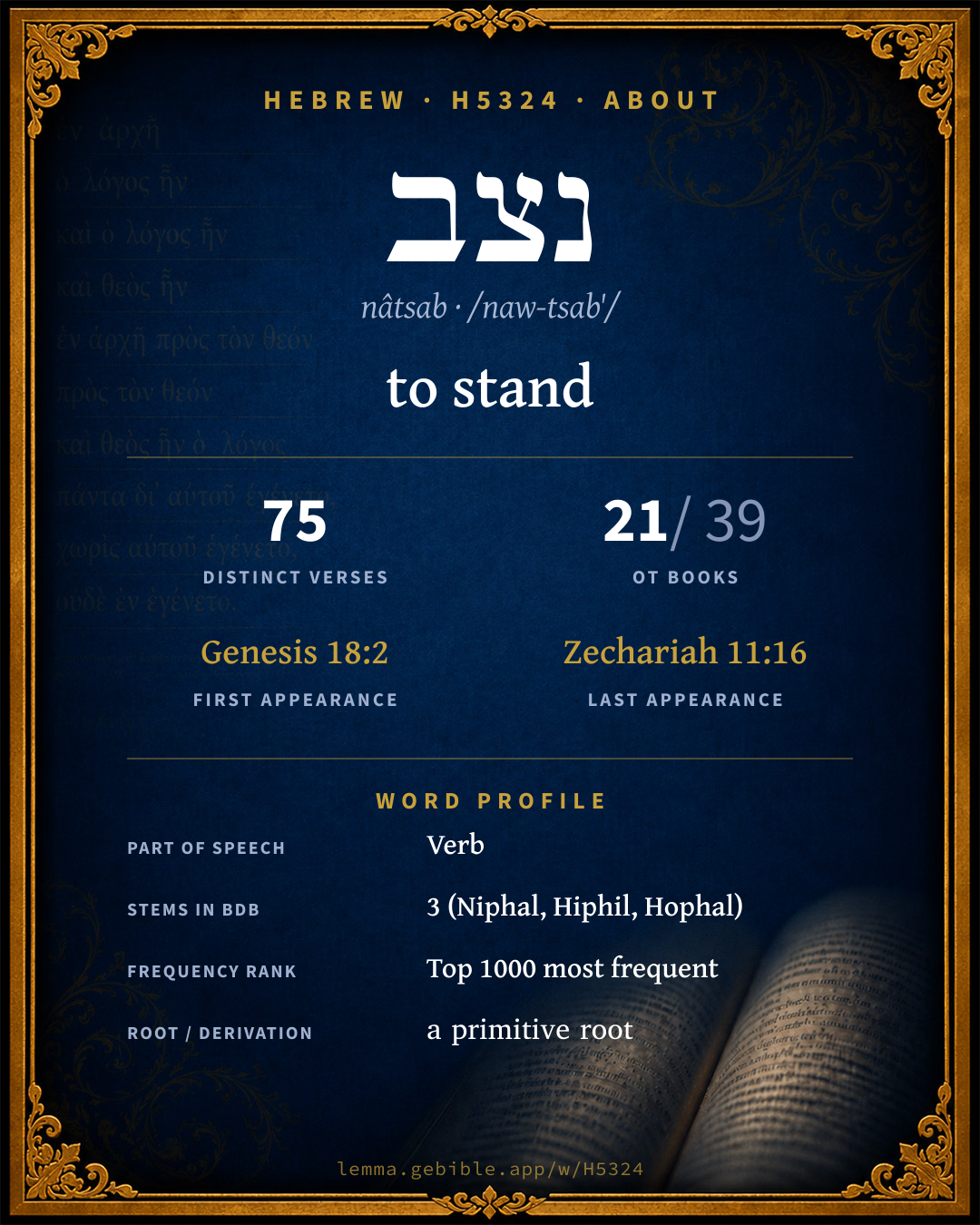
נָצַב
to stand
also: take one's stand, stand upright, be set, establish fuller range ↓
Full lexicon entry — Brown-Driver-Briggs (BDB)
From Brown-Driver-Briggs (BDB)
Where this word appears
See every Niphal verb in the Hebrew Bible →
Grammar key — what these labels mean
Part of speech
- Verb
- An action or state-of-being word.
Stem
- Niphal
- Usually the simple passive or reflexive of the Qal (“he was written”). Here: ‘station oneself’
- Hiphil
- The causative active stem (“he caused / brought about”). Here: ‘station’
- Hophal
- The passive counterpart of the Hiphil (“he was caused to…”).
Form
- Participle Active
- A verbal adjective expressing ongoing or characteristic action (“writing / one who writes”).
- Sequential Imperfect
- An imperfect with prefixed waw — the standard past-narrative form (waw-consecutive imperfect).
- Perfect
- A completed action or state — Hebrew marks aspect (completeness) more than strict tense (“he wrote”).
- Sequential Perfect
- A perfect with prefixed waw continuing a preceding imperfect or command (waw-consecutive perfect).
- Participle Passive
- A verbal adjective expressing action received (“written”).
- Imperfect
- An incomplete, ongoing, or future action (“he will / would write”).
- Infinitive Construct
- A bound verbal noun, frequently with prepositions (“to write / in writing”).
- Imperative
- A direct command (“write!”).
State
- Absolute
- The independent form of a noun, not bound to a following word.
Person
- 3rd Person
- The one spoken about (“he / she / it / they”).
- 2nd Person
- The one addressed (“you”).
Gender
- Masculine
- Grammatically masculine.
- Feminine
- Grammatically feminine.
- Common
- Either gender — not distinguished for this form.
Number
- Singular
- One.
- Plural
- More than one (in Hebrew, generally three or more).
51 distinct verses where H5324 appears in the Niphal stem, across 16 books. Filtered view — show all forms. Click any verse to open its interlinear word-by-word view. Verse text shown in the World English Bible for context — . Each verse’s Hebrew form is shown with its reference; the English is not keyword-highlighted, since the data carries no word-level English alignment. Use “Compare translations” on any verse to read it across multiple English versions. This concordance covers the Hebrew Bible; Septuagint (Greek Old Testament) occurrences are not indexed here.
Genesis 6 verses
- Genesis 18:2 נִצָּבִ֖ים Niphal ptcp.act mp He lifted up his eyes and looked, and saw that three men stood opposite him. When he saw them, he ran to meet them from the tent door, and bowed himself to the earth,
- Genesis 24:13 נִצָּ֖ב Niphal ptcp.act ms Behold, I am standing by the spring of water. The daughters of the men of the city are coming out to draw water.
- Genesis 24:43 נִצָּ֖ב Niphal ptcp.act ms Behold, I am standing by the spring of water. Let it happen, that the maiden who comes forth to draw, to whom I will say, Give me, I pray you, a little water from your pitcher to drink.
- Genesis 28:13 נִצָּ֣ב Niphal ptcp.act ms Behold, Yahweh stood above it, and said, "I am Yahweh, the God of Abraham your father, and the God of Isaac. The land whereon you lie, to you will I give it, and to your seed.
- Genesis 37:7 נִצָּ֑בָה Niphal pf 3fs for, behold, we were binding sheaves in the field, and behold, my sheaf arose and also stood upright; and behold, your sheaves came around, and bowed down to my sheaf."
- Genesis 45:1 הַ/נִּצָּבִים֙ ptcl def.art + Niphal ptcp.act mp Then Joseph couldn't control himself before all those who stood before him, and he cried, "Cause every man to go out from me!" There stood no man with him, while Joseph made himself known to his brothers.
Exodus 8 verses
- Exodus 5:20 נִצָּבִ֖ים Niphal ptcp.act mp They met Moses and Aaron, who stood in the way, as they came forth from Pharaoh:
- Exodus 7:15 וְ/נִצַּבְתָּ֥ conj + Niphal wpf 2ms Go to Pharaoh in the morning. Behold, he goes out to the water; and you shall stand by the river's bank to meet him; and the rod which was turned to a serpent you shall take in your hand.
- Exodus 15:8 נִצְּב֥וּ Niphal pf 3cp With the blast of your nostrils the waters were piled up. The floods stood upright as a heap. The deeps were congealed in the heart of the sea.
- Exodus 17:9 נִצָּב֙ Niphal ptcp.act ms Moses said to Joshua, "Choose men for us, and go out, fight with Amalek. Tomorrow I will stand on the top of the hill with God's rod in my hand."
- Exodus 18:14 נִצָּ֥ב Niphal ptcp.act ms When Moses' father-in-law saw all that he did to the people, he said, "What is this thing that you do for the people? Why do you sit alone, and all the people stand around you from morning to evening?"
- Exodus 33:8 וְ/נִ֨צְּב֔וּ conj + Niphal wpf 3cp It happened that when Moses went out to the Tent, that all the people rose up, and stood, everyone at their tent door, and watched Moses, until he had gone into the Tent.
- Exodus 33:21 וְ/נִצַּבְתָּ֖ conj + Niphal wpf 2ms Yahweh also said, "Behold, there is a place by me, and you shall stand on the rock.
- Exodus 34:2 וְ/נִצַּבְתָּ֥ conj + Niphal pf 2ms Be ready by the morning, and come up in the morning to Mount Sinai, and present yourself there to me on the top of the mountain.
Numbers 6 verses
- Numbers 16:27 נִצָּבִ֗ים Niphal ptcp.act mp So they got them up from the tent of Korah, Dathan, and Abiram, on every side: and Dathan and Abiram came out, and stood at the door of their tents, and their wives, and their sons, and their little ones.
- Numbers 22:23 נִצָּ֣ב Niphal ptcp.act ms The donkey saw the angel of Yahweh standing in the way, with his sword drawn in his hand; and the donkey turned aside out of the way, and went into the field: and Balaam struck the donkey, to turn her into the way.
- Numbers 22:31 נִצָּ֣ב Niphal ptcp.act ms Then Yahweh opened the eyes of Balaam, and he saw the angel of Yahweh standing in the way, with his sword drawn in his hand; and he bowed his head, and fell on his face.
- Numbers 22:34 נִצָּ֥ב Niphal ptcp.act ms Balaam said to the angel of Yahweh, I have sinned; for I didn't know that you stood in the way against me: now therefore, if it displease you, I will get me back again.
- Numbers 23:6 נִצָּ֖ב Niphal ptcp.act ms He returned to him, and, behold, he was standing by his burnt-offering, he, and all the princes of Moab.
- Numbers 23:17 נִצָּב֙ Niphal ptcp.act ms He came to him, and, behold, he was standing by his burnt offering, and the princes of Moab with him. Balak said to him, What has Yahweh spoken?
Deuteronomy 1 verse
Judges 2 verses
- Judges 18:16 נִצָּבִ֖ים Niphal ptcp.act mp The six hundred men girt with their weapons of war, who were of the children of Dan, stood by the entrance of the gate.
- Judges 18:17 נִצָּב֙ Niphal ptcp.act ms The five men who went to spy out the land went up, and came in there, and took the engraved image, and the ephod, and the teraphim, and the molten image: and the priest stood by the entrance of the gate with the six hundred men girt with weapons of war.
Ruth 2 verses
- Ruth 2:5 הַ/נִּצָּ֖ב ptcl def.art + Niphal ptcp.act ms Then said Boaz to his servant who was set over the reapers, Whose young lady is this?
- Ruth 2:6 הַ/נִּצָּ֥ב ptcl def.art + Niphal ptcp.act ms The servant who was set over the reapers answered, It is the Moabite lady who came back with Naomi out of the country of Moab:
1 Samuel 7 verses
- 1 Samuel 1:26 הַ/נִּצֶּ֤בֶת ptcl def.art + Niphal ptcp.act fs She said, Oh, my lord, as your soul lives, my lord, I am the woman who stood by you here, praying to Yahweh.
- 1 Samuel 4:20 הַ/נִּצָּב֣וֹת ptcl def.art + Niphal ptcp.act fp About the time of her death the women who stood by her said to her, Don't be afraid; for you have brought forth a son. But she didn't answer, neither did she regard it.
- 1 Samuel 19:20 נִצָּ֖ב Niphal ptcp.act ms Saul sent messengers to take David: and when they saw the company of the prophets prophesying, and Samuel standing as head over them, the Spirit of God came on the messengers of Saul, and they also prophesied.
- 1 Samuel 22:6 נִצָּבִ֥ים Niphal ptcp.act mp Saul heard that David was discovered, and the men who were with him: now Saul was sitting in Gibeah, under the tamarisk tree in Ramah, with his spear in his hand, and all his servants were standing about him.
- 1 Samuel 22:7 הַ/נִּצָּבִ֣ים ptcl def.art + Niphal ptcp.act mp Saul said to his servants who stood about him, Hear now, you Benjamites; will the son of Jesse give everyone of you fields and vineyards, will he make you all captains of thousands and captains of hundreds,
- 1 Samuel 22:9 נִצָּ֥ב Niphal ptcp.act ms Then answered Doeg the Edomite, who stood by the servants of Saul, and said, I saw the son of Jesse coming to Nob, to Ahimelech the son of Ahitub.
- 1 Samuel 22:17 הַ/נִּצָּבִ֨ים ptcl def.art + Niphal ptcp.act mp The king said to the guard who stood about him, Turn, and kill the priests of Yahweh; because their hand also is with David, and because they knew that he fled, and didn't disclose it to me. But the servants of the king wouldn't put forth their hand to fall on the priests of Yahweh.
2 Samuel 1 verse
1 Kings 6 verses
- 1 Kings 4:5 הַ/נִּצָּבִ֑ים ptcl def.art + Niphal ptcp.act mp and Azariah the son of Nathan was over the officers; and Zabud the son of Nathan was chief minister, [and] the king's friend;
- 1 Kings 4:7 נִצָּבִים֙ Niphal ptcp.act mp Solomon had twelve officers over all Israel, who provided food for the king and his household: each man had to make provision for a month in the year.
- 1 Kings 4:27 הַ/נִּצָּבִ֨ים ptcl def.art + Niphal ptcp.act mp Those officers provided food for king Solomon, and for all who came to king Solomon's table, every man in his month; they let nothing be lacking.
- 1 Kings 5:16 הַ/נִּצָּבִ֤ים ptcl def.art + Niphal ptcp.act mp besides Solomon's chief officers who were over the work, three thousand and three hundred, who bore rule over the people who labored in the work.
- 1 Kings 9:23 הַ/נִּצָּבִ֗ים ptcl def.art + Niphal ptcp.act mp These were the chief officers who were over Solomon's work, five hundred fifty, who bore rule over the people who labored in the work.
- 1 Kings 22:47 נִצָּ֥ב Niphal ptcp.act ms There was no king in Edom: a deputy was king.
2 Chronicles 1 verse
Psalms 4 verses
- Psalms 39:5 נִצָּ֥ב Niphal ptcp.act ms Behold, you have made my days handbreadths. My lifetime is as nothing before you. Surely every man stands as a breath." Selah.
- Psalms 45:9 נִצְּבָ֥ה Niphal pf 3fs Kings' daughters are among your honorable women. At your right hand the queen stands in gold of Ophir.
- Psalms 82:1 נִצָּ֥ב Niphal ptcp.act ms God presides in the great assembly. He judges among the gods.
- Psalms 119:89 נִצָּ֥ב Niphal ptcp.act ms Yahweh, your word is settled in heaven forever.
Proverbs 1 verse
Isaiah 2 verses
Lamentations 1 verse
Amos 2 verses
- Amos 7:7 נִצָּ֖ב Niphal ptcp.act ms Thus he showed me and, behold, the Lord stood beside a wall made by a plumb line, with a plumb line in his hand.
- Amos 9:1 נִצָּ֣ב Niphal ptcp.act ms I saw the Lord standing beside the altar, and he said, "Strike the tops of the pillars, that the thresholds may shake; and break them in pieces on the head of all of them; and I will kill the last of them with the sword: there shall not one of them flee away, and there shall not one of them escape.
Zechariah 1 verse
About this entry
At a glance — auto-summarized from this page’s data, not written by a person. Every figure links to its source below. This summary describes the numbers; it doesn’t interpret them.
“to stand” is the headline sense of the Hebrew verb נצב (nâtsab). Translators differ — “stood” in the King James Version, then “standing” (Berean Standard Bible), as the renderings breakdown shows. With 75 verses in 21 books, it is a moderately common word in the Hebrew Bible. First canonically at Genesis 18:2, it enters the text early. Across 3 stems, its meaning turns on the binyan (Niphal, Hiphil). The sections below give every sense, occurrence, and version rendering.
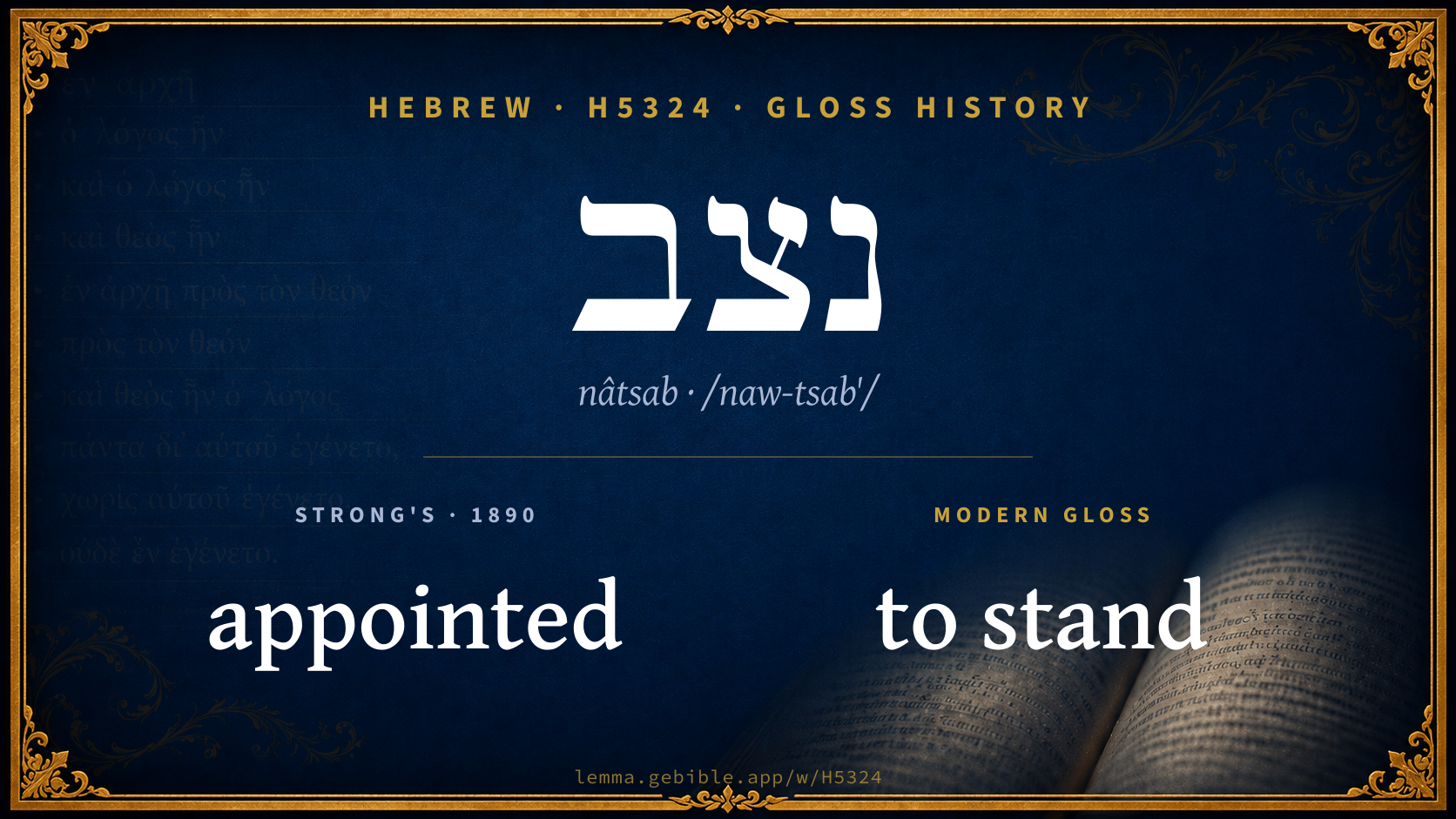
Gloss history
Strong's 1890 vs modern scholarship
About this word
Strong's H5324 catalogs a Hebrew word from the Hebrew Old Testament.
These counts are not copied from any lexicon or concordance. They are computed here, from the morphology-tagged Hebrew Old Testament. What Lemma adds →
- 75
- distinct verses
- The word appears in 75 distinct verses.
- 21 / 39
- OT books
- The word appears in 21 of 39 Old Testament books.
- #532
- by frequency
- Top 1000 most frequent Hebrew words (rank 532 of 8,640 Hebrew words by occurrence).
View all 75 occurrences in the concordance →
By section of the Old Testament
By traditional corpus
Conventional, traditional groupings — biblical authorship is debated, so this is a traditional corpus grouping, not an authorship claim. Each share is this word’s portion of its verses in that division of the Hebrew canon. Each figure is a share of the word’s 75 distinct verses.
- Prophets (Nevi'im) 32 verses · 43%
- Torah (Pentateuch) 28 verses · 37%
- Writings (Ketuvim) 15 verses · 20%
How translations render this word
Counts come from each version’s own published word-to-Strong’s tagging or interlinear alignment — an approximate guide to how each version renders this word, not a word-level alignment the data otherwise carries. Because each total is that version’s own tagged count, the per-version totals vary from one another and need not match the appearance or distinct-verse counts above. These counts may also differ from a printed concordance because Lemma counts each distinctly tagged rendering and does not collapse phrase taggings into a single head-word total. This is a fixed set of word-tagged versions (KJV, ASV, BSB, ULT) and does not change with the reading translation you choose elsewhere. Each version’s license is shown beside its name below (and on Sources).
BDB lists this Strong’s number as 2 distinct words (homographs). Each count above pools all of them and is not split by sense — see the Senses section below. A low-frequency rendering may belong to a different one of those words, not the primary meaning.
- King James Version†: Stood 12×, Officers 5×, Set 3×
- American Standard Version†: Stood 11×, Officers 5×, Set 4×
- Berean Standard Bible†: Standing 8×, Stood 6×, Was standing 4×
- unfoldingWord Literal Text†: Deputies 4×, And 3×, Set up 3×
King James Version Public Domain
Renders H5324 across 75† tagged occurrences — most commonly:
Plus 34 renderings that appear only once — usually multi-word phrases or single function words the recovered tagging swept in, not distinct renderings.
American Standard Version Public Domain
Renders H5324 across 75† tagged occurrences — most commonly:
Plus 44 renderings that appear only once — usually multi-word phrases or single function words the recovered tagging swept in, not distinct renderings.
Berean Standard Bible Public Domain
Renders H5324 across 69† tagged occurrences — most commonly:
Plus 39 renderings that appear only once — usually multi-word phrases or single function words the recovered tagging swept in, not distinct renderings. Not rendered by a distinct English word in 5 further occurrences.
unfoldingWord Literal Text CC BY-SA 4.0
Renders H5324 across 78† tagged occurrences — most commonly:
Plus other, less common renderings. Plus 39 renderings that appear only once — usually multi-word phrases or single function words the recovered tagging swept in, not distinct renderings.
16 senses and sub-senses in the full BDB
Hebrew verbs can shift meaning by stem (binyan): Qal is the basic action, Niphal is often passive or reflexive, Piel often intensifies or makes it factitive, and Hiphil is typically causative. The senses below are grouped under the stem BDB assigns to each. This entry also uses Hophal (the passive of Hiphil).
What do BDB’s symbols mean?
BDB uses these scholarly abbreviations:
| Symbol | Meaning |
|---|---|
| 𝔊 | the Septuagint (the ancient Greek translation, LXX) |
| 𝔙 | the Vulgate (the Latin translation) |
| 𝔖 | the Syriac version (the Peshitta) |
| 𝔗 | the Targum (the Aramaic translation) |
| ψ | the Psalms |
| √ | root (the underlying root or stem) |
| ‖ | parallel passage (a synonymous or contrasted parallel) |
| † | the dagger: every passage where the word occurs is cited |
The 16 senses and sub-senses the full Brown-Driver-Briggs lexicon distinguishes for this word, in lexicon order (not ranked by frequency), with BDB’s own verbatim wording and sub-sense lettering. Shown in Hebrew script with BDB’s own scholarly abbreviations. The condensed entry is in the Lexicon Entry tab. See also the Forms in the corpus table below.
נצב I iph. take one’s stand, stand (NH נִצָּב id. (rare), הַצָּבָה n. taking a stand
Niphal
- Pf. 3 fs. נִצְּבָה ψ 45:10, נִצָּ֑בָה Gn 37:7; Pr 8:2; 2 ms. וְנִצַּבְתָּ֫ Ex 7:15 + 2 times; 3 pl. נִצְּבוּ 15:8, וְנִצְּבוּ consec. 33:8; Pt. נִצָּב Gn 24:13 +, f. נִצָּבָה Zc 11:16, נִצֶּ֫בֶת 1 S 1:26; mpl. נִצָּבִים Ex 5:20 +; fpl. נִצָּבוֹת 1 S 4:20;— e.g. Psalms 45:10
- 1.
- a. station oneself, take one’s stand, for definite purpose, c. עַל loc. (by, on) Gn 24:13, 43; 28:13; Ex 7:15; 33:21; 34:2 (all J), Ex 17:9; 18:14 (E), Nu 23:6, 17 (JE); Am 7:7; 9:1; Pr 8:2; of י׳ Is 3:13 taketh his stand to plead; c. ב loc. Ex 5:20 ψ 82:1 (of God), cf. Nu 22:23, 31, 34; נ׳ עִמְּכָה 1 S 1:26; לִפְנֵי י׳ Dt 29:9; c. פֶּתַח Nu 16:27 (JE), Ju 18:16, 17; abs. La 2:4 (on text v. Löhr). e.g. Genesis 24:13
- b. stand = be stationed (by appointment, or in fulfilment of duty), c. עַל pers. (sitting or lying) Gn 45:1; 1 S 4:20; 22:6, 7, 17; נ׳ עַל־מִשְׁמַרְתִּי Is 21:8 stand at my watchman’s post (‖ עֹמֵד); לִימִינְךָ ψ 45:10; abs. 2 S 13:31. e.g. Genesis 45:1
- c. take an upright position, stand, יָקוּמוּ וְנ׳ Ex 33:8 (E; + פֶּתַח loc.), cf. Gn 37:7 (E; of sheaf); of waters, נ׳ כְמוֹ־נֵד Ex 15:8 (song). e.g. Exodus 33:8
- 2. be stationed = appointed over (על), 1 S 22:9; Ru 2:5, 6; with Samuel presiding over (על) them 1 S 19:20. e.g. 1 Samuel 22:9
- 3. Pt. as subst. deputy, prefect (as appointed, deputed), only 1 K 4:5, 7; 5:7, 30; 9:23 2 Ch 8:10 (all of Sol.’s officers; so also 2 Ch 8:10 Qr, נציב), 1 K 22:48 (of Edom). e.g. 1 Kings 4:5
- 4. stand firm, fig. כָּל־אָדָם נִצָּב ψ 39:6 every man, (even) the firm-standing, is wholly vanity (but expression strange, and text dub.); נ׳ בַּשָּׁמָ֑יִם 119:89 (of י׳’s word); that which stands firm Zc 11:16 (Isr. under fig. of sheep), but dub.; We GASm leave untranslated; Now proposes הַנַּחֲלָה the diseased. e.g. Psalms 39:6
Hiphil
- Pf. הִצִּיב 1 K 16:34; 2 ms. הִצַּבְתָּ Gn 21:29 ψ 74:17; 3 mpl. הִצִּ֫יבוּ Je 5:26; Impf. יַצִּיב Jos 6:26, יַצֵּב Dt 32:8 (dub.; poet. for וַיּ׳ Ew§ 233a Di; rhythmical shortening Ges§ 109 k; read יַצִּב Dr DaSynt. p. 94), וַיַּצֶּב־ 2 S 18:18; sf. וַיַּצִּיבֵ֫נוּ La 3:12; Imv. fs. הַצִּ֫יבִי Je 31:21; Inf. cstr. הַצִּיב 1 S 13:21; 1 Ch 18:3; Pt. מַצִּיב 1 S 15:12 (but read הִצִּיב 𝔊 We Dr Bu Kit HPS);— e.g. 1 Kings 16:34
- 1. station, set: c. acc., ewes Gn 21:28, 29 (E; לְבַד apart), trap Je 5:26; fig. set me before thee (לְפָנֶיךָ) ψ 41:13; set me as a target La 3:12. e.g. Genesis 21:28
- 2. set up, erect pillar (מַצֵּבָה) Gn 35:14, 20 (E), 2 S 18:18, + אֲשֵׁרִים 2 K 17:10; altar Gn 33:20 (E), stone-heap 2 S 18:17; monument 1 S 15:12; 1 Ch 18:3; Je 31:21; city-gates (c. ב), Jos 6:26 (JE) = 1 K 16:34. e.g. Genesis 35:14
- 3. cause to stand erect, waters, כְּמוֹ־נֵד ψ 78:13 (cf. Qal Ex 15:8). e.g. Psalms 78:13
- 4. fix, establish boundary (subj. י׳) Dt 32:8 ψ 74:17; Pr 15:25; dominion (יַד) 1 Ch 18:3 (of king).—1 S 13:21 is dub.; AV sharpen, RV set; Kit ‘gerade machen’; Klo נִצַּב subst., v. infr.; cf. HPS. e.g. Deuteronomy 32:8
Hophal
- Pf. 3 ms. הֻצַּב Na 2:8 it is fixed, determined (Kl Or), but very dub.; perhaps n.pr., or epith., of queen, cf. We Now GASm, q.v.; Pt. סֻלָּם מֻצָּב אַ֫רְצָה Gn 28:12 (E) a ladder set up on the earth; אֵלוֹן מ׳ Ju 9:6, read אֵלוֹן הַמַּצֵּבָה GFM, v. infr.—Cf. also יצב Hithp. e.g. Nahum 2:8
נצב II
- 1. haft, hilt of sword Ju 3:22 (Arabic نِصَابٌ handle of knife, ‘in wh. the سِيلَان [i.e. the shank] is set’ Lane2800). e.g. Judges 3:22
- 2. prefect, deputy, v. נצב Niph.
- 3. .
Senses from the full Brown-Driver-Briggs lexicon (Brown, Driver, Briggs; Oxford 1906 — public domain), digitized via Sefaria, supplemented by the OpenScriptures HebrewLexicon (CC BY 4.0). Full attribution on Sources.
Word origin
I. Na 2:8 dub.; perhaps txt. error; v. נצב.
I. vb.Niph. take one’s stand, stand (NH נִצָּב id. (rare), הַצָּבָה n. taking a stand; Ph. (Pun.) נצב, מנצבת, מצבת monument Lzb 325; Nab. Palm. נצב set up; Zinj. id., statue, all Lzb 325 Cook 82; Palm. מצבא image, Nab. נצב id., DHMVOJ viii (1984), 12, cf. Lzb l.c.; perhaps Assyrian naṣâbu TelAm., Wkl TA 24b; Aramaic נְצַב, ܢܨܰܒ Arabic نَصَبَ set up, erect, نَصْبٌ sign, mark, way-mark; Sab. נצב cippus CIS iv. 23 Sab Denkm95 DHM ZMG xxx (1876), 115f. Derenb JAs, 1883, Aug.–Sept. 244; Min. מצב statue (= מנצב) HomSüdar. Chrest. 128);—
— Brown-Driver-Briggs (Oxford 1906, public domain), digitized via Sefaria, supplemented by the OpenScriptures HebrewLexicon (CC BY 4.0). See Sources.
Origin: a primitive root
Jastrow Dictionary
A second Hebrew/Aramaic lexicon for comparison, covering Aramaic and post-biblical (Talmudic, Targumic, Midrashic) usage that the biblical-Hebrew BDB does not. Matched by lemma rather than by Strong’s number, so a lemma may carry more than one Jastrow headword (shown separately below), and the entries cover usage well beyond the Bible.
נָצַב
- to put up, place, v. יָצַב.
- to stand (defiantly). Num. R. s. 18, v. הַצָּבָה.
נְצַב
- , to put up, plant. Targ. Gen. IX, 20 (h. text נטע). Targ. Y. Deut. XXXII, 50 (cmp. נָטַע); a. fr.—Lev. R. s. 25 למִנְצַב נציבין to plant (trees); Koh. R. to II, 20 למִינְצַב. Y. Orl. I, 61ᵃ top ונ׳ לון בארץ and planted them in the land (Palestine); a. fr.—Part. pass. נְצִיב, נְצִיבָא. Lam. R. to I, 1 חד גופנא … והוה נ׳ (רבתי) וכ׳ we had a vine which was planted on our father’s grave.
- to point, sharpen (cmp. נצבתא, Dan. II, 41). Targ. I Sam. XIII, 21 לאַנְצָבָא, (Ar. לאנצא, v. אֲנַץ; h. text להציב). e.g. Daniel 2:41
A Dictionary of the Targumim, the Talmud Babli and Yerushalmi, and the Midrashic Literature (Marcus Jastrow; London, Luzac, 1903) — Public Domain. Digitized via Sefaria. Digitized via Sefaria. Full attribution on Sources.
Forms in the corpus
The 51 distinct written forms H5324 takes in the Hebrew Bible, most frequent first — each parse links to that stem’s occurrences in the concordance. Hebrew forms include their vowel points and cantillation, so a single lemma takes many written forms.
Same root — word family
Other BDB entries built from the same root as H5324, grouped by Strong’s listed origin. These share a root / origin per the lexicon — not necessarily a shared meaning. Each links to that word’s own entry.
Derived from this word
- מצב matstsâb H4673 station
- מצב mutstsâb H4674 entrenchment
- מצבה matstsêbâh H4676 pillar
- מצבת matstsebeth H4678 pillar
- נצב nitstsâb H5325 hilt
- נצבה nitsbâh H5326 firmness
- נציב nᵉtsîyb H5333 garrison
Compare all same-root words → Showing 4 of 8 — not the complete family. They share a root, not necessarily a meaning.
Septuagint verse parallels
This word appears in 70 verses that also exist in the Greek Old Testament (Septuagint), out of the 75 Hebrew verses it occurs in. You can read those verses in Greek by switching the Old Testament edition to the Septuagint.
Read these verses in the Septuagint
- Genesis 18:2
- Exodus 5:20
- Numbers 16:27
- Deuteronomy 29:10
- Joshua 6:26
- Judges 9:6
- Ruth 2:5
- 1 Samuel 1:26
- 2 Samuel 13:31
- 1 Kings 4:5
- 2 Kings 17:10
- 1 Chronicles 18:3
This is a verse-level parallel only — the same verses exist in both the Hebrew and Greek Old Testaments. No word-level Hebrew↔Greek correspondence is claimed: the data carries no such alignment, so no Greek word is shown as this Hebrew word’s translation. Coverage is not total — the Septuagint omits the deuterocanon and renumbers the Psalms, so some Hebrew verses have no direct Greek parallel.