
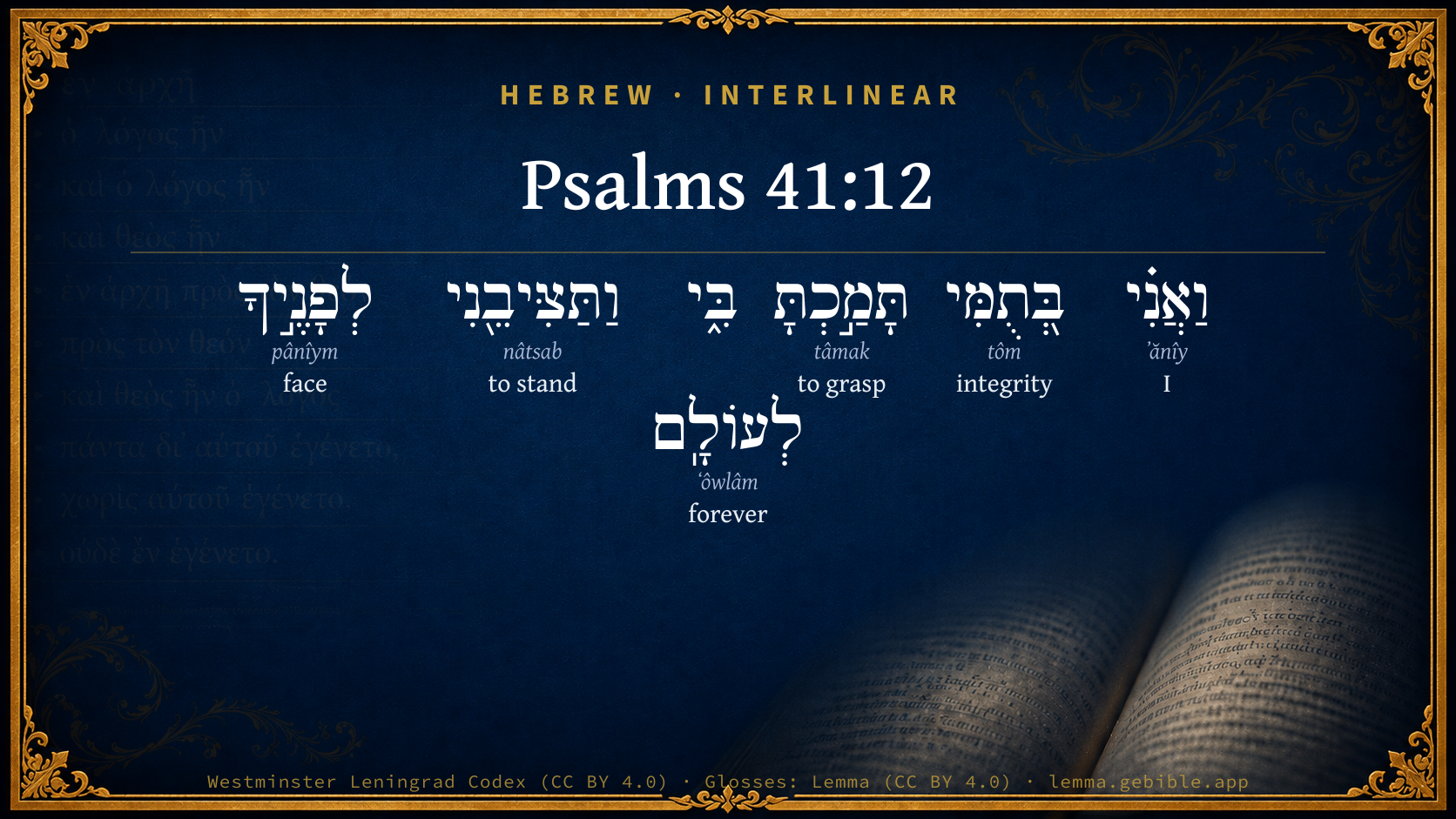
Psalms 41:12

Hebrew (Westminster Leningrad Codex) Psalms 41:12 appears in the Hebrew Old Testament. The text above is from the Westminster Leningrad Codex. Each word links to its Strong’s number, a concise gloss, and parsing drawn from the Open Scriptures Hebrew Bible morphology. Click any word for its full Brown-Driver-Briggs (BDB) entry.
Download image
Cite this verse

Psalms 41:12 (World English Bible). Public Domain. Lemma interlinear Bible study tool, https://lemma.gebible.app/v/psalms/41/12.

Show BibTeX & RIS
BibTeX
RIS
English Translation
As for me, you uphold me in my integrity, And set me in your presence forever.
World English Bible · Public Domain
Download a study sheet

One document with this verse’s original text, its word-by-word gloss line, the meaning frame, cross-references with their text, attributed commentary, and full source and license credits — printable, and it pastes into notes with its structure intact.

This verse Autodidact and up

Study sheet (.html) Plain text (.txt)

A passage Seminary Student

Up to 50 verses in one chapter. A passage sheet keeps up to 6 commentary sources and 12 cross-references per verse, in the order this page ranks them, and says so on the sheet whenever that leaves anything out. Ask for a single verse and you get the Autodidact verse sheet above.

Everything on this page stays free to read, with no account — the sheet is a download of what is already on screen, not access to it.

Want to remove ads? Support Godless Engineer
Compare translations 3

The same verse in 3 English versions, stacked beneath the original-language interlinear above. Click any original word for its lexicon entry.

Each is an independent rendering of the whole verse — the interlinear is not word-aligned to these translations.

Highlighted words mark where these versions differ — a whole-verse word diff, not a word-by-word alignment.

  • World English Bible Public Domain
    As for me, you uphold me in my integrity, And set me in your presence forever.
  • King James Version Public Domain
    And as for me, thou upholdest me in mine integrity, and settest me before thy face for ever.
  • unfoldingWord Literal Text CC BY-SA 4.0
    And I, in my integrity you upheld me, and you set me to your face forever.

unfoldingWord Literal Text — © unfoldingWord, licensed CC BY-SA 4.0. Word-aligned USFM3 via Door43 (git.door43.org/unfoldingWord/en_ult).

Versions to compare (up to 4)

3 of 4 selected

Show all 18 translations

Every available English version of this verse, each an independent rendering of the whole verse.

  • World English Bible Public Domain
    As for me, you uphold me in my integrity, And set me in your presence forever.
  • Berean Standard Bible Public Domain
    In my integrity You uphold me and set me in Your presence forever.
  • Majority Standard Bible Public Domain
    In my integrity You uphold me and set me in Your presence forever.
  • King James Version Public Domain
    And as for me, thou upholdest me in mine integrity, and settest me before thy face for ever.
  • American Standard Version (1901) Public Domain
    And as for me, thou upholdest me in mine integrity, And settest me before thy face for ever.
  • Revised Version (1885) Public Domain
    And as for me, thou upholdest me in mine integrity, and settest me before thy face for ever.
  • Geneva Bible (1599) Public Domain
    And as for me, thou vpholdest me in mine integritie, and doest set me before thy face for euer.
  • Douay-Rheims (1899) Public Domain
    By this I know, that thou hast had a good will for me: because my enemy shall not rejoice over me.
  • Young's Literal Translation Public Domain
    As to me, in mine integrity, Thou hast taken hold upon me, And causest me to stand before Thee to the age.
  • Literal Standard Version CC BY-SA 4.0
    As for me, in my integrity, || You have taken hold on me, || And cause me to stand before You for all time.
  • Unlocked Literal Bible CC BY-SA 4.0
    As for me, you support me in my integrity and will keep me before your face forever.
  • unfoldingWord Literal Text CC BY-SA 4.0
    And I, in my integrity you upheld me, and you set me to your face forever.
  • Darby Bible Public Domain
    But as for me, thou upholdest me in mine integrity, and settest me before thy face for ever.
  • World Messianic Bible Public Domain
    As for me, you uphold me in my integrity, and set me in your presence forever.
  • Webster's Bible Public Domain
    \\41:11\\By this I know that thou favorest me, because my enemy doth not triumph over me.
  • Free Bible Version CC BY-SA 4.0
    You have supported me because of my integrity, you have brought me into your presence forever.
  • Bible in Basic English Public Domain
    And as for me, you are my support in my righteousness, giving me a place before your face for ever.
  • JPS Tanakh (1917) Public Domain
    (41-13) And as for me, Thou upholdest me because of mine integrity, and settest me before Thy face for ever.

Literal Standard Version (2020), Covenant Press — licensed CC BY-SA 4.0. Text via the HelloAO Bible API (eBible.org). Unlocked Literal Bible (unfoldingWord) — licensed CC BY-SA 4.0. Text via the HelloAO Bible API (eBible.org). unfoldingWord Literal Text — © unfoldingWord, licensed CC BY-SA 4.0. Word-aligned USFM3 via Door43 (git.door43.org/unfoldingWord/en_ult). Free Bible Version, Dr. Jonathan Gallagher — licensed CC BY-SA 4.0. Text via the HelloAO Bible API (eBible.org).

Word by word

More ways to search: Search by grammar → Find every occurrence → Compare this word →

Practice this passage: Drill this verse → Learn its vocabulary →

תָּמַ֣כְתָּ
tâmak
H8551
“to grasp”
Verb, Qal, Perfect, 2nd Person, Masculine, Singular
Part of Speech
Verb
Stem
Qal
Form
Perfect
Person
2nd Person
Gender
Masculine
Number
Singular
Full BDB Definition

Origin: a primitive root

TWOT: 2520

to grasp, hold, support, attain, lay hold of, hold fast - (Qal) - to grasp, lay hold of, attain - to hold up, support - to hold, keep - to take hold of each other - (Niphal) to be seized, be held
  1. וַאֲנִ֗י ʼănîy H589 “and · I” Conjunction + Pronoun, Personal, 1st Person, Common, Singular
  2. בְּ֭תֻמִּי tôm H8537 “in/at · integrity · my” Preposition + Noun, Common, Masculine, Singular, Construct + Suffix, Personal, 1st Person, Common, Singular
  3. וַתַּצִּיבֵ֖נִי nâtsab H5324 “and · to stand · me” Conjunction + Verb, Hiphil, Sequential Imperfect, 2nd Person, Masculine, Singular + Suffix, Personal, 1st Person, Common, Singular
  4. לְפָנֶ֣יךָ pânîym H6440 “to/for · face(s) · your” Preposition + Noun, Common, Both, Plural, Construct + Suffix, Personal, 2nd Person, Masculine, Singular
  5. לְעוֹלָֽם ʻôwlâm H5769 “to/for · forever” Preposition + Noun, Common, Masculine, Singular, Absolute

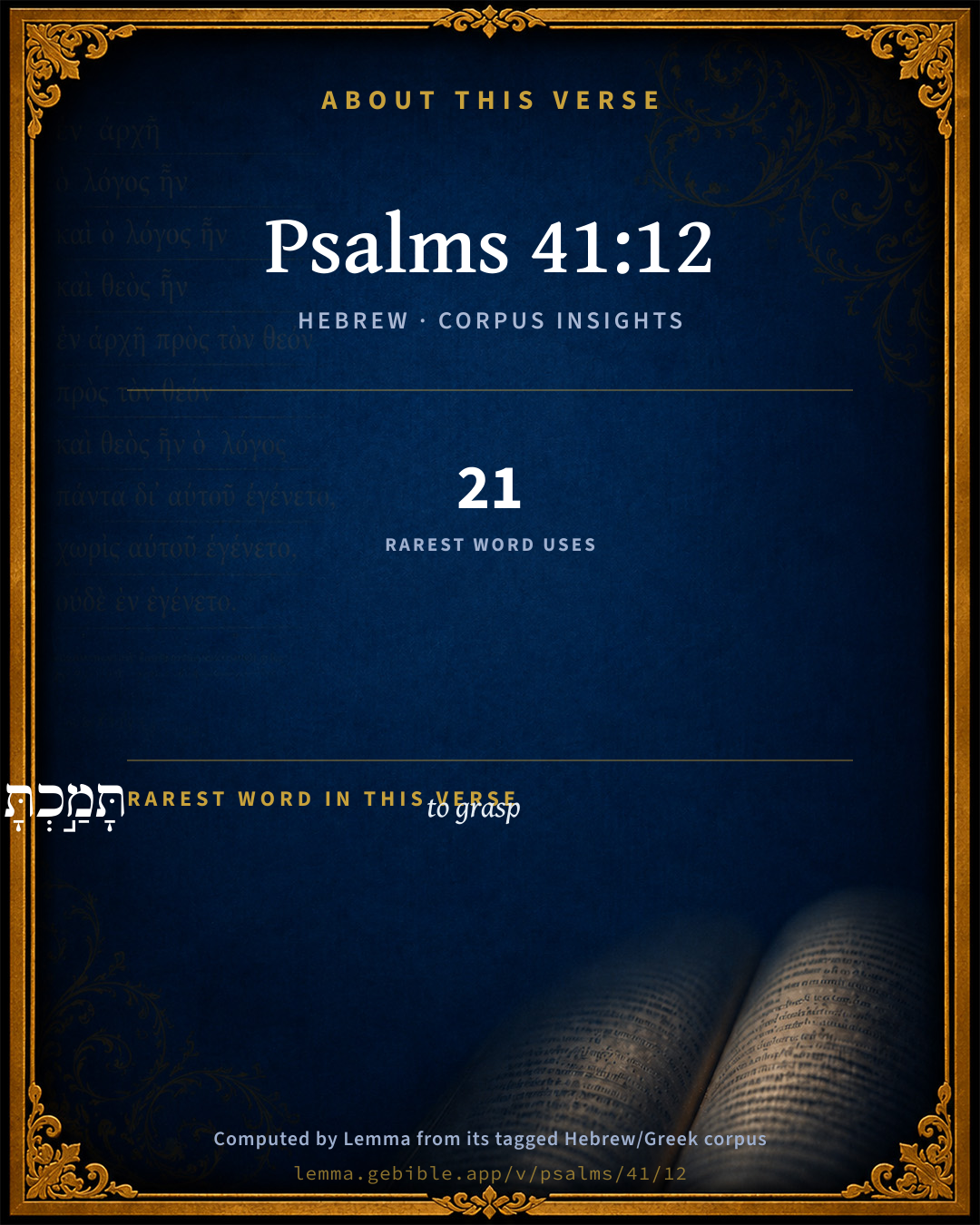
About this verse

These counts appear in no published source. They are computed here, from the morphology-tagged text and Lemma’s own curated glosses. What Lemma adds →

7
words
6
distinct lemmas
Wisdom
section

Notable vocabulary

The rarest word here is תָּמַ֣כְתָּ to grasp H8551 — appearing just 21 times in the whole Hebrew Bible.

Shared distinctive vocabulary

תָּמַ֣כְתָּ to grasp H8551 occurs in 20 verses of the Hebrew Bible. Also found in:

Grammatical profile

  • 2 verbs
  • 3 nouns
  • 1 pronoun
  • 1 preposition

Verb forms

  • תָּמַ֣כְתָּ Qal · Perfect
  • וַתַּצִּיבֵ֖נִי Hiphil · Sequential Imperfect

Hebrew & Septuagint length

In English translation the verse runs 16 words from the Hebrew and 17 from the Septuagint (LXX English) — closely comparable.

A rough comparison of the two English renderings, which tokenize alike — not a word-level alignment.

Word counts can differ between the Hebrew and the Greek without any difference in meaning — e.g. the Hebrew direct-object marker אֵת has no separate Greek word, and Greek often adds the article ὁ.

Cross-references

10

Topical passages linked to Psalms 41:12 in the Treasury of Scripture Knowledge — connected by theme and wording, ordered by reader-vote popularity; previews shown in the World English Bible.

  • Job 36:7 He doesn't withdraw his eyes from the righteous, But with kings on the throne, He sets them forever, and they are exalted.
  • Psalms 73:23–24 Nevertheless, I am continually with you. You have held my right hand.
  • Psalms 34:15 Yahweh's eyes are toward the righteous. His ears listen to their cry.
  • Psalms 37:17 For the arms of the wicked shall be broken, But Yahweh upholds the righteous.
  • John 17:24 Father, I desire that they also whom you have given me be with me where I am, that they may see my glory, which you have given me, for you loved me before the foundation of the world.
  • Psalms 25:21 Let integrity and uprightness preserve me, For I wait for you.
  • Psalms 63:8 My soul stays close to you. Your right hand holds me up.
  • Psalms 16:11 You will show me the path of life. In your presence is fullness of joy. In your right hand there are pleasures forevermore.
  • Psalms 17:15 As for me, I shall see your face in righteousness; I shall be satisfied, when I awake, with seeing your form.
  • Psalms 94:18 When I said, "My foot is slipping!" Your loving kindness, Yahweh, held me up.

Cross-references courtesy of OpenBible.info (CC BY 4.0).

Hebrew and Greek witnesses Masoretic Hebrew ↔ Greek Septuagint

The same verse in the two great witnesses to the Old Testament, shown verse-for-verse.

You’re reading Greek Psalm 40 (Hebrew Psalm 41). The Septuagint counts the superscription, so verse numbers can differ from the Hebrew — chapter-level alignment, not verse-by-verse. Numbering follows Rahlfs.

These are two independent witnesses, not word-aligned to each other, and the Septuagint is shown in lemma (dictionary) form.

Hebrew Psalms 41:12 Masoretic · Westminster Leningrad Codex

וַאֲנִ֗י בְּ֭תֻמִּי תָּמַ֣כְתָּ בִּ֑י וַתַּצִּיבֵ֖נִי לְפָנֶ֣יךָ לְעוֹלָֽם

As for me, you uphold me in my integrity, And set me in your presence forever.

World English Bible · Public Domain

Greek LXX Greek Psalm 40:12 Septuagint · lemma form

ἐν οὗτος γιγνώσκω ὅτι θέλω ἐγώ ὅτι οὐ μή ἐπιχαίρω ὁ ἐχθρός ἐγώ ἐπί ἐγώ

But you did help me because of my innocence, and have established me before you for ever.

LXX2012 (modern English Septuagint) · Public Domain

On this verse, The Cambridge Bible for Schools and Colleges discusses the Septuagint’s reading. Read the note in Commentary ↓

Hebrew: Westminster Leningrad Codex (CC BY 4.0). Greek: Septuagint (public domain); English from LXX2012 (modern English Septuagint) (Public Domain). How the Septuagint differs from the Hebrew →

Commentary

Notes on Psalms 41:12 from classic Christian and Jewish commentators (each source and its license shown beneath its notes). The classic Christian expositions comment on the surrounding passage and are grouped to its opening verse, so a note may address several verses; the Jewish commentaries on the Tanakh (Rashi and others) are per-verse, so they appear only where the commentator wrote on this verse.

Lemma curates 59 commentaries, every one of them public domain or Creative Commons licensed, each selected and text-cleaned for this edition rather than reprinted as found. About our sources →

Trapp's Complete Commentary

John Trapp

Psa 41:12 And as for me, thou upholdest me in mine integrity, and settest me before thy face for ever.

Ver. 12. And as for me, thou upholdest me in mine integrity] Which earth and hell had conspired to rob me of, but in vain, through thy help. My shield is yet in safety. My faith faileth me not, nor yet mine innocence in regard of men, or the righteousness of my cause.

And settest me before thy face for ever] So that, being never out of thy sight, I cannot possibly be out of thy mind. Confer 1Ki 17:1.

John Trapp, A Commentary or Exposition upon All the Books of the Old and New Testament (1647–1656) — public domain. Text from a community e-Sword module.

J. A. Alexander on Psalms

Joseph Addison Alexander

13. (Psa 41:12). And as for me—in my integrity thou hast held me, and hast made me stand before thy face for ever. The first phrase literally means and I, as if agreeing with some verb suppressed, or as if the construction had been suddenly changed from I have been held to thou hast held me. The integrity here claimed is not absolute or sinless perfection, as appears from the confession in Psa 41:5 (4), but freedom from essential or fatal defect. See above, on Psa 18:21-25 (20-24). In my integrity, not simply on account of it, which is rather implied than expressed, but in the possession and exercise of it. Thou hast held may either mean held fast or held up, but the first seems to be the essential meaning of the verb, and really involves or at least suggests the other. "Thou hast so held me fast as to hold me up. By retaining thy hold upon me thou hast sustained me." Setting before the face seems here to mean making one the object of attention. keeping constantly in view. The reciprocal act of man towards God is spoken of in Psa 16:8. As man sets God before him as an object of trust, so God sets man before him as an object of protection. That this is not to be a transient but a permanent relation, is implied in the future form of the verb, and expressed in the adverbial phrase for ever.

Joseph Addison Alexander, The Psalms Translated and Explained (1850) — public domain. Text from a community e-Sword module.

Geneva Bible (1599)

Geneva Bible translators

Meaning, either in prosperity of life, or in the true fear of God against all tentations.

Showing me evident signs of thy fatherly providence.

Geneva Bible (1599) marginal notes — public domain. Text via Bolls.life.

Jamieson, Fausset & Brown

Robert Jamieson, A. R. Fausset & David Brown

settest . . . before thy face--under thy watch and care, as God before man's face (Psa 16:8) is an object of trust and love.

Jamieson, Fausset & Brown — Commentary Critical and Explanatory on the Whole Bible (1871) — public domain (CC PDM 1.0). Text via the HelloAO Bible API.

Adam Clarke's Commentary

Verse 12. Thou upholdest me] I am still enabled to show that my heart was upright before God.

Settest me before thy face for ever.] Thou showest that thou dost approve of me: that I stand in thy presence, under the smiles of thy approbation.

This also has been applied to our Lord, and considered as pointing out his mediatorial office at the right hand of God.

Adam Clarke's Commentary on the Bible (1810–1826) — public domain. Text from a community e-Sword/MySword module.

John Calvin's Commentaries

12 And as for me, thou wilt uphold me in my integrity Some expound the clause thus: That, as David followed after uprightness, God had stretched out the hand to him. But this interpretation does not agree very well with a preceding sentence, in which he acknowledged that he had been justly punished by God. The calamity which had befallen him exposed him to the insult and derision of his enemies; but it is not likely that they were the authors of it: and hence, it would have been out of place to have adduced his integrity for this purpose, because the Lord is said to have respect to our integrity, when he defends us against our enemies, and delivers us from the outrage of men. We must therefore seek another meaning. The Hebrew word which we have rendered integrity might be referred to the body as well as the mind, thus: I shall continue sound, because thou wilt preserve and establish me. He seems, however, to extend the favor of God still farther; as if he had said, that he had been assisted not only once by his hand, but that, during the whole course of the period he had enjoyed prosperity, he had always been upheld in safety by the power of God. If any would rather understand by this term the piety and sincere disposition for which David was distinguished, — and this meaning would be very suitable, — it will not follow from this that David boasts of his past life, but only that he declares that, when brought to the test, or in the midst of the conflict, even although Satan and wicked men endeavored to shake his faith, he had not turned aside from the fear of God. By these words, then, he bears testimony to his patience, because, when sorely vexed and tormented, he had not forsaken the path of uprightness. If this meaning should be adopted, it must be observed, that this benefit, namely, that David continued invincible, and boldly sustained these assaults of temptation, is immediately after ascribed to God, and that for the future, David looked for preservation by no other means than by the sustaining power of God. If the language should be understood as referring to his external condition, this will be found to suit equally well the scope of the passage, and the meaning will be this, That God will never cease to manifest his favor, until he has preserved his servants in safety, even to the end. As to the form of expression, that God establishes them before his face, this is said of those whom he defends and preserves in such a manner, that he shows by evident tokens the paternal care which he exercises over them; as, on the other hand, when he seems to have forgotten his own people, he is said to hide his face from them.

John Calvin's Commentaries (1540-1563) — public domain. Text from the Calvin Translation Society English edition (1840s-50s) via the Christian Classics Ethereal Library (ccel.org). Calvin's coverage is partial (roughly two-thirds of the Bible); uncommented books and verses are honest gaps, never fabricated. The 19th-century editor's footnotes and remarks are omitted so the notes are faithfully Calvin's own voice.

Ellicott's Commentary for English Readers

(12) Thou upholdest.—Here we seem to have the acknowledgment that the prayer just uttered is answered.

A Bible Commentary for English Readers, edited by Charles John Ellicott (1878–1897) — public domain. Text from a community e-Sword module.

The Cambridge Bible for Schools and Colleges

gen. ed. J. J. S. Perowne

12. Cp. Psa_26:11; Psa_63:8. Thou upholdest (lit. hast upheld) is either a reference to past mercies, or more probably a retrospect from the standpoint of deliverance granted. In mine integrity is no contradiction to Psa_41:4. Integrity (Psa_7:8; Psa_15:2) is not synonymous with sinlessness.

and settest me before thy face for ever] His enemies hope that his name will perish. He knows that he will be admitted to stand in the presence of the King of Kings. Cp. Psa_11:7 (note); Psa_16:11; Psa_17:15; Psa_61:7; and the fundamental promise in 2Sa_7:16 (read before me with LXX).

Thus the first book of the Psalter ends with a hope, destined to be illuminated with a new light by the revelation of the Gospel. See Rev_22:4.

The Cambridge Bible for Schools and Colleges (gen. ed. J. J. S. Perowne; Cambridge University Press, 1878–1918) — public domain. Text from a community e-Sword module.

John Gill's Exposition

And as for me, thou upholdest me in mine integrity,.... In the innocence of his nature, being free from sin, original and actual; in the uprightness of his life and conversation before God and men; and in the perfection of his obedience and sacrifice, whereby he brought in a perfect righteousness, made complete atonement, and obtained full salvation and redemption for his people; and, because of all this, Jehovah the Father upheld him in his sufferings, as man and Mediator, that he failed not, and was not discouraged: or rather the sense is, that by several things which turned up in Providence, as the disagreement of the witnesses, declaration of his judge, and the confession of Judas his betrayer, he was cleared of the charges brought against him, and his innocence was maintained, and he upheld in it; but especially this was done by raising him from the dead, when he was openly acquitted, discharged, and justified, and declared to be the Holy One of God, Ti1 3:16;

and settest me before thy face for ever; after his resurrection, he was introduced into the presence of his Father, and was made glad with his countenance; where he sits before him as the Angel of his presence, and appears in the presence of God in the behalf of his people; is the Lamb in the midst of the throne, as though he had been slain; where his person, blood, righteousness, and sacrifice, are ever in view for their acceptance, and where he ever lives to make intercession for them; for here he will continue until the time of the restitution of all things.

John Gill's Exposition of the Whole Bible (1746–1763) — public domain (CC PDM 1.0). Text via the HelloAO Bible API.

Albert Barnes' Notes on the Bible

And as for me - literally, “and I;” as if there were some verb understood. The reference is turned on himself; on all that was suggested by this train of remark as bearing on himself. The result of the whole was a firm assurance that God would sustain him, and that he would be established before God forever. The train of thought is this: “And I... thou upholdest me.” Perhaps the course of expression, if it had not been suddenly changed, would have been, “And I am sustained or held up.” The thought, however, turns rather on God than on himself, and instead of carrying out the reference to himself so prominently, he turns to God as the source from where all this was derived.

Thou upholdest me - Not merely in strengthening me in my sickness, but, what is more important, in vindicating my character against the aspersions which are cast upon it. Thou dost show that I am upright.

In mine integrity - literally, “in my perfection.” See the notes at Job 1:1. The word here means uprightness, sincerity, probity. He had been calumniated by his foes. His sickness had been regarded by them as a proof that he was a hypocrite or a stranger to God. If he had died, they would have urged that fact as evidence that he was the object of the divine displeasure. His restored health was clear proof that their suggestions were false, and that he was not suffering for the cause which they alleged. God thus showed that he regarded him as upright and sincere. The claim is not that of “absolute perfections,” but only of a character of piety or integrity in opposition to the slanderous charges of his enemies. Compare Psa 7:8; Psa 25:21; Psa 26:1, Psa 26:11.

And settest me before thy face for ever - That is, Thou wilt do it. God would always have him in his presence, permit him always to dwell with him - the highest proof of his friendship.

Albert Barnes' Notes on the Bible (1834–1885) — public domain. Text from a community e-Sword/MySword module.

Matthew Poole's English Annotations

In mine integrity; as I have kept my integrity, so thou hast kept me in and with it. Or, for mine integrity; because thou hast seen my innocency, notwithstanding all the calumnies of mine enemies; and thou hast promised and usest to afford thy protection to the innocent and upright.

Settest me before thy face for ever; or, hast confirmed or established me in thy presence (i.e. either under thine eye and special care; or to minister unto thee, not only in thy temple, but as a king over thy people, or in that land, where thou art peculiarly present) for ever; either,

1. Properly; and so this was done to David, either in his own person, partly here, and partly in the next life; or in regard of his posterity, in whom the kingdom was established for ever. Or,

2. For my whole life, or for a long time, as that phrase is commonly used.

Matthew Poole's English Annotations on the Holy Bible (1683–1685) — public domain. Text from a community e-Sword/MySword module.

The Treasury of David

Charles H. Spurgeon

Ver. 12. And as for me, despite them all and in the sight of them all, thou upholdest me in mine integrity; thy power enables me to rise above the reach of slander by living in purity and righteousness. Our innocence and consistency are the result of the divine upholding. We are like those glasses without feet, which can only be upright while they are held in the hand; we fall, and spill, and spoil all, if left to ourselves. The Lord should be praised every day if we are preserved from gross sin. When others sin they show us what we should do but for grace. "He today and I tomorrow, "was the exclamation of a holy man, whenever he saw another falling into sin. Our integrity is comparative as well as dependent, we must therefore be humbled while we are grateful. If we are clear of the faults alleged against us by our calumniators, we have nevertheless quite enough of actual blameworthiness to render it shameful for us to boast. And settest me before thy face for ever. He rejoiced that he lived under the divine surveillance; tended, cared for, and smiled upon by his Lord; and yet more, that it would be so world without end. To stand before an earthly monarch is considered to be a singular honour, but what must it be to be a perpetual courtier in the palace of the King Eternal, Immortal, Invisible?

Ver. 12. Integrity. This same integrity is like Noah's ark, wherein he was preserved, when others perished, being without it. It is like the red thread, which the spies of Joshua gave to Rahab, it was a charter whereby she claimed her life when the rest were destroyed, which had not the like. So is this integrity of small reckoning, I confess, with the men of this world, which think that there is no other heaven but earth; but as Rahab's thread was better to her than all her goods and substance when the sword came, so this is better to God's children than all the world when death comes. If they have this within they care not, nay, they need not care what can come without. If Satan's buffeting come, this is a helmet of proof; if Satan's darts fly out, this is a shield to quench them; if floods of crosses come to carry us away, this is a boat to bear us up; if all the world cast mire and filth in our faces, we are never a whit the more deformed, but still beautiful for all that, for "the king's daughter, "(saith Solomon, Ps 45:13), that is, the church of Christ, "is all glorious within." William Burton.

Ver. 12. Settest me before thy face for ever; or hast confirmed or established me in thy presence; i.e, either under thine eye and special care, or to minister to thee, not only in thy temple, but as a king over thy people, or in that land where thou art peculiarly present. Matthew Poole.

Ver. 12. This text reveals the insignia of those whom grace has distinguished.

1. Their integrity is manifest.

2. Their character is divinely sustained.

3. They dwell in the favour of God.

4. Their position is stable and continues.

5. Their eternal future is secure.

Psalms 41:13*

Charles H. Spurgeon's The Treasury of David (1869–1885) — public domain. Psalms only. Text from a community e-Sword/MySword module.

Whedon's Commentary on the Bible

Daniel D. Whedon

12. And as for me—Literally, And I. The “I” is emphatic, as in Psa_41:4. He contrasts God’s treatment towards him with that of his enemies, whom God had doomed to destruction.

Mine integrity—As between him and his enemies David could plead his blamelessness, but as between his soul and God he confessed, as in Psa_41:4, his sin.

Settest me before thy face—A mark of noble rank and royal favour. See Psa_34:16.

For ever—To eternity, which only is the duration of this rule and dignity of David, realized in his illustrious seed, Messiah, who is blessed for evermore.

Daniel D. Whedon (gen. ed.), Commentary on the Old and New Testaments (1874–1909) — public domain. Text from a community e-Sword module.

The Pulpit Commentary

And as for me, thou upholdest me in mine integrity. (comp. Psa_26:1, and the comment ad loc. ) And settest me before thy face for ever. So that there falls upon me the light of thy countenance. (comp. Psa_4:6) The expression, "for ever," is remarkable in this connection, and may be fairly taken as indicating a hope of immortality. (comp. Psa_16:11 Psa_17:15 Psa_23:6 Psa_30:12)

The Pulpit Commentary (1880–1919), ed. H.D.M. Spence-Jones & Joseph S. Exell — public domain. Text from a community e-Sword module.

John Wesley's Explanatory Notes

Settest - Or, hast confirmed me in thy presence, under thine eye and special care: to minister unto thee, as a king over thy people. And in regard of his posterity, the kingdom was established forever. 13. Amen - Signifies an hearty assent and approbation, and withal an earnest desire of the thing, to which it is annexed. And as the Psalms are divided into five books, so each of them is closed with this word; the first here: the second, chap. lxxii, 19, the third, chap. lxxxix, 52, the fourth, chap. cvi, 48, the last in the end of chap. 1l, 6, the doubling of the word shews the fervency of his spirit, in this work of praising God.

John Wesley, Explanatory Notes Upon the Whole Bible (1754–1765) — public domain. Text via the GEBible commentary corpus.

Rashi

Rabbi Shlomo Yitzchaki (Rashi)

With this I shall know, etc. When You are gracious to me and raise me up, I shall know that You have desired me; when my enemy will not shout with shouts of joy over me, and I will see that because of my innocence, You have supported me.

Rashi on the Tanakh — English translations: “The Judaica Press complete Tanach with Rashi, translated by A. J. Rosenberg” (CC BY 4.0); “Pentateuch with Rashi's commentary by M. Rosenbaum and A.M. Silbermann, 1929-1934” (public domain); “The Metsudah Tanach series, Lakewood, N.J” (CC BY 4.0); and “The Book of Joshua, Metsudah Publications, 1997” (CC BY 4.0). Text via Sefaria.

Lesson kit

Teaching starters — assembled from the data on this page, not authored interpretation. Every prompt links to the verse data it draws on. Edit before teaching.

Psalms, in the Wisdom, opens this verse with 7 words (6 distinct Hebrew lemmas). Its most distinctive word is tâmak (“to grasp”). A historical commentator’s framing appears above. Read the whole chapter for the surrounding context.

Discussion questions

  1. What does “to grasp” (tâmak) contribute to the verse as a whole?
  2. Genesis 48:17 shares the word «to grasp» with this verse. How do the two illuminate each other?
  3. The translations on this page render this verse differently — a whole-verse word diff, not a word-by-word alignment. What might account for the different wordings?
  4. The verb «תָּמַ֣כְתָּ» is Qal Perfect. How does its form color the action?
  5. Reading how Trapp's Complete Commentary and J. A. Alexander on Psalms read this verse, where do the two commentators agree and where do they part?

Things to notice

Reading settings

Reading text

Shown beneath each verse's original-language words.

Old Testament
Old Testament edition

Read the OT as the Masoretic Hebrew (MT) or the Greek Septuagint (LXX).

English shown for the Greek Septuagint (in the Hebrew ↔ Greek comparison).

Comparing translations? Open the Compare panel on any verse page to stack up to four side by side.