
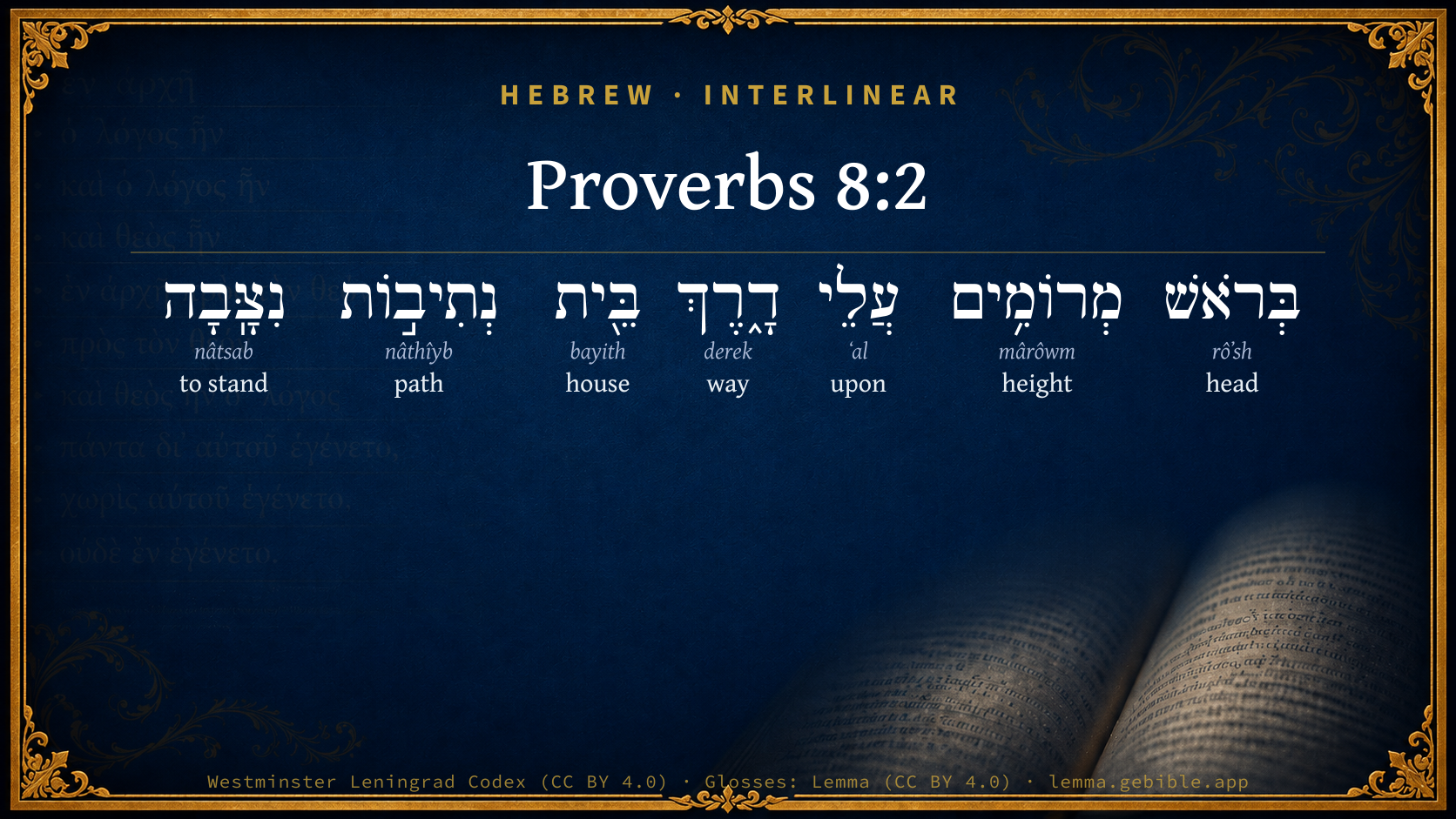
Proverbs 8:2

Hebrew (Westminster Leningrad Codex) Proverbs 8:2 appears in the Hebrew Old Testament. The text above is from the Westminster Leningrad Codex. Each word links to its Strong’s number, a concise gloss, and parsing drawn from the Open Scriptures Hebrew Bible morphology. Click any word for its full Brown-Driver-Briggs (BDB) entry.
Download image
Cite this verse

Proverbs 8:2 (World English Bible). Public Domain. Lemma interlinear Bible study tool, https://lemma.gebible.app/v/proverbs/8/2.

Show BibTeX & RIS
BibTeX
RIS
English Translation
On the top of high places by the way, Where the paths meet, she stands.
World English Bible · Public Domain
Download a study sheet

One document with this verse’s original text, its word-by-word gloss line, the meaning frame, cross-references with their text, attributed commentary, and full source and license credits — printable, and it pastes into notes with its structure intact.

This verse Autodidact and up

Study sheet (.html) Plain text (.txt)

A passage Seminary Student

Up to 50 verses in one chapter. A passage sheet keeps up to 6 commentary sources and 12 cross-references per verse, in the order this page ranks them, and says so on the sheet whenever that leaves anything out. Ask for a single verse and you get the Autodidact verse sheet above.

Everything on this page stays free to read, with no account — the sheet is a download of what is already on screen, not access to it.

Want to remove ads? Support Godless Engineer
Compare translations 3

The same verse in 3 English versions, stacked beneath the original-language interlinear above. Click any original word for its lexicon entry.

Each is an independent rendering of the whole verse — the interlinear is not word-aligned to these translations.

Highlighted words mark where these versions differ — a whole-verse word diff, not a word-by-word alignment.

  • World English Bible Public Domain
    On the top of high places by the way, Where the paths meet, she stands.
  • King James Version Public Domain
    She standeth in the top of high places, by the way in the places of the paths.
  • unfoldingWord Literal Text CC BY-SA 4.0
    At the head of the heights beside the road, the house of the paths, she stations herself.

unfoldingWord Literal Text — © unfoldingWord, licensed CC BY-SA 4.0. Word-aligned USFM3 via Door43 (git.door43.org/unfoldingWord/en_ult).

Versions to compare (up to 4)

3 of 4 selected

Show all 18 translations

Every available English version of this verse, each an independent rendering of the whole verse.

  • World English Bible Public Domain
    On the top of high places by the way, Where the paths meet, she stands.
  • Berean Standard Bible Public Domain
    On the heights overlooking the road, at the crossroads she takes her stand.
  • Majority Standard Bible Public Domain
    On the heights overlooking the road, at the crossroads she takes her stand.
  • King James Version Public Domain
    She standeth in the top of high places, by the way in the places of the paths.
  • American Standard Version (1901) Public Domain
    On the top of high places by the way, Where the paths meet, she standeth;
  • Revised Version (1885) Public Domain
    In the top of high places by the way, where the paths meet, she standeth;
  • Geneva Bible (1599) Public Domain
    She standeth in the top of the high places by the way in the place of the paths.
  • Douay-Rheims (1899) Public Domain
    Standing in the top of the highest places by the way, in the midst of the paths.
  • Young's Literal Translation Public Domain
    At the head of high places by the way, Between the paths she hath stood,
  • Literal Standard Version CC BY-SA 4.0
    At the head of high places by the way, || She has stood between the paths,
  • Unlocked Literal Bible CC BY-SA 4.0
    On the hilltops beside the road, at the crossroads, Wisdom has taken her stand.
  • unfoldingWord Literal Text CC BY-SA 4.0
    At the head of the heights beside the road, the house of the paths, she stations herself.
  • Darby Bible Public Domain
    On the top of high places by the way, at the cross-paths she taketh her stand.
  • World Messianic Bible Public Domain
    On the top of high places by the way, where the paths meet, she stands.
  • Webster's Bible Public Domain
    She standeth on the top of high places, by the way in the places of the paths.
  • Free Bible Version CC BY-SA 4.0
    On the top of the hill by the road, she stands up at the crossroads.
  • Bible in Basic English Public Domain
    At the top of the highways, at the meeting of the roads, she takes her place;
  • JPS Tanakh (1917) Public Domain
    In the top of high places by the way, where the paths meet, she standeth;

Literal Standard Version (2020), Covenant Press — licensed CC BY-SA 4.0. Text via the HelloAO Bible API (eBible.org). Unlocked Literal Bible (unfoldingWord) — licensed CC BY-SA 4.0. Text via the HelloAO Bible API (eBible.org). unfoldingWord Literal Text — © unfoldingWord, licensed CC BY-SA 4.0. Word-aligned USFM3 via Door43 (git.door43.org/unfoldingWord/en_ult). Free Bible Version, Dr. Jonathan Gallagher — licensed CC BY-SA 4.0. Text via the HelloAO Bible API (eBible.org).

Word by word

More ways to search: Search by grammar → Find every occurrence → Compare this word →

Practice this passage: Drill this verse → Learn its vocabulary →

About this verse

These counts appear in no published source. They are computed here, from the morphology-tagged text and Lemma’s own curated glosses. What Lemma adds →

7
words
7
distinct lemmas
Wisdom
section

Shared distinctive vocabulary

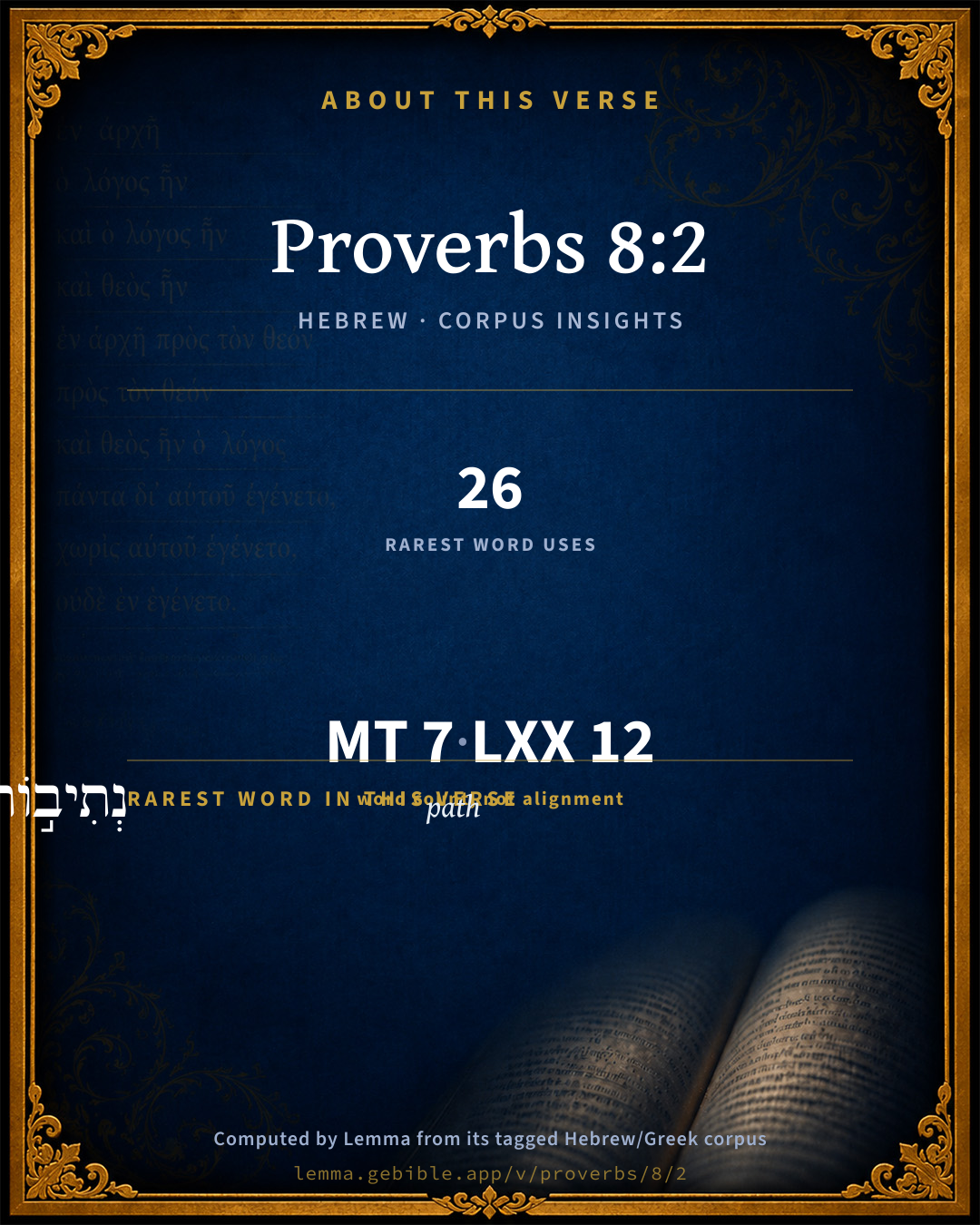
נְתִיב֣וֹת path H5410 occurs in 26 verses of the Hebrew Bible. Also found in:

Grammatical profile

  • 1 verb
  • 5 nouns
  • 1 preposition

Verb forms

  • נִצָּֽבָה Niphal · Perfect

Hebrew & Septuagint length

In English translation the verse runs 15 words from the Hebrew and 14 from the Septuagint (LXX English) — closely comparable.

A rough comparison of the two English renderings, which tokenize alike — not a word-level alignment.

Word counts can differ between the Hebrew and the Greek without any difference in meaning — e.g. the Hebrew direct-object marker אֵת has no separate Greek word, and Greek often adds the article ὁ.

In the original languages it is 7 Hebrew tokens and 12 Greek tokens — but the two are counted differently (Hebrew bundles its prefixes and suffixes into one token; the Greek is in lemma form), so that isn’t a like-for-like length.

Cross-references

2

Topical passages linked to Proverbs 8:2 in the Treasury of Scripture Knowledge — connected by theme and wording, ordered by reader-vote popularity; previews shown in the World English Bible.

  • Proverbs 9:14 She sits at the door of her house, On a seat in the high places of the city,
  • Proverbs 9:3 She has sent out her maidens. She cries from the highest places of the city:

Cross-references courtesy of OpenBible.info (CC BY 4.0).

Hebrew and Greek witnesses Masoretic Hebrew ↔ Greek Septuagint

The same verse in the two great witnesses to the Old Testament, shown verse-for-verse.

These are two independent witnesses, not word-aligned to each other, and the Septuagint is shown in lemma (dictionary) form.

Hebrew Proverbs 8:2 Masoretic · Westminster Leningrad Codex

בְּרֹאשׁ מְרוֹמִ֥ים עֲלֵי דָ֑רֶךְ בֵּ֖ית נְתִיב֣וֹת נִצָּֽבָה

On the top of high places by the way, Where the paths meet, she stands.

World English Bible · Public Domain

Greek LXX Proverbs 8:2 Septuagint · lemma form

ἐπί γάρ ὁ ὑψηλός ἄκρος εἰμί ἀνά μέσος δέ ὁ τρίβων ἵστημι

For she is on lofty eminences, and stands in the midst of the ways.

LXX2012 (modern English Septuagint) · Public Domain

Hebrew: Westminster Leningrad Codex (CC BY 4.0). Greek: Septuagint (public domain); English from LXX2012 (modern English Septuagint) (Public Domain). How the Septuagint differs from the Hebrew →

Commentary

Notes on Proverbs 8:2 from classic Christian and Jewish commentators (each source and its license shown beneath its notes). The classic Christian expositions comment on the surrounding passage and are grouped to its opening verse, so a note may address several verses; the Jewish commentaries on the Tanakh (Rashi and others) are per-verse, so they appear only where the commentator wrote on this verse.

Lemma curates 59 commentaries, every one of them public domain or Creative Commons licensed, each selected and text-cleaned for this edition rather than reprinted as found. About our sources →

Trapp's Complete Commentary

John Trapp

Pro 8:2 She standeth in the top of high places, by the way in the places of the paths.

Ver. 2. She standeth in the top of high places.] That is, saith an interpreter, In the lofty oracles of the patriarchs and prophets.

John Trapp, A Commentary or Exposition upon All the Books of the Old and New Testament (1647–1656) — public domain. Text from a community e-Sword module.

The Biblical Illustrator

Joseph S. Exell

Pro_8:2

She standeth in the top of high places.

The purpose and range of Wisdom

She sets up her tower everywhere, and speaks to all mankind. That is the true wisdom. When we come to understand the purpose and range of true wisdom, our business will be to see how many people we can get in, not how many we can keep out. Sometimes we shall endeavour to enlarge the gate, if haply we may bring some one in who otherwise would be kept outside. Wisdom does not whisper; she cries: she puts forth her voice; she asks the assistance of elevation; where men are found in greatest number she is found in greatest activity. Universality is a proof of the gospel. Any gospel that comes down to play the trick of eclecticism ought to be branded, and dismissed, and never inquired for. We want ministers that will speak to the world, in all its populations, climes, languages, and differences of civilisation and culture. (J. Parker, D. D.)

The Biblical Illustrator, edited by Joseph S. Exell (c. 1880s–1900s) — public domain. Text from a community e-Sword module.

Joseph Benson's Commentary

Pro 8:2-6. She standeth in the top of high places — Where she may be best seen and heard; not in corners, and in the dark, as the harlot did; by the way in the places of the paths — Where many paths meet, where there is a great concourse, and where travellers may need direction. She crieth at the gates — The places of judgment, and of the confluence of the people; at the entry of the city — To invite passengers at their first coming, and to conduct them to her house; at the coming in of the doors — Namely, of her house, as the harlot stood at her door to invite lovers. Unto you, O men, I call — To all men without exception, even to the meanest and most unworthy. O ye simple — Who want knowledge and experience, and are easily deceived; and ye fools — Wilful sinners. Hear, for I will speak excellent things — Hebrew, נגידים, princely things; things worthy of princes to learn and practise. Or such as excel common things, as much as princes do ordinary persons.

Joseph Benson's Commentary on the Old and New Testaments (1811–1818) — public domain. Text from a community e-Sword module.

Tyndale Open Study Notes

Tyndale Open Resources

8:2 The hilltop and crossroads provide maximum public access to all who pass by.

Tyndale Open Study Notes — © Tyndale Open Resources, licensed CC BY-SA 4.0. Text via the HelloAO Bible API.

Adam Clarke's Commentary

Verse 2. In the places of the paths.] בית נתיבת נצבה beith nethiboth nitstsabah, "The constituted house of the paths." Does not this mean the house of public worship? the tabernacle or temple, which stands a centre to the surrounding villages, the paths from all the parts leading to and terminating at it? In such a place, where the holy word of God is read or preached, there in a particular manner does wisdom cry, and understanding lift up her voice. There are the warnings, the precepts, and the promises of eternal truth; there the bread of God is broken to his children, and thither they that will may come and take the water of life freely.

Adam Clarke's Commentary on the Bible (1810–1826) — public domain. Text from a community e-Sword/MySword module.

Ellicott's Commentary for English Readers

(2) She standeth in the top of high places.—i.e., in the higher parts of the city, where her voice will best be heard.

By the way . . .—She goes everywhere where she may find the greatest concourse of people, “God not being willing that any should perish, but that all should come to repentance” (2Pe_3:9). So the apostles made large centres of population such as Antioch, Ephesus, or Corinth, the headquarters of their missionary enterprise.

A Bible Commentary for English Readers, edited by Charles John Ellicott (1878–1897) — public domain. Text from a community e-Sword module.

The Cambridge Bible for Schools and Colleges

gen. ed. J. J. S. Perowne

2. in the places of the paths] Lit. in the house or home of the paths, i.e. where many roads or streets run up into one common meeting-place, and so give vantage-ground for her call.

The R.V. arranges the verse in the order of the Heb.:

In the top of high places by the way,

Where the paths meet, she standeth.

The Cambridge Bible for Schools and Colleges (gen. ed. J. J. S. Perowne; Cambridge University Press, 1878–1918) — public domain. Text from a community e-Sword module.

John Gill's Exposition

She standeth in the top of high places,.... To be both seen and heard, for which reason Christ went up into a mountain and preached, Mat 5:1;

by the way; the roadside, to instruct and direct passengers as they go along, to show them the right way, and caution them against taking wrong ways; so did Christ, Mat 16:6;

in the places of the paths; or, "between the paths" (s); where more ways than one met together, and so difficult to know which was the right path to take; here Christ stands in the ministry of the word to direct, and says, "this is the way, walk ye in it", Isa 30:21; and as there are many ways which are proposed to men to walk in, some of open profaneness and impiety, and others that have a show of religion and devotion, but both lead men wrong; the ministers of Christ show, and he by them, the way of salvation, and how to avoid such as lead to destruction, Act 16:17.

(s) "in mediis semitis", V. L. "inter semitas", Tigurine version, Baynus; so some in Vatablus; "in mediis compitis", Schultens; to the Targum, Sept. and Arabic versions.

John Gill's Exposition of the Whole Bible (1746–1763) — public domain (CC PDM 1.0). Text via the HelloAO Bible API.

Albert Barnes' Notes on the Bible

The full enumeration of localities points to the publicity and openness of Wisdom’s teaching (see Pro 1:20 note), as contrasted with the stealth and secrecy and darkness which shroud the harlot’s enticements Pro 7:9.

Albert Barnes' Notes on the Bible (1834–1885) — public domain. Text from a community e-Sword/MySword module.

Matthew Poole's English Annotations

In the top of high places, where she may be best seen and heard; not in corners and in the dark, as the harlot did. In the places of the paths; where many paths meet, where there is a great concourse, and where travellers may need direction.

Matthew Poole's English Annotations on the Holy Bible (1683–1685) — public domain. Text from a community e-Sword/MySword module.

Whedon's Commentary on the Bible

Daniel D. Whedon

2, 3. She standeth — Is stationed, like a person making a public proclamation, in the top of high places, by the way; or, on the top of eminences, by the way side, and in the places of the paths; or, “at home among the paths.” — Miller. The idea conveyed is, that of entire and sought-for publicity, as of one who has an important public message to deliver — important to all.

At the gates — Hebrews, At the hand of the gates.

At the entry of the city — Hebrew, mouths of the city.

At the coming in at the doors — פתחים, (pethahhim,) means openings, gateways, and might be applied to avenues or other openings; but there is no example of such application. The general idea is, that she makes her proclamation at all places of public resort. “At the entrance of the avenues.” — Stuart. Persons desirous of proclaiming intelligence of great interest sought places where they could be most distinctly and most widely heard. Isa_40:9; Isa_52:7-8; Luk_12:3.

Daniel D. Whedon (gen. ed.), Commentary on the Old and New Testaments (1874–1909) — public domain. Text from a community e-Sword module.

The Pulpit Commentary

She standeth in the top of high places, by the way. She takes her stand, not in thievish corners of the streets, like the harlot, but in the most open and elevated parts of the city, where she may be best seen and heard by all who pass by. (see Pro_1:21, and note there) In the places of the paths; i.e. where many paths converge, and where people meet from different quarters.

The Pulpit Commentary (1880–1919), ed. H.D.M. Spence-Jones & Joseph S. Exell — public domain. Text from a community e-Sword module.

John Wesley's Explanatory Notes

High place - Where she may be best seen and heard. Paths - Where many paths meet, where there is a great concourse, and where travelers may need direction.

John Wesley, Explanatory Notes Upon the Whole Bible (1754–1765) — public domain. Text via the GEBible commentary corpus.

Lesson kit

Teaching starters — assembled from the data on this page, not authored interpretation. Every prompt links to the verse data it draws on. Edit before teaching.

Proverbs, in the Wisdom, opens this verse with 7 words (7 distinct Hebrew lemmas). Its most distinctive word is nâthîyb (“path”). A historical commentator’s framing appears above. Read the whole chapter for the surrounding context.

Discussion questions

  1. What does “path” (nâthîyb) contribute to the verse as a whole?
  2. How does Judges 5:6, which shares the word «path», read alongside this verse?
  3. These translations render this verse differently; the difference is in the English rendering, not the original. What questions does that raise?
  4. «נִצָּֽבָה» is a Niphal Perfect verb. How does that grammatical form shape the action described?
  5. Compare how Trapp's Complete Commentary and The Biblical Illustrator read this verse. Where do they agree or differ?

Things to notice

Reading settings

Reading text

Shown beneath each verse's original-language words.

Old Testament
Old Testament edition

Read the OT as the Masoretic Hebrew (MT) or the Greek Septuagint (LXX).

English shown for the Greek Septuagint (in the Hebrew ↔ Greek comparison).

Comparing translations? Open the Compare panel on any verse page to stack up to four side by side.