1 Kings 4:5

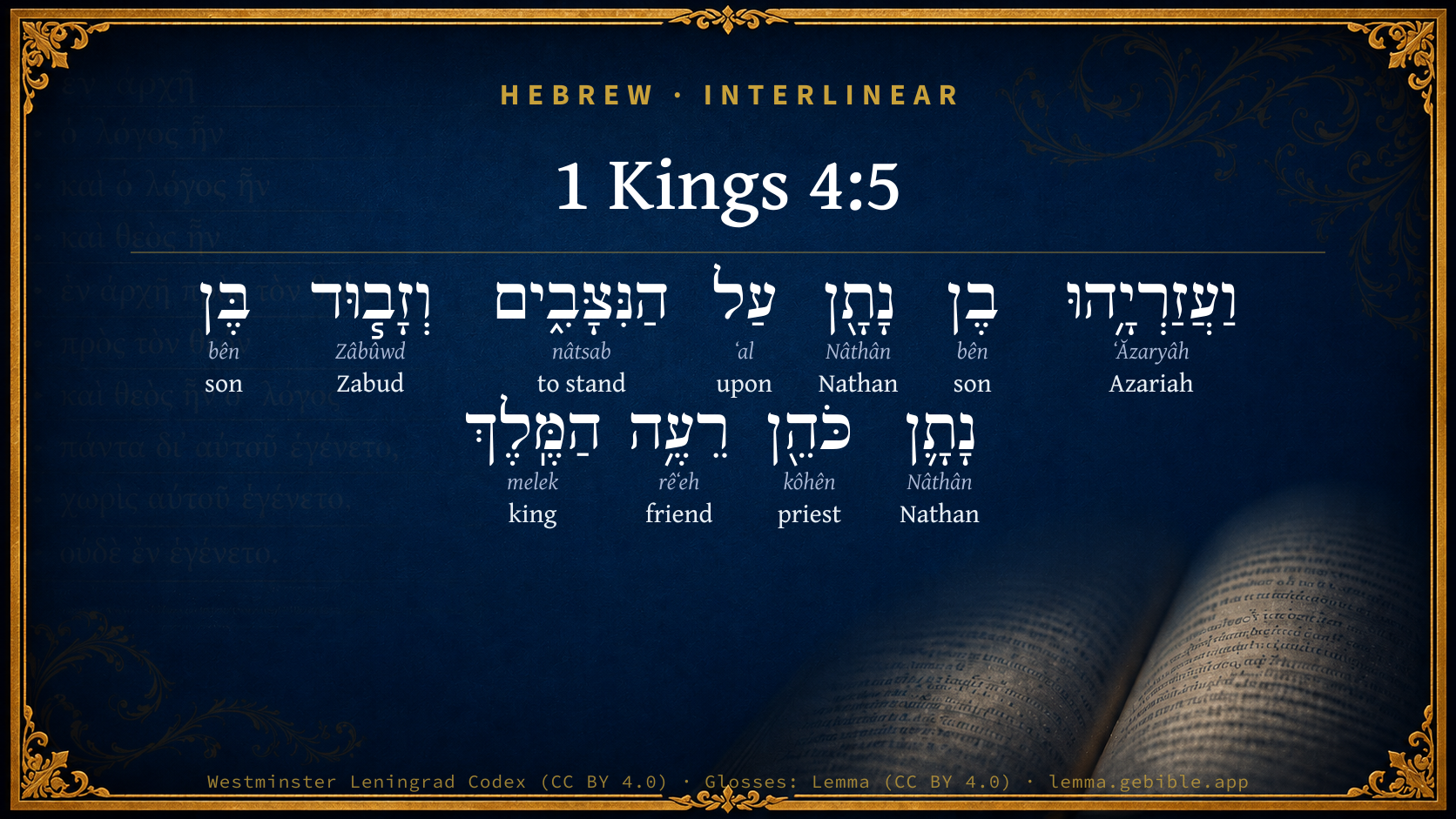
Hebrew (Westminster Leningrad Codex) 1 Kings 4:5 appears in the Hebrew Old Testament. The text above is from the Westminster Leningrad Codex. Each word links to its Strong’s number, a concise gloss, and parsing drawn from the Open Scriptures Hebrew Bible morphology. Click any word for its full Brown-Driver-Briggs (BDB) entry.
Download image
Cite this verse

1 Kings 4:5 (World English Bible). Public Domain. Lemma interlinear Bible study tool, https://lemma.gebible.app/v/1-kings/4/5.

Show BibTeX & RIS
BibTeX
RIS
English Translation
and Azariah the son of Nathan was over the officers; and Zabud the son of Nathan was chief minister, [and] the king's friend;
World English Bible · Public Domain
Highlights
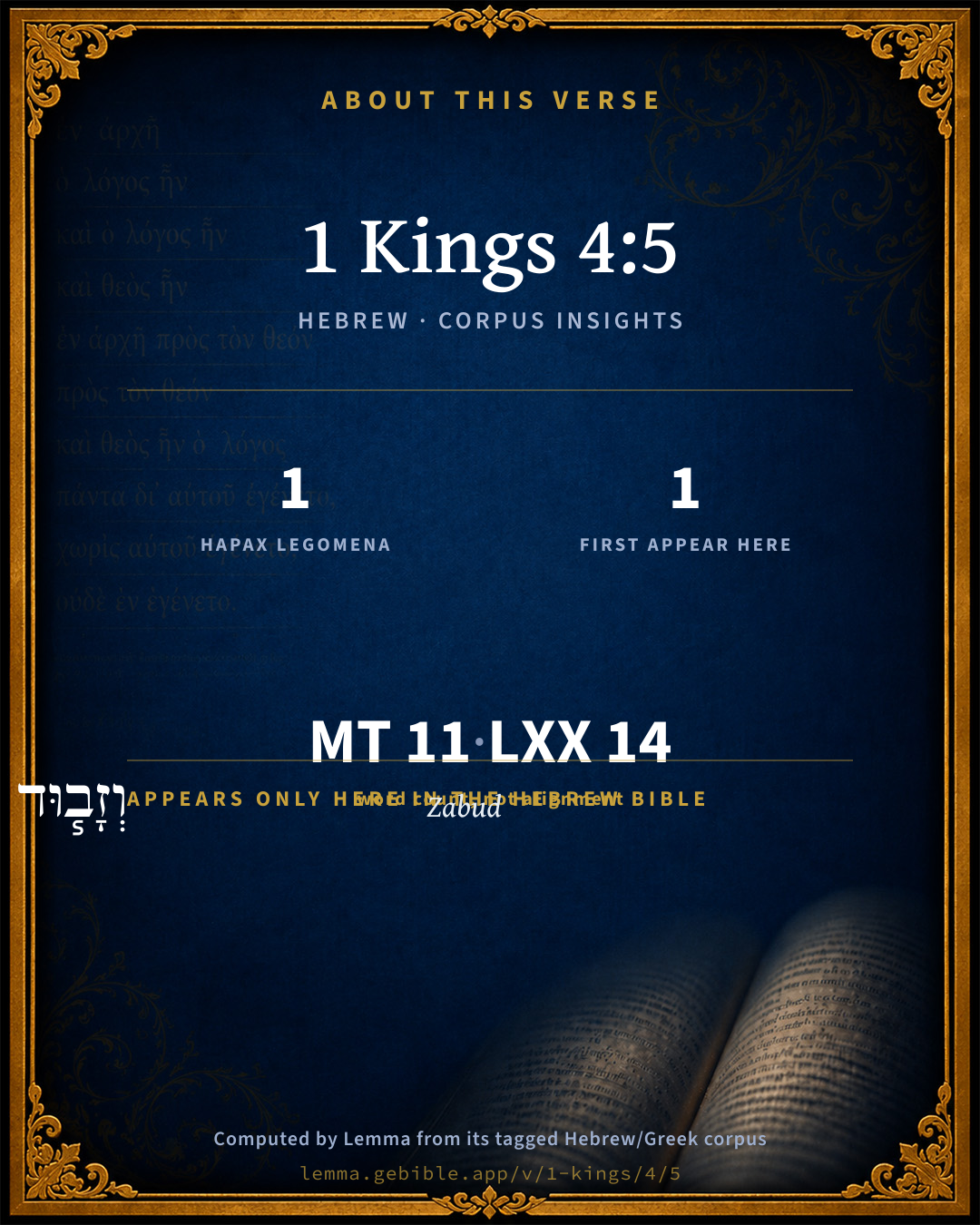
  • 1 hapax legomenon — only here in the Hebrew Bible
  • 1 first appearance in the Hebrew Bible
Full analysis ↓
Download a study sheet

One document with this verse’s original text, its word-by-word gloss line, the meaning frame, cross-references with their text, attributed commentary, and full source and license credits — printable, and it pastes into notes with its structure intact.

This verse Autodidact and up

Study sheet (.html) Plain text (.txt)

A passage Seminary Student

Up to 50 verses in one chapter. A passage sheet keeps up to 6 commentary sources and 12 cross-references per verse, in the order this page ranks them, and says so on the sheet whenever that leaves anything out. Ask for a single verse and you get the Autodidact verse sheet above.

Everything on this page stays free to read, with no account — the sheet is a download of what is already on screen, not access to it.

Want to remove ads? Support Godless Engineer
Compare translations 3

The same verse in 3 English versions, stacked beneath the original-language interlinear above. Click any original word for its lexicon entry.

Each is an independent rendering of the whole verse — the interlinear is not word-aligned to these translations.

Highlighted words mark where these versions differ — a whole-verse word diff, not a word-by-word alignment.

  • World English Bible Public Domain
    and Azariah the son of Nathan was over the officers; and Zabud the son of Nathan was chief minister, [and] the king's friend;
  • King James Version Public Domain
    And Azariah the son of Nathan was over the officers: and Zabud the son of Nathan was principal officer, and the king's friend:
  • unfoldingWord Literal Text CC BY-SA 4.0
    And Azariah, the son of Nathan, over the deputies. And Zabud, the son of Nathan, a priest, a friend of the king.

unfoldingWord Literal Text — © unfoldingWord, licensed CC BY-SA 4.0. Word-aligned USFM3 via Door43 (git.door43.org/unfoldingWord/en_ult).

Versions to compare (up to 4)

3 of 4 selected

Show all 18 translations

Every available English version of this verse, each an independent rendering of the whole verse.

  • World English Bible Public Domain
    and Azariah the son of Nathan was over the officers; and Zabud the son of Nathan was chief minister, [and] the king's friend;
  • Berean Standard Bible Public Domain
    Azariah son of Nathan was in charge of the governors; Zabud son of Nathan was a priest and adviser to the king;
  • Majority Standard Bible Public Domain
    Azariah son of Nathan was in charge of the governors; Zabud son of Nathan was a priest and adviser to the king;
  • King James Version Public Domain
    And Azariah the son of Nathan was over the officers: and Zabud the son of Nathan was principal officer, and the king's friend:
  • American Standard Version (1901) Public Domain
    and Azariah the son of Nathan was over the officers; and Zabud the son of Nathan was chief minister, `and' the king's friend;
  • Revised Version (1885) Public Domain
    and Azariah the son of Nathan was over the officers; and Zabud the son of Nathan was priest, and the king’s friend;
  • Geneva Bible (1599) Public Domain
    And Azariah the sonne of Nathan was ouer the officers, and Zabud the sonne of Nathan Priest was the Kings friend,
  • Douay-Rheims (1899) Public Domain
    Azarias the son of Nathan, over them that were about the king: Zabud, the son of Nathan the priest, the king's friend:
  • Young's Literal Translation Public Domain
    and Azariah son of Nathan `is' over the officers; and Zabud son of Nathan `is' minister, friend of the king;
  • Literal Standard Version CC BY-SA 4.0
    and Azariah son of Nathan [is] over the officers; and Zabud son of Nathan [is] minister, friend of the king;
  • Unlocked Literal Bible CC BY-SA 4.0
    Azariah son of Nathan was over the officers. Zabud son of Nathan was a priest and the king's friend.
  • unfoldingWord Literal Text CC BY-SA 4.0
    And Azariah, the son of Nathan, over the deputies. And Zabud, the son of Nathan, a priest, a friend of the king.
  • Darby Bible Public Domain
    and Azariah the son of Nathan was over the superintendents; and Zabud the son of Nathan was principal officer, the king's friend;
  • World Messianic Bible Public Domain
    Azariah the son of Nathan was over the officers; Zabud the son of Nathan was chief minister, the king’s friend;
  • Webster's Bible Public Domain
    And Azariah the son of Nathan was over the officers: and Zabud the son of Nathan was principal officer, and the king's friend:
  • Free Bible Version CC BY-SA 4.0
    Azariah, son of Nathan, was in charge of the governors. Zabud, son of Nathan, was a priest and the king's counselor.
  • Bible in Basic English Public Domain
    Azariah, the son of Nathan, was over those in authority in the different divisions of the country; Zabud, the son of Nathan, was priest and the king's friend;
  • JPS Tanakh (1917) Public Domain
    and Azariah the son of Nathan was over the officers; and Zabud the son of Nathan was chief minister and the king's friend;

Literal Standard Version (2020), Covenant Press — licensed CC BY-SA 4.0. Text via the HelloAO Bible API (eBible.org). Unlocked Literal Bible (unfoldingWord) — licensed CC BY-SA 4.0. Text via the HelloAO Bible API (eBible.org). unfoldingWord Literal Text — © unfoldingWord, licensed CC BY-SA 4.0. Word-aligned USFM3 via Door43 (git.door43.org/unfoldingWord/en_ult). Free Bible Version, Dr. Jonathan Gallagher — licensed CC BY-SA 4.0. Text via the HelloAO Bible API (eBible.org).

Word by word

More ways to search: Search by grammar → Find every occurrence → Compare this word →

Practice this passage: Drill this verse → Learn its vocabulary →

About this verse

These counts appear in no published source. They are computed here, from the morphology-tagged text and Lemma’s own curated glosses. What Lemma adds →

11
words
9
distinct lemmas
Historical
section

Notable vocabulary

1 hapax legomenon — a word that appears only here in the entire Hebrew Bible:

  • וְזָב֧וּד Zabud H2071

First appearance in Scripture

This word makes its first canonical appearance in the Hebrew Bible here:

  • וְזָב֧וּד Zabud H2071

Shared distinctive vocabulary

רֵעֶ֥ה friend H7463 occurs in 4 verses of the Hebrew Bible. Also found in:

Grammatical profile

  • 1 verb
  • 9 nouns
  • 1 preposition

Verb forms

  • הַנִּצָּבִ֑ים Niphal · Participle Active

Repetition

Words recur within this verse — often emphatic in Hebrew:

  • בֶן son H1121 ×2
  • נָתָ֖ן Nathan H5416 ×2

Hebrew & Septuagint length

In English translation the verse runs 23 words from the Hebrew and 19 from the Septuagint (LXX English) — closely comparable.

A rough comparison of the two English renderings, which tokenize alike — not a word-level alignment.

Word counts can differ between the Hebrew and the Greek without any difference in meaning — e.g. the Hebrew direct-object marker אֵת has no separate Greek word, and Greek often adds the article ὁ.

In the original languages it is 11 Hebrew tokens and 14 Greek tokens — but the two are counted differently (Hebrew bundles its prefixes and suffixes into one token; the Greek is in lemma form), so that isn’t a like-for-like length.

Cross-references

15

Topical passages linked to 1 Kings 4:5 in the Treasury of Scripture Knowledge — connected by theme and wording, ordered by reader-vote popularity; previews shown in the World English Bible.

  • 2 Samuel 15:37 So Hushai, David's friend, came into the city; and Absalom came into Jerusalem.
  • 2 Samuel 16:16 It happened, when Hushai the Archite, David's friend, was come to Absalom, that Hushai said to Absalom, [Long] live the king, [Long] live the king.
  • 1 Chronicles 27:33 Ahithophel was the king's counselor: and Hushai the Archite was the king's friend:
  • 2 Samuel 7:2 that the king said to Nathan the prophet, See now, I dwell in a house of cedar, but the ark of God dwells within curtains.
  • 2 Samuel 8:18 and Benaiah the son of Jehoiada [was over] the Cherethites and the Pelethites; and David's sons were chief ministers.
  • 2 Samuel 12:1–15 Yahweh sent Nathan to David. He came to him, and said to him, "There were two men in one city; the one rich, and the other poor.
  • 2 Samuel 12:25 and he sent by the hand of Nathan the prophet; and he named him Jedidiah, for Yahweh's sake.
  • 2 Samuel 19:37–38 Please let your servant turn back again, that I may die in my own city, by the grave of my father and my mother. But behold, your servant Chimham; let him go over with my lord the king; and do to him what shall seem good to you.
  • 2 Samuel 20:26 and also Ira the Jairite was chief minister to David.
  • 1 Kings 1:10–53 but Nathan the prophet, and Benaiah, and the mighty men, and Solomon his brother, he didn't call.
  • 1 Kings 4:7 Solomon had twelve officers over all Israel, who provided food for the king and his household: each man had to make provision for a month in the year.
  • Proverbs 22:11 He who loves purity of heart and speaks gracefully Is the king's friend.
  • John 13:23 One of his disciples, whom Jesus loved, was at the table, leaning against Jesus' breast.
  • John 15:14–15 You are my friends, if you do whatever I command you.
  • James 2:23 and the Scripture was fulfilled which says, "Abraham believed God, and it was accounted to him as righteousness;" and he was called the friend of God.

Cross-references courtesy of OpenBible.info (CC BY 4.0).

Hebrew and Greek witnesses Masoretic Hebrew ↔ Greek Septuagint

The same verse in the two great witnesses to the Old Testament, shown verse-for-verse.

These are two independent witnesses, not word-aligned to each other, and the Septuagint is shown in lemma (dictionary) form.

Hebrew 1 Kings 4:5 Masoretic · Westminster Leningrad Codex

וַעֲזַרְיָ֥הוּ בֶן נָתָ֖ן עַל הַנִּצָּבִ֑ים וְזָב֧וּד בֶּן נָתָ֛ן כֹּהֵ֖ן רֵעֶ֥ה הַמֶּֽלֶךְ

and Azariah the son of Nathan was over the officers; and Zabud the son of Nathan was chief minister, [and] the king's friend;

World English Bible · Public Domain

Greek LXX 1 Kings 4:5 Septuagint · lemma form

καί ορνια υἱός ναθαν ἐπί ὁ καταἵστημι καί ζαβουθ υἱός ναθαν ἑταῖρος ὁ βασιλεύς

And Ornia the son of Nathan was over the officers; and Zabuth son of Nathan was the king's friend.

LXX2012 (modern English Septuagint) · Public Domain

On this verse, The Pulpit Commentary discusses the Septuagint’s reading. Read the note in Commentary ↓

Hebrew: Westminster Leningrad Codex (CC BY 4.0). Greek: Septuagint (public domain); English from LXX2012 (modern English Septuagint) (Public Domain). How the Septuagint differs from the Hebrew →

Targum (Aramaic paraphrase)

1

The Targum is the ancient Jewish Aramaic paraphrase of the Hebrew Scriptures — an interpretive translation, not the Hebrew text itself. Onkelos (literal) and Pseudo-Jonathan (expansive) render the Torah, and Jonathan the Prophets. Coverage is partial: where no permissively-licensed English translation exists for a verse, only the Aramaic is shown. This is verse-level text, not a word-by-word alignment to the Hebrew.

  1. Targum Jonathan Prophets (Joshua–Malachi)
    וַעֲזַרְיָהוּ בַר נָתָן מְמַנָא עַל אִסְטַרְטִיגַיָא וְזָבוּד בַּר נָתָן רַבָּא שׁוֹשְׁבִינָא דְמַלְכָּא:

    (no public-domain English translation for this verse)

    Targum Jonathan — Aramaic: “Mikraot Gedolot” (public domain). English: “Sefaria Community Translation” (CC0 1.0 (public-domain dedication)); “London "Chaldee Paraphrase," 1871” (public domain). Text via Sefaria.

Commentary

Notes on 1 Kings 4:5 from classic Christian and Jewish commentators (each source and its license shown beneath its notes). The classic Christian expositions comment on the surrounding passage and are grouped to its opening verse, so a note may address several verses; the Jewish commentaries on the Tanakh (Rashi and others) are per-verse, so they appear only where the commentator wrote on this verse.

Lemma curates 59 commentaries, every one of them public domain or Creative Commons licensed, each selected and text-cleaned for this edition rather than reprinted as found. About our sources →

Trapp's Complete Commentary

John Trapp

1Ki 4:5 And Azariah the son of Nathan [was] over the officers: and Zabud the son of Nathan [was] principal officer, [and] the king’s friend:

Ver. 5. And Azariah the son of Nathan, &c.] These two had been Solomon’s fellow pupils, his play fellows, likely, and sons to his tutor, Nathan the prophet, who had done much for him, and for whom he could never do enough. Our king Edward VI did much for his tutor, Mr Cheek, and Queen Elizabeth for Dr Cox, upon whom she conferred many church dignities and real favours.

John Trapp, A Commentary or Exposition upon All the Books of the Old and New Testament (1647–1656) — public domain. Text from a community e-Sword module.

Joseph Benson's Commentary

1Ki 4:5-6. The son of Nathan was over the officers — Over those twelve officers named 1Ki 4:7, &c., who were all to give up their accounts to him. The Hebrew word, נצביםnitsabim, here, and 1Ki 4:7, rendered officers, signifies any governors, or commanders of the higher sort. See 2Ch 8:10. Zabud the son of Nathan — The prophet, who had been so highly instrumental in establishing Solomon on the throne; was principal officer — Possibly president of the king’s council. The Hebrew word is כהן, cohen, which, 1Ki 4:2, and generally, is rendered priest, although, as we have observed there, it may also be translated prince. And the king’s friend — His confidant, with whom he used to communicate his most secret counsels. Ahishar was over the household — Steward of the king’s house. Over the tribute — The personal tribute, or levy of men, as appears by comparing this with 1Ki 5:13-14; it being very fit that there should be some one person to whom the chief conduct or inspection of that great business should be committed.

Joseph Benson's Commentary on the Old and New Testaments (1811–1818) — public domain. Text from a community e-Sword module.

Tyndale Open Study Notes

Tyndale Open Resources

4:5 Two sons of Nathan also served in Solomon’s inner circle. Azariah supervised the twelve district governors, while Zabud . . . was a trusted adviser, a post held by Hushai under David (2 Sam 15:37).

Tyndale Open Study Notes — © Tyndale Open Resources, licensed CC BY-SA 4.0. Text via the HelloAO Bible API.

Jamieson, Fausset & Brown

Robert Jamieson, A. R. Fausset & David Brown

over the officers--that is, the provincial governors enumerated in Kg1 4:17-19.

principal officer, and the king's friend--perhaps president of the privy council, and Solomon's confidential friend or favorite. This high functionary had probably been reared along with Solomon. That he should heap those honors on the sons of Nathan was most natural, considering the close intimacy of the father with the late king, and the deep obligations under which Solomon personally lay to the prophet.

Jamieson, Fausset & Brown — Commentary Critical and Explanatory on the Whole Bible (1871) — public domain (CC PDM 1.0). Text via the HelloAO Bible API.

Adam Clarke's Commentary

Verse 5. Azariah - was over the officers] He had the superintendence of the twelve officers mentioned below; see 1Kg 4:7.

Zabud - was principal officer] Perhaps what we call premier, or prime minister.

The king's friend] His chief favourite - his confidant.

Adam Clarke's Commentary on the Bible (1810–1826) — public domain. Text from a community e-Sword/MySword module.

Ellicott's Commentary for English Readers

(5) Son of Nathan.—Probably Nathan, son of David, and own brother of Solomon (1Ch_3:5), is here intended; for the title Cohen, here given to Zabud, is expressly ascribed in 2Sa_8:18 to the “sons of David;” and Nathan the prophet always has his title, “the prophet,” appended to his name wherever first mentioned in this book. (See 1Ki_1:8; 1Ki_1:10; 1Ki_1:22; 1Ki_1:32, &c.)

Azariah is the “chief of the officers”—that is, chief over the twelve officers mentioned below (1Ki_4:7-19)—living, however, at Court.

Zabud, besides the title of Cohen, has that of “the king’s friend,” previously given to Hushai (2Sa_15:37; 2Sa_16:16), and apparently indicating special intimacy and wisdom as a “privy counsellor.”

A Bible Commentary for English Readers, edited by Charles John Ellicott (1878–1897) — public domain. Text from a community e-Sword module.

The Cambridge Bible for Schools and Colleges

gen. ed. J. J. S. Perowne

5. the officers] The word signifies such persons as had the oversight of any work. Thus the same word is used for the victualling officers in 1Ki_4:7; it is again used in 1Ki_5:16 for the persons at the head of the preparation for the temple-building, and in 1Ki_9:23 of those who bare rule over the people that wrought in such works as the building of cities which is there described.

principal officer] The Hebrew word is cohen, usually = ‘priest,’ but see on 1Ki_4:2.

the king’s friend] This means a chief and intimate counsellor. It is applied to Hushai (2Sa_15:37; 2Sa_16:16) and from the relation in which Hushai stood to David we may see what is implied in the title.

The Cambridge Bible for Schools and Colleges (gen. ed. J. J. S. Perowne; Cambridge University Press, 1878–1918) — public domain. Text from a community e-Sword module.

John Gill's Exposition

And Abiathar was over the household,.... Steward of the household:

and Adoniram the son of Abda was over the tribute, over those that collected the tribute, as the Targum, whether from the people of Israel or other nations, or both; this man was in the same post in David's time, Sa2 20:24.

John Gill's Exposition of the Whole Bible (1746–1763) — public domain (CC PDM 1.0). Text via the HelloAO Bible API.

Albert Barnes' Notes on the Bible

The son of Nathan - It is uncertain whether the Nathan of this verse is the prophet or the son of David 2Sa 5:14. While on the one hand the position of “king’s friend” is more likely to have been held by a contemporary, which the prophet’s son would have been, than by one so much younger as the son of a younger brother; on the other hand the title “cohen” seems to point to a member of the royal family. (See the next note.) Azariah who was “over the officers” was chief, that is, of the “officers” mentioned in 1Ki 4:8-19, as appears from the identity of the term here used with the title by which they are designated in 1Ki 4:7.

Principal officer - Or, “cohen.” The fact that the title כהן kôhên was borne by sons of David 2Sa 8:18, who could not be “priests” in the ordinary sense of the word, seems to identify the Nathan of this verse with David’s son 2Sa 5:14 rather than with the prophet.

Albert Barnes' Notes on the Bible (1834–1885) — public domain. Text from a community e-Sword/MySword module.

Haydock's Catholic Bible Commentary

King. President of the council, (Menochius) steward of the household. --- Priest refers to Zabud here, though the Hebrew is ambiguous. It means also a prince. (Haydock) --- He was chief officer and favourite of Solomon, (Calmet) as Chusai had been of David, 2 Kings xvi. 16.

George Leo Haydock (1774–1849), Haydock's Catholic Family Bible and Commentary, 1859 edition — public domain. Excludes Psalms (Douay-Rheims chapter numbering differs from Protestant) and Deuterocanonical books (Catholic canon only).

Matthew Poole's English Annotations

Over the officers, or overseers, or surveyors, to wit, over those twelve officers named 1Ki 4:7, &c., where this Hebrew word is used, who were all subject, and to give up their accounts to him; though the word signifies any governors or commanders of the higher sort, as 1Ki 5:16; 2Ch 8:10.

Son of Nathan, the prophet, who had been so highly instrumental in Solomon’s establishment in the throne.

Principal officer; possibly president of the king’s council. The Hebrew word is cohen, which, 1Ki 4:2, is rendered priest; whence some read this place thus: Zabud the son of Nathan the priest, or the minister, (as the word properly signifies, and that title well enough agrees to a prophet; or the prince, for the prophet Nathan was a man considerable both for his quality, and for his honour and esteem with the king,) was the king’s friend.

The king’s friend; either his special favourite, both for his father’s sake and for his own, having, it seems, been brought up with him; or his confidant, with whom he used to communicate his most secret counsels.

Matthew Poole's English Annotations on the Holy Bible (1683–1685) — public domain. Text from a community e-Sword/MySword module.

Whedon's Commentary on the Bible

Daniel D. Whedon

5. Son of Nathan — This Nathan may have been either the prophet or son of David mentioned 2Sa_5:14.

Over the officers — That is, the twelve officers mentioned in 1Ki_4:7. So he was a sort of commissary-general for the whole kingdom.

Principal officer — Here the word כהן, which usually means priest, manifestly has a different signification. By comparing 2Sa_8:18 with 1Ch_18:17, we infer that it means a high officer whom the king treats as his intimate counsellor and confidential adviser. David chose his own sons for this office; and where is the monarch or chieftain who has not had some person or persons to serve him in this capacity? During his short triumph Absalom virtually set Ahithophel and Hushai in this office. That the king always, or even usually, followed the counsels of this officer is not to be supposed.

His work was to suggest, not to adopt or decide, plans for his sovereign. He is further described as being the king’s friend — that is, his personal confidant and favourite.

Daniel D. Whedon (gen. ed.), Commentary on the Old and New Testaments (1874–1909) — public domain. Text from a community e-Sword module.

The Pulpit Commentary

And Azariah the son of Nathan Azariah was clearly not an uncommon name (ver. 2, and cf. 1Ch_2:39 Hebrews; A.V 6:9-14), especially in the high priest"s family. Keil and Bahr pronounce somewhat positively that this Nathan is not the prophet of that name, but Nathan the son of David (2Sa_5:14; Luk_3:31) It is quite impossible to decide with certainty which is meant, if either, though Zec_12:12 undoubtedly favours the supposition that the latter is here intended was over the officers the twelve prefects mentioned in vers. 7 sqq.: and Zabud the son of Nathan was principal officer Heb. priest, Vulg. sacerdos. Singularly, as before, the LXX (Vat.) omits the word. The expression can hardly mean "the son of Nathan the priest," but it may either signify that "Zabud ben Nathan, a priest, was king"s friend," or that (as in the A. V) he was a priest and king"s friend. But the former is every way preferable. I find it easier to believe that the true import of 2Sa_8:18 the passage which is cited (sometimes along withv) 2Sa_20:26, where the LXX, however, has iJereu to prove that there were secular "priests is not yet understood, than to hold (with Gesenius, Ewald, etc.), that there were sacrificing priests who were not of the sons of Aaron (cf., 2Ch_26:18) or that the word heK, the meaning of which was thoroughly fixed and understood, can have been familiarly applied, except in the strictly conventional way already indicated, to lay persons, and omit the king"s friend. "This appears to have been now a recognized office (2Sa_15:37 2Sa_16:16;" 1Ch_27:33) Rawlinson.

The Pulpit Commentary (1880–1919), ed. H.D.M. Spence-Jones & Joseph S. Exell — public domain. Text from a community e-Sword module.

John Wesley's Explanatory Notes

Officers - Over those twelve Officers, named ver. 7, &c. who were all to give up their accompts to him. Nathan - The prophet, who had been so highly instrumental in Solomon's establishment in the throne. Principal officer - Possibly, president of the king's council. Friend - His confident, with whom he used to communicate his most secret counsels.

John Wesley, Explanatory Notes Upon the Whole Bible (1754–1765) — public domain. Text via the GEBible commentary corpus.

unfoldingWord translationNotes

Door43 World Missions Community

General Information:

The list of Solomon's officials continues.

Azariah ... Nathan ... Zabud ... Ahishar ... Adoniram ... Abda

men's names (See: How to Translate Names)

the men who were subjected to forced labor

This can be translated in active form. AT: "the men whom Solomon forced to work for him" (See: Active or Passive)

translationWords

Nathan

household

subject

labor

unfoldingWord translationNotes — © Distant Shores Media and the Door43 World Missions Community, licensed CC BY-SA 4.0. Source: git.door43.org/Door43/en_tn.

Rashi

Rabbi Shlomo Yitzchaki (Rashi)

Over the officers. He had twelve officers to provide sustenance for the king and his household.

Rashi on the Tanakh — English translations: “The Judaica Press complete Tanach with Rashi, translated by A. J. Rosenberg” (CC BY 4.0); “Pentateuch with Rashi's commentary by M. Rosenbaum and A.M. Silbermann, 1929-1934” (public domain); “The Metsudah Tanach series, Lakewood, N.J” (CC BY 4.0); and “The Book of Joshua, Metsudah Publications, 1997” (CC BY 4.0). Text via Sefaria.

Lesson kit

Teaching starters — assembled from the data on this page, not authored interpretation. Every prompt links to the verse data it draws on. Edit before teaching.

1 Kings, in the Historical, opens this verse with 11 words (9 distinct Hebrew lemmas). Its most distinctive word is Zâbûwd (“Zabud”). A historical commentator’s framing appears above. Read the whole chapter for the surrounding context.

Discussion questions

  1. The word Zâbûwd carries the sense “Zabud.” How does it shape the verse?
  2. This verse holds 1 word here found nowhere else in the Hebrew Bible. What might the rare word draw attention to?
  3. The word “Zabud” first appears here in Scripture. What is being introduced at this debut?
  4. 2 Samuel 15:37 shares the word «friend» with this verse. How do the two illuminate each other?
  5. “son” occurs 2× in this one verse. What is the effect of the repetition?
  6. These translations render this verse differently; the difference is in the English rendering, not the original. What questions does that raise?
  7. The verb «הַנִּצָּבִ֑ים» is Niphal Participle Active. How does its form color the action?
  8. Reading how Trapp's Complete Commentary and Joseph Benson's Commentary read this verse, where do the two commentators agree and where do they part?

Things to notice

  • 1 word in this verse appears nowhere else in the Hebrew Bible.
  • 1 word makes its first canonical appearance in Scripture here.
  • This verse counts 11 Hebrew ↔ 14 Greek words.
  • These translations choose different wording for 9 words in this verse.
  • “son” occurs 2× in this single verse.

Reading settings

Reading text

Shown beneath each verse's original-language words.

Old Testament
Old Testament edition

Read the OT as the Masoretic Hebrew (MT) or the Greek Septuagint (LXX).

English shown for the Greek Septuagint (in the Hebrew ↔ Greek comparison).

Comparing translations? Open the Compare panel on any verse page to stack up to four side by side.