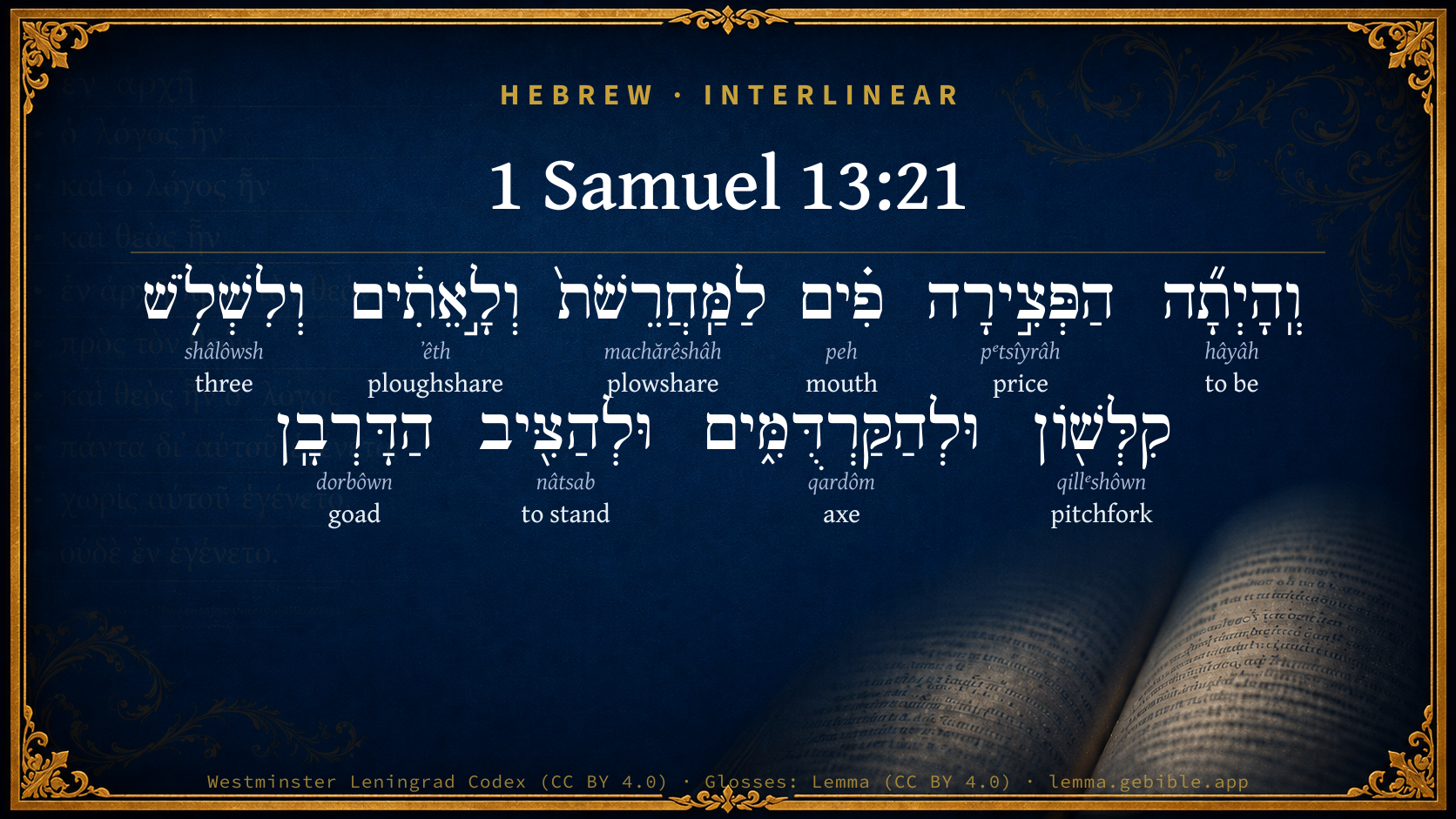
1 Samuel 13:21

Hebrew (Westminster Leningrad Codex) 1 Samuel 13:21 appears in the Hebrew Old Testament. The text above is from the Westminster Leningrad Codex. Each word links to its Strong’s number, a concise gloss, and parsing drawn from the Open Scriptures Hebrew Bible morphology. Click any word for its full Brown-Driver-Briggs (BDB) entry.
Download image
Cite this verse

1 Samuel 13:21 (World English Bible). Public Domain. Lemma interlinear Bible study tool, https://lemma.gebible.app/v/1-samuel/13/21.

Show BibTeX & RIS
BibTeX
RIS
English Translation
yet they had a file for the mattocks, and for the plowshares, and for the forks, and for the axes, and to set the goads.
World English Bible · Public Domain
Highlights
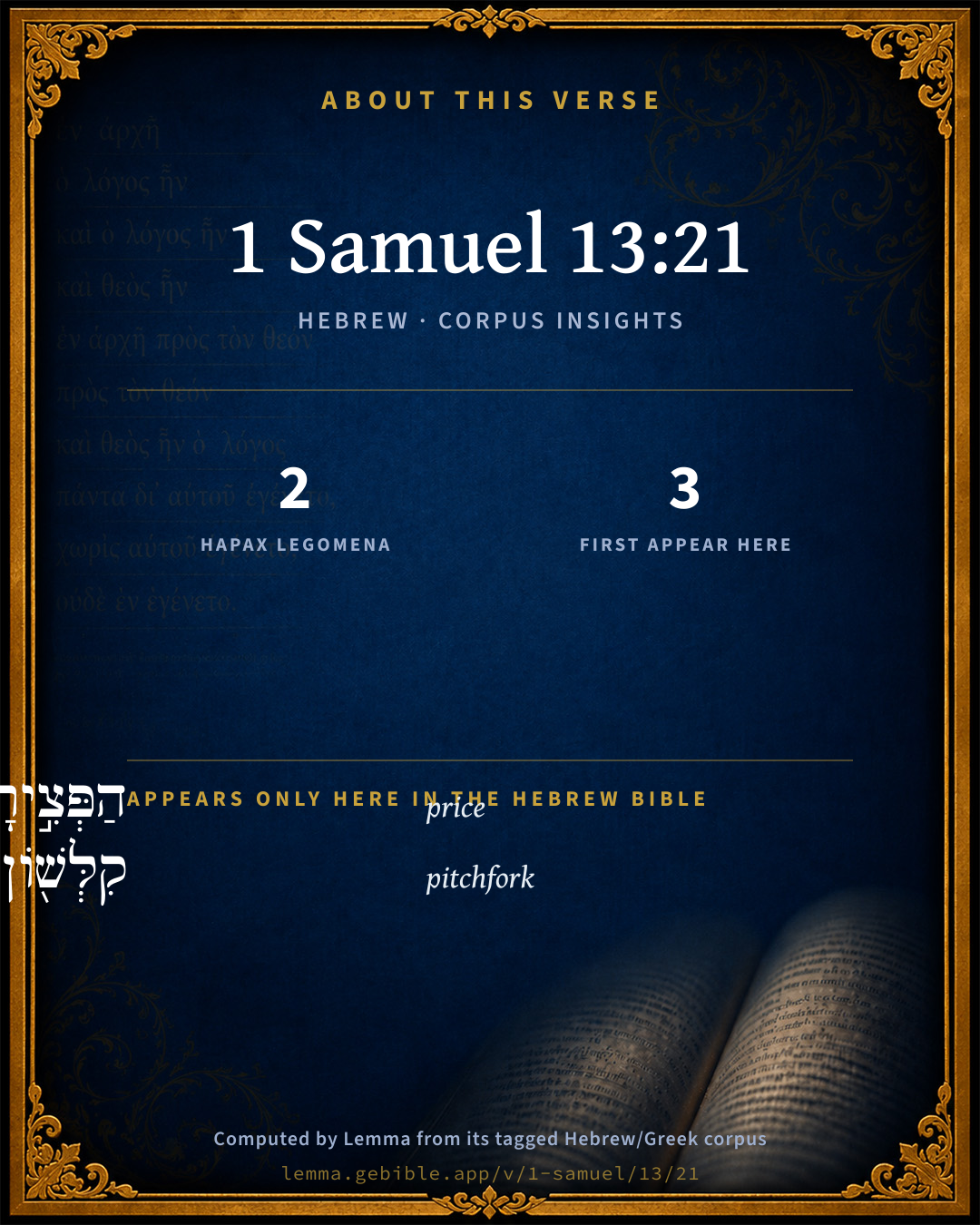
  • 2 hapax legomena — only here in the Hebrew Bible
  • 3 first appearances in the Hebrew Bible
Full analysis ↓
Download a study sheet

One document with this verse’s original text, its word-by-word gloss line, the meaning frame, cross-references with their text, attributed commentary, and full source and license credits — printable, and it pastes into notes with its structure intact.

This verse Autodidact and up

Study sheet (.html) Plain text (.txt)

A passage Seminary Student

Up to 50 verses in one chapter. A passage sheet keeps up to 6 commentary sources and 12 cross-references per verse, in the order this page ranks them, and says so on the sheet whenever that leaves anything out. Ask for a single verse and you get the Autodidact verse sheet above.

Everything on this page stays free to read, with no account — the sheet is a download of what is already on screen, not access to it.

Want to remove ads? Support Godless Engineer
Compare translations 3

The same verse in 3 English versions, stacked beneath the original-language interlinear above. Click any original word for its lexicon entry.

Each is an independent rendering of the whole verse — the interlinear is not word-aligned to these translations.

Highlighted words mark where these versions differ — a whole-verse word diff, not a word-by-word alignment.

  • World English Bible Public Domain
    yet they had a file for the mattocks, and for the plowshares, and for the forks, and for the axes, and to set the goads.
  • King James Version Public Domain
    Yet they had a file for the mattocks, and for the coulters, and for the forks, and for the axes, and to sharpen the goads.
  • unfoldingWord Literal Text CC BY-SA 4.0
    And the charge was a pim for plowshares and for picks and for a three-fork and for axes and for straightening the goad.

unfoldingWord Literal Text — © unfoldingWord, licensed CC BY-SA 4.0. Word-aligned USFM3 via Door43 (git.door43.org/unfoldingWord/en_ult).

Versions to compare (up to 4)

3 of 4 selected

Show all 18 translations

Every available English version of this verse, each an independent rendering of the whole verse.

  • World English Bible Public Domain
    yet they had a file for the mattocks, and for the plowshares, and for the forks, and for the axes, and to set the goads.
  • Berean Standard Bible Public Domain
    The charge was a pim for sharpening a plowshare or mattock, a third of a shekel for sharpening a pitchfork or an axe, and a third of a shekel for repointing an oxgoad.
  • Majority Standard Bible Public Domain
    The charge was a pim for sharpening a plowshare or mattock, a third of a shekel for sharpening a pitchfork or an axe, and a third of a shekel for repointing an oxgoad.
  • King James Version Public Domain
    Yet they had a file for the mattocks, and for the coulters, and for the forks, and for the axes, and to sharpen the goads.
  • American Standard Version (1901) Public Domain
    yet they had a file for the mattocks, and for the coulters, and for the forks, and for the axes, and to set the goads.
  • Revised Version (1885) Public Domain
    yet they had a file for the mattocks, and for the coulters, and for the forks, and for the axes; and to set the goads.
  • Geneva Bible (1599) Public Domain
    Yet they had a file for the shares, and for the mattockes, and for the picke forkes, and for the axes, and for to sharpen the goades.
  • Douay-Rheims (1899) Public Domain
    So that their shares, and their spades, and their forks, and their axes were blunt, even to the goad, which was to be mended.
  • Young's Literal Translation Public Domain
    and there hath been the file for mattocks, and for coulters, and for three-pronged rakes, and for the axes, and to set up the goads.
  • Literal Standard Version CC BY-SA 4.0
    and there has been the file for mattocks, and for coulters, and for three-pronged rakes, and for the axes, and to set up the goads.
  • Unlocked Literal Bible CC BY-SA 4.0
    The charge was two-thirds of a shekel for the plow points, and the mattocks, and one-third of a shekel for sharpening axes and for straightening the goads.
  • unfoldingWord Literal Text CC BY-SA 4.0
    And the charge was a pim for plowshares and for picks and for a three-fork and for axes and for straightening the goad.
  • Darby Bible Public Domain
    when the edges of the sickles, and the hoes, and the forks, and the axes were blunted; and to set the goads.
  • World Messianic Bible Public Domain
    The price was one payim each to sharpen mattocks, plowshares, pitchforks, axes, and goads.
  • Webster's Bible Public Domain
    Yet they had a file for the mattocks, and for the colters, and for the forks, and for the axes, and to sharpen the goads.
  • Free Bible Version CC BY-SA 4.0
    The fee was two-thirds of a shekel for plowshares and pickaxes, and a third of a shekel for sharpening the axes and cattle prods.
  • Bible in Basic English Public Domain
    For they had instruments for putting an edge on their ploughs and blades and forks and axes, and for putting iron points on their ox-driving rods.
  • JPS Tanakh (1917) Public Domain
    And the price of the filing was a pim for the mattocks, and for the coulters, and for the forks with three teeth, and for the axes; and to set the goads.

Literal Standard Version (2020), Covenant Press — licensed CC BY-SA 4.0. Text via the HelloAO Bible API (eBible.org). Unlocked Literal Bible (unfoldingWord) — licensed CC BY-SA 4.0. Text via the HelloAO Bible API (eBible.org). unfoldingWord Literal Text — © unfoldingWord, licensed CC BY-SA 4.0. Word-aligned USFM3 via Door43 (git.door43.org/unfoldingWord/en_ult). Free Bible Version, Dr. Jonathan Gallagher — licensed CC BY-SA 4.0. Text via the HelloAO Bible API (eBible.org).

Word by word

More ways to search: Search by grammar → Find every occurrence → Compare this word →

Practice this passage: Drill this verse → Learn its vocabulary →

הַפְּצִ֣ירָה
pᵉtsîyrâh
H6477
“the · price”
Particle, Definite Article + Noun, Common, Feminine, Singular, Absolute
Part of Speech
Particle + Noun
Type
Common
Gender
Feminine
Number
Singular
State
Absolute
Full BDB Definition

Origin: from H6484

TWOT: 1801a

price, charge - meaning dubious - perhaps (CLBL) sharpening or (BDB) bluntness
  1. וְֽהָיְתָ֞ה hâyâh H1961 “and · to be” Conjunction + Verb, Qal, Sequential Perfect, 3rd Person, Feminine, Singular
  2. פִ֗ים peh H6310 “mouth” Noun, Common, Masculine, Singular, Absolute
  3. לַמַּֽחֲרֵשֹׁת֙ machărêshâh H4281 “to/for the · plowshares” Preposition, Determined + Noun, Common, Feminine, Plural, Absolute
  4. וְלָ֣אֵתִ֔ים ʼêth H855 “and · to/for the · ploughshares” Conjunction + Preposition, Determined + Noun, Common, Masculine, Plural, Absolute
  5. וְלִשְׁלֹ֥שׁ shâlôwsh H7969 “and · to/for · three” Conjunction + Preposition + Adjective, Cardinal number, Feminine, Singular, Absolute
  6. קִלְּשׁ֖וֹן qillᵉshôwn H7053 “pitchfork” Noun, Common, Masculine, Singular, Absolute
  7. וּלְהַקַּרְדֻּמִּ֑ים qardôm H7134 “and · to/for · the · axes” Conjunction + Preposition + Particle, Definite Article + Noun, Common, Both, Plural, Absolute
  8. וּלְהַצִּ֖יב nâtsab H5324 “and · to stand” Conjunction + Preposition + Verb, Hiphil, Infinitive Construct
  9. הַדָּרְבָֽן dorbôwn H1861 “the · goad” Particle, Definite Article + Noun, Common, Both, Singular, Absolute

About this verse

These counts appear in no published source. They are computed here, from the morphology-tagged text and Lemma’s own curated glosses. What Lemma adds →

10
words
10
distinct lemmas
Historical
section

Notable vocabulary

2 hapax legomena — words that appear only here in the entire Hebrew Bible:

  • הַפְּצִ֣ירָה price H6477
  • קִלְּשׁ֖וֹן pitchfork H7053

First appearance in Scripture

These words make their first canonical appearance in the Hebrew Bible here:

  • הַפְּצִ֣ירָה price H6477
  • קִלְּשׁ֖וֹן pitchfork H7053
  • הַדָּרְבָֽן goad H1861

Shared distinctive vocabulary

לַמַּֽחֲרֵשֹׁת֙ plowshare H4281 occurs in 2 verses of the Hebrew Bible. Also found in:

Grammatical profile

  • 2 verbs
  • 7 nouns
  • 1 adjective

Verb forms

  • וְֽהָיְתָ֞ה Qal · Sequential Perfect
  • וּלְהַצִּ֖יב Hiphil · Infinitive Construct

Hebrew & Septuagint length

In English translation the verse runs 25 words from the Hebrew and 31 from the Septuagint (LXX English) — closely comparable.

A rough comparison of the two English renderings, which tokenize alike — not a word-level alignment.

Word counts can differ between the Hebrew and the Greek without any difference in meaning — e.g. the Hebrew direct-object marker אֵת has no separate Greek word, and Greek often adds the article ὁ.

Hebrew and Greek witnesses Masoretic Hebrew ↔ Greek Septuagint

The same verse in the two great witnesses to the Old Testament, shown verse-for-verse.

These are two independent witnesses, not word-aligned to each other, and the Septuagint is shown in lemma (dictionary) form.

Hebrew 1 Samuel 13:21 Masoretic · Westminster Leningrad Codex

וְֽהָיְתָ֞ה הַפְּצִ֣ירָה פִ֗ים לַמַּֽחֲרֵשֹׁת֙ וְלָ֣אֵתִ֔ים וְלִשְׁלֹ֥שׁ קִלְּשׁ֖וֹן וּלְהַקַּרְדֻּמִּ֑ים וּלְהַצִּ֖יב הַדָּרְבָֽן

yet they had a file for the mattocks, and for the plowshares, and for the forks, and for the axes, and to set the goads.

World English Bible · Public Domain

Greek LXX 1 Samuel 13:21 Septuagint · lemma form

καί εἰμί ὁ τρύγητος ἕτοιμος ὁ θερίζω ὁ δέ σκεῦος εἰμί τρεῖς σίκλος εἰς ὁ ὀδούς καί ὁ ἀξίνη καί ὁ δρέπανον ὑπόστασις εἰμί ὁ αὐτός

And it was near the time of vintage: and their tools were valued at three shekels for a plowshare, and there was the same rate for the axe and the sickle.

LXX2012 (modern English Septuagint) · Public Domain

On this verse, Ellicott's Commentary for English Readers discusses the Septuagint’s reading. Read the note in Commentary ↓

Hebrew: Westminster Leningrad Codex (CC BY 4.0). Greek: Septuagint (public domain); English from LXX2012 (modern English Septuagint) (Public Domain). How the Septuagint differs from the Hebrew →

Targum (Aramaic paraphrase)

1

The Targum is the ancient Jewish Aramaic paraphrase of the Hebrew Scriptures — an interpretive translation, not the Hebrew text itself. Onkelos (literal) and Pseudo-Jonathan (expansive) render the Torah, and Jonathan the Prophets. Coverage is partial: where no permissively-licensed English translation exists for a verse, only the Aramaic is shown. This is verse-level text, not a word-by-word alignment to the Hebrew.

  1. Targum Jonathan Prophets (Joshua–Malachi)
    וַהֲוֵי לְהוֹן שׁוֹפִינָא לְחָרָפָא בֵּיהּ פִּגְמַת כָּל מָאן דְבַרְזֶל לְעוּשְׁפַיָא וּלְסִיכַת פַדְנַיָא וּלְמִצְלַת קַצְרַיָא דִי לָהּ תְּלַת שְׁנִין וּלְכוּלְבַיָא וּלְאַנְצְבָא זָקָת:

    (no public-domain English translation for this verse)

    Targum Jonathan — Aramaic: “Mikraot Gedolot” (public domain). English: “Sefaria Community Translation” (CC0 1.0 (public-domain dedication)); “London "Chaldee Paraphrase," 1871” (public domain). Text via Sefaria.

Commentary

Notes on 1 Samuel 13:21 from classic Christian and Jewish commentators (each source and its license shown beneath its notes). The classic Christian expositions comment on the surrounding passage and are grouped to its opening verse, so a note may address several verses; the Jewish commentaries on the Tanakh (Rashi and others) are per-verse, so they appear only where the commentator wrote on this verse.

Lemma curates 59 commentaries, every one of them public domain or Creative Commons licensed, each selected and text-cleaned for this edition rather than reprinted as found. About our sources →

Trapp's Complete Commentary

John Trapp

1Sa 13:21 Yet they had a file for the mattocks, and for the coulters, and for the forks, and for the axes, and to sharpen the goads.

Ver. 21. Yet they had a file.] This was all the help they allowed them, "The tender mercies of the wicked are cruelties."

John Trapp, A Commentary or Exposition upon All the Books of the Old and New Testament (1647–1656) — public domain. Text from a community e-Sword module.

Jamieson, Fausset & Brown

Robert Jamieson, A. R. Fausset & David Brown

Yet they had a file--as a kind of privilege, for the purpose of sharpening sundry smaller utensils of husbandry.

Next: 1 Samuel Chapter 14

Jamieson, Fausset & Brown — Commentary Critical and Explanatory on the Whole Bible (1871) — public domain (CC PDM 1.0). Text via the HelloAO Bible API.

Adam Clarke's Commentary

Verse 21. Yet they had a file] The Hebrew פצירה petsirah, from פצר patsar, to rub hard, is translated very differently by the versions and by critics. Our translation may be as likely as any: they permitted them the use of files, (I believe the word means grindstone), to restore the blunted edges of their tridents axes, and goads.

Adam Clarke's Commentary on the Bible (1810–1826) — public domain. Text from a community e-Sword/MySword module.

Ellicott's Commentary for English Readers

(21) Yet they had a file for the mattocks . . .—This translation, the sense of which is not very clear, is supported by the Targum and by many of the great Hebrew commentators—Rashi, for instance. Gesenius and the majority of modern scholars, however, render the word in the original translated “file” (p’tsirah) by “bluntness.” The passage then would run: “And there was bluntness (or dulness) of edge to the mattocks; “or,” so that bluntness of the edges occurred to the mattocks.” “The forks” were probably an instrument with three prongs, like our trident.

And to sharpen the goads.—The words from “and there was bluntness,” &c. (English Version, “they had a file”), down to “axes,” form a parenthesis.

“This parenthesis indicates that the result of the burthensome necessity of going to the Philistines was that many tools became useless by dulness, so that even these poorer sort of arms did the Israelites not much service at the breaking out of the war.”—Bunsen.

The LXX. read this 21st verse with considerable changes: “And the vintage was ready to be gathered, and the tools were three shekels to the tooth to sharpen], and to the axe and to the scythe there was the same rate” (or, as the Greek has been rendered,” tools cost three shekels apiece [to sharpen]”).

A Bible Commentary for English Readers, edited by Charles John Ellicott (1878–1897) — public domain. Text from a community e-Sword module.

The Cambridge Bible for Schools and Colleges

gen. ed. J. J. S. Perowne

21. Yet they had a file] So the Targum and some Rabbinic commentators. If the rendering is correct, the meaning will be that for the ordinary sharpening of tools they had files, but for any forging work they had to go to the Philistines. But the best rendering appears to be either, “When the edges, &c. were blunt:” or that of the Vulgate, “So the edges of the mattocks … used to be blunt.” The result of the necessity of going so far to get their tools repaired was that they got into a very unserviceable condition. The words, “and to set (i.e. sharpen or point) the goad” must be taken as depending on “the Israelites went down to the Philistines,” the intervening words being regarded as a parenthesis.

The Cambridge Bible for Schools and Colleges (gen. ed. J. J. S. Perowne; Cambridge University Press, 1878–1918) — public domain. Text from a community e-Sword module.

John Gill's Exposition

Yet they had a file for the mattocks, and for the coulters, and for the forks, and for the axes,.... Those that would not go to the Philistines, or were not able, or thought it too much trouble, these kept files by them to sharpen those several instruments with upon occasion; though the words are by some rendered in connection with the preceding, to this sense, that they went to the Philistines to sharpen them, when the mouths, or edges, of the mattocks, coulters, &c. were dull; or "blunt" (i); and so needed sharpening; and even

to sharpen the goads; with which they pricked and pushed on the oxen in ploughing, when sluggish and remiss. (The word for "file" in the verse is "pim", and occurs only here in the Hebrew scriptures. It is not used elsewhere in other Hebrew writings. Therefore the translators of the 1611 Authorised Version had only the root derivation to deduce what the word meant. Literally, it means "a file with mouths". However, recently archaeologists have found a stone inscribed with this word. Also they found a stone inscribed with the word "shekel". Hence they deduced that the word was really a weight of measure equal to about one third of a shekel. Newer translations usually translate this as "the charge was a third of a shekel ...", hence removing the obvious contradiction between this verse and the preceding one. Editor.)

(i) "retusae itaque erant acies vomerum", V. L. "quandoquidem acies cultrorum aratri", &c. "obtusae erant", Tigurine version.

John Gill's Exposition of the Whole Bible (1746–1763) — public domain (CC PDM 1.0). Text via the HelloAO Bible API.

Haydock's Catholic Bible Commentary

Mended, by the Philistines. (Haydock) --- The Hebrew is variously translated. "Their implements were like saws; or, they had a file to sharpen the," &c. (Calmet) --- Septuagint, "and the fruits were ready to be gathered. But the vessels (instruments for labour) were three sicles for a tooth, and the same price (or station, Greek: upostasis, a word used [in] ver. 23, in the latter sense) for an axe or a scythe;" as if the Philistines required three sicles for doing the smallest thing, when the harvest was at hand. (Haydock)

George Leo Haydock (1774–1849), Haydock's Catholic Family Bible and Commentary, 1859 edition — public domain. Excludes Psalms (Douay-Rheims chapter numbering differs from Protestant) and Deuterocanonical books (Catholic canon only).

Matthew Poole's English Annotations

So the sense is, They allowed them some small helps to make their mattocks, and in some sort to serve their present use. But these words may be otherwise translated, and are so by some learned, both ancient and modern, translators: thus, Therefore the mouths or edges of the mattocks a coulters, &. were dull or blunt. Or rather thus, When (Heb. and put for when, as the particle and is sometimes rendered, as Mar 15:25) the mouths or edges of the mattocks, &c. were blunt. So this passage very well agrees both with the foregoing and following words; and the whole sense of the place is entirely thus, They went to the Philistines to sharpen their shares, and mattocks, and coulters, and axes, when they were blunt, and (which was more strange, they were forced to go to them even)

to sharpen their goads.

Matthew Poole's English Annotations on the Holy Bible (1683–1685) — public domain. Text from a community e-Sword/MySword module.

Whedon's Commentary on the Bible

Daniel D. Whedon

21. A file — Or, as the margin, a file with mouths. So the Rabbins and other interpreters have understood the Hebrew words, הפצירה פים. But the words can hardly mean a sharpening tool. The root, פצר, means to notch, to indent; and פצירה, applied to the edges of instruments for cutting, most naturally means indentation in the sense of dulling. Thus this verse tells us the result of the lack of smiths in Israel: the agricultural instruments became nicked and dull. Keil supposes that the final הin פצירה should be connected with the next word as the article, and he translates the verse thus: So that bluntness of the edges occurred in the edge tools, and the plough-shares, and the trident, and the axes, and the setting of the goad.

Daniel D. Whedon (gen. ed.), Commentary on the Old and New Testaments (1874–1909) — public domain. Text from a community e-Sword module.

The Pulpit Commentary

A file. Margin, a file with mouths. The word only occurs here, and is translated a file on the authority of Rashi. Almost all modern commentators agree that it means bluntness, and that this verse should be joined on to the preceding, and the two be translated, "But all the Israelites went down to the Philistines to sharpen his sickle, and his ploughshare, and his axe, and his mattock, whenever the edges of the mattocks, and the ploughshares, and the forks, and the axes were blunt, and also to set (so the margin rightly) the goads." The Israelites were thus in a state of complete dependence upon the Philistines, even for carrying on their agriculture, and probably retained only the hill country, while their enemies were masters of the plains.

The Pulpit Commentary (1880–1919), ed. H.D.M. Spence-Jones & Joseph S. Exell — public domain. Text from a community e-Sword module.

Rashi

Rabbi Shlomo Yitzchaki (Rashi)

There was a multi-edged file that was used for the tools. For those who found it troublesome to go down to the Philistines to sharpen, had the פְּצִירָה פִים, lime in O.F., which has many mouths, i.e. many sharp and jagged surfaces to sharpen the tools and mattocks.

Three pronged pitchforks. A fork similar to a pitchfork, which is called 'forche' [in O.F.], having three prongs.

And for setting the yoke. To sharpen the tip, and to insert it and set it into the handle.

Rashi on the Tanakh — English translations: “The Judaica Press complete Tanach with Rashi, translated by A. J. Rosenberg” (CC BY 4.0); “Pentateuch with Rashi's commentary by M. Rosenbaum and A.M. Silbermann, 1929-1934” (public domain); “The Metsudah Tanach series, Lakewood, N.J” (CC BY 4.0); and “The Book of Joshua, Metsudah Publications, 1997” (CC BY 4.0). Text via Sefaria.

Lesson kit

Teaching starters — assembled from the data on this page, not authored interpretation. Every prompt links to the verse data it draws on. Edit before teaching.

1 Samuel, in the Historical, opens this verse with 10 words (10 distinct Hebrew lemmas). Its most distinctive word is pᵉtsîyrâh (“price”). A historical commentator’s framing appears above. Read the whole chapter for the surrounding context.

Discussion questions

  1. What does “price” (pᵉtsîyrâh) contribute to the verse as a whole?
  2. 2 words here appear nowhere else in the Hebrew Bible. Why might the author reach for such rare wording?
  3. 3 words make their first appearance in Scripture here. What does this debut establish?
  4. How does 1 Samuel 13:20, which shares the word «plowshare», read alongside this verse?
  5. The translations on this page render this verse differently — a whole-verse word diff, not a word-by-word alignment. What might account for the different wordings?
  6. «וְֽהָיְתָ֞ה» is a Qal Sequential Perfect verb. How does that grammatical form shape the action described?
  7. Compare how Trapp's Complete Commentary and Jamieson, Fausset & Brown read this verse. Where do they agree or differ?

Things to notice

  • 2 words in this verse appear nowhere else in the Hebrew Bible.
  • 3 words make their first canonical appearance in Scripture here.
  • These translations choose different wording for 15 words in this verse.
  • 10 distinct Hebrew lemmas span 10 words in this verse.

Reading settings

Reading text

Shown beneath each verse's original-language words.

Old Testament
Old Testament edition

Read the OT as the Masoretic Hebrew (MT) or the Greek Septuagint (LXX).

English shown for the Greek Septuagint (in the Hebrew ↔ Greek comparison).

Comparing translations? Open the Compare panel on any verse page to stack up to four side by side.