
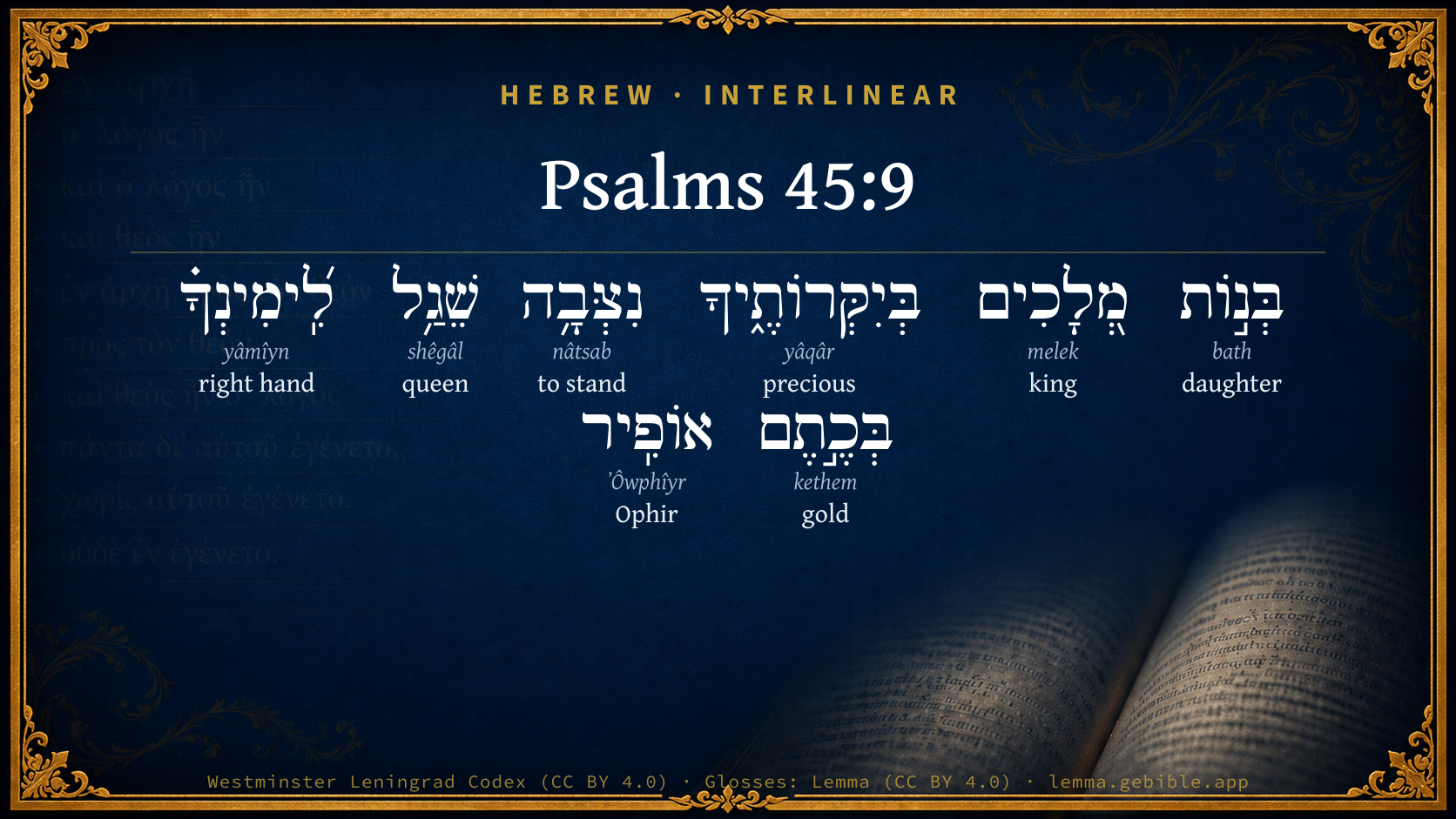
Psalms 45:9

Hebrew (Westminster Leningrad Codex) Psalms 45:9 appears in the Hebrew Old Testament. The text above is from the Westminster Leningrad Codex. Each word links to its Strong’s number, a concise gloss, and parsing drawn from the Open Scriptures Hebrew Bible morphology. Click any word for its full Brown-Driver-Briggs (BDB) entry.
Download image
Cite this verse

Psalms 45:9 (World English Bible). Public Domain. Lemma interlinear Bible study tool, https://lemma.gebible.app/v/psalms/45/9.

Show BibTeX & RIS
BibTeX
RIS
English Translation
Kings' daughters are among your honorable women. At your right hand the queen stands in gold of Ophir.
World English Bible · Public Domain
Download a study sheet

One document with this verse’s original text, its word-by-word gloss line, the meaning frame, cross-references with their text, attributed commentary, and full source and license credits — printable, and it pastes into notes with its structure intact.

This verse Autodidact and up

Study sheet (.html) Plain text (.txt)

A passage Seminary Student

Up to 50 verses in one chapter. A passage sheet keeps up to 6 commentary sources and 12 cross-references per verse, in the order this page ranks them, and says so on the sheet whenever that leaves anything out. Ask for a single verse and you get the Autodidact verse sheet above.

Everything on this page stays free to read, with no account — the sheet is a download of what is already on screen, not access to it.

Want to remove ads? Support Godless Engineer
Compare translations 3

The same verse in 3 English versions, stacked beneath the original-language interlinear above. Click any original word for its lexicon entry.

Each is an independent rendering of the whole verse — the interlinear is not word-aligned to these translations.

Highlighted words mark where these versions differ — a whole-verse word diff, not a word-by-word alignment.

  • World English Bible Public Domain
    Kings' daughters are among your honorable women. At your right hand the queen stands in gold of Ophir.
  • King James Version Public Domain
    Kings' daughters were among thy honourable women: upon thy right hand did stand the queen in gold of Ophir.
  • unfoldingWord Literal Text CC BY-SA 4.0
    Daughters of kings among your precious. The queen is stationed at your right hand in gold of Ophir.

unfoldingWord Literal Text — © unfoldingWord, licensed CC BY-SA 4.0. Word-aligned USFM3 via Door43 (git.door43.org/unfoldingWord/en_ult).

Versions to compare (up to 4)

3 of 4 selected

Show all 18 translations

Every available English version of this verse, each an independent rendering of the whole verse.

  • World English Bible Public Domain
    Kings' daughters are among your honorable women. At your right hand the queen stands in gold of Ophir.
  • Berean Standard Bible Public Domain
    The daughters of kings are among your honored women; the queen stands at your right hand, adorned with the gold of Ophir.
  • Majority Standard Bible Public Domain
    The daughters of kings are among your honored women; the queen stands at your right hand, adorned with the gold of Ophir.
  • King James Version Public Domain
    Kings' daughters were among thy honourable women: upon thy right hand did stand the queen in gold of Ophir.
  • American Standard Version (1901) Public Domain
    Kings' daughters are among thy honorable women: At thy right hand doth stand the queen in gold of Ophir.
  • Revised Version (1885) Public Domain
    Kings’ daughters are among thy honourable women: at thy right hand doth stand the queen in gold of Ophir.
  • Geneva Bible (1599) Public Domain
    Kings daugthers were among thine honorable wiues: vpon thy right hand did stand the Queene in a vesture of golde of Ophir.
  • Douay-Rheims (1899) Public Domain
    Myrrh and stacte and cassia perfume thy garments, from the ivory houses: out of which
  • Young's Literal Translation Public Domain
    Daughters of kings `are' among thy precious ones, A queen hath stood at thy right hand, In pure gold of Ophir.
  • Literal Standard Version CC BY-SA 4.0
    Daughters of kings [are] among Your precious ones, || A queen has stood at Your right hand, || In pure gold of Ophir.
  • Unlocked Literal Bible CC BY-SA 4.0
    Kings' daughters are among your honorable women; at your right hand stands the queen clothed in gold of Ophir.
  • unfoldingWord Literal Text CC BY-SA 4.0
    Daughters of kings among your precious. The queen is stationed at your right hand in gold of Ophir.
  • Darby Bible Public Domain
    Kings' daughters are among thine honourable women; upon thy right hand doth stand the queen in gold of Ophir.
  • World Messianic Bible Public Domain
    Kings’ daughters are among your honorable women. At your right hand the queen stands in gold of Ophir.
  • Webster's Bible Public Domain
    \\45:8\\All thy garments smell of myrrh, and aloes, and cassia, out of the ivory palaces, by which they have made thee glad.
  • Free Bible Version CC BY-SA 4.0
    The daughters of kings are among the noblewomen; the queen stands beside you on your right, wearing jewelry made of gold from Ophir.
  • Bible in Basic English Public Domain
    Kings' daughters are among your noble women: on your right is the queen in gold of Ophir.
  • JPS Tanakh (1917) Public Domain
    (45-10) Kings' daughters are among thy favourites; at thy right hand doth stand the queen in gold of Ophir.

Literal Standard Version (2020), Covenant Press — licensed CC BY-SA 4.0. Text via the HelloAO Bible API (eBible.org). Unlocked Literal Bible (unfoldingWord) — licensed CC BY-SA 4.0. Text via the HelloAO Bible API (eBible.org). unfoldingWord Literal Text — © unfoldingWord, licensed CC BY-SA 4.0. Word-aligned USFM3 via Door43 (git.door43.org/unfoldingWord/en_ult). Free Bible Version, Dr. Jonathan Gallagher — licensed CC BY-SA 4.0. Text via the HelloAO Bible API (eBible.org).

Word by word

More ways to search: Search by grammar → Find every occurrence → Compare this word →

Practice this passage: Drill this verse → Learn its vocabulary →

About this verse

These counts appear in no published source. They are computed here, from the morphology-tagged text and Lemma’s own curated glosses. What Lemma adds →

8
words
8
distinct lemmas
Wisdom
section

Notable vocabulary

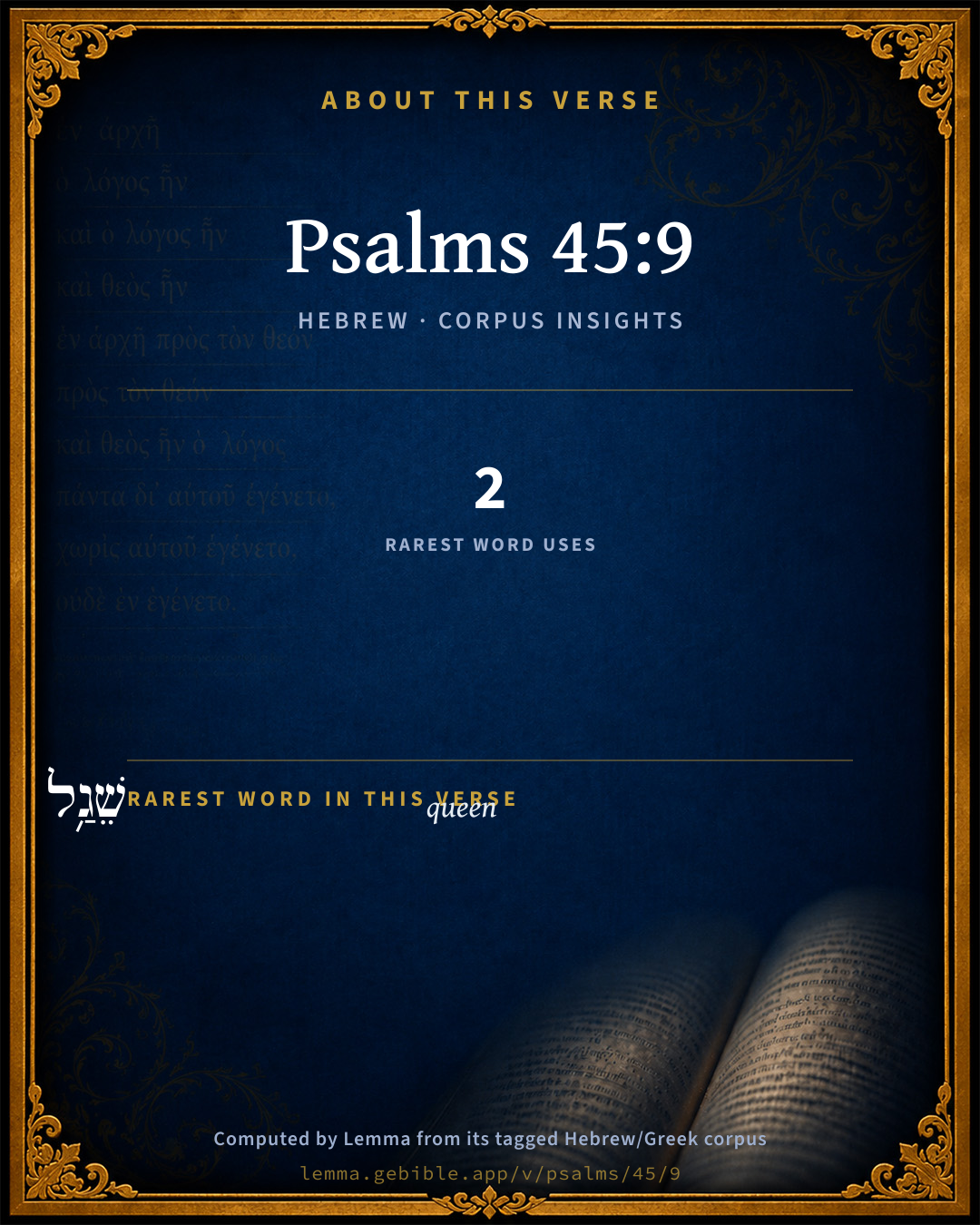
The rarest word here is שֵׁגַ֥ל queen H7694 — appearing just 2 times in the whole Hebrew Bible.

Shared distinctive vocabulary

שֵׁגַ֥ל queen H7694 occurs in 2 verses of the Hebrew Bible. Also found in:

Grammatical profile

  • 1 verb
  • 6 nouns
  • 1 adjective

Verb forms

  • נִצְּבָ֥ה Niphal · Perfect

Hebrew & Septuagint length

In English translation the verse runs 18 words from the Hebrew and 29 from the Septuagint (LXX English) — closely comparable.

A rough comparison of the two English renderings, which tokenize alike — not a word-level alignment.

Word counts can differ between the Hebrew and the Greek without any difference in meaning — e.g. the Hebrew direct-object marker אֵת has no separate Greek word, and Greek often adds the article ὁ.

Cross-references

17

Topical passages linked to Psalms 45:9 in the Treasury of Scripture Knowledge — connected by theme and wording, ordered by reader-vote popularity; previews shown in the World English Bible.

  • 1 Kings 2:19 Bathsheba therefore went to king Solomon, to speak to him for Adonijah. The king rose up to meet her, and bowed himself to her, and sat down on his throne, and caused a throne to be set for the king's mother; and she sat on his right hand.
  • Revelation 21:9 One of the seven angels who had the seven bowls, who were loaded with the seven last plagues came, and he spoke with me, saying, "Come here. I will show you the wife, the Lamb's bride."
  • Ephesians 5:26–27 that he might sanctify it, having cleansed it by the washing of water with the word,
  • Revelation 19:7 Let us rejoice and be exceedingly glad, and let us give the glory to him. For the marriage of the Lamb has come, and his wife has made herself ready."
  • Revelation 21:2 I saw the holy city, New Jerusalem, coming down out of heaven from God, made ready like a bride adorned for her husband.
  • Song of Solomon 6:8–9 There are sixty queens, eighty concubines, And virgins without number.
  • Song of Solomon 7:1 How beautiful are your feet in sandals, prince's daughter! Your rounded thighs are like jewels, The work of the hands of a skillful workman.
  • Isaiah 60:10–11 Foreigners shall build up your walls, and their kings shall minister to you: for in my wrath I struck you, but in my favor have I had mercy on you.
  • John 3:29 He who has the bride is the bridegroom; but the friend of the bridegroom, who stands and hears him, rejoices greatly because of the bridegroom's voice. This, my joy, therefore is made full.
  • Job 22:24 Lay your treasure in the dust, The gold of Ophir among the stones of the brooks.
  • Psalms 45:13 The princess inside is all glorious. Her clothing is interwoven with gold.
  • Isaiah 49:23 Kings shall be your nursing fathers, and their queens your nursing mothers: they shall bow down to you with their faces to the earth, and lick the dust of your feet; and you shall know that I am Yahweh; and those who wait for me shall not be disappointed.
  • Revelation 21:24 The nations will walk in its light. The kings of the earth bring the glory and honor of the nations into it.
  • 1 Kings 2:9 Now therefore don't hold him guiltless, for you are a wise man; and you will know what you ought to do to him, and you shall bring his gray head down to Sheol with blood.
  • 1 Kings 10:11 The navy also of Hiram, that brought gold from Ophir, brought in from Ophir great plenty of almug trees and precious stones.
  • Psalms 72:10 The kings of Tarshish and of the isles will bring tribute. The kings of Sheba and Seba shall offer gifts.
  • Song of Solomon 4:8–11 Come with me from Lebanon, my bride, With me from Lebanon. Look from the top of Amana, From the top of Senir and Hermon, From the lions' dens, From the mountains of the leopards.

Cross-references courtesy of OpenBible.info (CC BY 4.0).

Hebrew and Greek witnesses Masoretic Hebrew ↔ Greek Septuagint

The same verse in the two great witnesses to the Old Testament, shown verse-for-verse.

You’re reading Greek Psalm 44 (Hebrew Psalm 45). The Septuagint counts the superscription, so verse numbers can differ from the Hebrew — chapter-level alignment, not verse-by-verse. Numbering follows Rahlfs.

These are two independent witnesses, not word-aligned to each other, and the Septuagint is shown in lemma (dictionary) form.

Hebrew Psalms 45:9 Masoretic · Westminster Leningrad Codex

בְּנ֣וֹת מְ֭לָכִים בְּיִקְּרוֹתֶ֑יךָ נִצְּבָ֥ה שֵׁגַ֥ל לִֽ֝ימִינְךָ֗ בְּכֶ֣תֶם אוֹפִֽיר

Kings' daughters are among your honorable women. At your right hand the queen stands in gold of Ophir.

World English Bible · Public Domain

Greek LXX Greek Psalm 44:9 Septuagint · lemma form

σμύρνα καί στακτή καί κασία ἀπό ὁ ἱμάτιον σύ ἀπό βάρις ἐλεφάντινος ἐκ ὅς εὐφραίνω σύ

with which kings' daughters have gladdened you for your honor: the queen stood by on your right hand, clothed in vesture wrought with gold, and arrayed in various colors.

LXX2012 (modern English Septuagint) · Public Domain

On this verse, Ellicott's Commentary for English Readers discusses the Septuagint’s reading. Read the note in Commentary ↓

Hebrew: Westminster Leningrad Codex (CC BY 4.0). Greek: Septuagint (public domain); English from LXX2012 (modern English Septuagint) (Public Domain). How the Septuagint differs from the Hebrew →

Commentary

Notes on Psalms 45:9 from classic Christian and Jewish commentators (each source and its license shown beneath its notes). The classic Christian expositions comment on the surrounding passage and are grouped to its opening verse, so a note may address several verses; the Jewish commentaries on the Tanakh (Rashi and others) are per-verse, so they appear only where the commentator wrote on this verse.

Lemma curates 59 commentaries, every one of them public domain or Creative Commons licensed, each selected and text-cleaned for this edition rather than reprinted as found. About our sources →

Trapp's Complete Commentary

John Trapp

Psa 45:9 Kings’ daughters [were] among thy honourable women: upon thy right hand did stand the queen in gold of Ophir.

Ver. 9. Kings’ daughters were among thy honourable women] Thy ladies of honour attending upon thy royal consort (for after the description of Christ, the bridegroom, followeth another, of the queen, his bride, and of the royal nuptials): or, Kings’ daughters are in thy preciousnesses, that is, in thy comeliness that thou hast put upon them, Eze 16:14; for all the Church’s bravery is borrowed, and all her daughters, i.e. members, are adorned not with their own proper attire, Sed regio mundo et ornatu, out of the King Christ’s wardrobe; this is the righteousness of the saints, Rev 19:8, viz. imputed and imparted.

Upon thy right hand] Which is a place of dignity and safety. As Christ is at the Father’s right hand, so the Church is at Christ’s right hand; where, as his wife, she shineth with her Husband’s beams. This is very comfortable.

Did stand the queen] Heb. the wife, adiutorium illi exacte respondens, as Gen 2:18, saith Aben Ezra. Of our Edward III the chronicler saith, that he was happy in his wife, a lady of excellent virtue, who drew evenly with him in all the courses of honour that appertained to her side; and seemed a piece so just cut for him, as answered him rightly in every joint (Daniel’s Hist.).

John Trapp, A Commentary or Exposition upon All the Books of the Old and New Testament (1647–1656) — public domain. Text from a community e-Sword module.

The Biblical Illustrator

Joseph S. Exell

Psa_45:9

Kings daughters were among Thy honourable women.

Upon Thy right hand did stand the queen in gold of Ophir.

The consummation of Messiahs glory and the Churchs happiness

I. The general propriety and significance of the image of a marriage as it is here employed. Familiar emblems are needful for the better understanding of the Gospel by the mass of the people. Now, the relation between Christ and His Church, it is evident, must be of a nature not to be adequately typified by anything in the material world; and nothing could be found in human life which might so aptly represent it as the relation of husband and wife in the holy state of wedlock; and in this the analogy is so perfect that the notion of the ancient Jews has received the express sanction of St. Paul, that the relation of the Saviour and the Church was typified in the union of our first parents, and in the particular manner of Eves formation out of the substance of Adam.

II. The circumstances of this marriage. The magnificence of the court of the king as it appeared on the wedding-day, the splendour of the royal robes, the profusion of rich perfumes, are dwelt on. Of these last such quantities were used that the whole person was not merely sprinkled, but ran down with them to the very skirts of the garment. The psalmist describes the fragrance of Messiahs garments to be such as if the robes had been made of the very substance of aromatic woods. Thy garments are all myrrh, aloes and cassia. No palace adorned with ivory--a favourite ornament of palaces--could furnish such fragrance, no, nor even the incense that was burnt upon the golden altar as a grateful odour to the Lord. Now, all these perfumed garments were typical; first, of the graces and virtues of the Redeemer Himself in His human character; secondly, of whatever is refreshing, encouraging, consoling, and cheering in the external ministration of the word; and, thirdly, of the internal comforts of the Holy Spirit. We proceed to other particulars in the magnificent appearance of His court on the wedding-day, figurative of the glory of the Church in its final condition of purity and peace, and of the rank and order of particular churches. Kings daughters are among Thy honourable women. But the primary meaning of the word rendered honourable is bright, sparkling, and the imagery of the original would be better preserved if rendered thus, Kings daughters are among the bright beauties of Thy court. The beauty certainly is mystic--the beauty of evangelical sanctity and innocence. But who are these kings daughters? They are the kingdoms and peoples, perhaps the various national churches, fostered for many ages by the piety of Christian princes, and now brought to the perfection of beauty by their being cleansed from all wrong--they may welt be called kings daughters, of whom kings and queens are called in prophetic language the fathers and mothers. Then, the consort, the queen, who is she? Some expositors have imagined that the consort is an emblem of the Church catholic in her totality; the kings daughters, typical of the several particular churches of which that one universal is composed. But the queen consort here is unquestionably the Hebrew Church; the Church of the natural Israel, reunited, by her conversion, to her husband, and advanced to the high prerogative of the mother Church of Christendom; and the kings daughters are the churches which had been gathered out of the Gentiles in the interval between the expulsion of his wife and the taking of her home again, that is, between the dispersion of the Jews by the Romans and their restoration. The restoration of the Hebrew Church to the rights of a wife, to the situation of the queen consort in Messiahs kingdom upon earth, is the constant strain of prophecy. The prophet, I said, describes the Gentile converts as becoming, upon the reunion, children of the pardoned wife. And so St. Paul (Rom_11:1-36.). The standard gold upon the queens robe denotes the treasures of which the Church is the depositary--the Word and Sacraments, and the dispensation of grace and forgiveness by their due administration. Then follows--

III. The counsel to the bride (Verses10, 11). If a princess from a distant land, taken in marriage by a great king, were admonished to forget her own people and her fathers house, the purport of the advice would easily be understood to be, that she should divest herself of all attachment to the customs of her native country, and to the style of her fathers court, and learn to speak the language and assume the dress, the manners and the taste of her husbands people. The fathers house, and own people, which the psalmist advises the queen consort to forget, is the ancient Jewish religion in its external form, the ceremonies of the temple service, the sacrifices and the typical purgations of the Levitical priesthood. Not that she is to forget Gods gracious promises to Abraham, nor the covenant with her forefathers, nor any of the wonderful things God did for them. But only, so as to desire no more, the ancient Levitical rites and worship. They have served their purpose, and are now to be laid aside. Christ, her husband, is her paramount authority now, and is entitled to her unreserved obedience. There is given--

IV. The description of the queen (verse 13). The kings daughter. Who is this? Not some new personage, the Christian Church in general composed of both Jews and Gentiles, as Luther thought, but, as Bishop Hume observes, that the connection between Christ and His spouse unites in itself every relation and every affection. She is, therefore, daughter, wife and sister all in one. The same seems to have been the notion of a learned Dominican of the seventeenth century, who remarks that the Empress Julia, in the legends of some ancient coins, is called the daughter of Augustus, whose wife she was. But, with much general reverence for the opinions of these learned commentators, I am persuaded that the stops have been misplaced in the Hebrew manuscripts by the Jewish critics upon the last revision of the text--that translators have been misled by their false division of the text, and expositors misled by translators. The stops being rightly placed, the Hebrew words give this sense: She is all glorious--she, the consort of whom we have been speaking, is glorious in every respect--Daughter of a king! That is, she is a princess born; she is glorious, therefore, for her high birth. She is, indeed, of high and heavenly extraction! Accordingly, in the Apocalypse, the bride, the Lambs wife, is the holy Jerusalem descending out of heaven from God. The psalmist adds: She is conducted in procession to the king--in all the pomp of a public procession. This may point to some remarkable assistance which the Jews will receive from the Christian Gentiles in their re-settlement in the Holy Land (Isa_18:1-7, at end, and Zep_3:10). And then follow the prediction as to the Churchs children and the distinguished character they shall hold, and he closes with setting forth the design and predicting the effect of this Divine song. (Bishop Horsley.)

The Biblical Illustrator, edited by Joseph S. Exell (c. 1880s–1900s) — public domain. Text from a community e-Sword module.

Joseph Benson's Commentary

Psa 45:9. Kings’ daughters were among thy honourable women — Among them that attend upon thy spouse, as the manner was in nuptial solemnities. As the queen is the church in general, so these honourable women are particular believers, who are daily added to the church, Act 2:47. And although the church is made up of particular believers, yet she is distinguished from them for the decency of the parable, as the whole is often distinguished in our minds from the parts of which it consists, and as the daughters of Jerusalem are distinguished from the spouse in the book of Canticles, though the spouse (the church) be wholly made up of them. And these believers may be said to be kings’ daughters, because, among others, many persons of royal race embraced the faith, and because they are, in a spiritual sense, kings unto God, Rev 1:6. On thy right hand — The most honourable place; did stand the queen — In the posture of a servant; to show that although she is a queen, yet she is also his subject to serve and obey him. Or, rather, as נצבה, nitzebah, signifies, is placed, or seated, which seems more agreeable to the dignity of a queen, 1Ki 2:19, and of a spouse at the nuptial solemnity. In gold of Ophir — Clothed in the richest garments, made of the choicest gold; by which he designs the graces wherewith the church is adorned.

Joseph Benson's Commentary on the Old and New Testaments (1811–1818) — public domain. Text from a community e-Sword module.

J. A. Alexander on Psalms

Joseph Addison Alexander

10. (Psa 45:9). Daughters of kings (are) among thy precious (ones); stationed is the queen at thy right hand, in gold of Ophir. The idea of a marriage-feast, suggested in the foregoing verse, is here carried out by a description of the bride or brides. These are represented as being of the highest rank and splendid in appearance. Precious, dear, not in the sense of beloved, which the Hebrew word never has, but in that of costly, valuable, which it always has. Stationed, not simply stands, but placed there, as the post of honour. Compare 1Ki 2:19. The word translated queen means properly a spouse or consort, but is specially applied to the wives of kings, particularly those of Babylonia (Dan 5:2) and Persia (Neh 2:6). It is here used as a poetical expression, which is also the case with the word translated gold, and derived from a verb meaning to conceal; it may therefore denote ore, as hidden in the mine, or hoarded treasure. Here, and in Isa 13:12, it is combined with Ophir, one of the places to which Solomon's ships traded with the Phenicians (1Ki 9:28; 1Ki 10:11, 2Ch 8:18; 2Ch 9:10). Its situation is disputed, and of no exegetical importance in the case before us. Whether it was in India, Arabia, or Africa, it is here mentioned only as an El Dorado, with the very name of which the idea of gold was associated in the. mind of every Israelite, as it is in ours with the name of California. In gold means, of course, in garments decked with gold, or golden jewels. The image here presented of a queen surrounded by inferior princesses was probably borrowed from the court of Solomon (1Ki 11:1), but employed to represent the chosen people as the bride of the Messiah, and as such pre-eminent among the nations. This kind of personification is not uncommon. See, for example, Isa 47:1; Isa 54:1, Jer 46:11.

Joseph Addison Alexander, The Psalms Translated and Explained (1850) — public domain. Text from a community e-Sword module.

Tyndale Open Study Notes

Tyndale Open Resources

45:9 Marriages often sealed diplomatic connections between kings; the women became part of the harem (see 1 Kgs 11:1-3).

Tyndale Open Study Notes — © Tyndale Open Resources, licensed CC BY-SA 4.0. Text via the HelloAO Bible API.

Geneva Bible (1599)

Geneva Bible translators

Though he had many Kings’ daughters among his wives, yet he loved Pharaoh’s daughter best.

Geneva Bible (1599) marginal notes — public domain. Text via Bolls.life.

Jamieson, Fausset & Brown

Robert Jamieson, A. R. Fausset & David Brown

In completion of this picture of a marriage festival, female attendants or bridesmaids of the highest rank attend Him, while the queen, in rich apparel (Psa 45:13), stands ready for the nuptial procession.

Jamieson, Fausset & Brown — Commentary Critical and Explanatory on the Whole Bible (1871) — public domain (CC PDM 1.0). Text via the HelloAO Bible API.

Adam Clarke's Commentary

Verse 9. Kings' daughters were among] Applied to Solomon, these words have no difficulty. We know he had seven hundred wives, princesses; and the mention of those here may be intended only to show how highly respected he was among the neighbouring sovereigns, when they cheerfully gave him their daughters to constitute his harem. If we apply it to Solomon's marriage with the daughter of the king of Egypt, it may signify no more than the princesses and ladies of honour who accompanied her to the Israelitish court. Applied to Christ, it may signify that the Gospel, though preached particularly to the poor, became also the means of salvation to many of the kings, queens, and nobles, of the earth. The Chaldee interprets the queen standing at his right hand, by the law; and the honourable women, by the different regions and countries coming to receive that law from his right hand. Perhaps by kings' daughters may be meant different regions and countries, which are represented as constituting the families of potentates. Whole nations shall be converted to the Christian faith; and the queen-the Christian Church, shall be most elegantly adorned with all the graces and good works which at once constitute and adorn the Christian character.

Adam Clarke's Commentary on the Bible (1810–1826) — public domain. Text from a community e-Sword/MySword module.

Ellicott's Commentary for English Readers

(9) Honourable women.—Literally, precious ones, i.e., possibly the favourites of the harem. See Pro_6:26, where this word precious is used (comp. Jer_31:20), or there may be an allusion to the costliness and magnificence of the harem rather than to affection for its inmates. Perhaps both senses are combined in the word, and we may compare Shakespeare’s

“The jewels of our father, with washed eyes

Cordelia leaves you.”

Upon thy right hand.—Comp. 1Ki_2:19.

Did stand.—Better, was stationed, referring to the position assigned to the bride when the marriage procession was formed.

In gold of Ophir.—Or, possibly, as (i.e., precious as) gold of Ophir, a common use of this particle. For Ophir and its gold see 1Ki_9:28. The LXX. and Vulg. miss the proper name, and read, “clothed in golden vesture and many-coloured.”

A Bible Commentary for English Readers, edited by Charles John Ellicott (1878–1897) — public domain. Text from a community e-Sword module.

The Cambridge Bible for Schools and Colleges

gen. ed. J. J. S. Perowne

9. Kings’ daughters are among thy honourable women:

At thy right hand doth stand the queen in gold of Ophir (R.V.).

An Oriental monarch prided himself on the number and nobility of the wives in his harem, and some at least of the Jewish monarchs were no exception to the rule (1Ki_11:3; Son_6:8). It may seem strange that such a degradation of the true ideal of marriage should find place in a Psalm which opens up such lofty thoughts and hopes. But the Psalm reflects the actual facts and customs of the age: it is not intended to depict a perfect state of things. One of the wives takes precedence of the rest and occupies the place of honour (1Ki_2:19) at the king’s right hand. It is implied that this place is reserved for the new bride whom the poet now turns to address. The verse is a general description of the king’s state, for the bride has not yet been brought in (Psa_45:14); or is the poet anticipating? Gold of Ophir was the choicest gold (1Ki_9:28; 1Ki_10:11; Job_22:24; Job_28:16), but where Ophir was is not known. Most probably it was in S. Arabia or India.

The Cambridge Bible for Schools and Colleges (gen. ed. J. J. S. Perowne; Cambridge University Press, 1878–1918) — public domain. Text from a community e-Sword module.

John Gill's Exposition

Kings' daughters were among thy honourable women,.... Or "maids of honour" (n); who filled and adorned the king's court, and made a splendid appearance there, the same with the virgins, the companions of the bride, in Psa 45:14; and design truly gracious souls, believers in Christ, who are his "precious ones" (o), as the word may be rendered; the excellent in the earth, in whom is all his delight; the precious sons of Zion, comparable to fine gold; his portion, his jewels, his peculiar treasure, and the apple of his eye: and since they have been precious to him, they have been "honourable", as they are, both by birth and marriage, being born of God, and espoused to Christ; by their character, kings and priests; and by their company, being among princes, and especially by their having communion with Father, Son, and Spirit: and among these are "kings' daughters"; yea, they are all of them the sons and daughters of the King of kings; not by their first birth, by which they were mean, base, and dishonourable, wretched and miserable, and children of wrath, as others; but by their second birth, or regeneration, through being born from above, and of God, to an incorruptible inheritance; and so are clothed and fed like the daughters of kings, and have the attendance of such, angels to wait upon them and guard them; and through adopting grace, which regeneration is the evidence of, by virtue of which some of the children of men become the sons and daughters of the Lord God Almighty; and through their marriage to the King's Son, the Lord Jesus Christ: the words may be rendered, "Kings' daughters were in thy precious things" (p); that is, were arrayed with them: meaning either the graces of the Spirit, comparable to gems, pearls, jewels, and precious stones; see Sol 1:10; or else the rich robe of Christ's righteousness, and garments of salvation, with which believers being clothed, are as a bridegroom decked with ornaments, and as a bride adorned with jewels, Isa 61:10; and this agrees with what follows;

upon thy right hand did stand the queen in gold of Ophir; by whom is meant the church, whose title is a "queen", being the bride, the Lamb's wife: wherefore, because he is King, she is queen; for this title she has not of herself; it is founded not in her own right, but upon her relation to Christ, being married to him; and so is expressive of relation to him, union with him, and of privilege and dignity through him; she sharing with him in all he has, even in his kingdom and government, reigning with him, and on the same throne: her being "on his right hand" shows the honour she is advanced unto; yet "standing" may denote subjection to him as her Lord and head; and being so close by him may suggest her fidelity and inviolable attachment to him, and strict adherence to his person, cause and interest; as well as her protection from him, being held and upheld by his right hand; and her reception of favours from thence, and her enjoyment of his presence, at whose right hand are pleasures for evermore. Her dress is "gold of Ophir": a place famous for gold; See Gill on Kg1 9:28; with which the clothes of great personages used to be embroidered; so Esther is said (q) to put on her royal apparel, adorned with the good gold of "Ophir": here it means, that the queen's or church's clothing was of wrought gold, as in Psa 45:13, and intends the righteousness of Christ, with which she is arrayed, comparable to it for its richness, purity, lustre, glory, and duration.

(n) "inter noblies tuas", Tigurine version. (o) Heb. "pretiosas", Piscator; so Ainsworth. (p) In "pretiositatibus tuis", Montanus, Gejerus; so some in Vatablus. (q) Targum Sheni in Esther v. 1.

John Gill's Exposition of the Whole Bible (1746–1763) — public domain (CC PDM 1.0). Text via the HelloAO Bible API.

Albert Barnes' Notes on the Bible

Kings’ daughters were among thy honorable women - Those who were in attendance on him and on the bride were from the most elevated ranks; among the most honorable of the earth. The word rendered “honorable women,” means properly, precious, costly; and then, dear, beloved; and this might be rendered “kings’ daughters are among thy beloved ones;” that is, in the number of thy maidens, or of those attending on thee. The allusion is to a marriage, and the description is drawn from the usual accompaniments of a marriage in the east. The design, as applicable to the Messiah and to his union with the Church, his bride, is to describe him as accompanied with every circumstance of distinction and honor, to throw around him all that constituted beauty and splendor in an Oriental marriage ceremony. Nothing of earth could be too rich or beautiful to illustrate the glory of the union of the Redeemer with his redeemed Church.

Upon thy right hand did stand the queen - The right hand is the place of honor, and that idea is intended here: 1Ki 2:19; Mar 14:62; Mar 16:19; Heb 1:3; Act 7:55. The idea here is, that the Church, the bride of the Lamb of God, as seen in the vision, is exalted to the highest post of honor. That Church has the place in his affections which the newly-married bride has in the affections of her husband.

In field of Ophir - In garments decked or ornamented with the finest gold. On the phrase “the gold of Ophir,” see the notes at Isa 13:12.

Albert Barnes' Notes on the Bible (1834–1885) — public domain. Text from a community e-Sword/MySword module.

Matthew Poole's English Annotations

Among thy honourable women, i.e. amongst them that attend upon thy spouse, as the manner was in nuptial solemnities; as men attended upon the bridegroom, whence they were called friends, Joh 3:29. In reference to Christ, as the spouse or queen is the church in general, so these honourable women are particular believers, who are daily added to the church, Act 2:47, and submit themselves to it. And although the church is made up of particular believers, yet she is distinguished from them, for the decency of the parable, as the whole is oft distinguished by our minds from the parts of which it consists, and as the daughters of Jerusalem are distinguished from the spouse in the book of the Canticles, though the spouse be wholly made up of them. And these believers may be said to be kings’ daughters, either because amongst others many persons of royal or princely races did embrace the faith, as was prophesied of them, Isa 49:7; 60:10,11, &c., or because they are in a spiritual sense kings unto God, Rev 1:6.

Upon thy right hand; the most honourable place next to the king’s. See 1Ki 2:9; Mat 26:64. Did stand; which is the posture of a servant; to show that as she is a queen, she is also his subject to serve and obey him. Or, is placed, or seated; which seems more agreeable to the person of a queen, 1Ki 2:19, and of a spouse at the nuptial solemnity.

In gold of Ophir; clothed in the richest garments made of the choicest gold; by which he designs the graces wherewith the church is accomplished.

Matthew Poole's English Annotations on the Holy Bible (1683–1685) — public domain. Text from a community e-Sword/MySword module.

The Treasury of David

Charles H. Spurgeon

Ver. 9. King's daughters were among thy honourable women. Our Lord's courts lack not for courtiers, and those the fairest and noblest. Virgin souls are maids of honour to the court, the true lilies of heaven. The lowly and pure in heart are esteemed by the Lord Jesus as his most familiar friends, their place in his palace is not among the menials but near the throne. The day will come when those who are "king's daughters" literally will count it their greatest honour to serve the church, and, meanwhile every believing sister is spiritually a King's daughter, a member of the royal family of heaven. Upon thy right hand, in the place of love, honour, and power, did stand the queen in gold of Ophir: the church shares her Lord's honour and happiness, he sets her in the place of dignity, he clothes her with the best of the best. Gold is the richest of metals, and Ophir gold the purest known. Jesus bestows nothing inferior or of secondary value upon his beloved church. In imparted and imputed righteousness the church is divinely arrayed. Happy those who are members of a church so honoured, so beloved; unhappy those who persecute the beloved people, for as a husband will not endure that his wife should be insulted or maltreated, so neither will the heavenly Husband; he will speedily avenge his own elect. Mark, then, the solemn pomp of the verses we have read. The King is seen with rapture, he girds himself as a warrior, robes himself as a monarch, mounts his chariot, darts his arrows, and conquers his foes. Then he ascends his throne with his sceptre in his hand, fills the palace hall with perfume brought from his secret chambers, his retinue stand around him, and, fairest of all, his bride is at his right hand, with daughters of subject princes as her attendants. Faith is no stranger to this sight, and every time she looks she adores, she loves, she rejoices, she expects.

Ver. 9. King's daughters. Albeit the Catholic church consisting of true converts or real saints be but the one and only true spouse of Christ, yet particular visible churches consisting of saints by calling, by obligation, by profession, and common estimation, their own or others, are many. The true church consisting of true converts (whose praise is of God, to whom only they are certainly known, and not of men), being but one, is compared to the queen; but the particular, whose collections and consociations are known to men, being many, are compared to ladies of honour who serve the queen. David Dickson.

Ver. 9. The queen. It is written of Matilda, the empress, that she was the daughter of a king, the mother of a king, and the wife of a king.

Ortu magna, viro major, sed maxima prole,

Hic jacet Henrici filia, nupta, parens.

So David intimates in this hymn, that the church is the daughter of a King, at the 13th verse, "The king's daughter is all glorious within; "and the mother of a king, at the 16th verse, "Instead of thy fathers shall be thy children, whom thou mayest make princes in all the earth; "and the wife of a king, in this verse, Upon thy right hand did stand the queen, as being (I speak in the language of Canaan), spiritually the wedded and bedded wife to the king of glory. John Boys.

Ver. 9-10.

1. The connections of the Bridegroom are to be remembered, those of the Bride to be forgotten.

Psalms 45:10*

Ver. 9-10.

1. The connections of the Bridegroom are to be remembered, those of the Bride to be forgotten.

Charles H. Spurgeon's The Treasury of David (1869–1885) — public domain. Psalms only. Text from a community e-Sword/MySword module.

Whedon's Commentary on the Bible

Daniel D. Whedon

9. Kings’ daughters—Historically the description here given could apply only to Solomon.

Queen—The word means bride, or queen consort.

Right hand—The place of honour, 1Ki_2:19.

In gold of Ophir— With garments trimmed and decorated with gold. Where Ophir was is not known. It was a country reached only by sea, and hence known only to the Tyrians, and to the Hebrews in David’s time through them.

Daniel D. Whedon (gen. ed.), Commentary on the Old and New Testaments (1874–1909) — public domain. Text from a community e-Sword module.

The Pulpit Commentary

King"s daughters were (rather, are) among thy honourable women. The marriage scene now begins to open upon us. The bridegroom has been depicted in all his glorious majesty. The bride has now to be brought forward. She comes, accompanied by a train of attendants women," or, noble ladies" (Kay), many of whom are "kings" daughters". (comp. 1Ki_7:3) It must not be expected that all the details of the scene shall have exact equivalents in the spiritual marriage which it represents. Upon thy right hand did stand (rather, stands) the queen in gold of Ophir; i.e. in a vesture richly embroidered with gold thread. (comp. Exo_28:5-8) "Gold of Ophir" was known, not merely to David, (1Ch_29:4) but even to Job.The (Job_28:16) "right hand" of the king was the place of honour. We find it assigned by Solomon to the queen-mother, Bathsheba. (1Ki_2:19)

The Pulpit Commentary (1880–1919), ed. H.D.M. Spence-Jones & Joseph S. Exell — public domain. Text from a community e-Sword module.

John Wesley's Explanatory Notes

Among - Among them that attend upon thy spouse, as the manner was in nuptial solemnities. As the queen is the church in general, and so these honourable women are particular believers, who are daily added to the church, Acts ii, 47. And although the church is made up of particular believers, yet she is distinguished from them, for the decency of the parable. And these believers may be said to be Kings daughters, because among others, many persons of royal race embraced the faith, and because they are in a spiritual sense, Kings unto God, Rev. i, 6. Right hand - The most honourable place. Ophir - Clothed in garments made of the choicest gold. By which he designs the graces wherewith the church is accomplished.

John Wesley, Explanatory Notes Upon the Whole Bible (1754–1765) — public domain. Text via the GEBible commentary corpus.

Rashi

Rabbi Shlomo Yitzchaki (Rashi)

Myrrh and aloes and cassia Heb. קדה (Exod. 30:24) is translated קציעתא, cassia.

all your garments All your garments smell with the fragrance of spices. Its midrashic interpretation is: All your betrayals (בגידותיך) and sins are expiated and smell of a fragrant scent.

more than ivory palaces, those that are Mine will cause you to rejoice More than the best ivory palaces, are the palaces that are prepared for you in Paradise to cause you to rejoice with them. שֵּׁן is ivoire in French, ivory.

those that are Mine will cause you to rejoice The palaces that are Mine they will make you rejoice, those that give you your reward.

Rashi on the Tanakh — English translations: “The Judaica Press complete Tanach with Rashi, translated by A. J. Rosenberg” (CC BY 4.0); “Pentateuch with Rashi's commentary by M. Rosenbaum and A.M. Silbermann, 1929-1934” (public domain); “The Metsudah Tanach series, Lakewood, N.J” (CC BY 4.0); and “The Book of Joshua, Metsudah Publications, 1997” (CC BY 4.0). Text via Sefaria.

Lesson kit

Teaching starters — assembled from the data on this page, not authored interpretation. Every prompt links to the verse data it draws on. Edit before teaching.

Psalms, in the Wisdom, opens this verse with 8 words (8 distinct Hebrew lemmas). Its most distinctive word is shêgâl (“queen”). A historical commentator’s framing appears above. Read the whole chapter for the surrounding context.

Discussion questions

  1. The word shêgâl carries the sense “queen.” How does it shape the verse?
  2. Nehemiah 2:6 shares the word «queen» with this verse. How do the two illuminate each other?
  3. These translations render this verse differently; the difference is in the English rendering, not the original. What questions does that raise?
  4. The verb «נִצְּבָ֥ה» is Niphal Perfect. How does its form color the action?
  5. Reading how Trapp's Complete Commentary and The Biblical Illustrator read this verse, where do the two commentators agree and where do they part?

Things to notice

Reading settings

Reading text

Shown beneath each verse's original-language words.

Old Testament
Old Testament edition

Read the OT as the Masoretic Hebrew (MT) or the Greek Septuagint (LXX).

English shown for the Greek Septuagint (in the Hebrew ↔ Greek comparison).

Comparing translations? Open the Compare panel on any verse page to stack up to four side by side.