
Psalms 119:89

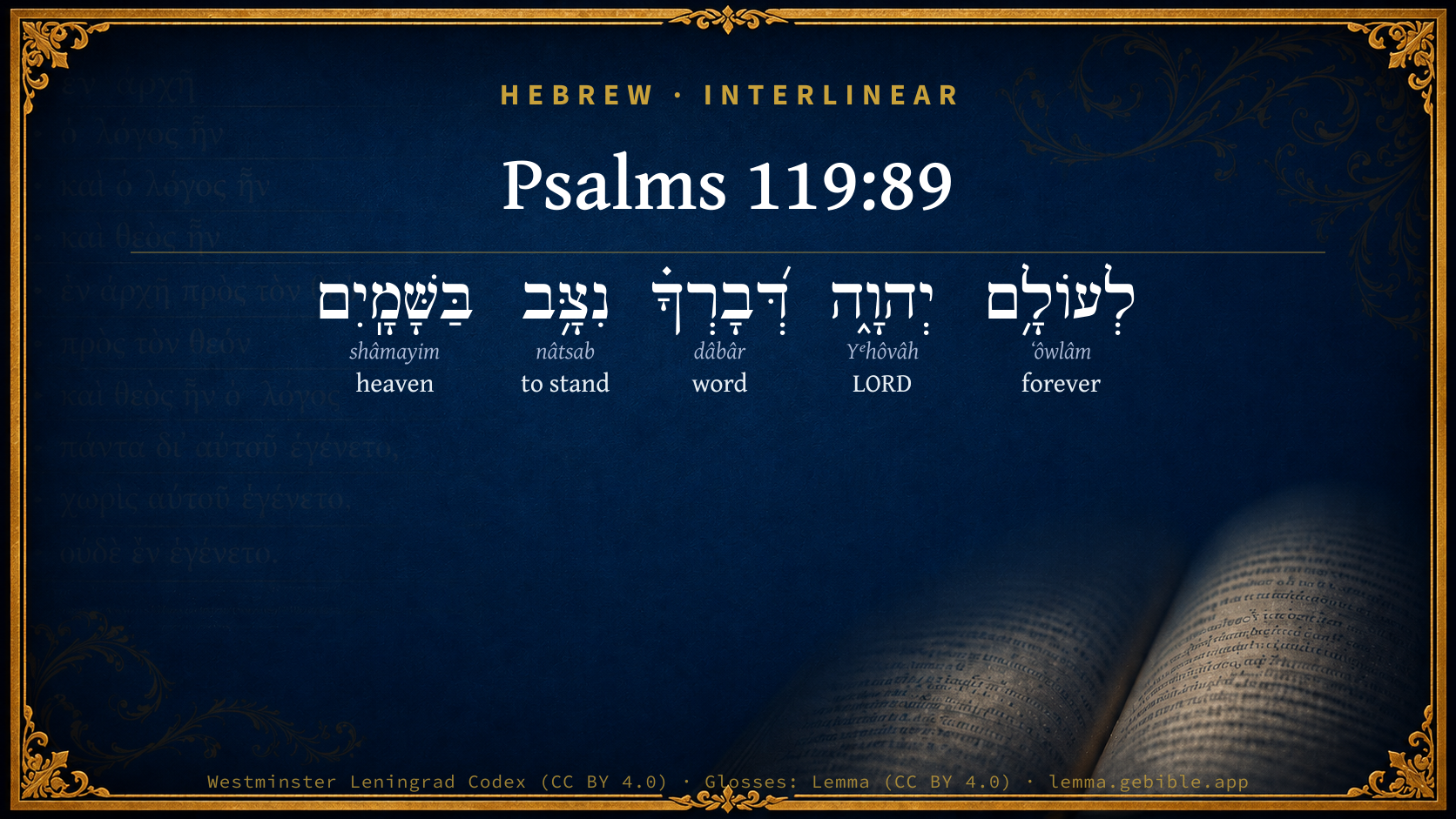
Hebrew (Westminster Leningrad Codex) Psalms 119:89 appears in the Hebrew Old Testament. The text above is from the Westminster Leningrad Codex. Each word links to its Strong’s number, a concise gloss, and parsing drawn from the Open Scriptures Hebrew Bible morphology. Click any word for its full Brown-Driver-Briggs (BDB) entry.
Download image
Cite this verse

Psalms 119:89 (World English Bible). Public Domain. Lemma interlinear Bible study tool, https://lemma.gebible.app/v/psalms/119/89.

Show BibTeX & RIS
BibTeX
RIS
English Translation
Yahweh, your word is settled in heaven forever.
World English Bible · Public Domain
Download a study sheet

One document with this verse’s original text, its word-by-word gloss line, the meaning frame, cross-references with their text, attributed commentary, and full source and license credits — printable, and it pastes into notes with its structure intact.

This verse Autodidact and up

Study sheet (.html) Plain text (.txt)

A passage Seminary Student

Up to 50 verses in one chapter. A passage sheet keeps up to 6 commentary sources and 12 cross-references per verse, in the order this page ranks them, and says so on the sheet whenever that leaves anything out. Ask for a single verse and you get the Autodidact verse sheet above.

Everything on this page stays free to read, with no account — the sheet is a download of what is already on screen, not access to it.

Want to remove ads? Support Godless Engineer
Compare translations 3

The same verse in 3 English versions, stacked beneath the original-language interlinear above. Click any original word for its lexicon entry.

Each is an independent rendering of the whole verse — the interlinear is not word-aligned to these translations.

Highlighted words mark where these versions differ — a whole-verse word diff, not a word-by-word alignment.

  • World English Bible Public Domain
    Yahweh, your word is settled in heaven forever.
  • King James Version Public Domain
    For ever, O LORD, thy word is settled in heaven.
  • unfoldingWord Literal Text CC BY-SA 4.0
    Forever, Yahweh, your word is established in the heavens.

unfoldingWord Literal Text — © unfoldingWord, licensed CC BY-SA 4.0. Word-aligned USFM3 via Door43 (git.door43.org/unfoldingWord/en_ult).

Versions to compare (up to 4)

3 of 4 selected

Show all 17 translations

Every available English version of this verse, each an independent rendering of the whole verse.

  • World English Bible Public Domain
    Yahweh, your word is settled in heaven forever.
  • Berean Standard Bible Public Domain
    Your word, O LORD, is everlasting; it is firmly fixed in the heavens.
  • Majority Standard Bible Public Domain
    Your word, O LORD, is everlasting; it is firmly fixed in the heavens.
  • King James Version Public Domain
    For ever, O LORD, thy word is settled in heaven.
  • American Standard Version (1901) Public Domain
    For ever, O Jehovah, Thy word is settled in heaven.
  • Revised Version (1885) Public Domain
    For ever, O LORD, thy word is settled in heaven.
  • Geneva Bible (1599) Public Domain
    LAMED. O Lord, thy worde endureth for euer in heauen.
  • Young's Literal Translation Public Domain
    `Lamed.' To the age, O Jehovah, Thy word is set up in the heavens.
  • Literal Standard Version CC BY-SA 4.0
    [LAMED] For all time, O YHWH, Your word is set up in the heavens.
  • Unlocked Literal Bible CC BY-SA 4.0
    Yahweh, your word stands forever; your word is established firmly in heaven.
  • unfoldingWord Literal Text CC BY-SA 4.0
    Forever, Yahweh, your word is established in the heavens.
  • Darby Bible Public Domain
    LAMED. For ever, O Jehovah, thy word is settled in the heavens.
  • World Messianic Bible Public Domain
    LORD, your word is settled in heaven forever.
  • Webster's Bible Public Domain
    LAMED. For ever, O LORD, thy word is settled in heaven.
  • Free Bible Version CC BY-SA 4.0
    Your word, Lord, lasts forever. It stands firm in the heavens.
  • Bible in Basic English Public Domain
    LAMED For ever, O Lord, your word is fixed in heaven.
  • JPS Tanakh (1917) Public Domain
    LAMED. For ever, O LORD, Thy word standeth fast in heaven.

Literal Standard Version (2020), Covenant Press — licensed CC BY-SA 4.0. Text via the HelloAO Bible API (eBible.org). Unlocked Literal Bible (unfoldingWord) — licensed CC BY-SA 4.0. Text via the HelloAO Bible API (eBible.org). unfoldingWord Literal Text — © unfoldingWord, licensed CC BY-SA 4.0. Word-aligned USFM3 via Door43 (git.door43.org/unfoldingWord/en_ult). Free Bible Version, Dr. Jonathan Gallagher — licensed CC BY-SA 4.0. Text via the HelloAO Bible API (eBible.org).

Word by word

More ways to search: Search by grammar → Find every occurrence → Compare this word →

Practice this passage: Drill this verse → Learn its vocabulary →

נִצָּ֥ב
nâtsab
H5324
“standing”
Verb, Niphal, Participle Active, Masculine, Singular, Absolute
Part of Speech
Verb
Stem
Niphal
Form
Participle Active
Gender
Masculine
Number
Singular
State
Absolute
Full BDB Definition

Origin: a primitive root

TWOT: 1398

to stand, take one's stand, stand upright, be set (over), establish - (Niphal) - to station oneself, take one's stand - to stand, be stationed - to stand, take an upright position - to be stationed, be appointed - deputy, prefect, appointed, deputed (substantive) - to stand firm - (Hiphil) - to station, set - to set up, erect - to cause to stand erect - to fix, establish - (Hophal) to be fixed, be determined, be stationary
  1. לְעוֹלָ֥ם ʻôwlâm H5769 “to/for · forever” Preposition + Noun, Common, Masculine, Singular, Absolute
  2. יְהוָ֑ה Yᵉhôvâh H3068 “LORD” Noun, Proper
  3. דְּ֝בָרְךָ֗ dâbâr H1697 “word · your” Noun, Common, Masculine, Singular, Construct + Suffix, Personal, 2nd Person, Masculine, Singular
  4. בַּשָּׁמָֽיִם shâmayim H8064 “in/at the · heaven(s)” Preposition, Determined + Noun, Common, Masculine, Plural, Absolute

About this verse

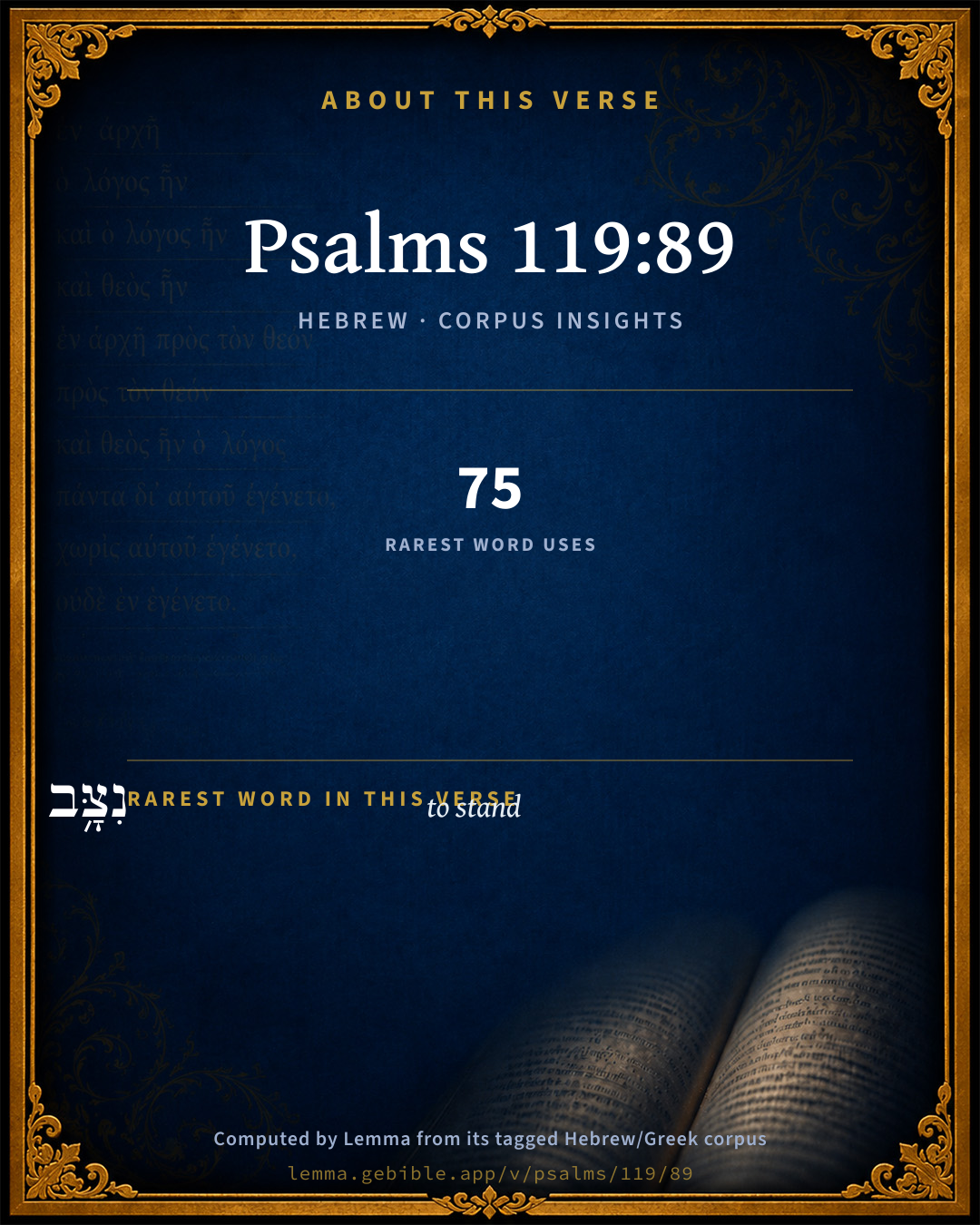
These counts appear in no published source. They are computed here, from the morphology-tagged text and Lemma’s own curated glosses. What Lemma adds →

5
words
5
distinct lemmas
Wisdom
section

Grammatical profile

  • 1 verb
  • 4 nouns

Verb forms

  • נִצָּ֥ב Niphal · Participle Active

Hebrew & Septuagint length

In English translation the verse runs 8 words from the Hebrew and 9 from the Septuagint (LXX English) — closely comparable.

A rough comparison of the two English renderings, which tokenize alike — not a word-level alignment.

Word counts can differ between the Hebrew and the Greek without any difference in meaning — e.g. the Hebrew direct-object marker אֵת has no separate Greek word, and Greek often adds the article ὁ.

Cross-references

7

Topical passages linked to Psalms 119:89 in the Treasury of Scripture Knowledge — connected by theme and wording, ordered by reader-vote popularity; previews shown in the World English Bible.

  • 1 Peter 1:25 But the Lord's word endures forever." This is the word of good news which was preached to you.
  • Matthew 5:18 For most assuredly, I tell you, until heaven and earth pass away, not even one smallest letter or one tiny pen stroke shall in any way pass away from the law, until all things are accomplished.
  • Matthew 24:34–35 Most assuredly I tell you, this generation will not pass away, until all these things are accomplished.
  • Psalms 119:160 All of your words are truth. Every one of your righteous ordinances endures forever.
  • Psalms 119:152 Of old I have known from your testimonies, That you have founded them forever.
  • Psalms 89:2 I indeed declare, "Love stands firm forever. You established the heavens. Your faithfulness is in them."
  • 2 Peter 3:13 But, according to his promise, we look for new heavens and a new earth, in which dwells righteousness.

Cross-references courtesy of OpenBible.info (CC BY 4.0).

Hebrew and Greek witnesses Masoretic Hebrew ↔ Greek Septuagint

The same verse in the two great witnesses to the Old Testament, shown verse-for-verse.

You’re reading Greek Psalm 118 (Hebrew Psalm 119). The Septuagint counts the superscription, so verse numbers can differ from the Hebrew — chapter-level alignment, not verse-by-verse. Numbering follows Rahlfs.

These are two independent witnesses, not word-aligned to each other, and the Septuagint is shown in lemma (dictionary) form.

Hebrew Psalms 119:89 Masoretic · Westminster Leningrad Codex

לְעוֹלָ֥ם יְהוָ֑ה דְּ֝בָרְךָ֗ נִצָּ֥ב בַּשָּׁמָֽיִם

Yahweh, your word is settled in heaven forever.

World English Bible · Public Domain

Greek LXX Greek Psalm 118:89 Septuagint · lemma form

λαβδ εἰς ὁ αἰών κύριος ὁ λόγος σύ διαμένω ἐν ὁ οὐρανός

Your word, O Lord, abides in heaven for ever.

LXX2012 (modern English Septuagint) · Public Domain

On this verse, The Cambridge Bible for Schools and Colleges discusses the Septuagint’s reading. Read the note in Commentary ↓

Hebrew: Westminster Leningrad Codex (CC BY 4.0). Greek: Septuagint (public domain); English from LXX2012 (modern English Septuagint) (Public Domain). How the Septuagint differs from the Hebrew →

Commentary

Notes on Psalms 119:89 from classic Christian and Jewish commentators (each source and its license shown beneath its notes). The classic Christian expositions comment on the surrounding passage and are grouped to its opening verse, so a note may address several verses; the Jewish commentaries on the Tanakh (Rashi and others) are per-verse, so they appear only where the commentator wrote on this verse.

Lemma curates 59 commentaries, every one of them public domain or Creative Commons licensed, each selected and text-cleaned for this edition rather than reprinted as found. About our sources →

Trapp's Complete Commentary

John Trapp

Psa 119:89 LAMED. For ever, O LORD, thy word is settled in heaven.

Ver. 89. For ever, O Lord, thy word] It is eternal and perpetual, neither can it be vacated or abolished by the injury of time or endeavours of tyrants. The Bible was imprinted at the New Jerusalem by the finger of Jehovah, and shall outlive the days of heaven, run parallel with the life of God, with the line of eternity. The saints also and angels in heaven live by the same law as we do here, and we pray to be conformed unto them.

John Trapp, A Commentary or Exposition upon All the Books of the Old and New Testament (1647–1656) — public domain. Text from a community e-Sword module.

The Biblical Illustrator

Joseph S. Exell

Psa_119:89-96

For ever, O Lord, Thy Word is settled in heaven.

My solace in affliction

I. Here we have strong consolation in certain facts which he remembered. Fly ye to the mountains when the enemy invades the land. Hide in the strongholds of your God.

1. The eternal existence of God, which is implied in the continuance of His faithfulness and power. The Lord liveth is the plea of souls harassed and haunted by foes without and fears within. Nothing happens to the Lord at haphazard. What can threaten His existence, thwart His purpose, weaken His power, diminish the tenderness of His heart, or distract the wisdom of His judgment?

2. The immutability of His Word. Thy Word is settled in heaven. Thus saith the Lord, The heaven is My throne, etc. His Word is settled in heaven and issued from heaven, the seat of His government, and it cannot be altered on earth, this distant colony of His empire. We refer to Gods Word, therefore, in grievous difficulties with great confidence, because we know that every statement it contains is reliable.

3. The faithfulness of the fulfilment of that Word. Thy faithfulness is unto all generations. Those men who have trusted Gods Word in any generation have always found it true.

4. The perpetuity of the Word in nature. Thou hast established the earth, etc.

5. The perpetuity of the Word in experience (verse 92).

II. The delights which he experienced in the time of his trouble. It is in such seasons of acute distress, when this world has no palliative to offer, that Gods Word can minister infinite delights to soothe the distractions and heal the sorrows of the heart. (C. H. Spurgeon.)

The eternal order

I. The source of the Divine order. Heaven. The heavens of creation declare the eternal order of the spiritual heavens. Be our views of the methods of creation what they may, it runs in the channels of the eternal order. Reflect upon it thus, as manifested in creation, moral government, redemption--in the infinitely great and the infinitely little.

II. Its stability. Thy Word is settled in heaven. It is not established upon the floods, by and by there shall be no sea; it is not founded upon the hills, by and by the mountains shall depart, and the hills be removed; it is not dependent upon the astronomical heavens, for by and by heaven and earth shall itself pass away; it is settled in Heaven, whose light, strength, and stability is God. Much should be said of the breadth and universality of the eternal order.

III. Its permanence (verses 90, 91). The eternal order implies infinite prevision, conscious purpose, consistency of aim, absoluteness of authority, harmony of design, beyond the possibility of chance or change to affect; it is inclusive of all operations, interests, duties, and possibilities; a grand plan, of which Jesus Christ is the Administrator, the Bible, for us men, the completed Revelation and Clue; the Blood the Seal; the Holy Spirit the Agent; and Glory the Consummation.

1. Sin is violation of, and opposition to, the eternal Order. It is the way to certain destruction.

2. Salvation is the voluntary falling in, by faith in Christ and a life of holiness, with the eternal Order. Thy statutes are my songs.

3. The practical effect of the contemplation of the eternal Order should be a faith which fears no foe. (Joseph Morris.)

Gods Word fixed in Heaven

The great problem in the construction of large lighthouses upon high and necessarily exposed points is, how best to prevent oscillation or swaying of the structure in times of prevailing wind or storm. It may be readily perceived that any variation, however slight, in the direction of the rays of light from the lamps when the lighthouse is in use, as at night, would make very material difference to the mariner far out at sea. Ships guiding their course in the path of the lighthouse beams would he very liable to be thrust from the line of safety altogether, and thus there would be created the danger of serious disaster, if indeed not actually causing loss to life and property. But no such danger confronts the Christian mariner out upon lifes sea, for Gods guiding light, the lighthouse of the Scriptures, is fixed in heaven. (G. V. Reichell.)

The Biblical Illustrator, edited by Joseph S. Exell (c. 1880s–1900s) — public domain. Text from a community e-Sword module.

The Treasury of David

Charles H. Spurgeon

Ver. 89. For ever, O LORD, thy word is settled in heaven. The strain is more joyful, for experience has given the sweet singer a comfortable knowledge of the word of the Lord, and this makes a glad theme. After tossing about on a sea of trouble the Psalmist here leaps to shore and stands upon a rock. Jehovah's word is not fickle nor uncertain; it is settled, determined, fixed, sure, immovable. Man's teachings change so often that there is never time for them to be settled; but the Lord's word is from of old the same, and will remain unchanged eternally. Some men are never happier than when they are unsettling everything and everybody; but God's mind is not with them. The power and glory of heaven have confirmed each sentence which the mouth of the Lord has spoken, and so confirmed it that to all eternity it must stand the same, settled in heaven, where nothing can reach it. In the former section David's soul fainted, but here the good man looks out of self and perceives that the Lord fainteth not, neither is weary, neither is there any failure in his word.

The verse takes the form of an ascription of praise: the faithfulness and immutability of God are fit themes for holy song, and when we are tired with gazing upon the shifting scene of this life, the thought of the immutable promise fills our mouth with singing. God's purposes, promises, and precepts are all settled in his own mind, and none of them shall be disturbed. Covenant settlements will not be removed, however unsettled the thoughts of men may become; let us therefore settle it in our minds that we abide in the faith of our Jehovah as long as we have any being.

LAMED. Ver. 89. Here the climax of the delineation of the suppliant's pilgrimage is reached. We have arrived at the centre of the psalm, and the thread of the connexion is purposely broken off. The substance of the first eleven strophes has evidently been: "Hitherto hath the Lord brought me: shall it be that I now perish?" To this the eleven succeeding strophes make answer, "The Lord's word changeth not; and in spite of all evil foreboding, the Lord will perfect concerning ms the work that he hath already begun." Joseph Francis Thruput, 1860.

Ver. 89. For ever, O LORD, thy word is settled in heaven. These words are usually rendered as making but one proposition; but the accent athnab showeth there are two branches; the one asserting the eternity of God; the other, the constancy and permanency of his word. Thus, 1. "For ever art thou O LORD." 2. "Thy word is settled in heaven." So the Syriac readeth it; and Geierus, and, after him, others prove and approve this reading. And so this verse and the following do the better correspond one with the other, if we observe beginning and ending: As thou art "for ever, O Lord, "and "thy faithfulness is unto all generations, "which are exactly parallel. And so also will the last clauses agree: "Thy word is settled in heaven, "and, "thou hast established the earth, and it abideth."

It implies that as God is eternal, so is his word, and that it hath a fit representation both in heaven and in earth: in heaven, in the constant motion of the heavenly bodies; in earth, in the consistency and permanency thereof; that as his word doth stand fast in heaven, so doth his faithfulness on earth, where the afflictions of the godly seem to contradict it. Thomas Manton.

Ver. 89. For ever, O LORD, thy word is settled in heaven. When Job considers his body turned to dust and worms (Job 14:19, 25), yet by faith he says, "My Redeemer lives, "etc. Even when patience failed in Job, yet faith failed not. Though God kill all other graces and comforts, and my soul too, yet he shall not kill my faith, says lie. If he separate my soul from my body, yet not faith from my soul. And therefore the just lives by faith, rather than by other graces, because when all is gone, yet faith remains, and faith remains because the promise remains: "For ever, O LORD, thy word is settled in heaven." And this is the proper and principal meaning of this place. Matthew Lawrence.

Ver. 89. For ever, O LORD, thy word is settled in heaven. If we look at God's word of promise, as it is in our unsettled hearts, we dream that it's as ready to waver as our hearts are; as the shadow of the sun and moon in the water seems to shake as much as the water doth which it shines upon. Yet for all this seeming shaking here below, the sun and moon go on m a steadfast course in heaven. So the Psalmist tells us that however our hearts stagger at a promise through unbelief, nay, and our unbelief makes us believe that the promise often is shaken; yet God's word is settled, though not in our hearts, yet "in heaven"; yea, and there "for ever, "as settled as heaven itself is; yea, more than so; for "heaven and earth may pass, "but "not one jot or tittle of the law (and therefore of the gospel) shall fail": Lu 16:17. Anthony Tuckney, 1599-1670.

Ver. 89. Settled. J. M. Good translates the verse as follows "For ever, O Jehovah, hath thy word given array to the heavens, "and observes that the Hebrew word bub is a military term, and applies to arraying and marshalling the divisions of an army in their proper stations when taking the field. The hosts of heaven are here supposed to be arrayed or marshalled with a like exact order; and to maintain for ever the relative duties imposed on them: while the earth, like the heavens, has as established a march prescribed to it, which it equally fulfils; for all are the servants of the great Creator; and hence, as they change, produce the beautiful regularity of the seasons, the rich returns of harvest, and daily declare the glory of the Lord.

Ver. 89. In heaven. Whenever you look to heaven, remember that within you have a God, who hath fixed his residence and shown his glory there, and made it the seat both of his mercy and justice. You have also there a Saviour who, after he had died for our sins, sat down at the right hand of Majesty, to see his promises accomplished, and by his word to subdue the whole world. There are angels that "do his commandment, hearkening to the voice of his word": Ps 103:20. There are glorified saints, who see God face to face, and dwell with him for evermore, and came thither by the same covenant which is propounded to us, as the charter of our peace and hope. In the outer region of heaven we see the sun and moon, and all the heavenly bodies, move in that fixed course and order wherein God hath set them; and will God show his constancy in the course of nature, and be fickle and changeable in the covenant of grace, wherein he hath disposed the order and method of his mercies? Thomas Manton.

Ver. 89, 91. In these verses there is affirmed to be an analogy between the word of God and the works of God. It is said of his "word, "that it is "settled in heaven, "and that it sustains its faithfulness from one generation to another. It is said of his "works, "and more especially of those that are immediately around us, even of the earth which we inhabit, that as it was established at the first so it abideth afterwards. And then, as if to perfect the assimilation between them, it is said of both in Ps 119:91, "They continue this day according to thine ordinances: for all are ray servants"; thereby identifying the sureness of that word which proceeded from his lips, with the unfailing constancy of that Nature which was formed and is upholden by his hands.

The constancy of Nature is taught by universal experience, and even strikes the popular eye as the most characteristic of those features which have been impressed upon her. It may need the aid of philosophy to learn how unvarying Nature is in all her processes how even the seeming anomalies can be traced to a law that is inflexible how what appears at first to be the caprices of her waywardness, are, in fact, the evolutions of a mechanism that never changes and that the more thoroughly she is sifted and put to the test by the interrogations of the curious, the more certainly will they find that she walks by a rule which knows no abatement, and perseveres with obedient footstep in that even course from which the eye of strictest scrutiny has never yet detected one hair breadth of deviation. It is no longer doubted by men of science, that every remaining semblance of irregularity in the universe is due, not to the fickleness of Nature, but to the ignorance of man that her most hidden movements are conducted with a uniformity as rigorous as Fate that even the fitful agitations of the weather have their law and their principle that the intensity of every breeze, and the number of drops in every shower, and the formation of every cloud, and all the occurring alternations of storm and sunshine, and the endless shifting of temperature, and those tremulous varieties of the air which our instruments have enabled us to discover but have not enabled us to explain that still, they follow each other by a method of succession, which, though greatly more intricate, is yet as absolute in itself as the order of the seasons, or the mathematical courses of astronomy. This is the impression of every philosophical mind with regard to Nature, and it is strengthened by each new accession that is made to science...But there is enough of patent and palpable regularity in Nature to give also to the popular mind the same impression of her constancy. There is a gross and general experience that teaches the same lesson, and that has lodged in every bosom a kind of secure and steadfast confidence in the uniformity of her processes. The very child knows and proceeds upon it. He is aware of an abiding character and property in the elements around him, and has already learned as much of the fire, and the water, and the food that he eats, and the firm ground that he treads upon, and even of the gravitation by which he must regulate his postures and his movements, as to prove that, infant though he be, he is fully initiated in the doctrine, that Nature has her laws and her ordinances, and that she continueth therein, and the proofs of this are ever multiplying along the journey of human observation; insomuch that when we come to manhood, we read of Nature's constancy throughout every department of the visible world. It meets us wherever we turn our eyes...God has so framed the machinery of my perceptions, as that I am led irresistibly to expect that everywhere events will follow each other in the very train in which I have ever been accustomed to observe them; and when God so sustains the uniformity of Nature, that in every instance it is rigidly so, he is just manifesting the faithfulness of his character. Were it otherwise, he would be practising a mockery on the expectation which he himself had inspired. God may be said to have promised to every human being that Nature will be constant if not by the whisper of an inward voice to every heart, at least by the force of an uncontrollable bias which he has impressed on every constitution. So that, when we behold Nature keeping up its constancy, we behold the God of Nature keeping up his faithfulness; and the system of visible things with its general laws, and its successions which are invariable, instead of an opaque materialism to intercept from the view of mortals the face of the Divinity, becomes the mirror which reflects upon the truth that is unchangeable, the ordination that never fails...And so it is, that in our text there are presented together, as if there was a tie of likeness between them that the same God who is fixed as to the ordinances of Nature, is faithful as to the declarations of his word; and as all experience proves how firmly he may be trusted for the one, so is there an argument as strong as experience, to prove how firmly he may be trusted for the other. By his work in us he hath awakened the expectation of a constancy in Nature, which he never disappoints. By his word to us, should he awaken the expectation of a certainty in his declarations, this he will never disappoint. It is because Nature is so fixed, that we apprehend the God of Nature to be so faithful. He who never falsities the hope that hath arisen in every bosom, from the instinct which he himself hath communicated, will never falsify the hope that shall arise in any bosom from the express utterance of his voice. Were he a God in whose hand the processes of nature were ever shifting, then might we conceive him a God from whose mouth the proclamations of grace had the like characters of variance and vacillation. But it is just because of our reliance on the one that we feel so much of repose in our dependence upon the other; and the same God who is so unfailing in the ordinances of his creation, we hold to be equally unfailing in the ordinances of his word. Thomas Chalmers.

Outlines Upon Keywords of the Psalm, By Pastor C. A. Davis.

Ver. 89-96. The immutable word of God. Is enthroned in heaven (Ps 119:89), and on earth (Ps 119:90-91), is the salvation of the believer in affliction (Ps 119:92, 94), His resource in danger (Ps 119:95), and the embodiment of perfection (Ps 119:96).

Ver. 89-92. The Psalmist here tells us the prescription which soothed his pains and sustained his spirits. Here we have strong consolation.

1. In certain facts which he remembered.

(a) The eternal existence of God.

(b) The immutability of his word.

(c) The faithfulness of the fulfilment of that word.

(d) The perpetuity of the word in nature.

(e) The perpetuity of the word in experience.

2. The delights which tie experienced in the time of his trouble. In bereavements; when everything seemed shifting and inconstant; when his own faith failed him; when all helpers failed him; he fell back upon the eternal settlements: "O Lord, thy word is settled, "etc. See "Spurgeon's Sermons, "No. 1656: "My Solace in my Affliction."

Ver. 89. Eternal settlements, or, heavenly certainties.

Ver. 89. God's eternal calm (in contrast with earth's mutations) imaged in the starry heavens. William Bickle Haynes, of Stafford, 1882.

Ver. 89. Consider,

1. The term, "thy word."

(a) A word is a revealed thought. The Scriptures are just

this: the thoughts and purposes of God made intelligible to

man.

(b) But a "word" also marks specially unity (it is one

word) and wholeness or completeness, a word, not a

syllable. The Scriptures are one and complete.

2. The statement, "for ever settled in heaven."

(a) "Settled in heaven" before it came to earth; therefore

it could come as a continuous unfolding, through various

dispensations, without the shadow of hesitation or

contradiction manifest in it.

(b) Abides "settled in heaven, "for its central revelation;

the atonement is a completed fact, and Christ is now in

heaven a perfected Saviour; thus the word is unalterable.

(c) "For ever settled in heaven." Not only because God in

heaven is of one mind and cannot be turned; but because

righteousness itself, the righteousness of heaven,

demands that an atonement by suffering shall be fully and

everlastingly answered by its due reward.

3. The lessons.

(a) If settled in heaven, men on earth can never unsettle

it.

(b) The wicked may not indulge a future hope arising from

any new dispensation beyond the grave; God's present word

to us cannot then be unsettled.

(c) The godly may rely on a settled word amidst the

unsettled experiences and feelings incident to earth. J.F.

Psalms 119:90*

Charles H. Spurgeon's The Treasury of David (1869–1885) — public domain. Psalms only. Text from a community e-Sword/MySword module.

Joseph Benson's Commentary

LAMED.

Psa 119:89-91. For ever, O Lord, thy word, &c. — The Hebrew may be rendered, thou art for ever, O Lord, thy word, &c. Or, thy word, O Lord, is for ever; firmly fixed in heaven. God’s truth or faithfulness, upon which his laws are founded, is as fixed as the heaven and the earth; for they owe their durableness to the same truth. Thy faithfulness is unto all generations — Every age affords fresh proofs of the truth of thy word. Thou hast established the earth, and it abideth — In that place and state in which thou didst establish it, Ecc 1:4. They — The heaven and the earth last mentioned; continue according to thine ordinance — As thou didst appoint, and by virtue of thine appointment. For all are thy servants — All things are subject to thy power and pleasure.

Joseph Benson's Commentary on the Old and New Testaments (1811–1818) — public domain. Text from a community e-Sword module.

Keil & Delitzsch

C. F. Keil & F. Delitzsch

The eightfold Lamed. Eternal and imperishable in the constant verifying of itself is the vigorous and consolatory word of God, to which the poet will ever cling. It has heaven as its standing-place, and therefore it also has the qualities of heaven, and before all others, heaven-like stability. Ps 89 (Psa 89:3) uses similar language in reference to God's faithfulness, of which here Psa 119:90 says that it endureth into all generations. The earth hath He creatively set up, and it standeth, viz., as a practical proof and as a scene of His infinite, unchangeable faithfulness. Heaven and earth are not the subjects of Psa 119:91 (Hupfeld), for only the earth is previously mentioned; the reference to the heavens in Psa 119:89 is of a very different character. Hitzig and others see the subject in למשׁפּטיך: with respect to Thy judgments, they stand fast unto this day; but the עבדיך which follows requires another meaning to be assigned to עמדוּ: either of taking up one's place ready for service, or, since עמד למשׁפט is a current phrase in Num 35:12; Jos 20:6; Eze 44:24, of placing one's self ready to obey (Bttcher). The subject of עמדוּ, as the following הכּל shows, is meant to be thought of in the most general sense (cf. Job 38:14): all beings are God's servants (subjects), and have accordingly to be obedient and humble before His judicial decisions - היּום, "even to this day," the poet adds, for these judicial decisions are those which are formulated beforehand in the Tra. Joy in this ever sure, all-conditioning word has upheld the poet in his affliction, Psa 119:92. He who has been persecuted and cast down as it were to death, owes his reviving to it, Psa 119:93. From Him whose possession or property he is in faith and love he also further looks for his salvation, Psa 119:94. Let evil-doers lie in wait for him (קוּוּ in a hostile sense, as in Psa 56:7, קוּה, cf. חכּה, going back to קוה, Arab. qawiya, with the broad primary signification, to be tight, firm, strong) to destroy him, he meditates on God's testimonies. He knows from experience that all (earthly) perfection (תּכלה) has an end (inasmuch as, having reached its height, it changes into its opposite); God's commandment (singular as in Deu 11:22), on the contrary, is exceeding broad (cf. Job 11:9), unlimited in its duration and verification.

Keil & Delitzsch — Biblical Commentary on the Old Testament (1861–1891) — public domain (CC PDM 1.0). Text via the HelloAO Bible API. (Old Testament only.)

J. A. Alexander on Psalms

Joseph Addison Alexander

89. (Psa 119:89) To eternity, Jehovah, thy word is settled in heaven. The translation, eternal (art thou), Lord, is contrary to usage, which requires the pronoun, in that case, to be expressed. Settled, literally made to stand, i.e. unalterably fixed. In heaven, beyond the reach of all disturbing causes. See above, Psa 89:2.

Joseph Addison Alexander, The Psalms Translated and Explained (1850) — public domain. Text from a community e-Sword module.

Tyndale Open Study Notes

Tyndale Open Resources

119:89-96 Lamedh (ל): The stability of God’s wisdom gives understanding. God’s word provides order and a framework for living, even when under pressure from adversaries.

Tyndale Open Study Notes — © Tyndale Open Resources, licensed CC BY-SA 4.0. Text via the HelloAO Bible API.

Geneva Bible (1599)

Geneva Bible translators

Because none should esteem God’s word according to the changes of things in this world, he showeth that it abideth in heaven, and therefore is immutable.

Geneva Bible (1599) marginal notes — public domain. Text via Bolls.life.

Matthew Henry's Commentary

Here, 1. The psalmist acknowledges the unchangeableness of the word of God and of all his counsels: "For ever, O Lord! thy word is settled. Thou art for ever thyself (so some read it); thou art the same, and with thee there is no variableness, and this is a proof of it. Thy word, by which the heavens were made, is settled there in the abiding products of it;" or the settling of God's word in heaven is opposed to the changes and revolutions that are here upon earth. All flesh is grass; but the word of the Lord endures for ever. It is settled in heaven, that is, in the secret counsel of God, which is hidden in himself and is far above out of our sight, and is immovable, as mountains of brass. And his revealed will is as firm as his secret will; as he will fulfil the thoughts of his heart, so no word of his shall fall to the ground; for it follows here, Thy faithfulness is unto all generations, that is, the promise is sure to every age of the church and it cannot be antiquated by lapse of time. The promises that look ever so far forward shall be performed in their season. 2. He produces, for proof of it, the constancy of the course of nature: Thou hast established the earth for ever and it abides; it is what it was at first made, and where it was at first placed, poised with its own weight, and notwithstanding the convulsions in its own bowels, the agitations of the sea that is interwoven with it, and the violent concussions of the atmosphere that surrounds it, it remains unmoved. "They" (the heavens and the earth and all the hosts of both) "continue to this day according to thy ordinances; they remain in the posts wherein thou hast set them; they fill up the place assigned them, and answer the purposes for which they were intended." The stability of the ordinances of the day and night, of heaven and earth, is produced to prove the perpetuity of God's covenant, Jer 31:35, Jer 31:36; Jer 33:20, Jer 33:21. It is by virtue of God's promise to Noah (Gen 8:22) that day and night, summer and winter, observe a steady course. "They have continued to this day, and shall still continue to the end of time, acting according to the ordinances which were at first given them; for all are thy servants; they do thy will, and set forth thy glory, and in both are thy servants." All the creatures are, in their places, and according to their capacities, serviceable to their Creator, and answer the ends of their creation; and shall man be the only rebel, the only revolter from his allegiance, and the only unprofitable burden of the earth.?

Matthew Henry's Commentary on the Whole Bible (1708–1710) — public domain (CC PDM 1.0). Text via the HelloAO Bible API.

Adam Clarke's Commentary

LETTER ל LAMED. - Twelfth Division

Verse 89. For ever, O Lord, thy word is settled in heaven.] Thy purposes are all settled above, and they shall all be fulfilled below.

Adam Clarke's Commentary on the Bible (1810–1826) — public domain. Text from a community e-Sword/MySword module.

John Calvin's Commentaries

89 Thy word, O Jehovah I endure for ever. Many explain this verse as if David adduced the stability of the heavens as a proof of God’s truth. According to them the meaning is, that God is proved to be true because the heavens continually remain in the same state. Others offer a still more forced interpretation, That God’s truth is more sure than the state of the heavens. But it appears to me that the prophet intended to convey a very different idea. As we see nothing constant or of long continuance upon earth, he elevates our minds to heaven, that they may fix their anchor there. David, no doubt, might have said, as he has done in many other places, that the whole order of the world bears testimony to the steadfastness of God’s word — that word which is most true. But as there is reason to fear that the minds of the godly would hang in uncertainty if they rested the proof of God’s truth upon the state of the world, in which such manifold disorders prevail; by placing God’s truth in the heavens, he allots to it a habitation subject to no changes. That no person then may estimate God’s word from the various vicissitudes which meet his eye in this world, heaven is tacitly set in opposition to the earth. Our salvation, as if it had been said, being shut up in God’s word, is not subject to change, as all earthly things are, but is anchored in a safe and peaceful haven. The same truth the Prophet Isaiah teaches in somewhat different words:

“All flesh is grass, and all the godliness thereof is as the flower of the field,” (Isaiah 40:6.)

He means, according to the Apostle Peter’s exposition, (1 Peter 1:24) that the certainty of salvation is to be sought in the word, and, therefor that they do wrong who settle their minds upon the world; for the steadfastness of God’s word far transcends the stability of the world.

John Calvin's Commentaries (1540-1563) — public domain. Text from the Calvin Translation Society English edition (1840s-50s) via the Christian Classics Ethereal Library (ccel.org). Calvin's coverage is partial (roughly two-thirds of the Bible); uncommented books and verses are honest gaps, never fabricated. The 19th-century editor's footnotes and remarks are omitted so the notes are faithfully Calvin's own voice.

Ellicott's Commentary for English Readers

LAMED.

(89, 90) See Psa_89:2.

A Bible Commentary for English Readers, edited by Charles John Ellicott (1878–1897) — public domain. Text from a community e-Sword module.

The Cambridge Bible for Schools and Colleges

gen. ed. J. J. S. Perowne

89. The A.V. rightly follows the LXX, Targ. and Jer. in treating the verse as one clause, the accentual division of the Hebr. being regarded as rhythmical not logical. Jehovah’s word is eternal, immutable; it belongs to that sphere which is raised above the accidents of chance and change, and shares its attributes. Cp. Psa_89:2.

is settled] Standeth fast.

89–96. Lamed. The eternity, immutability, and comprehensiveness of God’s law, which has been the Psalmist’s support in affliction.

The Cambridge Bible for Schools and Colleges (gen. ed. J. J. S. Perowne; Cambridge University Press, 1878–1918) — public domain. Text from a community e-Sword module.

John Gill's Exposition

I will never forget thy precepts,.... Not the precepts of the moral law, though he carefully observed and attended to them, laid them up in his mind, and did not forget to keep them; but the doctrines of the word, of the word which the Lord commanded to a thousand generations; these he endeavoured to remember, and not let them slip from him, since it follows:

for with them thou hast quickened me: not with the precepts of the moral law, which cannot give life, quicken a dead sinner, nor comfort a distressed saint it is the killing letter, and the ministration of condemnation and death: but the doctrines of the word, of the Gospel, which are spirit and life; the savour of life unto life, the means of quickening dead sinners, and of reviving drooping saints; of refreshing their spirits, and cheering their souls, when in distress: and when they are made thus useful, they are not easily forgotten, they leave impressions which do not soon wear off; and besides, saints are careful to remember such words and truths, which have been of use unto them, since they may have occasion for them again.

John Gill's Exposition of the Whole Bible (1746–1763) — public domain (CC PDM 1.0). Text via the HelloAO Bible API.

Albert Barnes' Notes on the Bible

Forever, O Lord, thy word is settled in heaven - This commences a new division of the psalm, indicated by the Hebrew letter Lamed (ל l), or “l.” On the meaning of the passage, see the notes at Psa 89:2. The word rendered “settled” means properly “to set, to put, to place;” and then, to stand, to cause to stand, to set up, as a column, Gen 35:20; an altar, Gen 33:20; a monument, 1Sa 15:12. The meaning here is, that the word - the law - the promise - of God was made firm, established, stable, in heaven; and would be so forever and ever. What God had ordained as law would always remain law; what he had affirmed would always remain true; what he had promised would be sure forever.

Albert Barnes' Notes on the Bible (1834–1885) — public domain. Text from a community e-Sword/MySword module.

Matthew Poole's English Annotations

LAMED

Although many things happen upon earth which seem contrary to thy word, and at which men take occasion to question the truth of thy word, yet in heaven it is sure and certainly true.

In heaven; either,

1. With thee in thy heavenly habitation, or in thy breast; as thy nature is unchangeable, so thy word is infallible. Or rather,

2. In the heavenly bodies, which are not subject to those changes and decays which are in this lower world, but constantly continue the same in their substance, and order, and courses, and this by virtue of that word of God by which they were made and established in this manner; and therefore God’s word delivered to his people upon earth, which is of the same nature, must needs be of equal certainty and stability. This sense best suits with the following verses, and with other scriptures, wherein the certainty of God’s word is set forth by comparing it with the stability of the heaven and the earth, as Mat 5:18, and elsewhere.

Matthew Poole's English Annotations on the Holy Bible (1683–1685) — public domain. Text from a community e-Sword/MySword module.

Whedon's Commentary on the Bible

Daniel D. Whedon

ל, Lamed.

89-96. Thy word is settled in heaven—This lofty declaration of the character of the word, gives the reason why it may be trusted. “Its seat is the bosom of God; its voice is the harmony of the worlds.”

“The word that rolls the stars around, Speaks all the promises.”

What the “word” is in the frame of nature, upholding all things so far that mortal vision does not reach to its boundary, such the writer finds it in his heart; it has supported and has quickened him.

Daniel D. Whedon (gen. ed.), Commentary on the Old and New Testaments (1874–1909) — public domain. Text from a community e-Sword module.

The Pulpit Commentary

lLAMED.

Forever, O Lord, thy Word is settled in heaven. God"s Word, or Law, is eternal and unchanging fixed and established forever in the heaven of heavens. (comp. Psa_89:2 Jam_1:17)

Vers. 89-96. A grateful confession of Divine aid.

How fitly this section follows on the foregoing one! There was darkness, indeed; but here is light. The psalmist celebrates let us do so with him the help of God.

I IT IS SETTLED IN HEAVEN FOREVER THAT SUCH AID SHALL BE FORTHCOMING. (Ver. 89) Therefore:

1. No power of man can hinder it. It is "settled.

2. Nor any lapse of time. Generations may come and go, but that matters not. God"s promise abides, even as the earth which he has established.

3. Nor any events or changes whatsoever. (Ver. 91) Divine decrees have ordained them, and all have to serve and minister thereto. Here is great consolation for the tried soul.

II IT SUSTAINS THE SERVANT OF GOD IS UTTERMOST PERIL. (Ver. 92) But for God"s settled love, which was full of delight for his servant, he could not have lived. God has ways and means by his Holy Spirit to so write his Word on our hearts, that they shall be filled with delight, and all the power of hell cannot destroy us. So was it here; so will it be with all like-minded men.

III THE EXPERIENCE OF ITS POWER MAKES IT IMPOSSIBLE FOR THE MEMORY TO LET IT GO. (Ver. 93) If we have been "quickened" by it, as was the psalmist, memory and heart and will cleave to it with a tenacity which never relaxes, but ever tightens its hold. Nothing but the experience of religion in the heart will do this. Creeds and rituals and sacraments, religious profession and work, have all been proved frail and feeble in this respect; but he who knows by actual experience how God can quicken his soul will simply never leave him.

IV AND LEADS TO ABSOLUTE SELF-SURRENDER AND CONFIDENT TRUST. (Ver. 94) "I am thine." The man is no longer his own. "Save me I know thou wilt; such is the implied meaning.

V IS AN ANTIDOTE TO ALL FEAR. (Ver. 95) What matters it that the wicked wait, etc.? He will consider the testimonies of God, those borne to him by redeemed souls, those borne by them in the psalmist"s own soul. Such considering banishes fear.

VI THERE IS NOTHING LIKE IT. All human schemes and teachings are naught compared with thy commandment. S.C.

The Pulpit Commentary (1880–1919), ed. H.D.M. Spence-Jones & Joseph S. Exell — public domain. Text from a community e-Sword module.

John Wesley's Explanatory Notes

In heaven - With thee in thy heavenly habitation.

John Wesley, Explanatory Notes Upon the Whole Bible (1754–1765) — public domain. Text via the GEBible commentary corpus.

Kretzmann's Popular Commentary

Paul E. Kretzmann

Lamed. The Imperishable Nature of the Divine Word. —

v. 89. Forever, O Lord, Thy Word is settled in heaven; like the essence of God, out of which it flowed, it is unchangeable and will endure throughout eternity. Cf Mat 24:35; Luk 21:33.

v. 90. Thy faithfulness is unto all generations, remains the same from one generation to the next, absolutely trustworthy: Thou hast established the earth, and it abideth, standing as long as God’s will so ordains.

v. 91. They continue this day according to Thine ordinances, the earth and all it contains being subject to His Word, obliged to carry out the dictates of His will; for all are Thy servants, humbly obeying His unalterable laws. The trust in the eternal faithfulness of Jehovah has sustained the psalmist in his affliction.

v. 92. Unless Thy Law, the Word of God with its divine instructions, had been my delights, the one thing affording him true happiness, I should then have perished in mine affliction, God’s Word alone giving him strength to endure.

v. 93. I will never forget Thy precepts, the special directions of God’s holy will; for with them Thou hast quickened me, given him new spiritual life and endurance in the midst of his trials.

v. 94. I am Thine, save me, delivering him from the difficulties which beset him; for I have sought Thy precepts, endeavoring earnestly to live up to all the directions which the Lord has laid down for the conduct of His children.

v. 95. The wicked have waited for me to destroy me, their object being thereby to remove the Word which the servant of the Lord always quoted against them; but I will consider Thy testimonies, for the Word of God will abide in spite of all the efforts of the enemies to destroy it.

v. 96. I have seen an end of all perfection, that is, no matter how perfect anything may seem here on earth, it has its limit or end, for absolute excellence is wanting where fallibility is natural; but Thy commandment is exceeding broad, the Word of God is not bound by the narrow limits of a human, earthly production. Man, be he never so wise, never outgrows the Word of God.

Paul E. Kretzmann, Popular Commentary of the Bible (1921–1924) — public domain. Text from a community e-Sword module.

unfoldingWord translationNotes

Door43 World Missions Community

LAMEDH

This is the name of the twelfth letter of the Hebrew alphabet. In the Hebrew language, each line of verses 89-96 begins with this letter.

your word stands forever

"what you have said will be true forever"

your word is established firmly in heaven

This speaks about what God has said as if it were an object that stands firmly upright. AT: "what you have said will be true in heaven forever" (See: Metaphor)

for all generations

"for all future generations." This is an idiom that means "forever." (See: Idiom)

translationWords

Yahweh

word of God

eternity

heaven

faithful

generation

unfoldingWord translationNotes — © Distant Shores Media and the Door43 World Missions Community, licensed CC BY-SA 4.0. Source: git.door43.org/Door43/en_tn.

Lesson kit

Teaching starters — assembled from the data on this page, not authored interpretation. Every prompt links to the verse data it draws on. Edit before teaching.

Psalms, in the Wisdom, opens this verse with 5 words (5 distinct Hebrew lemmas). Its most distinctive word is nâtsab (“to stand”). A historical commentator’s framing appears above. Read the whole chapter for the surrounding context.

Discussion questions

  1. What does “to stand” (nâtsab) contribute to the verse as a whole?
  2. 1 Peter 1:25 shares this passage’s theme. How do the two illuminate each other?
  3. The translations on this page render this verse differently — a whole-verse word diff, not a word-by-word alignment. What might account for the different wordings?
  4. The verb «נִצָּ֥ב» is Niphal Participle Active. How does its form color the action?
  5. Reading how Trapp's Complete Commentary and The Biblical Illustrator read this verse, where do the two commentators agree and where do they part?

Things to notice

Reading settings

Reading text

Shown beneath each verse's original-language words.

Old Testament
Old Testament edition

Read the OT as the Masoretic Hebrew (MT) or the Greek Septuagint (LXX).

English shown for the Greek Septuagint (in the Hebrew ↔ Greek comparison).

Comparing translations? Open the Compare panel on any verse page to stack up to four side by side.