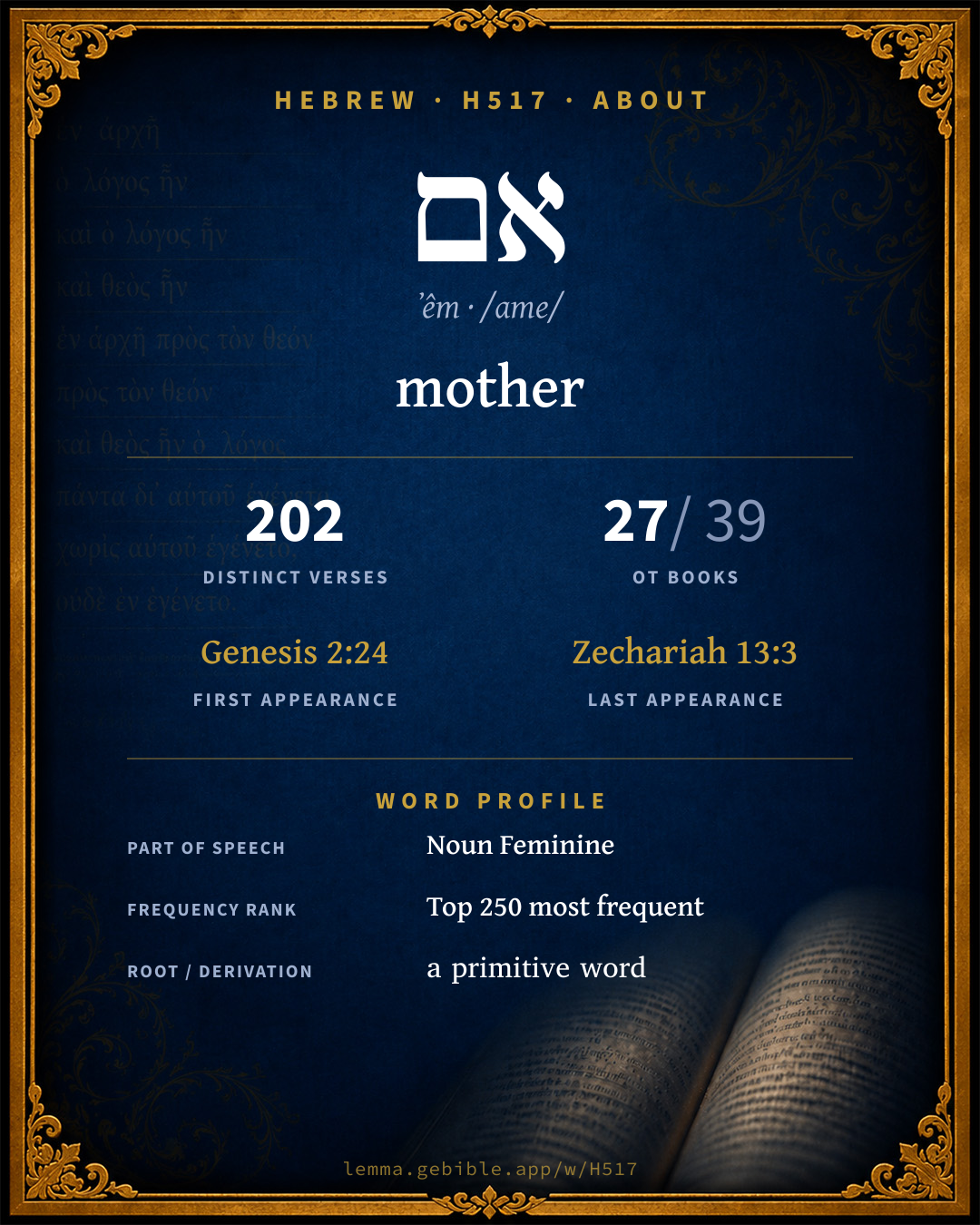
אֵם
mother
‘mother’ is one of 2 main senses fuller range ↓
Full lexicon entry — Brown-Driver-Briggs (BDB)
From Brown-Driver-Briggs (BDB)
Where this word appears
See every Construct-state word in the Hebrew Bible →
Grammar key — what these labels mean
Part of speech
- Noun
- A naming word — a person, place, thing, or idea.
Noun type
- Common
- A common noun — a general class of person, place, or thing (“king,” “city,” “water”), not a specific name.
State
- Construct
- A noun bound to a following noun in a possessive / “of” relationship (the construct chain).
- Absolute
- The independent form of a noun, not bound to a following word.
Gender
- Feminine
- Grammatically feminine.
Number
- Singular
- One.
- Plural
- More than one (in Hebrew, generally three or more).
Every verse where H517 appears in the Book of Genesis — 21 distinct verses. Click any verse to open its interlinear word-by-word view. Verse text shown in the World English Bible for context — . Each verse’s Hebrew form is shown with its reference; the English is not keyword-highlighted, since the data carries no word-level English alignment. Use “Compare translations” on any verse to read it across multiple English versions. This concordance covers the Hebrew Bible; Septuagint (Greek Old Testament) occurrences are not indexed here.
Genesis
- Genesis 2:24 אִמּ֑/וֹ n c fs cs + sfx pers 3ms Therefore a man will leave his father and his mother, and will join with his wife, and they will be one flesh.
- Genesis 3:20 אֵ֥ם n c fs cs The man called his wife Eve, because she was the mother of all living.
- Genesis 20:12 אִמִּ֑/י n c fs cs + sfx pers 1cs Moreover she is indeed my sister, the daughter of my father, but not the daughter of my mother; and she became my wife.
- Genesis 21:21 אִמּ֛/וֹ n c fs cs + sfx pers 3ms He lived in the wilderness of Paran. His mother took a wife for him out of the land of Egypt.
- Genesis 24:28 אִמָּ֑/הּ n c fs cs + sfx pers 3fs The young lady ran, and told her mother's house about these words.
- Genesis 24:53 וּ/לְ/אִמָּֽ/הּ conj + prep + n c fs cs + sfx pers 3fs The servant brought forth jewels of silver, and jewels of gold, and clothing, and gave them to Rebekah. He gave also to her brother and to her mother precious things.
- Genesis 24:55 וְ/אִמָּ֔/הּ conj + n c fs cs + sfx pers 3fs Her brother and her mother said, "Let the young lady stay with us a few days, at least ten. After that she will go."
- Genesis 24:67 אִמּ֔/וֹ אִמּֽ/וֹ n c fs cs + sfx pers 3ms n c fs cs + sfx pers 3ms Isaac brought her into his mother Sarah's tent, and took Rebekah, and she became his wife. He loved her. Isaac was comforted after his mother's death.
- Genesis 27:11 אִמּ֑/וֹ n c fs cs + sfx pers 3ms Jacob said to Rebekah his mother, "Behold, Esau my brother is a hairy man, and I am a smooth man.
- Genesis 27:13 אִמּ֔/וֹ n c fs cs + sfx pers 3ms His mother said to him, "Let your curse be on me, my son. Only obey my voice, and go get them for me."
- Genesis 27:14 לְ/אִמּ֑/וֹ אִמּ/וֹ֙ prep + n c fs cs + sfx pers 3ms n c fs cs + sfx pers 3ms He went, and got them, and brought them to his mother. His mother made savory food, such as his father loved.
- Genesis 27:29 אִמֶּ֑/ךָ n c fs cs + sfx pers 2ms Let peoples serve you, Nations bow down to you. Be lord over your brothers, Let your mother's sons bow down to you. Cursed be everyone who curses you, Blessed be everyone who blesses you."
- Genesis 28:2 אִמֶּ֑/ךָ אִמֶּֽ/ךָ n c fs cs + sfx pers 2ms n c fs cs + sfx pers 2ms Arise, go to Paddan Aram, to the house of Bethuel your mother's father. Take a wife from there from the daughters of Laban, your mother's brother.
- Genesis 28:5 אֵ֥ם n c fs cs Isaac sent Jacob away. He went to Paddan Aram to Laban, son of Bethuel the Syrian, Rebekah's brother, Jacob's and Esau's mother.
- Genesis 28:7 אִמּ֑/וֹ n c fs cs + sfx pers 3ms and that Jacob obeyed his father and his mother, and was gone to Paddan Aram.
- Genesis 29:10 אִמּ֔/וֹ אִמּ֑/וֹ אִמּֽ/וֹ n c fs cs + sfx pers 3ms n c fs cs + sfx pers 3ms n c fs cs + sfx pers 3ms It happened, when Jacob saw Rachel the daughter of Laban, his mother's brother, and the sheep of Laban, his mother's brother, that Jacob went near, and rolled the stone from the well's mouth, and watered the flock of Laban his mother's brother.
- Genesis 30:14 אִמּ֑/וֹ n c fs cs + sfx pers 3ms Reuben went in the days of wheat harvest, and found mandrakes in the field, and brought them to his mother, Leah. Then Rachel said to Leah, "Please give me some of your son's mandrakes."
- Genesis 32:11 אֵ֖ם n c fs Please deliver me from the hand of my brother, from the hand of Esau: for I fear him, lest he come and strike me, and the mothers with the children.
- Genesis 37:10 וְ/אִמְּ/ךָ֣ conj + n c fs cs + sfx pers 2ms He told it to his father and to his brothers. His father rebuked him, and said to him, "What is this dream that you have dreamed? Will I and your mother and your brothers indeed come to bow ourselves down to you to the earth?"
- Genesis 43:29 אִמּ/וֹ֒ n c fs cs + sfx pers 3ms He lifted up his eyes, and saw Benjamin, his brother, his mother's son, and said, "Is this your youngest brother, of whom you spoke to me?" He said, "God be gracious to you, my son."
- Genesis 44:20 לְ/אִמּ֖/וֹ prep + n c fs cs + sfx pers 3ms We said to my lord, 'We have a father, an old man, and a child of his old age, a little one; and his brother is dead, and he alone is left of his mother; and his father loves him.'
About this entry
At a glance — auto-summarized from this page’s data, not written by a person. Every figure links to its source below. This summary describes the numbers; it doesn’t interpret them.
At its core, אם (ʼêm) means “mother.” The King James Version also renders it “mother's,” a usage modern versions have dropped for “mother” — see the renderings breakdown. With 202 verses in 27 books, it is a common word in the Hebrew Bible. Scripture first uses it in Genesis 2:24. Not a single-sense word: explore its full sense range. Dig into 202-verse concordance and the renderings breakdown below.
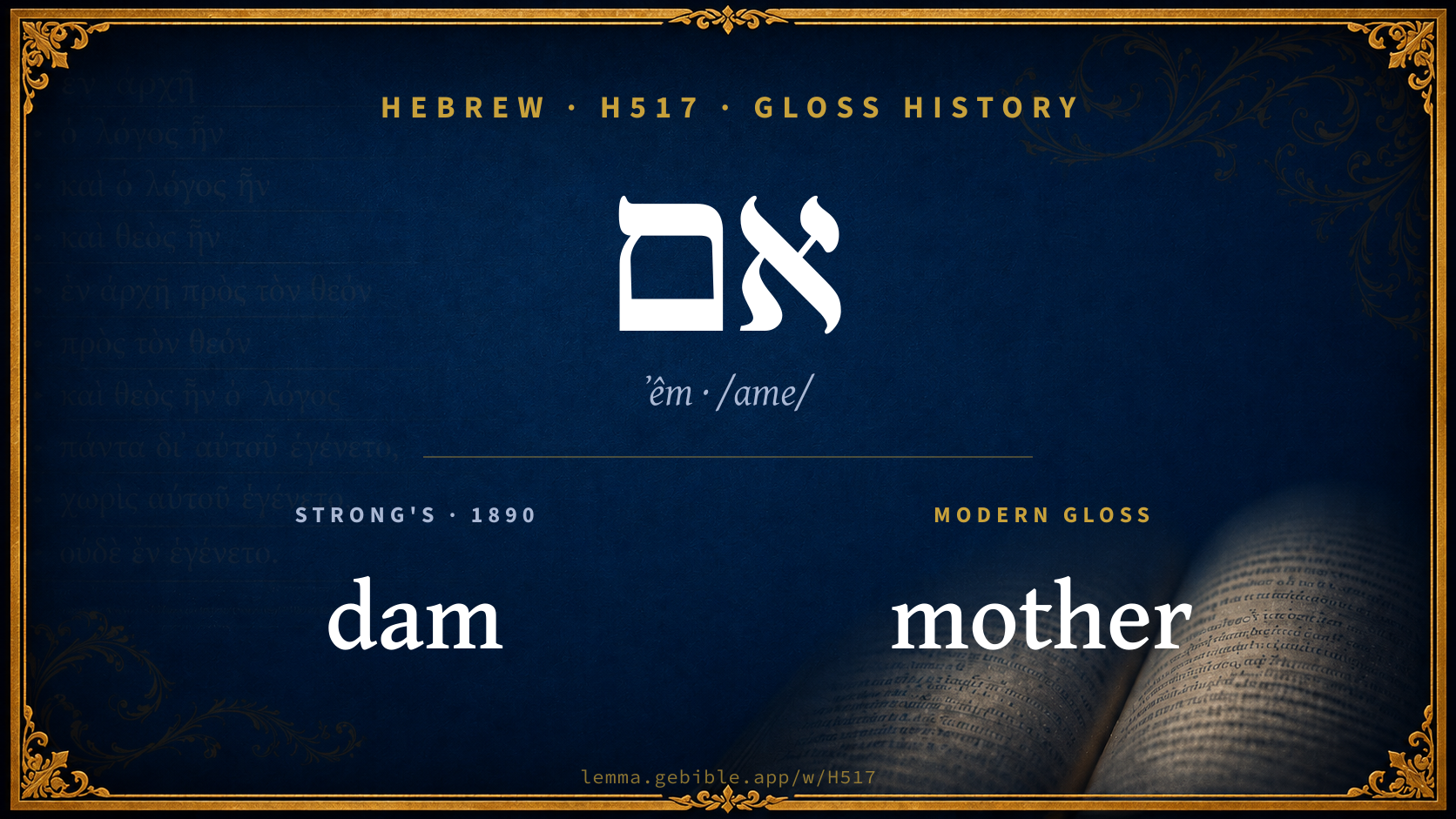
Gloss history
Strong's 1890 vs modern scholarship
About this word
Strong's H517 catalogs a Hebrew word from the Hebrew Old Testament.
These counts are not copied from any lexicon or concordance. They are computed here, from the morphology-tagged Hebrew Old Testament. What Lemma adds →
- 202
- distinct verses
- The word appears in 202 distinct verses.
- 27 / 39
- OT books
- The word appears in 27 of 39 Old Testament books.
- #215
- by frequency
- Top 250 most frequent Hebrew words (rank 215 of 8,640 Hebrew words by occurrence).
View all 202 occurrences in the concordance →
By section of the Old Testament
By traditional corpus
Conventional, traditional groupings — biblical authorship is debated, so this is a traditional corpus grouping, not an authorship claim. Each share is this word’s portion of its verses in that division of the Hebrew canon. Each figure is a share of the word’s 202 distinct verses.
- Prophets (Nevi'im) 92 verses · 46%
- Writings (Ketuvim) 56 verses · 28%
- Torah (Pentateuch) 54 verses · 27%
How translations render this word
Counts come from each version’s own published word-to-Strong’s tagging or interlinear alignment — an approximate guide to how each version renders this word, not a word-level alignment the data otherwise carries. Because each total is that version’s own tagged count, the per-version totals vary from one another and need not match the appearance or distinct-verse counts above. These counts may also differ from a printed concordance because Lemma counts each distinctly tagged rendering and does not collapse phrase taggings into a single head-word total. This is a fixed set of word-tagged versions (KJV, ASV, BSB, ULT) and does not change with the reading translation you choose elsewhere. Each version’s license is shown beside its name below (and on Sources).
- King James Version: Mother 109×, Mother's 61×, Or his mother 8×
- American Standard Version: Mother 155×, Or his mother 8×, 's mother 5×
- Berean Standard Bible: Mother 118×, Mother’s 53×, Or mother 14×
- unfoldingWord Literal Text: Mother 182×, Mother of 14×, Mothers 6×
King James Version Public Domain
Renders H517 across 220 tagged occurrences — most commonly:
Plus 34 renderings that appear only once — usually multi-word phrases or single function words the recovered tagging swept in, not distinct renderings.
American Standard Version Public Domain
Renders H517 across 220 tagged occurrences — most commonly:
Plus 39 renderings that appear only once — usually multi-word phrases or single function words the recovered tagging swept in, not distinct renderings.
Berean Standard Bible Public Domain
Renders H517 across 216 tagged occurrences — most commonly:
Plus 16 renderings that appear only once — usually multi-word phrases or single function words the recovered tagging swept in, not distinct renderings. Not rendered by a distinct English word in 4 further occurrences.
unfoldingWord Literal Text CC BY-SA 4.0
Renders H517 across 221 tagged occurrences — most commonly:
Plus 11 renderings that appear only once — usually multi-word phrases or single function words the recovered tagging swept in, not distinct renderings.
Senses in the full BDB
What do BDB’s symbols mean?
BDB uses these scholarly abbreviations:
| Symbol | Meaning |
|---|---|
| 𝔊 | the Septuagint (the ancient Greek translation, LXX) |
| 𝔙 | the Vulgate (the Latin translation) |
| 𝔖 | the Syriac version (the Peshitta) |
| 𝔗 | the Targum (the Aramaic translation) |
| ψ | the Psalms |
| √ | root (the underlying root or stem) |
| ‖ | parallel passage (a synonymous or contrasted parallel) |
| † | the dagger: every passage where the word occurs is cited |
The 4 senses and sub-senses the full Brown-Driver-Briggs lexicon distinguishes for this word, in lexicon order (not ranked by frequency), with BDB’s own verbatim wording and sub-sense lettering. Shown in Hebrew script with BDB’s own scholarly abbreviations. The condensed entry is in the Lexicon Entry tab. See also the Forms in the corpus table below.
- 1. lit. (human) mother, as parent Gn 20:12; 32:12; 44:20 Ex 2:8 ψ 51:7; 113:9 (opp. עֲקֶרֶת) Je 15:8, 10; 20:14; 22:26; 50:12 1 Ch 4:9 Ct 6:9; 8:5 +; hence of Eve אֵם כָּל־הָ֑י Gn 3:20; poet. of birth, יָצָא מִבֶּטֶן אֵם Jb 1:21 Ec 5:14; יָצָא מֵרֶחֶם אֵם Nu 12:12 cf. ψ 139:13 (Je 20:18 +) מִמְּעֵי אִמִּי גּוֹזִי ψ 71:6 (subj. י׳, cf. גחה 22:10; > גּוֹזִי = my benefactor from birth Thes Ew Hup Pe); also וַתְּהִי אִמִּי קִבְרִי Je 20:17; מִבֶּטֶן אֵם = from earliest existence Ju 16:17 Jb 31:18 ψ 22:11; so מִמְּעֵי אֵם Is 49:1; as giving suck Ct 8:1 (שְׁדֵי אֵם) ψ 22:10 cf. 131:2; (v. Ex 2:9 cf. v 8); as exercising authority Gn 21:21; 24:28; 27:11, 13, 14 Ju 17:2 f Ru 1:8 Ct 3:4; 8:2 etc.; especially of queen-mother as possessing dignity & influence 1 K 1:11; 2:13, 19, 20 2 Ch 22:2, 3 Ct 3:11 Pr 31:1; cf. names of mothers of kings of Judah 1 K 14:21, 31; 15:2, 10, 13 +; as shewing love & care 1 S 2:19 1 K 3:27; 17:23 2 K 4:30 Is 66:13 (sim. of י׳’s comforting his people; cf. also Gn 27:45); as beloved & lamented 1 K 19:20 (‖ אָב) Gn 24:67 ψ 35:14; בֶּן־אִמּוֹ = own (uterine) brother Gn 43:29; & ‖ אָח Gn 27:29 Dt 13:7 Ju 8:19 ψ 50:20; 69:9 Ct 1:6 cf. 8:1; so בַּת־אִמּוֹ Lv 18:9; 20:17 Dt 27:22 (‖ בַּת־אָבִיו) Gn 20:12; often with אָב, as parentes Je 16:3 Zc 13:3(×2) Is 8:4; as rightfully claiming honour, authority, etc., cf. supr., Gn 28:7 (P) cf. 37:10 (E) Ju 14:2f, so in precept Pr 1:8; 6:20; 10:1; 15:20 etc. cf. Ez 22:7; laws enjoining these Ex 20:12 = Dt 5:16 Lv 19:3 cf. Dt 22:15; laws prohib. contrary Ex 21:15, 17 (E) Lv 20:9(×2) (H) Dt 21:18, 19; 27:16; laws as to mourning for Lv 21:2, 11 (H) Nu 6:7 (P) cf. Je 16:7 Ez 44:25; left for wife Gn 2:24; for mother-in-law Ru 2:11; for husband Dt 21:13 (law for captive women); cf. Dt 33:9 (of devoted service of Levites); loving, caring for children Pr 4:3 (on the opposite cf. ψ 27:10); loved, cared for Jos 2:13 cf. v 18; 6:23 1 S 22:3 1 K 19:20 cf. 2 S 19:38. e.g. Genesis 20:12
- 2. fig. of Deborah as caring for her people אֵם בְּיִשְׂרָאֵל Ju 5:7 (cf. אָב Is 22:21 Jb 29:16); so of a city 2 S 20:19 (‘stock, race, community’ RSK 28 cf. Proph. iv. n 8); of Israel Ho 2:4, 7; 4:5 cf. 10:14; of Judah Is 50:1(×2); of Hittite as mother of Jerusalem אָבִיךְ הָאֱמֹרִי וְאִמֵּךְ חִתִּיתֹ Ez 16:3, 45 cf. v 44, 45; also 19:2, 10 & vid. 23:2. e.g. Judges 5:7
- 3. of animals, dam Ex 22:29 (of ox & sheep) Lv 22:27 (of bullock, sheep, or goat); Ex 23:19 = 34:26 = Dt 14:21 (of kid); mother-bird Dt 22:6(×2), 7; fig. Jb 17:14 לַשַּׁחַת קָרָאתי אָבִי אָ֑תָּה אִמִּי וַאֲחֹתִי לָרִמָּֽה׃. e.g. Exodus 22:29
- 4. = point of departure or division אֵם הַדֶּרֶךְ Ez 21:26 (‖ רֹאשׁ שְׁנֵי הַדְּרָכִים). e.g. Ezekiel 21:26
Senses from the full Brown-Driver-Briggs lexicon (Brown, Driver, Briggs; Oxford 1906 — public domain), digitized via Sefaria, supplemented by the OpenScriptures HebrewLexicon (CC BY 4.0). Full attribution on Sources.
Word origin
n.f. mother (Ph. אם, Arabic أُمٌّ, إِمٌّ, Ethiopic እም, Sab. אם (only in n.pr. cf. e.g. BaeRel. 118) Assyrian ummu COTGloss; Aramaic אֵם, אִימָּא, ܐܶܡܳܐ )—א׳ abs. Gn 32:12 +; cstr. Gn 3:20 +; sf. אִמִּי Gn 20:12 + etc.; †pl. only sf. אִמֹּתֵנוּ La 5:3; אִמֹּתָם Je 16:3 La 2:12(×2)—
— Brown-Driver-Briggs (Oxford 1906, public domain), digitized via Sefaria, supplemented by the OpenScriptures HebrewLexicon (CC BY 4.0). See Sources.
Origin: a primitive word
Jastrow Dictionary
A second Hebrew/Aramaic lexicon for comparison, covering Aramaic and post-biblical (Talmudic, Targumic, Midrashic) usage that the biblical-Hebrew BDB does not. Matched by lemma rather than by Strong’s number, so a lemma may carry more than one Jastrow headword (shown separately below), and the entries cover usage well beyond the Bible.
אִם
- 1. if, when. Mekh. Yithro, end כל א׳ שבתורה רשות every Im (If) in the Torah refers to voluntary actions (which you may or may not do) except three &c. Y. Gitt. VII, 48ᵈ בגין דאמר א׳ because he said, If (I die), i.e. conditional divorce. Succ. 53ᵃ א׳ אני כאן when I am here; a. fr.
- 2. whether. Yoma III, 1; a. fr.—א׳ … א׳ whether … or. Y. Pes. VI, beg. 33ᵃ א׳ פסח וכ׳ whether or not the Passover ceremonies supersede the Sabbath; a. fr. [Ib. אם יש תוחלת read יש וכ׳ אפשר, as before.]—אִם כֵּן (abbrev. א"כ) if this be so. Ber. I, 1; a. fr.—אֶלָּא אִם כֵּן (abbr. אא"כ) only when indeed, not until, unless. Keth. 76ᵃ; a. fr.
אֵם
- 1. mother, freq. = my mother. Sabb. 134ᵃ; a. fr.—Y. M. Kat. III, beg. 81ᶜ הניח חק אִמֹּו left his mother’s lap (Palestine).—Num. R. s. 10 (ref. to immo Prov. XXXI, 1) אמו זו … התורה וכ׳ ‘his mother’ that means the Law which trained Solomon and which is called a mother of those studying it, as you read (Prov. II, 3; text אִם is read אֵם ēm). e.g. Proverbs 31:1
- 2. womb, mouth of the womb. Ḥull. III, 2 (54ᵃ) ניטלה האם וכ׳ if the mouth of the womb is absent, cut out. Bekh. IV, 4 (28ᵇ).—Trnsf. legitimate existence, authority. Succ. 6ᵇ, a. fr. יש א׳ למסורת the traditional Scripture text (letters without vowels) is authoritative in Biblical interpretation, opp. יש א׳ למקרא the traditional reading (vowels) must guide us, e.g. בחלב (Ex. XXIII, 19) may be read בַּחֲלֵב as the traditional vocalization, or בְּחֵלֶב in the fat of.— Pl. אִמָּהוֹת, אִימָּהוֹת. Kidd. IV, 4 her genealogy must be traced back ארבע א׳ to the mothers of four generations (on each side) which is eight mothers. Y. Snh. II, 20ᵇ bot. they are not אֲמָהוֹת אלא אִימָּהוֹת maid-servants but mothers (of the nation).—Trnsf. א׳ של בצלים seed-onions. Peah III, 4. Erub. 29ᵃ; a. e.—Ch. אִימָּא. [Koh. R. to XII, 7 א׳ דבצלי׳, v. אַמָּה.] e.g. Exodus 23:19
A Dictionary of the Targumim, the Talmud Babli and Yerushalmi, and the Midrashic Literature (Marcus Jastrow; London, Luzac, 1903) — Public Domain. Digitized via Sefaria. Digitized via Sefaria. Full attribution on Sources.
Forms in the corpus
The 96 distinct written forms H517 takes in the Hebrew Bible, most frequent first — each parse links to that state’s occurrences in the concordance. Hebrew forms include their vowel points and cantillation, so a single lemma takes many written forms.
The 60 most common forms are shown; 36 rarer forms follow in the full concordance.
Same root — word family
Other BDB entries built from the same root as H517, grouped by Strong’s listed origin. These share a root / origin per the lexicon — not necessarily a shared meaning. Each links to that word’s own entry.
Derived from this word
Proper names from this root
People and places named from this root — a name, not an additional meaning of the word.
Compare all same-root words → 1 of the same-root words is a proper name (a person or place). They share a root, not necessarily a meaning.
Septuagint verse parallels
This word appears in 194 verses that also exist in the Greek Old Testament (Septuagint), out of the 202 Hebrew verses it occurs in. You can read those verses in Greek by switching the Old Testament edition to the Septuagint.
Read these verses in the Septuagint
- Genesis 2:24
- Exodus 2:8
- Leviticus 18:7
- Numbers 6:7
- Deuteronomy 5:16
- Joshua 2:13
- Judges 5:7
- Ruth 1:8
- 1 Samuel 2:19
- 2 Samuel 17:25
- 1 Kings 1:11
- 2 Kings 3:2
This is a verse-level parallel only — the same verses exist in both the Hebrew and Greek Old Testaments. No word-level Hebrew↔Greek correspondence is claimed: the data carries no such alignment, so no Greek word is shown as this Hebrew word’s translation. Coverage is not total — the Septuagint omits the deuterocanon and renumbers the Psalms, so some Hebrew verses have no direct Greek parallel.